Owners have filed 260 complaints
about the 2024 Tesla Cybertruck with NHTSA between 2024 and 2026.
The largest single group is the electrical system.
Across this model's run it ranks 1 of 3 worst.
The letter says how bad. This says what kind — whether this year drew
an unusual number of complaints, unusually dangerous
ones, or failures that arrived unusually early.
The dashed ring is 50 — the national norm. Further out is worse.
Complaint volume — 100
Against the median year of the Tesla Cybertruck. 50 means typical for this
model; 100 means roughly double.
Severity — 100
31.2% of these complaints
involved a crash, fire, injury or death, against a national rate of
9.7%.
Early failure — 100
100% of failures with a mileage on record happened under
36,000 miles, against a national rate of
29%.
How 2024 compares with every other Tesla Cybertruck
NHTSA files every complaint against a named sub-assembly, not just a
system. This is the difference between knowing it was "the engine" and
knowing which part of it — the list to hand a mechanic.
Body
2435.8%
Adaptive Cruise Control
1217.9%
Automatic Emergency Braking
913.4%
Assist
913.4%
Warnings
57.5%
Autonomous/Self Driving
34.5%
Blind Spot Detection
34.5%
Warnings
23.0%
When it fails
Odometer readings owners gave when they filed. About half of all
complaints include one.
1,000 – 9,999 miles
1376.5%
10,000 – 24,999 miles
211.8%
25,000 – 49,999 miles
211.8%
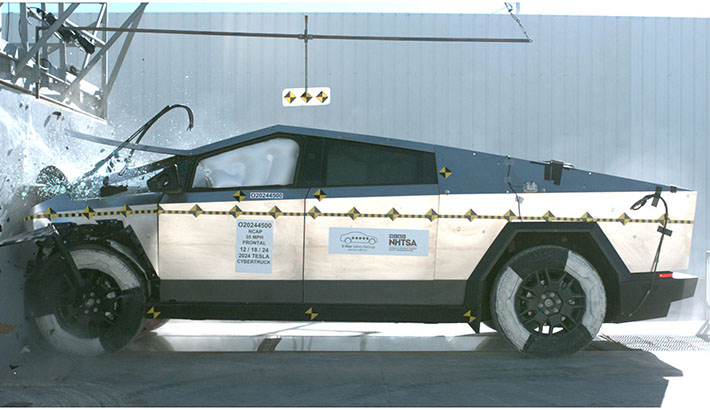
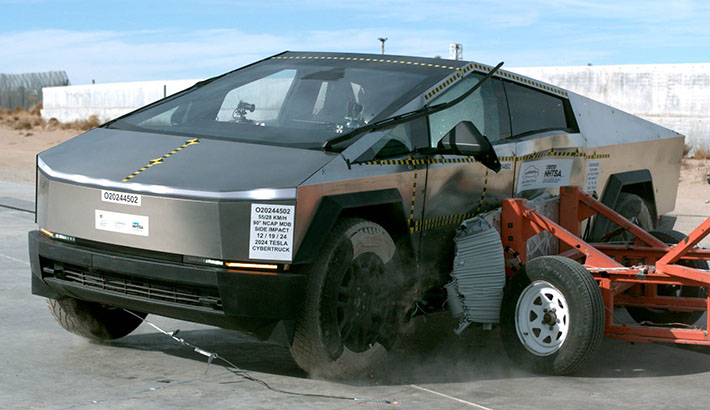
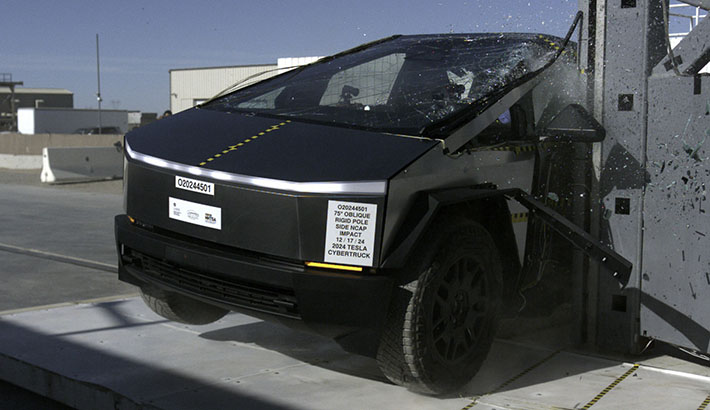
NHTSA crash tests
The agency crash-tested this model year itself. These are its own
photographs and star ratings.
Frontal crash test
Side barrier crash test
Side pole crash test
Photographs taken by NHTSA during its own New Car Assessment Program crash
tests of this model year. Public domain.
Configuration
Overall
Front
Side
Rollover
2024 Tesla Cybertruck PU/CC AWD
12.4% risk
When owners complained
A spike years after the car went on sale usually means a part wearing
out on schedule across the whole fleet — the kind of pattern no single
owner can see from inside their own car.
Apr 2024peak 43Sep 2026
NHTSA investigations into the 2024 Tesla Cybertruck
An investigation is the step before a recall: the agency has seen enough
complaints to look into a pattern itself. An open one means it thinks
something may be wrong and nothing has been fixed yet.
3
investigations are
still open.
EA26002Opened 18 Mar 2026Still openELECTRICAL SYSTEM:ADAS
FSD Collisions in Reduced Roadway Visibility Conditions
The Office of Defects Investigation (ODI) is opening this Engineering Analysis to evaluate Tesla’s Full Self Driving Beta and Full Self Driving (Supervised) (collectively, FSD) degradation detection system. The focus of this investigation will be to assess the system’s ability, when encountering reduced roadway visibility conditions, to detect degradation and alert the driver with sufficient time to respond. ODI will evaluate the performance of FSD in degraded roadway conditions and the updates or modifications by Tesla to the degradation detection system, including the timing, purpose, and ca...
PE25012Opened 7 Oct 2025Still openELECTRICAL SYSTEM:ADAS
Traffic safety violations while Full Self Driving ("FSD") is engaged
The Office of Defects Investigation (“ODI”) is opening this Preliminary Evaluation (PE) to assess the scope, frequency, and potential safety consequences of FSD executing driving maneuvers that constitute traffic safety violations. This investigation concerns versions of FSD that Tesla has labeled as "FSD (Supervised)" and "FSD (Beta)." Tesla characterizes FSD as an SAE Level 2 partial automation system requiring a fully attentive driver who is engaged in the driving task at all times. Level 2 partial automation systems are designed to support and assist the driver in performing certain aspects...
The Office of Defects Investigation (ODI) is opening a Recall Query to assess the remedy adequacy of Recall 23V838. On December 12, 2023, Tesla filed a Defect Information Report (Recall 23V838) applicable to all Tesla models produced and equipped with any version of its Autopilot system, which Tesla described as an SAE Level 2 (L2) Advanced Driver Assistance System (ADAS). Autopilot is the simultaneous engagement of Tesla’s Traffic-Aware Cruise Control (TACC) and Autosteer. In describing the safety defect, Tesla’s Defect Information Report (DIR) explained that “the prominence and scope of the...
PE24031Opened 17 Oct 2024Closed 18 Mar 2026ELECTRICAL SYSTEM:ADAS
FSD Collisions in Reduced Roadway Visibility Conditions
On October 17, 2024, NHTSA’s Office of Defects Investigation (ODI) opened a Preliminary Evaluation (PE24031) of Tesla’s Full Self Driving Beta and Full Self Driving (Supervised) (collectively, FSD) to assess: the ability of the FSD system to detect and respond appropriately to reduced roadway visibility conditions; whether any other FSD crashes had occurred under degraded roadway visibility conditions that are similar in nature to the four SGO-reported crashes identified in the opening document, and if so, the contributing circumstances for each of those crashes; and any updates or modificatio...
Recalls on the 2024 Tesla Cybertruck
A complaint is one owner's allegation. A recall is the point at which
the manufacturer or a regulator agreed the defect is real and dangerous
enough to fix for free — however old the car is.
United States — NHTSA
26V255000
WHEELS:LUGS/NUTS/BOLTS/STUDS
Tesla, Inc. (Tesla) is recalling certain 2024-2026 Cybertruck vehicles equipped with 18-inch steel wheels. The brake rotor stud holes may crack and allow the stud to separate from the wheel hub.
Risk: Wheel stud separation can cause a loss of vehicle control, increasing the risk of a crash.
25V735000
EXTERIOR LIGHTING
Tesla, Inc. (Tesla) is recalling certain 2024 Cybertruck vehicles equipped with a service-installed off-road light bar accessory. An incorrect surface primer may have been used to attach the lightbar to the windshield, causing the light bar to loosen and detach.
Risk: A detached light bar may fall, creating a road hazard for other vehicles and increasing the risk of a crash.
25V699000
EXTERIOR LIGHTING
Tesla, Inc. (Tesla) is recalling certain 2024-2026 Cybertruck vehicles operating software prior to 2025.38.3. The vehicle controller software may cause the front parking lights to be too bright and exceed the maximum light output, adversely affecting the vision of other drivers. As such, these vehicles fail to comply with the requirements of Federal Motor Vehicle Safety Standard (FMVSS) number 108, "Lamps, Reflective Devices, and Associated Equipment."
Risk: Parking lights that are too bright can reduce visibility of oncoming drivers, increasing the risk of a crash.
25V170000
STRUCTURE:BODY
Tesla, Inc. (Tesla) is recalling certain 2024-2025 Cybertruck vehicles. The light bar can delaminate and detach from the vehicle.
Risk: A detached light bar can become a road hazard, increasing the risk of a crash.
24V935000
TIRES:PRESSURE MONITORING AND REGULATING SYSTEMS
Tesla, Inc. (Tesla) is recalling certain 2024 Cybertruck, 2017-2025 Model 3, and 2020-2025 Model Y vehicles. The tire pressure monitoring system (TPMS) warning light may not remain illuminated between drive cycles, failing to warn the driver of low tire pressure. As such, these vehicles fail to comply with the requirements of Federal Motor Vehicle Safety Standard number 138, "Tire Pressure Monitoring Systems."
Risk: Driving with improperly inflated tires increases the risk of a crash.
24V832000
ELECTRICAL SYSTEM:PROPULSION SYSTEM:INVERTER
Tesla, Inc. (Tesla) is recalling certain 2024 Cybertruck vehicles. A fault in the drive inverter may cause a loss of drive power to the wheels.
Risk: A loss of drive power can increase the risk of a crash.
24V718000
BACK OVER PREVENTION:SOFTWARE
Tesla, Inc. (Tesla) is recalling certain 2024 Cybertruck vehicles. The rearview camera image may be delayed after shifting into reverse. As such, these vehicles fail to comply with the requirements of Federal Motor Vehicle Safety Standard (FMVSS) number 111, "Rear Visibility."
Risk: A delayed rearview image reduces the driver's view of what is behind the vehicle, increasing the risk of a crash.
24V457000
STRUCTURE:BODY
Tesla, Inc. (Tesla) is recalling certain 2024 Cybertruck vehicles. The trunk bed trim sail applique could have been improperly adhered and can loosen.
Risk: A loose applique can detach from the vehicle, creating a road hazard for following motorists and increasing the risk of a crash.
Canada — Transport Canada
Canada runs its own recall programme, and its campaigns do not
always mirror the American ones.
Recall 202559191 units in Canada
Structure
Issue: On certain vehicles, the optional off-road light bar installed during service may not have been attached properly. As a result, the light bar could loosen and detach from the vehicle. Safety Risk: A light bar that detaches from the vehicle could create a road hazard for others and increase the risk of a crash. Corrective Actions: Tesla will notify owners by email and advise you to contact Tesla Service to arrange for an inspection of the off-road light bar. Tesla Service will add additional fasteners to secure the light bar or, if necessary, replace the light bar and ensure that it's properly secured.
Recall 20255592,629 units in Canada
Lights And Instruments
Issue: On certain vehicles, the vehicle software could cause the front parking lights to be too bright. Canadian regulations specify a maximum brightness for parking lights. Safety Risk: Parking lights that are too bright could create confusion for others and increase the risk of a crash. Corrective Action: Tesla will notify affected owners by email. Tesla has released an over-the-air software update to fix this issue. There is no further action required if your vehicle has software release 2025.38.3 or a later release.
Recall 20251421,995 units in Canada
Structure
Issue: On certain trucks, the exterior stainless-steel trim panel(s) (cant rail) may not be attached properly. As a result, the panel(s) could loosen and detach from the truck. Safety Risk: A panel that detaches from the truck could create a road hazard for others and increase the risk of a crash. Corrective Actions: Tesla will notify owners by email and advise you to contact Tesla Service to arrange for the replacement of the cant rail assembly.
Reports where the owner recorded a crash, a fire, an injury or a death.
Pigeon Forge, TNCrash
FORWARD COLLISION AVOIDANCE: ADAPTIVE CRUISE CONTROL
Approximately 10 minutes after my vehicle was serviced at a Tesla Service Center for a Full Self-Driving (FSD) concern, I entered the highway and engaged FSD. The service center had stated the system was operating correctly. While traveling approximately 75 mph through a highway curve, FSD suddenly changed to an "Unavailable" state. According to Tesla's own accident data, I did not disengage FSD. There was no audible warning, no effective visual warning, no takeover request, no controlled deceleration, and no safe handoff to the driver before the vehicle stopped controlling itself. Within about one second of FSD becoming unavailable, the vehicle left its intended path and struck a concrete highway divider. If the divider had not been present, the vehicle likely would have crossed into oncoming highway traffic, creating the risk of a catastrophic head-on collision with other vehicles, including a semi-truck. Tesla's accident report confirms I did not disengage FSD and shows no warning or takeover request before impact. I possess documentation supporting that FSD became unavailable without a safe transition to the driver. This failure occurred immediately after Tesla serviced the vehicle and represented that the FSD system was functioning properly. Despite the accident data, Tesla Customer Support and the Service Center have refused to acknowledge or investigate what appears to be a failure of the FSD system's fail-safe behavior. The failed component appears to be the FSD/Autopilot system and its driver handoff logic. The vehicle and electronic records are available for inspection. An automated driving system should not terminate operation at highway speed without providing adequate warning, a safe transfer of control, or controlled deceleration. I believe this presents a serious safety defect that could result in fatal crashes. The collision caused approximately $15,500 in vehicle damage.
NHTSA complaint #11747861 — an unverified report by a vehicle owner.
Pigeon Forge, TNCrash
LANE DEPARTURE: ASSIST
Approximately 10 minutes after my vehicle was serviced at a Tesla Service Center for a Full Self-Driving (FSD) concern, I entered the highway and engaged FSD. The service center had stated the system was operating correctly. While traveling approximately 75 mph through a highway curve, FSD suddenly changed to an "Unavailable" state. According to Tesla's own accident data, I did not disengage FSD. There was no audible warning, no effective visual warning, no takeover request, no controlled deceleration, and no safe handoff to the driver before the vehicle stopped controlling itself. Within about one second of FSD becoming unavailable, the vehicle left its intended path and struck a concrete highway divider. If the divider had not been present, the vehicle likely would have crossed into oncoming highway traffic, creating the risk of a catastrophic head-on collision with other vehicles, including a semi-truck. Tesla's accident report confirms I did not disengage FSD and shows no warning or takeover request before impact. I possess documentation supporting that FSD became unavailable without a safe transition to the driver. This failure occurred immediately after Tesla serviced the vehicle and represented that the FSD system was functioning properly. Despite the accident data, Tesla Customer Support and the Service Center have refused to acknowledge or investigate what appears to be a failure of the FSD system's fail-safe behavior. The failed component appears to be the FSD/Autopilot system and its driver handoff logic. The vehicle and electronic records are available for inspection. An automated driving system should not terminate operation at highway speed without providing adequate warning, a safe transfer of control, or controlled deceleration. I believe this presents a serious safety defect that could result in fatal crashes. The collision caused approximately $15,500 in vehicle damage.
NHTSA complaint #11747861 — an unverified report by a vehicle owner.
Approximately 10 minutes after my vehicle was serviced at a Tesla Service Center for a Full Self-Driving (FSD) concern, I entered the highway and engaged FSD. The service center had stated the system was operating correctly. While traveling approximately 75 mph through a highway curve, FSD suddenly changed to an "Unavailable" state. According to Tesla's own accident data, I did not disengage FSD. There was no audible warning, no effective visual warning, no takeover request, no controlled deceleration, and no safe handoff to the driver before the vehicle stopped controlling itself. Within about one second of FSD becoming unavailable, the vehicle left its intended path and struck a concrete highway divider. If the divider had not been present, the vehicle likely would have crossed into oncoming highway traffic, creating the risk of a catastrophic head-on collision with other vehicles, including a semi-truck. Tesla's accident report confirms I did not disengage FSD and shows no warning or takeover request before impact. I possess documentation supporting that FSD became unavailable without a safe transition to the driver. This failure occurred immediately after Tesla serviced the vehicle and represented that the FSD system was functioning properly. Despite the accident data, Tesla Customer Support and the Service Center have refused to acknowledge or investigate what appears to be a failure of the FSD system's fail-safe behavior. The failed component appears to be the FSD/Autopilot system and its driver handoff logic. The vehicle and electronic records are available for inspection. An automated driving system should not terminate operation at highway speed without providing adequate warning, a safe transfer of control, or controlled deceleration. I believe this presents a serious safety defect that could result in fatal crashes. The collision caused approximately $15,500 in vehicle damage.
NHTSA complaint #11747861 — an unverified report by a vehicle owner.
Cumming, GACrash2 injured
UNKNOWN OR OTHER
I was driving my Tesla Cybertruck on the highway when I experienced unexpected steering movements from side to side. I attempted to maintain control of the vehicle and slow down. The vehicle ultimately left its intended path and collided with the median. I do not know the cause of the incident. At the time of the accident, I believe a Tesla driver-assistance feature may have been engaged, but I am requesting that Tesla review the vehicle data and logs to determine exactly what systems were active and whether any vehicle malfunction contributed to the event. The accident resulted in significant vehicle damage. I am submitting this report because I am concerned that a potential steering, vehicle control, or driver-assistance system issue may have contributed to the incident and I believe the event should be investigated.
NHTSA complaint #11743708 — an unverified report by a vehicle owner.
Cumming, GACrash2 injured
EXTERIOR LIGHTING
I was driving my Tesla Cybertruck on the highway when I experienced unexpected steering movements from side to side. I attempted to maintain control of the vehicle and slow down. The vehicle ultimately left its intended path and collided with the median. I do not know the cause of the incident. At the time of the accident, I believe a Tesla driver-assistance feature may have been engaged, but I am requesting that Tesla review the vehicle data and logs to determine exactly what systems were active and whether any vehicle malfunction contributed to the event. The accident resulted in significant vehicle damage. I am submitting this report because I am concerned that a potential steering, vehicle control, or driver-assistance system issue may have contributed to the incident and I believe the event should be investigated.
NHTSA complaint #11743708 — an unverified report by a vehicle owner.
Cumming, GACrash2 injured
STRUCTURE:BODY
I was driving my Tesla Cybertruck on the highway when I experienced unexpected steering movements from side to side. I attempted to maintain control of the vehicle and slow down. The vehicle ultimately left its intended path and collided with the median. I do not know the cause of the incident. At the time of the accident, I believe a Tesla driver-assistance feature may have been engaged, but I am requesting that Tesla review the vehicle data and logs to determine exactly what systems were active and whether any vehicle malfunction contributed to the event. The accident resulted in significant vehicle damage. I am submitting this report because I am concerned that a potential steering, vehicle control, or driver-assistance system issue may have contributed to the incident and I believe the event should be investigated.
NHTSA complaint #11743708 — an unverified report by a vehicle owner.
The most recent complaints
In the owners' own words, exactly as filed with NHTSA.
Houston, TX
UNKNOWN OR OTHER
Component AffectedComponent Name: Electrical System / Engine Cooling / Climate ControlSpecific Part: Front grille/louver assembly and HVAC condenserComplaint The front grille and louver area of the Tesla Cybertruck features an inadequate design that fails to protect critical cooling components from ordinary road conditions. The wide openings allow predictable road debris to easily enter the front end, causing direct impact damage and structural failure to the HVAC condenser. Tesla corporate communications acknowledge this vulnerability occurs but classify the resulting damage strictly as an "outside influence" rather than a systemic design defect, thereby refusing warranty coverage. This structural failure occurred on my vehicle despite recently undergoing an extensive $14,691.92 front-end repair that addressed the HVAC system. The lack of protective screening or mesh in the factory grille exposes essential thermal management systems to immediate damage during standard highway driving, representing a widespread product defect.Safety Impact Statement. Failure of the HVAC condenser due to unprotected debris intrusion poses a direct safety risk. The condenser is critical to the vehicle's thermal management system. A sudden loss of cooling capability can cause rapid passenger cabin overheating, unexpected window fogging that obscures driver visibility, or thermal management failures in the high-voltage battery system, potentially leading to a sudden loss of propulsion while driving.
NHTSA complaint #11763397 — an unverified report by a vehicle owner.
Lindon, UT
STRUCTURE:BODY
The left sail applique was nearly disconnected from the vehicle, so I removed it the rest of the way manually before it could fly off while driving at speed. The right one is still a little loose, but doesn't seem to be in danger of flying off. The model number stamped into the piece that came off indicates that it was replaced during recall work in Nov 2024 as part of Safety recall 24V-457, however because work had been done on the tonneau cover by Tesla in Jun 2026, I believe it exacerbated the problem causing the part to detach enough to be dangerous. They did not mention the problem to me at the time even though the vehicle was specifically brought into the service center prior to warranty expiration to check for covered issues. Tesla is now quoting $1190 and refusing free repair because the mileage is 53,500. I asked for, but did not receive a copy of the final estimate with the updated parts listed for $1190. I did upload a preliminary estimate where they showed the parts that would have been needed if the vehicle had the new rails installed.
NHTSA complaint #11761546 — an unverified report by a vehicle owner.
Palm Coast, FL
EXTERIOR LIGHTING
On XXX at approximately 5:15 AM, I was driving my 2024 Tesla Cybertruck (VIN [XXX], ~47,300 miles) on an interstate trip to [XXX] with Full Self-Driving (Supervised) engaged. I heard a loud pop from the front of the vehicle, immediately followed by an alert stating the left front turn signal was malfunctioning and that I needed to take over control. FSD disengaged and I was forced to manually drive in pre-dawn darkness with a failed turn signal until the next charging stop. The fault then behaved intermittently: it cleared on its own, returned, cleared again, and I resumed FSD for much of the trip. Then, with roughly 100 miles remaining, the left turn signal malfunction warning returned while the vehicle was actively driving itself, again forcing manual takeover and leaving me without a functioning left turn signal in traffic. This is a serious safety defect on multiple levels: (1) A failed turn signal prevents me from lawfully and safely signaling lane changes and turns to other drivers. (2) The failure occurred WHILE the automated driving system was operating and depends on functional signaling to execute its own lane changes — yet the system had been driving with a component that failed audibly and without warning. (3) The intermittent nature means the vehicle can re-enter a hazardous state at any time, without warning, at highway speed. (4) I cannot get a service appointment immediately, so I must continue operating a vehicle with an unrepairable intermittent signal failure, exposing me to citations and collision risk. This vehicle has an extensive repair history including body panel adhesion defects related to Tesla’s 2025 cant rail recall, and this electrical failure continues a pattern of defects across multiple systems. No warning preceded the pop. The failure is reproducible in the sense that it has recurred three times in one day. Service records and buyback correspondence with Tesla are available on request. INFORMATION REDACTED PURSUANT TO THE FREEDOM OF INFORMATION ACT (FOIA), 5 U.S.C. 552(B)(6)
NHTSA complaint #11754251 — an unverified report by a vehicle owner.
Palm Coast, FL
ELECTRICAL SYSTEM
On XXX at approximately 5:15 AM, I was driving my 2024 Tesla Cybertruck (VIN [XXX], ~47,300 miles) on an interstate trip to [XXX] with Full Self-Driving (Supervised) engaged. I heard a loud pop from the front of the vehicle, immediately followed by an alert stating the left front turn signal was malfunctioning and that I needed to take over control. FSD disengaged and I was forced to manually drive in pre-dawn darkness with a failed turn signal until the next charging stop. The fault then behaved intermittently: it cleared on its own, returned, cleared again, and I resumed FSD for much of the trip. Then, with roughly 100 miles remaining, the left turn signal malfunction warning returned while the vehicle was actively driving itself, again forcing manual takeover and leaving me without a functioning left turn signal in traffic. This is a serious safety defect on multiple levels: (1) A failed turn signal prevents me from lawfully and safely signaling lane changes and turns to other drivers. (2) The failure occurred WHILE the automated driving system was operating and depends on functional signaling to execute its own lane changes — yet the system had been driving with a component that failed audibly and without warning. (3) The intermittent nature means the vehicle can re-enter a hazardous state at any time, without warning, at highway speed. (4) I cannot get a service appointment immediately, so I must continue operating a vehicle with an unrepairable intermittent signal failure, exposing me to citations and collision risk. This vehicle has an extensive repair history including body panel adhesion defects related to Tesla’s 2025 cant rail recall, and this electrical failure continues a pattern of defects across multiple systems. No warning preceded the pop. The failure is reproducible in the sense that it has recurred three times in one day. Service records and buyback correspondence with Tesla are available on request. INFORMATION REDACTED PURSUANT TO THE FREEDOM OF INFORMATION ACT (FOIA), 5 U.S.C. 552(B)(6)
NHTSA complaint #11754251 — an unverified report by a vehicle owner.
Peoria, AZ
POWER TRAIN
The PCS (Power Conversion System) failed on my Cybertruck as it has on thousands of other trucks. It's an issue for me because the nearest supercharger station where I can charge is 45 miles away. I have to budget my daily driving so I don't run out of charge before reaching the supercharger. If I run out of charge, the truck will be inoperable until the service center can fix the vehicle. Right now the service appointment is 24 days from now.
NHTSA complaint #11753917 — an unverified report by a vehicle owner.
Royse City, TX
UNKNOWN OR OTHER
My 2024 cybertruck has a PCS2 onboard error. It has failed but Tesla has told me it’s under warranty however if I was past the warranty it wouldn’t be covered. This is a widespread issue known on 2024/2025 cybertruck. Nearly all VINs are affected.
NHTSA complaint #11753751 — an unverified report by a vehicle owner.
Bonita, CA
ELECTRICAL SYSTEM
I paid Tesla to perform a safety inspection of my Tesla Cybertruck after I purchased it. During that inspection, Tesla determined that the vehicle's as built configuration was **not safe** and required me to purchase a newer revision of the Power Conversion System (PCS). The required PCS revision did not exist when my vehicle was originally manufactured, meaning the vehicle could not have been built with that revision. The original PCS installed in my vehicle has a widespread failure rate among Cybertrucks. When the PCS fails, the vehicle is unable to charge, leaving it stranded. I believe this is a safety defect that warrants investigation by the NHTSA. Tesla's own words on their invoice state that the as-built configuration was determined to be unsafe, and required me to purchase a newer revision of the PCS (1777777-T2-G) to address the safety issue.
NHTSA complaint #11753655 — an unverified report by a vehicle owner.
Raymond, MS
ELECTRICAL SYSTEM
The vehicle has experienced an issue with its power conversion system (PCS2) that leaves AC charging unavailable. Based upon online forums and social media, this issue is clearly widespread amongst early VIN model Cybertrucks. The scope of the issue has lead to delays with repair. My vehicle has experienced this issue since early June 2026, and I am still awaiting repair. This is a safety concern because it could plausibly leave the vehicle stranded due to lack of ability to charge the vehicle. While Tesla and third party superchargers are widespread, they are not everywhere and cannot allow a vehicle to travel to most roads in the United States. There have been circumstances where, if AC charging was not an option, I would have been stranded in a desert and surely would have died of excessive heat exposure. With the PCS2 failure, this issue a plausible risk.
NHTSA complaint #11753745 — an unverified report by a vehicle owner.
Crystal Lake, IL
ELECTRICAL SYSTEM
PCS2 Failure alerts on the screen left the vehicle unable to charge at any level except supercharge. The vehicle can be stranded due to unavailibility of supercharges and inability to charge at any Level 1 or level 2 chrgers.
NHTSA complaint #11753802 — an unverified report by a vehicle owner.
Canton, MI
UNKNOWN OR OTHER
The car would stop charging at home and an error showed up about two months ago. After reporting to Tesla, they did a diagnostic over the air and concluded that the battery (HVB) needs to be replaced. The car is at the shop for over a month, and they are still waiting on parts.
NHTSA complaint #11751738 — an unverified report by a vehicle owner.
Canton, MI
ELECTRICAL SYSTEM
The car would stop charging at home and an error showed up about two months ago. After reporting to Tesla, they did a diagnostic over the air and concluded that the battery (HVB) needs to be replaced. The car is at the shop for over a month, and they are still waiting on parts.
NHTSA complaint #11751738 — an unverified report by a vehicle owner.
Auburn, MA
ELECTRICAL SYSTEM
I am filing a safety defect complaint regarding my Tesla Cybertruck. Water entered the truck bed outlet area and caused corrosion to the mounting bolts and surrounding components, resulting in Tesla determining that the entire bed wall panel requires replacement. The bed outlet is designed for outdoor use and exposure to weather conditions. In my opinion, water intrusion into this area represents a design defect because moisture can enter the electrical outlet assembly and associated mounting hardware, leading to corrosion and component deterioration. My concern is that continued corrosion could potentially affect the integrity or functionality of the electrical outlet system and create an electrical safety hazard for owners using the bed power outlets in normal outdoor conditions, including rain or vehicle washing. Tesla inspected the vehicle and confirmed water ingress and corrosion were present and advised that replacement of the bed wall panel was necessary to correct the condition. I request that NHTSA review whether the design of the Cybertruck bed outlet and surrounding components adequately protects against water intrusion and corrosion during normal vehicle use.
NHTSA complaint #11749753 — an unverified report by a vehicle owner.
at 3,000 milesWest Haven, CT
STRUCTURE
The contact owns a 2024 Tesla Cybertruck. The contact stated that while driving at an undisclosed speed, the vehicle made an abnormal rattling sound, and the contact noticed that the metal quarter panel was loose. The contact was concerned that the quarter panel detachment could cause a crash. The vehicle was taken to the local dealer, where a replacement quote was provided. The vehicle was not repaired. The manufacturer was contacted and confirmed that there was no coverage. The failure mileage was approximately 3,000.
NHTSA complaint #11748520 — an unverified report by a vehicle owner.
Pigeon Forge, TNCrash
FORWARD COLLISION AVOIDANCE: ADAPTIVE CRUISE CONTROL
Approximately 10 minutes after my vehicle was serviced at a Tesla Service Center for a Full Self-Driving (FSD) concern, I entered the highway and engaged FSD. The service center had stated the system was operating correctly. While traveling approximately 75 mph through a highway curve, FSD suddenly changed to an "Unavailable" state. According to Tesla's own accident data, I did not disengage FSD. There was no audible warning, no effective visual warning, no takeover request, no controlled deceleration, and no safe handoff to the driver before the vehicle stopped controlling itself. Within about one second of FSD becoming unavailable, the vehicle left its intended path and struck a concrete highway divider. If the divider had not been present, the vehicle likely would have crossed into oncoming highway traffic, creating the risk of a catastrophic head-on collision with other vehicles, including a semi-truck. Tesla's accident report confirms I did not disengage FSD and shows no warning or takeover request before impact. I possess documentation supporting that FSD became unavailable without a safe transition to the driver. This failure occurred immediately after Tesla serviced the vehicle and represented that the FSD system was functioning properly. Despite the accident data, Tesla Customer Support and the Service Center have refused to acknowledge or investigate what appears to be a failure of the FSD system's fail-safe behavior. The failed component appears to be the FSD/Autopilot system and its driver handoff logic. The vehicle and electronic records are available for inspection. An automated driving system should not terminate operation at highway speed without providing adequate warning, a safe transfer of control, or controlled deceleration. I believe this presents a serious safety defect that could result in fatal crashes. The collision caused approximately $15,500 in vehicle damage.
NHTSA complaint #11747861 — an unverified report by a vehicle owner.
Pigeon Forge, TNCrash
LANE DEPARTURE: ASSIST
Approximately 10 minutes after my vehicle was serviced at a Tesla Service Center for a Full Self-Driving (FSD) concern, I entered the highway and engaged FSD. The service center had stated the system was operating correctly. While traveling approximately 75 mph through a highway curve, FSD suddenly changed to an "Unavailable" state. According to Tesla's own accident data, I did not disengage FSD. There was no audible warning, no effective visual warning, no takeover request, no controlled deceleration, and no safe handoff to the driver before the vehicle stopped controlling itself. Within about one second of FSD becoming unavailable, the vehicle left its intended path and struck a concrete highway divider. If the divider had not been present, the vehicle likely would have crossed into oncoming highway traffic, creating the risk of a catastrophic head-on collision with other vehicles, including a semi-truck. Tesla's accident report confirms I did not disengage FSD and shows no warning or takeover request before impact. I possess documentation supporting that FSD became unavailable without a safe transition to the driver. This failure occurred immediately after Tesla serviced the vehicle and represented that the FSD system was functioning properly. Despite the accident data, Tesla Customer Support and the Service Center have refused to acknowledge or investigate what appears to be a failure of the FSD system's fail-safe behavior. The failed component appears to be the FSD/Autopilot system and its driver handoff logic. The vehicle and electronic records are available for inspection. An automated driving system should not terminate operation at highway speed without providing adequate warning, a safe transfer of control, or controlled deceleration. I believe this presents a serious safety defect that could result in fatal crashes. The collision caused approximately $15,500 in vehicle damage.
NHTSA complaint #11747861 — an unverified report by a vehicle owner.
Approximately 10 minutes after my vehicle was serviced at a Tesla Service Center for a Full Self-Driving (FSD) concern, I entered the highway and engaged FSD. The service center had stated the system was operating correctly. While traveling approximately 75 mph through a highway curve, FSD suddenly changed to an "Unavailable" state. According to Tesla's own accident data, I did not disengage FSD. There was no audible warning, no effective visual warning, no takeover request, no controlled deceleration, and no safe handoff to the driver before the vehicle stopped controlling itself. Within about one second of FSD becoming unavailable, the vehicle left its intended path and struck a concrete highway divider. If the divider had not been present, the vehicle likely would have crossed into oncoming highway traffic, creating the risk of a catastrophic head-on collision with other vehicles, including a semi-truck. Tesla's accident report confirms I did not disengage FSD and shows no warning or takeover request before impact. I possess documentation supporting that FSD became unavailable without a safe transition to the driver. This failure occurred immediately after Tesla serviced the vehicle and represented that the FSD system was functioning properly. Despite the accident data, Tesla Customer Support and the Service Center have refused to acknowledge or investigate what appears to be a failure of the FSD system's fail-safe behavior. The failed component appears to be the FSD/Autopilot system and its driver handoff logic. The vehicle and electronic records are available for inspection. An automated driving system should not terminate operation at highway speed without providing adequate warning, a safe transfer of control, or controlled deceleration. I believe this presents a serious safety defect that could result in fatal crashes. The collision caused approximately $15,500 in vehicle damage.
NHTSA complaint #11747861 — an unverified report by a vehicle owner.
Kansas City, MO
ELECTRICAL SYSTEM
PCS system has failed. This causes the vehicle to be unable to charge and can lead to loss of power if unable to get to a supercharger before the battery is depleted. It can now only be charged at full Tesla superchargers and not at other brands, hotel chargers, or home AC chargers. The vehicle did notify me of the PCS failure and recommended using a supercharger. Tesla proactively updated my account to allow for free supercharging, but this does not eliminate the risk when going to areas that do not have superchargers available. Parts are not currently available to repair the problem and my service requests are left in a "review" state. Vehicle is available for inspection if needed.
NHTSA complaint #11746326 — an unverified report by a vehicle owner.
Burbank, CA
VEHICLE SPEED CONTROL
This is reporting an issue with v14.3.3 and v14.3.4 of Tesla Full Self Driving (FSD) Supervised. This month I have driven over 4,000 miles with FSD enabled, approximately 2/3rd on 14.3.3 and 1/3 on 14.3.4. FSD has regularly failed to respect speed limit changes, even though it seems to recognize / observe the speed limit signs. I am certain it’s observing the signs because it renders them on the in-car display, but it doesn’t actually adjust its speed in response to those signs. The most egregious of cases have been when driving through Texas, New Mexico, and Arizona where the speed limit is often 75 mph on Interstate highways (e.g., [XXX]). On multiple occasions the vehicle has ignored construction speed limit changes to 55 mph, and instead has tried to maintain 75-80 mph through the construction zone. Not only could that get me a nasty speeding ticket, but it could also put construction workers lives at risk. It has also happened in non-construction zones, like when on a non-interstate highway that passes through towns and reduces speed when doing so. It doesn’t fail 100% of the time, but it has been an issue more than 50% of the time I enter a construction zone. INFORMATION REDACTED PURSUANT TO THE FREEDOM OF INFORMATION ACT (FOIA), 5 U.S.C. 552(B)(6)
NHTSA complaint #11745182 — an unverified report by a vehicle owner.
Burbank, CA
FORWARD COLLISION AVOIDANCE: ADAPTIVE CRUISE CONTROL
This is reporting an issue with v14.3.3 and v14.3.4 of Tesla Full Self Driving (FSD) Supervised. This month I have driven over 4,000 miles with FSD enabled, approximately 2/3rd on 14.3.3 and 1/3 on 14.3.4. FSD has regularly failed to respect speed limit changes, even though it seems to recognize / observe the speed limit signs. I am certain it’s observing the signs because it renders them on the in-car display, but it doesn’t actually adjust its speed in response to those signs. The most egregious of cases have been when driving through Texas, New Mexico, and Arizona where the speed limit is often 75 mph on Interstate highways (e.g., [XXX]). On multiple occasions the vehicle has ignored construction speed limit changes to 55 mph, and instead has tried to maintain 75-80 mph through the construction zone. Not only could that get me a nasty speeding ticket, but it could also put construction workers lives at risk. It has also happened in non-construction zones, like when on a non-interstate highway that passes through towns and reduces speed when doing so. It doesn’t fail 100% of the time, but it has been an issue more than 50% of the time I enter a construction zone. INFORMATION REDACTED PURSUANT TO THE FREEDOM OF INFORMATION ACT (FOIA), 5 U.S.C. 552(B)(6)
NHTSA complaint #11745182 — an unverified report by a vehicle owner.
Burbank, CA
LANE DEPARTURE: ASSIST
This is reporting an issue with v14.3.3 and v14.3.4 of Tesla Full Self Driving (FSD) Supervised. This month I have driven over 4,000 miles with FSD enabled, approximately 2/3rd on 14.3.3 and 1/3 on 14.3.4. FSD has regularly failed to respect speed limit changes, even though it seems to recognize / observe the speed limit signs. I am certain it’s observing the signs because it renders them on the in-car display, but it doesn’t actually adjust its speed in response to those signs. The most egregious of cases have been when driving through Texas, New Mexico, and Arizona where the speed limit is often 75 mph on Interstate highways (e.g., [XXX]). On multiple occasions the vehicle has ignored construction speed limit changes to 55 mph, and instead has tried to maintain 75-80 mph through the construction zone. Not only could that get me a nasty speeding ticket, but it could also put construction workers lives at risk. It has also happened in non-construction zones, like when on a non-interstate highway that passes through towns and reduces speed when doing so. It doesn’t fail 100% of the time, but it has been an issue more than 50% of the time I enter a construction zone. INFORMATION REDACTED PURSUANT TO THE FREEDOM OF INFORMATION ACT (FOIA), 5 U.S.C. 552(B)(6)
NHTSA complaint #11745182 — an unverified report by a vehicle owner.
Cumming, GACrash2 injured
UNKNOWN OR OTHER
I was driving my Tesla Cybertruck on the highway when I experienced unexpected steering movements from side to side. I attempted to maintain control of the vehicle and slow down. The vehicle ultimately left its intended path and collided with the median. I do not know the cause of the incident. At the time of the accident, I believe a Tesla driver-assistance feature may have been engaged, but I am requesting that Tesla review the vehicle data and logs to determine exactly what systems were active and whether any vehicle malfunction contributed to the event. The accident resulted in significant vehicle damage. I am submitting this report because I am concerned that a potential steering, vehicle control, or driver-assistance system issue may have contributed to the incident and I believe the event should be investigated.
NHTSA complaint #11743708 — an unverified report by a vehicle owner.
Cumming, GACrash2 injured
EXTERIOR LIGHTING
I was driving my Tesla Cybertruck on the highway when I experienced unexpected steering movements from side to side. I attempted to maintain control of the vehicle and slow down. The vehicle ultimately left its intended path and collided with the median. I do not know the cause of the incident. At the time of the accident, I believe a Tesla driver-assistance feature may have been engaged, but I am requesting that Tesla review the vehicle data and logs to determine exactly what systems were active and whether any vehicle malfunction contributed to the event. The accident resulted in significant vehicle damage. I am submitting this report because I am concerned that a potential steering, vehicle control, or driver-assistance system issue may have contributed to the incident and I believe the event should be investigated.
NHTSA complaint #11743708 — an unverified report by a vehicle owner.
Cumming, GACrash2 injured
STRUCTURE:BODY
I was driving my Tesla Cybertruck on the highway when I experienced unexpected steering movements from side to side. I attempted to maintain control of the vehicle and slow down. The vehicle ultimately left its intended path and collided with the median. I do not know the cause of the incident. At the time of the accident, I believe a Tesla driver-assistance feature may have been engaged, but I am requesting that Tesla review the vehicle data and logs to determine exactly what systems were active and whether any vehicle malfunction contributed to the event. The accident resulted in significant vehicle damage. I am submitting this report because I am concerned that a potential steering, vehicle control, or driver-assistance system issue may have contributed to the incident and I believe the event should be investigated.
NHTSA complaint #11743708 — an unverified report by a vehicle owner.
Manhattan Beach, CA
STRUCTURE:BODY
The rear passenger side sail applique flew off the truck while I was driving on the freeway.
NHTSA complaint #11743041 — an unverified report by a vehicle owner.
Los Altos, CA
FORWARD COLLISION AVOIDANCE: ADAPTIVE CRUISE CONTROL
Tesla does a warning if it can not detect your eyes on the road when using FSD (Full Self Driving). After few warnings on a trip it becomes a strike. After 5 strikes, they remove FSD and AutoPilot for a week. It becomes dangerous now since I have been driving on FSD for several years to drive the big CyberTruck without FSD. The removing FSD for a week behavior needs to be stopped. Without FSD chances of accident are 10000% increased.
NHTSA complaint #11743084 — an unverified report by a vehicle owner.