Owners have filed 56 complaints
about the 2021 Toyota Sienna Hybrid with NHTSA between 2020 and 2026.
The largest single group is the airbags.
Across this model's run it ranks 5 of 6 worst.
The letter says how bad. This says what kind — whether this year drew
an unusual number of complaints, unusually dangerous
ones, or failures that arrived unusually early.
The dashed ring is 50 — the national norm. Further out is worse.
Complaint volume — 29
Against the median year of the Toyota Sienna Hybrid. 50 means typical for this
model; 100 means roughly double.
Severity — 37
7.1% of these complaints
involved a crash, fire, injury or death, against a national rate of
9.7%.
Early failure — 100
63% of failures with a mileage on record happened under
36,000 miles, against a national rate of
29%.
How 2021 compares with every other Toyota Sienna Hybrid
Odometer readings owners gave when they filed. About half of all
complaints include one.
Under 1,000 miles
318.8%
1,000 – 9,999 miles
531.3%
10,000 – 24,999 miles
16.3%
25,000 – 49,999 miles
212.5%
50,000 – 74,999 miles
318.8%
75,000 – 99,999 miles
16.3%
150,000+ miles
16.3%
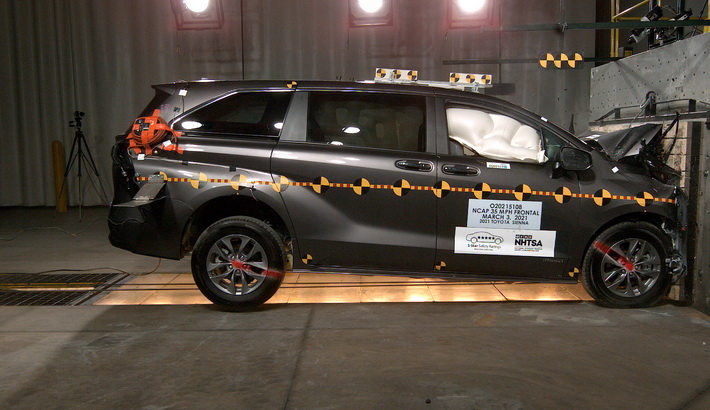
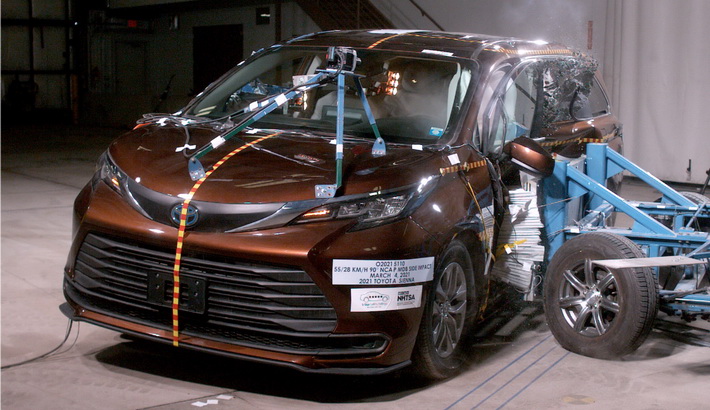
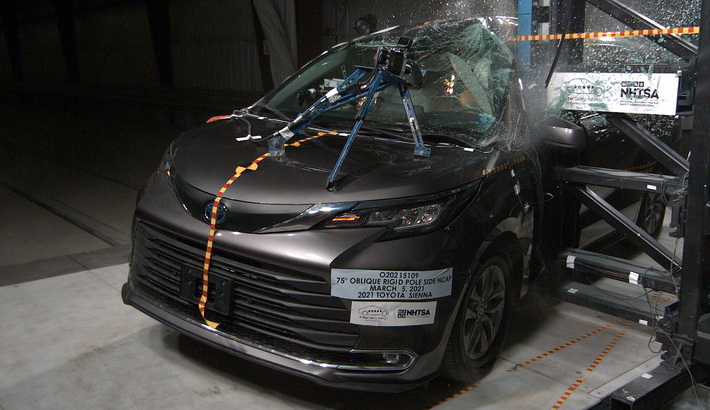
NHTSA crash tests
The agency crash-tested this model year itself. These are its own
photographs and star ratings.
Frontal crash test
Side barrier crash test
Side pole crash test
Photographs taken by NHTSA during its own New Car Assessment Program crash
tests of this model year. Public domain.
Configuration
Overall
Front
Side
Rollover
2021 Toyota SIENNA HYBRID VAN AWD
12.7% risk
2021 Toyota SIENNA HYBRID VAN FWD
14% risk
When owners complained
A spike years after the car went on sale usually means a part wearing
out on schedule across the whole fleet — the kind of pattern no single
owner can see from inside their own car.
Dec 2020peak 6Sep 2026
Recalls on the 2021 Toyota Sienna Hybrid
A complaint is one owner's allegation. A recall is the point at which
the manufacturer or a regulator agreed the defect is real and dangerous
enough to fix for free — however old the car is.
Vantage Mobility, LLC (VM) is recalling certain 2021-2026 Honda Odyssey, 2021-2025 Chrysler Pacifica, and Toyota Sienna vehicles equipped with QRT-Deluxe and QRT-Max wheelchair restraints. The retractors may not lock, preventing the wheelchair from being properly secured.
Risk: An unsecured wheelchair can move during transit, increasing the risk of injury.
25V086000
SEATS:MID/REAR ASSEMBLY:RECLINER
Toyota Motor Engineering & Manufacturing (Toyota) is recalling certain 2021-2025 Sienna Hybrid vehicles. The bolts for the seatbacks on the third-row seat assemblies may not be tightened properly. As such, these vehicles fail to comply with the requirements of Federal Motor Vehicle Safety Standard (FMVSS) numbers 202, "Head Restraints," 207, "Seating Systems," and 225, "Child Restraint Anchorage Systems."
Risk: An improperly tightened seatback may not adequately restrain the occupant during a crash, increasing their risk of injury.
23V865000
AIR BAGS:SENSOR:OCCUPANT CLASSIFICATION
Toyota Motor Engineering & Manufacturing (Toyota) is recalling certain 2020-2021 Avalon, Avalon Hybrid, Corolla, Highlander, Highlander Hybrid, RAV4, RAV4 Hybrid, Lexus ES350, Lexus RX350, Lexus RX450H, 2021 Sienna Hybrid, Lexus ES250, 2020-2022 Camry, Camry Hybrid, and ES300H vehicles. A short circuit may develop in the Occupant Classification System (OCS) sensor, preventing the front passenger air bag from deploying.
Risk: An air bag that does not deploy during a crash increases the risk of injury.
22V239000
ELECTRONIC STABILITY CONTROL (ESC):CONTROL MODULE:SOFTWARE
Toyota Engineering & Manufacturing (Toyota) is recalling certain 2022 Lexus LX 600, Lexus NX 350h, Lexus NX 450h+, Toytoa RAV4 Hybrid, 2021-2022 Lexus LS 500h, Toyota Mirai, RAV4 PRIME, Sienna, Venza, and 2020-2022 Toyota Highlander Hybrid vehicles. The Skid Control ECU software may not turn on the Vehicle Stability Control (VSC) system when the vehicle is restarted after the driver has disabled the VSC system. As such, these vehicles fail to comply with the requirements of Federal Motor Vehicle Safety Standard number 126, "Electronic Stability Control Systems."
Risk: Driving with a deactivated stability control system increases the risk of a crash.
Canada — Transport Canada
Canada runs its own recall programme, and its campaigns do not
always mirror the American ones.
Recall 202507017,686 units in Canada
Seats And Restraints
Issue: On certain vehicles, the bolts that secure the third-row seats may not have been tightened properly. As a result, the seats could move in a crash. Safety Risk: A seat that moves in a crash could increase the risk of injury. Corrective Action: Toyota will notify owners by mail and advise you to take your vehicle to a dealership to tighten the bolts for the third-row seats.
Reports where the owner recorded a crash, a fire, an injury or a death.
at 80,000 milesCanandaigua, NYFire
ENGINE
The contact owned a 2021 Toyota Sienna Hybrid. The vehicle was parked in the driveway when an explosion occurred; the vehicle burned down. The contact was inside the residence when a loud noise was heard, and the house "rocked." The contact ran to the front of the house to investigate and noticed that the vehicle was engulfed in flames. The fire damaged the driveway, melted the garage door, and melted a landscaping retaining wall. The fire damaged the post on the front porch. The contact and her family were unable to exit through the front door due to the fire and used the sliding kitchen door to exit the residence. The fire department was called to the scene. Per the contact, three fire trucks were at the scene. The fire department informed the contact that the fire went up to 3,000 degrees. The fire department concluded that the fire started from underneath the driver's back panel. The contact stated that the gas tank was underneath that area and believed the gas tank may have contributed to the fire. The towing company towed the vehicle to a towing yard, and it was later picked up and towed to an unknown location. The insurance company was notified and declared the vehicle a total loss. The manufacturer was made aware of the failure and advised the contact that an inspection was needed on the vehicle and asked for the location of the vehicle. However, the contact was awaiting the results. The failure mileage was approximately 80,000.
NHTSA complaint #11729036 — an unverified report by a vehicle owner.
at 2,000 milesBethlehem, PA1 injured
SEATS
HEADLINER CUT TOO LARGE, DOESN'T HOLD REAR PASSENGER CLIMATE CONTROLS, CLIMATE CONTROLS FALL OUT AND HIT REAR PASSENGERS. THIS HAPPENS AT ANY SPEED.
NHTSA complaint #11416133 — an unverified report by a vehicle owner.
at 2,000 milesBethlehem, PA1 injured
EXTERIOR LIGHTING
HEADLINER CUT TOO LARGE, DOESN'T HOLD REAR PASSENGER CLIMATE CONTROLS, CLIMATE CONTROLS FALL OUT AND HIT REAR PASSENGERS. THIS HAPPENS AT ANY SPEED.
NHTSA complaint #11416133 — an unverified report by a vehicle owner.
at 2,000 milesBethlehem, PA1 injured
STRUCTURE:BODY
HEADLINER CUT TOO LARGE, DOESN'T HOLD REAR PASSENGER CLIMATE CONTROLS, CLIMATE CONTROLS FALL OUT AND HIT REAR PASSENGERS. THIS HAPPENS AT ANY SPEED.
NHTSA complaint #11416133 — an unverified report by a vehicle owner.
The most recent complaints
In the owners' own words, exactly as filed with NHTSA.
Shell Lake, WI
STRUCTURE:BODY
The rear power liftgate hinges on my 2021 Toyota Sienna failed structurally under normal, everyday operation. The power liftgate motor and struts appear to exert uneven or excessive pressure on the rear hatch assembly, causing the metal hinges to crack. Before the failure, we noticed a loud popping/grinding sound when opening the hatch, which quickly progressed to the liftgate binding and misaligning. This is a severe safety hazard because the structural failure prevents the heavy rear hatch from closing or latching securely, creating a risk that it could fly open while driving, dropping cargo onto the roadway or exposing passengers. It also creates a risk of the heavy door falling unexpectedly on someone loading the vehicle. The vehicle had to be taken to a dealership body shop for structural repairs due to the cracked metal, costing me over $1,500 out of pocket. Toyota has not issued a recall or good faith reimbursment for this known design defect.
NHTSA complaint #11763294 — an unverified report by a vehicle owner.
Brea, CA
SEATS
brake sleeps sometime when i press brake pedal i took car to dealer once,they said need time i did not have much time took another time, they reseted system still... my warranty is over now. rear seat,make shake noise and check rear seat sign on dealer can't find problem. did not do anything since new car. i do not know any other 2021 sienna drivers have same problem.
NHTSA complaint #11762371 — an unverified report by a vehicle owner.
Brea, CA
SERVICE BRAKES
brake sleeps sometime when i press brake pedal i took car to dealer once,they said need time i did not have much time took another time, they reseted system still... my warranty is over now. rear seat,make shake noise and check rear seat sign on dealer can't find problem. did not do anything since new car. i do not know any other 2021 sienna drivers have same problem.
NHTSA complaint #11762371 — an unverified report by a vehicle owner.
Hewlett, NY
SEATS
The electronic driver's seat motor and track assembly failed completely on my 2021 Toyota Sienna (VIN: [XXX]) at less than 18,000 miles. The seat is permanently seized in a fixed position. This creates an immediate safety and crash-protection hazard, as drivers of different heights cannot safely adjust their distance from the steering wheel airbag or properly reach the pedals. Toyota corporate is refusing to repair this premature manufacturing defect on a known problematic seating system, leaving a severe safety risk unresolved. INFORMATION REDACTED PURSUANT TO THE FREEDOM OF INFORMATION ACT (FOIA), 5 U.S.C. 552(B)(6)
NHTSA complaint #11761587 — an unverified report by a vehicle owner.
Hoffman Estates, IL
STRUCTURE:BODY
My liftgate has been making loud noises upon closing. The dealership checked it and diagnosed that the trunk door is mis-aligned, leaving a gap so that the door WOULD NOT SECURELY CLOSE. I was referred to the body shop to have the shocks and hinges changed. Further discussions mentioned this was a common problem with the Toyota RAV-4 where the hydraulics fail causing a bad alignment therefore affecting the hinges. Although my vehicle is a Toyota SIENNA, I had asked if this was caused by mishandling on my part (ie, slamming/ forcing the door or stuffing the cargo) but the technician mentioned that there was nothing I could have done to prevent it nor done to have caused the hydraulics to fail or go bad. There were no lamps or alerts that warned me of the problem other than the "scraping noise" upon closing that was getting louder ever since. The problem had been assessed and confirmed by the body shop.
NHTSA complaint #11761738 — an unverified report by a vehicle owner.
Hyattsville, MD
AIR BAGS
SRS Airbag Malfunction, visit Dealer warning
NHTSA complaint #11759958 — an unverified report by a vehicle owner.
Sunrise, FL
UNKNOWN OR OTHER
Vehicle safety SOS button is not functioning properly. When the SOS button is depressed in case of emergency, the vehicle notifies user at the emergency system is un operational. Toyota includes this for 10 years from the date purchase and my vehicle is a 2021 making this feature active till 2031. By having the SOS button nonfunctional occupants of the vehicle, which may rely on this feature may sustain injury or death by this feature not operating correctly in the event of an accident.
NHTSA complaint #11752014 — an unverified report by a vehicle owner.
Grand Island, NY
ELECTRICAL SYSTEM
FAILURE: Blind spot monitor module failed due to a corroded internal electrical connector. The failure disabled both the Blind Spot Monitor (BSM) and Rear Cross-Traffic Alert (RCTA). Both remain inoperative. The failed component has not been replaced and is available for inspection. SAFETY RISK: Two active safety systems are disabled. The vehicle no longer warns of vehicles in the blind spot during lane changes, and no longer warns of cross traffic when backing out of parking spaces or driveways. WARNING LAMPS: Yes. Multiple warning lamps illuminated simultaneously in February 2026, including BSM and RCTA malfunction messages. No prior symptoms or gradual degradation. CONFIRMED BY DEALER: Yes. A Toyota dealer diagnosed the corroded connector as the cause. Repair quoted at approximately $2,500-$3,000. Repair not performed. INSPECTED BY MANUFACTURER: Diagnosed by a Toyota dealer. Goodwill assistance was requested from Toyota and declined, on the stated grounds that the vehicle had not been regularly serviced at a Toyota dealer. NOT A WEAR ITEM: A sealed electrical connector that corrodes to failure is a component defect. No step in the manufacturer's published maintenance schedule inspects, services, or protects this connector — no owner action could have prevented it, and service history has no bearing on a connector that no service procedure touches. Vehicle purchased new September 2021; failure occurred at approximately [XXX] of age. REQUEST: Request that ODI evaluate whether the BSM sensor and connector design used on this vehicle is inadequately sealed against moisture intrusion, resulting in premature failure of two active safety systems. INFORMATION REDACTED PURSUANT TO THE FREEDOM OF INFORMATION ACT (FOIA), 5 U.S.C. 552(B)(6)
NHTSA complaint #11750096 — an unverified report by a vehicle owner.
Grand Island, NY
SERVICE BRAKES
FAILURE: Brake control system. Vehicle intermittently surges forward while braking at low speed, most often through a curve — the brakes momentarily release and the vehicle lurches before braking resumes. Appears to occur during the transition between regenerative and friction braking. Vehicle available for inspection. SAFETY RISK: Unpredictable momentary loss of braking at low speed, in parking lots, residential streets and curves where pedestrians and other vehicles are close. Driver cannot anticipate it. WARNING LAMPS: None. No lamp, no message, no stored trouble code. Present since early in ownership; purchased new September 2021. CONFIRMED BY DEALER: No. Reported to a Toyota dealer in 2022 under warranty. Dealer test drove, could not reproduce the intermittent condition, took no action. Also reported in writing to Toyota in August 2022; no substantive response. MANUFACTURER REMEDY: In May 2024 Toyota issued TSB T-SB-0047-24, a brake control module software update for this exact low-speed braking condition on 2021-2022 Sienna Hybrids. Warranty had lapsed, so it was applied at owner expense in late June 2026 at ~156,000 miles. The defect persists after Toyota's own remedy. The surge still occurs, including within the past week at ~157,000 miles. REQUEST: A TSB is not a recall — owners are not notified, and the software remedy did not eliminate the defect on this vehicle. Request that ODI evaluate whether this condition warrants a defect investigation and recall.
NHTSA complaint #11750094 — an unverified report by a vehicle owner.
Grand Island, NY
LANE DEPARTURE: BLIND SPOT DETECTION
FAILURE: Blind spot monitor module failed due to a corroded internal electrical connector. The failure disabled both the Blind Spot Monitor (BSM) and Rear Cross-Traffic Alert (RCTA). Both remain inoperative. The failed component has not been replaced and is available for inspection. SAFETY RISK: Two active safety systems are disabled. The vehicle no longer warns of vehicles in the blind spot during lane changes, and no longer warns of cross traffic when backing out of parking spaces or driveways. WARNING LAMPS: Yes. Multiple warning lamps illuminated simultaneously in February 2026, including BSM and RCTA malfunction messages. No prior symptoms or gradual degradation. CONFIRMED BY DEALER: Yes. A Toyota dealer diagnosed the corroded connector as the cause. Repair quoted at approximately $2,500-$3,000. Repair not performed. INSPECTED BY MANUFACTURER: Diagnosed by a Toyota dealer. Goodwill assistance was requested from Toyota and declined, on the stated grounds that the vehicle had not been regularly serviced at a Toyota dealer. NOT A WEAR ITEM: A sealed electrical connector that corrodes to failure is a component defect. No step in the manufacturer's published maintenance schedule inspects, services, or protects this connector — no owner action could have prevented it, and service history has no bearing on a connector that no service procedure touches. Vehicle purchased new September 2021; failure occurred at approximately [XXX] of age. REQUEST: Request that ODI evaluate whether the BSM sensor and connector design used on this vehicle is inadequately sealed against moisture intrusion, resulting in premature failure of two active safety systems. INFORMATION REDACTED PURSUANT TO THE FREEDOM OF INFORMATION ACT (FOIA), 5 U.S.C. 552(B)(6)
NHTSA complaint #11750096 — an unverified report by a vehicle owner.
Grand Island, NY
BACK OVER PREVENTION: REARVIEW SYSTEM BRAKING
FAILURE: Blind spot monitor module failed due to a corroded internal electrical connector. The failure disabled both the Blind Spot Monitor (BSM) and Rear Cross-Traffic Alert (RCTA). Both remain inoperative. The failed component has not been replaced and is available for inspection. SAFETY RISK: Two active safety systems are disabled. The vehicle no longer warns of vehicles in the blind spot during lane changes, and no longer warns of cross traffic when backing out of parking spaces or driveways. WARNING LAMPS: Yes. Multiple warning lamps illuminated simultaneously in February 2026, including BSM and RCTA malfunction messages. No prior symptoms or gradual degradation. CONFIRMED BY DEALER: Yes. A Toyota dealer diagnosed the corroded connector as the cause. Repair quoted at approximately $2,500-$3,000. Repair not performed. INSPECTED BY MANUFACTURER: Diagnosed by a Toyota dealer. Goodwill assistance was requested from Toyota and declined, on the stated grounds that the vehicle had not been regularly serviced at a Toyota dealer. NOT A WEAR ITEM: A sealed electrical connector that corrodes to failure is a component defect. No step in the manufacturer's published maintenance schedule inspects, services, or protects this connector — no owner action could have prevented it, and service history has no bearing on a connector that no service procedure touches. Vehicle purchased new September 2021; failure occurred at approximately [XXX] of age. REQUEST: Request that ODI evaluate whether the BSM sensor and connector design used on this vehicle is inadequately sealed against moisture intrusion, resulting in premature failure of two active safety systems. INFORMATION REDACTED PURSUANT TO THE FREEDOM OF INFORMATION ACT (FOIA), 5 U.S.C. 552(B)(6)
NHTSA complaint #11750096 — an unverified report by a vehicle owner.
Lakewood Ranch, FL
SERVICE BRAKES
Car surged as brakes were applied when stopping. Very dangerous. Could have easily rear-ended another vehicle. Surge was immediate and occurred when brake was being applied. Not confirmed yet, but another driver of vehicle told me of having similar problems when braking this car. Very scary. No warnings or messsages.
NHTSA complaint #11747761 — an unverified report by a vehicle owner.
Clarksville, TN
POWER TRAIN
Unexpected failure of the acceleration pedal to accelerate from a complete stop to a go at an intersection. The electric vehicle (EV) motor began accelerating up to about 3 mph than instantly had a failure to accelerate, even with the gas pedal continuously pushed to the floor. After about 4 to 5 seconds the engine kicked on and began accelerating. The failure seemed to occur during the EV motor swapping over to the gas powered engine. This has been the fourth occurrence and can be extremely dangerous at intersections with oncoming traffic. No fault codes or check engine lights came on.
NHTSA complaint #11746943 — an unverified report by a vehicle owner.
Clarksville, TN
ELECTRICAL SYSTEM
Unexpected failure of the acceleration pedal to accelerate from a complete stop to a go at an intersection. The electric vehicle (EV) motor began accelerating up to about 3 mph than instantly had a failure to accelerate, even with the gas pedal continuously pushed to the floor. After about 4 to 5 seconds the engine kicked on and began accelerating. The failure seemed to occur during the EV motor swapping over to the gas powered engine. This has been the fourth occurrence and can be extremely dangerous at intersections with oncoming traffic. No fault codes or check engine lights came on.
NHTSA complaint #11746943 — an unverified report by a vehicle owner.
Clarksville, TN
FUEL/PROPULSION SYSTEM
Unexpected failure of the acceleration pedal to accelerate from a complete stop to a go at an intersection. The electric vehicle (EV) motor began accelerating up to about 3 mph than instantly had a failure to accelerate, even with the gas pedal continuously pushed to the floor. After about 4 to 5 seconds the engine kicked on and began accelerating. The failure seemed to occur during the EV motor swapping over to the gas powered engine. This has been the fourth occurrence and can be extremely dangerous at intersections with oncoming traffic. No fault codes or check engine lights came on.
NHTSA complaint #11746943 — an unverified report by a vehicle owner.
Rochester, NY
UNKNOWN OR OTHER
1. The rear underbody air conditioning (AC) lines and their supporting structural mounting brackets have failed due to severe corrosion. Specifically, a heavy steel mounting bracket has rusted excessively, causing localized galvanic corrosion at the point of contact with the adjacent aluminum AC lines. This structural and material failure caused the aluminum line to erode, crack, and leak high-pressure chemical refrigerant into the environment. The vehicle, failed components, and detailed photographic evidence of the galvanic corrosion and rusted bracket are fully available for inspection upon request. 2. The failure presents multiple safety and health hazards: •Environmental and Inhalation Hazard: The high-pressure leak of mobile air conditioning refrigerant (R-1234yf or R-134a) releases a hazardous chemical compound directly beneath the cabin. •Defrost and Visibility Failure: The rapid loss of system pressure completely disables the vehicle’s climate control and window defrosting/demisting capabilities, severely compromising driver visibility during inclement or humid weather. •Structural Degradation: The severe rust and erosion of the underbody mounting bracket mean structural components are failing prematurely on a 2021 model, creating a risk of loose or dragging underbody debris at highway speeds. 3. The physical failure (loss of refrigerant and severe physical corrosion) has been visually confirmed. However, the Toyota dealership service center actively refused to document the cause. However, photographic evidence clearly reveals the distinct, localized galvanic corrosion occurring exactly where the rusted steel bracket contacts the aluminum line. Further, Toyota’s highlander model had this same problem which was addressed through T-SB-0021-26. 4. The vehicle was inspected by an authorized Toyota dealership which acknowledged the leak but refused to provide a written technical breakdown. 5. Rust, corrosion, and loss of cooling ability.
NHTSA complaint #11745261 — an unverified report by a vehicle owner.
Rensselaer, NY
SERVICE BRAKES
My 2021 Toyota Sienna Hybrid has an intermittent and dangerous brake failure where the brakes suddenly release pressure during normal braking. When slowing down—especially at lower speeds or approaching a stop—the brake pedal briefly loses resistance and the vehicle surges forward as if the brakes let go. I must immediately re‑apply hard pedal pressure to avoid rolling into traffic or another vehicle. The vehicle as a result can stop up to six feet past the intended stopping point in some instances. This issue is unpredictable and has occurred multiple times. It creates a serious safety risk. Toyota performed T‑SB‑0047‑24 (Brake ECU Reprogramming) on my vehicle, whereafter the brakes seemed to function normally for several months, but the problem resurfaced and occurred threee time in one week in May of 2026, which prompted me to bring it backk to Toyota for another look. The dealer has been unable to reproduce the issue and therefore has not repaired it. The veicle has been returned to me, and continues to have the problem intermittently at a random frequency. Toyota corporate Brand Engagement Center has been notified, and a case was opened (Ref # 260528002416). This case was closed however after telling me that the dealership connot reproduce the problem, therefore they cannot repair it. This appears to be a brake control defect involving the hybrid brake‑by‑wire system. Because the failure is intermittent and leaves no diagnostic codes, it is extremely difficult for the dealer to diagnose, but the safety risk is severe. I'd like to advise that I have owned and driven earlier hybrid models (2012-14) that never exhibited this type of brake failure. I'd also like to point out... an internet search of this problem reveals that this problem seems to be prevelant in newer Toyota hybrid models. This was confirmed by the service manager at my local dealership. I have not been informed of any continuing engineering efforts given the failure of the TSB.
NHTSA complaint #11741894 — an unverified report by a vehicle owner.
Boise, ID
AIR BAGS
SRS light has been showing up on the dashboard, off and on for 3 weeks. Diagnostic reader completed by the dealership states it is an airbag module malfunction of the 2nd row left passenger seat. The seat has never been removed, there have been zero accidents and no damage to the seat or wiring.
NHTSA complaint #11740978 — an unverified report by a vehicle owner.
Lees Summit, MO
SUSPENSION
Both front struts of the vehicle have failed and are leaking. There is only 36,000 miles on this vehicle when they should last 200,000 miles per Toyota's service department. Toyota refuses to acknowledge this is their problem and that it's a "wear and tear' part. However clearly these parts should not fail after so little usage.
NHTSA complaint #11739075 — an unverified report by a vehicle owner.
Moreno Valley, CA
AIR BAGS
Unknown, I got the SRS Airbag system malfunction in my vehicle, I got the same error in my vehicle dashboard a few times in the past but it would go away and since yesterday I have the message in my dashboard
NHTSA complaint #11737555 — an unverified report by a vehicle owner.
Oklahoma City, OK
UNKNOWN OR OTHER
We were stopped at a stoplight. As soon as we stepped on the gas pedal, there was a loud clunk sound and plastic parts started flying out from under the car. We immediately pulled over. Oil was spilling out everywhere. The transmission oil pump was laying on the inside of the engine compartment. We had towed to Toyota. They diagnosed a bent piston went through engine which also caused a hole in the transmission. I had it towed for a 2nd opinion. Neither toyota or the 2nd opinion had ever seen anything like it. My mechanic also said there are a bunch of other suspension parts that were damaged due to the violent stop of the engine. There are a few of the same incidents online in chat rooms. The car is totalled and we are out of a car now.
NHTSA complaint #11730547 — an unverified report by a vehicle owner.
Oklahoma City, OK
SUSPENSION
We were stopped at a stoplight. As soon as we stepped on the gas pedal, there was a loud clunk sound and plastic parts started flying out from under the car. We immediately pulled over. Oil was spilling out everywhere. The transmission oil pump was laying on the inside of the engine compartment. We had towed to Toyota. They diagnosed a bent piston went through engine which also caused a hole in the transmission. I had it towed for a 2nd opinion. Neither toyota or the 2nd opinion had ever seen anything like it. My mechanic also said there are a bunch of other suspension parts that were damaged due to the violent stop of the engine. There are a few of the same incidents online in chat rooms. The car is totalled and we are out of a car now.
NHTSA complaint #11730547 — an unverified report by a vehicle owner.
Oklahoma City, OK
ENGINE
We were stopped at a stoplight. As soon as we stepped on the gas pedal, there was a loud clunk sound and plastic parts started flying out from under the car. We immediately pulled over. Oil was spilling out everywhere. The transmission oil pump was laying on the inside of the engine compartment. We had towed to Toyota. They diagnosed a bent piston went through engine which also caused a hole in the transmission. I had it towed for a 2nd opinion. Neither toyota or the 2nd opinion had ever seen anything like it. My mechanic also said there are a bunch of other suspension parts that were damaged due to the violent stop of the engine. There are a few of the same incidents online in chat rooms. The car is totalled and we are out of a car now.
NHTSA complaint #11730547 — an unverified report by a vehicle owner.
at 80,000 milesCanandaigua, NYFire
ENGINE
The contact owned a 2021 Toyota Sienna Hybrid. The vehicle was parked in the driveway when an explosion occurred; the vehicle burned down. The contact was inside the residence when a loud noise was heard, and the house "rocked." The contact ran to the front of the house to investigate and noticed that the vehicle was engulfed in flames. The fire damaged the driveway, melted the garage door, and melted a landscaping retaining wall. The fire damaged the post on the front porch. The contact and her family were unable to exit through the front door due to the fire and used the sliding kitchen door to exit the residence. The fire department was called to the scene. Per the contact, three fire trucks were at the scene. The fire department informed the contact that the fire went up to 3,000 degrees. The fire department concluded that the fire started from underneath the driver's back panel. The contact stated that the gas tank was underneath that area and believed the gas tank may have contributed to the fire. The towing company towed the vehicle to a towing yard, and it was later picked up and towed to an unknown location. The insurance company was notified and declared the vehicle a total loss. The manufacturer was made aware of the failure and advised the contact that an inspection was needed on the vehicle and asked for the location of the vehicle. However, the contact was awaiting the results. The failure mileage was approximately 80,000.
NHTSA complaint #11729036 — an unverified report by a vehicle owner.
San Lorenzo, CA
POWER TRAIN
The car jerks when coming to a stop. Like when the regenerative system is disengaged it jerks. For the Adaptive cruise control the car will accelerate instead of braking when another car merges in front of you.
NHTSA complaint #11717402 — an unverified report by a vehicle owner.