Owners have filed 154 complaints
about the 2024 Cadillac Lyriq with NHTSA between 2024 and 2026.
The largest single group is the driver assist & collision avoidance.
Across this model's run it ranks 1 of 4 worst.
The letter says how bad. This says what kind — whether this year drew
an unusual number of complaints, unusually dangerous
ones, or failures that arrived unusually early.
The dashed ring is 50 — the national norm. Further out is worse.
Complaint volume — 100
Against the median year of the Cadillac Lyriq. 50 means typical for this
model; 100 means roughly double.
Severity — 100
27.3% of these complaints
involved a crash, fire, injury or death, against a national rate of
9.7%.
Early failure — 100
100% of failures with a mileage on record happened under
36,000 miles, against a national rate of
29%.
NHTSA files every complaint against a named sub-assembly, not just a
system. This is the difference between knowing it was "the engine" and
knowing which part of it — the list to hand a mechanic.
Automatic Emergency Braking
2144.7%
Warnings
919.1%
Automatic System Braking
612.8%
Warnings
48.5%
Rearview System Braking
36.4%
Adaptive Cruise Control
36.4%
Body
12.1%
When it fails
Odometer readings owners gave when they filed. About half of all
complaints include one.
1,000 – 9,999 miles
233.3%
10,000 – 24,999 miles
233.3%
25,000 – 49,999 miles
233.3%
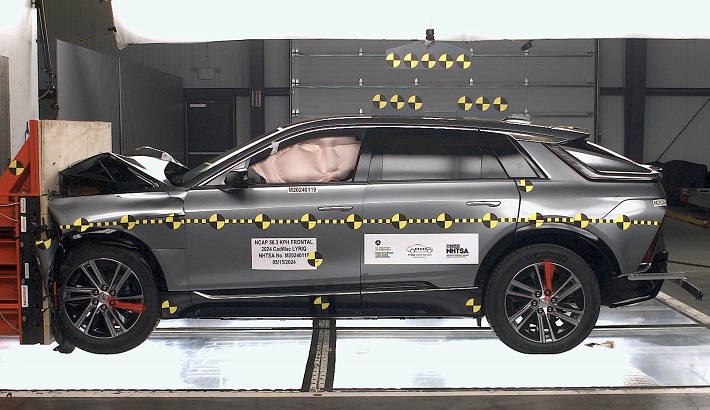
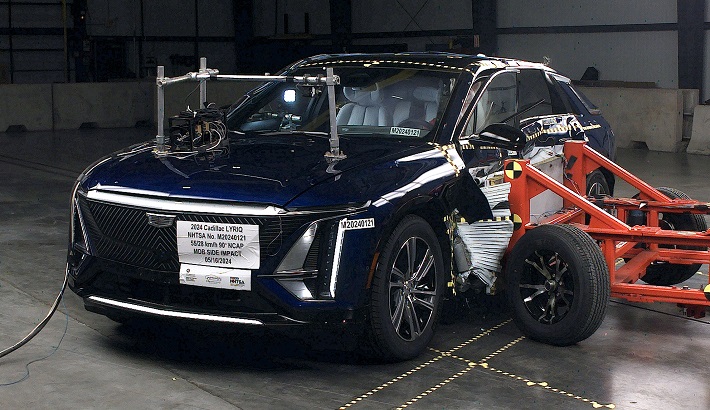
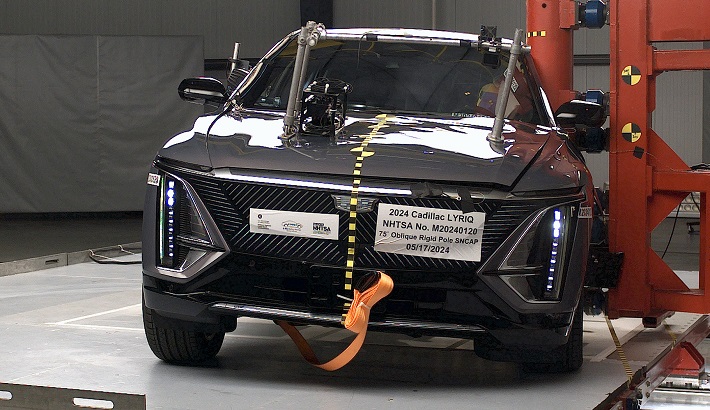
NHTSA crash tests
The agency crash-tested this model year itself. These are its own
photographs and star ratings.
Frontal crash test
Side barrier crash test
Side pole crash test
Photographs taken by NHTSA during its own New Car Assessment Program crash
tests of this model year. Public domain.
Configuration
Overall
Front
Side
Rollover
2024 Cadillac LYRIQ SUV AWD
8.9% risk
2024 Cadillac LYRIQ SUV RWD
8.9% risk
When owners complained
A spike years after the car went on sale usually means a part wearing
out on schedule across the whole fleet — the kind of pattern no single
owner can see from inside their own car.
Apr 2024peak 12Sep 2026
NHTSA investigations into the 2024 Cadillac Lyriq
An investigation is the step before a recall: the agency has seen enough
complaints to look into a pattern itself. An open one means it thinks
something may be wrong and nothing has been fixed yet.
1
investigation is
still open.
EA26006Opened 21 Aug 2026Still openSERVICE BRAKES
Electronic Brake Module Component Failure
On April 11, 2024, the Office of Defects Investigation (ODI) opened Preliminary Evaluation PE24011 after receiving complaints concerning a loss of brake assist in 2023 MY Cadillac Lyriq vehicles. These complaints allege a hard brake pedal, followed by a “Brake System Failure” message at start up or while driving. GM shared records regarding several internal investigations for loss of brake assist due to alleged spindle fractures in the eBoost system. GM has stated that in the event of a spindle fracture, anti-lock brakes (ABS), stability control, and traction control remain functional until th...
Recalls on the 2024 Cadillac Lyriq
A complaint is one owner's allegation. A recall is the point at which
the manufacturer or a regulator agreed the defect is real and dangerous
enough to fix for free — however old the car is.
United States — NHTSA
26V082000
BACK OVER PREVENTION:SOFTWARE
General Motors, LLC (GM) is recalling certain 2024 Lyriq vehicles. The rearview camera screen may turn gray with no camera image.
Risk: An inoperative rearview camera can reduce the driver's rear visibility, increasing the risk of a crash.
General Motors, LLC (GM) is recalling certain 2023 – 2024 model year Cadillac Lyriq vehicles. The driver video display may go blank while driving.
Risk: A blank video display can result in a loss of critical safety information, such as the speedometer, warning lights, and rearview camera image, increasing the risk of a crash.
25V232000
SUSPENSION:FRONT:STABILIZER BAR
General Motors LLC (GM) is recalling certain 2023-2025 Cadillac LYRIQ vehicles. The left or right front stabilizer bar bracket bolts may have been improperly tightened, which can allow the bolts to loosen and separate from the vehicle frame. A detached stabilizer bar or bracket can damage the vehicle's high voltage cables or EV battery coolant lines.
Risk: Damaged cables or coolant lines can result in a vehicle shutdown, causing a loss of drive power and increasing the risk of a crash.
24V589000
SERVICE BRAKES, HYDRAULIC:ANTILOCK/TRACTION CONTROL/ELECTRONIC LIMITED SLIP:CONTROL UNIT/MODULE
General Motors, LLC (GM) is recalling certain 2023-2024 Cadillac LYRIQ all-wheel drive vehicles. The anti-lock brake system (ABS) may activate unexpectedly and release brake pressure in the vehicle's service brake system.
Risk: A release of brake pressure can cause a loss of braking ability, increasing the risk of a crash.
24V320000
ELECTRICAL SYSTEM:WIRING
General Motors, LLC (GM) is recalling certain 2024 Cadillac Lyriq, Chevrolet Blazer EV, Chevrolet Silverado EV, GMC Hummer EV SUV, and GMC Sierra EV vehicles. The electric motors in the rear drive units may have insufficiently insulated wires that can contact each other, resulting in a loss of drive power.
Risk: A loss of drive power increases the risk of a crash.
23V785000
SEAT BELTS:REAR/OTHER:ANCHORAGE
General Motors, LLC (GM) is recalling certain 2023-2024 LYRIQ vehicles. The bracket that anchors the left-rear and center-rear seat belts may have been improperly welded to the seat frame.
Risk: An improperly welded seat belt bracket may not restrain an occupant as intended, increasing their risk of injury during a crash.
Canada — Transport Canada
Canada runs its own recall programme, and its campaigns do not
always mirror the American ones.
Recall 20262734,812 units in Canada
Other
Issue: Under certain conditions, when the vehicle is stopped, it may not produce enough sound to be detected by other road users. Safety Risk: This error does not affect safety. Corrective Actions: This is not a recall. General Motors has made changes to ensure that all new vehicles comply with Canadian regulations.
Recall 202605933 units in Canada
Visual System
Issue: On certain vehicles, a software problem could cause the rearview camera image not to display when the transmission is shifted into reverse. Safety Risk: A rearview camera image that doesn't display could reduce a driver's ability to see behind the vehicle while backing up. This could increase the risk of a crash. Corrective Actions: General Motors will notify owners by mail and send a wireless over-the-air software update to eligible vehicles to update the vehicle cockpit unit (VCU) software. Alternatively, you may schedule an appointment to have the update performed at a GM dealership.
Recall 20252934,815 units in Canada
Lights And Instruments
Issue: On certain vehicles, a software problem could cause the driver video display (instrument cluster) to go blank while driving. If this happens, you may not be able to see certain information about the vehicle, including the speedometer, warnings, and tell-tales. In addition, the rearview camera image may not display when the transmission is shifted into reverse. Safety Risk: Warnings, tell-tales and gauges that don't display could increase the risk of a crash. Additionally, a rearview camera image that doesn't display could reduce a driver's ability to see behind the vehicle while backing up. This could also increase the risk of a crash. Corrective Actions: General Motors will notify owners by mail and send a wireless over-the-air software update to eligible vehicles to update the video display control module software. Alternatively, you may schedule an appointment to have the update performed at a GM dealership.
Recall 20244532,703 units in Canada
Brakes
Issue: Under certain conditions, a software problem could cause the antilock braking system (ABS) not to work properly. As a result, the ABS could cause reduced braking or a loss of brakes. Safety Risk: Reduced braking or a loss of brakes can increase the risk of a crash. Corrective Actions: General Motors will notify owners by mail and send a wireless over-the-air software update to eligible vehicles to update the electronic brake control module software. Alternatively, you may schedule an appointment to have the update performed at a GM dealership.
Recall 2024060273,306 units in Canada
Lights And Instruments
Issue: On certain vehicles, a software problem could cause the lower beam headlamps not to turn on as it becomes dark outside if the multi-function switch is in the "OFF" or "PARKING LAMP" position. This could also cause the daytime running lamps (DRLs) to turn off when the vehicle is moving. As a result, the vehicles may not meet certain requirements of Canadian regulations. Safety Risk: Headlamps and/or DRLs that don't turn on could reduce visibility, make the vehicle less visible to others and increase the risk of a crash. Corrective Actions: General Motors will notify owners by mail and advise you to take your vehicle to a dealership to update the body control module (BCM)software.
I put the car in reverse and released the parking brake. The car started to move backwards. However, the back passenger door was wide open, and the passenger was standing outside the car in the path of the open door. The door hit a guide wire running from the top of a power pole to the sidewalk beside the car. The wire pulled the door backwards, destroying it. This was fortunate. Without the wire in the way, I would’ve had not heard the crashing of the door and would have continued to drive over the person standing beside the car as the passenger door knocked him down. The indicator that the door was still open is so small on the gauge cluster that I couldn’t see that the door was still open when I put the car into reverse. There was no audible warning that I was about to move before all doors were closed, and the emergency braking didn’t stop the car from moving. The passenger’s leg got pushed sideways under the open door. Had the guidewire not pulled the door backwards and caused so much noise that I stopped, the door would’ve broken the passenger’s leg and potentially pushed him under the rear passenger side tire.
NHTSA complaint #11739744 — an unverified report by a vehicle owner.
Orlando, FLCrash1 injured
BACK OVER PREVENTION: WARNINGS
I put the car in reverse and released the parking brake. The car started to move backwards. However, the back passenger door was wide open, and the passenger was standing outside the car in the path of the open door. The door hit a guide wire running from the top of a power pole to the sidewalk beside the car. The wire pulled the door backwards, destroying it. This was fortunate. Without the wire in the way, I would’ve had not heard the crashing of the door and would have continued to drive over the person standing beside the car as the passenger door knocked him down. The indicator that the door was still open is so small on the gauge cluster that I couldn’t see that the door was still open when I put the car into reverse. There was no audible warning that I was about to move before all doors were closed, and the emergency braking didn’t stop the car from moving. The passenger’s leg got pushed sideways under the open door. Had the guidewire not pulled the door backwards and caused so much noise that I stopped, the door would’ve broken the passenger’s leg and potentially pushed him under the rear passenger side tire.
NHTSA complaint #11739744 — an unverified report by a vehicle owner.
Rockville, MDCrash
VEHICLE SPEED CONTROL
COMPONENT: Vehicle Speed Control — Automatic Emergency Braking / Anti-Lock Braking System (ABS) COMPLAINT: I am filing this complaint to report a POST-REMEDY FAILURE of the repair performed under NHTSA Safety Recall 24V589 (GM Program #N242453471) on my 2024 Cadillac Lyriq AWD. RECALL REMEDY COMPLETED: My vehicle received the Electronic Brake Control Module (EBCM) software update on August 13, 2024, under GM Program #N242453471. The recall was marked "Complete" by the servicing dealership on that date. FAILURE INCIDENT: On March 15, 2026, at low speed (under 25 mph) on a dry surface, my Lyriq failed to activate its Automatic Emergency Braking system while approaching a stationary object. The vehicle did not decelerate or stop as designed. The ABS system appeared to release braking pressure rather than maintain it, allowing the vehicle to continue forward and strike the object. The front grille assembly sustained significant physical damage as a direct result. This failure is identical in nature to the defect described in Recall 24V589 — specifically, the ABS falsely activating and releasing braking pressure during low-speed operation on a dry surface — despite the recall remedy having been applied and certified complete ten months prior. SAFETY CONCERN: The software remedy applied under Recall 24V589 did not correct the defect on my vehicle. This raises serious concerns about the effectiveness of the EBCM software update as a remedy across all affected vehicles. If other vehicles received the same software update and the defect persists, there is a significant ongoing safety risk to the public. I am requesting that NHTSA: Investigate whether the Recall 24V589 remedy (EBCM software update) has been effective across all affected vehicles Determine whether a supplemental or revised recall remedy is necessary Require GM/Cadillac to cover physical damages resulting from this post-remedy failure I have also contacted Cadillac Customer Care direct
NHTSA complaint #11725667 — an unverified report by a vehicle owner.
COMPONENT: Vehicle Speed Control — Automatic Emergency Braking / Anti-Lock Braking System (ABS) COMPLAINT: I am filing this complaint to report a POST-REMEDY FAILURE of the repair performed under NHTSA Safety Recall 24V589 (GM Program #N242453471) on my 2024 Cadillac Lyriq AWD. RECALL REMEDY COMPLETED: My vehicle received the Electronic Brake Control Module (EBCM) software update on August 13, 2024, under GM Program #N242453471. The recall was marked "Complete" by the servicing dealership on that date. FAILURE INCIDENT: On March 15, 2026, at low speed (under 25 mph) on a dry surface, my Lyriq failed to activate its Automatic Emergency Braking system while approaching a stationary object. The vehicle did not decelerate or stop as designed. The ABS system appeared to release braking pressure rather than maintain it, allowing the vehicle to continue forward and strike the object. The front grille assembly sustained significant physical damage as a direct result. This failure is identical in nature to the defect described in Recall 24V589 — specifically, the ABS falsely activating and releasing braking pressure during low-speed operation on a dry surface — despite the recall remedy having been applied and certified complete ten months prior. SAFETY CONCERN: The software remedy applied under Recall 24V589 did not correct the defect on my vehicle. This raises serious concerns about the effectiveness of the EBCM software update as a remedy across all affected vehicles. If other vehicles received the same software update and the defect persists, there is a significant ongoing safety risk to the public. I am requesting that NHTSA: Investigate whether the Recall 24V589 remedy (EBCM software update) has been effective across all affected vehicles Determine whether a supplemental or revised recall remedy is necessary Require GM/Cadillac to cover physical damages resulting from this post-remedy failure I have also contacted Cadillac Customer Care direct
NHTSA complaint #11725667 — an unverified report by a vehicle owner.
at 18,125 milesActon, CACrash
SERVICE BRAKES
The contact owns a 2024 Cadillac Lyriq. The contact stated that while reversing, the rear-view safety sensor alert did not function as intended. In addition, the contact stated that the auto-braking safety sensor did not activate. The contact's vehicle crashed into a tree. The vehicle was not diagnosed or repaired by an independent mechanic or dealer. The manufacturer was made aware of the failure, and a case was filed. The contact stated that the case was denied. In addition, contact was denied to receive any documents providing the decision of the case. The failure mileage was approximately 18,125.
NHTSA complaint #11722944 — an unverified report by a vehicle owner.
at 18,125 milesActon, CACrash
BACK OVER PREVENTION
The contact owns a 2024 Cadillac Lyriq. The contact stated that while reversing, the rear-view safety sensor alert did not function as intended. In addition, the contact stated that the auto-braking safety sensor did not activate. The contact's vehicle crashed into a tree. The vehicle was not diagnosed or repaired by an independent mechanic or dealer. The manufacturer was made aware of the failure, and a case was filed. The contact stated that the case was denied. In addition, contact was denied to receive any documents providing the decision of the case. The failure mileage was approximately 18,125.
NHTSA complaint #11722944 — an unverified report by a vehicle owner.
The most recent complaints
In the owners' own words, exactly as filed with NHTSA.
Scottsdale, AZ
UNKNOWN OR OTHER
The vehicle is a Cadillac Lyriq. Following an over the air software update pushed by the manufacturer, the vehicle began displaying a high voltage system error message and lost the ability to DC fast charge. The high voltage components themselves are reported to be functional, the issue appears to be caused entirely by the software update rather than a hardware failure. The vehicle has been at an authorized dealership service center since August 14, 2026, awaiting a resolution. The dealership has confirmed the fault is present and is consistent with a known issue caused by the manufacturer's software update, but has not been able to repair it independently, since the fix requires a corrected software release from the manufacturer. As of this writing, the manufacturer has not issued the corrected update and has not provided a timeline for when one will be available. This creates a safety risk because the vehicle cannot be relied upon for longer trips or situations requiring DC fast charging, which can leave the driver stranded or unable to reach a destination or charging option within a safe range, particularly in hot weather conditions common in this region. The warning message and loss of fast charging capability appeared immediately after the software update was applied, with no prior symptoms. It is unknown whether the manufacturer has independently inspected this specific vehicle beyond the dealership's diagnosis. The high voltage system and charging hardware remain available for inspection upon request. Multiple other owners of this same model have reported the identical issue following the same software update, suggesting this is a widespread defect rather than an isolated incident.
NHTSA complaint #11761303 — an unverified report by a vehicle owner.
Nantucket, MA
POWER TRAIN
On August 9, 2026, at approximately 3:40 a.m., while driving, the vehicle suddenly lost all propulsion and became completely disabled on the roadway. The vehicle remained powered on but would not move forward or backward. At approximately the time of the failure, Cadillac/OnStar Advanced Diagnostics generated a critical Electric Drive Unit warning instructing immediate service and reported diagnostic code P0A78. Additional vehicle diagnostic warnings involved the electric drive unit/high-voltage propulsion system. I immediately contacted roadside assistance but was unable to obtain a workable towing solution for several hours. The vehicle ultimately had to be privately towed and has remained undriveable since the incident. The loss of propulsion occurred unexpectedly while the vehicle was being driven, without advance warning that would have allowed me to safely plan for the vehicle to become disabled. I am concerned that the same sudden loss of propulsion could occur at higher speed, in traffic, at an intersection, or in another location where an unexpected loss of motive power could create a serious crash risk. The vehicle requires diagnosis and repair for the Electric Drive Unit/P0A78 condition.
NHTSA complaint #11758673 — an unverified report by a vehicle owner.
Nantucket, MA
ELECTRICAL SYSTEM
On August 9, 2026, at approximately 3:40 a.m., while driving, the vehicle suddenly lost all propulsion and became completely disabled on the roadway. The vehicle remained powered on but would not move forward or backward. At approximately the time of the failure, Cadillac/OnStar Advanced Diagnostics generated a critical Electric Drive Unit warning instructing immediate service and reported diagnostic code P0A78. Additional vehicle diagnostic warnings involved the electric drive unit/high-voltage propulsion system. I immediately contacted roadside assistance but was unable to obtain a workable towing solution for several hours. The vehicle ultimately had to be privately towed and has remained undriveable since the incident. The loss of propulsion occurred unexpectedly while the vehicle was being driven, without advance warning that would have allowed me to safely plan for the vehicle to become disabled. I am concerned that the same sudden loss of propulsion could occur at higher speed, in traffic, at an intersection, or in another location where an unexpected loss of motive power could create a serious crash risk. The vehicle requires diagnosis and repair for the Electric Drive Unit/P0A78 condition.
NHTSA complaint #11758673 — an unverified report by a vehicle owner.
Nantucket, MA
FUEL/PROPULSION SYSTEM
On August 9, 2026, at approximately 3:40 a.m., while driving, the vehicle suddenly lost all propulsion and became completely disabled on the roadway. The vehicle remained powered on but would not move forward or backward. At approximately the time of the failure, Cadillac/OnStar Advanced Diagnostics generated a critical Electric Drive Unit warning instructing immediate service and reported diagnostic code P0A78. Additional vehicle diagnostic warnings involved the electric drive unit/high-voltage propulsion system. I immediately contacted roadside assistance but was unable to obtain a workable towing solution for several hours. The vehicle ultimately had to be privately towed and has remained undriveable since the incident. The loss of propulsion occurred unexpectedly while the vehicle was being driven, without advance warning that would have allowed me to safely plan for the vehicle to become disabled. I am concerned that the same sudden loss of propulsion could occur at higher speed, in traffic, at an intersection, or in another location where an unexpected loss of motive power could create a serious crash risk. The vehicle requires diagnosis and repair for the Electric Drive Unit/P0A78 condition.
NHTSA complaint #11758673 — an unverified report by a vehicle owner.
Aurora, CO
ELECTRICAL SYSTEM
The infotainment screen in my car plus the menu control went completely dead. With the screen dead completely this mean you cannot see the speedomoter, rear camera feeds, warning symbols on the dash. You cannot see current speed, you cannot hear any sound so all alerting systems are down. You are completely blind in a vehicle built around this screen. Dealership has already confirmed faulty computer module. However was told it would have been originally resolved under N252500680. It has only been inspected by the manufacture. No warnings, no nothing, just dead screen out of nowhere that requires new part to bring online. Meaning dead dead; part is currently on back order and design changes were made after this exact model year showing knowledge of the fault.
NHTSA complaint #11753137 — an unverified report by a vehicle owner.
Maurertown, VA
FORWARD COLLISION AVOIDANCE: ADAPTIVE CRUISE CONTROL
This is about an issue with the ACC system. While driving with the ACC engaged, it will intermittently disengage and without notification. Then the vehicle applies hard braking. After many multiple occurrences, I now tap the brake pedal and apply acceleration. I can't tell you how concerning this can be while driving at interstate speed. Just the thought of a large truck behind me will put the fear into you. Additionally, I have been able to hear an electrical clicking noise emitting from the left side of the steering wheel. When this occurs the ACC is unavailable and/or unable to be selected. A barrage of notifications will appear saying the Adaptive Cruise Control Selected or Cruise Control Selected. Our Lyriq has been in the shop for this problem at least 3 times. Everytime the outcome is CND or WAD
NHTSA complaint #11753122 — an unverified report by a vehicle owner.
This is about an issue with the ACC system. While driving with the ACC engaged, it will intermittently disengage and without notification. Then the vehicle applies hard braking. After many multiple occurrences, I now tap the brake pedal and apply acceleration. I can't tell you how concerning this can be while driving at interstate speed. Just the thought of a large truck behind me will put the fear into you. Additionally, I have been able to hear an electrical clicking noise emitting from the left side of the steering wheel. When this occurs the ACC is unavailable and/or unable to be selected. A barrage of notifications will appear saying the Adaptive Cruise Control Selected or Cruise Control Selected. Our Lyriq has been in the shop for this problem at least 3 times. Everytime the outcome is CND or WAD
NHTSA complaint #11753122 — an unverified report by a vehicle owner.
The infotainment screen in my car plus the menu control went completely dead. With the screen dead completely this mean you cannot see the speedomoter, rear camera feeds, warning symbols on the dash. You cannot see current speed, you cannot hear any sound so all alerting systems are down. You are completely blind in a vehicle built around this screen. Dealership has already confirmed faulty computer module. However was told it would have been originally resolved under N252500680. It has only been inspected by the manufacture. No warnings, no nothing, just dead screen out of nowhere that requires new part to bring online. Meaning dead dead; part is currently on back order and design changes were made after this exact model year showing knowledge of the fault.
NHTSA complaint #11753137 — an unverified report by a vehicle owner.
Aurora, CO
BACK OVER PREVENTION: WARNINGS
The infotainment screen in my car plus the menu control went completely dead. With the screen dead completely this mean you cannot see the speedomoter, rear camera feeds, warning symbols on the dash. You cannot see current speed, you cannot hear any sound so all alerting systems are down. You are completely blind in a vehicle built around this screen. Dealership has already confirmed faulty computer module. However was told it would have been originally resolved under N252500680. It has only been inspected by the manufacture. No warnings, no nothing, just dead screen out of nowhere that requires new part to bring online. Meaning dead dead; part is currently on back order and design changes were made after this exact model year showing knowledge of the fault.
NHTSA complaint #11753137 — an unverified report by a vehicle owner.
Dallas, TX
SERVICE BRAKES
In the past 18 months the vehicle has experienced phantom breaking while driving 3 times. Each time there were no vehicles within 30 or more feet from the vehicle. All 3 times occurred while driving the vehicle and going between 20-40 mph. The vehicle engaged in an emergency break and stopped the car in the road. All three times could have resulted in a major accident as it occurred on busy roadways. This last time it happened in the middle of an intersection with no vehicles around me or behind me. This is a major safety concern and put my family and I in a potentially dangerous situation that could have caused major injuries to myself, my family and others around us. The vehicle is currently with Cadillac being inspected. During conversations with Cadillac they said this is a known issue and suggested that I turn the mechanism off and bypass the safety feature to avoid it from happening again. This is not a systematic fix. This is a bypass. We purchased the car for the safety and security and how sophisticated the safety mechanisms are and we have now been told as a suggestion to simply bypass it. This is very concerning on a national level of That the vehicle is known for doing this. We no longer feel safe in this vehicle The dealer has not confirmed if they have gotten it to duplicate. The only updates we have is that they are still working on the diagnostic testing. There were no warnings prior to the phantom breaking taking place.
NHTSA complaint #11749877 — an unverified report by a vehicle owner.
In the past 18 months the vehicle has experienced phantom breaking while driving 3 times. Each time there were no vehicles within 30 or more feet from the vehicle. All 3 times occurred while driving the vehicle and going between 20-40 mph. The vehicle engaged in an emergency break and stopped the car in the road. All three times could have resulted in a major accident as it occurred on busy roadways. This last time it happened in the middle of an intersection with no vehicles around me or behind me. This is a major safety concern and put my family and I in a potentially dangerous situation that could have caused major injuries to myself, my family and others around us. The vehicle is currently with Cadillac being inspected. During conversations with Cadillac they said this is a known issue and suggested that I turn the mechanism off and bypass the safety feature to avoid it from happening again. This is not a systematic fix. This is a bypass. We purchased the car for the safety and security and how sophisticated the safety mechanisms are and we have now been told as a suggestion to simply bypass it. This is very concerning on a national level of That the vehicle is known for doing this. We no longer feel safe in this vehicle The dealer has not confirmed if they have gotten it to duplicate. The only updates we have is that they are still working on the diagnostic testing. There were no warnings prior to the phantom breaking taking place.
NHTSA complaint #11749877 — an unverified report by a vehicle owner.
Cedar Lake, IN
STEERING
Component Involved: Steering Wheel Assembly (Super Cruise Steering Wheel Light Bar / Rim)Safety Defect Description:The plastic insert covering the Super Cruise LED light bar and the surrounding leather wrap located directly on the top rim of the steering wheel are breaking apart, peeling, and separating. This is an immediate and severe driving safety hazard. While executing turns and maneuvering the vehicle, the driver’s hands and clothing sleeves are actively getting caught and snagged on the exposed, broken plastic edges and peeling wrap on the wheel rim. This causes physical interference and sudden, unexpected entrapment of the driver's hand or clothing during active steering.Consequences of the Defect:This defect presents an imminent risk of a vehicle crash due to sudden mechanical restriction of the driver's hands. If a driver’s sleeve or fingers become trapped or snagged by the peeling steering wheel trim while negotiating a sharp turn, curve, or emergency evasive maneuver, they will be unable to smoothly rotate the wheel, leading to a direct loss of steering control.
NHTSA complaint #11746363 — an unverified report by a vehicle owner.
I put the car in reverse and released the parking brake. The car started to move backwards. However, the back passenger door was wide open, and the passenger was standing outside the car in the path of the open door. The door hit a guide wire running from the top of a power pole to the sidewalk beside the car. The wire pulled the door backwards, destroying it. This was fortunate. Without the wire in the way, I would’ve had not heard the crashing of the door and would have continued to drive over the person standing beside the car as the passenger door knocked him down. The indicator that the door was still open is so small on the gauge cluster that I couldn’t see that the door was still open when I put the car into reverse. There was no audible warning that I was about to move before all doors were closed, and the emergency braking didn’t stop the car from moving. The passenger’s leg got pushed sideways under the open door. Had the guidewire not pulled the door backwards and caused so much noise that I stopped, the door would’ve broken the passenger’s leg and potentially pushed him under the rear passenger side tire.
NHTSA complaint #11739744 — an unverified report by a vehicle owner.
Orlando, FLCrash1 injured
BACK OVER PREVENTION: WARNINGS
I put the car in reverse and released the parking brake. The car started to move backwards. However, the back passenger door was wide open, and the passenger was standing outside the car in the path of the open door. The door hit a guide wire running from the top of a power pole to the sidewalk beside the car. The wire pulled the door backwards, destroying it. This was fortunate. Without the wire in the way, I would’ve had not heard the crashing of the door and would have continued to drive over the person standing beside the car as the passenger door knocked him down. The indicator that the door was still open is so small on the gauge cluster that I couldn’t see that the door was still open when I put the car into reverse. There was no audible warning that I was about to move before all doors were closed, and the emergency braking didn’t stop the car from moving. The passenger’s leg got pushed sideways under the open door. Had the guidewire not pulled the door backwards and caused so much noise that I stopped, the door would’ve broken the passenger’s leg and potentially pushed him under the rear passenger side tire.
NHTSA complaint #11739744 — an unverified report by a vehicle owner.
LAS Vegas, NV
SERVICE BRAKES
What component or system failed or malfunctioned, and is it available for inspection upon request? The issue involves the Anti-lock Braking System (ABS) and the transition between regenerative braking and friction braking in my Cadillac Lyriq (RWD). The ABS engages unexpectedly during normal braking conditions when using one-pedal driving. The vehicle is available for inspection upon request. How was your safety or the safety of others put at risk? The unexpected ABS activation creates inconsistent and unpredictable braking behavior, including a pulsing sensation and reduced braking confidence. This affects the driver’s ability to modulate braking smoothly and predict stopping distance, increasing the risk of a collision, especially in normal traffic conditions where consistent braking response is critical. Has the problem been reproduced or confirmed by a dealer or independent service center? Yes. The issue has been reproduced during multiple visits to authorized Cadillac dealerships. However, I have been told that the vehicle is “operating as designed,” despite the abnormal braking behavior. Has the vehicle or component been inspected by the manufacturer, police, insurance representatives or others? The vehicle has been inspected by multiple authorized Cadillac dealerships and the issue has been escalated to General Motors. No resolution or fix has been provided to date. Were there any warning lamps, messages or other symptoms of the problem prior to the failure, and when did they first appear? There are no warning lights or messages associated with this issue. The problem occurs intermittently during normal driving conditions, particularly when transitioning from regenerative braking (one-pedal driving) to applying the brake pedal. The issue began shortly after taking delivery of the vehicle and has persisted since.
NHTSA complaint #11732706 — an unverified report by a vehicle owner.
Edgewater, NJ
POWER TRAIN
My 2024 Cadillac LYRIQ generated the following High Voltage Battery fault codes via On-Demand Diagnostic: U2B4A, U2B4D, U2B50, U2B53, U2B56, U2B59, U2B5C, U2B5F, U2B62, U2B65, U2B68 — all under module VIC - Lithium-Ion Battery. Multiple codes are flagged "Service Right Away" indicating an active fault in the high voltage propulsion battery system. I brought the vehicle to Lindsay Cadillac, Alexandria VA [XXX] ) on [INSERT DROP-OFF DATE]. As of today [INSERT TODAY'S DATE], the vehicle has been sitting at the dealership for [X] days with ZERO repair action taken. The service manager has stated he does not know what to do, has no timeline, and cannot provide any answers. GM Technical Service Bulletins PIP6009B and 25-NA-044 specifically cover these exact DTCs and provide a documented repair procedure. The dealer has failed to follow or initiate this procedure. No loaner vehicle was provided despite this being a warranty repair on inoperative vehicle. I have been forced to rent a vehicle at $125/day out of pocket. I have an open Cadillac Concierge case number [93707662 #]. Cadillac Concierge was unable to reach the dealer's service department by phone. I have escalated in writing to GM's executive office including [XXX] and [XXX] with no resolution. This is a high voltage battery fault on an all-electric vehicle flagged as "Service Right Away" severity. The vehicle remains unrepaired, the dealer is unresponsive, and GM's own customer service cannot reach the dealer. This represents both a safety concern and a complete failure of the warranty service obligation. I am requesting NHTSA investigation of both the underlying battery defect and the dealer's failure to act on a known TSB. INFORMATION REDACTED PURSUANT TO THE FREEDOM OF INFORMATION ACT (FOIA), 5 U.S.C. 552(B)(6)
NHTSA complaint #11732450 — an unverified report by a vehicle owner.
Edgewater, NJ
UNKNOWN OR OTHER
My 2024 Cadillac LYRIQ generated the following High Voltage Battery fault codes via On-Demand Diagnostic: U2B4A, U2B4D, U2B50, U2B53, U2B56, U2B59, U2B5C, U2B5F, U2B62, U2B65, U2B68 — all under module VIC - Lithium-Ion Battery. Multiple codes are flagged "Service Right Away" indicating an active fault in the high voltage propulsion battery system. I brought the vehicle to Lindsay Cadillac, Alexandria VA [XXX] ) on [INSERT DROP-OFF DATE]. As of today [INSERT TODAY'S DATE], the vehicle has been sitting at the dealership for [X] days with ZERO repair action taken. The service manager has stated he does not know what to do, has no timeline, and cannot provide any answers. GM Technical Service Bulletins PIP6009B and 25-NA-044 specifically cover these exact DTCs and provide a documented repair procedure. The dealer has failed to follow or initiate this procedure. No loaner vehicle was provided despite this being a warranty repair on inoperative vehicle. I have been forced to rent a vehicle at $125/day out of pocket. I have an open Cadillac Concierge case number [93707662 #]. Cadillac Concierge was unable to reach the dealer's service department by phone. I have escalated in writing to GM's executive office including [XXX] and [XXX] with no resolution. This is a high voltage battery fault on an all-electric vehicle flagged as "Service Right Away" severity. The vehicle remains unrepaired, the dealer is unresponsive, and GM's own customer service cannot reach the dealer. This represents both a safety concern and a complete failure of the warranty service obligation. I am requesting NHTSA investigation of both the underlying battery defect and the dealer's failure to act on a known TSB. INFORMATION REDACTED PURSUANT TO THE FREEDOM OF INFORMATION ACT (FOIA), 5 U.S.C. 552(B)(6)
NHTSA complaint #11732450 — an unverified report by a vehicle owner.
Edgewater, NJ
ELECTRICAL SYSTEM
My 2024 Cadillac LYRIQ generated the following High Voltage Battery fault codes via On-Demand Diagnostic: U2B4A, U2B4D, U2B50, U2B53, U2B56, U2B59, U2B5C, U2B5F, U2B62, U2B65, U2B68 — all under module VIC - Lithium-Ion Battery. Multiple codes are flagged "Service Right Away" indicating an active fault in the high voltage propulsion battery system. I brought the vehicle to Lindsay Cadillac, Alexandria VA [XXX] ) on [INSERT DROP-OFF DATE]. As of today [INSERT TODAY'S DATE], the vehicle has been sitting at the dealership for [X] days with ZERO repair action taken. The service manager has stated he does not know what to do, has no timeline, and cannot provide any answers. GM Technical Service Bulletins PIP6009B and 25-NA-044 specifically cover these exact DTCs and provide a documented repair procedure. The dealer has failed to follow or initiate this procedure. No loaner vehicle was provided despite this being a warranty repair on inoperative vehicle. I have been forced to rent a vehicle at $125/day out of pocket. I have an open Cadillac Concierge case number [93707662 #]. Cadillac Concierge was unable to reach the dealer's service department by phone. I have escalated in writing to GM's executive office including [XXX] and [XXX] with no resolution. This is a high voltage battery fault on an all-electric vehicle flagged as "Service Right Away" severity. The vehicle remains unrepaired, the dealer is unresponsive, and GM's own customer service cannot reach the dealer. This represents both a safety concern and a complete failure of the warranty service obligation. I am requesting NHTSA investigation of both the underlying battery defect and the dealer's failure to act on a known TSB. INFORMATION REDACTED PURSUANT TO THE FREEDOM OF INFORMATION ACT (FOIA), 5 U.S.C. 552(B)(6)
NHTSA complaint #11732450 — an unverified report by a vehicle owner.
Dallas, TX
ELECTRICAL SYSTEM
The vehicle has experienced repeated failures of the infotainment and display system, including the screen going blank and displaying “no content available” while functions such as Apple CarPlay are actively in use. The issue affects the ability to control media and view system information from both the main display and steering wheel controls. The vehicle has undergone multiple repair attempts, including replacement of the human machine interface (HMI) module and radio module, as well as repeated programming. Despite these repairs, the issue continues to reoccur, including immediately after the most recent repair. The condition is intermittent and difficult to duplicate, and a field service engineer has been unable to consistently reproduce the issue. The dealership has indicated there may not be a current fix and that resolution could depend on a future software update. This ongoing failure of critical display and control systems raises safety concerns and has not been resolved despite multiple repair attempts.
NHTSA complaint #11729930 — an unverified report by a vehicle owner.
Oxon Hill, MD
UNKNOWN OR OTHER
Sunroof/moonroof cracked without any impact or signs of impact.
NHTSA complaint #11727743 — an unverified report by a vehicle owner.
Libertyville, IL
ELECTRICAL SYSTEM
We own a 2024 Cadillac Lyriq EV. We began experiencing safety concerns related to battery performance and overall vehicle reliability during the active bumper-to-bumper warranty period. These concerns were reported to an authorized GM dealer, Napleton Cadillac, prior to warranty expiration. Service records at Napleton Cadillac document the history of these complaints. The vehicle has been unable to process required over-the-air (OTA) software updates through GM's intended automated update process. During a dealer visit on February 17, 2026, at GM's direction, the Napleton Cadillac service technician confirmed that the vehicle had multiple open notices and that our reported concerns are consistent with known issues affecting the 2024 Cadillac Lyriq across multiple units — indicating this is not an isolated occurrence. The dealer advised that correcting the update failure would require approximately five hours of manual labor at an estimated cost of $1,250 — a cost GM has declined to cover, despite the fact that the OTA update process is the manufacturer's intended method for delivering safety-critical corrections and the failure to update is a vehicle deficiency, not a customer-caused condition. Due to these unresolved safety concerns, we have not been driving the vehicle. We do not have confidence that the vehicle is operating safely or as designed. We formally requested a repurchase from General Motors through the EV Concierge program (Case No. 87486271). That request was denied on March 14, 2026, citing two rationales: (1) the vehicle is out of warranty, and (2) system updates do not qualify for repurchase. We believe these rationales fail to account for the fact that the original safety complaints were filed during the warranty period and that the root issue is battery and system safety — not a routine software preference. We are filing this complaint to create a formal federal safety record and to request that NHTSA evaluate an investigation or recall.
NHTSA complaint #11725923 — an unverified report by a vehicle owner.
Rockville, MDCrash
VEHICLE SPEED CONTROL
COMPONENT: Vehicle Speed Control — Automatic Emergency Braking / Anti-Lock Braking System (ABS) COMPLAINT: I am filing this complaint to report a POST-REMEDY FAILURE of the repair performed under NHTSA Safety Recall 24V589 (GM Program #N242453471) on my 2024 Cadillac Lyriq AWD. RECALL REMEDY COMPLETED: My vehicle received the Electronic Brake Control Module (EBCM) software update on August 13, 2024, under GM Program #N242453471. The recall was marked "Complete" by the servicing dealership on that date. FAILURE INCIDENT: On March 15, 2026, at low speed (under 25 mph) on a dry surface, my Lyriq failed to activate its Automatic Emergency Braking system while approaching a stationary object. The vehicle did not decelerate or stop as designed. The ABS system appeared to release braking pressure rather than maintain it, allowing the vehicle to continue forward and strike the object. The front grille assembly sustained significant physical damage as a direct result. This failure is identical in nature to the defect described in Recall 24V589 — specifically, the ABS falsely activating and releasing braking pressure during low-speed operation on a dry surface — despite the recall remedy having been applied and certified complete ten months prior. SAFETY CONCERN: The software remedy applied under Recall 24V589 did not correct the defect on my vehicle. This raises serious concerns about the effectiveness of the EBCM software update as a remedy across all affected vehicles. If other vehicles received the same software update and the defect persists, there is a significant ongoing safety risk to the public. I am requesting that NHTSA: Investigate whether the Recall 24V589 remedy (EBCM software update) has been effective across all affected vehicles Determine whether a supplemental or revised recall remedy is necessary Require GM/Cadillac to cover physical damages resulting from this post-remedy failure I have also contacted Cadillac Customer Care direct
NHTSA complaint #11725667 — an unverified report by a vehicle owner.
COMPONENT: Vehicle Speed Control — Automatic Emergency Braking / Anti-Lock Braking System (ABS) COMPLAINT: I am filing this complaint to report a POST-REMEDY FAILURE of the repair performed under NHTSA Safety Recall 24V589 (GM Program #N242453471) on my 2024 Cadillac Lyriq AWD. RECALL REMEDY COMPLETED: My vehicle received the Electronic Brake Control Module (EBCM) software update on August 13, 2024, under GM Program #N242453471. The recall was marked "Complete" by the servicing dealership on that date. FAILURE INCIDENT: On March 15, 2026, at low speed (under 25 mph) on a dry surface, my Lyriq failed to activate its Automatic Emergency Braking system while approaching a stationary object. The vehicle did not decelerate or stop as designed. The ABS system appeared to release braking pressure rather than maintain it, allowing the vehicle to continue forward and strike the object. The front grille assembly sustained significant physical damage as a direct result. This failure is identical in nature to the defect described in Recall 24V589 — specifically, the ABS falsely activating and releasing braking pressure during low-speed operation on a dry surface — despite the recall remedy having been applied and certified complete ten months prior. SAFETY CONCERN: The software remedy applied under Recall 24V589 did not correct the defect on my vehicle. This raises serious concerns about the effectiveness of the EBCM software update as a remedy across all affected vehicles. If other vehicles received the same software update and the defect persists, there is a significant ongoing safety risk to the public. I am requesting that NHTSA: Investigate whether the Recall 24V589 remedy (EBCM software update) has been effective across all affected vehicles Determine whether a supplemental or revised recall remedy is necessary Require GM/Cadillac to cover physical damages resulting from this post-remedy failure I have also contacted Cadillac Customer Care direct
NHTSA complaint #11725667 — an unverified report by a vehicle owner.
at 18,125 milesActon, CACrash
SERVICE BRAKES
The contact owns a 2024 Cadillac Lyriq. The contact stated that while reversing, the rear-view safety sensor alert did not function as intended. In addition, the contact stated that the auto-braking safety sensor did not activate. The contact's vehicle crashed into a tree. The vehicle was not diagnosed or repaired by an independent mechanic or dealer. The manufacturer was made aware of the failure, and a case was filed. The contact stated that the case was denied. In addition, contact was denied to receive any documents providing the decision of the case. The failure mileage was approximately 18,125.
NHTSA complaint #11722944 — an unverified report by a vehicle owner.
at 18,125 milesActon, CACrash
BACK OVER PREVENTION
The contact owns a 2024 Cadillac Lyriq. The contact stated that while reversing, the rear-view safety sensor alert did not function as intended. In addition, the contact stated that the auto-braking safety sensor did not activate. The contact's vehicle crashed into a tree. The vehicle was not diagnosed or repaired by an independent mechanic or dealer. The manufacturer was made aware of the failure, and a case was filed. The contact stated that the case was denied. In addition, contact was denied to receive any documents providing the decision of the case. The failure mileage was approximately 18,125.
NHTSA complaint #11722944 — an unverified report by a vehicle owner.