Owners have filed 665 complaints
about the 2022 Hyundai Ioniq 5 with NHTSA between 2022 and 2026.
The largest single group is the electrical system.
Across this model's run it ranks 2 of 5 worst.
The letter says how bad. This says what kind — whether this year drew
an unusual number of complaints, unusually dangerous
ones, or failures that arrived unusually early.
The dashed ring is 50 — the national norm. Further out is worse.
Complaint volume — 77
Against the median year of the Hyundai Ioniq 5. 50 means typical for this
model; 100 means roughly double.
Severity — 11
2.1% of these complaints
involved a crash, fire, injury or death, against a national rate of
9.7%.
Early failure — 100
82% of failures with a mileage on record happened under
36,000 miles, against a national rate of
29%.
How 2022 compares with every other Hyundai Ioniq 5
NHTSA files every complaint against a named sub-assembly, not just a
system. This is the difference between knowing it was "the engine" and
knowing which part of it — the list to hand a mechanic.
Automatic Emergency Braking
923.7%
Adaptive Cruise Control
821.1%
Warnings
821.1%
12V/24V/48V Battery
513.2%
Assist
37.9%
Port
25.3%
Body
25.3%
Charger LOW Voltage Battery
12.6%
When it fails
Odometer readings owners gave when they filed. About half of all
complaints include one.
Under 1,000 miles
414.3%
1,000 – 9,999 miles
310.7%
10,000 – 24,999 miles
1035.7%
25,000 – 49,999 miles
621.4%
50,000 – 74,999 miles
310.7%
100,000 – 149,999 miles
27.1%
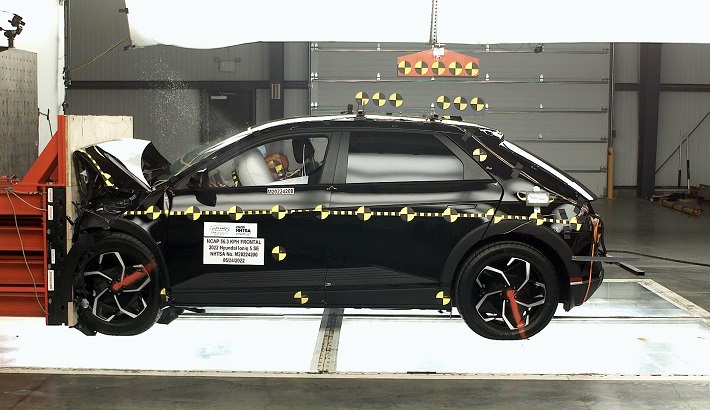
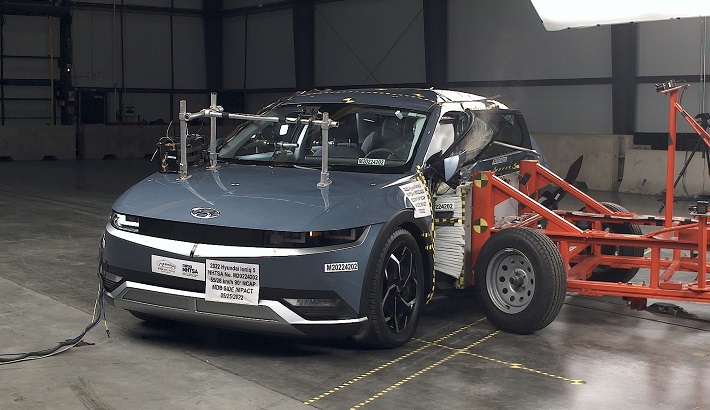
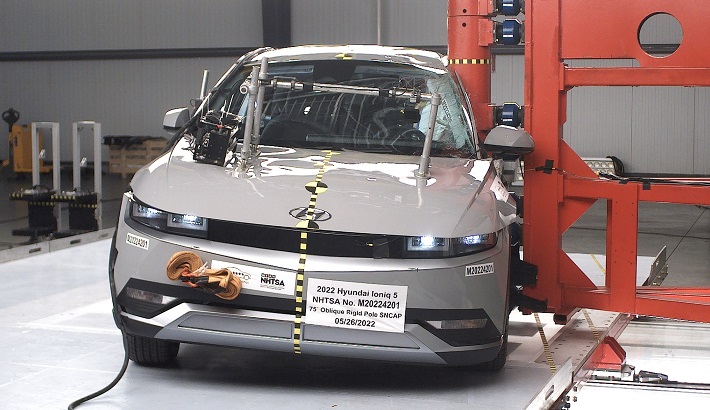
NHTSA crash tests
The agency crash-tested this model year itself. These are its own
photographs and star ratings.
Frontal crash test
Side barrier crash test
Side pole crash test
Photographs taken by NHTSA during its own New Car Assessment Program crash
tests of this model year. Public domain.
Configuration
Overall
Front
Side
Rollover
2022 Hyundai Ioniq 5 SUV AWD
8.3% risk
2022 Hyundai Ioniq 5 SUV RWD
—
—
When owners complained
A spike years after the car went on sale usually means a part wearing
out on schedule across the whole fleet — the kind of pattern no single
owner can see from inside their own car.
Apr 2022peak 62Sep 2026
NHTSA investigations into the 2022 Hyundai Ioniq 5
An investigation is the step before a recall: the agency has seen enough
complaints to look into a pattern itself. An open one means it thinks
something may be wrong and nothing has been fixed yet.
On July 3, 2023, the Office of Defect Investigation (ODI) opened PE23012 to investigate allegations of loss of motor power on model year (MY) 2022 Kia EV6 vehicles. Some consumers reported loss of motor power immediately after warning lamp illumination or reduction of motive power while the vehicle was in motion. This investigation found that the Integrated Charing Unit (ICCU) may become damaged over time from transient high voltage and thermal cycling. A damaged ICCU may not be able to charge the 12-volt battery which can discharge gradually while driving with a reduction of motive power. The...
DP22005Opened 27 Jan 2023Closed 7 Aug 2023ELECTRICAL SYSTEM:PROPULSION SYSTEM
Pedestrian alert sounds
NHTSA received a petition on or about July 18, 2022, requesting that Federal Motor Vehicle Safety Standard (FMVSS) 141 be applied to all electric and hybrid vehicles operating in the United States. The petition can be reviewed at NHTSA.gov under ODI Number 11486072. FMVSS 141 establishes performance requirements for pedestrian alert sounds for motor vehicles. The standard applies to hybrid and electric vehicles that have a gross vehicle weight rating of 4,536 KG or less or are defined as low-speed vehicles. The standard became fully applicable to all such vehicles manufactured on or after Marc...
Recalls on the 2022 Hyundai Ioniq 5
A complaint is one owner's allegation. A recall is the point at which
the manufacturer or a regulator agreed the defect is real and dangerous
enough to fix for free — however old the car is.
United States — NHTSA
24V868000
ELECTRICAL SYSTEM:12V/24V/48V BATTERY
Hyundai Motor America (Hyundai) is recalling certain 2022-2024 IONIQ 5, 2023-2025 IONIQ 6, Genesis GV60, Genesis GV70 "Electrified," and Genesis G80 "Electrified" vehicles. The Integrated Charging Control Unit (ICCU) may become damaged and stop charging the 12-volt battery, which can result in a loss of drive power.
Risk: A loss of drive power increases the risk of a crash.
24V204000
ELECTRICAL SYSTEM:12V/24V/48V BATTERY
Hyundai Motor America (Hyundai) is recalling certain 2022-2024 IONIQ 5, 2023-2024 IONIQ 6, Genesis GV60, Genesis GV70 "Electrified," and Genesis G80 "Electrified" vehicles. The Integrated Charging Control Unit (ICCU) may become damaged and stop charging the 12-Volt battery, which can result in a loss of drive power.
Risk: A loss of drive power increases the risk of a crash.
22V324000
PARKING BRAKE:ELECTRICAL:CONTROL MODULE:SOFTWARE
Hyundai Motor America (Hyundai) is recalling certain 2022 Ioniq 5 vehicles. A software error in the Shifter Control Unit (SCU) may disengage the parking mechanism, which can allow the vehicle to rollaway.
Risk: Vehicle rollaway can increase the risk of a crash or injury.
Canada — Transport Canada
Canada runs its own recall programme, and its campaigns do not
always mirror the American ones.
Recall 202470134,529 units in Canada
High Voltage
Issue: Over time, the integrated charging control unit (ICCU) could become damaged. As a result, the 12 V battery will not charge and could cause the vehicle to enter a reduced power mode. If this happens, and you continue to drive the vehicle, there could be a loss of power to the wheels. Note: This recall replaces Transport Canada recall no. 2024-174. Vehicles that were repaired under that recall also require this repair. This problem will cause a warning light to turn on and warning messages to display before any loss of power. For the Genesis GV70 and G80 models, only the electric versions (EV) are affected. Safety Risk: A loss of power to the wheels could increase the risk of a crash. Corrective Actions: Hyundai will notify owners by mail and advise you to take your vehicle to a dealership to update the vehicle software. The dealer will also inspect and, if necessary, replace the ICCU and ICCU fuse.
Recall 2024552824,695 units in Canada
Label
Issue: On certain vehicles, the compliance label may be missing information in French. The words listed on the label for "Tires", "Rims", "Front" and "Rear" appear in English only, when they should be listed as "Tires/Pneus", "Rims/Jantes", "Front/Avant" and "Rear/Arriere". Canadian regulations require this information to be listed on the label in both English and French. Safety Risk: These small errors do not affect vehicle safety. Corrective Actions: This is not a recall. The company has corrected the compliance label for all new vehicles.
Recall 202417419,443 units in Canada
High Voltage
This recall was replaced by Transport Canada recall no. 2024-701. Issue: Over time, the integrated charging control unit (ICCU) could become damaged. As a result, the 12 V battery will not charge and could cause the vehicle to enter a reduced power mode. If this happens, and you continue to drive the vehicle, there could be a loss of power to the wheels. Note: This problem will cause a warning light to turn on and warning messages to display before any loss of power. Safety Risk: A loss of power to the wheels could increase the risk of a crash. Corrective Actions: Hyundai will notify owners by mail and advise you to take your vehicle to a dealership to update the vehicle software. The dealer will also inspect and, if necessary, replace the ICCU and ICCU fuse.
Recall 20222493,539 units in Canada
Powertrain
Issue: On certain vehicles, the parking pawl could disengage for a short time just after the vehicle is parked and turned off. As a result, the vehicle could move suddenly if the parking brake isn't used. Safety Risk: A parked vehicle that moves suddenly could create the risk of an injury or a crash. Corrective Actions: Hyundai will notify owners by mail and instruct you to take your vehicle to a dealership to update the shifter control unit software. To reduce the safety risk, Hyundai recommends that you should use the parking brake each time that you park.
Reports where the owner recorded a crash, a fire, an injury or a death.
Cedar Hills, UTFire
ELECTRICAL SYSTEM
Component that failed: High-voltage main battery pack assembly and associated electrical architecture. The vehicle and the component are currently located at my home and are available for inspection upon request. Description of Incident & Safety Risk: While attempting to drive the car and when connected to the vehicle to a standard charging infrastructure, a catastrophic internal failure occurred within the high-voltage system (Diagnostic Trouble Code P1AA600). Upon attempting to plug the vehicle in, active electrical arcing and physical sparks emanated from the high-voltage architecture. This structural manufacturing component defect presents an immediate, severe, and active fire and safety hazard to the occupants, the vehicle, and any surrounding property. The vehicle is currently completely un-driveable and unsafe to connect to any power grid. Dealer Confirmation & Inspection: The vehicle was driven to a certified manufacturer dealership service center. A certified dealership technician formally inspected the vehicle, reproduced the fault, and explicitly documented the active electrical arcing and sparking coming from the high-voltage pack in the official service records. The vehicle history was also escalated to the manufacturer's executive consumer affairs team, who acknowledged the intake statement but refused to authorize a remedy or repair. Warning Symptoms: There were no long-term warning lamps or prior symptoms leading up to the structural breakdown. The high-voltage system failure occurred suddenly and catastrophically, immediately triggering a critical malfunction indicator on the dashboard cluster at the time of the failure.
NHTSA complaint #11743803 — an unverified report by a vehicle owner.
Cedar Hills, UTFire
ENGINE
Component that failed: High-voltage main battery pack assembly and associated electrical architecture. The vehicle and the component are currently located at my home and are available for inspection upon request. Description of Incident & Safety Risk: While attempting to drive the car and when connected to the vehicle to a standard charging infrastructure, a catastrophic internal failure occurred within the high-voltage system (Diagnostic Trouble Code P1AA600). Upon attempting to plug the vehicle in, active electrical arcing and physical sparks emanated from the high-voltage architecture. This structural manufacturing component defect presents an immediate, severe, and active fire and safety hazard to the occupants, the vehicle, and any surrounding property. The vehicle is currently completely un-driveable and unsafe to connect to any power grid. Dealer Confirmation & Inspection: The vehicle was driven to a certified manufacturer dealership service center. A certified dealership technician formally inspected the vehicle, reproduced the fault, and explicitly documented the active electrical arcing and sparking coming from the high-voltage pack in the official service records. The vehicle history was also escalated to the manufacturer's executive consumer affairs team, who acknowledged the intake statement but refused to authorize a remedy or repair. Warning Symptoms: There were no long-term warning lamps or prior symptoms leading up to the structural breakdown. The high-voltage system failure occurred suddenly and catastrophically, immediately triggering a critical malfunction indicator on the dashboard cluster at the time of the failure.
NHTSA complaint #11743803 — an unverified report by a vehicle owner.
Avon, CT1 injured
UNKNOWN OR OTHER
While the vehicle was parked in a garage and charging overnight, I briefly went to the vehicle to retrieve an item from the back seat. I was barefoot at the time. I opened the driver‑side rear door and reached inside with my right hand while my left hand was near the upper door area where the door seal is located. When my left hand grazed the door frame, it felt unusually sharp. When I touched the area again to determine what was sharp, I received a significant electric shock. There were no warning lights, messages, or prior symptoms before the incident. The presence of electrical current on an exterior door surface poses a safety risk during normal vehicle use.
NHTSA complaint #11734481 — an unverified report by a vehicle owner.
Avon, CT1 injured
ELECTRICAL SYSTEM
While the vehicle was parked in a garage and charging overnight, I briefly went to the vehicle to retrieve an item from the back seat. I was barefoot at the time. I opened the driver‑side rear door and reached inside with my right hand while my left hand was near the upper door area where the door seal is located. When my left hand grazed the door frame, it felt unusually sharp. When I touched the area again to determine what was sharp, I received a significant electric shock. There were no warning lights, messages, or prior symptoms before the incident. The presence of electrical current on an exterior door surface poses a safety risk during normal vehicle use.
NHTSA complaint #11734481 — an unverified report by a vehicle owner.
Nokomis, FLCrash
VEHICLE SPEED CONTROL
I was coasting into a library parking space with my foot off the accelerator. The car accelerated even with my foot on the brake, jumped a curb and was stopped with above ground tree roots. The dashboard should have been lighted up with collision warning indicators and the automatic braking should have engaged. It did none of that. The car was totaled. Nothing was ever checked to see if it was a mechanical error. My insurer totaled the car.
NHTSA complaint #11697499 — an unverified report by a vehicle owner.
Nokomis, FLCrash
ELECTRICAL SYSTEM
I was coasting into a library parking space with my foot off the accelerator. The car accelerated even with my foot on the brake, jumped a curb and was stopped with above ground tree roots. The dashboard should have been lighted up with collision warning indicators and the automatic braking should have engaged. It did none of that. The car was totaled. Nothing was ever checked to see if it was a mechanical error. My insurer totaled the car.
NHTSA complaint #11697499 — an unverified report by a vehicle owner.
The most recent complaints
In the owners' own words, exactly as filed with NHTSA.
Seattle, WA
POWER TRAIN
This report is an addendum to report 11762283 that was made yesterday. The vehicle allows driving with the rear liftgate ajar, however under some circumstances it engages the EPB when the vehicle comes to a stop while the gear state is still Drive. The gear state of the car remains in Drive when the EPB engages. This presents the driver with the choice, in the middle of the road and possibly in the middle of an intersection, of either exiting the vehicle and rearranging contents of the vehicle to allow the rear liftgate to close, or activating the accelerator to continue driving with the traction motor overpowering clamped EPB. Neither option is safe. I have attempted to reproduce this unsafe state of the vehicle and was successful in one case and unsuccessful in another. My hypothesis for the differentiating factor is the top speed reached prior to decelerating to a stop: in the first case, 13mph, and in the second, 15mph. I have attached a single frame from one of two videos, of the successful case. The instrument display shows gear state is Drive, the car is moving, high torque is being applied by the traction motors (but typically the screen center shows ADAS state, and there is no indication of instantaneous traction torque), and the EPB is engaged. The car is in the middle of an intersection at the time.
NHTSA complaint #11762370 — an unverified report by a vehicle owner.
Seattle, WA
VEHICLE SPEED CONTROL
This report is an addendum to report 11762283 that was made yesterday. The vehicle allows driving with the rear liftgate ajar, however under some circumstances it engages the EPB when the vehicle comes to a stop while the gear state is still Drive. The gear state of the car remains in Drive when the EPB engages. This presents the driver with the choice, in the middle of the road and possibly in the middle of an intersection, of either exiting the vehicle and rearranging contents of the vehicle to allow the rear liftgate to close, or activating the accelerator to continue driving with the traction motor overpowering clamped EPB. Neither option is safe. I have attempted to reproduce this unsafe state of the vehicle and was successful in one case and unsuccessful in another. My hypothesis for the differentiating factor is the top speed reached prior to decelerating to a stop: in the first case, 13mph, and in the second, 15mph. I have attached a single frame from one of two videos, of the successful case. The instrument display shows gear state is Drive, the car is moving, high torque is being applied by the traction motors (but typically the screen center shows ADAS state, and there is no indication of instantaneous traction torque), and the EPB is engaged. The car is in the middle of an intersection at the time.
NHTSA complaint #11762370 — an unverified report by a vehicle owner.
Seattle, WA
SERVICE BRAKES
This report is an addendum to report 11762283 that was made yesterday. The vehicle allows driving with the rear liftgate ajar, however under some circumstances it engages the EPB when the vehicle comes to a stop while the gear state is still Drive. The gear state of the car remains in Drive when the EPB engages. This presents the driver with the choice, in the middle of the road and possibly in the middle of an intersection, of either exiting the vehicle and rearranging contents of the vehicle to allow the rear liftgate to close, or activating the accelerator to continue driving with the traction motor overpowering clamped EPB. Neither option is safe. I have attempted to reproduce this unsafe state of the vehicle and was successful in one case and unsuccessful in another. My hypothesis for the differentiating factor is the top speed reached prior to decelerating to a stop: in the first case, 13mph, and in the second, 15mph. I have attached a single frame from one of two videos, of the successful case. The instrument display shows gear state is Drive, the car is moving, high torque is being applied by the traction motors (but typically the screen center shows ADAS state, and there is no indication of instantaneous traction torque), and the EPB is engaged. The car is in the middle of an intersection at the time.
NHTSA complaint #11762370 — an unverified report by a vehicle owner.
Seattle, WA
VEHICLE SPEED CONTROL
After coming to a stop at a stop sign, and while the gear state was in Drive, the vehicle auto-applied the electronic parking brake because the tailgate was ajar. Gear state remained in Drive. Upon accelerator input, the parking brake did not release, and the vehicle delivered propulsion torque overcoming the parking brake. As a result, the vehicle accelerated and drove several blocks with the rear brakes fully clamped, which was only effectively indicated by a smell and smoke emitted from the rear wheel wells. An irritating repetitive audio and large flashing visual alert in the display cluster indicating the tailgate state distracted from any additional indications that may have been displayed. That distracting indication was continuously active from when gear state was first switched to Drive and did not correlate with EPB engagement.
NHTSA complaint #11762283 — an unverified report by a vehicle owner.
Seattle, WA
SERVICE BRAKES
After coming to a stop at a stop sign, and while the gear state was in Drive, the vehicle auto-applied the electronic parking brake because the tailgate was ajar. Gear state remained in Drive. Upon accelerator input, the parking brake did not release, and the vehicle delivered propulsion torque overcoming the parking brake. As a result, the vehicle accelerated and drove several blocks with the rear brakes fully clamped, which was only effectively indicated by a smell and smoke emitted from the rear wheel wells. An irritating repetitive audio and large flashing visual alert in the display cluster indicating the tailgate state distracted from any additional indications that may have been displayed. That distracting indication was continuously active from when gear state was first switched to Drive and did not correlate with EPB engagement.
NHTSA complaint #11762283 — an unverified report by a vehicle owner.
Cedar Hills, UT
ELECTRICAL SYSTEM
Active powertrain failure on my 2022 Ioniq 5 SE, which poses an immediate and severe safety risk. On May 18, 2026, the vehicle suffered a catastrophic loss of power and a complete failure to charge. At Murdock Hyundai of Lindon, technicians diagnosed it with trouble code P1AA600 and recommended a total high-voltage battery pack replacement at a cost of over $44,000. Immediate Fire & Safety Risk: The dealership technician explicitly warned me that if I continue to attempt to drive or plug in the vehicle, it will cause an electrical fire. Visible Electrical Arcing: The service technician stated that they physically witnessed an electrical arc occur when connecting the vehicle's high-voltage charging components. The technician's diagnosis strongly points to a catastrophic internal short circuit or a failed Power Relay Assembly (PRA) within the high-voltage housing. The company completely stopped working and Hyundai would not help. This has been an ongoing issue with other cars too. I tried multiple times working with both the deal and Hyudnai.
NHTSA complaint #11759832 — an unverified report by a vehicle owner.
Cedar Hills, UT
ENGINE
Active powertrain failure on my 2022 Ioniq 5 SE, which poses an immediate and severe safety risk. On May 18, 2026, the vehicle suffered a catastrophic loss of power and a complete failure to charge. At Murdock Hyundai of Lindon, technicians diagnosed it with trouble code P1AA600 and recommended a total high-voltage battery pack replacement at a cost of over $44,000. Immediate Fire & Safety Risk: The dealership technician explicitly warned me that if I continue to attempt to drive or plug in the vehicle, it will cause an electrical fire. Visible Electrical Arcing: The service technician stated that they physically witnessed an electrical arc occur when connecting the vehicle's high-voltage charging components. The technician's diagnosis strongly points to a catastrophic internal short circuit or a failed Power Relay Assembly (PRA) within the high-voltage housing. The company completely stopped working and Hyundai would not help. This has been an ongoing issue with other cars too. I tried multiple times working with both the deal and Hyudnai.
NHTSA complaint #11759832 — an unverified report by a vehicle owner.
Scottsdale, AZ
STEERING
While driving 70mph on the highway in Phoenix, multiple emergency lights illuminated on the dashboard and I lost all control over the steering wheel and braking mechanisms. The car has been serviced regularly with multiple check-ins focusing on battery efficiency.
NHTSA complaint #11754530 — an unverified report by a vehicle owner.
Scottsdale, AZ
ELECTRICAL SYSTEM
While driving 70mph on the highway in Phoenix, multiple emergency lights illuminated on the dashboard and I lost all control over the steering wheel and braking mechanisms. The car has been serviced regularly with multiple check-ins focusing on battery efficiency.
NHTSA complaint #11754530 — an unverified report by a vehicle owner.
While driving 70mph on the highway in Phoenix, multiple emergency lights illuminated on the dashboard and I lost all control over the steering wheel and braking mechanisms. The car has been serviced regularly with multiple check-ins focusing on battery efficiency.
NHTSA complaint #11754530 — an unverified report by a vehicle owner.
Edison, NJ
ELECTRICAL SYSTEM
On June 3, 2026, my 2022 Hyundai Ioniq 5 SE Dual Motor AWD (approximately 31,000 miles) experienced a sudden and severe high-voltage battery failure. Prior to complete failure, I noticed “Check Electrical” warning sign occurring simultaneously: a sudden and dramatic drop in driving range, dashboard warning lights illuminating, and the vehicle failing to charge properly at both home and public charging stations. The vehicle was still drivable at the time I brought it to an authorized Hyundai dealership, but displayed serious warnings indicating the HV battery system was critically compromised. Upon inspection, the dealership confirmed the main high-voltage battery had failed and required full replacement. The dealership has advised that the repair will take several months due to parts availability. This failure is not an isolated incident. Hyundai issued a recall covering 2022–2024 Ioniq 5 models for HV battery and charging system defects (including ICCU failure). My vehicle’s failure is consistent with this known defect pattern. Despite the vehicle being subject to this known systemic issue, Hyundai Motor America has declined to offer a goodwill buyback, and my case manager has stated the vehicle does not qualify for lemon law relief. The sudden loss of range and charging capability while the vehicle is in motion or in use presents a serious safety concern — particularly on highways where unexpected power loss could lead to accidents. I am currently without a vehicle for what Hyundai estimates to be several months. I am requesting NHTSA investigate this failure pattern in 2022–2024 Hyundai Ioniq 5 vehicles and take appropriate action to protect consumers from this known defect.
NHTSA complaint #11752268 — an unverified report by a vehicle owner.
Salt Lake City, UT
ELECTRICAL SYSTEM
Complaint Summary: Mandated federal safety recall remedies performed on my vehicle have directly induced a cascading, critical safety failure of the vehicle's high-voltage propulsion management system. My 2022 Hyundai IONIQ 5 (VIN: [XXX]) was brought to an authorized dealer on XXX at 200,224 miles to complete safety recall Campaign 272 / NHTSA Recall 24V-204 (ICCU Software Update and Fuse Inspection). After receiving this software flash, the vehicle's electrical charging system failed (DTC P0D5C00), requiring a full hardware replacement of the Integrated Charging Control Unit (ICCU) on XXX. 142 miles after the physical replacement of the high-voltage ICCU, the vehicle displayed an emergency battery malfunction message on the dashboard. Diagnostic scans reveal active fault code P1BC700 in the Battery Management System. The manufacturer's dealership is now charging $1,909.77 out-of-pocket to replace the Power Relay Assembly (PRA).The current recall modifications for the E-GMP platform are failing to safely mitigate high-voltage current spikes. The electrical strain or servicing procedure required by the recall has directly compromised the adjacent power relays. This creates a severe safety hazard, leaving drivers exposed to subsequent high-voltage component failure immediately after completing mandated federal safety recalls. NHTSA should investigate cascading high-voltage component failures occurring in vehicles directly following the completion of Recall 24V-204. INFORMATION REDACTED PURSUANT TO THE FREEDOM OF INFORMATION ACT (FOIA), 5 U.S.C. 552(B)(6)
NHTSA complaint #11748828 — an unverified report by a vehicle owner.
Salt Lake City, UT
FUEL/PROPULSION SYSTEM
Complaint Summary: Mandated federal safety recall remedies performed on my vehicle have directly induced a cascading, critical safety failure of the vehicle's high-voltage propulsion management system. My 2022 Hyundai IONIQ 5 (VIN: [XXX]) was brought to an authorized dealer on XXX at 200,224 miles to complete safety recall Campaign 272 / NHTSA Recall 24V-204 (ICCU Software Update and Fuse Inspection). After receiving this software flash, the vehicle's electrical charging system failed (DTC P0D5C00), requiring a full hardware replacement of the Integrated Charging Control Unit (ICCU) on XXX. 142 miles after the physical replacement of the high-voltage ICCU, the vehicle displayed an emergency battery malfunction message on the dashboard. Diagnostic scans reveal active fault code P1BC700 in the Battery Management System. The manufacturer's dealership is now charging $1,909.77 out-of-pocket to replace the Power Relay Assembly (PRA).The current recall modifications for the E-GMP platform are failing to safely mitigate high-voltage current spikes. The electrical strain or servicing procedure required by the recall has directly compromised the adjacent power relays. This creates a severe safety hazard, leaving drivers exposed to subsequent high-voltage component failure immediately after completing mandated federal safety recalls. NHTSA should investigate cascading high-voltage component failures occurring in vehicles directly following the completion of Recall 24V-204. INFORMATION REDACTED PURSUANT TO THE FREEDOM OF INFORMATION ACT (FOIA), 5 U.S.C. 552(B)(6)
NHTSA complaint #11748828 — an unverified report by a vehicle owner.
Belleville, IL
ELECTRICAL SYSTEM
Experienced ICCU failure under everyday conditions, driving home from an appointment. Car had sat in direct sun for 30 mins, and starting the car and driving away with the AC fully blasting is when the failure occurred.
NHTSA complaint #11748510 — an unverified report by a vehicle owner.
Belleville, IL
FUEL/PROPULSION SYSTEM
Experienced ICCU failure under everyday conditions, driving home from an appointment. Car had sat in direct sun for 30 mins, and starting the car and driving away with the AC fully blasting is when the failure occurred.
NHTSA complaint #11748510 — an unverified report by a vehicle owner.
Cedar Hills, UTFire
ELECTRICAL SYSTEM
Component that failed: High-voltage main battery pack assembly and associated electrical architecture. The vehicle and the component are currently located at my home and are available for inspection upon request. Description of Incident & Safety Risk: While attempting to drive the car and when connected to the vehicle to a standard charging infrastructure, a catastrophic internal failure occurred within the high-voltage system (Diagnostic Trouble Code P1AA600). Upon attempting to plug the vehicle in, active electrical arcing and physical sparks emanated from the high-voltage architecture. This structural manufacturing component defect presents an immediate, severe, and active fire and safety hazard to the occupants, the vehicle, and any surrounding property. The vehicle is currently completely un-driveable and unsafe to connect to any power grid. Dealer Confirmation & Inspection: The vehicle was driven to a certified manufacturer dealership service center. A certified dealership technician formally inspected the vehicle, reproduced the fault, and explicitly documented the active electrical arcing and sparking coming from the high-voltage pack in the official service records. The vehicle history was also escalated to the manufacturer's executive consumer affairs team, who acknowledged the intake statement but refused to authorize a remedy or repair. Warning Symptoms: There were no long-term warning lamps or prior symptoms leading up to the structural breakdown. The high-voltage system failure occurred suddenly and catastrophically, immediately triggering a critical malfunction indicator on the dashboard cluster at the time of the failure.
NHTSA complaint #11743803 — an unverified report by a vehicle owner.
Cedar Hills, UTFire
ENGINE
Component that failed: High-voltage main battery pack assembly and associated electrical architecture. The vehicle and the component are currently located at my home and are available for inspection upon request. Description of Incident & Safety Risk: While attempting to drive the car and when connected to the vehicle to a standard charging infrastructure, a catastrophic internal failure occurred within the high-voltage system (Diagnostic Trouble Code P1AA600). Upon attempting to plug the vehicle in, active electrical arcing and physical sparks emanated from the high-voltage architecture. This structural manufacturing component defect presents an immediate, severe, and active fire and safety hazard to the occupants, the vehicle, and any surrounding property. The vehicle is currently completely un-driveable and unsafe to connect to any power grid. Dealer Confirmation & Inspection: The vehicle was driven to a certified manufacturer dealership service center. A certified dealership technician formally inspected the vehicle, reproduced the fault, and explicitly documented the active electrical arcing and sparking coming from the high-voltage pack in the official service records. The vehicle history was also escalated to the manufacturer's executive consumer affairs team, who acknowledged the intake statement but refused to authorize a remedy or repair. Warning Symptoms: There were no long-term warning lamps or prior symptoms leading up to the structural breakdown. The high-voltage system failure occurred suddenly and catastrophically, immediately triggering a critical malfunction indicator on the dashboard cluster at the time of the failure.
NHTSA complaint #11743803 — an unverified report by a vehicle owner.
League City, TX
ELECTRICAL SYSTEM
The ICCU failed to charge the car via level 1 (120VAC or 240VAC), but does charge using public DC chargers. Fortunately the issue occurred at home so no traffic issue occurred, in this case. The level 1 charger indicated a fault and would not charge the car. I drove the vehicle without any issues to a public charger and established that the DC charging is working. Hyundai repair center diagnosed the problem and confirmed that a repair is needed. I am currently awaiting a repair. The fault was diagnosed on January 22, 2026 and as of June 01, 2026 no repair has been done.
NHTSA complaint #11741280 — an unverified report by a vehicle owner.
Bryans Road, MD
ELECTRICAL SYSTEM
Unknown. It just happened in November and i called Hyundai but they didn't want to fix it. I haven't been able to use my car properly since then.
NHTSA complaint #11737714 — an unverified report by a vehicle owner.
Bryans Road, MD
SERVICE BRAKES
Unknown. It just happened in November and i called Hyundai but they didn't want to fix it. I haven't been able to use my car properly since then.
NHTSA complaint #11737714 — an unverified report by a vehicle owner.
Bryans Road, MD
LANE DEPARTURE: ASSIST
Unknown. It just happened in November and i called Hyundai but they didn't want to fix it. I haven't been able to use my car properly since then.
NHTSA complaint #11737714 — an unverified report by a vehicle owner.
Los Angeles, CA
ELECTRICAL SYSTEM
ICCU failure. I received a message that said "Check electric vehicle system." Then seconds later another message that said "Stop vehicle and check power supply." Vehicle became nonfunctional (with my [XXX] daughter in the car) and had to have it towed to the nearest Hyundai dealership. INFORMATION REDACTED PURSUANT TO THE FREEDOM OF INFORMATION ACT (FOIA), 5 U.S.C. 552(B)(6)
NHTSA complaint #11736789 — an unverified report by a vehicle owner.
Tacoma, WA
ELECTRICAL SYSTEM
The battery is charged but will not start. It says pull over safely before it goes completely dead.i can jump the battery but it does not continue after being turned off. Slow and hard turning.
NHTSA complaint #11735203 — an unverified report by a vehicle owner.
Avon, CT1 injured
UNKNOWN OR OTHER
While the vehicle was parked in a garage and charging overnight, I briefly went to the vehicle to retrieve an item from the back seat. I was barefoot at the time. I opened the driver‑side rear door and reached inside with my right hand while my left hand was near the upper door area where the door seal is located. When my left hand grazed the door frame, it felt unusually sharp. When I touched the area again to determine what was sharp, I received a significant electric shock. There were no warning lights, messages, or prior symptoms before the incident. The presence of electrical current on an exterior door surface poses a safety risk during normal vehicle use.
NHTSA complaint #11734481 — an unverified report by a vehicle owner.
Avon, CT1 injured
ELECTRICAL SYSTEM
While the vehicle was parked in a garage and charging overnight, I briefly went to the vehicle to retrieve an item from the back seat. I was barefoot at the time. I opened the driver‑side rear door and reached inside with my right hand while my left hand was near the upper door area where the door seal is located. When my left hand grazed the door frame, it felt unusually sharp. When I touched the area again to determine what was sharp, I received a significant electric shock. There were no warning lights, messages, or prior symptoms before the incident. The presence of electrical current on an exterior door surface poses a safety risk during normal vehicle use.
NHTSA complaint #11734481 — an unverified report by a vehicle owner.