Owners have filed 227 complaints
about the 2014 Hyundai Santa FE Sport with NHTSA between 2017 and 2026.
The largest single group is the engine & cooling.
Across this model's run it ranks 3 of 6 worst.
The letter says how bad. This says what kind — whether this year drew
an unusual number of complaints, unusually dangerous
ones, or failures that arrived unusually early.
The dashed ring is 50 — the national norm. Further out is worse.
Complaint volume — 43
Against the median year of the Hyundai Santa FE Sport. 50 means typical for this
model; 100 means roughly double.
Severity — 68
13.2% of these complaints
involved a crash, fire, injury or death, against a national rate of
9.7%.
Early failure — 40
24% of failures with a mileage on record happened under
36,000 miles, against a national rate of
29%.
How 2014 compares with every other Hyundai Santa FE Sport
Odometer readings owners gave when they filed. About half of all
complaints include one.
1,000 – 9,999 miles
21.4%
10,000 – 24,999 miles
2115.1%
25,000 – 49,999 miles
2215.8%
50,000 – 74,999 miles
3827.3%
75,000 – 99,999 miles
2820.1%
100,000 – 149,999 miles
2417.3%
150,000+ miles
42.9%
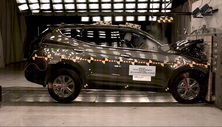
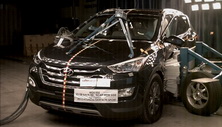
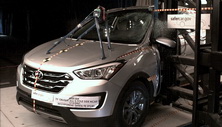
NHTSA crash tests
The agency crash-tested this model year itself. These are its own
photographs and star ratings.
Frontal crash test
Side barrier crash test
Side pole crash test
Photographs taken by NHTSA during its own New Car Assessment Program crash
tests of this model year. Public domain.
Configuration
Overall
Front
Side
Rollover
2014 Hyundai Santa Fe Sport SUV FWD
15.1% risk
2014 Hyundai Santa Fe Sport SUV AWD
14.3% risk
When owners complained
A spike years after the car went on sale usually means a part wearing
out on schedule across the whole fleet — the kind of pattern no single
owner can see from inside their own car.
Jun 2017peak 10Aug 2026
NHTSA investigations into the 2014 Hyundai Santa FE Sport
An investigation is the step before a recall: the agency has seen enough
complaints to look into a pattern itself. An open one means it thinks
something may be wrong and nothing has been fixed yet.
The Office of Defects Investigation (ODI) has received eight Hyundai Motor America (Hyundai) and eight Kia America, Inc. (Kia) Part 573 Recall Reports between 2016 and 2023. The combined 16 safety recalls all involve the antilock braking system (ABS) modules or Hydraulic Electronic Control Units (HECU) manufactured by the equipment supplier Mando. The Part 573 Recall Reports contain varying defect descriptions and differing remedy descriptions for the same or similar equipment supplied by Mando. Safety recalls included in this Audit Query (AQ) review include: Hyundai recalls 20V-520, 20V-543,...
DP22003Opened 12 Sep 2022Closed 12 Dec 2023ENGINE
Loss of Motive Power
The National Highway Traffic Safety Administration (NHTSA) received a letter dated July 13, 2022, petitioning the Agency to initiate a safety defect investigation into loss of motive power allegations attributed to oil drain pan assembly failures on certain Hyundai Motor America, Inc. and Kia America, Inc. vehicles spanning Model Years (MY) 2005-2021. The Petitioners cited examples of complaints indicating that the subject vehicles were experiencing rapid loss of engine oil due to oil drain plug back outs, resulting in loss of motive power and/or catastrophic engine damage. Additional complain...
EA21003Opened 22 Dec 2021Closed 5 Feb 2024ENGINE
Engine Fires
On March 29, 2019, the Office of Defects Investigation (ODI) opened two Preliminary Evaluations (PE19-003 on Hyundai and PE19-004 on Kia) to broadly investigate incidents of non-crash fires (regardless of origin or operational status of the vehicle) on various model year Hyundai and Kia vehicles. During the PE investigations, Hyundai and Kia issued several recalls to address vehicle fires, including those due to engine failures involving various engine types. The remedies for the engine failure recalls typically involve engine inspection (to detect existing damage), and if necessary, engine...
PE19003Opened 29 Mar 2019Closed 22 Dec 2021ELECTRICAL SYSTEM:12V/24V/48V BATTERY:CABLES
Non-crash Vehicle Fires
During this Preliminary Evaluation (PE), the Office of Defects Investigation (ODI) assessed the scope, frequency and potential safety-related consequences of non-crash vehicle fires caused by both engine failures and failures of other vehicle systems/components in model year (MY) 2011-2014 Hyundai Sonata and Santa Fe vehicles equipped with Theta II and Lambda II engines (approximately 1.3 million vehicles). ODI also reviewed field data of other Hyundai vehicles equipped with Theta II, Gamma, Nu and Lambda engines (approximately 4.8 million). As a result of this PE, Hyundai has issued NHTSA Rec...
DP18003Opened 21 Aug 2018Closed 10 May 2019ELECTRICAL SYSTEM:12V/24V/48V BATTERY:CABLES
Non-crash Vehicle Fires
In a letter dated June 11, 2018, the Center for Auto Safety (CAS) petitioned the National Highway Traffic Safety Administration (NHTSA) to initiate a safety defect investigation into non-collision related fires on model year (MY) 2011-2014 Kia Optima and Sorento, and Hyundai Sonata and Santa Fe vehicles. In a letter dated July 24, 2018, CAS requested that MY 2010-2015 Kia Soul vehicles be added to the petition. CAS stated that there is a higher number of complaints to NHTSA regarding non-crash fires on these vehicles compared to other similar vehicles. The Office of Defects Investigation (ODI)...
Recalls on the 2014 Hyundai Santa FE Sport
A complaint is one owner's allegation. A recall is the point at which
the manufacturer or a regulator agreed the defect is real and dangerous
enough to fix for free — however old the car is.
United States — NHTSA
21V303000
SERVICE BRAKES, HYDRAULIC:ANTILOCK/TRACTION CONTROL/ELECTRONIC LIMITED SLIP:CONTROL UNIT/MODULE
Hyundai Motor America (Hyundai) is recalling certain 2013-2015 Santa Fe Sport vehicles. Brake fluid may leak inside the Anti-lock Brake System (ABS) module, possibly resulting in an electrical short.
Risk: An electrical short in the ABS module can increase the risk of an engine compartment fire while parked or driving.
20V520000
SERVICE BRAKES, HYDRAULIC:ANTILOCK/TRACTION CONTROL/ELECTRONIC LIMITED SLIP:CONTROL UNIT/MODULE
Hyundai Motor America (Hyundai) is recalling certain 2013-2015 Santa Fe Sport vehicles. Brake fluid may leak inside the Anti-lock Brake System (ABS) module, possibly resulting in an electrical short.
Risk: If the ABS module short circuits, there is an increased risk of an engine compartment fire.
18V934000
ENGINE
Hyundai Motor America (Hyundai) is recalling certain 2011-2014 Sonata and 2013-2014 Santa Fe Sport vehicles previously repaired under recall numbers 15V-568 and 17V-226. The high pressure fuel pipe that connects to the fuel pump outlet may have been damaged, misaligned, or improperly torqued during the engine replacement procedure, allowing fuel to leak from the pipe.
Risk: A fuel leak in the presence of an ignition source can increase the risk of a fire.
17V358000
LATCHES/LOCKS/LINKAGES:HOOD:LATCH
Hyundai Motor America (Hyundai) is recalling certain 2013-2017 Santa Fe and Santa Fe Sport vehicles. In the affected vehicles, the secondary hood latch actuating cable may corrode and bind, causing the secondary hood latch to remain in the unlatched position when the hood is closed.
Risk: If the hood is not securely closed or the primary latch is inadvertently released and the secondary latch is not engaged, the hood could unexpectedly open while driving, increasing the risk of a vehicle crash.
17V226000
ENGINE AND ENGINE COOLING:ENGINE
Hyundai Motor America (Hyundai) is recalling certain 2013-2014 Sonata and Santa Fe Sport vehicles. Machining errors during the engine manufacturing process may cause premature bearing wear within the engine.
Risk: Bearing wear may result in the engine seizing, increasing the risk of a crash.
Canada — Transport Canada
Canada runs its own recall programme, and its campaigns do not
always mirror the American ones.
Recall 2024552824,695 units in Canada
Label
Issue: On certain vehicles, the compliance label may be missing information in French. The words listed on the label for "Tires", "Rims", "Front" and "Rear" appear in English only, when they should be listed as "Tires/Pneus", "Rims/Jantes", "Front/Avant" and "Rear/Arriere". Canadian regulations require this information to be listed on the label in both English and French. Safety Risk: These small errors do not affect vehicle safety. Corrective Actions: This is not a recall. The company has corrected the compliance label for all new vehicles.
Recall 202265984,034 units in Canada
Electrical
Issue: On certain vehicles, the rear parking assist sensors (mounted in the rear bumper) could short circuit. Note: This recall replaces Transport Canada recall 2022-118. Vehicles that were already repaired under Hyundai recall R0212 don't require this repair. Safety Risk: A short circuit could create a fire risk. Corrective Actions: Hyundai will notify owners by mail and instruct you to bring your vehicle to a dealership to replace the rear parking assist sensor fuse and any defective sensors. Hyundai recommends that if the instrument cluster does not work, the transmission shifter is stuck in park, or if you see melted plastic on the rear bumper, you should park the vehicle outside and contact a Hyundai dealer.
Recall 202211830,840 units in Canada
Accessories
This recall was replaced by Transport Canada Recall No. 2022-659. Issue: On certain vehicles, the rear parking assist sensors (mounted in the rear bumper) could short circuit. Note: Vehicles repaired under Hyundai recall R0078 (Transport Canada Recall No. 2013-067) also require this repair. Safety Risk: A short circuit could create a fire risk. Corrective Actions: Hyundai will notify owners by mail and instruct you to bring your vehicle to a dealership to replace the rear parking assist sensor fuse and any defective sensors. Hyundai recommends that if the instrument cluster does not work, the transmission shifter is stuck in park, or if you see melted plastic on the rear bumper, you should park the vehicle outside and contact a Hyundai dealer.
Recall 202125352,304 units in Canada
Brakes
Issue: On certain vehicles, brake fluid can enter the brake Hydraulic Electronic Control Unit (HECU) and cause a short circuit. Note: This recall replaces R0172 (Transport Canada recall 2020-410). Vehicles that were repaired under that recall also require this repair. Safety Risk: A short circuit could create a fire risk. Corrective Actions: Hyundai will notify owners by mail and instruct you to take your vehicle to a dealer to have the HECU inspected and replaced if necessary. The dealer will also replace the ABS multi-fuse. Hyundai recommends that you should park your vehicle outdoors, and away from other vehicles or structures until the recall repairs have been completed.
Recall 202041052,304 units in Canada
Brakes
This recall was replaced by Transport Canada Recall No. 2021-253. Issue: On certain vehicles, brake fluid can enter the brake Hydraulic Electronic Control Unit (HECU) and cause a short circuit. Note: This problem may cause the ABS warning light to turn on. Safety Risk: A short circuit could create a fire risk. Corrective Actions: Hyundai will notify owners by mail and instruct you to take your vehicle to a dealer to have the HECU inspected and replaced if necessary. Hyundai recommends that you should park your vehicle outdoors, and away from other vehicles or structures until the recall repairs have been completed.
Recall 202009129,959 units in Canada
Electrical
Issue: Certain vehicles may be equipped with an accessory trailer wiring harness kit that could fail. Over time, moisture could enter the control module and cause a short circuit. Note: This recall only affects Hyundai Genuine Accessory trailer wiring harness kits that were manufactured by third parties and sold in Canada. These kits may have been ordered at the time of a vehicle purchase, or purchased separately from a dealer as an aftermarket accessory. Safety Risk: A short circuit could create a fire risk. This risk remains even when the vehicle is parked. Corrective Actions: Hyundai will notify owners by mail and instruct you to inspect your vehicle to see if it has an affected trailer wiring harness installed. If it does, Hyundai will advise you to take your vehicle to a dealer to install a redesigned trailer wiring harness. Hyundai recommends that you should park your vehicle outdoors, and away from other vehicles or structures until the recall repairs have been completed.
Recall 2019640275,533 units in Canada
Engine
Issue: Hyundai Auto Canada is conducting a Product Improvement Campaign that provides an update to the engine control module to detect potential problems before an engine fails. An engine failure would cause a sudden loss of power with an inability to restart. Note: This affects Sonata and Santa Fe Sport equipped with a 2.4 L GDI or 2.0 L Turbo GDI engine, as well as Tucson equipped with a 2.4 L GDI engine. Safety Risk: A sudden loss of engine power could increase the risk of an accident. Corrective Actions: The company will notify owners by mail. Owners will be instructed to take their vehicle to a dealer to update the software for the engine control module. Note: Vehicles previously repaired under Product Improvement Campaign R0153 (TC # 2019-130) do not require this software update. Owners can find additional information at <a href="http://www.hyundaiengineinfo.ca">www.hyundaiengineinfo.ca</a>.
Recall 20194205,327 units in Canada
Other
Issue: This recall is for aftermarket replacement rear window glass produced by Vitro Automotriz. Certain rear window glass may not have been properly tempered. If the window breaks, the glass may separate into large pieces instead of very small ones. Note: This is a voluntary recall that is not being conducted under the requirements of the Motor Vehicle Safety Act. Safety Risk: Glass that breaks in to large pieces could create a risk of injury. Corrective Actions: The company will notify consumers by mail and instruct them to inspect the designation code marked on the rear window glass. Products affected by this recall have the designation “DOT 287” along with the lettering “VMR” (Replacement Market) and a date code that is before July 2019. This information is printed on the bottom corner of the glass. Consumers should contact Vitro's customer service at 1-412-995-6457 or [email protected] to arrange for replacement of the glass.
Reports where the owner recorded a crash, a fire, an injury or a death.
Anchorage, AKFire
ELECTRICAL SYSTEM
On June 20, 2026, while the 2014 Hyundai Santa Fe Sport was being driven on Richardson Highway near Mile 155 in Alaska, smoke and flames developed from the engine compartment without any collision. The driver stopped and both occupants exited before the vehicle became fully engulfed. The fire created an immediate risk of serious injury or death and blocked the northbound lane. There were no known prior drivability problems, warning lamps, or other symptoms before the incident. The exact failed component is UNKNOWN. Potential areas requiring investigation include the engine, electrical system, ABS/HECU brake module, multi-fuse, fuel system, and other engine-compartment components. Alaska Department of Public Safety responded. Its report states that there was no obvious cause, but that the fire appeared to have originated in the engine compartment. The vehicle was towed and preserved for the manufacturer. Hyundai inspected the vehicle and confirmed that the inspection was completed on July 11, 2026. Hyundai later stated orally that it did not find an engine defect, but it has not provided the complete inspection report, testing methods, photographs, technical findings, or a written origin-and-cause determination. Hyundai has not explained whether the ABS/HECU, electrical system, multi-fuse, fuel system, or other potential fire sources were separately examined. The vehicle sustained catastrophic damage and was a total loss. Both occupants escaped, but experienced severe ongoing psychological distress after the fire. I request that NHTSA evaluate whether the fire involved an engine, electrical, ABS/HECU, fuel-system, recall-remedy, or other safety defect. The vehicle was available for Hyundai's inspection. Its current availability for further inspection is UNKNOWN. The vehicle remains preserved and is currently available for further inspection upon request.
NHTSA complaint #11753388 — an unverified report by a vehicle owner.
Anchorage, AKFire
ENGINE
On June 20, 2026, while the 2014 Hyundai Santa Fe Sport was being driven on Richardson Highway near Mile 155 in Alaska, smoke and flames developed from the engine compartment without any collision. The driver stopped and both occupants exited before the vehicle became fully engulfed. The fire created an immediate risk of serious injury or death and blocked the northbound lane. There were no known prior drivability problems, warning lamps, or other symptoms before the incident. The exact failed component is UNKNOWN. Potential areas requiring investigation include the engine, electrical system, ABS/HECU brake module, multi-fuse, fuel system, and other engine-compartment components. Alaska Department of Public Safety responded. Its report states that there was no obvious cause, but that the fire appeared to have originated in the engine compartment. The vehicle was towed and preserved for the manufacturer. Hyundai inspected the vehicle and confirmed that the inspection was completed on July 11, 2026. Hyundai later stated orally that it did not find an engine defect, but it has not provided the complete inspection report, testing methods, photographs, technical findings, or a written origin-and-cause determination. Hyundai has not explained whether the ABS/HECU, electrical system, multi-fuse, fuel system, or other potential fire sources were separately examined. The vehicle sustained catastrophic damage and was a total loss. Both occupants escaped, but experienced severe ongoing psychological distress after the fire. I request that NHTSA evaluate whether the fire involved an engine, electrical, ABS/HECU, fuel-system, recall-remedy, or other safety defect. The vehicle was available for Hyundai's inspection. Its current availability for further inspection is UNKNOWN. The vehicle remains preserved and is currently available for further inspection upon request.
NHTSA complaint #11753388 — an unverified report by a vehicle owner.
Anchorage, AKFire
SERVICE BRAKES
On June 20, 2026, while the 2014 Hyundai Santa Fe Sport was being driven on Richardson Highway near Mile 155 in Alaska, smoke and flames developed from the engine compartment without any collision. The driver stopped and both occupants exited before the vehicle became fully engulfed. The fire created an immediate risk of serious injury or death and blocked the northbound lane. There were no known prior drivability problems, warning lamps, or other symptoms before the incident. The exact failed component is UNKNOWN. Potential areas requiring investigation include the engine, electrical system, ABS/HECU brake module, multi-fuse, fuel system, and other engine-compartment components. Alaska Department of Public Safety responded. Its report states that there was no obvious cause, but that the fire appeared to have originated in the engine compartment. The vehicle was towed and preserved for the manufacturer. Hyundai inspected the vehicle and confirmed that the inspection was completed on July 11, 2026. Hyundai later stated orally that it did not find an engine defect, but it has not provided the complete inspection report, testing methods, photographs, technical findings, or a written origin-and-cause determination. Hyundai has not explained whether the ABS/HECU, electrical system, multi-fuse, fuel system, or other potential fire sources were separately examined. The vehicle sustained catastrophic damage and was a total loss. Both occupants escaped, but experienced severe ongoing psychological distress after the fire. I request that NHTSA evaluate whether the fire involved an engine, electrical, ABS/HECU, fuel-system, recall-remedy, or other safety defect. The vehicle was available for Hyundai's inspection. Its current availability for further inspection is UNKNOWN. The vehicle remains preserved and is currently available for further inspection upon request.
NHTSA complaint #11753388 — an unverified report by a vehicle owner.
East Hartford, CTFire
UNKNOWN OR OTHER
While driving west across [XXX] , towing a 5x8 enclosed trailer, there was a smell of burnt rubber and I pulled over to inspect for a busted tire. At no time were there indicator lights on the dash. Upon bringing the vehicle to a stop on the side of the road the cabin began to fill with smoke. I popped the hood of the car with the intention of looking to see what was occurring. Exiting the vehicle and coming around to the front there were already flames coming out from under the hood. Within 10 minutes the car and trailer were engulfed in flames and have been deemed total losses by insurance. I had the vehicle serviced two days prior in Columbus Ohio and was cleared for the 4 day journey. I had the brakes done in 4 months prior in [XXX] . Had no issues getting to Columbus, no problems driving to Kansas City. INFORMATION REDACTED PURSUANT TO THE FREEDOM OF INFORMATION ACT (FOIA), 5 U.S.C. 552(B)(6)
NHTSA complaint #11729308 — an unverified report by a vehicle owner.
Madison, WIFire
ELECTRICAL SYSTEM
What happened: While driving in Montana on September 21, 2025, the cabin suddenly filled with gasoline fumes and the accelerator pedal stopped responding. After pulling over, flames erupted from under the hood and the vehicle was completely destroyed within minutes. The passenger-side door could not be opened from the inside at first, delaying escape and creating a serious safety risk. No warning lights or messages appeared before or during the fire. (1) While driving, gasoline suddenly filled the cabin and the accelerator pedal stopped responding. Within seconds, the vehicle caught fire. The cause appears related to the fuel system, and possibly the ABS module. The vehicle was completely destroyed but remains available for inspection in a private tow lot. (2) The fire spread extremely quickly. Both occupants were nearly trapped inside when the passenger-side door would not open from the inside, delaying escape. The vehicle burned on the shoulder of a busy highway in Montana, posing danger to us and to surrounding motorists. (3) Not after this fire, but a similar problem occurred in 2023 when gasoline filled the cabin and caused the engine to stall. At that time, Hyundai replaced the engine under warranty. (4) No. The vehicle has not yet been inspected by the manufacturer, police, or insurance. It is secured in a private tow lot and is available for inspection. (5) No. There were no warnings at all before or during the failure. Even as gasoline filled the cabin and the vehicle caught fire, the check engine light stayed off and no alerts appeared. INFORMATION REDACTED PURSUANT TO THE FREEDOM OF INFORMATION ACT (FOIA), 5 U.S.C. 552(B)(6)
NHTSA complaint #11690004 — an unverified report by a vehicle owner.
Madison, WIFire
ENGINE
What happened: While driving in Montana on September 21, 2025, the cabin suddenly filled with gasoline fumes and the accelerator pedal stopped responding. After pulling over, flames erupted from under the hood and the vehicle was completely destroyed within minutes. The passenger-side door could not be opened from the inside at first, delaying escape and creating a serious safety risk. No warning lights or messages appeared before or during the fire. (1) While driving, gasoline suddenly filled the cabin and the accelerator pedal stopped responding. Within seconds, the vehicle caught fire. The cause appears related to the fuel system, and possibly the ABS module. The vehicle was completely destroyed but remains available for inspection in a private tow lot. (2) The fire spread extremely quickly. Both occupants were nearly trapped inside when the passenger-side door would not open from the inside, delaying escape. The vehicle burned on the shoulder of a busy highway in Montana, posing danger to us and to surrounding motorists. (3) Not after this fire, but a similar problem occurred in 2023 when gasoline filled the cabin and caused the engine to stall. At that time, Hyundai replaced the engine under warranty. (4) No. The vehicle has not yet been inspected by the manufacturer, police, or insurance. It is secured in a private tow lot and is available for inspection. (5) No. There were no warnings at all before or during the failure. Even as gasoline filled the cabin and the vehicle caught fire, the check engine light stayed off and no alerts appeared. INFORMATION REDACTED PURSUANT TO THE FREEDOM OF INFORMATION ACT (FOIA), 5 U.S.C. 552(B)(6)
NHTSA complaint #11690004 — an unverified report by a vehicle owner.
The most recent complaints
In the owners' own words, exactly as filed with NHTSA.
at 89,687 milesVista, CA
ENGINE
The contact owns a 2014 Hyundai Santa FE. The contact stated that while driving the vehicle at 60 mph the vehicle began to shake violently, and the engine experienced a complete loss of automotive power, the service vehicle soon, ABS and check engine warning lights were illuminated. The contact veered off an exit into the parking lot of an AutoZone where a diagnostic scanner displayed the code "P0302". The vehicle was towed to an independent mechanic where it was diagnosed, and the contact was advised that the exhaust valve on cylinder two had dissolved and needed to be replaced. The vehicle was towed to a local Hyundai dealer where it was diagnosed, and the contact was advised that the exhaust valve in cylinder two was faulty and needed to be replaced. The vehicle was not repaired. The manufacturer was notified of the failure. The failure mileage was 89,687.
NHTSA complaint #11757038 — an unverified report by a vehicle owner.
Anchorage, AKFire
ELECTRICAL SYSTEM
On June 20, 2026, while the 2014 Hyundai Santa Fe Sport was being driven on Richardson Highway near Mile 155 in Alaska, smoke and flames developed from the engine compartment without any collision. The driver stopped and both occupants exited before the vehicle became fully engulfed. The fire created an immediate risk of serious injury or death and blocked the northbound lane. There were no known prior drivability problems, warning lamps, or other symptoms before the incident. The exact failed component is UNKNOWN. Potential areas requiring investigation include the engine, electrical system, ABS/HECU brake module, multi-fuse, fuel system, and other engine-compartment components. Alaska Department of Public Safety responded. Its report states that there was no obvious cause, but that the fire appeared to have originated in the engine compartment. The vehicle was towed and preserved for the manufacturer. Hyundai inspected the vehicle and confirmed that the inspection was completed on July 11, 2026. Hyundai later stated orally that it did not find an engine defect, but it has not provided the complete inspection report, testing methods, photographs, technical findings, or a written origin-and-cause determination. Hyundai has not explained whether the ABS/HECU, electrical system, multi-fuse, fuel system, or other potential fire sources were separately examined. The vehicle sustained catastrophic damage and was a total loss. Both occupants escaped, but experienced severe ongoing psychological distress after the fire. I request that NHTSA evaluate whether the fire involved an engine, electrical, ABS/HECU, fuel-system, recall-remedy, or other safety defect. The vehicle was available for Hyundai's inspection. Its current availability for further inspection is UNKNOWN. The vehicle remains preserved and is currently available for further inspection upon request.
NHTSA complaint #11753388 — an unverified report by a vehicle owner.
Anchorage, AKFire
ENGINE
On June 20, 2026, while the 2014 Hyundai Santa Fe Sport was being driven on Richardson Highway near Mile 155 in Alaska, smoke and flames developed from the engine compartment without any collision. The driver stopped and both occupants exited before the vehicle became fully engulfed. The fire created an immediate risk of serious injury or death and blocked the northbound lane. There were no known prior drivability problems, warning lamps, or other symptoms before the incident. The exact failed component is UNKNOWN. Potential areas requiring investigation include the engine, electrical system, ABS/HECU brake module, multi-fuse, fuel system, and other engine-compartment components. Alaska Department of Public Safety responded. Its report states that there was no obvious cause, but that the fire appeared to have originated in the engine compartment. The vehicle was towed and preserved for the manufacturer. Hyundai inspected the vehicle and confirmed that the inspection was completed on July 11, 2026. Hyundai later stated orally that it did not find an engine defect, but it has not provided the complete inspection report, testing methods, photographs, technical findings, or a written origin-and-cause determination. Hyundai has not explained whether the ABS/HECU, electrical system, multi-fuse, fuel system, or other potential fire sources were separately examined. The vehicle sustained catastrophic damage and was a total loss. Both occupants escaped, but experienced severe ongoing psychological distress after the fire. I request that NHTSA evaluate whether the fire involved an engine, electrical, ABS/HECU, fuel-system, recall-remedy, or other safety defect. The vehicle was available for Hyundai's inspection. Its current availability for further inspection is UNKNOWN. The vehicle remains preserved and is currently available for further inspection upon request.
NHTSA complaint #11753388 — an unverified report by a vehicle owner.
Anchorage, AKFire
SERVICE BRAKES
On June 20, 2026, while the 2014 Hyundai Santa Fe Sport was being driven on Richardson Highway near Mile 155 in Alaska, smoke and flames developed from the engine compartment without any collision. The driver stopped and both occupants exited before the vehicle became fully engulfed. The fire created an immediate risk of serious injury or death and blocked the northbound lane. There were no known prior drivability problems, warning lamps, or other symptoms before the incident. The exact failed component is UNKNOWN. Potential areas requiring investigation include the engine, electrical system, ABS/HECU brake module, multi-fuse, fuel system, and other engine-compartment components. Alaska Department of Public Safety responded. Its report states that there was no obvious cause, but that the fire appeared to have originated in the engine compartment. The vehicle was towed and preserved for the manufacturer. Hyundai inspected the vehicle and confirmed that the inspection was completed on July 11, 2026. Hyundai later stated orally that it did not find an engine defect, but it has not provided the complete inspection report, testing methods, photographs, technical findings, or a written origin-and-cause determination. Hyundai has not explained whether the ABS/HECU, electrical system, multi-fuse, fuel system, or other potential fire sources were separately examined. The vehicle sustained catastrophic damage and was a total loss. Both occupants escaped, but experienced severe ongoing psychological distress after the fire. I request that NHTSA evaluate whether the fire involved an engine, electrical, ABS/HECU, fuel-system, recall-remedy, or other safety defect. The vehicle was available for Hyundai's inspection. Its current availability for further inspection is UNKNOWN. The vehicle remains preserved and is currently available for further inspection upon request.
NHTSA complaint #11753388 — an unverified report by a vehicle owner.
Birmingham, AL
ELECTRICAL SYSTEM
*"I am filing a complaint against Hallmark Hyundai in [XXX] regarding an active safety recall on my vehicle's ABS (Anti-lock Braking System) module.My vehicle was brought to the dealership on XXX. As of today, XXX, the dealership has held my car for 27 days without completing the safety remedy. The dealership continues to give me conflicting stories, refuses to provide an expected repair date, and is denying me manufacturer-funded alternative transportation while my vehicle is grounded for this safety defect.I am reporting this because the dealership is failing to provide a timely remedy for a critical braking safety hazard, leaving me without a safe vehicle." The warning lights came on on XXX every light on my dash is flashing. Hallmark Hyundai inspected my vehicle and said it was the abs module I have been without transportation for a whole month with no answers on when my car will be ready for pick. The advisor Devita keep telling me lie after lie I need my car immediately no way it takes a whole month to fix a recall repair I need my car I have lost my job due to this I’ve missed important dr appointments do to my car being held for a month with no answers INFORMATION REDACTED PURSUANT TO THE FREEDOM OF INFORMATION ACT (FOIA), 5 U.S.C. 552(B)(6)
NHTSA complaint #11751694 — an unverified report by a vehicle owner.
Moncks Corner, SC
UNKNOWN OR OTHER
Both front doors stopped opening cant get in the vehicle or out of the vehicle from the front doors. Both stopped working within two weeks. The locks unlock and lock but the doors will not open. Hyundai dealership wants 8,000 dollars to replace Both door panels. This is a safety issue. If I get stuck inside the car and cant get out
NHTSA complaint #11751278 — an unverified report by a vehicle owner.
at 120,577 milesSilver Spring, MD
ENGINE AND ENGINE COOLING
The contact owns a 2014 Hyundai Santa Fe Sport. The contact stated that while driving at undisclosed speeds, the vehicle started to lose power while depressing the accelerator pedal, with black smoke coming from the engine compartment. The oil, check engine, and battery warning lights were displayed on the instrument panel. The contact pulled over and discovered black smoke coming from under the hood. Due to the failure, the vehicle was towed to an independent mechanic, and the engine was replaced. Two weeks after the replacement, the starter failed to operate as needed, and the vehicle was towed back to the independent mechanic, where the starter was replaced. Upon investigation, the mechanic discovered NHTSA Campaign Number: 17V226000 (ENGINE AND ENGINE COOLING); and associated the vehicle with the recall. The contact was referred to the NHTSA Hotline to report the failure. The vehicle remained with the independent mechanic and was not repaired. The manufacturer was not notified of the failure. The failure mileage was 120,577.
NHTSA complaint #11750844 — an unverified report by a vehicle owner.
Broken Arrow, OK
VEHICLE SPEED CONTROL
I am reporting a severe safety failure on my 2014 Hyundai Santa Fe Sport that perfectly matches the safety defect described in Recall 21V-303 / Campaign 205. This happened even though I had the dealer perform the official recall fuse fix back in 2024. The problem started after I left the car parked for about 3 to 4 hours. When I came back, I heard a motor (not the motor) loudly running under the hood even though the ignition was completely off. It stayed on even after starting and turning the car off. The battery in the vehicle had drained so bad it was deemed bad when hooked up to a tester at the auto parts store. After getting a new battery and trying to drive the car, the electrical system went haywire. The dashboard lit up with every brake warning light on, the speedometer stopped working, miles to empty being erratic, and the exterior rear brake lights kept flickering erratically after the car was turned off. The steering was acting abnormal and unnatural, not crisp and easy to turn as usual. There were absolutely no warning lights or symptoms before I parked the vehicle. I had it towed to my local Hyundai dealership, and their diagnostic scan confirmed major brake and chassis issues, specifically code C2402 for an ABS Pump Motor Circuit Malfunction and codes C1200, C1203, and C1206 for a loss of wheel speed data. The vehicle has not been inspected by police or insurance representatives, but it is currently sitting at the dealership waiting for a resolution from a Hyundai customer care case manager. The 2024 recall remedy only involved dropping the fuse amperage to mitigate fire intensity; it did not replace the module housing or prevent the internal brake fluid leak from eventually destroying the system. The defect has seemingly now fully manifested, knocking out primary braking indicators and power steering assist, presenting an ongoing safety and fire hazard while driving and parked.
NHTSA complaint #11749195 — an unverified report by a vehicle owner.
Broken Arrow, OK
ELECTRICAL SYSTEM
I am reporting a severe safety failure on my 2014 Hyundai Santa Fe Sport that perfectly matches the safety defect described in Recall 21V-303 / Campaign 205. This happened even though I had the dealer perform the official recall fuse fix back in 2024. The problem started after I left the car parked for about 3 to 4 hours. When I came back, I heard a motor (not the motor) loudly running under the hood even though the ignition was completely off. It stayed on even after starting and turning the car off. The battery in the vehicle had drained so bad it was deemed bad when hooked up to a tester at the auto parts store. After getting a new battery and trying to drive the car, the electrical system went haywire. The dashboard lit up with every brake warning light on, the speedometer stopped working, miles to empty being erratic, and the exterior rear brake lights kept flickering erratically after the car was turned off. The steering was acting abnormal and unnatural, not crisp and easy to turn as usual. There were absolutely no warning lights or symptoms before I parked the vehicle. I had it towed to my local Hyundai dealership, and their diagnostic scan confirmed major brake and chassis issues, specifically code C2402 for an ABS Pump Motor Circuit Malfunction and codes C1200, C1203, and C1206 for a loss of wheel speed data. The vehicle has not been inspected by police or insurance representatives, but it is currently sitting at the dealership waiting for a resolution from a Hyundai customer care case manager. The 2024 recall remedy only involved dropping the fuse amperage to mitigate fire intensity; it did not replace the module housing or prevent the internal brake fluid leak from eventually destroying the system. The defect has seemingly now fully manifested, knocking out primary braking indicators and power steering assist, presenting an ongoing safety and fire hazard while driving and parked.
NHTSA complaint #11749195 — an unverified report by a vehicle owner.
Broken Arrow, OK
SERVICE BRAKES
I am reporting a severe safety failure on my 2014 Hyundai Santa Fe Sport that perfectly matches the safety defect described in Recall 21V-303 / Campaign 205. This happened even though I had the dealer perform the official recall fuse fix back in 2024. The problem started after I left the car parked for about 3 to 4 hours. When I came back, I heard a motor (not the motor) loudly running under the hood even though the ignition was completely off. It stayed on even after starting and turning the car off. The battery in the vehicle had drained so bad it was deemed bad when hooked up to a tester at the auto parts store. After getting a new battery and trying to drive the car, the electrical system went haywire. The dashboard lit up with every brake warning light on, the speedometer stopped working, miles to empty being erratic, and the exterior rear brake lights kept flickering erratically after the car was turned off. The steering was acting abnormal and unnatural, not crisp and easy to turn as usual. There were absolutely no warning lights or symptoms before I parked the vehicle. I had it towed to my local Hyundai dealership, and their diagnostic scan confirmed major brake and chassis issues, specifically code C2402 for an ABS Pump Motor Circuit Malfunction and codes C1200, C1203, and C1206 for a loss of wheel speed data. The vehicle has not been inspected by police or insurance representatives, but it is currently sitting at the dealership waiting for a resolution from a Hyundai customer care case manager. The 2024 recall remedy only involved dropping the fuse amperage to mitigate fire intensity; it did not replace the module housing or prevent the internal brake fluid leak from eventually destroying the system. The defect has seemingly now fully manifested, knocking out primary braking indicators and power steering assist, presenting an ongoing safety and fire hazard while driving and parked.
NHTSA complaint #11749195 — an unverified report by a vehicle owner.
Thornton, CO
ENGINE
On March 20, 2026, while driving, my 2014 Hyundai Santa Fe Sport (VIN: [XXX]) equipped with a Theta II 2.4L GDI engine, the car experienced a catastrophic, sudden loss of motive power. The engine suffered a total mechanical failure/seizure, creating an immediate highway safety hazard. This vehicle is part of the "In re: Hyundai and Kia Engine Litigation II" settlement population due to known factory manufacturing defects where residual metal debris blocks oil flow to the connecting rod bearings. Hyundai Corporate has issued a blanket refusal to honor the lifetime safety warranty extension, using an unverified allegation of "outside influence" to avoid executing the mandatory engine replacement protocols required under NHTSA Campaign T3G. INFORMATION REDACTED PURSUANT TO THE FREEDOM OF INFORMATION ACT (FOIA), 5 U.S.C. 552(B)(6)
NHTSA complaint #11748225 — an unverified report by a vehicle owner.
Patterson, NY
ENGINE
ID # 11746004. I accidentally entered the wrong incident date on my original submission. The correct date of the incident is June 17, 2026. Please update my file to reflect this correct timeline.
NHTSA complaint #11746944 — an unverified report by a vehicle owner.
Biddeford, ME
SERVICE BRAKES
: "Vehicle is currently grounded at Rowe Hyundai Westbrook in Westbrook, Maine. Dealer confirms HECU has an active electrical short matching Recall 205 (Campaign 21V303000) but refuses to replace the safety defect because it lacks an external fluid leak. The vehicle is unsafe to drive due to fire risk and brake hazard, and the manufacturer's agent is refusing the federal remedy."
NHTSA complaint #11746439 — an unverified report by a vehicle owner.
Patterson, NY
ENGINE
The engine failed completely and is currently available for inspection at my residence. While traveling on a family vacation at highway speeds, the engine suffered a catastrophic connecting-rod bearing failure and seized. This caused an immediate loss of motive power, braking assistance, and steering control, nearly resulting in a fatal multi-car collision with my child in the vehicle. Warning lights illuminated on the dashboard during the failure as a sudden metallic knocking sound occurred and the engine died. The vehicle became completely disabled and had to be limped off the highway and towed. The VIN has a completed Campaign 953 from September 2019 qualifying it for the Lifetime Warranty Extension under the Theta II settlement.
NHTSA complaint #11746004 — an unverified report by a vehicle owner.
Fort Pierce, FL
POWER TRAIN
Engine code p1326. The engine went into limp mode it was only able to drive about 15 miles then check engine light came popped on and the vehicle stopped and I had the get the vehicle towed. Yes Route 60 of Hyundai in Vero Beach was aware of the issue and also I took the vehicle to Hyundai in Fort pierce where they also was well aware of the engine issue. When I received a recall letter in the mail and brought my vehicle into Route 60 Hyundai of Vero Beach. My vehicle was also apart of the Theta 2 issue class act litigation.
NHTSA complaint #11738905 — an unverified report by a vehicle owner.
Fort Pierce, FL
ELECTRICAL SYSTEM
Engine code p1326. The engine went into limp mode it was only able to drive about 15 miles then check engine light came popped on and the vehicle stopped and I had the get the vehicle towed. Yes Route 60 of Hyundai in Vero Beach was aware of the issue and also I took the vehicle to Hyundai in Fort pierce where they also was well aware of the engine issue. When I received a recall letter in the mail and brought my vehicle into Route 60 Hyundai of Vero Beach. My vehicle was also apart of the Theta 2 issue class act litigation.
NHTSA complaint #11738905 — an unverified report by a vehicle owner.
Fort Pierce, FL
ENGINE
Engine code p1326. The engine went into limp mode it was only able to drive about 15 miles then check engine light came popped on and the vehicle stopped and I had the get the vehicle towed. Yes Route 60 of Hyundai in Vero Beach was aware of the issue and also I took the vehicle to Hyundai in Fort pierce where they also was well aware of the engine issue. When I received a recall letter in the mail and brought my vehicle into Route 60 Hyundai of Vero Beach. My vehicle was also apart of the Theta 2 issue class act litigation.
NHTSA complaint #11738905 — an unverified report by a vehicle owner.
Antigo, WI
POWER TRAIN
As I would be driving down the road, most of the time when getting up to speeds of either 25-30mph or 55-60mph is when the dash board lights up check BSD detection system failure, then it will rev out rpm’s to 5,000-6,000 then lose power to accelerator. I also notice on the dash board where the panel for your selected gear displays is blank and doesn’t show whether you are in park,drive neutral, ECT. After this occurs I can not drive it any longer until I safely stop the car (most of the time on a busy highway or country road Highway where once this happens it becomes dangerous due to the power loss in the accelerator) and put it in park, I’ve tried to put the vehicle in park, once fully stopped, and try to put it back into drive but the shifter is locked into park and will not let me shift the vehicle, I then have to shut the vehicle completely off and open the driver door to get the backup power cut off as-well to have zero power to the vehicle. Once that is completed I then Re-Start the vehicle where it operates normally again, this situation happens at least twice a week if not 3-4. It sometimes has put my passengers and myself at risk of getting into accidents or struck by other vehicle on the road. my vehicle is still under a warranty through the dealership I purchased it from, but when I ask them about it they say that because there is no prompt on the dash once I get there that they cannot do anything about it, nor do they allegedly know why it’s happening, I’ve asked a few other mechanics I know and they say that they have seen this malfunction before with this vehicle and usually it is a transmission sensor? Or a transmission speed sensor issue? I then relay this message back to the dealer ship and they still act like they don’t know what it is, I truly believe that the dealership just doesn’t want to deal with the issue and I only have 2-3000 miles left under their warranty, I do enjoy the vehicle and respect Hyundai for their great customer service.
NHTSA complaint #11738419 — an unverified report by a vehicle owner.
Antigo, WI
ELECTRICAL SYSTEM
As I would be driving down the road, most of the time when getting up to speeds of either 25-30mph or 55-60mph is when the dash board lights up check BSD detection system failure, then it will rev out rpm’s to 5,000-6,000 then lose power to accelerator. I also notice on the dash board where the panel for your selected gear displays is blank and doesn’t show whether you are in park,drive neutral, ECT. After this occurs I can not drive it any longer until I safely stop the car (most of the time on a busy highway or country road Highway where once this happens it becomes dangerous due to the power loss in the accelerator) and put it in park, I’ve tried to put the vehicle in park, once fully stopped, and try to put it back into drive but the shifter is locked into park and will not let me shift the vehicle, I then have to shut the vehicle completely off and open the driver door to get the backup power cut off as-well to have zero power to the vehicle. Once that is completed I then Re-Start the vehicle where it operates normally again, this situation happens at least twice a week if not 3-4. It sometimes has put my passengers and myself at risk of getting into accidents or struck by other vehicle on the road. my vehicle is still under a warranty through the dealership I purchased it from, but when I ask them about it they say that because there is no prompt on the dash once I get there that they cannot do anything about it, nor do they allegedly know why it’s happening, I’ve asked a few other mechanics I know and they say that they have seen this malfunction before with this vehicle and usually it is a transmission sensor? Or a transmission speed sensor issue? I then relay this message back to the dealer ship and they still act like they don’t know what it is, I truly believe that the dealership just doesn’t want to deal with the issue and I only have 2-3000 miles left under their warranty, I do enjoy the vehicle and respect Hyundai for their great customer service.
NHTSA complaint #11738419 — an unverified report by a vehicle owner.
Antigo, WI
LANE DEPARTURE: BLIND SPOT DETECTION
As I would be driving down the road, most of the time when getting up to speeds of either 25-30mph or 55-60mph is when the dash board lights up check BSD detection system failure, then it will rev out rpm’s to 5,000-6,000 then lose power to accelerator. I also notice on the dash board where the panel for your selected gear displays is blank and doesn’t show whether you are in park,drive neutral, ECT. After this occurs I can not drive it any longer until I safely stop the car (most of the time on a busy highway or country road Highway where once this happens it becomes dangerous due to the power loss in the accelerator) and put it in park, I’ve tried to put the vehicle in park, once fully stopped, and try to put it back into drive but the shifter is locked into park and will not let me shift the vehicle, I then have to shut the vehicle completely off and open the driver door to get the backup power cut off as-well to have zero power to the vehicle. Once that is completed I then Re-Start the vehicle where it operates normally again, this situation happens at least twice a week if not 3-4. It sometimes has put my passengers and myself at risk of getting into accidents or struck by other vehicle on the road. my vehicle is still under a warranty through the dealership I purchased it from, but when I ask them about it they say that because there is no prompt on the dash once I get there that they cannot do anything about it, nor do they allegedly know why it’s happening, I’ve asked a few other mechanics I know and they say that they have seen this malfunction before with this vehicle and usually it is a transmission sensor? Or a transmission speed sensor issue? I then relay this message back to the dealer ship and they still act like they don’t know what it is, I truly believe that the dealership just doesn’t want to deal with the issue and I only have 2-3000 miles left under their warranty, I do enjoy the vehicle and respect Hyundai for their great customer service.
NHTSA complaint #11738419 — an unverified report by a vehicle owner.
Manistee, MI
UNKNOWN OR OTHER
Car randomly dies. Constantly needing oil due to it leaking. Check engine light on
NHTSA complaint #11737489 — an unverified report by a vehicle owner.
Manistee, MI
FUEL/PROPULSION SYSTEM
Car randomly dies. Constantly needing oil due to it leaking. Check engine light on
NHTSA complaint #11737489 — an unverified report by a vehicle owner.
Jacksonville,, FL
UNKNOWN OR OTHER
Failure consistent with known recall defect (NHTSA Recall 17V226) involving premature bearing wear resulting in engine seizure and sudden loss of power while driving.
NHTSA complaint #11730941 — an unverified report by a vehicle owner.
Jacksonville,, FL
ENGINE
Failure consistent with known recall defect (NHTSA Recall 17V226) involving premature bearing wear resulting in engine seizure and sudden loss of power while driving.
NHTSA complaint #11730941 — an unverified report by a vehicle owner.
East Hartford, CTFire
UNKNOWN OR OTHER
While driving west across [XXX] , towing a 5x8 enclosed trailer, there was a smell of burnt rubber and I pulled over to inspect for a busted tire. At no time were there indicator lights on the dash. Upon bringing the vehicle to a stop on the side of the road the cabin began to fill with smoke. I popped the hood of the car with the intention of looking to see what was occurring. Exiting the vehicle and coming around to the front there were already flames coming out from under the hood. Within 10 minutes the car and trailer were engulfed in flames and have been deemed total losses by insurance. I had the vehicle serviced two days prior in Columbus Ohio and was cleared for the 4 day journey. I had the brakes done in 4 months prior in [XXX] . Had no issues getting to Columbus, no problems driving to Kansas City. INFORMATION REDACTED PURSUANT TO THE FREEDOM OF INFORMATION ACT (FOIA), 5 U.S.C. 552(B)(6)
NHTSA complaint #11729308 — an unverified report by a vehicle owner.