Owners have filed 73 complaints
about the 2016 Volkswagen Golf Sportwagen with NHTSA between 2018 and 2026.
The largest single group is the airbags.
Across this model's run it ranks 3 of 5 worst.
The letter says how bad. This says what kind — whether this year drew
an unusual number of complaints, unusually dangerous
ones, or failures that arrived unusually early.
The dashed ring is 50 — the national norm. Further out is worse.
Complaint volume — 75
Against the median year of the Volkswagen Golf Sportwagen. 50 means typical for this
model; 100 means roughly double.
Severity — 14
2.7% of these complaints
involved a crash, fire, injury or death, against a national rate of
9.7%.
Early failure — 44
26% of failures with a mileage on record happened under
36,000 miles, against a national rate of
29%.
How 2016 compares with every other Volkswagen Golf Sportwagen
Odometer readings owners gave when they filed. About half of all
complaints include one.
10,000 – 24,999 miles
512.8%
25,000 – 49,999 miles
1846.2%
50,000 – 74,999 miles
717.9%
75,000 – 99,999 miles
820.5%
100,000 – 149,999 miles
12.6%
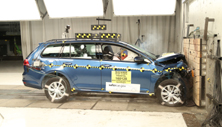
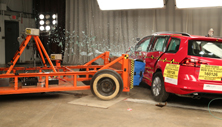
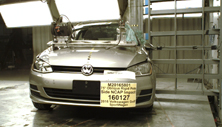
NHTSA crash tests
The agency crash-tested this model year itself. These are its own
photographs and star ratings.
Frontal crash test
Side barrier crash test
Side pole crash test
Photographs taken by NHTSA during its own New Car Assessment Program crash
tests of this model year. Public domain.
Configuration
Overall
Front
Side
Rollover
2016 Volkswagen Golf Sportwagen SW FWD
13.4% risk
When owners complained
A spike years after the car went on sale usually means a part wearing
out on schedule across the whole fleet — the kind of pattern no single
owner can see from inside their own car.
Apr 2018peak 5Aug 2026
Recalls on the 2016 Volkswagen Golf Sportwagen
A complaint is one owner's allegation. A recall is the point at which
the manufacturer or a regulator agreed the defect is real and dangerous
enough to fix for free — however old the car is.
United States — NHTSA
24V110000
FUEL SYSTEM, GASOLINE
Volkswagen Group of America, Inc. (Volkswagen) is recalling certain front-wheel drive 2015-2020 Audi A3 Sedan, 2015-2019 Audi A3 Cabriolet, 2019-2020 Volkswagen Jetta GLI, 2018 Golf Sportwagen GP, 2018-2019 Golf Sportwagen A7, 2015-2017 Golf Sportwagen, 2015-2020 Golf GTI, and 2015-2020 Golf A7 vehicles. Due to a problem with a suction jet pump seal inside the fuel tank, fuel may flow into the evaporative emissions (EVAP) system and possibly leak out of the charcoal canister.
Risk: A fuel leak in the presence of an ignition source increases the risk of a fire.
22V543000
AIR BAGS:FRONTAL:PASSENGER SIDE:INFLATOR MODULE
Volkswagen Group of America, Inc. (Volkswagen) is recalling certain 2016 Audi TT Roadster, TT Coupe, S3 Sedan, R8 Coupe, A3 Sedan, A3 Etron, A3 Cabriolet, 2016 Golf Sportwagen, Golf R, Golf GTI, Golf A7, and E Golf vehicles. During air bag deployment, the front passenger air bag may explode or deploy improperly.
Risk: An inflator explosion may result in sharp metal fragments striking occupants, resulting in serious injury or death. An improper air bag deployment may not properly restrain the occupant, increasing their risk of injury in a crash.
18V464000
STEERING:COLUMN LOCKING:ANTI-THEFT DEVICE
Volkswagen Group of America, Inc. (Volkswagen) is recalling certain 2015-2018 Volkswagen Golf and Golf Sportwagen vehicles. The build of silicate on the shift lever micro switch contacts may enable the key to be removed from the ignition while the vehicle shift lever is not in "Park." As such, these vehicles fail to comply with the requirements of Federal Motor Vehicle Safety Standard (FMVSS) number 114, "Theft Protection and Rollaway Prevention."
Risk: Removing the key while the shift lever is in a position other than "Park" increases the risk of an unintended vehicle rollaway that may result in personal injury or a crash.
Reports where the owner recorded a crash, a fire, an injury or a death.
Davenport, IACrash
AIR BAGS
1. I BELIEVE THE DRIVER'S SIDE AIRBAG MAY HAVE FAILED OR BEEN DISABLED DURING A RECENT COLLISION THAT OCCURRED ON 5/25/21. A DEER STRUCK THE FRONT END OF MY VEHICLE WHILE TRAVELING ON A 55MPH STATE HIGHWAY. THE VEHICLE IS CURRENTLY AT A COLLISION REPAIR SHOP GETTING AN ESTIMATE. THE SHERIFF'S DEPUTY WHO RESPONDED TO THE SCENE GAVE AN INITIAL DAMAGE ESTIMATE OF $9000.00. 2. IMMEDIATELY UPON IMPACT THE AIRBAG ERROR LIGHT ILLUMINATED BUT DID NOT DEPLOY. 3.ON 5/26/21, THE DAY AFTER MY ACCIDENT, I RECEIVED A WARRANTY EXTENSION NOTICE DUE TO A POTENTIAL CLOCK SPRING FAILURE THAT COULD RESULT IN THE DRIVER'S SIDE AIRBAG NOT DEPLOYING. 4. VEHICLE HAS BEEN INSPECTED BY SHERIFF'S DEPT AND IS CURRENTLY BE EVALUATED BY COLLISION SPECIALIST AND INSURANCE ADJUSTER. 5. THE AIRBAG ERROR LIGHT HAD NEVER ILLUMINATED PRIOR TO THE ACCIDENT.
NHTSA complaint #11418740 — an unverified report by a vehicle owner.
at 38,000 milesSimi Valley, CACrash
AIR BAGS
I WAS IN A VERY MINOR ACCIDENT INVOLVING ONLY THE FRONT END. I WAS A A COMPLETE STOP AT A TRAFFIC LIGHT AND HIT THE CAR DIRECTLY IN FRONT OF ME, I HIT THE CAR CAR GOING NO MORE THAN 10 MILES PER HOUR. ALL OF THE AIR BAGS DEPLOYED, DRIVER, PASSENGER, AS WELL AS FRONT AND BACK SIDE AIRBAGS. ADDITIONALLY, WHEN THE AIRBAGS DEPLOYED THE WINDSHIELD COMPLETELY SHATTERED ON THE PASSENGER SIDE. LUCKILY MY SON WAS NOT INJURED WITH THE EXTREME FORE OF THE AIRBAG DEPLOYMENT. I TOOK THE CAR FOR AN ESTIMATE AND JUST FOR THE INSIDE AIRBAG DAMAGE THE TOTAL WOULD BE $9,300. THIS WAS AN EXTREME SHOCK, NOT ONLY WHEN THE MINOR FENDER BENDER OCCURED BUT NOW THE CAR IS TOTALED BECAUSE OF THE AIRBAG DEPLOYMENT.IN THIS SITUATION THE AIRBAGS SHOULD NOT HAVE GONE OFF FOR SUCH A MINOR CRASH. I NEED THIS TO BE LOOKED INTO FOR OTHER PEOPLE'S SAFETY.
NHTSA complaint #11290772 — an unverified report by a vehicle owner.
The most recent complaints
In the owners' own words, exactly as filed with NHTSA.
Minneapolis, MN
AIR BAGS
SRS/airbag warning light illuminated. A diagnostic scan (VCDS) confirmed stored fault codes for both front airbag crash sensors: driver's side 'short to ground' and passenger's side 'open or short to plus.' Upon further inspection, water was found pooled at the airbag control module connector, located under the center dash. The AC condensate drain line is routed directly above this module, and appears to be the source of the water intrusion — water drained from the connector itself when disconnected, and dampness was present at both the upper and lower AC drain hose connections near the module. After drying and reconnecting all components, an attempt was made to clear the fault codes via VCDS. The airbag module returned a 'not acknowledged' response to the clear command, indicating the fault condition and/or internal component damage may still be present. This vehicle's VIN was checked against active airbag recalls for this model year and found not to be included. However, given the safety-critical nature of the SRS system and the apparent design proximity of the AC drain to the airbag module connector, this may represent a broader risk for this chassis. Multiple independent repair shops declined to service this issue, citing liability concerns related to airbag system water intrusion. Volkswagen customer service denied a goodwill repair request, citing vehicle age/mileage without reviewing supporting documentation (VCDS diagnostic report and photos).
NHTSA complaint #11754963 — an unverified report by a vehicle owner.
Atlanta, GA
ENGINE
Junction between thermostat and water pump failed leading to total loss of coolant. At the time I was driving north on I-75 in heavy morning traffic at 65 MPH. I was able to steer the vehicle off the road without hitting anyone or coming to a complete stop. Had the vehicle towed to Jim Ellis VW of Kennesaw where they diagnosed the problem and replaced the water pump. The car had 18,762 miles on it at the time. Mechanic stated that the problem was oil from cam covers leaking onto water pump and was frequently seen. Vehicle had low coolant warning lights twice and I added several ounces of distilled water each time. Car had an engine warning light and was being taken to dealer for service that day. When the incident happened, there was an audible alarm for loss of coolant and a flashing yellow light on the dashboard. The car had been serviced and inspected at the dealership annually, there had been no reports of leaking oil from cam covers. There was no indication the water pump would catastrophically fail. The waterpump should not fail with this few miles on it. .
NHTSA complaint #11702007 — an unverified report by a vehicle owner.
Glendale, CA
UNKNOWN OR OTHER
The fuel pump on my 2016 Volkswagen Golf SportWagen failed approximately three months after a safety recall repair for the suction jet pump (recall 20Y6). My independent mechanic explained that failure of the suction jet pump can cause fuel leakage or vapor transfer into the EVAP system, which may create pressure or vacuum imbalance inside the fuel tank. This can potentially damage other fuel-system components, including the fuel pump. My vehicle had no prior fuel-system issues. After the recall repair, the vehicle began experiencing symptoms consistent with fuel delivery problems, and the fuel pump ultimately failed. The mechanic who performed the repair noted that the failure was “highly likely related” to the suction-jet-pump defect because of the short time between the recall repair and the component failure. Volkswagen’s customer-service team stated that the fuel pump and suction jet pump are “unrelated,” but did not provide a technical explanation for that conclusion. Because both components interact within the sealed fuel/EVAP system, I am concerned that the recall defect or repair may have contributed to the fuel-pump failure. This problem may indicate a pattern of post-recall fuel-system failures involving suction-jet-pump malfunction, tank pressure changes, or collateral damage to in-tank components. I am submitting this report so NHTSA can review whether similar issues are occurring in other vehicles.
NHTSA complaint #11699966 — an unverified report by a vehicle owner.
Glendale, CA
ENGINE
The fuel pump on my 2016 Volkswagen Golf SportWagen failed approximately three months after a safety recall repair for the suction jet pump (recall 20Y6). My independent mechanic explained that failure of the suction jet pump can cause fuel leakage or vapor transfer into the EVAP system, which may create pressure or vacuum imbalance inside the fuel tank. This can potentially damage other fuel-system components, including the fuel pump. My vehicle had no prior fuel-system issues. After the recall repair, the vehicle began experiencing symptoms consistent with fuel delivery problems, and the fuel pump ultimately failed. The mechanic who performed the repair noted that the failure was “highly likely related” to the suction-jet-pump defect because of the short time between the recall repair and the component failure. Volkswagen’s customer-service team stated that the fuel pump and suction jet pump are “unrelated,” but did not provide a technical explanation for that conclusion. Because both components interact within the sealed fuel/EVAP system, I am concerned that the recall defect or repair may have contributed to the fuel-pump failure. This problem may indicate a pattern of post-recall fuel-system failures involving suction-jet-pump malfunction, tank pressure changes, or collateral damage to in-tank components. I am submitting this report so NHTSA can review whether similar issues are occurring in other vehicles.
NHTSA complaint #11699966 — an unverified report by a vehicle owner.
Glendale, CA
FUEL/PROPULSION SYSTEM
The fuel pump on my 2016 Volkswagen Golf SportWagen failed approximately three months after a safety recall repair for the suction jet pump (recall 20Y6). My independent mechanic explained that failure of the suction jet pump can cause fuel leakage or vapor transfer into the EVAP system, which may create pressure or vacuum imbalance inside the fuel tank. This can potentially damage other fuel-system components, including the fuel pump. My vehicle had no prior fuel-system issues. After the recall repair, the vehicle began experiencing symptoms consistent with fuel delivery problems, and the fuel pump ultimately failed. The mechanic who performed the repair noted that the failure was “highly likely related” to the suction-jet-pump defect because of the short time between the recall repair and the component failure. Volkswagen’s customer-service team stated that the fuel pump and suction jet pump are “unrelated,” but did not provide a technical explanation for that conclusion. Because both components interact within the sealed fuel/EVAP system, I am concerned that the recall defect or repair may have contributed to the fuel-pump failure. This problem may indicate a pattern of post-recall fuel-system failures involving suction-jet-pump malfunction, tank pressure changes, or collateral damage to in-tank components. I am submitting this report so NHTSA can review whether similar issues are occurring in other vehicles.
NHTSA complaint #11699966 — an unverified report by a vehicle owner.
Bend, OR
UNKNOWN OR OTHER
Component: Sunroof / Roof Assembly - Water Ingress Make / Model / Year: 2016 Volkswagen Golf SportWagen VIN: [XXX] Mileage: ~40,000 Sunroof leaks water while closed and glass intact. First replacement frame arrived damaged. Repair extended into second week. Known manufacturer defect (VW bulletin MC-10241196-0001). Volkswagen denied reimbursement based on time expiration despite incredibly low mileage ~40,000. Effect: Interior damage to headliner/carpets, possible electrical damage, disruption of daily use. Requested Action: Document for safety/recall investigation; use data to support future recall or enforcement action. INFORMATION REDACTED PURSUANT TO THE FREEDOM OF INFORMATION ACT (FOIA), 5 U.S.C. 552(B)(6)
NHTSA complaint #11692002 — an unverified report by a vehicle owner.
Ukiah, CA
FUEL/PROPULSION SYSTEM
My car started smelling like gas 10 days ago. There was no visible leak. We took it to the shop still can’t figure out the issues. Took it to pick up my son from school, it started leaking fuel (I had 1/4 of a tank left). I turned off the car and it stopped leaking fuel. Needing a fix quick, I then drove 4 miles to get to the shop. Before I started driving I checked and it said I had enough gas to drive 15 miles. However, while at a stop light, the car shuddered and completely died. We then had it towed to the shop and hour away. The dealership had had it since then and found that it was related to the fuel pump suction recall. However, because the problem has gotten so bad, I now need a new fuel tank. Because it will in fact continue to keep leaking fuel and no matter how much gas you put it will just leak out. This is a safety hazard not only for me as a driver but also to other drivers. After diagnosing the problem, the dealership called VW corporate to inquire whether they will cover the fix since the recall was what caused the issue. 10 days later, VW is still looking into it, and I’ve now spent over $1500 on a rental car and towing fees. This car was completely unsafe to drive. And it is completely irresponsible for VW to allow customers to drive an unsafe vehicle and make us pay for repairs for issues that we didn’t cause.
NHTSA complaint #11665944 — an unverified report by a vehicle owner.
FPO, CA
FUEL/PROPULSION SYSTEM
VW USA is offering no help in getting our recall work done. Their only suggestion is for us to work with our shipper. Our car is located in Italy because we are an active duty family stationed under orders at naval air station Sigonella. Our shipper has contacted VW Italy, and they refuse to help. The shipper also notes that they can’t ship the car anywhere anyways because the recall has to do with the fuel system. In effect, our car is now trapped in Italy, unable to be shipped off the continent. Perhaps NHTSA could persuade VW USA to perform our recall work here in Italy?
NHTSA complaint #11615900 — an unverified report by a vehicle owner.
Hilo, HI
FUEL SYSTEM, GASOLINE
See attached document for complaint.
NHTSA complaint #11610141 — an unverified report by a vehicle owner.
SAN Francisco, CA
UNKNOWN OR OTHER
It has been 3 months since the issue below was reported (per NHTSA) and no repair is available. I called and asked what I can do in the meantime to ensure safety of me and my 6 year old and was not provided with any information. Feb 14,2024 Manufacturer Recall Number20UF NHTSA Recall Number24V110 Recall StatusRecall Incomplete, remedy not yet available Summary The suction jet pump inside the fuel tank is designed to purge fuel from the Evaporative Emissions (EVAP) system. If a specific seal inside an affected suction jet pump fails, the fuel may flow directly into the EVAP system. If this happens, fuel could accumulate in the EVAP system and may leak through the charcoal canister filter element. Leaking fuel, in the presence of an ignition source, may result in a fire. Safety Risk Leaking fuel, in the presence of an ignition source, may result in a fire. Remedy REPAIR NOT YET AVAILABLE Manufacturer's Notes If you should have any questions, please contact Volkswagen using your preferred method of communication at www.vw.com/contact or by calling 800-893-5298.
NHTSA complaint #11588744 — an unverified report by a vehicle owner.
SAN Francisco, CA
STRUCTURE:BODY
Despite settling a class action lawsuit re: moonroof leakage, VW refuses to cover the same repair for my VW Golf Sportwagen. I have the same issue but could not participate in the class action suit due to mileage. I routinely have to bail 1/2 - 1 gallon of water out the spare tire area if its been raining. Water now also collects in the footwell behind the driver's seat/in front of my child's seat. The bolts affixing the seatbelts to the floor are rusted and there is mold under the carpet. The car now has electrical issues, including the alarm no longer sounding when I am reversing and someone is approaching in my blind spot. In addition, when the weather has been wet, the back up camera does not work and, mid trip, the car alarms sound, indicating the car must be serviced and the brakes and airbags are not working. These problems disappear after a few days of dry weather.
NHTSA complaint #11588747 — an unverified report by a vehicle owner.
SAN Francisco, CA
ELECTRICAL SYSTEM
Despite settling a class action lawsuit re: moonroof leakage, VW refuses to cover the same repair for my VW Golf Sportwagen. I have the same issue but could not participate in the class action suit due to mileage. I routinely have to bail 1/2 - 1 gallon of water out the spare tire area if its been raining. Water now also collects in the footwell behind the driver's seat/in front of my child's seat. The bolts affixing the seatbelts to the floor are rusted and there is mold under the carpet. The car now has electrical issues, including the alarm no longer sounding when I am reversing and someone is approaching in my blind spot. In addition, when the weather has been wet, the back up camera does not work and, mid trip, the car alarms sound, indicating the car must be serviced and the brakes and airbags are not working. These problems disappear after a few days of dry weather.
NHTSA complaint #11588747 — an unverified report by a vehicle owner.
SAN Francisco, CA
FUEL/PROPULSION SYSTEM
It has been 3 months since the issue below was reported (per NHTSA) and no repair is available. I called and asked what I can do in the meantime to ensure safety of me and my 6 year old and was not provided with any information. Feb 14,2024 Manufacturer Recall Number20UF NHTSA Recall Number24V110 Recall StatusRecall Incomplete, remedy not yet available Summary The suction jet pump inside the fuel tank is designed to purge fuel from the Evaporative Emissions (EVAP) system. If a specific seal inside an affected suction jet pump fails, the fuel may flow directly into the EVAP system. If this happens, fuel could accumulate in the EVAP system and may leak through the charcoal canister filter element. Leaking fuel, in the presence of an ignition source, may result in a fire. Safety Risk Leaking fuel, in the presence of an ignition source, may result in a fire. Remedy REPAIR NOT YET AVAILABLE Manufacturer's Notes If you should have any questions, please contact Volkswagen using your preferred method of communication at www.vw.com/contact or by calling 800-893-5298.
NHTSA complaint #11588744 — an unverified report by a vehicle owner.
SAN Francisco, CA
BACK OVER PREVENTION: WARNINGS
Despite settling a class action lawsuit re: moonroof leakage, VW refuses to cover the same repair for my VW Golf Sportwagen. I have the same issue but could not participate in the class action suit due to mileage. I routinely have to bail 1/2 - 1 gallon of water out the spare tire area if its been raining. Water now also collects in the footwell behind the driver's seat/in front of my child's seat. The bolts affixing the seatbelts to the floor are rusted and there is mold under the carpet. The car now has electrical issues, including the alarm no longer sounding when I am reversing and someone is approaching in my blind spot. In addition, when the weather has been wet, the back up camera does not work and, mid trip, the car alarms sound, indicating the car must be serviced and the brakes and airbags are not working. These problems disappear after a few days of dry weather.
NHTSA complaint #11588747 — an unverified report by a vehicle owner.
Hanover, NH
SUSPENSION
Performed NH Safety Inspection. Found upon Inspection Left Rear, Driver Side, Coil Spring has failed. Broken. This will make over Ten VW or Audi vehicles we have seen in the last year with this problem.
NHTSA complaint #11578205 — an unverified report by a vehicle owner.
Sunland, CA
AIR BAGS
Clockspring failure. VW does not cover this critical safety part under warranty. Air bag is non functional (air bag light on) horn is non functional. Other controls on steering wheel not functional.
NHTSA complaint #11576762 — an unverified report by a vehicle owner.
Sunland, CA
ELECTRICAL SYSTEM
Clockspring failure. VW does not cover this critical safety part under warranty. Air bag is non functional (air bag light on) horn is non functional. Other controls on steering wheel not functional.
NHTSA complaint #11576762 — an unverified report by a vehicle owner.
at 135,000 milesLisbon, ME
SUSPENSION:REAR:SPRINGS:COIL SPRINGS
The contact owns a 2016 Volkswagen Golf Sportwagen. The contact stated while driving at high speeds, the vehicle started to shake abnormally. No warning lights were illuminated. The vehicle was taken to an auto body shop where it was diagnosed and determined that the rear axle coil springs had fractured and needed to be replaced. The vehicle was not repaired. The dealer was not notified of the failure. The manufacturer was not notified of the failure. The failure mileage was approximately 135,000.
NHTSA complaint #11547064 — an unverified report by a vehicle owner.
Kensington, MD
FUEL/PROPULSION SYSTEM
The fuel system is completely shot, with fuel leaking from the gas tank after a ride once and pressure building up in the gas tank. Gas pumps click off after only putting one to two gallons in the tank, despite the tank being nearly empty. Mechanic replaced Evap canister and fuel suction pump, seemingly solving the problem temporarily only for them to resurface. Fuel leaking from the tank while driving severely risks my safety, as it is possible that pressure could cause the fuel to leak onto the engine, thus causing rapid combustion of the vehicle. The dealership has not assessed the problem, only a qualified mechanic has. It has not been inspected by manufacturer, police, insurance representatives, but has been inspected by a mechanic. No warning lights or messages have appeared in relation to this problem.
NHTSA complaint #11538456 — an unverified report by a vehicle owner.
Whitefish bay, WI
SUSPENSION
The rear coil spring fractured and caused a suspension issue. This is the same issue as reported in NHTSA campaign number: 19V188000 covering the same vehicles built a few months after mine. The vehcile is being repaired now and the issue has been confirmed. The component has been inspected by a service technician and the issue has been confirmed. Parts have been retained for evidence. There were no warnings, messages or symptoms. VW has been notified, but confirmed this is not their issue to fix. This issue should result in an extended recall to cover the same vehcile, just earlier models, so there are no resulting accidents, injuries, or deaths.
NHTSA complaint #11532824 — an unverified report by a vehicle owner.
Woodstock, GA
ENGINE
Car loses power due to clogged wastegate actuator and EPC light turns on and off. This has been confirmed by 2 different service centers. I have seen several cases of people saying they had the same problem which requires you to replace the entire turbo, which my car only has 67,000 miles. I have a 16 year old son who will drive my car and this could cause him an accident if he is not able to accelerate. This is clearly a faulty part as they've discontinued using the model of the original turbo.
NHTSA complaint #11527996 — an unverified report by a vehicle owner.
Ponce, PR
UNKNOWN OR OTHER
May 27 and May 28: The car turned on the EPC and check engine lights while on parking mode and on. Started to loose power and didnt want to start again. Later on, the lights turned off and it started again. While trying to fill the fuel tank at the gasoline station it stopped and it was only half tank.(The system didnt allowed to continue). While driving in the highway, started to loose power and a strong smell of fuel was inside the car so the driver had to open all the windows to avoid an intoxication with emissions(as it seemed to be). When the driver got to the destination in the highway, near San Juan, the smell of fuel was so strong that had to turn off the car and call a tow truck because the return travel would be long and the smell of fuel was stronger… it seemed to be spilling fuel and it was not safe to drive the car back home. Tow truck carried the car home because the dealer was closed on Sunday. On monday 29, the car was towed again but from home to the Flagship dealer in Ponce, PR. In the dealer they say it doesnt “have anything” . It seems they didnt care about the hazzards being discussed. The dealer returned our car and insisted there wasnt a recall or issue to attend. As soon as the dealer returned the car we drove home and the fuel odor or emissions were perceived inmediately inside the car. The car was stopped at home and a fuel leak was visible on the road. We need help inmediately. It is a matter of safety and risks. Please advice us and help with this issue. It is my only car.
NHTSA complaint #11525519 — an unverified report by a vehicle owner.
Ponce, PR
FUEL/PROPULSION SYSTEM
May 27 and May 28: The car turned on the EPC and check engine lights while on parking mode and on. Started to loose power and didnt want to start again. Later on, the lights turned off and it started again. While trying to fill the fuel tank at the gasoline station it stopped and it was only half tank.(The system didnt allowed to continue). While driving in the highway, started to loose power and a strong smell of fuel was inside the car so the driver had to open all the windows to avoid an intoxication with emissions(as it seemed to be). When the driver got to the destination in the highway, near San Juan, the smell of fuel was so strong that had to turn off the car and call a tow truck because the return travel would be long and the smell of fuel was stronger… it seemed to be spilling fuel and it was not safe to drive the car back home. Tow truck carried the car home because the dealer was closed on Sunday. On monday 29, the car was towed again but from home to the Flagship dealer in Ponce, PR. In the dealer they say it doesnt “have anything” . It seems they didnt care about the hazzards being discussed. The dealer returned our car and insisted there wasnt a recall or issue to attend. As soon as the dealer returned the car we drove home and the fuel odor or emissions were perceived inmediately inside the car. The car was stopped at home and a fuel leak was visible on the road. We need help inmediately. It is a matter of safety and risks. Please advice us and help with this issue. It is my only car.
NHTSA complaint #11525519 — an unverified report by a vehicle owner.
Mesa, AZ
ENGINE
The EPC light has been continuously coming on for almost a year. It has been taken to the dealership 5 times and they cannot fix it or find the cause of it. At times when driving it enters "limp mode". Other times it has acted like it was overheating. And twice it has completely shut down. The vehicle is now out of warranty and no fix has been put in place. The EPC light will still randomly come on. VW has not addressed or come up with cause for this very common issue on their vehicles.
NHTSA complaint #11523217 — an unverified report by a vehicle owner.
Staatsburg, NY
SUSPENSION
Both rear coil springs broken
NHTSA complaint #11518602 — an unverified report by a vehicle owner.