Owners have filed 528 complaints
about the 2020 Ford Ecosport with NHTSA between 2020 and 2026.
The largest single group is the engine & cooling.
Across this model's run it ranks 3 of 5 worst.
The letter says how bad. This says what kind — whether this year drew
an unusual number of complaints, unusually dangerous
ones, or failures that arrived unusually early.
The dashed ring is 50 — the national norm. Further out is worse.
Complaint volume — 53
Against the median year of the Ford Ecosport. 50 means typical for this
model; 100 means roughly double.
Severity — 30
5.9% of these complaints
involved a crash, fire, injury or death, against a national rate of
9.7%.
Early failure — 25
15% of failures with a mileage on record happened under
36,000 miles, against a national rate of
29%.
Odometer readings owners gave when they filed. About half of all
complaints include one.
Under 1,000 miles
10.7%
1,000 – 9,999 miles
32.0%
10,000 – 24,999 miles
74.7%
25,000 – 49,999 miles
2114.1%
50,000 – 74,999 miles
5838.9%
75,000 – 99,999 miles
4932.9%
100,000 – 149,999 miles
96.0%
150,000+ miles
10.7%
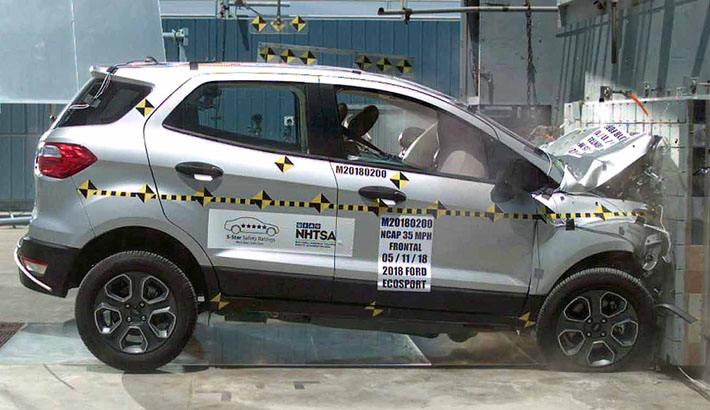
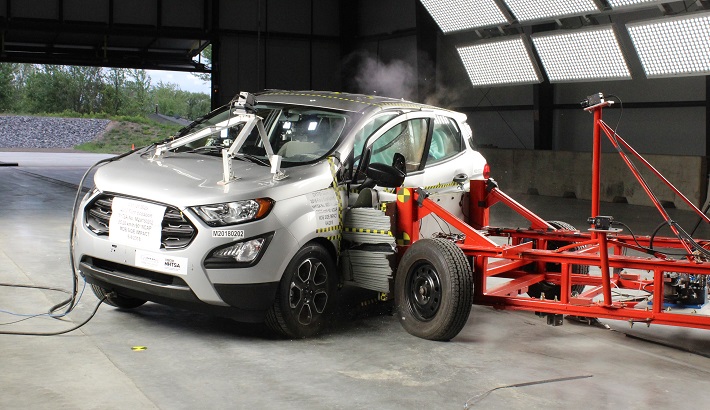
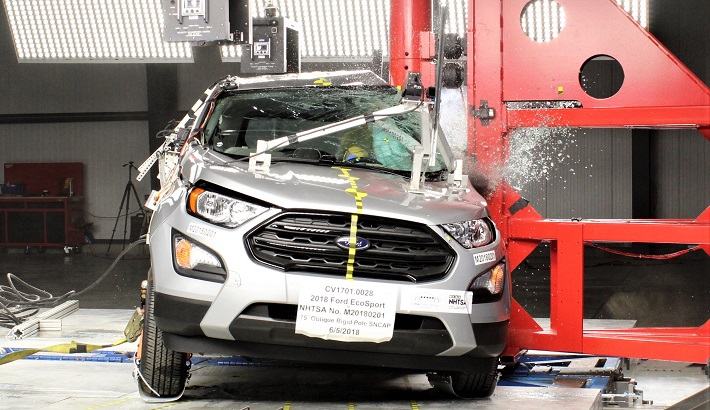
NHTSA crash tests
The agency crash-tested this model year itself. These are its own
photographs and star ratings.
Frontal crash test
Side barrier crash test
Side pole crash test
Photographs taken by NHTSA during its own New Car Assessment Program crash
tests of this model year. Public domain.
Configuration
Overall
Front
Side
Rollover
2020 Ford EcoSport SUV AWD
19.1% risk
2020 Ford EcoSport SUV FWD
20.4% risk
When owners complained
A spike years after the car went on sale usually means a part wearing
out on schedule across the whole fleet — the kind of pattern no single
owner can see from inside their own car.
Dec 2020peak 29Sep 2026
Recalls on the 2020 Ford Ecosport
A complaint is one owner's allegation. A recall is the point at which
the manufacturer or a regulator agreed the defect is real and dangerous
enough to fix for free — however old the car is.
United States — NHTSA
25V442000
BACK OVER PREVENTION:SOFTWARE
Ford Motor Company (Ford) is recalling certain 2018-2022 Transit Connect, 2019-2020 MKZ, MKX, Edge, Continental, F-150, Nautilus, Fusion, 2019-2023 Ranger, Mustang, 2020-2021 EcoSport, Expedition, Navigator, 2020-2022 Escape, F-250 SD, Corsair, 2020-2023 Aviator, Transit, 2020-2024 Explorer, 2021-2024 Bronco Sport, and 2022-2024 Maverick vehicles. A software error may cause the rearview camera to display a blank image, or the image may remain on the display after the backing event has ended.
Risk: A rearview camera that displays a blank image can reduce the driver's view behind the vehicle. A rearview image that continues to be displayed after the vehicle is shifted out of reverse may distract the driver. Both of these situations can increase the risk of a crash.
23V905000
ENGINE AND ENGINE COOLING:ENGINE:OIL/LUBRICATION:PUMP
Ford Motor Company (Ford) is recalling certain 2016-2018 Ford Focus and 2018-2022 Ford EcoSport vehicles. The oil pump drive belt or drive belt tensioner may fail, resulting in a loss of engine oil pressure.
Risk: A loss of oil pressure can result in an engine stall and a loss of power braking assist, increasing the risk of a crash.
20V791000
AIR BAGS:FRONTAL:DRIVER SIDE:INFLATOR MODULE
Ford Motor Company (Ford) is recalling certain 2020 EcoSport and 2019-2020 Transit Connect vehicles. Depending on the model, either the driver side or passenger side frontal air bag modules are missing the first-stage booster propellant and sleeve. As such, these vehicles fail to comply with the requirements of Federal Motor Vehicle Safety Standard number 208, "Occupant Crash Protection."
Risk: Air bag modules missing the first-stage booster propellant will not deploy as intended in a crash, increasing the risk of injury.
Canada — Transport Canada
Canada runs its own recall programme, and its campaigns do not
always mirror the American ones.
Recall 202536016,575 units in Canada
Visual System
Issue: On certain vehicles, a software problem could cause the rearview camera image not to display when the transmission is shifted into reverse. Canadian regulations require the rearview image to display when the vehicle is reversing. Safety Risk: A rearview camera image that doesn't display could reduce a driver's ability to see behind the vehicle while backing up. This could increase the risk of a crash. Corrective Actions: Ford will notify owners by mail and advise you to take your vehicle to a dealership to update the SYNC software.
Recall 20237047,164 units in Canada
Engine
Issue: On certain vehicles, the engine oil pump tensioner and/or the engine oil pump drive belt could fail and cause a loss of engine oil pressure. If this happens, the engine could fail and cause a loss of power to the wheels and a loss of power braking assist. Note: This recall only affects vehicles equipped with a 1.0L engine. Safety Risk: A sudden loss of power to the wheels could increase the risk of a crash. A loss of power brakes can cause an increase in brake pedal force and lead to an increase in stopping distance. Corrective Actions: Ford will notify owners by mail and advise you to take your vehicle to a dealership to inspect and, if necessary, replace the oil pump drive belt tensioner assembly. The dealer will also replace the oil pump drive belt.
Recall 20206341 units in Canada
Airbag
Issue: On one vehicle, there may be a problem with the passenger-front airbag inflator. As a result, the airbag may not deploy properly in a crash. Safety Risk: An airbag that does not work properly could create an increased risk of injury in a crash. Corrective Actions: Ford will notify the owner and instruct them to take their vehicle to a dealer to replace the passenger-front airbag module.
Reports where the owner recorded a crash, a fire, an injury or a death.
Kansas City, MOFire
POWER TRAIN
On April 3, 2026, this vehicle suffered a sudden, catastrophic mechanical failure as I was driving on US-169, in Kansas City, Mo.,l The engine seized and the fuel line ruptured resulting in an undercarriage fire with small explosions. I had to be physically extracted from the burning vehicle by a Clay County Sheriff’s Deputy, Clay County Sheriff’s Department, Liberty, Missouri (Report #CC2600810). This catastrophic asset and recall remedy failure is the direct result of a recognized federal safety defect (Ford Safety Recall 23S64 / NHTSA Campaign 23V905). The original engine blew from an oil pump failure in October 2024 and was towed to certified Ford dealer Smithville (Mo.) Ford on October 9, 2024 as per the recall. The new engine was not re-installed until May 24, 2025 due to delay in getting parts At the time of the recall reinstallation, the vehicle had 61,556 miles on it. When the fire happened on April 3 of this year, the vehicle had 70, 956 miles . I want to emphasize that Under explicit authorization from Ford Motor Company’s recall interim guidelines, the dealership performed a complete engine assembly swap. Per the official service invoice, this replacement engine was backed by a 3-year or 100,000-mile Ford Powertrain Warranty. At the time of the fire 11 months later, the vehicle had not yet reached 71,000 miles and was fully covered under active factory warranty.
NHTSA complaint #11748321 — an unverified report by a vehicle owner.
Kansas City, MOFire
ENGINE
On April 3, 2026, this vehicle suffered a sudden, catastrophic mechanical failure as I was driving on US-169, in Kansas City, Mo.,l The engine seized and the fuel line ruptured resulting in an undercarriage fire with small explosions. I had to be physically extracted from the burning vehicle by a Clay County Sheriff’s Deputy, Clay County Sheriff’s Department, Liberty, Missouri (Report #CC2600810). This catastrophic asset and recall remedy failure is the direct result of a recognized federal safety defect (Ford Safety Recall 23S64 / NHTSA Campaign 23V905). The original engine blew from an oil pump failure in October 2024 and was towed to certified Ford dealer Smithville (Mo.) Ford on October 9, 2024 as per the recall. The new engine was not re-installed until May 24, 2025 due to delay in getting parts At the time of the recall reinstallation, the vehicle had 61,556 miles on it. When the fire happened on April 3 of this year, the vehicle had 70, 956 miles . I want to emphasize that Under explicit authorization from Ford Motor Company’s recall interim guidelines, the dealership performed a complete engine assembly swap. Per the official service invoice, this replacement engine was backed by a 3-year or 100,000-mile Ford Powertrain Warranty. At the time of the fire 11 months later, the vehicle had not yet reached 71,000 miles and was fully covered under active factory warranty.
NHTSA complaint #11748321 — an unverified report by a vehicle owner.
Kansas City, MOFire
FUEL/PROPULSION SYSTEM
On April 3, 2026, this vehicle suffered a sudden, catastrophic mechanical failure as I was driving on US-169, in Kansas City, Mo.,l The engine seized and the fuel line ruptured resulting in an undercarriage fire with small explosions. I had to be physically extracted from the burning vehicle by a Clay County Sheriff’s Deputy, Clay County Sheriff’s Department, Liberty, Missouri (Report #CC2600810). This catastrophic asset and recall remedy failure is the direct result of a recognized federal safety defect (Ford Safety Recall 23S64 / NHTSA Campaign 23V905). The original engine blew from an oil pump failure in October 2024 and was towed to certified Ford dealer Smithville (Mo.) Ford on October 9, 2024 as per the recall. The new engine was not re-installed until May 24, 2025 due to delay in getting parts At the time of the recall reinstallation, the vehicle had 61,556 miles on it. When the fire happened on April 3 of this year, the vehicle had 70, 956 miles . I want to emphasize that Under explicit authorization from Ford Motor Company’s recall interim guidelines, the dealership performed a complete engine assembly swap. Per the official service invoice, this replacement engine was backed by a 3-year or 100,000-mile Ford Powertrain Warranty. At the time of the fire 11 months later, the vehicle had not yet reached 71,000 miles and was fully covered under active factory warranty.
NHTSA complaint #11748321 — an unverified report by a vehicle owner.
Atlanta, GAFire
UNKNOWN OR OTHER
Incident Date: 12/28/2025 Location: [XXX] Related Recall: 23V905 / 23S64 On December 28, 2025, while driving at highway speeds on [XXX] , my 2020 Ford EcoSport suffered a sudden engine fire. There were no prior dashboard warnings or "Check Engine" lights until the fire began, the vehicle speed started to slow down itself, and I immediately pulled over on the side of the interstate. I turned off the vehicle, and lifted the hood, since I saw smoke, and there was a fire under the hood. I called [XXX] , and the [XXX] /Cobb County Fire Department responded to the scene and inspected the vehicle under the hood. I have video evidence of the fire department on-scene and the emergency inspection of the burning engine. This vehicle is subject to Safety Recall 23V905 (Ford 23S64) for oil pump belt/tensioner failure leading to engine seizure. Crucially, a recall "repair" had been previously performed on this vehicle, yet the engine still suffered a catastrophic thermal event. This indicates either an ineffective remedy or a negligent installation. The vehicle was towed to Hennessy Ford [XXX] ). Their diagnosis confirmed: "COIL PACK BURN AND BURNED THE #2 INJECTOR AND HARNESS AND VALVE COVER." Despite the federal mandate that recall-related failures be handled at no cost, the dealership attempted to charge me over $2,000 for the diagnosis and repairs. Furthermore, Ford Customer Relationship Center (escalated 03/27/2026) has stalled the case by moving it to legal counsel with a 15-day waiting period. I am reporting this as a serious safety defect and a failure of a prior recall remedy. I am requesting a full investigation into the fire and a manufacturer buyback as the vehicle's safety integrity is now compromised. Also, I filed a claim with Ford Customer Relationship Center, here is my case number: [XXX] INFORMATION REDACTED PURSUANT TO THE FREEDOM OF INFORMATION ACT (FOIA), 5 U.S.C. 552(B)(6)
NHTSA complaint #11727714 — an unverified report by a vehicle owner.
Atlanta, GAFire
ENGINE
Incident Date: 12/28/2025 Location: [XXX] Related Recall: 23V905 / 23S64 On December 28, 2025, while driving at highway speeds on [XXX] , my 2020 Ford EcoSport suffered a sudden engine fire. There were no prior dashboard warnings or "Check Engine" lights until the fire began, the vehicle speed started to slow down itself, and I immediately pulled over on the side of the interstate. I turned off the vehicle, and lifted the hood, since I saw smoke, and there was a fire under the hood. I called [XXX] , and the [XXX] /Cobb County Fire Department responded to the scene and inspected the vehicle under the hood. I have video evidence of the fire department on-scene and the emergency inspection of the burning engine. This vehicle is subject to Safety Recall 23V905 (Ford 23S64) for oil pump belt/tensioner failure leading to engine seizure. Crucially, a recall "repair" had been previously performed on this vehicle, yet the engine still suffered a catastrophic thermal event. This indicates either an ineffective remedy or a negligent installation. The vehicle was towed to Hennessy Ford [XXX] ). Their diagnosis confirmed: "COIL PACK BURN AND BURNED THE #2 INJECTOR AND HARNESS AND VALVE COVER." Despite the federal mandate that recall-related failures be handled at no cost, the dealership attempted to charge me over $2,000 for the diagnosis and repairs. Furthermore, Ford Customer Relationship Center (escalated 03/27/2026) has stalled the case by moving it to legal counsel with a 15-day waiting period. I am reporting this as a serious safety defect and a failure of a prior recall remedy. I am requesting a full investigation into the fire and a manufacturer buyback as the vehicle's safety integrity is now compromised. Also, I filed a claim with Ford Customer Relationship Center, here is my case number: [XXX] INFORMATION REDACTED PURSUANT TO THE FREEDOM OF INFORMATION ACT (FOIA), 5 U.S.C. 552(B)(6)
NHTSA complaint #11727714 — an unverified report by a vehicle owner.
Atlanta, GAFire
FUEL/PROPULSION SYSTEM
Incident Date: 12/28/2025 Location: [XXX] Related Recall: 23V905 / 23S64 On December 28, 2025, while driving at highway speeds on [XXX] , my 2020 Ford EcoSport suffered a sudden engine fire. There were no prior dashboard warnings or "Check Engine" lights until the fire began, the vehicle speed started to slow down itself, and I immediately pulled over on the side of the interstate. I turned off the vehicle, and lifted the hood, since I saw smoke, and there was a fire under the hood. I called [XXX] , and the [XXX] /Cobb County Fire Department responded to the scene and inspected the vehicle under the hood. I have video evidence of the fire department on-scene and the emergency inspection of the burning engine. This vehicle is subject to Safety Recall 23V905 (Ford 23S64) for oil pump belt/tensioner failure leading to engine seizure. Crucially, a recall "repair" had been previously performed on this vehicle, yet the engine still suffered a catastrophic thermal event. This indicates either an ineffective remedy or a negligent installation. The vehicle was towed to Hennessy Ford [XXX] ). Their diagnosis confirmed: "COIL PACK BURN AND BURNED THE #2 INJECTOR AND HARNESS AND VALVE COVER." Despite the federal mandate that recall-related failures be handled at no cost, the dealership attempted to charge me over $2,000 for the diagnosis and repairs. Furthermore, Ford Customer Relationship Center (escalated 03/27/2026) has stalled the case by moving it to legal counsel with a 15-day waiting period. I am reporting this as a serious safety defect and a failure of a prior recall remedy. I am requesting a full investigation into the fire and a manufacturer buyback as the vehicle's safety integrity is now compromised. Also, I filed a claim with Ford Customer Relationship Center, here is my case number: [XXX] INFORMATION REDACTED PURSUANT TO THE FREEDOM OF INFORMATION ACT (FOIA), 5 U.S.C. 552(B)(6)
NHTSA complaint #11727714 — an unverified report by a vehicle owner.
The most recent complaints
In the owners' own words, exactly as filed with NHTSA.
Mt Sterling, KY
POWER TRAIN
Kept like revving the engine like it was whining tight never show no check engine light nothing ever showed up was driving down the road and the car completely shut off no warning signs no nothing all was coming out of it like a oil pump or something had went out in the car.
NHTSA complaint #11763855 — an unverified report by a vehicle owner.
Mt Sterling, KY
ENGINE
Kept like revving the engine like it was whining tight never show no check engine light nothing ever showed up was driving down the road and the car completely shut off no warning signs no nothing all was coming out of it like a oil pump or something had went out in the car.
NHTSA complaint #11763855 — an unverified report by a vehicle owner.
at 63,000 milesDetroit, MI
ENGINE
The contact owns a 2020 Ford EcoSport. The contact stated that while driving at approximately 60 MPH, smoke was observed coming from the rear of the vehicle, and the check engine warning light illuminated. The vehicle was towed to the dealer, where the contact was informed that the vehicle needed a tune-up. The contact later received a notification through the mobile application indicating that the engine had multiple misfires. The vehicle was taken back to the dealer, where it was diagnosed that the engine had failed and needed to be replaced. The vehicle was not repaired. The contact stated that the failure occurred after a recall-related engine replacement had previously been completed. The manufacturer was made aware of the failure and denied the contact's request for a buyback. The failure mileage was approximately 63,000.
NHTSA complaint #11761908 — an unverified report by a vehicle owner.
Willards, MD
POWER TRAIN
Statement of Problem & Safety Risk: I am filing a complaint regarding a persistent, critical safety defect on my 2020 Ford EcoSport. This vehicle previously suffered an engine failure linked to Ford Recall 23S64 / NHTSA Campaign 23V-905 (oil pump drive belt/tensioner failure causing loss of oil pressure). An engine assembly replacement was performed under the recall around 58,000 miles. Despite having the recall service performed, the replacement engine has now experienced a secondary failure. The vehicle’s wrench light illuminated, and the car went into severe "Limp Mode" while being driven, resulting in an immediate loss of accelerator power and engine torque. This creates an extreme safety hazard, causing a sudden loss of drive power in traffic and exposing the engine to potential oil starvation, complete engine seizure, and loss of power braking assist. Manufacturer & Dealership Non-Compliance: Both Ford Motor Company customer service and local Ford dealership management have stonewalled our requests to diagnose and address this recurring safety hazard under the active federal recall. They have refused to assist or provide appropriate loaner transportation while the vehicle remains unsafe to operate. I request that NHTSA document this failed recall repair, investigate repeat oil pump belt/engine failures on vehicles serviced under Campaign 23V-905, and compel Ford Motor Company to honor its safety recall obligations. This is an ongoing problem these cars are junk and the consumer is stuck paying for it. I am not sure what date to put underneath here because the issue is ongoing
NHTSA complaint #11760700 — an unverified report by a vehicle owner.
Willards, MD
ENGINE
Statement of Problem & Safety Risk: I am filing a complaint regarding a persistent, critical safety defect on my 2020 Ford EcoSport. This vehicle previously suffered an engine failure linked to Ford Recall 23S64 / NHTSA Campaign 23V-905 (oil pump drive belt/tensioner failure causing loss of oil pressure). An engine assembly replacement was performed under the recall around 58,000 miles. Despite having the recall service performed, the replacement engine has now experienced a secondary failure. The vehicle’s wrench light illuminated, and the car went into severe "Limp Mode" while being driven, resulting in an immediate loss of accelerator power and engine torque. This creates an extreme safety hazard, causing a sudden loss of drive power in traffic and exposing the engine to potential oil starvation, complete engine seizure, and loss of power braking assist. Manufacturer & Dealership Non-Compliance: Both Ford Motor Company customer service and local Ford dealership management have stonewalled our requests to diagnose and address this recurring safety hazard under the active federal recall. They have refused to assist or provide appropriate loaner transportation while the vehicle remains unsafe to operate. I request that NHTSA document this failed recall repair, investigate repeat oil pump belt/engine failures on vehicles serviced under Campaign 23V-905, and compel Ford Motor Company to honor its safety recall obligations. This is an ongoing problem these cars are junk and the consumer is stuck paying for it. I am not sure what date to put underneath here because the issue is ongoing
NHTSA complaint #11760700 — an unverified report by a vehicle owner.
Sharonville, OH
ENGINE
"I am reporting a severe, high-risk safety and under-hood fire hazard involving a 2020 Ford EcoSport tied directly to federal Safety Recall 23S64 [23S64]. The vehicle suffered a catastrophic loss of internal oil pressure, leading to an official diagnostic scan by Kerry Ford confirming a hard-stored P0015 Camshaft Timing defect [23S64]. The dealership is actively evading the federal recall remedy by falsely claiming the failure is just a bad sensor [23S64]. The vehicle is now experiencing critical failure symptoms: it is consuming extreme amounts of gasoline rapidly and filling both the interior cabin and exterior air with a heavy, toxic odor of raw fuel while running, making it entirely unsafe to operate in public traffic [23S64]. Furthermore, our auto lender has verbally stated on a recorded line that they are refusing repossession because the car holds zero value, forcing a hazardous, un-remedied federal safety defect to remain stranded on a residential property [23S64]."
NHTSA complaint #11760733 — an unverified report by a vehicle owner.
Sharonville, OH
FUEL/PROPULSION SYSTEM
"I am reporting a severe, high-risk safety and under-hood fire hazard involving a 2020 Ford EcoSport tied directly to federal Safety Recall 23S64 [23S64]. The vehicle suffered a catastrophic loss of internal oil pressure, leading to an official diagnostic scan by Kerry Ford confirming a hard-stored P0015 Camshaft Timing defect [23S64]. The dealership is actively evading the federal recall remedy by falsely claiming the failure is just a bad sensor [23S64]. The vehicle is now experiencing critical failure symptoms: it is consuming extreme amounts of gasoline rapidly and filling both the interior cabin and exterior air with a heavy, toxic odor of raw fuel while running, making it entirely unsafe to operate in public traffic [23S64]. Furthermore, our auto lender has verbally stated on a recorded line that they are refusing repossession because the car holds zero value, forcing a hazardous, un-remedied federal safety defect to remain stranded on a residential property [23S64]."
NHTSA complaint #11760733 — an unverified report by a vehicle owner.
Washington, DC
ENGINE AND ENGINE COOLING
The contact owns a 2020 Ford EcoSport. The contact received notification of NHTSA Campaign Number: 23V905000 (ENGINE AND ENGINE COOLING); however, the part to do the recall repair was unavailable. The dealer was notified of the failure and confirmed that parts were unavailable. The contact later received a letter stating that parts were available; however, the dealer stated that due to a limited supply, they could only service the recall if the vehicle had experienced the failure. The contact stated that while driving 65 MPH, the check engine warning light illuminated, and the vehicle hesitated while depressing the accelerator pedal. Due to the failure, the vehicle was towed to a dealer to be repaired. Upon inspection, the mechanic discovered that the engine oil pump drive belt tensioner arm was fractured, and the engine needed to be replaced. The vehicle was not repaired and remained with the dealer. The manufacturer was not notified of the failure. The failure mileage was unknown.
NHTSA complaint #11755410 — an unverified report by a vehicle owner.
Florence, AZ
ENGINE
It was a recall oil pump tensor bar. They fixed that blew the engine.I had to wait for them to fix what they messed up with the engine.They fixed that drove forty miles away from the dealer and the engine overheated
NHTSA complaint #11749561 — an unverified report by a vehicle owner.
Westland, MI
POWER TRAIN
The affected component is the powertrain system in my 2020 Ford EcoSport. The vehicle has experienced repeated powertrain-related failures and is available for inspection upon request. In May 2025, the vehicle required a full engine replacement, yet I am continuing to experience serious powertrain-related issues. The vehicle has displayed powertrain malfunction warnings and has experienced improper acceleration, hesitation, loss of power, and instances where the vehicle has stopped at intersections. These issues create a serious safety risk because the vehicle may not respond when acceleration is needed, including when entering traffic, turning, merging, or attempting to avoid hazards. A vehicle that loses power or stops unexpectedly at intersections creates a risk of collision and puts myself, my passengers, and other motorists in danger. This issue has occurred multiple times and has required repeated service attention. The vehicle is scheduled to be inspected again due to the ongoing powertrain failure concern. Despite significant repairs, including a complete engine replacement, the underlying issue appears to remain unresolved. Prior to the failures, the vehicle displayed warning messages related to the powertrain system. The symptoms have included reduced acceleration, hesitation, loss of power, and the vehicle stopping unexpectedly while driving. The vehicle has been inspected by Ford service providers, including the prior engine replacement performed in May 2025. I am submitting this complaint because repeated powertrain failures, loss of acceleration, and unexpected stopping while operating the vehicle present a significant safety concern. I believe this issue warrants investigation to determine whether there is a broader defect affecting 2020 Ford EcoSport vehicles.
NHTSA complaint #11748784 — an unverified report by a vehicle owner.
Burien, WA
POWER TRAIN
My automatic transmission has a problem going into gear, slow to engage in any gear. when needing to accelerate there is no response, just the high rev of the engine but absolutely no acceleration. The car has a hard jerk and thud sound when it does go into gear, this is when driving the car.
NHTSA complaint #11748806 — an unverified report by a vehicle owner.
Westland, MI
VEHICLE SPEED CONTROL
The affected component is the powertrain system in my 2020 Ford EcoSport. The vehicle has experienced repeated powertrain-related failures and is available for inspection upon request. In May 2025, the vehicle required a full engine replacement, yet I am continuing to experience serious powertrain-related issues. The vehicle has displayed powertrain malfunction warnings and has experienced improper acceleration, hesitation, loss of power, and instances where the vehicle has stopped at intersections. These issues create a serious safety risk because the vehicle may not respond when acceleration is needed, including when entering traffic, turning, merging, or attempting to avoid hazards. A vehicle that loses power or stops unexpectedly at intersections creates a risk of collision and puts myself, my passengers, and other motorists in danger. This issue has occurred multiple times and has required repeated service attention. The vehicle is scheduled to be inspected again due to the ongoing powertrain failure concern. Despite significant repairs, including a complete engine replacement, the underlying issue appears to remain unresolved. Prior to the failures, the vehicle displayed warning messages related to the powertrain system. The symptoms have included reduced acceleration, hesitation, loss of power, and the vehicle stopping unexpectedly while driving. The vehicle has been inspected by Ford service providers, including the prior engine replacement performed in May 2025. I am submitting this complaint because repeated powertrain failures, loss of acceleration, and unexpected stopping while operating the vehicle present a significant safety concern. I believe this issue warrants investigation to determine whether there is a broader defect affecting 2020 Ford EcoSport vehicles.
NHTSA complaint #11748784 — an unverified report by a vehicle owner.
Westland, MI
ENGINE
The affected component is the powertrain system in my 2020 Ford EcoSport. The vehicle has experienced repeated powertrain-related failures and is available for inspection upon request. In May 2025, the vehicle required a full engine replacement, yet I am continuing to experience serious powertrain-related issues. The vehicle has displayed powertrain malfunction warnings and has experienced improper acceleration, hesitation, loss of power, and instances where the vehicle has stopped at intersections. These issues create a serious safety risk because the vehicle may not respond when acceleration is needed, including when entering traffic, turning, merging, or attempting to avoid hazards. A vehicle that loses power or stops unexpectedly at intersections creates a risk of collision and puts myself, my passengers, and other motorists in danger. This issue has occurred multiple times and has required repeated service attention. The vehicle is scheduled to be inspected again due to the ongoing powertrain failure concern. Despite significant repairs, including a complete engine replacement, the underlying issue appears to remain unresolved. Prior to the failures, the vehicle displayed warning messages related to the powertrain system. The symptoms have included reduced acceleration, hesitation, loss of power, and the vehicle stopping unexpectedly while driving. The vehicle has been inspected by Ford service providers, including the prior engine replacement performed in May 2025. I am submitting this complaint because repeated powertrain failures, loss of acceleration, and unexpected stopping while operating the vehicle present a significant safety concern. I believe this issue warrants investigation to determine whether there is a broader defect affecting 2020 Ford EcoSport vehicles.
NHTSA complaint #11748784 — an unverified report by a vehicle owner.
Kansas City, MOFire
POWER TRAIN
On April 3, 2026, this vehicle suffered a sudden, catastrophic mechanical failure as I was driving on US-169, in Kansas City, Mo.,l The engine seized and the fuel line ruptured resulting in an undercarriage fire with small explosions. I had to be physically extracted from the burning vehicle by a Clay County Sheriff’s Deputy, Clay County Sheriff’s Department, Liberty, Missouri (Report #CC2600810). This catastrophic asset and recall remedy failure is the direct result of a recognized federal safety defect (Ford Safety Recall 23S64 / NHTSA Campaign 23V905). The original engine blew from an oil pump failure in October 2024 and was towed to certified Ford dealer Smithville (Mo.) Ford on October 9, 2024 as per the recall. The new engine was not re-installed until May 24, 2025 due to delay in getting parts At the time of the recall reinstallation, the vehicle had 61,556 miles on it. When the fire happened on April 3 of this year, the vehicle had 70, 956 miles . I want to emphasize that Under explicit authorization from Ford Motor Company’s recall interim guidelines, the dealership performed a complete engine assembly swap. Per the official service invoice, this replacement engine was backed by a 3-year or 100,000-mile Ford Powertrain Warranty. At the time of the fire 11 months later, the vehicle had not yet reached 71,000 miles and was fully covered under active factory warranty.
NHTSA complaint #11748321 — an unverified report by a vehicle owner.
Kansas City, MOFire
ENGINE
On April 3, 2026, this vehicle suffered a sudden, catastrophic mechanical failure as I was driving on US-169, in Kansas City, Mo.,l The engine seized and the fuel line ruptured resulting in an undercarriage fire with small explosions. I had to be physically extracted from the burning vehicle by a Clay County Sheriff’s Deputy, Clay County Sheriff’s Department, Liberty, Missouri (Report #CC2600810). This catastrophic asset and recall remedy failure is the direct result of a recognized federal safety defect (Ford Safety Recall 23S64 / NHTSA Campaign 23V905). The original engine blew from an oil pump failure in October 2024 and was towed to certified Ford dealer Smithville (Mo.) Ford on October 9, 2024 as per the recall. The new engine was not re-installed until May 24, 2025 due to delay in getting parts At the time of the recall reinstallation, the vehicle had 61,556 miles on it. When the fire happened on April 3 of this year, the vehicle had 70, 956 miles . I want to emphasize that Under explicit authorization from Ford Motor Company’s recall interim guidelines, the dealership performed a complete engine assembly swap. Per the official service invoice, this replacement engine was backed by a 3-year or 100,000-mile Ford Powertrain Warranty. At the time of the fire 11 months later, the vehicle had not yet reached 71,000 miles and was fully covered under active factory warranty.
NHTSA complaint #11748321 — an unverified report by a vehicle owner.
Kansas City, MOFire
FUEL/PROPULSION SYSTEM
On April 3, 2026, this vehicle suffered a sudden, catastrophic mechanical failure as I was driving on US-169, in Kansas City, Mo.,l The engine seized and the fuel line ruptured resulting in an undercarriage fire with small explosions. I had to be physically extracted from the burning vehicle by a Clay County Sheriff’s Deputy, Clay County Sheriff’s Department, Liberty, Missouri (Report #CC2600810). This catastrophic asset and recall remedy failure is the direct result of a recognized federal safety defect (Ford Safety Recall 23S64 / NHTSA Campaign 23V905). The original engine blew from an oil pump failure in October 2024 and was towed to certified Ford dealer Smithville (Mo.) Ford on October 9, 2024 as per the recall. The new engine was not re-installed until May 24, 2025 due to delay in getting parts At the time of the recall reinstallation, the vehicle had 61,556 miles on it. When the fire happened on April 3 of this year, the vehicle had 70, 956 miles . I want to emphasize that Under explicit authorization from Ford Motor Company’s recall interim guidelines, the dealership performed a complete engine assembly swap. Per the official service invoice, this replacement engine was backed by a 3-year or 100,000-mile Ford Powertrain Warranty. At the time of the fire 11 months later, the vehicle had not yet reached 71,000 miles and was fully covered under active factory warranty.
NHTSA complaint #11748321 — an unverified report by a vehicle owner.
Los Angeles, CA
POWER TRAIN
My 2020 Ford EcoSport (1.0L EcoBoost) is covered by Recall 23S64 / NHTSA 23V905 (engine oil pump drive belt). The defect causes sudden loss of motive power at highway speed (65+ mph), usually after 40+ minutes of driving, with the powertrain warning light and code P0299 (turbo underboost). Losing power in Los Angeles freeway traffic is the safety hazard. The recall remedy has failed repeatedly. In Oct 2025 the dealer tore down the engine, confirmed the oil pump belt had disintegrated and clogged the oil pickup, and replaced the complete engine (long block) under the recall in Dec 2025. The recall now shows as completed for this vehicle, but since that repair, with under 500 miles driven: (1) the turbocharger failed again and was replaced under warranty in Feb 2026, about 77 miles after the new engine; (2) in Apr 2026 the dealer found a cracked valve cover leaking oil into cylinder 3 (codes P0313, P0299); (3) on May 23, 2026 I picked the car up and the same power-loss condition returned THE SAME DAY - the dealer then found a loose air charge pipe; (4) on Jun 20, 2026 I picked the car up again and it failed THE SAME DAY. Both same-day failures are corroborated by round-trip rideshare receipts. The vehicle has been at the dealer since Jun 20, 2026, and the service advisor has not answered my written requests for diagnosis or coverage for over a week. Before the recall was confirmed, the same defect caused repeated repairs from Jun 2024 on (13 shop visits, 9 to Ford dealers). In Aug 2025 Ford's own technical hotline directed an engine teardown to find the root cause; the dealer advisor declined it. The remedy under Recall 23S64 has not remedied the defect: the recall-replaced engine has failed component by component within 500 miles and the vehicle remains out of service. All components are available for inspection at the dealer. Full repair orders, invoices, and dated records are available on request.
NHTSA complaint #11748099 — an unverified report by a vehicle owner.
Los Angeles, CA
ENGINE
My 2020 Ford EcoSport (1.0L EcoBoost) is covered by Recall 23S64 / NHTSA 23V905 (engine oil pump drive belt). The defect causes sudden loss of motive power at highway speed (65+ mph), usually after 40+ minutes of driving, with the powertrain warning light and code P0299 (turbo underboost). Losing power in Los Angeles freeway traffic is the safety hazard. The recall remedy has failed repeatedly. In Oct 2025 the dealer tore down the engine, confirmed the oil pump belt had disintegrated and clogged the oil pickup, and replaced the complete engine (long block) under the recall in Dec 2025. The recall now shows as completed for this vehicle, but since that repair, with under 500 miles driven: (1) the turbocharger failed again and was replaced under warranty in Feb 2026, about 77 miles after the new engine; (2) in Apr 2026 the dealer found a cracked valve cover leaking oil into cylinder 3 (codes P0313, P0299); (3) on May 23, 2026 I picked the car up and the same power-loss condition returned THE SAME DAY - the dealer then found a loose air charge pipe; (4) on Jun 20, 2026 I picked the car up again and it failed THE SAME DAY. Both same-day failures are corroborated by round-trip rideshare receipts. The vehicle has been at the dealer since Jun 20, 2026, and the service advisor has not answered my written requests for diagnosis or coverage for over a week. Before the recall was confirmed, the same defect caused repeated repairs from Jun 2024 on (13 shop visits, 9 to Ford dealers). In Aug 2025 Ford's own technical hotline directed an engine teardown to find the root cause; the dealer advisor declined it. The remedy under Recall 23S64 has not remedied the defect: the recall-replaced engine has failed component by component within 500 miles and the vehicle remains out of service. All components are available for inspection at the dealer. Full repair orders, invoices, and dated records are available on request.
NHTSA complaint #11748099 — an unverified report by a vehicle owner.
Los Angeles, CA
FUEL/PROPULSION SYSTEM
My 2020 Ford EcoSport (1.0L EcoBoost) is covered by Recall 23S64 / NHTSA 23V905 (engine oil pump drive belt). The defect causes sudden loss of motive power at highway speed (65+ mph), usually after 40+ minutes of driving, with the powertrain warning light and code P0299 (turbo underboost). Losing power in Los Angeles freeway traffic is the safety hazard. The recall remedy has failed repeatedly. In Oct 2025 the dealer tore down the engine, confirmed the oil pump belt had disintegrated and clogged the oil pickup, and replaced the complete engine (long block) under the recall in Dec 2025. The recall now shows as completed for this vehicle, but since that repair, with under 500 miles driven: (1) the turbocharger failed again and was replaced under warranty in Feb 2026, about 77 miles after the new engine; (2) in Apr 2026 the dealer found a cracked valve cover leaking oil into cylinder 3 (codes P0313, P0299); (3) on May 23, 2026 I picked the car up and the same power-loss condition returned THE SAME DAY - the dealer then found a loose air charge pipe; (4) on Jun 20, 2026 I picked the car up again and it failed THE SAME DAY. Both same-day failures are corroborated by round-trip rideshare receipts. The vehicle has been at the dealer since Jun 20, 2026, and the service advisor has not answered my written requests for diagnosis or coverage for over a week. Before the recall was confirmed, the same defect caused repeated repairs from Jun 2024 on (13 shop visits, 9 to Ford dealers). In Aug 2025 Ford's own technical hotline directed an engine teardown to find the root cause; the dealer advisor declined it. The remedy under Recall 23S64 has not remedied the defect: the recall-replaced engine has failed component by component within 500 miles and the vehicle remains out of service. All components are available for inspection at the dealer. Full repair orders, invoices, and dated records are available on request.
NHTSA complaint #11748099 — an unverified report by a vehicle owner.
Duarte, CA
ENGINE
Fuel injectors, hand brake when reversing, spuddering when push on gas, windshield crack when cleaning from the inside accidently hit rear view mirror.
NHTSA complaint #11745387 — an unverified report by a vehicle owner.
Duarte, CA
SERVICE BRAKES
Fuel injectors, hand brake when reversing, spuddering when push on gas, windshield crack when cleaning from the inside accidently hit rear view mirror.
NHTSA complaint #11745387 — an unverified report by a vehicle owner.
Duarte, CA
FUEL/PROPULSION SYSTEM
Fuel injectors, hand brake when reversing, spuddering when push on gas, windshield crack when cleaning from the inside accidently hit rear view mirror.
NHTSA complaint #11745387 — an unverified report by a vehicle owner.
Texarkana, TX
UNKNOWN OR OTHER
I had my car fixed from a recall for an engine oil pump or something like that. After it was fixed, my car will shut off when I’m at a stop light or while I’m driving. It is not safe and scares me. My check engine light will come on and off, and my local dealership won’t help unless the check engine light is on when I bring it in. This has been going on since early May.
NHTSA complaint #11743081 — an unverified report by a vehicle owner.
Coldwater, MI
UNKNOWN OR OTHER
Backup Camera Blue Screen Failure. Does Not Work; Happened within time frame of the other ford vehicle recalls for backup camera safety concerns.
NHTSA complaint #11742515 — an unverified report by a vehicle owner.
Coldwater, MI
VISIBILITY/WIPER
Backup Camera Blue Screen Failure. Does Not Work; Happened within time frame of the other ford vehicle recalls for backup camera safety concerns.
NHTSA complaint #11742515 — an unverified report by a vehicle owner.