Owners have filed 677 complaints
about the 2013 Tesla Model S with NHTSA between 2013 and 2026.
The largest single group is the electrical system.
Across this model's run it ranks 4 of 13 worst.
The letter says how bad. This says what kind — whether this year drew
an unusual number of complaints, unusually dangerous
ones, or failures that arrived unusually early.
The dashed ring is 50 — the national norm. Further out is worse.
Complaint volume — 83
Against the median year of the Tesla Model S. 50 means typical for this
model; 100 means roughly double.
Severity — 92
17.7% of these complaints
involved a crash, fire, injury or death, against a national rate of
9.7%.
Early failure — 38
22% of failures with a mileage on record happened under
36,000 miles, against a national rate of
29%.
NHTSA files every complaint against a named sub-assembly, not just a
system. This is the difference between knowing it was "the engine" and
knowing which part of it — the list to hand a mechanic.
Body
1445.2%
Blind Spot Detection
516.1%
Warnings
39.7%
Automatic Emergency Braking
39.7%
Driveshaft
26.5%
12V/24V/48V Battery
26.5%
Accessory
13.2%
Exterior
13.2%
When it fails
Odometer readings owners gave when they filed. About half of all
complaints include one.
Under 1,000 miles
102.3%
1,000 – 9,999 miles
204.7%
10,000 – 24,999 miles
409.3%
25,000 – 49,999 miles
6615.4%
50,000 – 74,999 miles
7818.2%
75,000 – 99,999 miles
9021.0%
100,000 – 149,999 miles
10524.5%
150,000+ miles
194.4%
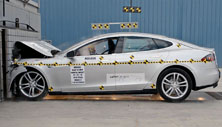
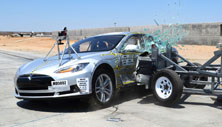
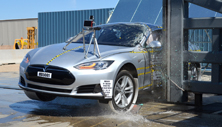
NHTSA crash tests
The agency crash-tested this model year itself. These are its own
photographs and star ratings.
Frontal crash test
Side barrier crash test
Side pole crash test
Photographs taken by NHTSA during its own New Car Assessment Program crash
tests of this model year. Public domain.
Configuration
Overall
Front
Side
Rollover
2013 Tesla Model S 5 HB RWD
5.7% risk
When owners complained
A spike years after the car went on sale usually means a part wearing
out on schedule across the whole fleet — the kind of pattern no single
owner can see from inside their own car.
Feb 2013peak 68Jun 2026
NHTSA investigations into the 2013 Tesla Model S
An investigation is the step before a recall: the agency has seen enough
complaints to look into a pattern itself. An open one means it thinks
something may be wrong and nothing has been fixed yet.
The Office of Defects Investigation (ODI) is opening a Recall Query to assess the remedy adequacy of Recall 23V838. On December 12, 2023, Tesla filed a Defect Information Report (Recall 23V838) applicable to all Tesla models produced and equipped with any version of its Autopilot system, which Tesla described as an SAE Level 2 (L2) Advanced Driver Assistance System (ADAS). Autopilot is the simultaneous engagement of Tesla’s Traffic-Aware Cruise Control (TACC) and Autosteer. In describing the safety defect, Tesla’s Defect Information Report (DIR) explained that “the prominence and scope of the...
DP23002Opened 29 Jun 2023Still openVEHICLE SPEED CONTROL
Sudden Unintended Acceleration
The Office of Defects Investigation (ODI) received a petition requesting that ODI reevaluate its decision to deny DP20-001 on the basis that intermittent high electrical current demands on the vehicles' 12VDC systems may have caused some or all of the incidents examined by ODI in DP20-001. The petitioner bases this information on a review of open-source research and the DP20-001 denial. The petition and related materials can be reviewed at NHTSA.gov under the following ODI number: 11528471.
From 2000 through 2017, Takata produced millions of air bag inflators using two types of phase-stabilized ammonium nitrate ("PSAN") propellant -- propellant 2004 and propellant 2004L. After prolonged exposure to high temperature cycles and humidity, inflators using propellant 2004 can degrade, causing the propellant to burn too quickly when ignited. The rapid burning can cause the inflator to rupture during deployment, potentially causing serious or even fatal injury to vehicle occupants. See 2016 Blomquist Report at www.nhtsa.gov/sites/nhtsa.gov/files/documents/expert_report-hrblomquist.pdf.C...
DP23001Opened 7 Apr 2023Closed 18 Mar 2026UNKNOWN OR OTHER
Defect Petition Interlock Request
On March 21, 2023, the Office of Defects Investigation (ODI) received a petition requesting a “recall of all Tesla cars” produced from 2013 to the date on which the petition was filed due to what Petitioner considers to be the increased likelihood of pedal misapplication. Attached to the Petition is a paper authored by Petitioner. According to Petitioner, the differences in the operator controls between the subject Tesla vehicles and internal combustion engine powered vehicles promote driver pedal misapplication, leading to sudden unintended acceleration (SUA) incidents. To fix this alleged de...
DP22005Opened 27 Jan 2023Closed 7 Aug 2023ELECTRICAL SYSTEM:PROPULSION SYSTEM
Pedestrian alert sounds
NHTSA received a petition on or about July 18, 2022, requesting that Federal Motor Vehicle Safety Standard (FMVSS) 141 be applied to all electric and hybrid vehicles operating in the United States. The petition can be reviewed at NHTSA.gov under ODI Number 11486072. FMVSS 141 establishes performance requirements for pedestrian alert sounds for motor vehicles. The standard applies to hybrid and electric vehicles that have a gross vehicle weight rating of 4,536 KG or less or are defined as low-speed vehicles. The standard became fully applicable to all such vehicles manufactured on or after Marc...
EA22002Opened 8 Jun 2022Closed 25 Apr 2024ELECTRICAL SYSTEM
Autopilot System Driver Controls
The Office of Defects Investigation (ODI) upgraded PE21020 to EA22002 on June 8, 2022, to extend work and deepen the PE21020 crash analysis, to supplement that analysis with additional data, and to perform vehicle evaluations to understand how Tesla’s Autopilot system may exacerbate human factors or behavioral safety risks by undermining the effectiveness of the driver’s supervision. To support this work, ODI collected additional crash information and assessed vehicle control authority, driver engagement technologies, and related human factors considerations associated with partial automation...
PE20020Opened 22 Nov 2020Closed 12 Aug 2024SUSPENSION:FRONT:CONTROL ARM:LOWER ARM
Fore Link Failure
The Office of Defects Investigation (ODI) opened this Preliminary Evaluation based on forty-three complaints alleging failure of the left or right front suspension fore links in Tesla model year (MY) 2015 through 2017 Model S and MY 2016 through 2017 Model X vehicles. The investigation has identified 426 instances of failure on part number 1041570-00-A or 1041575-00-A fore links.None of the instances resulted in any loss of vehicle control. One minor crash with no injuries is associated with the 426 instances fore link failures.A majority of the failures occurred between one to fifteen mph whi...
EA20003Opened 12 Nov 2020Closed 2 May 2024BACK OVER PREVENTION: SENSING SYSTEM: CAMERA
Loss of rearview camera
On November 20, 2020, the Office of Defects Investigation (ODI) opened Engineering Analysis (EA) 20-003 to investigate incidents of media control unit (MCU) failures resulting in loss of rearview camera in model year (MY) 2012-18 Tesla Model S and model year (MY) 2016-2018 Tesla Model X vehicles equipped with the NVIDIA Tegra 3 processor with an integrated 8GB eMMC NAND flash memory device. During its investigation, ODI learned that the expected usage life rating for the 8GB eMMC NAND flash memory device is approximately 3,000 “P/E” or Program-Erase cycles, after which the eMMC NAND flash memo...
Recalls on the 2013 Tesla Model S
A complaint is one owner's allegation. A recall is the point at which
the manufacturer or a regulator agreed the defect is real and dangerous
enough to fix for free — however old the car is.
United States — NHTSA
24V376000
SEAT BELTS:FRONT:WARNING LIGHT/DEVICES
Tesla, Inc. (Tesla) is recalling certain 2012-2024 Model S, 2015-2024 Model X, 2017-2023 Model 3, and 2020-2023 Model Y vehicles. In the event of an unbelted driver, the seat belt warning light and audible chime may not activate as intended. As such, these vehicles fail to comply with the requirements of Federal Motor Vehicle Safety Standard number 208, "Occupant Crash Protection."
Risk: A seat belt warning system that fails to alert occupants of an unbelted seat belt can increase the risk of injury during a crash.
Tesla, Inc. (Tesla) is recalling certain 2013, 2018-2021 Model S, 2020-2021 Model X, 2018-2022 Model 3, and 2020-2022 Model Y vehicles. A factory reset muted the Pedestrian Warning System (PWS) sounds. As such, these vehicles fail to comply with the requirements of Federal Motor Vehicle Safety Standard number 141, "Minimum Sound Requirements for Hybrid and Electric Vehicles."
Risk: Pedestrians may be unaware of an approaching vehicle if the PWS sounds are muted, increasing the risk of a crash.
24V051000
ELECTRICAL SYSTEM: INSTRUMENT CLUSTER/PANEL
Tesla, Inc. (Tesla) is recalling certain 2012-2023 Model S, 2016-2024 Model X, 2017-2023 Model 3, 2019-2024 Model Y, and 2024 Cybertruck vehicles. An incorrect font size is displayed on the instrument panel for the Brake, Park, and Antilock Brake System (ABS) warning lights. As such, these vehicles fail to comply with the requirements of Federal Motor Vehicle Safety Standard number 105, "Hydraulic and Electric Brake Systems" and 135, "Light Vehicle Brake Systems."
Risk: Warning lights with a smaller font size can make critical safety information on the instrument panel difficult to read, increasing the risk of a crash.
Tesla, Inc. (Tesla) is recalling 2012-2023 Model S, 2016-2023 Model X, 2017-2023 Model 3, and 2020-2023 Model Y vehicles equipped with all versions of Autosteer leading up to the version(s) that contains the recall remedy. In certain circumstances when Autosteer is engaged, the prominence and scope of the feature's controls may not be sufficient to prevent driver misuse of the SAE Level 2 advanced driver-assistance feature.
Risk: In certain circumstances when Autosteer is engaged, and the driver does not maintain responsibility for vehicle operation and is unprepared to intervene as necessary or fails to recognize when Autosteer is canceled or not engaged, there may be an increased risk of a crash.
21V035000
BACK OVER PREVENTION:SOFTWARE
Tesla, Inc. (Tesla) is recalling certain 2012-2018 Tesla Model S and 2016-2018 Model X vehicles with a center display equipped with a NVIDIA Tegra 3 processor and an 8GB eMMC NAND flash memory device. When the 8GB eMMC NAND flash memory device for the center display reaches lifetime wear, the eMMC controller will no longer be able to maintain the integrity of the filesystem, causing a failure in some of the center display functions.
Risk: The eMMC controller wear-out condition can cause the loss of the rearview camera display, defrost/defog control settings, and exterior turn signal lighting, reducing visibility and increasing the risk of a crash.
18V204000
STEERING:ELECTRIC POWER ASSIST SYSTEM
Tesla, Inc. (Tesla) is recalling certain 2012-2016 Tesla Model S vehicles equipped with Bosch steering racks. The aluminum bolts that attach the power steering gear assist motor to the gear housing may corrode and fracture causing a reduction or complete loss of power steering assist.
Risk: Loss of power steering assist would require a higher steering effort, especially at lower speeds, which may increase the risk of a crash.
18V031000
AIR BAGS:FRONTAL:PASSENGER SIDE:INFLATOR MODULE
Tesla, Inc. (Tesla) is recalling all 2013 Model S vehicles equipped with certain air bag inflators assembled as part of the passenger frontal air bag modules used as original equipment or replacement equipment. In the event of a crash necessitating deployment of the passenger frontal air bag, these inflators may explode due to propellant degradation occurring after long-term exposure to absolute humidity and temperature cycling.
Risk: An inflator explosion may result in sharp metal fragments striking the driver or other occupants resulting in serious injury or death.
17V260000
PARKING BRAKE
Tesla, Inc. (Tesla) is recalling certain 2016 Model S and Model X vehicles. The electric parking brake calipers have an internal gear that may be improperly manufactured, possibly resulting in the gear fracturing during parking brake application or release.
Risk: If the gear breaks during parking brake release, the vehicle will not be able to be moved. If the gear breaks during parking brake application, the parking brake may not adequately hold the vehicle, potentially resulting in the vehicle rolling, increasing the risk of a crash.
Canada — Transport Canada
Canada runs its own recall programme, and its campaigns do not
always mirror the American ones.
Recall 2024283109,791 units in Canada
Lights And Instruments
Issue: A previous over-the-air (OTA) software update could cause the vehicle not to display the correct visual warning indicators when there are problems with the brake system or when the parking brake is applied. As a result, the BRAKE, PARK, and antilock brake system (ABS) visual indicators would display as text instead of symbols. Safety Risk: While there is a low risk to safety, Canadian regulations require visual warnings to use common symbols, instead of words, to avoid driver confusion. Corrective Actions: Tesla will notify affected owners by email. Tesla has released an over-the-air software update to fix this problem. There is no further action required if your vehicle has software release 2024.3.25, 2024.14.5, or a release later than 2024.14.5.
Recall 2023657192,769 units in Canada
Accessories
Issue: On vehicles equipped with the Autosteer advanced driver-assistance feature, when using the feature, the vehicle may not provide strong enough warnings or monitor the driver closely enough to prevent misuse of the feature. Safety Risk: A driver that doesn't pay close attention while using the Autosteer feature or who doesn't react quickly when Autosteer is canceled could have an increased risk of a crash. Corrective Actions: Tesla will notify owners by email and supply an over-the-air software update to improve driver monitoring and alerts while using the Autosteer feature. Tesla advises that you must always pay attention and be ready to take control of the vehicle at any time while using the Autosteer advanced driver-assistance feature.
Recall 20210389,023 units in Canada
Electrical
Issue: On certain vehicles, the internal memory for the media control unit (MCU) could run out of storage capacity over time. If this happens, the center display can turn off while driving and cause some of the car's systems not to work properly. This includes the rearview camera display, defrost/defog control settings, and exterior turn signal lighting. Safety Risk: A rearview camera image that does not display could reduce a driver's ability to see behind the vehicle while backing up. A windshield that cannot be defrosted/defogged could reduce visibility. Turn signals that do not work could cause a following driver not to recognize that a vehicle ahead intends to turn. These conditions could increase the risk of a crash. Corrective Actions: Tesla advises owners to ensure that their vehicle software is up to date. Tesla will notify owners by email, including when parts are available to schedule service to upgrade the internal memory in the MCU.
Recall 202049749,984 units in Canada
Lights And Instruments
Issue: On certain vehicles, when switching the distance display setting from kilometers to miles, the speedometer displays the vehicle speed in miles per hour (mph) only. Canadian regulations require that speed be displayed in either kilometers per hour (km/h) or in both km/h and mph. Safety Risk: This small error does not affect vehicle safety. Corrective Actions: This is not a recall. Tesla has made changes to ensure that all new vehicle speedometers display mph and km/h when the display distance is set to miles. In addition, this change was sent to all vehicles in firmware update 2020.36.11.
Recall 20181494,275 units in Canada
Steering
On certain vehicles, the bolts that attach the power steering gear assist motor to the gear housing may corrode and fracture. This could allow the power steering gear assist motor to move, causing the belt to slip which could result in a loss of power steering assist. A loss of power steering assist would require additional steering effort which could increase the risk of a crash causing injury and/or damage to property. Correction: Tesla service centers will replace the aluminum mounting bolts with coated steel bolts and will apply a corrosion-preventative sealer around the gear housing and connecting bolts. If bolts are found to be broken or break during the removal process, Tesla will also install a new steering gear.
Recall 2018017638 units in Canada
Airbag
On certain vehicles, long-term exposure to high absolute humidity and temperature, combined with high temperature cycling, could eventually degrade the propellant contained in the passenger frontal airbag. This could cause the airbag to deploy with more force than normal. As a result, if the vehicle were involved in a collision that warrants airbag deployment, fragments could be propelled toward vehicle occupants, and the airbag assembly could be damaged, preventing proper function. These issues could increase the risk of injury. Correction: Service centers will replace the passenger frontal airbag inflator. Note: Canadian climate results in the propellant degrading slowly. The recall is being conducted as a precaution to address future risk, and is expected to replace airbag inflators before their function would be affected.
Recall 2016614280 units in Canada
Electrical
*** This notice is provided for information purposes only as the subject equipment is not regulated under the Motor Vehicle Safety Act *** The NEMA 14-30, NEMA 10-30 and NEMA 6-50 electrical adapter that could have been separately purchased as an accessory for the universal mobile charging connector on certain Tesla Motors vehicles may be impacted by higher than normal electrical resistance due to a potential manufacturing defect. This could cause the adapter to overheat, potentially increasing the risk of a fire causing injury and/or damage to property. Correction: impacted owners will be supplied with a redesigned NEMA adapter. Updated adapters will be sent by Canada Post or commercial carrier once available.
Recall 20155533,911 units in Canada
Seats And Restraints
On certain vehicles, the driver and front passenger seatbelt anchor plate may not have been properly bolted to the pretensioner anchor plate during assembly. In the event of a crash, the seatbelt may be unable to provide sufficient restraint force, which could increase the risk of injury to the seat occupant. Correction: Tesla Service Technicians at authorized locations will inspect and affect repairs as necessary.
Reports where the owner recorded a crash, a fire, an injury or a death.
Saratoga, CACrash
SERVICE BRAKES
- Vehicle accelerated while I was pressing the brake on my 2013 Model S Tesla Car - My vehicle rammed into another vehicle waiting at the traffic light resulting in damage to both the cars as well trauma for the female driver in the other car - I see exact complaints have been filed by many others - Tesla has rejected these complaints and blamed it on the driver - There were no warning indications
NHTSA complaint #11674924 — an unverified report by a vehicle owner.
Eastvale, CACrash
UNKNOWN OR OTHER
slowing down pulling into a parking spot and there was a sudden unintended acceleration causing the vehicle to jump over the bumper onto the other side of the parking lot causing property damage to the front passenger side and a vehicle to the right parking spot.
NHTSA complaint #11567902 — an unverified report by a vehicle owner.
Dallas, TXCrash
SERVICE BRAKES
I PULLED INTO A PARKING SPOT GOING UNDER 5MILES AND MY VEHICLE SUDDENLY ACCELERATED AT FULL SPEED. THE CAR SUDDENLY STOPPED A FEW FEET LATER BEFORE DOING PROPERTY DAMAGE TO THE BUILDING. I HIT A TRASH CAN. THE INSURANCE COMPANY TOTALLED THE CAR. TESLA HAS THE INFORMATION ABOUT THE VEHICLE. IF I HAD BEEN THERE 2 HOURS LATER I WOULD HAVE KILLED SOMEONE WHO WAS LINED UP OUTSIDE THE STORE TO BUY A PS5. TESLA'S POSITION IS THAT I MOVED MY FOOT FROM THE BRAKE AND HIT THE ACCELARATOR AT FULL SPEED. THAT'S RIDICULOUS. NO ONE WOULD DO THAT. MY TESLA WAS ONE OF THE FIRST ONES IN DALLAS. IT IS A 2013. I LOVED THE CAR BUT NOW AM SCARED TO DEATH OF IT. I KNOW NHTSA HAS INVESTIGATED THIS. IT IS , HOWEVER, IMPROBABLE THAT THIS SAME THING HAS HAPPENED TO SO MANY DRIVERS AND IT IS DRIVER ERROR. ADDITIONALLY, THE TESLA"BLACK BOX" UPDATES EVERY 14 DAYS, SO THERE IS NO INVESTIGATION POSSIBLE AND TESLA CAN SAY "HUMAN ERROR" AS CAN NHTSA.
NHTSA complaint #11474391 — an unverified report by a vehicle owner.
Charlotte, NCCrash1 injured
UNKNOWN OR OTHER
The rear view camera did not deploy when I was backing out of a driveway and I was struck by another vehicle. The police determined it was a no-fault accident. My insurance company deemed me primarily responsible. I was unable to see any oncoming traffic because the camera was not working and there were obstacles to seeing oncoming traffic. The car was deemed totaled by the mechanic and my insurance company. The car battery died soon after the accident and the vehicle remains in my garage and is immovable. I sustained minor head, neck and back injuries.
NHTSA complaint #11443631 — an unverified report by a vehicle owner.
Charlotte, NCCrash1 injured
ELECTRICAL SYSTEM
The rear view camera did not deploy when I was backing out of a driveway and I was struck by another vehicle. The police determined it was a no-fault accident. My insurance company deemed me primarily responsible. I was unable to see any oncoming traffic because the camera was not working and there were obstacles to seeing oncoming traffic. The car was deemed totaled by the mechanic and my insurance company. The car battery died soon after the accident and the vehicle remains in my garage and is immovable. I sustained minor head, neck and back injuries.
NHTSA complaint #11443631 — an unverified report by a vehicle owner.
San Ramon, CAFire
ELECTRICAL SYSTEM
Car was charging in the garage on Dec 30, 2020 when at 5:25 AM a message was sent to my phone that the charging had been interrupted but not completed. 12 minutes later at 5:37 AM a message was sent that the Alarm on the vehicle had been activated. 2 minutes later the second Tesla in the garage sent a message that the alarm had been activated. None of these messages were seen at the time since we were asleep in the back of the house, but the car alarm did wake us up. Hearing the alarm woke us and soon after we heard smoke alarms from teh garage and throughout the house. When we walked to the front of the house, we could see flames from the garage to the top of the second story. We immediately exited the house. The attached article and video describes the situation. https://www.washingtonpost.com/technology/2021/08/04/tesla-fire/ Both Tesla cars and half the house was destroyed by the fire. Tesla never came to the house to inspect the car that started the fire. To date it has not been examined and Tesla takes no responsibility for the damage. They advertise that the battery is warranted and that they will cover any damage caused by a faulty battery, but have refused to do anything.
NHTSA complaint #11440932 — an unverified report by a vehicle owner.
The most recent complaints
In the owners' own words, exactly as filed with NHTSA.
West Union, IL
POWER TRAIN
The vehicle has suffered a catastrophic, intermittent low-voltage network crash caused by a failing Body Control Module (BCM), resulting in multiple dangerous safety-critical failure modes. On a previous occasion, the vehicle woke up with severe network faults and automatically forced itself into Neutral. When the driver stepped out to get the child and shut the door, the system crashed entirely and the exterior electronic door handles failed to present, trapping an infant child inside the running vehicle. Most recently, while driving in a rainstorm, the vehicle suffered a complete failure of the windshield wipers, a total loss of the high-beam headlights, a total loss of the horn, and a total loss of electronic communication to the electronic parking brake system. Most critically, the vehicle experienced an uncommanded propulsion hazard where it hard-locked itself in the 'Drive' gear and absolutely refused to shift into 'Park' or 'Neutral,' forcing the driver to physically maintain heavy hydraulic brake pressure to keep the vehicle from creeping forward. Because the horn failed and the parking brake was disabled, the driver was trapped in the driver's seat holding the brakes and was forced to call 911 for emergency first responders to come and physically block the wheels so the driver and infant could safely exit. Tesla Service has diagnosed the issue as a failed central Body Control Module (Part #1010906-00-D), but the cascading network failure modes present an extreme, life-threatening hazard regarding vehicle control and child entrapment.
NHTSA complaint #11746345 — an unverified report by a vehicle owner.
West Union, IL
STEERING
The vehicle has suffered a catastrophic, intermittent low-voltage network crash caused by a failing Body Control Module (BCM), resulting in multiple dangerous safety-critical failure modes. On a previous occasion, the vehicle woke up with severe network faults and automatically forced itself into Neutral. When the driver stepped out to get the child and shut the door, the system crashed entirely and the exterior electronic door handles failed to present, trapping an infant child inside the running vehicle. Most recently, while driving in a rainstorm, the vehicle suffered a complete failure of the windshield wipers, a total loss of the high-beam headlights, a total loss of the horn, and a total loss of electronic communication to the electronic parking brake system. Most critically, the vehicle experienced an uncommanded propulsion hazard where it hard-locked itself in the 'Drive' gear and absolutely refused to shift into 'Park' or 'Neutral,' forcing the driver to physically maintain heavy hydraulic brake pressure to keep the vehicle from creeping forward. Because the horn failed and the parking brake was disabled, the driver was trapped in the driver's seat holding the brakes and was forced to call 911 for emergency first responders to come and physically block the wheels so the driver and infant could safely exit. Tesla Service has diagnosed the issue as a failed central Body Control Module (Part #1010906-00-D), but the cascading network failure modes present an extreme, life-threatening hazard regarding vehicle control and child entrapment.
NHTSA complaint #11746345 — an unverified report by a vehicle owner.
West Union, IL
ELECTRICAL SYSTEM
The vehicle has suffered a catastrophic, intermittent low-voltage network crash caused by a failing Body Control Module (BCM), resulting in multiple dangerous safety-critical failure modes. On a previous occasion, the vehicle woke up with severe network faults and automatically forced itself into Neutral. When the driver stepped out to get the child and shut the door, the system crashed entirely and the exterior electronic door handles failed to present, trapping an infant child inside the running vehicle. Most recently, while driving in a rainstorm, the vehicle suffered a complete failure of the windshield wipers, a total loss of the high-beam headlights, a total loss of the horn, and a total loss of electronic communication to the electronic parking brake system. Most critically, the vehicle experienced an uncommanded propulsion hazard where it hard-locked itself in the 'Drive' gear and absolutely refused to shift into 'Park' or 'Neutral,' forcing the driver to physically maintain heavy hydraulic brake pressure to keep the vehicle from creeping forward. Because the horn failed and the parking brake was disabled, the driver was trapped in the driver's seat holding the brakes and was forced to call 911 for emergency first responders to come and physically block the wheels so the driver and infant could safely exit. Tesla Service has diagnosed the issue as a failed central Body Control Module (Part #1010906-00-D), but the cascading network failure modes present an extreme, life-threatening hazard regarding vehicle control and child entrapment.
NHTSA complaint #11746345 — an unverified report by a vehicle owner.
Orange, CA
SEAT BELTS
This issue appears to be related to a known MCU failure affecting early Tesla Model S vehicles. The touchscreen exhibits screen melting/discoloration and eventually goes blank or becomes inoperative. When this occurs, critical functions including occupant detection indicators, seatbelt warnings, and windshield defrost controls may become unavailable. The loss of these functions creates potential safety risks involving visibility, occupant protection, and driver awareness while operating the vehicle."
NHTSA complaint #11744090 — an unverified report by a vehicle owner.
Orange, CA
SEAT BELTS
This issue appears to be related to a known MCU failure affecting early Tesla Model S vehicles. The touchscreen exhibits screen melting/discoloration and eventually goes blank or becomes inoperative. When this occurs, critical functions including occupant detection indicators, seatbelt warnings, and windshield defrost controls may become unavailable. The loss of these functions creates potential safety risks involving visibility, occupant protection, and driver awareness while operating the vehicle."
NHTSA complaint #11744091 — an unverified report by a vehicle owner.
Orange, CA
AIR BAGS
This issue appears to be related to a known MCU failure affecting early Tesla Model S vehicles. The touchscreen exhibits screen melting/discoloration and eventually goes blank or becomes inoperative. When this occurs, critical functions including occupant detection indicators, seatbelt warnings, and windshield defrost controls may become unavailable. The loss of these functions creates potential safety risks involving visibility, occupant protection, and driver awareness while operating the vehicle."
NHTSA complaint #11744090 — an unverified report by a vehicle owner.
Orange, CA
AIR BAGS
This issue appears to be related to a known MCU failure affecting early Tesla Model S vehicles. The touchscreen exhibits screen melting/discoloration and eventually goes blank or becomes inoperative. When this occurs, critical functions including occupant detection indicators, seatbelt warnings, and windshield defrost controls may become unavailable. The loss of these functions creates potential safety risks involving visibility, occupant protection, and driver awareness while operating the vehicle."
NHTSA complaint #11744091 — an unverified report by a vehicle owner.
Orange, CA
UNKNOWN OR OTHER
This issue appears to be related to a known MCU failure affecting early Tesla Model S vehicles. The touchscreen exhibits screen melting/discoloration and eventually goes blank or becomes inoperative. When this occurs, critical functions including occupant detection indicators, seatbelt warnings, and windshield defrost controls may become unavailable. The loss of these functions creates potential safety risks involving visibility, occupant protection, and driver awareness while operating the vehicle."
NHTSA complaint #11744090 — an unverified report by a vehicle owner.
Orange, CA
UNKNOWN OR OTHER
This issue appears to be related to a known MCU failure affecting early Tesla Model S vehicles. The touchscreen exhibits screen melting/discoloration and eventually goes blank or becomes inoperative. When this occurs, critical functions including occupant detection indicators, seatbelt warnings, and windshield defrost controls may become unavailable. The loss of these functions creates potential safety risks involving visibility, occupant protection, and driver awareness while operating the vehicle."
NHTSA complaint #11744091 — an unverified report by a vehicle owner.
Portland, OR
POWER TRAIN
While driving my 2013 Tesla Model S at normal road speed, the vehicle suddenly lost all propulsion without any warning. I had to coast and maneuver across traffic to avoid being hit before the car came to a stop. After shifting into Park, the vehicle displayed DI_w072 and DI_f072 gate‑drive faults, which indicate inverter/drive‑unit failure and match a pattern reported by other early‑model‑year Tesla owners. This sudden loss of motive power created a serious safety hazard, including risk of rear‑end collision and exposure to oncoming traffic while disabled. • No alerts appeared before the failure • Fault codes appeared only after the vehicle stopped • Vehicle required towing • Incident occurred under normal driving conditions • Tesla has denied responsibility or involvement It was serviced by Tesla a couple days before. During servicing they stated on one side the drive axle was not completely installed upon arrival. They stated they "popped it in for free but the drive unit will likely need replacement soon." Prior to this visit i have had no issues or alerts with these parts or systems, I declined any work to these areas. The next day after receiving my vehicle back, I discovered the coolant reservoir was completely empty. No warning was provided that the coolant system had been left unfilled, and the lack of coolant may have contributed to thermal damage in the drive unit or inverter. They denied any work they did involve these parts and denied any responsibility. They denied my request to have the car towed to their service center and diagnose it unless i paid for it. They also estimated the repair to cost me 6k without any further investigation. I request that NHTSA evaluate whether this failure mode represents a broader defect affecting 2012–2015 Model S drive units/inverter electronics and whether further investigation or recall is warranted.
NHTSA complaint #11741781 — an unverified report by a vehicle owner.
Portland, OR
ELECTRICAL SYSTEM
While driving my 2013 Tesla Model S at normal road speed, the vehicle suddenly lost all propulsion without any warning. I had to coast and maneuver across traffic to avoid being hit before the car came to a stop. After shifting into Park, the vehicle displayed DI_w072 and DI_f072 gate‑drive faults, which indicate inverter/drive‑unit failure and match a pattern reported by other early‑model‑year Tesla owners. This sudden loss of motive power created a serious safety hazard, including risk of rear‑end collision and exposure to oncoming traffic while disabled. • No alerts appeared before the failure • Fault codes appeared only after the vehicle stopped • Vehicle required towing • Incident occurred under normal driving conditions • Tesla has denied responsibility or involvement It was serviced by Tesla a couple days before. During servicing they stated on one side the drive axle was not completely installed upon arrival. They stated they "popped it in for free but the drive unit will likely need replacement soon." Prior to this visit i have had no issues or alerts with these parts or systems, I declined any work to these areas. The next day after receiving my vehicle back, I discovered the coolant reservoir was completely empty. No warning was provided that the coolant system had been left unfilled, and the lack of coolant may have contributed to thermal damage in the drive unit or inverter. They denied any work they did involve these parts and denied any responsibility. They denied my request to have the car towed to their service center and diagnose it unless i paid for it. They also estimated the repair to cost me 6k without any further investigation. I request that NHTSA evaluate whether this failure mode represents a broader defect affecting 2012–2015 Model S drive units/inverter electronics and whether further investigation or recall is warranted.
NHTSA complaint #11741781 — an unverified report by a vehicle owner.
Portland, OR
FUEL/PROPULSION SYSTEM
While driving my 2013 Tesla Model S at normal road speed, the vehicle suddenly lost all propulsion without any warning. I had to coast and maneuver across traffic to avoid being hit before the car came to a stop. After shifting into Park, the vehicle displayed DI_w072 and DI_f072 gate‑drive faults, which indicate inverter/drive‑unit failure and match a pattern reported by other early‑model‑year Tesla owners. This sudden loss of motive power created a serious safety hazard, including risk of rear‑end collision and exposure to oncoming traffic while disabled. • No alerts appeared before the failure • Fault codes appeared only after the vehicle stopped • Vehicle required towing • Incident occurred under normal driving conditions • Tesla has denied responsibility or involvement It was serviced by Tesla a couple days before. During servicing they stated on one side the drive axle was not completely installed upon arrival. They stated they "popped it in for free but the drive unit will likely need replacement soon." Prior to this visit i have had no issues or alerts with these parts or systems, I declined any work to these areas. The next day after receiving my vehicle back, I discovered the coolant reservoir was completely empty. No warning was provided that the coolant system had been left unfilled, and the lack of coolant may have contributed to thermal damage in the drive unit or inverter. They denied any work they did involve these parts and denied any responsibility. They denied my request to have the car towed to their service center and diagnose it unless i paid for it. They also estimated the repair to cost me 6k without any further investigation. I request that NHTSA evaluate whether this failure mode represents a broader defect affecting 2012–2015 Model S drive units/inverter electronics and whether further investigation or recall is warranted.
NHTSA complaint #11741781 — an unverified report by a vehicle owner.
Parlier, CA
EXTERIOR LIGHTING
Vehicle lights turned off while driving home with my family. Pulling over and turning off and on the car reset the problem. When lights turned off I received a warning light identifying a faulty right headlight and faulty left headlight. No accident and vehicle is currently outside manufacture warranty.
NHTSA complaint #11727760 — an unverified report by a vehicle owner.
at 108,000 milesWaldrof, MD
ELECTRICAL SYSTEM:12V/24V/48V BATTERY
The contact owns a 2013 Tesla Model S. The contact stated that the parking brake seized while leaving a charging station, and the vehicle screeched into oncoming traffic and stalled. The parking brake warning light was illuminated. The local dealer was contacted, and an appointment was scheduled. The vehicle had not been charged prior to a snowstorm, and the battery became fully drained. The vehicle was taken to the local dealer, where it was determined that the main battery and 12-Volt battery needed to be replaced before the diagnostic test. The vehicle was repaired, but the failure reoccurred. The vehicle failed to shift into drive or move. The jack mode was disengaged. While driving, the rear wheels were screeching. The contact stated that the failure was related to TSB: SB-21-33-002). The vehicle was towed to another local dealer, Tesla Service Arlington-Glebe Rd (2710 S Glebe Rd, Arlington, VA 22206). The vehicle was not diagnosed or repaired. The battery was at 19 percent. The manufacturer was contacted, but no additional assistance was provided. The failure mileage was approximately 108,000.
NHTSA complaint #11720889 — an unverified report by a vehicle owner.
at 108,000 milesWaldrof, MD
PARKING BRAKE
The contact owns a 2013 Tesla Model S. The contact stated that the parking brake seized while leaving a charging station, and the vehicle screeched into oncoming traffic and stalled. The parking brake warning light was illuminated. The local dealer was contacted, and an appointment was scheduled. The vehicle had not been charged prior to a snowstorm, and the battery became fully drained. The vehicle was taken to the local dealer, where it was determined that the main battery and 12-Volt battery needed to be replaced before the diagnostic test. The vehicle was repaired, but the failure reoccurred. The vehicle failed to shift into drive or move. The jack mode was disengaged. While driving, the rear wheels were screeching. The contact stated that the failure was related to TSB: SB-21-33-002). The vehicle was towed to another local dealer, Tesla Service Arlington-Glebe Rd (2710 S Glebe Rd, Arlington, VA 22206). The vehicle was not diagnosed or repaired. The battery was at 19 percent. The manufacturer was contacted, but no additional assistance was provided. The failure mileage was approximately 108,000.
NHTSA complaint #11720889 — an unverified report by a vehicle owner.
at 108,000 milesWaldrof, MD
ENGINE
The contact owns a 2013 Tesla Model S. The contact stated that the parking brake seized while leaving a charging station, and the vehicle screeched into oncoming traffic and stalled. The parking brake warning light was illuminated. The local dealer was contacted, and an appointment was scheduled. The vehicle had not been charged prior to a snowstorm, and the battery became fully drained. The vehicle was taken to the local dealer, where it was determined that the main battery and 12-Volt battery needed to be replaced before the diagnostic test. The vehicle was repaired, but the failure reoccurred. The vehicle failed to shift into drive or move. The jack mode was disengaged. While driving, the rear wheels were screeching. The contact stated that the failure was related to TSB: SB-21-33-002). The vehicle was towed to another local dealer, Tesla Service Arlington-Glebe Rd (2710 S Glebe Rd, Arlington, VA 22206). The vehicle was not diagnosed or repaired. The battery was at 19 percent. The manufacturer was contacted, but no additional assistance was provided. The failure mileage was approximately 108,000.
NHTSA complaint #11720889 — an unverified report by a vehicle owner.
Redmond, WA
UNKNOWN OR OTHER
I have a 2013 Tesla Model-S, I have so far spent thousands on this car for door handle related problems over its lifetime. And Tesla still keeps charging for any door repairs. As of now, the driver side door doesn't open from outside and this is a serious safety hazard in case of an accident
NHTSA complaint #11718480 — an unverified report by a vehicle owner.
Bogart, GA
VEHICLE SPEED CONTROL
On [XXX], at approximately [XXX], I was driving my 2013 Tesla Model S (VIN: [XXX] ) on [XXX] in Barrow County, Georgia when the instrument cluster/speedometer display went completely blank while driving. This is an intermittent issue that occurs without warning - the display turns off and sometimes freezes. Because the speedometer was not displaying, I had no way to know my actual speed. I was pulled over by Barrow County Sheriff’s Office and cited for speeding. I explained the instrument cluster malfunction to the officer at the scene and showed him the blank display. I took my vehicle to Tesla Service Center in Duluth, GA (3380 Satellite Blvd) on November 4, 2025 - as soon as I could get an appointment after the incident. Tesla cleared the filesystem caches but did NOT inform me about the existing eMMC recall (SB-21-21-001) that affects my vehicle, nor did they perform the recall repair. My 2013 Model S is equipped with the MCU1 with the 8GB eMMC that is subject to NHTSA Recall 21V-119. This is a known defect that NHTSA determined to be a safety issue because it affects critical displays including the speedometer, backup camera, and turn signal indicators. I have video evidence of the malfunction occurring and the Tesla service receipt documenting the issue. The fact that Tesla’s service center did not notify me of the applicable recall or perform the free recall repair. This defect directly resulted in me receiving a traffic citation because I could not see my speedometer while driving INFORMATION REDACTED PURSUANT TO THE FREEDOM OF INFORMATION ACT (FOIA), 5 U.S.C. 552(B)(6)
NHTSA complaint #11712888 — an unverified report by a vehicle owner.
Bogart, GA
ELECTRICAL SYSTEM
On [XXX], at approximately [XXX], I was driving my 2013 Tesla Model S (VIN: [XXX] ) on [XXX] in Barrow County, Georgia when the instrument cluster/speedometer display went completely blank while driving. This is an intermittent issue that occurs without warning - the display turns off and sometimes freezes. Because the speedometer was not displaying, I had no way to know my actual speed. I was pulled over by Barrow County Sheriff’s Office and cited for speeding. I explained the instrument cluster malfunction to the officer at the scene and showed him the blank display. I took my vehicle to Tesla Service Center in Duluth, GA (3380 Satellite Blvd) on November 4, 2025 - as soon as I could get an appointment after the incident. Tesla cleared the filesystem caches but did NOT inform me about the existing eMMC recall (SB-21-21-001) that affects my vehicle, nor did they perform the recall repair. My 2013 Model S is equipped with the MCU1 with the 8GB eMMC that is subject to NHTSA Recall 21V-119. This is a known defect that NHTSA determined to be a safety issue because it affects critical displays including the speedometer, backup camera, and turn signal indicators. I have video evidence of the malfunction occurring and the Tesla service receipt documenting the issue. The fact that Tesla’s service center did not notify me of the applicable recall or perform the free recall repair. This defect directly resulted in me receiving a traffic citation because I could not see my speedometer while driving INFORMATION REDACTED PURSUANT TO THE FREEDOM OF INFORMATION ACT (FOIA), 5 U.S.C. 552(B)(6)
NHTSA complaint #11712888 — an unverified report by a vehicle owner.
Las Vegas, NV
ELECTRICAL SYSTEM
While charging my 2013 Tesla Model S, the vehicle experienced a charging system failure and would no longer charge. Upon inspection, I discovered water intrusion and corrosion on the lower portion of the charging-related electronic circuit board at the bottom of the charging port and right where the High Voltage cables are located as well. The affected electronics are located in an area that is not normally exposed to water and is not owner-serviceable. Later model Tesla Model S vehicles (2014 and newer) include a drain in this exact location, which this vehicle does not have. This design change appears to directly address the same water accumulation issue that caused the failure in my vehicle. The failure results in loss of the vehicle’s ability to charge, rendering the vehicle inoperable. Tesla declined to repair the issue, stating the vehicle is out of warranty, despite acknowledging the design change in later models. This appears to be a latent design issue related to water ingress into critical charging electronics, which presents a safety and reliability concern due to loss of propulsion capability and water exposure to High Voltage parts.
NHTSA complaint #11712551 — an unverified report by a vehicle owner.
LOS Gatos, CA
ELECTRICAL SYSTEM
The screen abruptly shuts down and that is a safety hazard. Tesla has refused to fix this issue.
NHTSA complaint #11708089 — an unverified report by a vehicle owner.
Syosset, NY
UNKNOWN OR OTHER
November 20, 2025 To the National Highway Traffic Safety Administration (NHTSA) Office of Defects Investigation Subject: Safety Defect Complaint – Tesla Model S I am submitting this complaint regarding a serious and dangerous safety defect involving my Tesla Model S. Safety Defect Summary: • After the high-voltage battery failed, the vehicle would not enter Neutral. • I had to use Tow Mode in the middle of a street on a hill to avoid blocking traffic. • Once in Tow Mode, the car could not enter Park and the emergency/parking brake would not engage. • The car became completely free-rolling, posing danger to myself, other drivers, and pedestrians. • When Tesla returned the car to my home, their technicians also could not get the vehicle into Park or activate any emergency braking system. • The car is currently stuck in Tow Mode in my driveway with physical objects placed behind the wheels to prevent it from rolling. Why This Is a Safety Hazard: A vehicle that cannot shift into Park, cannot use its emergency brake, and remains free-moving after a failure represents a serious safety defect. This occurred without warning and left the vehicle unsafe to operate or even store. Request: I respectfully request that NHTSA investigate this as a potential safety defect affecting the Tesla Model S when the high-voltage battery fails. A car should never lose all ability to secure itself.
NHTSA complaint #11700490 — an unverified report by a vehicle owner.
Syosset, NY
ELECTRICAL SYSTEM
November 20, 2025 To the National Highway Traffic Safety Administration (NHTSA) Office of Defects Investigation Subject: Safety Defect Complaint – Tesla Model S I am submitting this complaint regarding a serious and dangerous safety defect involving my Tesla Model S. Safety Defect Summary: • After the high-voltage battery failed, the vehicle would not enter Neutral. • I had to use Tow Mode in the middle of a street on a hill to avoid blocking traffic. • Once in Tow Mode, the car could not enter Park and the emergency/parking brake would not engage. • The car became completely free-rolling, posing danger to myself, other drivers, and pedestrians. • When Tesla returned the car to my home, their technicians also could not get the vehicle into Park or activate any emergency braking system. • The car is currently stuck in Tow Mode in my driveway with physical objects placed behind the wheels to prevent it from rolling. Why This Is a Safety Hazard: A vehicle that cannot shift into Park, cannot use its emergency brake, and remains free-moving after a failure represents a serious safety defect. This occurred without warning and left the vehicle unsafe to operate or even store. Request: I respectfully request that NHTSA investigate this as a potential safety defect affecting the Tesla Model S when the high-voltage battery fails. A car should never lose all ability to secure itself.
NHTSA complaint #11700490 — an unverified report by a vehicle owner.
November 20, 2025 To the National Highway Traffic Safety Administration (NHTSA) Office of Defects Investigation Subject: Safety Defect Complaint – Tesla Model S I am submitting this complaint regarding a serious and dangerous safety defect involving my Tesla Model S. Safety Defect Summary: • After the high-voltage battery failed, the vehicle would not enter Neutral. • I had to use Tow Mode in the middle of a street on a hill to avoid blocking traffic. • Once in Tow Mode, the car could not enter Park and the emergency/parking brake would not engage. • The car became completely free-rolling, posing danger to myself, other drivers, and pedestrians. • When Tesla returned the car to my home, their technicians also could not get the vehicle into Park or activate any emergency braking system. • The car is currently stuck in Tow Mode in my driveway with physical objects placed behind the wheels to prevent it from rolling. Why This Is a Safety Hazard: A vehicle that cannot shift into Park, cannot use its emergency brake, and remains free-moving after a failure represents a serious safety defect. This occurred without warning and left the vehicle unsafe to operate or even store. Request: I respectfully request that NHTSA investigate this as a potential safety defect affecting the Tesla Model S when the high-voltage battery fails. A car should never lose all ability to secure itself.
NHTSA complaint #11700490 — an unverified report by a vehicle owner.
Richmond, TX
ELECTRICAL SYSTEM
The instrument panel went blank permanently posing a safety hazard due to loss of vehicle function status indicators such as speed, direction, gauges, warnings, and signaling.
NHTSA complaint #11695532 — an unverified report by a vehicle owner.