Owners have filed 546 complaints
about the 2014 Tesla Model S with NHTSA between 2014 and 2026.
The largest single group is the electrical system.
Across this model's run it ranks 5 of 13 worst.
The letter says how bad. This says what kind — whether this year drew
an unusual number of complaints, unusually dangerous
ones, or failures that arrived unusually early.
The dashed ring is 50 — the national norm. Further out is worse.
Complaint volume — 67
Against the median year of the Tesla Model S. 50 means typical for this
model; 100 means roughly double.
Severity — 100
22.5% of these complaints
involved a crash, fire, injury or death, against a national rate of
9.7%.
Early failure — 49
29% of failures with a mileage on record happened under
36,000 miles, against a national rate of
29%.
NHTSA files every complaint against a named sub-assembly, not just a
system. This is the difference between knowing it was "the engine" and
knowing which part of it — the list to hand a mechanic.
Body
2559.5%
Adaptive Cruise Control
716.7%
Latch
37.1%
Automatic Emergency Braking
24.8%
Warnings
24.8%
Rearview System Braking
12.4%
Warnings
12.4%
Assist
12.4%
When it fails
Odometer readings owners gave when they filed. About half of all
complaints include one.
Under 1,000 miles
113.3%
1,000 – 9,999 miles
216.3%
10,000 – 24,999 miles
4112.3%
25,000 – 49,999 miles
6619.9%
50,000 – 74,999 miles
9027.1%
75,000 – 99,999 miles
4012.0%
100,000 – 149,999 miles
4814.5%
150,000+ miles
154.5%
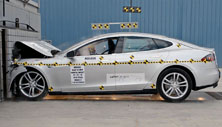
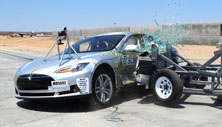
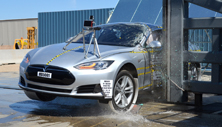
NHTSA crash tests
The agency crash-tested this model year itself. These are its own
photographs and star ratings.
Frontal crash test
Side barrier crash test
Side pole crash test
Photographs taken by NHTSA during its own New Car Assessment Program crash
tests of this model year. Public domain.
Configuration
Overall
Front
Side
Rollover
2014 Tesla Model S 5 HB RWD
5.7% risk
When owners complained
A spike years after the car went on sale usually means a part wearing
out on schedule across the whole fleet — the kind of pattern no single
owner can see from inside their own car.
Sep 2014peak 48Jul 2026
NHTSA investigations into the 2014 Tesla Model S
An investigation is the step before a recall: the agency has seen enough
complaints to look into a pattern itself. An open one means it thinks
something may be wrong and nothing has been fixed yet.
The Office of Defects Investigation (ODI) is opening a Recall Query to assess the remedy adequacy of Recall 23V838. On December 12, 2023, Tesla filed a Defect Information Report (Recall 23V838) applicable to all Tesla models produced and equipped with any version of its Autopilot system, which Tesla described as an SAE Level 2 (L2) Advanced Driver Assistance System (ADAS). Autopilot is the simultaneous engagement of Tesla’s Traffic-Aware Cruise Control (TACC) and Autosteer. In describing the safety defect, Tesla’s Defect Information Report (DIR) explained that “the prominence and scope of the...
DP23002Opened 29 Jun 2023Still openVEHICLE SPEED CONTROL
Sudden Unintended Acceleration
The Office of Defects Investigation (ODI) received a petition requesting that ODI reevaluate its decision to deny DP20-001 on the basis that intermittent high electrical current demands on the vehicles' 12VDC systems may have caused some or all of the incidents examined by ODI in DP20-001. The petitioner bases this information on a review of open-source research and the DP20-001 denial. The petition and related materials can be reviewed at NHTSA.gov under the following ODI number: 11528471.
From 2000 through 2017, Takata produced millions of air bag inflators using two types of phase-stabilized ammonium nitrate ("PSAN") propellant -- propellant 2004 and propellant 2004L. After prolonged exposure to high temperature cycles and humidity, inflators using propellant 2004 can degrade, causing the propellant to burn too quickly when ignited. The rapid burning can cause the inflator to rupture during deployment, potentially causing serious or even fatal injury to vehicle occupants. See 2016 Blomquist Report at www.nhtsa.gov/sites/nhtsa.gov/files/documents/expert_report-hrblomquist.pdf.C...
DP23001Opened 7 Apr 2023Closed 18 Mar 2026UNKNOWN OR OTHER
Defect Petition Interlock Request
On March 21, 2023, the Office of Defects Investigation (ODI) received a petition requesting a “recall of all Tesla cars” produced from 2013 to the date on which the petition was filed due to what Petitioner considers to be the increased likelihood of pedal misapplication. Attached to the Petition is a paper authored by Petitioner. According to Petitioner, the differences in the operator controls between the subject Tesla vehicles and internal combustion engine powered vehicles promote driver pedal misapplication, leading to sudden unintended acceleration (SUA) incidents. To fix this alleged de...
DP22005Opened 27 Jan 2023Closed 7 Aug 2023ELECTRICAL SYSTEM:PROPULSION SYSTEM
Pedestrian alert sounds
NHTSA received a petition on or about July 18, 2022, requesting that Federal Motor Vehicle Safety Standard (FMVSS) 141 be applied to all electric and hybrid vehicles operating in the United States. The petition can be reviewed at NHTSA.gov under ODI Number 11486072. FMVSS 141 establishes performance requirements for pedestrian alert sounds for motor vehicles. The standard applies to hybrid and electric vehicles that have a gross vehicle weight rating of 4,536 KG or less or are defined as low-speed vehicles. The standard became fully applicable to all such vehicles manufactured on or after Marc...
EA22002Opened 8 Jun 2022Closed 25 Apr 2024ELECTRICAL SYSTEM
Autopilot System Driver Controls
The Office of Defects Investigation (ODI) upgraded PE21020 to EA22002 on June 8, 2022, to extend work and deepen the PE21020 crash analysis, to supplement that analysis with additional data, and to perform vehicle evaluations to understand how Tesla’s Autopilot system may exacerbate human factors or behavioral safety risks by undermining the effectiveness of the driver’s supervision. To support this work, ODI collected additional crash information and assessed vehicle control authority, driver engagement technologies, and related human factors considerations associated with partial automation...
PE21020Opened 13 Aug 2021Closed 8 Jun 2022ELECTRICAL SYSTEM:ADAS
Autopilot & First Responder Scenes
On August 13, 2021, NHTSA?s Office of Defects Investigation (ODI) opened a Preliminary Evaluation (PE21-020) to assess the performance of Tesla?s Autopilot system (a system characterized by Tesla as an SAE Level 2 driving automation system designed to support and assist the driver in performing the driving task) available in Tesla vehicles. The investigation opening was motivated by an accumulation of crashes in which Tesla vehicles, operating with Autopilot engaged, struck stationary in-road or roadside first responder vehicles tending to pre-existing collision scenes. Upon opening the invest...
PE20020Opened 22 Nov 2020Closed 12 Aug 2024SUSPENSION:FRONT:CONTROL ARM:LOWER ARM
Fore Link Failure
The Office of Defects Investigation (ODI) opened this Preliminary Evaluation based on forty-three complaints alleging failure of the left or right front suspension fore links in Tesla model year (MY) 2015 through 2017 Model S and MY 2016 through 2017 Model X vehicles. The investigation has identified 426 instances of failure on part number 1041570-00-A or 1041575-00-A fore links.None of the instances resulted in any loss of vehicle control. One minor crash with no injuries is associated with the 426 instances fore link failures.A majority of the failures occurred between one to fifteen mph whi...
Recalls on the 2014 Tesla Model S
A complaint is one owner's allegation. A recall is the point at which
the manufacturer or a regulator agreed the defect is real and dangerous
enough to fix for free — however old the car is.
United States — NHTSA
24V376000
SEAT BELTS:FRONT:WARNING LIGHT/DEVICES
Tesla, Inc. (Tesla) is recalling certain 2012-2024 Model S, 2015-2024 Model X, 2017-2023 Model 3, and 2020-2023 Model Y vehicles. In the event of an unbelted driver, the seat belt warning light and audible chime may not activate as intended. As such, these vehicles fail to comply with the requirements of Federal Motor Vehicle Safety Standard number 208, "Occupant Crash Protection."
Risk: A seat belt warning system that fails to alert occupants of an unbelted seat belt can increase the risk of injury during a crash.
24V051000
ELECTRICAL SYSTEM: INSTRUMENT CLUSTER/PANEL
Tesla, Inc. (Tesla) is recalling certain 2012-2023 Model S, 2016-2024 Model X, 2017-2023 Model 3, 2019-2024 Model Y, and 2024 Cybertruck vehicles. An incorrect font size is displayed on the instrument panel for the Brake, Park, and Antilock Brake System (ABS) warning lights. As such, these vehicles fail to comply with the requirements of Federal Motor Vehicle Safety Standard number 105, "Hydraulic and Electric Brake Systems" and 135, "Light Vehicle Brake Systems."
Risk: Warning lights with a smaller font size can make critical safety information on the instrument panel difficult to read, increasing the risk of a crash.
Tesla, Inc. (Tesla) is recalling 2012-2023 Model S, 2016-2023 Model X, 2017-2023 Model 3, and 2020-2023 Model Y vehicles equipped with all versions of Autosteer leading up to the version(s) that contains the recall remedy. In certain circumstances when Autosteer is engaged, the prominence and scope of the feature's controls may not be sufficient to prevent driver misuse of the SAE Level 2 advanced driver-assistance feature.
Risk: In certain circumstances when Autosteer is engaged, and the driver does not maintain responsibility for vehicle operation and is unprepared to intervene as necessary or fails to recognize when Autosteer is canceled or not engaged, there may be an increased risk of a crash.
21V00B000
LATCHES/LOCKS/LINKAGES:HOOD:LATCH
Tesla, Inc. (Tesla) is recalling certain 2014-2021 Model S vehicles. The front trunk latch assembly may be misaligned, preventing the secondary hood latch from engaging. As such, these vehicles fail to comply with the requirements of Federal Motor Vehicle Safety Standard number 113, "Hood Latch System."
Risk: If the primary latch is inadvertently released and the secondary latch is not engaged, the hood could open unexpectedly, obstructing the driver's view and increasing the risk of a crash.
21V035000
BACK OVER PREVENTION:SOFTWARE
Tesla, Inc. (Tesla) is recalling certain 2012-2018 Tesla Model S and 2016-2018 Model X vehicles with a center display equipped with a NVIDIA Tegra 3 processor and an 8GB eMMC NAND flash memory device. When the 8GB eMMC NAND flash memory device for the center display reaches lifetime wear, the eMMC controller will no longer be able to maintain the integrity of the filesystem, causing a failure in some of the center display functions.
Risk: The eMMC controller wear-out condition can cause the loss of the rearview camera display, defrost/defog control settings, and exterior turn signal lighting, reducing visibility and increasing the risk of a crash.
19V002000
AIR BAGS:FRONTAL:PASSENGER SIDE:INFLATOR MODULE
Tesla, Inc. (Tesla) is recalling all 2014-2016 Model S vehicles equipped with certain air bag inflators assembled as part of the passenger frontal air bag modules used as original equipment or replacement equipment. In the event of a crash necessitating deployment of the passenger frontal air bag, these inflators may explode due to propellant degradation occurring after long-term exposure to absolute humidity and temperature cycling.
Risk: An inflator explosion may result in sharp metal fragments striking the driver or other occupants resulting in serious injury or death.
18V204000
STEERING:ELECTRIC POWER ASSIST SYSTEM
Tesla, Inc. (Tesla) is recalling certain 2012-2016 Tesla Model S vehicles equipped with Bosch steering racks. The aluminum bolts that attach the power steering gear assist motor to the gear housing may corrode and fracture causing a reduction or complete loss of power steering assist.
Risk: Loss of power steering assist would require a higher steering effort, especially at lower speeds, which may increase the risk of a crash.
17V260000
PARKING BRAKE
Tesla, Inc. (Tesla) is recalling certain 2016 Model S and Model X vehicles. The electric parking brake calipers have an internal gear that may be improperly manufactured, possibly resulting in the gear fracturing during parking brake application or release.
Risk: If the gear breaks during parking brake release, the vehicle will not be able to be moved. If the gear breaks during parking brake application, the parking brake may not adequately hold the vehicle, potentially resulting in the vehicle rolling, increasing the risk of a crash.
Canada — Transport Canada
Canada runs its own recall programme, and its campaigns do not
always mirror the American ones.
Recall 2024283109,791 units in Canada
Lights And Instruments
Issue: A previous over-the-air (OTA) software update could cause the vehicle not to display the correct visual warning indicators when there are problems with the brake system or when the parking brake is applied. As a result, the BRAKE, PARK, and antilock brake system (ABS) visual indicators would display as text instead of symbols. Safety Risk: While there is a low risk to safety, Canadian regulations require visual warnings to use common symbols, instead of words, to avoid driver confusion. Corrective Actions: Tesla will notify affected owners by email. Tesla has released an over-the-air software update to fix this problem. There is no further action required if your vehicle has software release 2024.3.25, 2024.14.5, or a release later than 2024.14.5.
Recall 2023657192,769 units in Canada
Accessories
Issue: On vehicles equipped with the Autosteer advanced driver-assistance feature, when using the feature, the vehicle may not provide strong enough warnings or monitor the driver closely enough to prevent misuse of the feature. Safety Risk: A driver that doesn't pay close attention while using the Autosteer feature or who doesn't react quickly when Autosteer is canceled could have an increased risk of a crash. Corrective Actions: Tesla will notify owners by email and supply an over-the-air software update to improve driver monitoring and alerts while using the Autosteer feature. Tesla advises that you must always pay attention and be ready to take control of the vehicle at any time while using the Autosteer advanced driver-assistance feature.
Recall 20217837,604 units in Canada
Structure
Issue: On certain vehicles, the front trunk (frunk) hood latch may not be positioned properly. As a result, the secondary latch may not hold the hood closed. This could cause the hood to open suddenly while driving if the primary hood latch is released. Safety Risk: A hood that opens suddenly while driving could block the driver's view and increase the risk of a crash. Corrective Actions: Tesla will notify owners by e-mail and arrange for an inspection of the secondary hood latch. If the hood doesn't latch properly, Tesla Service will reassemble and reposition the latch mechanism.
Recall 20210389,023 units in Canada
Electrical
Issue: On certain vehicles, the internal memory for the media control unit (MCU) could run out of storage capacity over time. If this happens, the center display can turn off while driving and cause some of the car's systems not to work properly. This includes the rearview camera display, defrost/defog control settings, and exterior turn signal lighting. Safety Risk: A rearview camera image that does not display could reduce a driver's ability to see behind the vehicle while backing up. A windshield that cannot be defrosted/defogged could reduce visibility. Turn signals that do not work could cause a following driver not to recognize that a vehicle ahead intends to turn. These conditions could increase the risk of a crash. Corrective Actions: Tesla advises owners to ensure that their vehicle software is up to date. Tesla will notify owners by email, including when parts are available to schedule service to upgrade the internal memory in the MCU.
Recall 202049749,984 units in Canada
Lights And Instruments
Issue: On certain vehicles, when switching the distance display setting from kilometers to miles, the speedometer displays the vehicle speed in miles per hour (mph) only. Canadian regulations require that speed be displayed in either kilometers per hour (km/h) or in both km/h and mph. Safety Risk: This small error does not affect vehicle safety. Corrective Actions: This is not a recall. Tesla has made changes to ensure that all new vehicle speedometers display mph and km/h when the display distance is set to miles. In addition, this change was sent to all vehicles in firmware update 2020.36.11.
Recall 20190044,583 units in Canada
Airbag
Issue: On certain vehicles, long-term exposure to high absolute humidity and temperature, combined with high temperature cycling, may eventually degrade the propellant contained in the passenger-front airbag. This could cause the airbag to deploy with more force than normal. If the airbag inflator ruptures, fragments could be propelled toward vehicle occupants or cause damage to the airbag assembly, preventing its proper function. Safety Risk: If the vehicle is involved in a crash requiring an airbag deployment, the airbag inflator could rupture and create a risk of injury. Corrective Actions: Owners will be notified by mail and instructed to take their vehicle to a Tesla service center to have the passenger-front airbag inflator replaced. Note: The Canadian climate results in the propellant degrading slowly. This recall is being conducted as a precaution to address future risk. It is expected that all airbag inflators will be replaced before their function would be affected.
Recall 20181494,275 units in Canada
Steering
On certain vehicles, the bolts that attach the power steering gear assist motor to the gear housing may corrode and fracture. This could allow the power steering gear assist motor to move, causing the belt to slip which could result in a loss of power steering assist. A loss of power steering assist would require additional steering effort which could increase the risk of a crash causing injury and/or damage to property. Correction: Tesla service centers will replace the aluminum mounting bolts with coated steel bolts and will apply a corrosion-preventative sealer around the gear housing and connecting bolts. If bolts are found to be broken or break during the removal process, Tesla will also install a new steering gear.
Recall 2016614280 units in Canada
Electrical
*** This notice is provided for information purposes only as the subject equipment is not regulated under the Motor Vehicle Safety Act *** The NEMA 14-30, NEMA 10-30 and NEMA 6-50 electrical adapter that could have been separately purchased as an accessory for the universal mobile charging connector on certain Tesla Motors vehicles may be impacted by higher than normal electrical resistance due to a potential manufacturing defect. This could cause the adapter to overheat, potentially increasing the risk of a fire causing injury and/or damage to property. Correction: impacted owners will be supplied with a redesigned NEMA adapter. Updated adapters will be sent by Canada Post or commercial carrier once available.
Reports where the owner recorded a crash, a fire, an injury or a death.
Coronado, CACrash1 injured
VEHICLE SPEED CONTROL
I have been driving my Model S Tesla for 13 years. On 30 April as I was pulling into a parking space at my local grocery store, I applied the brakes to ease into the space and my car surged forward with unintended acceleration. I smashed into the concrete base of a light pole, the airbags deployed and my car ricocheted back about 8 feet. There were no warning messages. I was taken to the emergency room and had whiplash and a burn on my leg from the airbag. No one else was hurt. I know it was the car that malfunctioned because my foot was still on the brake after the collision and the airbags bruised the right side of my right leg. It could not have bruised it in that way if my foot had been on the accelerator. The insurance company inspected and declared a total loss. I obtained the black box data from Tesla and am uploading the documents below. The car is currently at the Tesla collision center. They do not seem interested in evaluating the problem.
NHTSA complaint #11741164 — an unverified report by a vehicle owner.
Coronado, CACrash1 injured
SERVICE BRAKES
I have been driving my Model S Tesla for 13 years. On 30 April as I was pulling into a parking space at my local grocery store, I applied the brakes to ease into the space and my car surged forward with unintended acceleration. I smashed into the concrete base of a light pole, the airbags deployed and my car ricocheted back about 8 feet. There were no warning messages. I was taken to the emergency room and had whiplash and a burn on my leg from the airbag. No one else was hurt. I know it was the car that malfunctioned because my foot was still on the brake after the collision and the airbags bruised the right side of my right leg. It could not have bruised it in that way if my foot had been on the accelerator. The insurance company inspected and declared a total loss. I obtained the black box data from Tesla and am uploading the documents below. The car is currently at the Tesla collision center. They do not seem interested in evaluating the problem.
NHTSA complaint #11741164 — an unverified report by a vehicle owner.
at 180,000 milesBellevue, WACrash1 injured
STEERING
The contact owned a 2014 Tesla Model S. The contact stated that while driving at an undisclosed speed on the highway, the vehicle exited into a tunnel. The contact stated that his hands were on the steering wheel and that the steering wheel did not move; however, the vehicle inadvertently made a sharp left turn, and the passenger-side headlight struck the tunnel wall. The vehicle spun rapidly, and the contact's head snapped to the right. The air bags did not deploy. The contact received medical attention for whiplash. Police were made aware of the crash but did not arrive on the scene. There was no police report filed. The contact pulled over on the shoulder of the road and then restarted the vehicle. The vehicle had driven for a mile when the tire pressure dropped to zero. The vehicle was towed to the residence and then to a tow yard, where it was deemed totaled by the insurance company. The manufacturer was made aware of the failure. The failure mileage was approximately 180,000.
NHTSA complaint #11717659 — an unverified report by a vehicle owner.
Cape Coral, FLFire
AIR BAGS
Three separate reports from car to Tesla: Traction Control Disabled Stability Control Disabled Automatic Emergency Braking Disabled Two hours later my car caught on fire while parked at my home. It was declared a total loss.
NHTSA complaint #11545459 — an unverified report by a vehicle owner.
Cape Coral, FLFire
STRUCTURE:BODY
Three separate reports from car to Tesla: Traction Control Disabled Stability Control Disabled Automatic Emergency Braking Disabled Two hours later my car caught on fire while parked at my home. It was declared a total loss.
NHTSA complaint #11545459 — an unverified report by a vehicle owner.
Cape Coral, FLFire
ELECTRICAL SYSTEM
Three separate reports from car to Tesla: Traction Control Disabled Stability Control Disabled Automatic Emergency Braking Disabled Two hours later my car caught on fire while parked at my home. It was declared a total loss.
NHTSA complaint #11545459 — an unverified report by a vehicle owner.
The most recent complaints
In the owners' own words, exactly as filed with NHTSA.
Carmel, IN
UNKNOWN OR OTHER
Dashboard is leaking glue out the bottom center causing the computer screen and dash control panels to move. I'm not feeling safe driving as I'm not sure if they will drop down or stop functioning at any point. Tesla wants $1500 to fix, and I don't have that money being retired. How can Tesla glue their cars together, and it only last for about 10 yrs?? I feel like this is a safety issue that they should be fixing.
NHTSA complaint #11750141 — an unverified report by a vehicle owner.
Orange, CA
SEAT BELTS
This issue appears to be related to a known MCU failure affecting early Tesla Model S vehicles. The touchscreen exhibits screen melting/discoloration and eventually goes blank or becomes inoperative. When this occurs, critical functions including occupant detection indicators, seatbelt warnings, and windshield defrost controls may become unavailable. The loss of these functions creates potential safety risks involving visibility, occupant protection, and driver awareness while operating the vehicle."
NHTSA complaint #11744089 — an unverified report by a vehicle owner.
Orange, CA
AIR BAGS
This issue appears to be related to a known MCU failure affecting early Tesla Model S vehicles. The touchscreen exhibits screen melting/discoloration and eventually goes blank or becomes inoperative. When this occurs, critical functions including occupant detection indicators, seatbelt warnings, and windshield defrost controls may become unavailable. The loss of these functions creates potential safety risks involving visibility, occupant protection, and driver awareness while operating the vehicle."
NHTSA complaint #11744089 — an unverified report by a vehicle owner.
Orange, CA
UNKNOWN OR OTHER
This issue appears to be related to a known MCU failure affecting early Tesla Model S vehicles. The touchscreen exhibits screen melting/discoloration and eventually goes blank or becomes inoperative. When this occurs, critical functions including occupant detection indicators, seatbelt warnings, and windshield defrost controls may become unavailable. The loss of these functions creates potential safety risks involving visibility, occupant protection, and driver awareness while operating the vehicle."
NHTSA complaint #11744089 — an unverified report by a vehicle owner.
Coronado, CACrash1 injured
VEHICLE SPEED CONTROL
I have been driving my Model S Tesla for 13 years. On 30 April as I was pulling into a parking space at my local grocery store, I applied the brakes to ease into the space and my car surged forward with unintended acceleration. I smashed into the concrete base of a light pole, the airbags deployed and my car ricocheted back about 8 feet. There were no warning messages. I was taken to the emergency room and had whiplash and a burn on my leg from the airbag. No one else was hurt. I know it was the car that malfunctioned because my foot was still on the brake after the collision and the airbags bruised the right side of my right leg. It could not have bruised it in that way if my foot had been on the accelerator. The insurance company inspected and declared a total loss. I obtained the black box data from Tesla and am uploading the documents below. The car is currently at the Tesla collision center. They do not seem interested in evaluating the problem.
NHTSA complaint #11741164 — an unverified report by a vehicle owner.
Coronado, CACrash1 injured
SERVICE BRAKES
I have been driving my Model S Tesla for 13 years. On 30 April as I was pulling into a parking space at my local grocery store, I applied the brakes to ease into the space and my car surged forward with unintended acceleration. I smashed into the concrete base of a light pole, the airbags deployed and my car ricocheted back about 8 feet. There were no warning messages. I was taken to the emergency room and had whiplash and a burn on my leg from the airbag. No one else was hurt. I know it was the car that malfunctioned because my foot was still on the brake after the collision and the airbags bruised the right side of my right leg. It could not have bruised it in that way if my foot had been on the accelerator. The insurance company inspected and declared a total loss. I obtained the black box data from Tesla and am uploading the documents below. The car is currently at the Tesla collision center. They do not seem interested in evaluating the problem.
NHTSA complaint #11741164 — an unverified report by a vehicle owner.
Austin, TX
POWER TRAIN
Motor suddenly failed after a required update while driving, nearly causing a crash with multiple commercial vehicles and pedestrians, leaving brake lights dangerously always on and alarm sounding, killed 12v as well.
NHTSA complaint #11735218 — an unverified report by a vehicle owner.
Austin, TX
EXTERIOR LIGHTING
Motor suddenly failed after a required update while driving, nearly causing a crash with multiple commercial vehicles and pedestrians, leaving brake lights dangerously always on and alarm sounding, killed 12v as well.
NHTSA complaint #11735218 — an unverified report by a vehicle owner.
Austin, TX
ENGINE
Motor suddenly failed after a required update while driving, nearly causing a crash with multiple commercial vehicles and pedestrians, leaving brake lights dangerously always on and alarm sounding, killed 12v as well.
NHTSA complaint #11735218 — an unverified report by a vehicle owner.
Franklin, TN
POWER TRAIN
**Incident / Defect Description for NHTSA Safety Complaint** **Vehicle Information** - Make: Tesla - Model: Model S - Year: 2014 - VIN: [XXX] - Approximate Mileage: 148,129 miles - Date of Discovery / Failure: 04/23/2026 **Description of the Defect** This vehicle is equipped with Tesla’s Large Drive Unit (LDU / rear drive unit), which was used in the majority of 2012–early 2020 Model S vehicles (RWD and Performance models). The LDU design routes coolant through the hollow rotor shaft. Over time, the rotor seal fails and allows ethylene glycol coolant to leak internally into the motor and inverter. Evidence of this failure is easily visible by removing the rear speed sensor, where blue coolant, corrosion, and debris are present. This is a well-documented design flaw affecting thousands of vehicles. **Consequences of the Defect** Coolant intrusion causes: • Corrosion and rust in the stator windings • Washing out of bearing grease • High-voltage isolation faults • Inverter damage • Complete drive unit failure **Safety Risks** This defect presents an unreasonable risk to motor vehicle safety because: • Drive unit failure can occur suddenly and without warning while driving, resulting in total loss of propulsion. This is especially dangerous on highways, in traffic, or at high speeds. • Coolant inside high-voltage electrical components increases the risk of electrical shorts, arcing, or fire. • Reduced power or complete shutdown can lead to loss of vehicle control and potential crashes. I have experienced complete drive unit failure. Many other owners report identical issues, often between 50,000–120,000 miles. Tesla has not issued a recall despite this being a widespread, predictable design defect. INFORMATION REDACTED PURSUANT TO THE FREEDOM OF INFORMATION ACT (FOIA), 5 U.S.C. 552(B)(6)
NHTSA complaint #11734270 — an unverified report by a vehicle owner.
Roanoke, AL
ELECTRICAL SYSTEM
Agency: National Highway Traffic Safety Administration I am submitting a complaint regarding repeated denial of access to charging infrastructure for my electric vehicle due to fraudulent billing activity within Tesla’s Supercharger network. I own a 2014 Tesla Model S located in Alabama. My Tesla account has repeatedly recorded Supercharging sessions in California that were not performed by my vehicle. Tesla customer support representatives have acknowledged that this issue appears to involve VIN cloning or a flaw in their charging identification system. Because I blocked my credit card to prevent fraudulent charges, Tesla’s system repeatedly flags my account as having unpaid balances and automatically disables my vehicle’s access to the Supercharger network until those balances are resolved. This creates a situation where my vehicle can be denied access to charging infrastructure even though the charges are fraudulent and unrelated to my vehicle’s actual activity. The issue has occurred multiple times over several months and requires repeated calls to Tesla customer support to restore charging functionality. Loss of access to charging infrastructure can significantly impact the usability and operational reliability of an electric vehicle. I am requesting that this issue be investigated as a potential defect in the Supercharger billing or authentication system that could affect multiple vehicle owners.
NHTSA complaint #11723948 — an unverified report by a vehicle owner.
Glen Ellyn, IL
STRUCTURE:BODY
Rear Door handles are inoperable again after repairs made by dealer. The fault is due to design fault with the wiring harness on the door handles. Manufacturer refuses to make repairs under warranty
NHTSA complaint #11721790 — an unverified report by a vehicle owner.
Bay Point, CA
UNKNOWN OR OTHER
The rear door handle has failed and now the door pops open when parked.
NHTSA complaint #11720129 — an unverified report by a vehicle owner.
Bay Point, CA
STRUCTURE:BODY
The rear door handle has failed and now the door pops open when parked.
NHTSA complaint #11720129 — an unverified report by a vehicle owner.
Bay Point, CA
ELECTRICAL SYSTEM
The rear door handle has failed and now the door pops open when parked.
NHTSA complaint #11720129 — an unverified report by a vehicle owner.
Austin, TX
ENGINE
This is regarding a 2014 Model S fully electric vehicle. Any reference to an 'engine' simply implies the motor. Accelerator pedal became unresponsive and abruptly lost drive power while going ~55mph on the highway. The PRND display on the display panel went red. Car was towed to the service center Immediately after this malfunction, I somehow cruised along towards the shoulder with just with brakes and hazard lights. Total loss of motor power caused vehicle to slow down and vehicles behind me had to slow down (and honk). After coming to complete stop and shifting to Park the PRND display turned white again indicating function was restored. Shifting to D seem to re-engage the motor and I could pull away to the nearest exit and then into a parking lot. At this location it no longer responded to R or D positions and had to finally towed. Frequent drive unit failure is apparently a prevalent issue on certain models. Not sure if anyone else was in a similar situation. Service centers admit this as well as there is evidence on online forums Warning sign (PRND turning red) appeared at the exact moment of failure. On stopping and going back to Park it would go away. No persistent errors remained on the screen. After the motor had completely failed, various other warnings started appearing (ref photos)
NHTSA complaint #11718369 — an unverified report by a vehicle owner.
at 180,000 milesBellevue, WACrash1 injured
STEERING
The contact owned a 2014 Tesla Model S. The contact stated that while driving at an undisclosed speed on the highway, the vehicle exited into a tunnel. The contact stated that his hands were on the steering wheel and that the steering wheel did not move; however, the vehicle inadvertently made a sharp left turn, and the passenger-side headlight struck the tunnel wall. The vehicle spun rapidly, and the contact's head snapped to the right. The air bags did not deploy. The contact received medical attention for whiplash. Police were made aware of the crash but did not arrive on the scene. There was no police report filed. The contact pulled over on the shoulder of the road and then restarted the vehicle. The vehicle had driven for a mile when the tire pressure dropped to zero. The vehicle was towed to the residence and then to a tow yard, where it was deemed totaled by the insurance company. The manufacturer was made aware of the failure. The failure mileage was approximately 180,000.
NHTSA complaint #11717659 — an unverified report by a vehicle owner.
Hillsboro, OR
EXTERIOR LIGHTING
I am the current owner of a 2014 Tesla Model S equipped with MCU1. While driving, including at freeway speeds, the center touchscreen has rebooted unexpectedly, showing only the Tesla logo before recovering. During these reboots, critical vehicle functions are unavailable, including the rearview camera, HVAC/defrost controls, and other essential features. This failure matches the exact safety defect described in NHTSA Recall 21V-035 related to the MCU/eMMC failure. I reported this safety issue to Tesla Service and provided photo evidence of the screen rebooting while driving. Tesla has refused to address this as a recall or safety repair. Tesla claims the recall was previously completed under a prior owner but refuses to provide any documentation proving that the recall repair was actually performed, citing prior owner privacy. Tesla has further stated that diagnosis of this active safety defect would be customer-paid due to the basic warranty being expired and has indicated that the only path forward is a paid infotainment upgrade. Tesla is effectively requiring payment to diagnose and resolve a known safety defect. As the safety defect is actively occurring while driving and Tesla has marked the recall as complete without providing proof or correcting the issue, I am requesting NHTSA review whether Tesla is improperly closing out recalls without ensuring the defect has been remedied and whether charging customers to diagnose known safety defects is appropriate. After entering my VIN into NHTSA’s recall lookup, NHTSA shows Recall 21V-035 (MCU/eMMC failure) as Recall Incomplete for my vehicle. This directly contradicts Tesla’s claim that the recall was previously completed. Tesla has refused to provide documentation and is requiring paid diagnosis and a paid infotainment upgrade despite the recall being listed by NHTSA as unresolved.
NHTSA complaint #11705673 — an unverified report by a vehicle owner.
Hillsboro, OR
ELECTRICAL SYSTEM
I am the current owner of a 2014 Tesla Model S equipped with MCU1. While driving, including at freeway speeds, the center touchscreen has rebooted unexpectedly, showing only the Tesla logo before recovering. During these reboots, critical vehicle functions are unavailable, including the rearview camera, HVAC/defrost controls, and other essential features. This failure matches the exact safety defect described in NHTSA Recall 21V-035 related to the MCU/eMMC failure. I reported this safety issue to Tesla Service and provided photo evidence of the screen rebooting while driving. Tesla has refused to address this as a recall or safety repair. Tesla claims the recall was previously completed under a prior owner but refuses to provide any documentation proving that the recall repair was actually performed, citing prior owner privacy. Tesla has further stated that diagnosis of this active safety defect would be customer-paid due to the basic warranty being expired and has indicated that the only path forward is a paid infotainment upgrade. Tesla is effectively requiring payment to diagnose and resolve a known safety defect. As the safety defect is actively occurring while driving and Tesla has marked the recall as complete without providing proof or correcting the issue, I am requesting NHTSA review whether Tesla is improperly closing out recalls without ensuring the defect has been remedied and whether charging customers to diagnose known safety defects is appropriate. After entering my VIN into NHTSA’s recall lookup, NHTSA shows Recall 21V-035 (MCU/eMMC failure) as Recall Incomplete for my vehicle. This directly contradicts Tesla’s claim that the recall was previously completed. Tesla has refused to provide documentation and is requiring paid diagnosis and a paid infotainment upgrade despite the recall being listed by NHTSA as unresolved.
NHTSA complaint #11705673 — an unverified report by a vehicle owner.
Hillsboro, OR
VISIBILITY/WIPER
I am the current owner of a 2014 Tesla Model S equipped with MCU1. While driving, including at freeway speeds, the center touchscreen has rebooted unexpectedly, showing only the Tesla logo before recovering. During these reboots, critical vehicle functions are unavailable, including the rearview camera, HVAC/defrost controls, and other essential features. This failure matches the exact safety defect described in NHTSA Recall 21V-035 related to the MCU/eMMC failure. I reported this safety issue to Tesla Service and provided photo evidence of the screen rebooting while driving. Tesla has refused to address this as a recall or safety repair. Tesla claims the recall was previously completed under a prior owner but refuses to provide any documentation proving that the recall repair was actually performed, citing prior owner privacy. Tesla has further stated that diagnosis of this active safety defect would be customer-paid due to the basic warranty being expired and has indicated that the only path forward is a paid infotainment upgrade. Tesla is effectively requiring payment to diagnose and resolve a known safety defect. As the safety defect is actively occurring while driving and Tesla has marked the recall as complete without providing proof or correcting the issue, I am requesting NHTSA review whether Tesla is improperly closing out recalls without ensuring the defect has been remedied and whether charging customers to diagnose known safety defects is appropriate. After entering my VIN into NHTSA’s recall lookup, NHTSA shows Recall 21V-035 (MCU/eMMC failure) as Recall Incomplete for my vehicle. This directly contradicts Tesla’s claim that the recall was previously completed. Tesla has refused to provide documentation and is requiring paid diagnosis and a paid infotainment upgrade despite the recall being listed by NHTSA as unresolved.
NHTSA complaint #11705673 — an unverified report by a vehicle owner.
Lagrange, GA
ELECTRICAL SYSTEM
My [XXX] mother owns a 2014 Tesla Model S P85+ (VIN: [XXX] ) with only 50,367 miles. The vehicle suddenly became completely inoperable without warning. It would not turn on, would not charge, and the charge port would not open. The vehicle had to be towed. Tesla diagnosed failures of the high-voltage battery contactors, the onboard charger assembly, and HV circuit integrity. These are essential high-voltage components that should not fail at such low mileage. When these parts fail, the vehicle loses all ability to charge, loses all propulsion capability, and becomes a stranded hazard. This represents a safety concern because the vehicle can shut down without warning and cannot be moved, which could leave occupants stuck in unsafe conditions or traffic. The charge port failing to open is also a safety issue, as the vehicle cannot be charged in an emergency and the owner has no way to safely get the vehicle off the road once it loses power. Tesla quoted nearly $4,000 for repairs and refused goodwill assistance even though this is a known early Model S issue and these components have been redesigned in later models. My mother is on a fixed Social Security income and cannot afford the repair or even the diagnostic fee. This situation may cause her vehicle to be repossessed through no fault of her own. I am requesting NHTSA to review premature high-voltage component failures on early Tesla Model S vehicles, as these failures pose safety risks and leave owners stranded with no warning. INFORMATION REDACTED PURSUANT TO THE FREEDOM OF INFORMATION ACT (FOIA), 5 U.S.C. 552(B)(6)
NHTSA complaint #11703740 — an unverified report by a vehicle owner.
Walnut, CA
UNKNOWN OR OTHER
After a high-voltage junction box repair performed by Tesla, the vehicle shut down 15 miles after leaving the service center. Tesla replaced the high-voltage harness at no cost but provided no explanation. After the HV harness replacement, new proximity/sensor alerts began triggering that were not present before their HV work. Multiple reasonable diagnostic procedures were refused, including bench-testing the sensors. Tesla is pressuring me to take possession of the vehicle without providing written confirmation that it is safe to operate following the HV system failure and subsequent replacement of HV components. I am concerned the vehicle may have unresolved high-voltage or wiring issues that could pose a safety hazard.
NHTSA complaint #11701015 — an unverified report by a vehicle owner.
Walnut, CA
ELECTRICAL SYSTEM
After a high-voltage junction box repair performed by Tesla, the vehicle shut down 15 miles after leaving the service center. Tesla replaced the high-voltage harness at no cost but provided no explanation. After the HV harness replacement, new proximity/sensor alerts began triggering that were not present before their HV work. Multiple reasonable diagnostic procedures were refused, including bench-testing the sensors. Tesla is pressuring me to take possession of the vehicle without providing written confirmation that it is safe to operate following the HV system failure and subsequent replacement of HV components. I am concerned the vehicle may have unresolved high-voltage or wiring issues that could pose a safety hazard.
NHTSA complaint #11701015 — an unverified report by a vehicle owner.
Walnut, CA
FUEL/PROPULSION SYSTEM
After a high-voltage junction box repair performed by Tesla, the vehicle shut down 15 miles after leaving the service center. Tesla replaced the high-voltage harness at no cost but provided no explanation. After the HV harness replacement, new proximity/sensor alerts began triggering that were not present before their HV work. Multiple reasonable diagnostic procedures were refused, including bench-testing the sensors. Tesla is pressuring me to take possession of the vehicle without providing written confirmation that it is safe to operate following the HV system failure and subsequent replacement of HV components. I am concerned the vehicle may have unresolved high-voltage or wiring issues that could pose a safety hazard.
NHTSA complaint #11701015 — an unverified report by a vehicle owner.
Bucharest, PR
UNKNOWN OR OTHER
The main touchscreen (MCU1) and instrument cluster on my 2014 Tesla Model S frequently freeze, reboot, or go blank while driving. When this happens, I lose access to defrost, turn signals, backup camera, and speed display. I contacted Tesla Service, but they refused to repair or replace the unit under recall EA20-003 or the extended warranty, even though the symptoms match the known eMMC 8GB memory failure. The black screen and frozen instrument cluster create a clear safety risk. Tesla should cover this issue under the recall or provide an equivalent MCU2 replacement if MCU1 parts are unavailable.
NHTSA complaint #11695537 — an unverified report by a vehicle owner.