Owners have filed 2,378 complaints
about the 2017 Chrysler Pacifica with NHTSA between 2016 and 2026.
The largest single group is the engine & cooling.
Across this model's run it ranks 2 of 15 worst.
The letter says how bad. This says what kind — whether this year drew
an unusual number of complaints, unusually dangerous
ones, or failures that arrived unusually early.
The dashed ring is 50 — the national norm. Further out is worse.
Complaint volume — 100
Against the median year of the Chrysler Pacifica. 50 means typical for this
model; 100 means roughly double.
Severity — 27
5.3% of these complaints
involved a crash, fire, injury or death, against a national rate of
9.7%.
Early failure — 100
64% of failures with a mileage on record happened under
36,000 miles, against a national rate of
29%.
How 2017 compares with every other Chrysler Pacifica
NHTSA files every complaint against a named sub-assembly, not just a
system. This is the difference between knowing it was "the engine" and
knowing which part of it — the list to hand a mechanic.
Body
5264.2%
Door
67.4%
Adaptive Cruise Control
56.2%
Warnings
44.9%
Automatic Emergency Braking
44.9%
Warnings
44.9%
Rearview System Braking
33.7%
Assist
33.7%
When it fails
Odometer readings owners gave when they filed. About half of all
complaints include one.
Under 1,000 miles
886.9%
1,000 – 9,999 miles
23518.4%
10,000 – 24,999 miles
33426.1%
25,000 – 49,999 miles
33326.0%
50,000 – 74,999 miles
17813.9%
75,000 – 99,999 miles
604.7%
100,000 – 149,999 miles
372.9%
150,000+ miles
141.1%
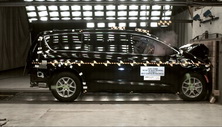
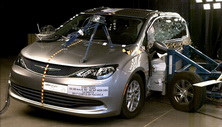
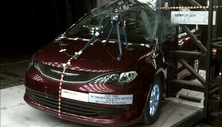
NHTSA crash tests
The agency crash-tested this model year itself. These are its own
photographs and star ratings.
Frontal crash test
Side barrier crash test
Side pole crash test
Photographs taken by NHTSA during its own New Car Assessment Program crash
tests of this model year. Public domain.
Configuration
Overall
Front
Side
Rollover
2017 Chrysler Pacifica VAN FWD
11.6% risk
When owners complained
A spike years after the car went on sale usually means a part wearing
out on schedule across the whole fleet — the kind of pattern no single
owner can see from inside their own car.
May 2016peak 61Sep 2026
NHTSA investigations into the 2017 Chrysler Pacifica
An investigation is the step before a recall: the agency has seen enough
complaints to look into a pattern itself. An open one means it thinks
something may be wrong and nothing has been fixed yet.
2
investigations are
still open.
PE25009Opened 5 Sep 2025Still openSTEERING:ELECTRIC POWER ASSIST SYSTEM
Intermittent Loss of Electric Power Steering
The Office of Defects Investigation (ODI) is opening this Preliminary Evaluation to assess the scope, frequency, and potential safety consequences of alleged defects related to the electric power steering (EPS) system in model year (MY) 2017–2018 Chrysler Pacifica vehicles. ODI has received 94 Vehicle Owner Questionnaires (VOQs) reporting a condition in which the steering system exhibits a sticking sensation during gradual turns, particularly when the steering wheel is positioned near the 11 o'clock or 1 o'clock position. Complainants allege that during these events, increased steering effort...
RQ24001Opened 16 Jan 2024Still openELECTRICAL SYSTEM:PROPULSION SYSTEM:TRACTION BATTERY
Ignition-off high voltage battery fire (Remedy effectiveness of Recall 22V-077)
On February 11, 2022, Fiat Chrysler Automobiles (FCA) issued a safety recall (NHTSA Recall 22V-077) on all 2017-2018 Pacifica Plug-In Hybrid Electric Vehicles (PHEV) produced between August 12, 2016 through August 7, 2018. The recall addresses ignition “OFF’ fires that originate at the high voltage (HV) battery pack assembly. An ignition ‘OFF’ vehicle fire can result in an increased risk of occupant injury, injury to persons outside the vehicle, and property damage, with little to no warning. At the time of the recall filing the root cause of the vehicle fires was unknown and under investigati...
DP17003Opened 1 Dec 2017Closed 1 Mar 2018ENGINE AND ENGINE COOLING:ENGINE:GASOLINE
Stall/Loss of Motive Power
By letter dated November 30, 2017, the Center for Auto Safety (CAS) petitioned the National Highway Traffic Safety Administration requesting it open an investigation into allegations of engine stalling in the model year (MY) 2017 Chrysler Pacifica, a new vehicle platform. In support of its petition, CAS cited 57 NHTSA complaints alleging an engine stall in the subject Pacifica vehicles, in addition to other information it provided.On December 1, 2017, NHTSA's Office of Defects Investigation opened Defect Petition 17-003 as requested by CAS.ODI sent an information request letter to Fiat Chrysle...
Recalls on the 2017 Chrysler Pacifica
A complaint is one owner's allegation. A recall is the point at which
the manufacturer or a regulator agreed the defect is real and dangerous
enough to fix for free — however old the car is.
Rollx Vans (Rollx) is recalling certain GMC Yukon, Sierra, Chevrolet Express 2500, Ford Transit, E-250, Toyota Sienna, Sienna Hybrid, Honda Odyssey, Chrysler Town and Country, Voyager, Pacifica, Dodge Grand Caravan, and Ram Promaster vehicles equipped with QRT-Deluxe and QRT-Max wheelchair restraints. Please refer to Rollx's recall report for specific model year information. The retractors may not lock, preventing the wheelchair from being properly secured.
Risk: An unsecured wheelchair can move during transit, increasing the risk of injury.
Chrysler (FCA US, LLC) is recalling certain 2017-2023 Pacifica Plug-In Hybrid Electric vehicles (PHEVs). An internal transmission wiring connector may short circuit, resulting in an unexpected engine shutdown.
Risk: An unexpected engine shutdown can cause a loss of drive power, increasing the risk of a crash.
19V348000
ELECTRICAL SYSTEM:12V/24V/48V BATTERY
Chrysler (FCA US LLC) is recalling certain 2017-2019 Pacifica vehicles equipped with engine stop/start systems. A loose battery ground connection may result in an intermittent loss of power steering assist and/or a stall.
Risk: A loss of power steering assist or a stall can increase the risk of crash.
18V524000
ELECTRICAL SYSTEM:WIRING:FRONT UNDERHOOD
Chrysler (FCA US LLC) is recalling certain 2018 Jeep Renegade, Compass and Grand Cherokee, RAM 1500 and Promaster, Fiat 500x, Dodge Journey, Challenger, Charger and Durango and Chrysler 300x vehicles, 2017-2018 Jeep Wrangler, Dodge Grand Caravan and Chrysler Town and Country vehicles and 2018-2019 Jeep Cherokee and 2018 Chrysler Pacifica and Pacifica Hybrid vehicles. The powertrain control module may be equipped with a voltage regulator chip in the circuit board that may fail, causing a stall or a no start condition.
Risk: A vehicle stall can increase the risk of a crash.
Chrysler (FCA US LLC) is recalling certain 2017-2018 Chrysler Pacifica vehicles. The Manual Park Release (MPR) plug may be removed without a tool. As such, these vehicles fail to comply with the requirements of Federal Motor Vehicle Safety Standard (FMVSS) number 114, "Theft Protection."
Risk: If the MPR is engaged unintentionally, the vehicle could roll away striking and injuring a bystander or cause a crash.
18V332000
ELECTRICAL SYSTEM:WIRING
Chrysler (FCA US LLC) is recalling certain 2014-2018 Dodge Journey, Charger and Durango, RAM 2500, 3500, 3500 Cab Chassis (more than 10,000lb), 4500 Cab Chassis and 5500 Cab Chassis, Jeep Cherokee and Grand Cherokee and Chrysler 300, 2014-2019 RAM 1500, 2015-2018 Dodge Challenger, 2015-2017 Chrysler 200, 2016-2018 RAM 3500 Cab Chassis (less than 10,000 lb), 2017-2018 Chrysler Pacifica and 2018 Jeep Wrangler vehicles. These vehicles are being recalled to address a defect that could prevent the cruise control system from disengaging. If, when using cruise control, there is a short circuit within the vehicle's wiring, the driver may not be able to shut off the cruise control either by depressing the brake pedal or manually turning the system off once it has been engaged, resulting in either the vehicle maintaining its current speed or possibly accelerating.
Risk: If the vehicle maintains its speed or accelerates despite attempts to deactivate the cruise control, there would be an increased risk of a crash.
18V049000
ELECTRICAL SYSTEM:SOFTWARE
Chrysler (FCA US LLC) is recalling certain 2017 Chrysler Pacifica vehicles equipped with a 3.6l engine. The engine control software may become out of sync with the crankshaft position sensor, possibly resulting in an engine stall.
Risk: An engine stall can increase the risk of a crash.
17V542000
SEAT BELTS:REAR/OTHER
Chrysler (FCA US LLC) is recalling certain 2017-2018 Chrysler Pacifica vehicles equipped with the 8-passenger seating option. In certain passenger seating and vehicle situations, the second-row center seating position seat belt buckle could cause the left outboard seat belt to become unlatched.
Risk: Inadvertent unlatching of the left outboard seat belt can increase the risk of injury in the event of a crash.
Canada — Transport Canada
Canada runs its own recall programme, and its campaigns do not
always mirror the American ones.
Recall 2024548314,717 units in Canada
Label
Issue: On certain vehicles, the tire and loading information label does not list that there is no spare tire in both official languages. The label reads as "NONE" when it should read as "NONE / AUCUN". Canadian regulations require the information to be listed on the label in both English and French. Safety Risk: This error does not affect vehicle safety. Corrective Actions: This is not a recall. The company has corrected the tire and loading information label for all new vehicles.
Recall 20244122,293 units in Canada
High Voltage
Issue: On certain vehicles, the recall repairs completed by an FCA dealer during recall Z11 (Transport Canada recall no. 2022-063) may not be effective. As a result, a second repair is required. On certain vehicles, a problem inside the high-voltage battery assembly could cause a short circuit. Note: This recall only affects plug-in hybrid (PHEV) models. Safety Risk: A short circuit can create the risk of a fire, even while the vehicle is parked and turned off. Corrective Actions: To reduce the safety risk, FCA advises not to charge your vehicle and to park it outdoors and away from other vehicles or structures until the recall repairs are completed. FCA Canada will notify owners by mail and advise you take your vehicle to a dealership to update the high-voltage battery pack control module (BPCM) software. The dealer will also inspect and, if necessary, replace the battery pack assembly.
Recall 20230087,335 units in Canada
Electrical
Issue: On certain plug-in hybrid electric vehicles (PHEV), a wiring connector inside the transmission could short circuit. As a result, the engine could shut down and cause a sudden loss of power to the wheels. Safety Risk: A sudden loss of power to the wheels could increase the risk of a crash. Corrective Actions: FCA will notify owners by mail and instruct you to take your vehicle to a dealership to update the power inverter module (PIM) and, if necessary, update the instrument panel cluster software.
Recall 20220632,317 units in Canada
High Voltage
Issue: On certain Pacifica Hybrid models, there could be a problem inside the high-voltage battery assembly that can cause a fire, even while parked with the ignition off. Safety Risk: The vehicle could catch fire, even while parked and turned off. Corrective Actions: FCA Canada will notify owners by mail advise you take your vehicle to a dealership to update the high-voltage battery pack control module (BPCM) software. The dealer will also inspect and, if necessary, replace the battery pack assembly. FCA advises not to recharge your vehicle, and to park it outdoors and away from other vehicles or structures until the recall repairs have been completed.
Recall 20202543,404 units in Canada
Electrical
Issue: On certain Plug-In Hybrid Electric Vehicles (PHEV), there could be a problem with the connection at the 12 volt battery isolator post. As a result, the connection could build a high-resistance and overheat. Note: This connection is located on the floor behind the driver's seat. Safety Risk: A high-resistance connection could cause a fire. This can happen even if the vehicle is parked. Corrective Actions: FCA will notify owners by mail and instruct you to take your vehicle to a dealer to install a gasket on the 12 volt battery isolator post. Additionally, the dealer will also inspect the isolator post connection joint and, if necessary, replace the isolator post and 12 volt electrical cables. Note: FCA advises you to take the following precautions until the final repairs are completed: - Do not park your vehicle inside of a building or structure, or near other vehicles. - Keep liquids out of the backseat area, including things like beverages, wet items, umbrellas, or bottled liquids that may leak.
Recall 20192228,294 units in Canada
Steering
Issue: On certain vehicles equipped with an engine stop/start system, a loose battery connection could cause an intermittent loss of power steering assist and/or a loss of engine power. An intermittent loss of power steering assist could result in sudden changes in steering effort. Safety Risk: Sudden changes in steering effort and/or a loss of engine power could increase the risk of a crash. Corrective Actions: The company will notify owners by mail and instruct them to take their vehicle to a dealer to inspect and clean the battery ground connection.
Recall 20185741,208 units in Canada
Engine
On certain Plug-in Hybrid Electric Vehicles (PHEV), during auto start, the engine may experience a mis-synchronization, which could cause overheating of the catalytic converter. This could potentially lead to a vehicle fire and/or a loss of motive power, increasing the risk of a crash causing injury and/or damage to property. Correction: Dealers will update the power control module (PCM) software to detect and correct the engine mis-synchronization and will inspect the catalytic converter and replace it if necessary.
Recall 201832310,938 units in Canada
Powertrain
Certain vehicles were built with a manual park release (MPR) cover that may not conform to Canada Motor Vehicle Safety Standard (CMVSS) 114 - Theft Protection and Rollaway Prevention. The MPR could be accessed without the aid of a tool, contrary to the requirements of the standard. Unintentional activation of the MPR could result in inadvertent vehicle movement, which could increase the risk of property damage and/or injury. Correction: Dealers will replace the manual park release cover with one that requires the use of a tool for removal.
Reports where the owner recorded a crash, a fire, an injury or a death.
Easton, PAFire
ELECTRICAL SYSTEM
The contact owned a 2017 Chrysler Pacifica. The contact stated that while the vehicle was parked at the residence and unoccupied for over 24 hours, the contact's son smelled smoke, looked out the bedroom window, and observed flames coming from the tailgate and the rear of the vehicle. The contact's son notified 911, and the fire department responded and extinguished the fire. A police report was not filed. The vehicle was towed to Next Gear Auto Sales (Easton, PA). The vehicle was destroyed. The vehicle was not insured. The manufacturer was not notified of the failure. The failure mileage was unknown.
NHTSA complaint #11758502 — an unverified report by a vehicle owner.
Easton, PAFire
STRUCTURE:BODY:TAILGATE
The contact owned a 2017 Chrysler Pacifica. The contact stated that while the vehicle was parked at the residence and unoccupied for over 24 hours, the contact's son smelled smoke, looked out the bedroom window, and observed flames coming from the tailgate and the rear of the vehicle. The contact's son notified 911, and the fire department responded and extinguished the fire. A police report was not filed. The vehicle was towed to Next Gear Auto Sales (Easton, PA). The vehicle was destroyed. The vehicle was not insured. The manufacturer was not notified of the failure. The failure mileage was unknown.
NHTSA complaint #11758502 — an unverified report by a vehicle owner.
Easton, PAFire
FIRERELATED
The contact owned a 2017 Chrysler Pacifica. The contact stated that while the vehicle was parked at the residence and unoccupied for over 24 hours, the contact's son smelled smoke, looked out the bedroom window, and observed flames coming from the tailgate and the rear of the vehicle. The contact's son notified 911, and the fire department responded and extinguished the fire. A police report was not filed. The vehicle was towed to Next Gear Auto Sales (Easton, PA). The vehicle was destroyed. The vehicle was not insured. The manufacturer was not notified of the failure. The failure mileage was unknown.
NHTSA complaint #11758502 — an unverified report by a vehicle owner.
Binghamton, NYCrash
STEERING
Vehicle lost power, steering, and breaks on the george washington bridge in NYC causing it to roll into the back of another vehicle.
NHTSA complaint #11721632 — an unverified report by a vehicle owner.
Binghamton, NYCrash
ENGINE
Vehicle lost power, steering, and breaks on the george washington bridge in NYC causing it to roll into the back of another vehicle.
NHTSA complaint #11721632 — an unverified report by a vehicle owner.
Binghamton, NYCrash
SERVICE BRAKES
Vehicle lost power, steering, and breaks on the george washington bridge in NYC causing it to roll into the back of another vehicle.
NHTSA complaint #11721632 — an unverified report by a vehicle owner.
The most recent complaints
In the owners' own words, exactly as filed with NHTSA.
Lynchburg, VA
STEERING
I have a 2017 Chrysler Pacifica that I recently purchased a couple months ago. I've noticed now that while I'm driving and steering in a slight curve or turn the steering wheel almost gets stuck and locked up and I have to use extra force to correct it. There isn't any recalls on this yet but I have researched it and it's apparently a known problem with these minivans.
NHTSA complaint #11763940 — an unverified report by a vehicle owner.
Lansing, MI
STEERING
noticeable "sticking" or binding feel during gradual turns-often near the 11 o'clock or 1 o'clock steering wheel positions-which can cause unexpected oversteer at highway speeds. Very scary feeling since you almost loss control of your vehicle at highway speed. I read many forums which they report the same issue
NHTSA complaint #11763858 — an unverified report by a vehicle owner.
Mesa, AZ
ENGINE
One year ago (114k miles) I started having some rough idle, stumbling, etc. Then a cylinder 5 misfire code appeared. I swapped around coils and injectors, replaced the PCV valve, replaced lower intake manifold, coolant flush. Still no improvement. So I then replaced all the coils, plugs, and bench cleaned and tested all of the fuel injectors and reinstalled them with new o-rings. Misfire code kept returning. On Veteran's Day last year on our way back from a parade it would barely go over 35 mph with the CEL flashing. I limped it straight to the dealership. For context, I have never run the vehicle hot and have kept up on regular maintenance intervals. I gave them a detailed list of everything I did to the vehicle. They had it in the shop and did a compression test. Compression was good on the cylinder head for 1, 3, and 5. However, a leak down test was performed and showed a significant leak in cylinder 5, prompting the need to replace that cylinder head. Luckily, we still had our extended warranty and this $10k job was completely covered. Fast forward to a month ago (126k miles) I was getting a noise from the accessory drive area. After looking closer, I had to replace the serpentine belt. In order to do that I had to remove the lower radiator hoses and drain the coolant. Got everything back together and started it up. The noise I previously heard was louder and more like a chatter. Then a cylinder 4 misfire code appeared. I tore it down, looked at the plugs and coils. All checked out. Did a compression test and compression in all 3 cylinders was good at #2: 155 psi, #4: 151 psi, #6: 153 psi. Ibwent ahead and replaced fuel injector for that cylinder. Vehicle has been running for a few weeks and is still registering misfires for cylinder 4. Everything is pointing towards a cylinder head replacement, which will cost upwards of $10k, just as the previous cylinder head replacement did. This is a far too common problem on these engines.
NHTSA complaint #11763261 — an unverified report by a vehicle owner.
Olathe, KS
STEERING
This is in regards to the potentially death-inducing NHTSA Campaign # PE25009. Within the past two weeks, I have experienced an intermittent and concerning steering problem with my 2017 Chrysler Pacifica. When traveling approximately 20–60 MPH and making a gradual turn, particularly when the steering wheel is positioned around the 11 o'clock or 1 o'clock position, the steering appears to "stick" or bind rather than naturally returning toward center. I must apply additional force to the steering wheel to overcome the resistance and bring the vehicle back toward a straight driving path. This behavior is extremely concerning because the steering does not respond normally and unexpectedly requires additional steering force to correct the vehicle's path. When this occurs during normal highway or city driving, there is a significant risk of unintentionally applying too much steering input while attempting to overcome the binding. This could cause the vehicle to suddenly move outside its intended path, potentially resulting in a lane departure, collision with another vehicle, or loss of vehicle control. There are no warning lights or dashboard alerts associated with this behavior. This makes the issue particularly concerning because a driver may have no indication that a potentially serious steering problem is occurring until the steering resistance is encountered while the vehicle is in motion. I have not yet had the vehicle inspected by a Chrysler dealer, so I cannot identify the specific component causing the problem. However, I have since found numerous reports and discussions describing similar steering behavior involving 2017 Chrysler Pacifica vehicles. Given the potential consequences of unexpected steering resistance or binding, I believe this issue warrants investigation.
NHTSA complaint #11762765 — an unverified report by a vehicle owner.
Alexandria, KY
STEERING
Mainly driving on highways at the end of long curves the steering is sticky and it is difficult to change the steering wheel back to 12 o'clock. Unpleasant and probably unsafe driving, as overreacting could occur, if it will stick more. It is happening more and more often.
NHTSA complaint #11762413 — an unverified report by a vehicle owner.
Shelbyville, TN
STEERING
Steering is sticking at 11:00 and 1:00 positions.
NHTSA complaint #11762452 — an unverified report by a vehicle owner.
State Road, NC
STEERING
The steering wheel has begun "sticking" when driving >35 mph (estimate, not measured). It seems to stick somewhere in the 10:00/1:00 range, and can be resolved by giving a small but firm counter-tug. So far, there has been no accidents, and seems to be resolved easily but there is a small concern that perhaps it could get worse or happen at an inopportune time which could be dangerous.
NHTSA complaint #11762107 — an unverified report by a vehicle owner.
Loganville, GA
ELECTRICAL SYSTEM
On XXX, my 2017 Chrysler Pacifica suffered a catastrophic malfunction on [XXX], only 3.4 miles after I picked it up from Mall of Georgia Chrysler. The dealership had kept it for over two weeks to diagnose an intermittent “Service Shifter” warning and communication fault codes. While driving in traffic, the gear indicator unexpectedly cycled among Drive, Neutral, and Park. The vehicle stalled, moved unpredictably, displayed flashing warnings, and sounded chimes. I could no longer reliably control its propulsion or determine whether it would remain in gear. This nearly caused a multi-vehicle collision before the vehicle became disabled and had to be towed. This was not merely a “Service Shifter” warning. The safety event involved an unexpected Neutral condition, loss of reliable propulsion and gear control, stalling, and a simultaneous electrical malfunction. Christian Brothers Automotive had replaced both batteries and the service shifter module. The warning continued, with stored codes U0103, U1465, U1467, and U11E3. Mall of Georgia Chrysler identified the same codes but again replaced the main battery and service shifter module. The vehicle malfunctioned after those repairs, was returned for further diagnosis, and then suffered this roadway failure immediately after its next release. Despite repeated repair attempts, no root cause has been documented. The dealership proposed replacing another transmission-related module and electrical component but could not guarantee the repair. I am concerned that parts are being replaced through trial and error while the safety defect remains unresolved. Chrysler TSB 21-027-17 Rev. A addresses transmission shift and drivability concerns in certain 2017 Pacificas, including code U0103. I ask NHTSA to investigate this as a loss-of-propulsion, unintended-Neutral, transmission-control, and electrical-communication safety defect—not simply a dashboard warning. The vehicle remains unsafe to operate. INFORMATION REDACTED PURSUANT TO THE FREEDOM OF INFORMATION ACT (FOIA), 5 U.S.
NHTSA complaint #11762230 — an unverified report by a vehicle owner.
at 58,000 milesMiddleburg, FL
STEERING
The contact owns a 2017 Chrysler Pacifica. The contact stated that while driving at various speeds and while driving 70 MPH on a toll road, the steering wheel unintendedly pulled to the right, nearly causing the vehicle to drift out of the intended lane. The contact was able to pull the steering wheel back to center after each failure, and the steering wheel was moderately difficult to turn. The vehicle was taken to a dealer, where it was test-driven, but the failure could not be reproduced; however, the failure persisted. The failure mileage was approximately 58,000.
NHTSA complaint #11761694 — an unverified report by a vehicle owner.
Fairfax, VA
STEERING
The steering at times will “stick” and a bit of force has to be used to get it to release. Also, when turning slightly at low speeds (steering wheel in the 11 or 1 position at less than 20mph) the steering will “shudder” or “vibrate.” This affects the entire steering system. The entire vehicle vibrates and it feels as though you may lose control of the vehicle. This issue has been continuous since approximately 2022. In an attempt to fix the issue, we have replaced the shocks, coil springs, front axels, front hub assemblies, sway bar links, and tie rod ends. None of this fixes the issue. This seems to be similar to the complaints contained in the NHTSA Campaign Number PE25009.
NHTSA complaint #11761745 — an unverified report by a vehicle owner.
Odometer Fraud. The contact purchased a 2017 Chrysler Pacifica. The vehicle was a private sale. At the time of the purchase, the mileage was 139,000. The contact stated that while attempting to resell the vehicle at the dealer, it was discovered that there was a mileage discrepancy and that the actual mileage was 158,000.
NHTSA complaint #11761525 — an unverified report by a vehicle owner.
Stillwater, MN
Chest Clip, Buckle, Harness
The foam is showing through on the child’s headrest. It’s the fabric does not fully cover it, and it can be accessed by the child. The bottom part of the cushion my child is able to grab it and pull it off of the car seat while he is riding in it, it is only secured by two little pieces of Velcro so he ripped up the Velcro and exposes the harness tightening strap, and the button in order to loosen his harness he can reach the button and loosen the harness on his own, becoming a safety hazard while I am driving in the car because his stripes are no longer tight to fit, and he could slip through them and become projected from the car seat in the event of an accident
NHTSA complaint #11761268 — an unverified report by a vehicle owner.
Stillwater, MN
Carry Handle, Shell, Base
The foam is showing through on the child’s headrest. It’s the fabric does not fully cover it, and it can be accessed by the child. The bottom part of the cushion my child is able to grab it and pull it off of the car seat while he is riding in it, it is only secured by two little pieces of Velcro so he ripped up the Velcro and exposes the harness tightening strap, and the button in order to loosen his harness he can reach the button and loosen the harness on his own, becoming a safety hazard while I am driving in the car because his stripes are no longer tight to fit, and he could slip through them and become projected from the car seat in the event of an accident
NHTSA complaint #11761268 — an unverified report by a vehicle owner.
Stillwater, MN
Insert, Padding
The foam is showing through on the child’s headrest. It’s the fabric does not fully cover it, and it can be accessed by the child. The bottom part of the cushion my child is able to grab it and pull it off of the car seat while he is riding in it, it is only secured by two little pieces of Velcro so he ripped up the Velcro and exposes the harness tightening strap, and the button in order to loosen his harness he can reach the button and loosen the harness on his own, becoming a safety hazard while I am driving in the car because his stripes are no longer tight to fit, and he could slip through them and become projected from the car seat in the event of an accident
NHTSA complaint #11761268 — an unverified report by a vehicle owner.
Natalia, TX
STEERING
Steering wheel got hard while I was driving home. Warning light came on. I pulled off of highway and got on access road to drive home. It was hard to turn steering wheel. The next day I took it to dealership and they said my van was not covered under recall but yet there is a recall on this problem. Not sure why my van is not covered thru this recall. I would like to know why if yall can respond to this.
NHTSA complaint #11760276 — an unverified report by a vehicle owner.
Hamilton, NJ
STEERING
Steering sticks when turning at a lower speed which causes me to have to over steer in the opposite direction and have to steer back fast when it frees up so I do not swerve. This happens frequently.
NHTSA complaint #11760285 — an unverified report by a vehicle owner.
Fairfield Twp, OH
ELECTRICAL SYSTEM
Vehicle steering wheel regularly gets stuck when doing slight turns to the left. This started at least around February of 2026 if not end of 2025, however didn't know i could file a complaint until now and it is getting worse. Have to increase force of turn to overcome the sticking and has nearly caused accidents with me and my family in the vehicle. it is increasing in it's frequency to be a near (multiple time) each day issue. it has not been inspected. no warning lights or messages occur for this, however I do get at different times a warning light that the battery saver backup can not work at specific times, unrelated to the times i have the eps issue. upon searching it is the exact issue others desribe " The 2017–2018 Pacifica models have documented complaints and federal investigations regarding an EPS defect. The steering gear or motor can stick or catch near certain turns (like 11 or 1 o'clock), requiring extra effort before releasing abruptly." this
NHTSA complaint #11760436 — an unverified report by a vehicle owner.
Sun City Center, FL
POWER TRAIN
Head gasket leaking and may cause engine to lock up while driving
NHTSA complaint #11759801 — an unverified report by a vehicle owner.
at 107,000 milesPiedmont, SC
STEERING
The contact owns a 2017 Chrysler Pacifica. The contact stated that the check engine warning light was displayed on the instrument panel soon after the vehicle was purchased. An independent mechanic replaced the EVAP purge valve, but after the repair, the power steering assist failed, and several unknown warning lights were illuminated. A mobile mechanic attempted to clear the codes, but the power steering failure persisted. The vehicle was then towed back to the independent mechanic, where a diagnostic test provided several fault codes, including electrical, ABS, brakes, traction control, rack and pinion, and the check engine warning light was displayed. The vehicle remained with the mechanic unrepaired. The dealer and manufacturer were notified of the failure but provided no assistance. The failure mileage was 107,000.
NHTSA complaint #11759210 — an unverified report by a vehicle owner.
at 107,000 milesPiedmont, SC
SERVICE BRAKES, HYDRAULIC
The contact owns a 2017 Chrysler Pacifica. The contact stated that the check engine warning light was displayed on the instrument panel soon after the vehicle was purchased. An independent mechanic replaced the EVAP purge valve, but after the repair, the power steering assist failed, and several unknown warning lights were illuminated. A mobile mechanic attempted to clear the codes, but the power steering failure persisted. The vehicle was then towed back to the independent mechanic, where a diagnostic test provided several fault codes, including electrical, ABS, brakes, traction control, rack and pinion, and the check engine warning light was displayed. The vehicle remained with the mechanic unrepaired. The dealer and manufacturer were notified of the failure but provided no assistance. The failure mileage was 107,000.
NHTSA complaint #11759210 — an unverified report by a vehicle owner.
at 107,000 milesPiedmont, SC
ENGINE
The contact owns a 2017 Chrysler Pacifica. The contact stated that the check engine warning light was displayed on the instrument panel soon after the vehicle was purchased. An independent mechanic replaced the EVAP purge valve, but after the repair, the power steering assist failed, and several unknown warning lights were illuminated. A mobile mechanic attempted to clear the codes, but the power steering failure persisted. The vehicle was then towed back to the independent mechanic, where a diagnostic test provided several fault codes, including electrical, ABS, brakes, traction control, rack and pinion, and the check engine warning light was displayed. The vehicle remained with the mechanic unrepaired. The dealer and manufacturer were notified of the failure but provided no assistance. The failure mileage was 107,000.
NHTSA complaint #11759210 — an unverified report by a vehicle owner.
Easton, PAFire
ELECTRICAL SYSTEM
The contact owned a 2017 Chrysler Pacifica. The contact stated that while the vehicle was parked at the residence and unoccupied for over 24 hours, the contact's son smelled smoke, looked out the bedroom window, and observed flames coming from the tailgate and the rear of the vehicle. The contact's son notified 911, and the fire department responded and extinguished the fire. A police report was not filed. The vehicle was towed to Next Gear Auto Sales (Easton, PA). The vehicle was destroyed. The vehicle was not insured. The manufacturer was not notified of the failure. The failure mileage was unknown.
NHTSA complaint #11758502 — an unverified report by a vehicle owner.
Easton, PAFire
STRUCTURE:BODY:TAILGATE
The contact owned a 2017 Chrysler Pacifica. The contact stated that while the vehicle was parked at the residence and unoccupied for over 24 hours, the contact's son smelled smoke, looked out the bedroom window, and observed flames coming from the tailgate and the rear of the vehicle. The contact's son notified 911, and the fire department responded and extinguished the fire. A police report was not filed. The vehicle was towed to Next Gear Auto Sales (Easton, PA). The vehicle was destroyed. The vehicle was not insured. The manufacturer was not notified of the failure. The failure mileage was unknown.
NHTSA complaint #11758502 — an unverified report by a vehicle owner.
Easton, PAFire
FIRERELATED
The contact owned a 2017 Chrysler Pacifica. The contact stated that while the vehicle was parked at the residence and unoccupied for over 24 hours, the contact's son smelled smoke, looked out the bedroom window, and observed flames coming from the tailgate and the rear of the vehicle. The contact's son notified 911, and the fire department responded and extinguished the fire. A police report was not filed. The vehicle was towed to Next Gear Auto Sales (Easton, PA). The vehicle was destroyed. The vehicle was not insured. The manufacturer was not notified of the failure. The failure mileage was unknown.
NHTSA complaint #11758502 — an unverified report by a vehicle owner.
at 44,450 milesBuffalo, NY
STRUCTURE:BODY:DOOR
The contact's girlfriend owns a 2017 Chrysler Pacifica. The contact stated that while his girlfriend was attempting to open the rear passenger’s side sliding door, the door detached from the track. The local dealer was not contacted. The vehicle was not diagnosed or repaired. The manufacturer was made aware of the failure. The failure mileage was approximately 44,450.
NHTSA complaint #11758191 — an unverified report by a vehicle owner.