Owners have filed 128 complaints
about the 2024 Honda Cr-V Hybrid with NHTSA between 2023 and 2026.
The largest single group is the fuel & propulsion.
Across this model's run it ranks 4 of 6 worst.
The letter says how bad. This says what kind — whether this year drew
an unusual number of complaints, unusually dangerous
ones, or failures that arrived unusually early.
The dashed ring is 50 — the national norm. Further out is worse.
Complaint volume — 54
Against the median year of the Honda Cr-V Hybrid. 50 means typical for this
model; 100 means roughly double.
Severity — 36
7% of these complaints
involved a crash, fire, injury or death, against a national rate of
9.7%.
Early failure — 100
92% of failures with a mileage on record happened under
36,000 miles, against a national rate of
29%.
How 2024 compares with every other Honda Cr-V Hybrid
Odometer readings owners gave when they filed. About half of all
complaints include one.
Under 1,000 miles
323.1%
1,000 – 9,999 miles
538.5%
10,000 – 24,999 miles
323.1%
25,000 – 49,999 miles
17.7%
50,000 – 74,999 miles
17.7%
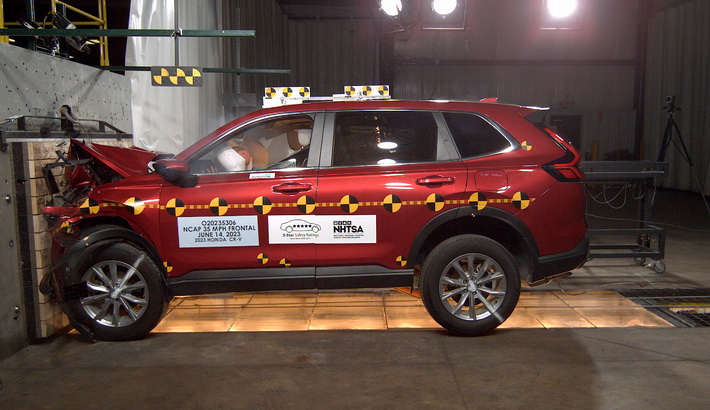
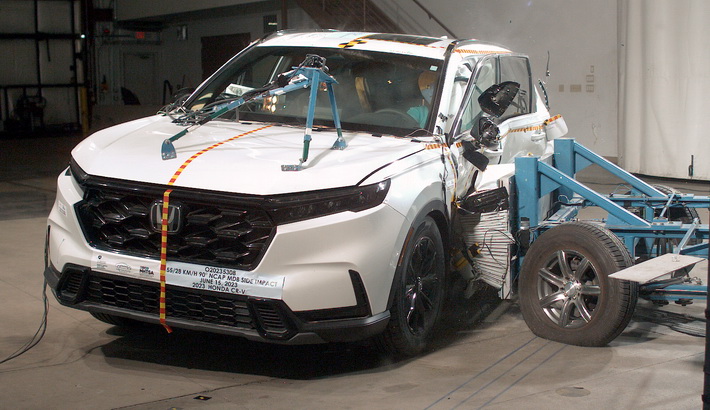
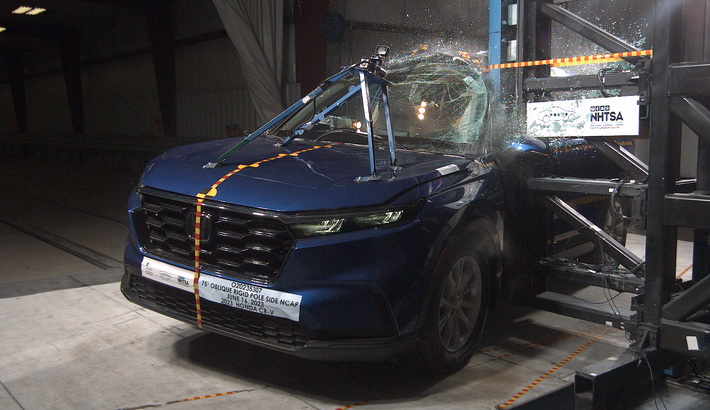
NHTSA crash tests
The agency crash-tested this model year itself. These are its own
photographs and star ratings.
Frontal crash test
Side barrier crash test
Side pole crash test
Photographs taken by NHTSA during its own New Car Assessment Program crash
tests of this model year. Public domain.
Configuration
Overall
Front
Side
Rollover
2024 Honda CR-V HYBRID SUV AWD
15.5% risk
2024 Honda CR-V HYBRID SUV FWD
15.5% risk
When owners complained
A spike years after the car went on sale usually means a part wearing
out on schedule across the whole fleet — the kind of pattern no single
owner can see from inside their own car.
Aug 2023peak 12Aug 2026
Recalls on the 2024 Honda Cr-V Hybrid
A complaint is one owner's allegation. A recall is the point at which
the manufacturer or a regulator agreed the defect is real and dangerous
enough to fix for free — however old the car is.
United States — NHTSA
26V366000
TIRES:TEMPORARY/EMERGENCY SPARE TIRE
Honda (American Honda Motor Co.) is recalling certain 2023-2026 CR-V Hybrid, Accord Hybrid, and 2025-2026 CR-V Fuel Cell EV vehicles. When using the tire repair kit, pressure may build within the sealant bottle, causing the bottle cap to detach.
Risk: A detached bottle cap can become a projectile and strike the user or others nearby, increasing the risk of injury.
24V763000
FUEL SYSTEM, GASOLINE:DELIVERY:FUEL PUMP
Honda (American Honda Motor Co.) is recalling certain 2023-2024 Honda Accord, Accord Hybrid, 2023-2025 Honda CR-V Hybrid, and 2025 Honda Civic and Civic Hybrid vehicles. The high-pressure fuel pump may crack and leak fuel.
Risk: A fuel leak in the presence of an ignition source can increase the risk of a fire.
24V744000
STEERING
Honda (American Honda Motor Co.) is recalling certain 2023-2025 Acura Integra, Civic Type R, CR-V Hybrid, CR-V, HR-V, 2022-2025 Civic, Civic Hatchback, 2024-2025 Acura Integra Type S, 2025 CR-V Fuel Cell EV, Civic Hybrid, and Civic Hatchback Hybrid vehicles. The steering gearbox assembly may have been manufactured incorrectly, which can cause excessive internal friction and lead to difficulty steering the vehicle.
Risk: Difficulty steering can increase the risk of a crash.
Canada — Transport Canada
Canada runs its own recall programme, and its campaigns do not
always mirror the American ones.
Recall 2026274117,350 units in Canada
Other
Issue: On certain vehicles, if the tire repair kit nozzle is not properly attached to the tire valve, pressure could build up in the sealant bottle. As a result, excessive pressure could cause the bottle cap to detach. Safety Risk: If the bottle cap detaches, it could increase the risk of injury. Corrective Actions: Honda will notify owners by mail and advise you to take your vehicle to a dealership to replace the nozzle on the tire repair kit. If the sealant bottle has been previously used, it will be replaced.
Reports where the owner recorded a crash, a fire, an injury or a death.
Suwanee, GA1 injured
STRUCTURE:BODY
The contact owns a 2024 Honda CR-V Hybrid. The contact stated that the trunk was not designed with a safety barrier at the entry, causing a propane tank to roll out of the vehicle upon opening the trunk. The propane tank hit the ground, bounced and hit the contact's chin. The contact sustained temporary pain. The dealer was notified of the issue and informed the contact that it was a factory design flaw. The dealer advised the contact to purchase a trunk storage net to resolve the issue. The manufacturer was not contacted. The issue was not resolved.
NHTSA complaint #11742364 — an unverified report by a vehicle owner.
Trumansburg, NYCrash
SERVICE BRAKES
While stopped at a red light I thought a car was rolling back into me. I took my brain a hot second to realize maybe I was rolling forward into him? But no, I told myself, my foot was on the brake and was pushing as hard as I could once I thought it was me (yep, should have hit the parking brake, but it all happened super-fast). I rolled into him, the light turned green and he pulled ahead, I got aside him rolled window down to ask if his vehicle was standard as I was still convinced he rolled back into me. Needless to say he said no and pretty much ripped me a new asshole for tapping him - I apologized and said "i thought you rolled into me". Brake hold is always on but I was not using the hold, my foot was on the pedal (pushing like a madwoman at one point).
NHTSA complaint #11654017 — an unverified report by a vehicle owner.
at 25,000 milesDaytona Beach, FLFire
FUEL SYSTEM, GASOLINE
The contact owned a 2024 Honda CR-V. The contact stated that while driving on a state road at 35 MPH, the contact reported seeing and smelling smoke inside the cabin of their vehicle, the smoke began to increasingly become heavy, and from the rearview mirror, flames could be seen emitted from the rear end of the vehicle. No warning lights were illuminated. The contact immediately pulled over into a parking lot and exited the vehicle within minutes the vehicle was engulfed in flames. The origin of the fire was unknown. The fire was extinguished by the local fire department. A police report was filed. The vehicle was destroyed. No injuries were reported. The vehicle was towed to a local dealer where the vehicle was inspected and declared a total loss. The contact referenced NHTSA Campaign Number 24V763000 (FUEL SYSTEM, GASOLINE) as probable cause for the failure. The manufacturer was notified of the failure. The approximate failure mileage was 25,000.
NHTSA complaint #11649454 — an unverified report by a vehicle owner.
Columbus, INCrash
UNKNOWN OR OTHER
Description of incident: Saturday, [XXX] I was in traffic on I [XXX] near the [XXX] exit in Indiana. It was a stop/go, stop/go event as 6 lanes were going down to 1 lane. I was behind a Kroger semi-truck. I had my foot on the brake. I thought the people next to me had started to move, but then I noticed that I was getting closer to the truck (while my foot was on the brake). I pushed the brakes down further. I felt normal resistance. Nothing happened. I hit the cancel button of the adaptive cruise multiple times on my steering wheel thinking that perhaps my adaptive cruise started my movement. I kept rolling. Kept hitting the brakes wondering why I didn't stop. No beeps went off like they normally do. I rolled into the truck. My adaptive cruise had been set to 70, and I had used it before the incident. It was still on standby, but not green. My odometer was around 9547. This happened around 9:50am. No beeping sounds started or emergency braking happened. I would approximate my speed of hitting around 3-5 mph. I hit the truck. I had tried to switch to neutral and then to park. I could not move the gear shaft. I was hitting the brake hold. Anything to make me stop. Nothing worked, and I hit the truck. I did not move after hitting the truck, maybe one of the things I attempted to do worked. My foot was still on the brake. I pulled over, turned off the car, and restarted it. I have not applied the adaptive cruise since then. I don't know if it had anything to do with the incident, but I'm afraid to use it. If I had been moving at a faster rate, my safety and others would have been at risk. I took the car to the dealership. They provided me with a Honda multi-point vehicle inspection checklist and stated that they couldn't find anything wrong. There is definitely something wrong. If I manually apply the brakes, the car should stop. INFORMATION REDACTED PURSUANT TO THE FREEDOM OF INFORMATION ACT (FOIA), 5 U.S.C. 552(B)(6)
NHTSA complaint #11633650 — an unverified report by a vehicle owner.
Columbus, INCrash
SERVICE BRAKES
Description of incident: Saturday, [XXX] I was in traffic on I [XXX] near the [XXX] exit in Indiana. It was a stop/go, stop/go event as 6 lanes were going down to 1 lane. I was behind a Kroger semi-truck. I had my foot on the brake. I thought the people next to me had started to move, but then I noticed that I was getting closer to the truck (while my foot was on the brake). I pushed the brakes down further. I felt normal resistance. Nothing happened. I hit the cancel button of the adaptive cruise multiple times on my steering wheel thinking that perhaps my adaptive cruise started my movement. I kept rolling. Kept hitting the brakes wondering why I didn't stop. No beeps went off like they normally do. I rolled into the truck. My adaptive cruise had been set to 70, and I had used it before the incident. It was still on standby, but not green. My odometer was around 9547. This happened around 9:50am. No beeping sounds started or emergency braking happened. I would approximate my speed of hitting around 3-5 mph. I hit the truck. I had tried to switch to neutral and then to park. I could not move the gear shaft. I was hitting the brake hold. Anything to make me stop. Nothing worked, and I hit the truck. I did not move after hitting the truck, maybe one of the things I attempted to do worked. My foot was still on the brake. I pulled over, turned off the car, and restarted it. I have not applied the adaptive cruise since then. I don't know if it had anything to do with the incident, but I'm afraid to use it. If I had been moving at a faster rate, my safety and others would have been at risk. I took the car to the dealership. They provided me with a Honda multi-point vehicle inspection checklist and stated that they couldn't find anything wrong. There is definitely something wrong. If I manually apply the brakes, the car should stop. INFORMATION REDACTED PURSUANT TO THE FREEDOM OF INFORMATION ACT (FOIA), 5 U.S.C. 552(B)(6)
NHTSA complaint #11633650 — an unverified report by a vehicle owner.
Description of incident: Saturday, [XXX] I was in traffic on I [XXX] near the [XXX] exit in Indiana. It was a stop/go, stop/go event as 6 lanes were going down to 1 lane. I was behind a Kroger semi-truck. I had my foot on the brake. I thought the people next to me had started to move, but then I noticed that I was getting closer to the truck (while my foot was on the brake). I pushed the brakes down further. I felt normal resistance. Nothing happened. I hit the cancel button of the adaptive cruise multiple times on my steering wheel thinking that perhaps my adaptive cruise started my movement. I kept rolling. Kept hitting the brakes wondering why I didn't stop. No beeps went off like they normally do. I rolled into the truck. My adaptive cruise had been set to 70, and I had used it before the incident. It was still on standby, but not green. My odometer was around 9547. This happened around 9:50am. No beeping sounds started or emergency braking happened. I would approximate my speed of hitting around 3-5 mph. I hit the truck. I had tried to switch to neutral and then to park. I could not move the gear shaft. I was hitting the brake hold. Anything to make me stop. Nothing worked, and I hit the truck. I did not move after hitting the truck, maybe one of the things I attempted to do worked. My foot was still on the brake. I pulled over, turned off the car, and restarted it. I have not applied the adaptive cruise since then. I don't know if it had anything to do with the incident, but I'm afraid to use it. If I had been moving at a faster rate, my safety and others would have been at risk. I took the car to the dealership. They provided me with a Honda multi-point vehicle inspection checklist and stated that they couldn't find anything wrong. There is definitely something wrong. If I manually apply the brakes, the car should stop. INFORMATION REDACTED PURSUANT TO THE FREEDOM OF INFORMATION ACT (FOIA), 5 U.S.C. 552(B)(6)
NHTSA complaint #11633650 — an unverified report by a vehicle owner.
The most recent complaints
In the owners' own words, exactly as filed with NHTSA.
Westport, NY
POWER TRAIN
2024 Honda CR-V Hybrid with approximately 91,000 miles. Vehicle is less than two years old, has received all required maintenance and mileage is predominantly highway driving. I experienced intermittent chugging/rough engine operation, particularly when the gasoline engine engaged at light throttle. There was no check-engine light. The vehicle subsequently displayed: “POWER REDUCED - Shutter grille system problem. Power may be reduced. See your dealer.” I brought the vehicle to an authorized Honda dealer. According to the technician's written diagnostic notes, no diagnostic trouble codes were present. During inspection, however, the technician found the engine coolant level low. The spark plugs were removed and the cylinders inspected. The technician found coolant leaking into cylinder #4, which was documented by borescope photograph. Honda authorized replacement of the cylinder-head gasket. My safety concern is that an internal coolant leak/head-gasket failure was present without a check-engine light or stored diagnostic trouble code, and the vehicle ultimately displayed a warning that power could be reduced. I am concerned that this condition could potentially result in unexpected reduced propulsion or overheating while driving. American Honda has also issued Service Bulletin 26-088, Product Update: 2023-26 CR-V Hybrid PGM-FI Software Update, dated August 7, 2026. Honda states that the update was developed “to better manage engine temperatures” by optimizing electric water pump operation. My Honda dealer has advised that the applicable campaign update will be performed on my vehicle. I am not alleging that the software condition caused my head-gasket failure, but I believe NHTSA should evaluate whether internal coolant leakage/head-gasket failures in these vehicles can occur without an appropriate engine warning or stored DTC and whether the condition could result in reduced power, overheating, or loss of propulsion while driving.
NHTSA complaint #11756658 — an unverified report by a vehicle owner.
Westport, NY
ENGINE
2024 Honda CR-V Hybrid with approximately 91,000 miles. Vehicle is less than two years old, has received all required maintenance and mileage is predominantly highway driving. I experienced intermittent chugging/rough engine operation, particularly when the gasoline engine engaged at light throttle. There was no check-engine light. The vehicle subsequently displayed: “POWER REDUCED - Shutter grille system problem. Power may be reduced. See your dealer.” I brought the vehicle to an authorized Honda dealer. According to the technician's written diagnostic notes, no diagnostic trouble codes were present. During inspection, however, the technician found the engine coolant level low. The spark plugs were removed and the cylinders inspected. The technician found coolant leaking into cylinder #4, which was documented by borescope photograph. Honda authorized replacement of the cylinder-head gasket. My safety concern is that an internal coolant leak/head-gasket failure was present without a check-engine light or stored diagnostic trouble code, and the vehicle ultimately displayed a warning that power could be reduced. I am concerned that this condition could potentially result in unexpected reduced propulsion or overheating while driving. American Honda has also issued Service Bulletin 26-088, Product Update: 2023-26 CR-V Hybrid PGM-FI Software Update, dated August 7, 2026. Honda states that the update was developed “to better manage engine temperatures” by optimizing electric water pump operation. My Honda dealer has advised that the applicable campaign update will be performed on my vehicle. I am not alleging that the software condition caused my head-gasket failure, but I believe NHTSA should evaluate whether internal coolant leakage/head-gasket failures in these vehicles can occur without an appropriate engine warning or stored DTC and whether the condition could result in reduced power, overheating, or loss of propulsion while driving.
NHTSA complaint #11756658 — an unverified report by a vehicle owner.
Myrtle Beach, SC
ENGINE
My 2024 Honda CRV Sport Touring Hybrid AWD has the very same engine and parts as the Canadian model. So far the Canadian version with the exact same equipment as well as the U.S. version has a poorly designed HEAD GASKET that have resulted in NUMEROUS engine failures with no warning. In CANADA the engines have been recalled for this safety concern and resulting catastrophic engine failure. My complaint is that since there are many drivers in the U.S. that have the EXACT same engine with the EXACT same problem deserve the SAME recall to correct this manufacturing defect that will result in an UNSAFE condition without repair.
NHTSA complaint #11751652 — an unverified report by a vehicle owner.
Suwanee, GA1 injured
STRUCTURE:BODY
The contact owns a 2024 Honda CR-V Hybrid. The contact stated that the trunk was not designed with a safety barrier at the entry, causing a propane tank to roll out of the vehicle upon opening the trunk. The propane tank hit the ground, bounced and hit the contact's chin. The contact sustained temporary pain. The dealer was notified of the issue and informed the contact that it was a factory design flaw. The dealer advised the contact to purchase a trunk storage net to resolve the issue. The manufacturer was not contacted. The issue was not resolved.
NHTSA complaint #11742364 — an unverified report by a vehicle owner.
at 51,500 milesSmithsburg, MD
SERVICE BRAKES, HYDRAULIC
The contact owns a 2024 Honda CR-V. The contact stated that while driving at 30-40 MPH, the brakes became inoperable. The brake light was illuminated. The local dealer was contacted, where it was diagnosed and determined the failure was due to the brake pedal sensor. The vehicle was not repaired. The manufacturer was called, but there was no response due to being closed. The failure mileage was approximately 51,500.
NHTSA complaint #11736479 — an unverified report by a vehicle owner.
Los Banos, CA
UNKNOWN OR OTHER
Incident 1 — April 23, 2026 | ~71,289 miles While merging onto the freeway, multiple warning lights illuminated simultaneously on the dashboard. Vehicle exhibited uncontrolled acceleration and became unsafe to operate. Incident was captured on video. Vehicle was driven to Salinas Honda [XXX] ). Dealer performed two open safety recalls: Campaign 24-049:6YP00 (Fuel Pump Safety Recall, 2023–25 Multi Model Hybrids) and Campaign 24-117:6JP00 (EPS Gearbox Greasing Safety Recall, 2023–25 CR-V). Work Order #XXX. Incident 2 — April 24, 2026 | 71,302 miles Warning lights returned the same day the vehicle was retrieved from the dealer — within hours of release. Vehicle was returned immediately to Salinas Honda. Dealer found misfire codes (P0300, P0302, P0303), performed a hard battery reset and steering angle relearn, and conducted a 30-mile test drive. Vehicle was released as repaired. Invoice #XXX. Incident 3 — April 24, 2026 (current) Following the second dealer visit, vehicle was driven approximately 90 miles from [XXX] to [XXX] without incident. Approximately 30 minutes after parking, vehicle was restarted for a short local trip. Upon restart, the engine emitted a loud abnormal noise and exhibited severe difficulty accelerating. On April 27, 2026, a third party OBD-II scan performed at Autozone confirmed active misfire codes P0300, P0302, and P0303 were still present following a hard battery reset performed by the owner's. Codes were not cleared by the reset. INFORMATION REDACTED PURSUANT TO THE FREEDOM OF INFORMATION ACT (FOIA), 5 U.S.C. 552(B)(6)
NHTSA complaint #11734856 — an unverified report by a vehicle owner.
Boston, MA
ELECTRICAL SYSTEM
While driving under normal conditions on a dry road (no snow or ice), the vehicle experienced a sudden loss of braking performance while in motion. The vehicle was traveling approximately 10–15 mph and approaching an intersection with a red traffic light. A warning message appeared stating: “Brake system problem. Brake performance may be reduced. See your dealer.” Immediately after this message, braking performance was significantly reduced. Multiple attempts to slow the vehicle using the brake pedal resulted in minimal deceleration. The stopping distance was much longer than expected for the speed and conditions. The vehicle only came to a stop after the brake pedal was pressed with full force. Shortly after the initial brake warning, multiple additional safety-related systems went offline, including collision avoidance and other braking-related driver assistance systems. Approximately five to six warning messages appeared, indicating a cascading failure of safety systems while the vehicle was still in motion. The driver was able to slowly maneuver the vehicle to the side of the road and park safely. No collision occurred. However, shortly before this incident, the vehicle had been driven on a highway. If the same failure had occurred at higher speeds or in traffic, it could have resulted in a serious crash or injury. The vehicle is relatively new (approximately two years old, low mileage) and has been routinely maintained. There were no prior warning signs before this event. The vehicle is currently available for inspection at a dealership. A preliminary dealer explanation suggested a possible low or discharged battery; however, the cause of the braking failure has not been clearly established. This incident involved loss of braking performance while the vehicle was in motion, presenting a significant safety risk.
NHTSA complaint #11715284 — an unverified report by a vehicle owner.
Boston, MA
SERVICE BRAKES
While driving under normal conditions on a dry road (no snow or ice), the vehicle experienced a sudden loss of braking performance while in motion. The vehicle was traveling approximately 10–15 mph and approaching an intersection with a red traffic light. A warning message appeared stating: “Brake system problem. Brake performance may be reduced. See your dealer.” Immediately after this message, braking performance was significantly reduced. Multiple attempts to slow the vehicle using the brake pedal resulted in minimal deceleration. The stopping distance was much longer than expected for the speed and conditions. The vehicle only came to a stop after the brake pedal was pressed with full force. Shortly after the initial brake warning, multiple additional safety-related systems went offline, including collision avoidance and other braking-related driver assistance systems. Approximately five to six warning messages appeared, indicating a cascading failure of safety systems while the vehicle was still in motion. The driver was able to slowly maneuver the vehicle to the side of the road and park safely. No collision occurred. However, shortly before this incident, the vehicle had been driven on a highway. If the same failure had occurred at higher speeds or in traffic, it could have resulted in a serious crash or injury. The vehicle is relatively new (approximately two years old, low mileage) and has been routinely maintained. There were no prior warning signs before this event. The vehicle is currently available for inspection at a dealership. A preliminary dealer explanation suggested a possible low or discharged battery; however, the cause of the braking failure has not been clearly established. This incident involved loss of braking performance while the vehicle was in motion, presenting a significant safety risk.
NHTSA complaint #11715284 — an unverified report by a vehicle owner.
While driving under normal conditions on a dry road (no snow or ice), the vehicle experienced a sudden loss of braking performance while in motion. The vehicle was traveling approximately 10–15 mph and approaching an intersection with a red traffic light. A warning message appeared stating: “Brake system problem. Brake performance may be reduced. See your dealer.” Immediately after this message, braking performance was significantly reduced. Multiple attempts to slow the vehicle using the brake pedal resulted in minimal deceleration. The stopping distance was much longer than expected for the speed and conditions. The vehicle only came to a stop after the brake pedal was pressed with full force. Shortly after the initial brake warning, multiple additional safety-related systems went offline, including collision avoidance and other braking-related driver assistance systems. Approximately five to six warning messages appeared, indicating a cascading failure of safety systems while the vehicle was still in motion. The driver was able to slowly maneuver the vehicle to the side of the road and park safely. No collision occurred. However, shortly before this incident, the vehicle had been driven on a highway. If the same failure had occurred at higher speeds or in traffic, it could have resulted in a serious crash or injury. The vehicle is relatively new (approximately two years old, low mileage) and has been routinely maintained. There were no prior warning signs before this event. The vehicle is currently available for inspection at a dealership. A preliminary dealer explanation suggested a possible low or discharged battery; however, the cause of the braking failure has not been clearly established. This incident involved loss of braking performance while the vehicle was in motion, presenting a significant safety risk.
NHTSA complaint #11715284 — an unverified report by a vehicle owner.
Lithonia, GA
ELECTRICAL SYSTEM:12V/24V/48V BATTERY
The contact owns a 2024 Honda CR-V. The contact stated that while driving at an undisclosed speed, the accelerator pedal was depressed; however, the vehicle failed to accelerate as intended. The contact stated that the power-reduced error message was displayed. The contact stated that the vehicle was driving abnormally sluggish and failed to exceed 18 MPH. The vehicle was driven to the shoulder of the road and turned off. The contact waited for a while before restarting the vehicle. The vehicle was driven to the residence. The vehicle was taken to the dealer, where it was diagnosed with a hybrid battery failure. The contact was informed that the hybrid battery needed to be replaced. The vehicle was repaired. The contact stated that the failure had started shortly after the vehicle was purchased. The vehicle was taken to the dealer several times; however, the failure was not duplicated. The contact was relieved that the vehicle was repaired; however, the contact was fearful that the failure could recur. The manufacturer was made aware of the failure, and a case was filed. The failure mileage was unknown.
NHTSA complaint #11681534 — an unverified report by a vehicle owner.
at 100 milesPlacida, FL
FORWARD COLLISION AVOIDANCE: ADAPTIVE CRUISE CONTROL
The contact owns a 2024 Honda CR-V Hybrid. The contact stated that while driving at various speeds with the Adaptive Cruise Control activated, the braking system erroneously activated, causing the vehicle to abruptly slow down and decelerate. The contact stated that the failure had occurred on several occasions with a second vehicle in next lane slowing down. The vehicle was taken to the local dealer who was unable to duplicate the failure. The vehicle was not repaired. The manufacturer was notified of the failure. The failure mileage was 100.
NHTSA complaint #11675283 — an unverified report by a vehicle owner.
at 752 milesMiami Beach, FL
FUEL SYSTEM, GASOLINE
The contact owns a 2024 Honda CR-V. The contact stated that after driving during rainy weather at various speeds, the check engine and TPMS warning lights illuminated. The vehicle was taken to a local dealer, where it was diagnosed with water intrusion in the canister valve. The water was flushed, and the system was restarted; however, the parts were not available to replace the canister valve. The vehicle was taken back to the same local dealer due to the failure recurring; however, the parts for the repairs were not replaced. The check engine warning light illuminated. The vehicle was taken back to the same local dealer where it was diagnosed as needing further diagnostic tests and repairs. The vehicle was not diagnosed or repaired due to the cost. The contact related the failure to NHTSA Campaign Number: 24V763000 (Fuel System, Gasoline); however, the VIN was not included. The manufacturer was made aware of the failure. The failure mileage was approximately 752.
NHTSA complaint #11668977 — an unverified report by a vehicle owner.
at 752 milesMiami Beach, FL
TIRES:PRESSURE MONITORING AND REGULATING SYSTEMS
The contact owns a 2024 Honda CR-V. The contact stated that after driving during rainy weather at various speeds, the check engine and TPMS warning lights illuminated. The vehicle was taken to a local dealer, where it was diagnosed with water intrusion in the canister valve. The water was flushed, and the system was restarted; however, the parts were not available to replace the canister valve. The vehicle was taken back to the same local dealer due to the failure recurring; however, the parts for the repairs were not replaced. The check engine warning light illuminated. The vehicle was taken back to the same local dealer where it was diagnosed as needing further diagnostic tests and repairs. The vehicle was not diagnosed or repaired due to the cost. The contact related the failure to NHTSA Campaign Number: 24V763000 (Fuel System, Gasoline); however, the VIN was not included. The manufacturer was made aware of the failure. The failure mileage was approximately 752.
NHTSA complaint #11668977 — an unverified report by a vehicle owner.
Cartersville, GA
ENGINE
My 2024 Honda CR-V Hybrid began experiencing a noticeable loss of engine power and severe shaking while idling. The problem first appeared when I was parked with the engine running, and the car suddenly started vibrating strongly. Shortly after, the “Emissions System Problem” warning message appeared on the dashboard. A local Honda dealer suspected a malfunction in the fuel injector system, which may have led to improper fuel combustion, reduced acceleration, and overall unstable engine behavior. This issue could increase the risk of an accident, particularly when merging or accelerating in traffic, due to delayed throttle response. Many other CR-V Hybrid owners have reported similar symptoms online, pointing to a potential widespread defect in the fuel delivery system. Despite this, there is currently no official recall for the fuel injectors in this model. I am concerned that this issue, if left unresolved, could lead to engine damage or even pose a fire risk due to unregulated or incomplete fuel combustion. Given the number of reports and the potential danger, I respectfully urge the NHTSA to investigate this issue and consider initiating a recall to protect driver safety.
NHTSA complaint #11665691 — an unverified report by a vehicle owner.
Cartersville, GA
FUEL/PROPULSION SYSTEM
My 2024 Honda CR-V Hybrid began experiencing a noticeable loss of engine power and severe shaking while idling. The problem first appeared when I was parked with the engine running, and the car suddenly started vibrating strongly. Shortly after, the “Emissions System Problem” warning message appeared on the dashboard. A local Honda dealer suspected a malfunction in the fuel injector system, which may have led to improper fuel combustion, reduced acceleration, and overall unstable engine behavior. This issue could increase the risk of an accident, particularly when merging or accelerating in traffic, due to delayed throttle response. Many other CR-V Hybrid owners have reported similar symptoms online, pointing to a potential widespread defect in the fuel delivery system. Despite this, there is currently no official recall for the fuel injectors in this model. I am concerned that this issue, if left unresolved, could lead to engine damage or even pose a fire risk due to unregulated or incomplete fuel combustion. Given the number of reports and the potential danger, I respectfully urge the NHTSA to investigate this issue and consider initiating a recall to protect driver safety.
NHTSA complaint #11665691 — an unverified report by a vehicle owner.
at 11,000 milesCocoa, FL
VISIBILITY:SUN/MOON ROOF ASSEMBLY
The contact owns a 2024 Honda CR-V Hybrid. The contact stated that while driving at an undisclosed speed, the moon roof suddenly shattered without impact, raining glass down into the interior of vehicle. No warning lights were illuminated. The vehicle was not taken to the dealer or an independent mechanic. The contact stated that the vehicle was not diagnosed or repaired. The manufacturer was not notified of the failure. The failure mileage was 11,000. The VIN was not available.
NHTSA complaint #11664864 — an unverified report by a vehicle owner.
Conroe, TX
ENGINE
Car went from regular driving to very rough running engine, multiple warning lights activated and limp mode activated. Drove 25mph to get home. Car was towed to Dealership and after inspection, Fuel injectors and spark plug # 3 had to be replaced. Many many CRV owners seen to be having this problem and this could cause an accident should it happen on a freeway.
NHTSA complaint #11664127 — an unverified report by a vehicle owner.
Conroe, TX
FUEL/PROPULSION SYSTEM
Car went from regular driving to very rough running engine, multiple warning lights activated and limp mode activated. Drove 25mph to get home. Car was towed to Dealership and after inspection, Fuel injectors and spark plug # 3 had to be replaced. Many many CRV owners seen to be having this problem and this could cause an accident should it happen on a freeway.
NHTSA complaint #11664127 — an unverified report by a vehicle owner.
Calhoun, GA
ELECTRICAL SYSTEM
Back up camera flashes and will appear in black and white causing a safety issue as you can’t see with the camera.
NHTSA complaint #11657068 — an unverified report by a vehicle owner.
Yucaipa, CA
STEERING
I want to announce that is going to be 78 DAYS on Monday 21st of this month! Since I discovered after the recall repair done at authorized Honda dealership on Jan the 15th. I'm a vehicle inspector and have documented and recorded on live video on the steering problem that this vehicle that we have owned on new conditions. Honda and even the arbitrator according to them I don't have enough evidence for this vehicle to be re-repaired again. On California lemon law anything that has been more than a month qualifies for a replacement or a refund. The problem is that the dealership states that is normal operation standards to them. I need a 3rd party inspection or an attorney that can represent, we have solid evidence that after the recall repair still has the same issue. I'm a nobody without help. Contacted BAR as well. I need someone that investigates deeply what's going on with Honda of America. This vehicle needs to be taken to a Lab and diagnosed. We're going to take it again Monday the 21 to diag job in Spreen Honda of Loma Linda. Please help!
NHTSA complaint #11655612 — an unverified report by a vehicle owner.
Trumansburg, NYCrash
SERVICE BRAKES
While stopped at a red light I thought a car was rolling back into me. I took my brain a hot second to realize maybe I was rolling forward into him? But no, I told myself, my foot was on the brake and was pushing as hard as I could once I thought it was me (yep, should have hit the parking brake, but it all happened super-fast). I rolled into him, the light turned green and he pulled ahead, I got aside him rolled window down to ask if his vehicle was standard as I was still convinced he rolled back into me. Needless to say he said no and pretty much ripped me a new asshole for tapping him - I apologized and said "i thought you rolled into me". Brake hold is always on but I was not using the hold, my foot was on the pedal (pushing like a madwoman at one point).
NHTSA complaint #11654017 — an unverified report by a vehicle owner.
Fremont, CA
STEERING
The contact owns a 2024 Honda CR-V. The contact received notifications of NHTSA Campaign Number: 24V763000 (Fuel System, Gasoline) and 24V744000 (STEERING); however, the parts to do the recall repairs were not yet available. The contact stated that the manufacturer had exceeded a reasonable amount of time for the recall repairs. The dealer was contacted and confirmed that parts were not yet available. The vehicle was not diagnosed or repaired. The manufacturer was made aware of the issue and informed the contact that parts were available. The contact had not experienced a failure. Parts distribution disconnect.
NHTSA complaint #11650123 — an unverified report by a vehicle owner.
Fremont, CA
FUEL SYSTEM, GASOLINE
The contact owns a 2024 Honda CR-V. The contact received notifications of NHTSA Campaign Number: 24V763000 (Fuel System, Gasoline) and 24V744000 (STEERING); however, the parts to do the recall repairs were not yet available. The contact stated that the manufacturer had exceeded a reasonable amount of time for the recall repairs. The dealer was contacted and confirmed that parts were not yet available. The vehicle was not diagnosed or repaired. The manufacturer was made aware of the issue and informed the contact that parts were available. The contact had not experienced a failure. Parts distribution disconnect.
NHTSA complaint #11650123 — an unverified report by a vehicle owner.
at 4,907 milesHendersonville, TN
ENGINE
engine begain shuddering, went to 1/2 power, emissions warning and check engine light came on. happened on highway 3x, happened at stop signs 3-4 times too.
NHTSA complaint #11650170 — an unverified report by a vehicle owner.
at 25,000 milesDaytona Beach, FLFire
FUEL SYSTEM, GASOLINE
The contact owned a 2024 Honda CR-V. The contact stated that while driving on a state road at 35 MPH, the contact reported seeing and smelling smoke inside the cabin of their vehicle, the smoke began to increasingly become heavy, and from the rearview mirror, flames could be seen emitted from the rear end of the vehicle. No warning lights were illuminated. The contact immediately pulled over into a parking lot and exited the vehicle within minutes the vehicle was engulfed in flames. The origin of the fire was unknown. The fire was extinguished by the local fire department. A police report was filed. The vehicle was destroyed. No injuries were reported. The vehicle was towed to a local dealer where the vehicle was inspected and declared a total loss. The contact referenced NHTSA Campaign Number 24V763000 (FUEL SYSTEM, GASOLINE) as probable cause for the failure. The manufacturer was notified of the failure. The approximate failure mileage was 25,000.
NHTSA complaint #11649454 — an unverified report by a vehicle owner.