Owners have filed 407 complaints
about the 2020 Subaru Ascent with NHTSA between 2019 and 2026.
The largest single group is the electrical system.
Across this model's run it ranks 2 of 7 worst.
The letter says how bad. This says what kind — whether this year drew
an unusual number of complaints, unusually dangerous
ones, or failures that arrived unusually early.
The dashed ring is 50 — the national norm. Further out is worse.
Complaint volume — 100
Against the median year of the Subaru Ascent. 50 means typical for this
model; 100 means roughly double.
Severity — 30
5.9% of these complaints
involved a crash, fire, injury or death, against a national rate of
9.7%.
Early failure — 100
93% of failures with a mileage on record happened under
36,000 miles, against a national rate of
29%.
NHTSA files every complaint against a named sub-assembly, not just a
system. This is the difference between knowing it was "the engine" and
knowing which part of it — the list to hand a mechanic.
Windshield
1126.2%
Body
921.4%
Automatic Emergency Braking
819.0%
Adaptive Cruise Control
511.9%
Warnings
49.5%
Assist
37.1%
Warning
12.4%
Warnings
12.4%
When it fails
Odometer readings owners gave when they filed. About half of all
complaints include one.
Under 1,000 miles
137.9%
1,000 – 9,999 miles
9859.4%
10,000 – 24,999 miles
3621.8%
25,000 – 49,999 miles
95.5%
50,000 – 74,999 miles
42.4%
75,000 – 99,999 miles
21.2%
100,000 – 149,999 miles
31.8%
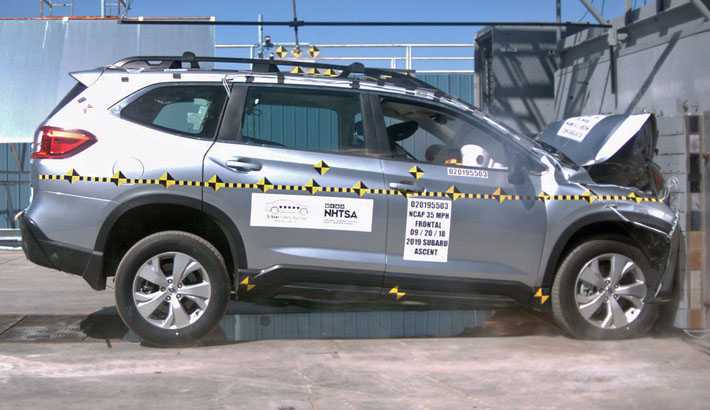
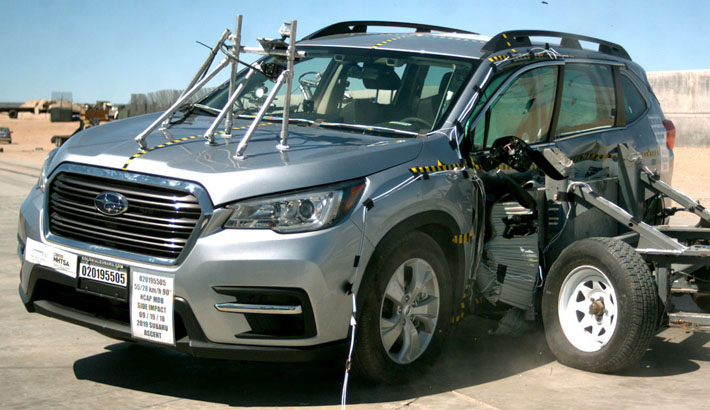
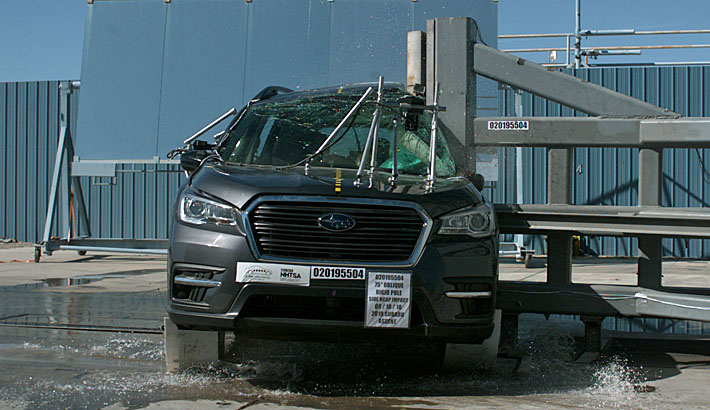
NHTSA crash tests
The agency crash-tested this model year itself. These are its own
photographs and star ratings.
Frontal crash test
Side barrier crash test
Side pole crash test
Photographs taken by NHTSA during its own New Car Assessment Program crash
tests of this model year. Public domain.
Configuration
Overall
Front
Side
Rollover
2020 Subaru Ascent SUV AWD
17% risk
When owners complained
A spike years after the car went on sale usually means a part wearing
out on schedule across the whole fleet — the kind of pattern no single
owner can see from inside their own car.
Sep 2019peak 17Sep 2026
Recalls on the 2020 Subaru Ascent
A complaint is one owner's allegation. A recall is the point at which
the manufacturer or a regulator agreed the defect is real and dangerous
enough to fix for free — however old the car is.
United States — NHTSA
26V436000
EQUIPMENT:OTHER:LABELS
Subaru of America, Inc. (Subaru) is recalling certain 2026 Crosstrek Hybrid, 2025-2026 Forester Hybrid, Forester, and 2019-2026 Ascent vehicles. These vehicles were manufactured with an incorrect Gross Axle Weight Rating (GAWR) on the certification label. As such, these vehicles fail to comply with the requirements of Federal Motor Vehicle Safety Standard (FMVSS) 110, "Tire selection and rims."
Risk: An incorrect GAWR label may lead to an overloaded vehicle, increasing the risk of a crash.
22V907000
ELECTRICAL SYSTEM:WIRING:INTERIOR/UNDER DASH
Subaru of America, Inc. (Subaru) is recalling certain 2019-2022 Ascent vehicles. The ground bolt that secures the ground terminal of the Positive Temperature Coefficient (PTC) heater may have been improperly fastened, which could result in melting of the ground terminal and surrounding components.
Risk: A melting ground terminal increases the risk of a fire.
21V955000
POWER TRAIN:AUTOMATIC TRANSMISSION:CONTROL MODULE (TCM/PCM/TECM)
Subaru of America, Inc. (Subaru) is recalling certain 2019-2020 Ascent, 2020 Legacy and Outback vehicles. A programming error in the Transmission Control Unit (TCU) may allow the clutch to engage before the drive chain is completely clamped.
Risk: An improperly secured drive chain may slip and break, causing a loss of drive power and increasing the risk of a crash.
21V954000
STEERING:LINKAGES:TIE ROD ASSEMBLY
Subaru of America, Inc. (Subaru) is recalling certain 2020 Ascent vehicles. Due to an incorrect tapered hole in the housing, the front tie rod ends may not fit properly. The improper fit can result in the tie rods and housings being deformed during assembly and service replacement if excessive torque is applied.
Risk: The tie rods may separate from the housing, causing a loss of steering control and increasing the risk of a crash.
21V587000
FUEL SYSTEM, GASOLINE:DELIVERY:FUEL PUMP
Subaru of America, Inc. (Subaru) is recalling certain 2019-2020 Ascent, 2018 Forester, 2018-2020 Impreza, Legacy, Outback, 2018-2019 BRZ, WRX, and Toyota 86 vehicles. The low-pressure fuel pump inside the fuel tank may fail.
Risk: Fuel pump failure can cause an engine stall while driving, increasing the risk of a crash.
Canada — Transport Canada
Canada runs its own recall programme, and its campaigns do not
always mirror the American ones.
Recall 202632928,461 units in Canada
Label
Issue: On certain vehicles, the compliance label lists an incorrect gross axle weight rating (GAWR). This could lead you to overload the vehicle, which could cause poor handling or a tire failure. Note: For the Forester model, this recall affects both gas and hybrid models. For the Crosstrek model, only the Crosstrek Hybrid model is affected. Safety Risk: Poor handling or a tire failure could cause a loss of control and increase the risk of a crash. Corrective Actions: Subaru will mail a new compliance label to each owner. If you'd like help to install the label, you can contact a Subaru dealer to have it installed free of charge.
Recall 2024546499,490 units in Canada
Label
Issue: On certain vehicles, the compliance label may be missing information in French. The words listed on the label for "Tires", "Rims", "Front" and "Rear" appear in English only, when they should be listed as "Tires/Pneus", "Rims/Jantes", "Front/Avant" and "Rear/Arriere". Canadian regulations require this information to be listed on the label in both English and French. Safety Risk: These small errors do not affect vehicle safety. Corrective Actions: This is not a recall. Subaru has corrected the compliance label for all new vehicles.
Recall 202270313,954 units in Canada
Electrical
Issue: On certain vehicles, the bolt for the ground terminal on the auxiliary heater may not have been properly tightened. As a result, the ground terminal and nearby parts could overheat and melt. Safety Risk: Wiring that overheats and melts could create the risk of a fire. Corrective Actions: Subaru will notify owners by mail and instruct you to take your vehicle to a dealership to replace the PTC (positive temperature coefficient) heater ground bolt. The ground wire and the connector holder will be replaced, if necessary. Subaru advises not remote start your vehicle using Subaru Starlink Connected Services (if equipped) or an aftermarket remote starter (if installed). Subaru also advises not leave the vehicle running while unattended, and that you should park it outdoors and away from other vehicles or structures until the recall repairs have been completed.
Recall 202174513,034 units in Canada
Powertrain
Issue: On certain vehicles, a software problem in the transmission control unit (TCU) may cause the drive chain to slip or break. If this happens while the vehicle is in motion, there could be a loss of power to the wheels. Safety Risk: A loss of power to the wheels could increase the risk of a crash. Corrective Actions: Subaru will notify owners by mail and instruct you to take your vehicle to a dealer to inspect the transmission chain guide and update the TCU. If necessary, the transmission assembly will be replaced.
Recall 202174694 units in Canada
Steering
Issue: On certain vehicles, the mounting holes for the tie rod ends were not manufactured correctly. As a result, the front tie rods may not fit properly. This could lead to damage during assembly and servicing. Over time, parts that do not fit correctly could separate and cause a loss of steering control. Safety Risk: A loss of steering control could create the risk of a crash. Corrective Actions: Subaru will notify owners by mail and instruct you to take your car to a dealer to replace the left and right steering knuckles, tie rod ends, and related hardware.
Reports where the owner recorded a crash, a fire, an injury or a death.
Cape Coral, FLCrash
SERVICE BRAKES
I am reporting a repeat safety concern involving a 2020 Subaru Ascent. The vehicle was involved in two separate collisions after failing to decelerate as expected following normal brake pedal application. The first incident occurred on January 26, 2026. While approaching a traffic signal, I applied the brakes under normal driving conditions. The vehicle did not slow as expected and struck the rear of another vehicle. Property damage occurred, but no injuries were reported. The second incident occurred on May 5, 2026. While approaching a stop sign at approximately 35 mph, I again applied the brakes under normal driving conditions. The vehicle did not decelerate as expected and entered the intersection, colliding with a vehicle traveling perpendicular to my direction of travel. Both vehicles were towed. No injuries were reported. During both incidents, there were no forward collision warnings, automatic emergency braking interventions, or other alerts observed prior to impact. Following the second collision, the vehicle was inspected by an independent technician. Brake components inspected were found to be within serviceable condition and no evidence of neglect or improper maintenance was noted. During inspection, abnormal brake pedal behavior was observed, including continued downward pedal travel while steady pressure was applied. The technician documented that the reported condition was not consistent with normal braking performance and stated that an intermittent hydraulic and/or brake assist related issue could not be ruled out. The vehicle has been regularly maintained according to manufacturer recommendations. Due to the repeat nature of the condition, the lack of warning or intervention from safety systems, and the occurrence of two collisions despite normal brake application, I believe this condition represents a significant safety risk. The vehicle has since been declared a total loss and may be available for further inspection.
NHTSA complaint #11740848 — an unverified report by a vehicle owner.
Cape Coral, FLCrash
FORWARD COLLISION AVOIDANCE: WARNINGS
I am reporting a repeat safety concern involving a 2020 Subaru Ascent. The vehicle was involved in two separate collisions after failing to decelerate as expected following normal brake pedal application. The first incident occurred on January 26, 2026. While approaching a traffic signal, I applied the brakes under normal driving conditions. The vehicle did not slow as expected and struck the rear of another vehicle. Property damage occurred, but no injuries were reported. The second incident occurred on May 5, 2026. While approaching a stop sign at approximately 35 mph, I again applied the brakes under normal driving conditions. The vehicle did not decelerate as expected and entered the intersection, colliding with a vehicle traveling perpendicular to my direction of travel. Both vehicles were towed. No injuries were reported. During both incidents, there were no forward collision warnings, automatic emergency braking interventions, or other alerts observed prior to impact. Following the second collision, the vehicle was inspected by an independent technician. Brake components inspected were found to be within serviceable condition and no evidence of neglect or improper maintenance was noted. During inspection, abnormal brake pedal behavior was observed, including continued downward pedal travel while steady pressure was applied. The technician documented that the reported condition was not consistent with normal braking performance and stated that an intermittent hydraulic and/or brake assist related issue could not be ruled out. The vehicle has been regularly maintained according to manufacturer recommendations. Due to the repeat nature of the condition, the lack of warning or intervention from safety systems, and the occurrence of two collisions despite normal brake application, I believe this condition represents a significant safety risk. The vehicle has since been declared a total loss and may be available for further inspection.
NHTSA complaint #11740848 — an unverified report by a vehicle owner.
I am reporting a repeat safety concern involving a 2020 Subaru Ascent. The vehicle was involved in two separate collisions after failing to decelerate as expected following normal brake pedal application. The first incident occurred on January 26, 2026. While approaching a traffic signal, I applied the brakes under normal driving conditions. The vehicle did not slow as expected and struck the rear of another vehicle. Property damage occurred, but no injuries were reported. The second incident occurred on May 5, 2026. While approaching a stop sign at approximately 35 mph, I again applied the brakes under normal driving conditions. The vehicle did not decelerate as expected and entered the intersection, colliding with a vehicle traveling perpendicular to my direction of travel. Both vehicles were towed. No injuries were reported. During both incidents, there were no forward collision warnings, automatic emergency braking interventions, or other alerts observed prior to impact. Following the second collision, the vehicle was inspected by an independent technician. Brake components inspected were found to be within serviceable condition and no evidence of neglect or improper maintenance was noted. During inspection, abnormal brake pedal behavior was observed, including continued downward pedal travel while steady pressure was applied. The technician documented that the reported condition was not consistent with normal braking performance and stated that an intermittent hydraulic and/or brake assist related issue could not be ruled out. The vehicle has been regularly maintained according to manufacturer recommendations. Due to the repeat nature of the condition, the lack of warning or intervention from safety systems, and the occurrence of two collisions despite normal brake application, I believe this condition represents a significant safety risk. The vehicle has since been declared a total loss and may be available for further inspection.
NHTSA complaint #11740848 — an unverified report by a vehicle owner.
Crete, ILCrash
ENGINE
On Friday evening, February 23, 2024 , I pulled onto my driveway and came to a complete stop before driving into the garage . I reached up and hit the garage door remote. When the door began to go up I took my foot off the brake. Instead of creeping up the driveway the car took off like a proverbial "bat out of hell" It was as if I had pushed the accelerator compltely down.to the floor board. The brakes had no effect. I smashed through the garage door,. The car jumped a six inch concrete step up, obliterated the garage cabinets and pushed the contents of the cabinets and garage wall into our family room.The car came to a rest just outside our family room. My son opened the door to the garage and yelled out to me "Are you okay" Because the engine was still racing he said "Get your foot off the accelerator' My reply was I DON'T HAVE MY FOOT N THE ACCELERATOR". I then tuned the ignition off and the ordeal was over.. It appears that the engine continued to recieve fuel irregardless of the position of the accelerator., the automatic braking system failed miserably and the the forward collision warning was malfunctioning. I am waiting for the insurance company to remove the car from the garage and do a structural assessment.. Because there may be serious structual damage I want the insurance company to remove the vehicle less the second floor collapses onto the garage. My son was on the couch just seconds before the wall "exploded". The couch was moved eight feet across the room. If a piece of debris came through the windsield I also might have been injured. The potential for serious injury to others in another set of ircumstances also scares me. The malfunction came without warning. The damages will be in the tens of thousands of dollars. I am blessed that no one was injured or killed.
NHTSA complaint #11574100 — an unverified report by a vehicle owner.
Crete, ILCrash
FUEL/PROPULSION SYSTEM
On Friday evening, February 23, 2024 , I pulled onto my driveway and came to a complete stop before driving into the garage . I reached up and hit the garage door remote. When the door began to go up I took my foot off the brake. Instead of creeping up the driveway the car took off like a proverbial "bat out of hell" It was as if I had pushed the accelerator compltely down.to the floor board. The brakes had no effect. I smashed through the garage door,. The car jumped a six inch concrete step up, obliterated the garage cabinets and pushed the contents of the cabinets and garage wall into our family room.The car came to a rest just outside our family room. My son opened the door to the garage and yelled out to me "Are you okay" Because the engine was still racing he said "Get your foot off the accelerator' My reply was I DON'T HAVE MY FOOT N THE ACCELERATOR". I then tuned the ignition off and the ordeal was over.. It appears that the engine continued to recieve fuel irregardless of the position of the accelerator., the automatic braking system failed miserably and the the forward collision warning was malfunctioning. I am waiting for the insurance company to remove the car from the garage and do a structural assessment.. Because there may be serious structual damage I want the insurance company to remove the vehicle less the second floor collapses onto the garage. My son was on the couch just seconds before the wall "exploded". The couch was moved eight feet across the room. If a piece of debris came through the windsield I also might have been injured. The potential for serious injury to others in another set of ircumstances also scares me. The malfunction came without warning. The damages will be in the tens of thousands of dollars. I am blessed that no one was injured or killed.
NHTSA complaint #11574100 — an unverified report by a vehicle owner.
On Friday evening, February 23, 2024 , I pulled onto my driveway and came to a complete stop before driving into the garage . I reached up and hit the garage door remote. When the door began to go up I took my foot off the brake. Instead of creeping up the driveway the car took off like a proverbial "bat out of hell" It was as if I had pushed the accelerator compltely down.to the floor board. The brakes had no effect. I smashed through the garage door,. The car jumped a six inch concrete step up, obliterated the garage cabinets and pushed the contents of the cabinets and garage wall into our family room.The car came to a rest just outside our family room. My son opened the door to the garage and yelled out to me "Are you okay" Because the engine was still racing he said "Get your foot off the accelerator' My reply was I DON'T HAVE MY FOOT N THE ACCELERATOR". I then tuned the ignition off and the ordeal was over.. It appears that the engine continued to recieve fuel irregardless of the position of the accelerator., the automatic braking system failed miserably and the the forward collision warning was malfunctioning. I am waiting for the insurance company to remove the car from the garage and do a structural assessment.. Because there may be serious structual damage I want the insurance company to remove the vehicle less the second floor collapses onto the garage. My son was on the couch just seconds before the wall "exploded". The couch was moved eight feet across the room. If a piece of debris came through the windsield I also might have been injured. The potential for serious injury to others in another set of ircumstances also scares me. The malfunction came without warning. The damages will be in the tens of thousands of dollars. I am blessed that no one was injured or killed.
NHTSA complaint #11574100 — an unverified report by a vehicle owner.
The most recent complaints
In the owners' own words, exactly as filed with NHTSA.
Coral Gables, FL
WHEELS
After replacing tires I started hearing noises from rear wheel. I searched online and it appears there is an issue with wheel bearings on several Subaru models (see YOUTUBE video by FIXBOOK dated July 12, 2026). The issue was confirmed by my Subaru dealer on 9/10/2026. Subary wheel bearings prior to 2026 were subject to poor design resulting in premature corrosion, complete failure and possible separation from the under carriage. New Subaru wheel bearing was redesigned in 2026 (part 28473XC00E), but Subaru never recalled the defective wheel bearings in Tribeca, WRX, Forester, Ascent, Outback models sold prior to 2026?
NHTSA complaint #11763590 — an unverified report by a vehicle owner.
THE Villages, FL
EXTERIOR LIGHTING
Subaru has a known problem/design with their LED daytime running lamps on the Ascent model. Dealerships are seeing a high failure rate of these LED lights, and it is always with the left side headlamp assembly. The LED strip quits working. In my case my car has about 42,000 miles on it with estimated 1,500 hours of operation. LED lights are designed to last a minimum of 30,000 and up to 100,000 hours. I see these models all the time with their left daytime lamps out. These lamps are provided for safety reasons and to bring visibility to other drivers. Even Subaru dealer's state that this is a known problem and always the left headlight assembly. FYI, the whole assembly needs to be replaced, and the price range is around $1,300.00. I have reached out to Subaru, and they simply state vehicle is out of warranty, and they will not do anything about it. I say this is a known imbedded issue due to engineering, quality control etc. and each delivered vehicle is more than likely going to experience this issue which again I perceive as a safety issue. Again, LED lights are used because of their long-life expectancy. But in Subaru's case, their lights are designed to fail much sooner than one should reasonably expect. Subaru needs to do the right thing and stand behind these faulty lights and return the vehicle to the level of safety it was intended to offer. However, the only way they are possibly going to consider this if the NHTSB gets involved. I have provided a phot of my car showing the lights. One is lit and one is not.
NHTSA complaint #11762193 — an unverified report by a vehicle owner.
at 145,000 milesAnderson, SC
POWER TRAIN
The contact owns a 2020 Subaru Ascent. The contact stated that while driving at an undisclosed speed, the vehicle was skipping. The failure was recurrent. The contact associated the failure with NHTSA Campaign Number: 21V955000 (Power Train); however, the dealer informed the contact that the recall repair was completed on July 15, 2025. The contact was the vehicle owner on that date and stated that the vehicle was never taken to the dealer for the recall repair. The dealer diagnosed the vehicle with CVT failure and advised that the vehicle was outside warranty coverage. The vehicle was not repaired. The manufacturer was notified of the failure. The failure mileage was approximately 145,000.
NHTSA complaint #11759965 — an unverified report by a vehicle owner.
Colorado Springs, CO
POWER TRAIN
1. The vehicle is experiencing a transmission malfunction/failure. The dealership was able to replicate the issue and confirm the malfunction, which caused the check engine light to illuminate. The vehicle is currently being evaluated by the dealership, and any failed components should be available for inspection upon request while the vehicle remains in their possession. 2.The transmission malfunction is affecting the vehicle's ability to accelerate, maintain speed, and operate predictably. This creates a potential safety risk when the vehicle loses power or experiences unexpected changes in operation while driving, particularly in traffic or at highway speeds. The concern is heightened because transmission failure can leave the vehicle unable to safely continue operating and can cause collisions with other vehicles on the road. 3.Yes. The dealership was able to reproduce the issue, which caused the check engine light to illuminate and confirmed that there is an active problem requiring further diagnosis/repair. 4.The vehicle has been inspected and evaluated by the Subaru dealership/service center. To my knowledge, it has not been inspected by police or insurance representatives. Subaru of America has reviewed my case and the repair history but has declined assistance with the repair or to open a case. 5.Yes. The dealership was able to reproduce the issue, which caused the check engine light to illuminate. The transmission problem was also associated with operation that prompted me to have the vehicle inspected. The check engine light illuminated when the dealership replicated the condition. This current transmission is a replacement transmission done by Subaru do to a previous recall of the same issue. The current transmission only has 83,000 miles on it.
NHTSA complaint #11758390 — an unverified report by a vehicle owner.
Lithia, FL
POWER TRAIN
The Transmission is slipping on my 2020 Ascent. I had the recall wrk-21 performed in July of 2025. Over the last 6 months the car has been hesitant to go at low speeds and shakes at high speeds. Over the last month the transmission started to slip while accelerating , especially up hill. There would be a grinding noise and RPMs would jump. I took it to the dealer and they confirmed it was the transmission via camera test. I called Subaru of America for goodwill help with the cost knowing that there is a know issue with the transmission. They refused due to the mileage, 121,010. •What component or system failed or malfunctioned, and is it available for inspection upon request? The transmission is slipping •How was your safety or the safety of others put at risk? The car is hesitant to go from a starting position. The car will jerk back and forth when trying accelerate when merging or crossing a road. I am also very concerned of catastrophic failure at high speeds. •Has the problem been reproduced or confirmed by a dealer or independent service center? The dealer has confirmed the transmission is bad via camera teat. •Has the vehicle or component been inspected by the manufacturer, police, insurance representatives or others? Just the dealership •Were there any warning lamps, messages or other symptoms of the problem prior to the failure, and when did they first appear? No dash lights just the feeling and sounds.
NHTSA complaint #11753615 — an unverified report by a vehicle owner.
Hamilton, MI
SUSPENSION
My strut bearings have been replaced several times in the drivers sides, my shock and strut has been replaced twice on the drivers side and now the passenger side is doing the same thing. The dealership tells me that there is nothing wrong but research shows this car has known suspension issues. My passenger side front has a loud metallic grinding sound when turning the wheel in park. I’m told this is the brakes which makes no sense. The car feels like it is on ice or sailing down the road, and the car does not maintain an alignment causing the insides of tires to wear out after 15,000-20,000 miles and need to be replaced.
NHTSA complaint #11751605 — an unverified report by a vehicle owner.
Cape Coral, FLCrash
SERVICE BRAKES
I am reporting a repeat safety concern involving a 2020 Subaru Ascent. The vehicle was involved in two separate collisions after failing to decelerate as expected following normal brake pedal application. The first incident occurred on January 26, 2026. While approaching a traffic signal, I applied the brakes under normal driving conditions. The vehicle did not slow as expected and struck the rear of another vehicle. Property damage occurred, but no injuries were reported. The second incident occurred on May 5, 2026. While approaching a stop sign at approximately 35 mph, I again applied the brakes under normal driving conditions. The vehicle did not decelerate as expected and entered the intersection, colliding with a vehicle traveling perpendicular to my direction of travel. Both vehicles were towed. No injuries were reported. During both incidents, there were no forward collision warnings, automatic emergency braking interventions, or other alerts observed prior to impact. Following the second collision, the vehicle was inspected by an independent technician. Brake components inspected were found to be within serviceable condition and no evidence of neglect or improper maintenance was noted. During inspection, abnormal brake pedal behavior was observed, including continued downward pedal travel while steady pressure was applied. The technician documented that the reported condition was not consistent with normal braking performance and stated that an intermittent hydraulic and/or brake assist related issue could not be ruled out. The vehicle has been regularly maintained according to manufacturer recommendations. Due to the repeat nature of the condition, the lack of warning or intervention from safety systems, and the occurrence of two collisions despite normal brake application, I believe this condition represents a significant safety risk. The vehicle has since been declared a total loss and may be available for further inspection.
NHTSA complaint #11740848 — an unverified report by a vehicle owner.
Cape Coral, FLCrash
FORWARD COLLISION AVOIDANCE: WARNINGS
I am reporting a repeat safety concern involving a 2020 Subaru Ascent. The vehicle was involved in two separate collisions after failing to decelerate as expected following normal brake pedal application. The first incident occurred on January 26, 2026. While approaching a traffic signal, I applied the brakes under normal driving conditions. The vehicle did not slow as expected and struck the rear of another vehicle. Property damage occurred, but no injuries were reported. The second incident occurred on May 5, 2026. While approaching a stop sign at approximately 35 mph, I again applied the brakes under normal driving conditions. The vehicle did not decelerate as expected and entered the intersection, colliding with a vehicle traveling perpendicular to my direction of travel. Both vehicles were towed. No injuries were reported. During both incidents, there were no forward collision warnings, automatic emergency braking interventions, or other alerts observed prior to impact. Following the second collision, the vehicle was inspected by an independent technician. Brake components inspected were found to be within serviceable condition and no evidence of neglect or improper maintenance was noted. During inspection, abnormal brake pedal behavior was observed, including continued downward pedal travel while steady pressure was applied. The technician documented that the reported condition was not consistent with normal braking performance and stated that an intermittent hydraulic and/or brake assist related issue could not be ruled out. The vehicle has been regularly maintained according to manufacturer recommendations. Due to the repeat nature of the condition, the lack of warning or intervention from safety systems, and the occurrence of two collisions despite normal brake application, I believe this condition represents a significant safety risk. The vehicle has since been declared a total loss and may be available for further inspection.
NHTSA complaint #11740848 — an unverified report by a vehicle owner.
I am reporting a repeat safety concern involving a 2020 Subaru Ascent. The vehicle was involved in two separate collisions after failing to decelerate as expected following normal brake pedal application. The first incident occurred on January 26, 2026. While approaching a traffic signal, I applied the brakes under normal driving conditions. The vehicle did not slow as expected and struck the rear of another vehicle. Property damage occurred, but no injuries were reported. The second incident occurred on May 5, 2026. While approaching a stop sign at approximately 35 mph, I again applied the brakes under normal driving conditions. The vehicle did not decelerate as expected and entered the intersection, colliding with a vehicle traveling perpendicular to my direction of travel. Both vehicles were towed. No injuries were reported. During both incidents, there were no forward collision warnings, automatic emergency braking interventions, or other alerts observed prior to impact. Following the second collision, the vehicle was inspected by an independent technician. Brake components inspected were found to be within serviceable condition and no evidence of neglect or improper maintenance was noted. During inspection, abnormal brake pedal behavior was observed, including continued downward pedal travel while steady pressure was applied. The technician documented that the reported condition was not consistent with normal braking performance and stated that an intermittent hydraulic and/or brake assist related issue could not be ruled out. The vehicle has been regularly maintained according to manufacturer recommendations. Due to the repeat nature of the condition, the lack of warning or intervention from safety systems, and the occurrence of two collisions despite normal brake application, I believe this condition represents a significant safety risk. The vehicle has since been declared a total loss and may be available for further inspection.
NHTSA complaint #11740848 — an unverified report by a vehicle owner.
Hollsopple, PA
UNKNOWN OR OTHER
I am submitting this complaint regarding a known exhaust manifold/flex pipe failure affecting my 2020 Subaru Ascent Touring (VIN: [XXX] ). My vehicle was diagnosed by a Subaru dealership with a “broken flex pipe on the header” causing excessive exhaust noise and exhaust leak concerns. Repair estimate was slightly over $2,000. After researching the issue, I discovered numerous reports from other Subaru Ascent owners describing identical failures involving cracked exhaust manifold welds and failed flex pipe sections. Subaru has also issued TSB 09-106-23 involving exhaust manifold weld cracking and redesigned replacement components for this issue. Symptoms began in the low 70,000-mile range and progressively worsened before formal diagnosis at approximately 83,000 miles. This appears to be a widespread defect involving emissions/exhaust components. Many owners online report loud cold-start exhaust noise, cracked manifold welds, failed flex pipe sections, exhaust fumes/smells, and expensive manifold replacement repairs. My concern is both the widespread nature of the defect and Subaru’s handling of complaints regarding the issue. Initially, Subaru denied assistance because the vehicle has a branded title. After documentation was provided showing federally mandated emissions-related coverage/extensions were active for this VIN regardless of title status, the denial basis changed to mileage. After explaining symptoms began prior to the mileage threshold, Subaru then cited lack of dealership service history after my ownership despite the vehicle being regularly maintained by a local mechanic. I am requesting NHTSA review whether this exhaust manifold/flex pipe defect represents a broader reliability and emissions-related defect trend affecting Subaru Ascent vehicles. INFORMATION REDACTED PURSUANT TO THE FREEDOM OF INFORMATION ACT (FOIA), 5 U.S.C. 552(B)(6)
NHTSA complaint #11739638 — an unverified report by a vehicle owner.
Phoenix, AZ
POWER TRAIN
The pressure sensor coming out of the transmission has failed, and it's pushed transmission fluid throughout the engine harness, transmission harness, the bull harness in the dash and the 02 sensors. All of those have been damaged. The car is now unsafe to drive due to the pressure sensor failing. This information comes directly from the Subaru dealership. There was nothing prior to this that indicated there was a problem. I bought the car from a certified dealership 8 months ago and it was a certified pre owned vehicle.
NHTSA complaint #11738197 — an unverified report by a vehicle owner.
Phoenix, AZ
ELECTRICAL SYSTEM
The pressure sensor coming out of the transmission has failed, and it's pushed transmission fluid throughout the engine harness, transmission harness, the bull harness in the dash and the 02 sensors. All of those have been damaged. The car is now unsafe to drive due to the pressure sensor failing. This information comes directly from the Subaru dealership. There was nothing prior to this that indicated there was a problem. I bought the car from a certified dealership 8 months ago and it was a certified pre owned vehicle.
NHTSA complaint #11738197 — an unverified report by a vehicle owner.
Phoenix, AZ
ENGINE
The pressure sensor coming out of the transmission has failed, and it's pushed transmission fluid throughout the engine harness, transmission harness, the bull harness in the dash and the 02 sensors. All of those have been damaged. The car is now unsafe to drive due to the pressure sensor failing. This information comes directly from the Subaru dealership. There was nothing prior to this that indicated there was a problem. I bought the car from a certified dealership 8 months ago and it was a certified pre owned vehicle.
NHTSA complaint #11738197 — an unverified report by a vehicle owner.
at 82,000 milesBatesville, AR
POWER TRAIN
The contact owns a 2020 Subaru Ascent. The contact stated that while driving on several occasions at various speeds, the steering wheel became loose and then tightened inadvertently. The vehicle was taken to a dealer where the failure could not be replicated. The contact also stated that on several occasions while driving, the vehicle puttered and a grinding noise was heard emanating from the engine compartment. The vehicle was towed to a dealer where it was diagnosed during the first visit to be the transmission module. The vehicle was repaired, but the failure persisted sporadically. The vehicle was taken back to the same dealer on the second visit where it was diagnosed that the transmission needed to be replaced. The vehicle was repaired, but the failures reoccurred approximately 5,000 miles later. The vehicle was taken to the same dealer on the third visit where it was diagnosed that the tie rod end and bushing needed to be replaced. The vehicle was repaired, but the failure persisted. The vehicle was then taken to the same dealer on the fourth visit where the failure could not be replicated. The vehicle towed to the same dealer on a fifth occasion where it was diagnosed that the transmission needed to be replaced. The vehicle was not repaired as of yet. The manufacturer was notified of the failure and a complaint was filed. The failure mileage was approximately 82,000.
NHTSA complaint #11735635 — an unverified report by a vehicle owner.
at 82,000 milesBatesville, AR
STEERING
The contact owns a 2020 Subaru Ascent. The contact stated that while driving on several occasions at various speeds, the steering wheel became loose and then tightened inadvertently. The vehicle was taken to a dealer where the failure could not be replicated. The contact also stated that on several occasions while driving, the vehicle puttered and a grinding noise was heard emanating from the engine compartment. The vehicle was towed to a dealer where it was diagnosed during the first visit to be the transmission module. The vehicle was repaired, but the failure persisted sporadically. The vehicle was taken back to the same dealer on the second visit where it was diagnosed that the transmission needed to be replaced. The vehicle was repaired, but the failures reoccurred approximately 5,000 miles later. The vehicle was taken to the same dealer on the third visit where it was diagnosed that the tie rod end and bushing needed to be replaced. The vehicle was repaired, but the failure persisted. The vehicle was then taken to the same dealer on the fourth visit where the failure could not be replicated. The vehicle towed to the same dealer on a fifth occasion where it was diagnosed that the transmission needed to be replaced. The vehicle was not repaired as of yet. The manufacturer was notified of the failure and a complaint was filed. The failure mileage was approximately 82,000.
NHTSA complaint #11735635 — an unverified report by a vehicle owner.
Pittsford, NY
SERVICE BRAKES
In December 2025, I had brake replacement, tire service, and wheel alignment performed at Monro Auto Service located at [XXX] child were traveling on the highway during a winter storm when the brakes began making a loud banging noise. My wife was unable to immediately locate a service location and was forced to continue driving for an extended period in winter storm conditions while in fear for her safety and that of our child. When she was finally able to reach a second Monro location between [XXX] and [XXX] , a technician discovered that one brake caliper bolt was missing entirely and a second was dangerously loose. The vehicle had been driven at highway speeds in a winter storm with an improperly and incompletely assembled brake system for an extended distance before help was found. The second Monro location secured the caliper bolt and confirmed the vehicle safe to continue. The original Fairport location was contacted and their manager acknowledged the issue but has failed to provide any meaningful resolution after nearly four months. In a formal BBB complaint response, Monro Inc. confirmed that the caliper bolt had not been properly secured and acknowledged filing an insurance claim for resulting rim damage — an implicit admission of negligence. I am filing this complaint because an improperly assembled brake system — specifically a missing caliper bolt — represents a serious and potentially fatal safety hazard. If this is a pattern of negligence at Monro locations, other consumers may be at risk. BBB Complaint Case #XXX is on file documenting Monro's formal response and admission. INFORMATION REDACTED PURSUANT TO THE FREEDOM OF INFORMATION ACT (FOIA), 5 U.S.C. 552(B)(6)
NHTSA complaint #11735368 — an unverified report by a vehicle owner.
Washington, DC
POWER TRAIN
My 2020 Subaru Ascent struggles to retain power when accelerating, especially from stopping and especially when the fuel is low. The vehicle stalls or loses some power when trying to accelerate. The check engine light is not on and there is no other indication that there is a problem with the vehicle. I have discussed it thoroughly with my mechanic and we both think it sounds like a fuel pump issue. He looked at the other Subaru recalls and thinks my vehicle should be included in the other Subaru fuel pump recall (NHTSA ID Number: 21V587000). Does my vehicle qualify for this fuel pump recall? Thank you.
NHTSA complaint #11732360 — an unverified report by a vehicle owner.
Washington, DC
FUEL/PROPULSION SYSTEM
My 2020 Subaru Ascent struggles to retain power when accelerating, especially from stopping and especially when the fuel is low. The vehicle stalls or loses some power when trying to accelerate. The check engine light is not on and there is no other indication that there is a problem with the vehicle. I have discussed it thoroughly with my mechanic and we both think it sounds like a fuel pump issue. He looked at the other Subaru recalls and thinks my vehicle should be included in the other Subaru fuel pump recall (NHTSA ID Number: 21V587000). Does my vehicle qualify for this fuel pump recall? Thank you.
NHTSA complaint #11732360 — an unverified report by a vehicle owner.
Suwanee, GA
UNKNOWN OR OTHER
Water intrusion occurred inside the vehicle, resulting in extensive mold contamination throughout the interior, including the seats, front and rear carpets, and a child’s car seat. The source of the water intrusion has not been identified. The vehicle was taken to an authorized Subaru retailer, which confirmed in writing that water was present inside the vehicle and that mold was covering interior surfaces, including the child’s car seat. The only diagnostic test performed was a car wash to check for a sunroof leak, which did not replicate the issue. The retailer indicated that further diagnostic work would require significant interior disassembly and cleaning at the owner’s expense before the source of the leak can be determined. The manufacturer was contacted regarding this issue and declined assistance, citing “lack of required maintenance.” The specific maintenance and its relationship to the water intrusion have not been identified, and the source of the leak has not yet been diagnosed. The retailer also stated that technicians would not enter the vehicle due to the extent of the mold contamination. As a result, standard recall repairs have not been performed while the vehicle remains in this condition. A dealership technician also documented in a recorded inspection that water was present beneath the carpet, that the source of the leak could not be identified without further disassembly, and that the extent of mold contamination created an unsafe working environment. This condition creates a potential health and safety concern due to mold exposure inside the passenger cabin, particularly for a child occupant. In addition, excessive interior moisture has caused window fogging, which may impair visibility while driving. No warning lights or prior indicators were observed before the issue was discovered. The problem has been confirmed by a Subaru retailer. The vehicle remains available for inspection.
NHTSA complaint #11728801 — an unverified report by a vehicle owner.
Suwanee, GA
STRUCTURE:BODY
Water intrusion occurred inside the vehicle, resulting in extensive mold contamination throughout the interior, including the seats, front and rear carpets, and a child’s car seat. The source of the water intrusion has not been identified. The vehicle was taken to an authorized Subaru retailer, which confirmed in writing that water was present inside the vehicle and that mold was covering interior surfaces, including the child’s car seat. The only diagnostic test performed was a car wash to check for a sunroof leak, which did not replicate the issue. The retailer indicated that further diagnostic work would require significant interior disassembly and cleaning at the owner’s expense before the source of the leak can be determined. The manufacturer was contacted regarding this issue and declined assistance, citing “lack of required maintenance.” The specific maintenance and its relationship to the water intrusion have not been identified, and the source of the leak has not yet been diagnosed. The retailer also stated that technicians would not enter the vehicle due to the extent of the mold contamination. As a result, standard recall repairs have not been performed while the vehicle remains in this condition. A dealership technician also documented in a recorded inspection that water was present beneath the carpet, that the source of the leak could not be identified without further disassembly, and that the extent of mold contamination created an unsafe working environment. This condition creates a potential health and safety concern due to mold exposure inside the passenger cabin, particularly for a child occupant. In addition, excessive interior moisture has caused window fogging, which may impair visibility while driving. No warning lights or prior indicators were observed before the issue was discovered. The problem has been confirmed by a Subaru retailer. The vehicle remains available for inspection.
NHTSA complaint #11728801 — an unverified report by a vehicle owner.
Suwanee, GA
VISIBILITY/WIPER
Water intrusion occurred inside the vehicle, resulting in extensive mold contamination throughout the interior, including the seats, front and rear carpets, and a child’s car seat. The source of the water intrusion has not been identified. The vehicle was taken to an authorized Subaru retailer, which confirmed in writing that water was present inside the vehicle and that mold was covering interior surfaces, including the child’s car seat. The only diagnostic test performed was a car wash to check for a sunroof leak, which did not replicate the issue. The retailer indicated that further diagnostic work would require significant interior disassembly and cleaning at the owner’s expense before the source of the leak can be determined. The manufacturer was contacted regarding this issue and declined assistance, citing “lack of required maintenance.” The specific maintenance and its relationship to the water intrusion have not been identified, and the source of the leak has not yet been diagnosed. The retailer also stated that technicians would not enter the vehicle due to the extent of the mold contamination. As a result, standard recall repairs have not been performed while the vehicle remains in this condition. A dealership technician also documented in a recorded inspection that water was present beneath the carpet, that the source of the leak could not be identified without further disassembly, and that the extent of mold contamination created an unsafe working environment. This condition creates a potential health and safety concern due to mold exposure inside the passenger cabin, particularly for a child occupant. In addition, excessive interior moisture has caused window fogging, which may impair visibility while driving. No warning lights or prior indicators were observed before the issue was discovered. The problem has been confirmed by a Subaru retailer. The vehicle remains available for inspection.
NHTSA complaint #11728801 — an unverified report by a vehicle owner.
Maplewood, MN
ENGINE
I was driving and I got check engine light and all safety features disabled while I was in the freeway, luckily I was able to drive to nearby Subaru dealer for inspection and I found out that there was a recall on the engine for this vehicle and when I contacted the manufacturer they asked me to take it for diagnostics and I did that at a Subaru retailer, but the case manager told me that this recall is being completed for the previous owner of the vehicle and cannot help me with anything, which was never disclosed when I was buying the vehicle.
NHTSA complaint #11726964 — an unverified report by a vehicle owner.
Maplewood, MN
LANE DEPARTURE: ASSIST
I was driving and I got check engine light and all safety features disabled while I was in the freeway, luckily I was able to drive to nearby Subaru dealer for inspection and I found out that there was a recall on the engine for this vehicle and when I contacted the manufacturer they asked me to take it for diagnostics and I did that at a Subaru retailer, but the case manager told me that this recall is being completed for the previous owner of the vehicle and cannot help me with anything, which was never disclosed when I was buying the vehicle.
NHTSA complaint #11726964 — an unverified report by a vehicle owner.
Maplewood, MN
BACK OVER PREVENTION: WARNINGS
I was driving and I got check engine light and all safety features disabled while I was in the freeway, luckily I was able to drive to nearby Subaru dealer for inspection and I found out that there was a recall on the engine for this vehicle and when I contacted the manufacturer they asked me to take it for diagnostics and I did that at a Subaru retailer, but the case manager told me that this recall is being completed for the previous owner of the vehicle and cannot help me with anything, which was never disclosed when I was buying the vehicle.
NHTSA complaint #11726964 — an unverified report by a vehicle owner.
Reno, NV
POWER TRAIN
Vehicle: 2020 Subaru Ascent (Build Date: March 2020) Component: Power Train – Automatic Transmission – Hydraulic Pressure Sensor / Wiring Harness The vehicle developed a flashing "Transmission Service" warning and check engine light. It was inspected by a certified technician at Lithia Reno Subaru. Diagnostic scan identified multiple transmission-related codes including P0137, P0700, P2096, P1867, P0867, P2723, and P0841. The technician documented the root cause as: "Found pressure sensor leaking oil through all harnesses." According to the dealership diagnosis, the transmission hydraulic pressure sensor failed and allowed transmission fluid to migrate into the vehicle's electrical wiring harness system. Fluid traveled through the transmission harness and continued into the bulkhead and engine harnesses, contaminating multiple electrical systems. Due to the extent of contamination, the dealership determined that all three harnesses must be replaced. The repair estimate is approximately $8,933. Transmission fluid entering the wiring harness can disrupt communication between the transmission control system and other powertrain components. This electrical contamination can cause erratic transmission operation or sudden loss of propulsion while the vehicle is in motion, increasing crash risk. Subaru has issued recalls and service bulletins involving CVT transmission and hydraulic pressure sensor failures in earlier Ascent vehicles using the same drivetrain. My March 2020 vehicle appears to have experienced the same failure pattern. Despite the documented component failure and extensive wiring contamination, the manufacturer declined to fully cover the repair. I request that NHTSA review this failure mode to determine whether hydraulic pressure sensor seal failures allowing transmission fluid to migrate into wiring harness systems represent a broader defect affecting Subaru Ascent vehicles.
NHTSA complaint #11723189 — an unverified report by a vehicle owner.