Owners have filed 562 complaints
about the 2019 Subaru Ascent with NHTSA between 2018 and 2026.
The largest single group is the electrical system.
Across this model's run it ranks 1 of 7 worst.
The letter says how bad. This says what kind — whether this year drew
an unusual number of complaints, unusually dangerous
ones, or failures that arrived unusually early.
The dashed ring is 50 — the national norm. Further out is worse.
Complaint volume — 100
Against the median year of the Subaru Ascent. 50 means typical for this
model; 100 means roughly double.
Severity — 34
6.6% of these complaints
involved a crash, fire, injury or death, against a national rate of
9.7%.
Early failure — 100
90% of failures with a mileage on record happened under
36,000 miles, against a national rate of
29%.
NHTSA files every complaint against a named sub-assembly, not just a
system. This is the difference between knowing it was "the engine" and
knowing which part of it — the list to hand a mechanic.
Windshield
1231.6%
Body
718.4%
Automatic Emergency Braking
513.2%
Adaptive Cruise Control
410.5%
Warnings
410.5%
12V/24V/48V Battery
37.9%
Sun/Moon Roof Assembly
25.3%
Warning
12.6%
When it fails
Odometer readings owners gave when they filed. About half of all
complaints include one.
Under 1,000 miles
3912.7%
1,000 – 9,999 miles
9530.9%
10,000 – 24,999 miles
11236.5%
25,000 – 49,999 miles
4414.3%
50,000 – 74,999 miles
123.9%
75,000 – 99,999 miles
31.0%
100,000 – 149,999 miles
20.7%
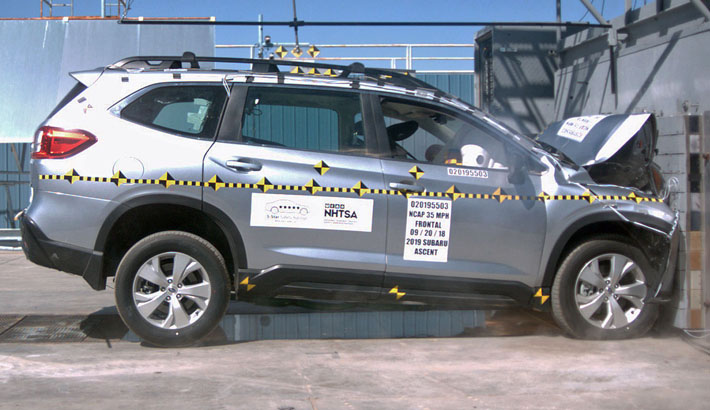
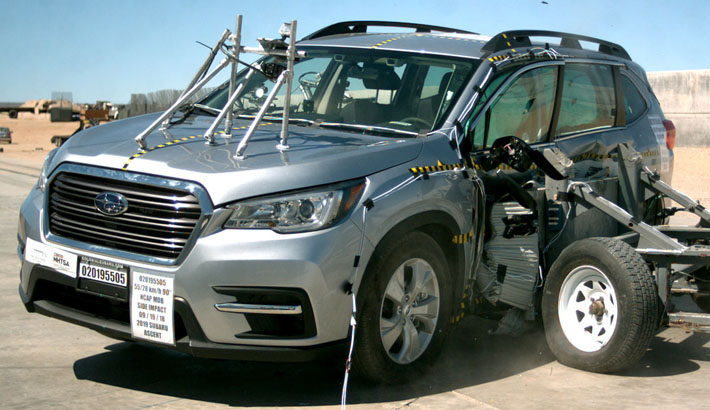
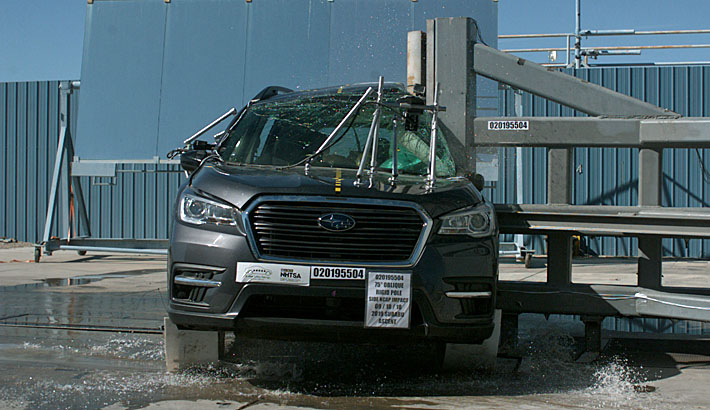
NHTSA crash tests
The agency crash-tested this model year itself. These are its own
photographs and star ratings.
Frontal crash test
Side barrier crash test
Side pole crash test
Photographs taken by NHTSA during its own New Car Assessment Program crash
tests of this model year. Public domain.
Configuration
Overall
Front
Side
Rollover
2019 Subaru Ascent SUV AWD
17% risk
When owners complained
A spike years after the car went on sale usually means a part wearing
out on schedule across the whole fleet — the kind of pattern no single
owner can see from inside their own car.
Aug 2018peak 29Sep 2026
Recalls on the 2019 Subaru Ascent
A complaint is one owner's allegation. A recall is the point at which
the manufacturer or a regulator agreed the defect is real and dangerous
enough to fix for free — however old the car is.
United States — NHTSA
26V436000
EQUIPMENT:OTHER:LABELS
Subaru of America, Inc. (Subaru) is recalling certain 2026 Crosstrek Hybrid, 2025-2026 Forester Hybrid, Forester, and 2019-2026 Ascent vehicles. These vehicles were manufactured with an incorrect Gross Axle Weight Rating (GAWR) on the certification label. As such, these vehicles fail to comply with the requirements of Federal Motor Vehicle Safety Standard (FMVSS) 110, "Tire selection and rims."
Risk: An incorrect GAWR label may lead to an overloaded vehicle, increasing the risk of a crash.
22V907000
ELECTRICAL SYSTEM:WIRING:INTERIOR/UNDER DASH
Subaru of America, Inc. (Subaru) is recalling certain 2019-2022 Ascent vehicles. The ground bolt that secures the ground terminal of the Positive Temperature Coefficient (PTC) heater may have been improperly fastened, which could result in melting of the ground terminal and surrounding components.
Risk: A melting ground terminal increases the risk of a fire.
21V955000
POWER TRAIN:AUTOMATIC TRANSMISSION:CONTROL MODULE (TCM/PCM/TECM)
Subaru of America, Inc. (Subaru) is recalling certain 2019-2020 Ascent, 2020 Legacy and Outback vehicles. A programming error in the Transmission Control Unit (TCU) may allow the clutch to engage before the drive chain is completely clamped.
Risk: An improperly secured drive chain may slip and break, causing a loss of drive power and increasing the risk of a crash.
21V587000
FUEL SYSTEM, GASOLINE:DELIVERY:FUEL PUMP
Subaru of America, Inc. (Subaru) is recalling certain 2019-2020 Ascent, 2018 Forester, 2018-2020 Impreza, Legacy, Outback, 2018-2019 BRZ, WRX, and Toyota 86 vehicles. The low-pressure fuel pump inside the fuel tank may fail.
Risk: Fuel pump failure can cause an engine stall while driving, increasing the risk of a crash.
20V218000
FUEL SYSTEM, GASOLINE:DELIVERY:FUEL PUMP
Subaru of America, Inc. (Subaru) is recalling certain 2019 Impreza, Outback, Legacy, and Ascent vehicles. The low pressure fuel pump may become inoperative.
Risk: If the low pressure fuel pump fails, the engine may stall without the ability to restart the vehicle, increasing the risk of a crash.
19V855000
POWER TRAIN:AUTOMATIC TRANSMISSION:CONTROL MODULE (TCM/PCM/TECM)
Subaru of America, Inc. (Subaru) is recalling certain 2019 Ascent vehicles. The transmission hydraulic sensor may inaccurately measure the hydraulic fluid pressure.
Risk: If the fluid pressure is measured higher than its actual value, the hydraulic pressure will be reduced. If this occurs, the transmission drive chain may not have the proper tension, resulting in a loss of drive power and an increased risk of a crash.
19V856000
ENGINE AND ENGINE COOLING:EXHAUST SYSTEM:EMISSION CONTROL:CRANKCASE (PCV)
Subaru of America, Inc. (Subaru) is recalling certain 2019 Crosstrek, Forester, and Ascent vehicles. The aluminum Positive Crankcase Ventilation (PCV) valve can separate, allowing the separated components to enter the engine, resulting in a loss of power while driving.
Risk: An unexpected loss of power while driving can increase the risk of a crash.
19V519000
POWER TRAIN:DRIVELINE:DRIVESHAFT
Subaru of America, Inc. (Subaru) is recalling certain 2019 Ascent vehicles. The center support bolts for the driveshaft may loosen, possibly resulting in the front portion of the driveshaft disconnecting.
Risk: If the front end of the driveshaft separates, it can increase the risk of a crash.
Canada — Transport Canada
Canada runs its own recall programme, and its campaigns do not
always mirror the American ones.
Recall 202632928,461 units in Canada
Label
Issue: On certain vehicles, the compliance label lists an incorrect gross axle weight rating (GAWR). This could lead you to overload the vehicle, which could cause poor handling or a tire failure. Note: For the Forester model, this recall affects both gas and hybrid models. For the Crosstrek model, only the Crosstrek Hybrid model is affected. Safety Risk: Poor handling or a tire failure could cause a loss of control and increase the risk of a crash. Corrective Actions: Subaru will mail a new compliance label to each owner. If you'd like help to install the label, you can contact a Subaru dealer to have it installed free of charge.
Recall 2024546499,490 units in Canada
Label
Issue: On certain vehicles, the compliance label may be missing information in French. The words listed on the label for "Tires", "Rims", "Front" and "Rear" appear in English only, when they should be listed as "Tires/Pneus", "Rims/Jantes", "Front/Avant" and "Rear/Arriere". Canadian regulations require this information to be listed on the label in both English and French. Safety Risk: These small errors do not affect vehicle safety. Corrective Actions: This is not a recall. Subaru has corrected the compliance label for all new vehicles.
Recall 202270313,954 units in Canada
Electrical
Issue: On certain vehicles, the bolt for the ground terminal on the auxiliary heater may not have been properly tightened. As a result, the ground terminal and nearby parts could overheat and melt. Safety Risk: Wiring that overheats and melts could create the risk of a fire. Corrective Actions: Subaru will notify owners by mail and instruct you to take your vehicle to a dealership to replace the PTC (positive temperature coefficient) heater ground bolt. The ground wire and the connector holder will be replaced, if necessary. Subaru advises not remote start your vehicle using Subaru Starlink Connected Services (if equipped) or an aftermarket remote starter (if installed). Subaru also advises not leave the vehicle running while unattended, and that you should park it outdoors and away from other vehicles or structures until the recall repairs have been completed.
Recall 202174513,034 units in Canada
Powertrain
Issue: On certain vehicles, a software problem in the transmission control unit (TCU) may cause the drive chain to slip or break. If this happens while the vehicle is in motion, there could be a loss of power to the wheels. Safety Risk: A loss of power to the wheels could increase the risk of a crash. Corrective Actions: Subaru will notify owners by mail and instruct you to take your vehicle to a dealer to inspect the transmission chain guide and update the TCU. If necessary, the transmission assembly will be replaced.
Recall 202146613,717 units in Canada
Fuel System
Issue: On certain vehicles, the low-pressure fuel pump could fail. If this happens, then engine may run rough or may not start and the check engine light may turn on. This could also result in a sudden loss of engine power while driving. Safety Risk: A sudden loss of engine power could increase the risk of a crash. Corrective Actions: Subaru will notify owners by mail and instruct you to take your vehicle to a dealer to replace the fuel pump.
Recall 202016213,744 units in Canada
Fuel System
Issue: On certain vehicles, the low-pressure fuel pump could fail. If this happens, then engine may run rough or may not start and the check engine light may turn on. This could also result in a sudden loss of engine power while driving. Safety Risk: A sudden loss of engine power could increase the risk of a crash. Corrective Actions: Subaru will notify owners by mail and instruct you to take your vehicle to a dealer to replace the fuel pump.
Recall 20196054,669 units in Canada
Powertrain
Issue: On certain vehicles, a hydraulic sensor in the transmission could malfunction. If this happens, the transmission may slip and cause vibrations or abnormal noises while driving. This can also cause a malfunction indicator lamp to turn on. If you continue driving, this could result in a loss of power to the wheels. Safety Risk: A loss of power to the wheels could increase the risk of a crash. Corrective Actions: Subaru will notify owners by mail and instruct you to take your vehicle to a dealer to update the Transmission Control Unit (TCU) software. The vehicle will be inspected after a drive test, and if certain trouble codes (DTCs) are stored, the hydraulic sensor harness will also be replaced. If vehicles are confirmed to have experienced, or are currently experiencing low drive chain tension, the transmission assembly will be replaced.
Recall 20196045,539 units in Canada
Engine
Issue: On certain vehicles, the positive crankcase ventilation (PCV) valve could fail. If you continue to operate the vehicle after this happens, pieces of the PCV valve may enter the engine and cause an engine failure. Safety Risk: A sudden loss of engine power could increase the risk of a crash. Corrective Actions: Subaru will notify owners by mail and instruct you to take your vehicle to a dealer to replace the PCV valve. Additionally, the replaced PCV valve will be inspected. If the valve is found to have separated, the separator cover and oil pan will be removed. If the separated parts are not located, the engine short block assembly will be replaced.
Reports where the owner recorded a crash, a fire, an injury or a death.
Amelia, OHCrashFire1 injured
AIR BAGS
The contact owns a 2019 Subaru Ascent. The contact stated that while his wife was driving at approximately 75 MPH, a deer ran across the highway and hit the left driver's side of the vehicle. The air bags did not deploy upon impact. A grayish smoke began to emit from the vehicle as the contact's wife immediately pulled off to the side of the road. Due to the damaged cause by the impact of the deer, the contact's wife had difficulty exiting the vehicle. The contact's wife used excessive force to open a crack in the door, which was enough to slide herself out of the vehicle. The vehicle became engulfed in flames soon after exiting the vehicle, and the authorities were called to the scene. The fire department arrived at the scene and managed to extinguish the fire. The contact's wife sustained bruising to her left shoulder, left leg, and left arm but did not seek medical attention. A police report was filed. The vehicle was initially towed to an independent tow yard and was later towed to an insurance holding facility. The contact stated that the vehicle was destroyed as a result of the fire, but the insurance adjuster had yet to determine a final ruling on the vehicle. Neither the dealer nor the manufacturer had yet been notified of the failure. The failure mileage was unknown.
NHTSA complaint #11726659 — an unverified report by a vehicle owner.
Amelia, OHCrashFire1 injured
ENGINE
The contact owns a 2019 Subaru Ascent. The contact stated that while his wife was driving at approximately 75 MPH, a deer ran across the highway and hit the left driver's side of the vehicle. The air bags did not deploy upon impact. A grayish smoke began to emit from the vehicle as the contact's wife immediately pulled off to the side of the road. Due to the damaged cause by the impact of the deer, the contact's wife had difficulty exiting the vehicle. The contact's wife used excessive force to open a crack in the door, which was enough to slide herself out of the vehicle. The vehicle became engulfed in flames soon after exiting the vehicle, and the authorities were called to the scene. The fire department arrived at the scene and managed to extinguish the fire. The contact's wife sustained bruising to her left shoulder, left leg, and left arm but did not seek medical attention. A police report was filed. The vehicle was initially towed to an independent tow yard and was later towed to an insurance holding facility. The contact stated that the vehicle was destroyed as a result of the fire, but the insurance adjuster had yet to determine a final ruling on the vehicle. Neither the dealer nor the manufacturer had yet been notified of the failure. The failure mileage was unknown.
NHTSA complaint #11726659 — an unverified report by a vehicle owner.
Bellevue, WACrash
FORWARD COLLISION AVOIDANCE: WARNINGS
I leased a 2019 Subaru Ascent (VIN: [XXX] ), which is equipped with the EyeSight driver-assist system. In the Spring of 2019, while driving in a parking lot at night with low visibility and snow, the vehicle struck a pole. Despite the imminent collision, the EyeSight system failed to engage Pre-Collision Braking or provide any audible/visual warning to alert me of the obstacle. The system did not disengage or indicate it was unavailable due to weather; it simply failed to function, resulting in a collision. Following this incident, I immediately contacted Subaru of America to report the failure. At that time, Subaru representatives denied any defect existed and stated the system was not at fault. I have recently learned that this vehicle is part of the [XXX], et al. v. Subaru of America, Inc. class action 9[XXX]), which addresses defects in the Pre-Collision Braking and Lane Keep Assist systems. Crucially, I was never notified of this class action or the associated defect by Subaru. I received no mail, email, or other communication alerting me to this safety risk or my eligibility for repair/reimbursement. I only discovered this information via a third-party news source after the settlement claim deadline of September 27, 2025, had passed. Upon contacting the Settlement Administrator and Subaru of America in January 2026, I was told that because the administrative deadline has passed, no remedy is available. Subaru is effectively refusing to address a known safety defect on a confirmed affected VIN solely due to a missed deadline that I was never informed of. I am filing this complaint to document the failure of the EyeSight system and Subaru’s failure to properly notify lessees/owners of known safety defects. INFORMATION REDACTED PURSUANT TO THE FREEDOM OF INFORMATION ACT (FOIA), 5 U.S.C. 552(B)(6)
NHTSA complaint #11713281 — an unverified report by a vehicle owner.
I leased a 2019 Subaru Ascent (VIN: [XXX] ), which is equipped with the EyeSight driver-assist system. In the Spring of 2019, while driving in a parking lot at night with low visibility and snow, the vehicle struck a pole. Despite the imminent collision, the EyeSight system failed to engage Pre-Collision Braking or provide any audible/visual warning to alert me of the obstacle. The system did not disengage or indicate it was unavailable due to weather; it simply failed to function, resulting in a collision. Following this incident, I immediately contacted Subaru of America to report the failure. At that time, Subaru representatives denied any defect existed and stated the system was not at fault. I have recently learned that this vehicle is part of the [XXX], et al. v. Subaru of America, Inc. class action 9[XXX]), which addresses defects in the Pre-Collision Braking and Lane Keep Assist systems. Crucially, I was never notified of this class action or the associated defect by Subaru. I received no mail, email, or other communication alerting me to this safety risk or my eligibility for repair/reimbursement. I only discovered this information via a third-party news source after the settlement claim deadline of September 27, 2025, had passed. Upon contacting the Settlement Administrator and Subaru of America in January 2026, I was told that because the administrative deadline has passed, no remedy is available. Subaru is effectively refusing to address a known safety defect on a confirmed affected VIN solely due to a missed deadline that I was never informed of. I am filing this complaint to document the failure of the EyeSight system and Subaru’s failure to properly notify lessees/owners of known safety defects. INFORMATION REDACTED PURSUANT TO THE FREEDOM OF INFORMATION ACT (FOIA), 5 U.S.C. 552(B)(6)
NHTSA complaint #11713281 — an unverified report by a vehicle owner.
Versailles, KYFire
ELECTRICAL SYSTEM
I have a 2019 Subaru Ascent Limited model with 96,xxx miles as of January 2025. In 2023, there was a safety recall for the PTC heater ground bolt sent first class mail for multiple year Ascent models. This recall was completed by local subaru dealership on 3/27/2023 stating "WRL 22 completed. Removed ground bolts and cleaned threads. Found no signs of heat damage. Removed and replaced bolts." Move forward to Saturday, [XXX]. I remote started vehicle from inside the house while on vacation in Bristol Tennesee. Car was running for roughly 5 minutes, when fire alarms inside the house starting going off. Seemed odd considering nothing was going on inside. Walked inside to see large amounts of white smoke coming from the windows of the Ascent. I was able to jump into the car and turn the engine off. I opened all 4 doors to let the car air out. I checked the engine, nothing seemed off. I then turned my attention to the air cabin filter, everything seemed normal as well. After the engine cooled and aired out, there is smoke damage to the vehicle. I was able to transport the car safely to Wallace Subaru which was less than 0.25 mile from our airbnb. I was quickly notified by the service technician that the car is not safe to drive until it was fixed. After further investigation, it was found that the PTC ground bolt has failed again, and this time melting the wiring harness and bolt around it. This was right next to the carpet and put my life as well as my wife, who is [XXX] and my [XXX] daughter. Thankfully we weren't in the vehicle when this occurred. There was no warning. No check engine light, nothing. No other issues leading into the incident. Car is still parked in Bristol TN at the dealership and I am 5 hours away in Lexington KY. Subaru has been uncooperative with this situation and is avoiding talking to me or making this situation better. I literally have no answers. INFORMATION REDACTED PURSUANT TO THE FREEDOM OF INFORMATION ACT (FOIA), 5 U.S.C. 552(B)(6)
NHTSA complaint #11638826 — an unverified report by a vehicle owner.
Elk Garden, WVFire
ELECTRICAL SYSTEM
Over the course of 5 years, a lot has been mechanically wrong with our vehicle. Each service appointment yielded a 'cannot duplicate' response. Recently, my car has been in the service department a few times. My car had recall work performed on a ground bolt, and my husband advised them that the car had a 'rich fuel' smell when starting with the hood open. I've complained since 2021 of a smell when pulling up the mountain. The smell is what I described as a perm solution smell. Each time, the response was 'cannot duplicate.' In February, I took the car in to have the exhaust inspected because it was getting louder each passing day. I was advised that the entire exhaust needed to be replaced, and I would be responsible for costs. I brought my car home, unrepaired, and called Subaru of America to file a claim through them. I had repeatedly expressed concerns, and nothing was done, yet I'm expected to foot the bill now. Since February 12th, I have been back and forth with Subaru and just made the appointment to get the exhaust work completed, with a small contribution from Subaru. However, this past Saturday, [XXX] my vehicle caught on fire while driving. I am fine, but my vehicle has now been deemed a total loss. As I was descending the mountain, I smelled the same 'perm solution' smell, and shortly after, there was smoke coming from under the hood. The smoke entered the cabin as I pulled off the road. Upon exiting the vehicle, flames and smoke were visible from the hood. I grabbed my purse and ran, called 911, and watched my vehicle engulfed in flames. INFORMATION REDACTED PURSUANT TO THE FREEDOM OF INFORMATION ACT (FOIA), 5 U.S.C. 552(B)(6)
NHTSA complaint #11583533 — an unverified report by a vehicle owner.
The most recent complaints
In the owners' own words, exactly as filed with NHTSA.
Roseburg, OR
POWER TRAIN
Subaru of America has a Bulletin out that changes the front suspension arms for both front ends. The dealership made this correction and now the front end rattles like there are loose parts. Dealership says they don’t hear it. Won’t investigate more unless I pay them a diagnostic fee. If Subaru of America knows this vehicle has a faulty part that causes the calipers to clamp down too hard thus warping the rotors! Dealership & SOA need to advertise this Bulletin as a recall.
NHTSA complaint #11762427 — an unverified report by a vehicle owner.
Roseburg, OR
UNKNOWN OR OTHER
Subaru of America has a Bulletin out that changes the front suspension arms for both front ends. The dealership made this correction and now the front end rattles like there are loose parts. Dealership says they don’t hear it. Won’t investigate more unless I pay them a diagnostic fee. If Subaru of America knows this vehicle has a faulty part that causes the calipers to clamp down too hard thus warping the rotors! Dealership & SOA need to advertise this Bulletin as a recall.
NHTSA complaint #11762427 — an unverified report by a vehicle owner.
Roseburg, OR
SUSPENSION
Subaru of America has a Bulletin out that changes the front suspension arms for both front ends. The dealership made this correction and now the front end rattles like there are loose parts. Dealership says they don’t hear it. Won’t investigate more unless I pay them a diagnostic fee. If Subaru of America knows this vehicle has a faulty part that causes the calipers to clamp down too hard thus warping the rotors! Dealership & SOA need to advertise this Bulletin as a recall.
NHTSA complaint #11762427 — an unverified report by a vehicle owner.
at 60,000 milesGeorgetown, TX
STRUCTURE:BODY:HOOD
The contact owns a 2019 Subaru Accent. The contact stated that while driving 60 MPH, the hood was shaking and vibrating abnormally. The dealer was made aware of the failure. The vehicle was taken to the dealer. The contact was informed that an unknown adjustment was needed. Additionally, the shocks were replaced, but the failure reoccurred. The vehicle was taken back to the dealer. The vehicle was not repaired. The contact was informed that the hinges were fractured. The contact was informed that the hinges needed to be replaced. The vehicle was not repaired. The failure mileage was approximately 60,000.
NHTSA complaint #11762249 — an unverified report by a vehicle owner.
Binghamton, NY
LATCHES/LOCKS/LINKAGES:HATCHBACK/LIFTGATE:LOCK
Immediately after pushing the lift gate release button on the dash, a loud and constant alarm tone began. The gate would then not open using the button on the dash, remote, or handle on the exterior of the lift gate door. To access the items in the rear (and to stop the alarm), we needed to get the door open. We followed the owner's manual exactly to access the internal emergency release. We removed the plastic cover for the gear unit, then used a screwdriver to manually move the release to the right. Despite every amount of pressure we tried, including adding pressure by pushing down on the gate from the outside with one person while another tried the release procedure, the gate would not open. We ended up looking on YouTube, and found a video that this is not uncommon - and that the solution is to disconnect the battery or to remove fuse #14 on the fuse panel. With tremendous effort and using a pair of pliers, we finally removed the fuse. The alarm stopped but the gate (and other parts of the electrical system) were now off. We replaced the fuse and the door returned to normal function and opened using the handle on the lift gate. This is a tremendous safety issue. First, there is no easy way to open the gate manually from the interior in the case of an emergency (removing the safety cover and the use of a screwdriver or similar tool is required). Second, this emergency process failed completely, as the gate couldn't be opened at all using the manual release.
NHTSA complaint #11758028 — an unverified report by a vehicle owner.
Binghamton, NY
STRUCTURE:BODY:HATCHBACK/LIFTGATE
Immediately after pushing the lift gate release button on the dash, a loud and constant alarm tone began. The gate would then not open using the button on the dash, remote, or handle on the exterior of the lift gate door. To access the items in the rear (and to stop the alarm), we needed to get the door open. We followed the owner's manual exactly to access the internal emergency release. We removed the plastic cover for the gear unit, then used a screwdriver to manually move the release to the right. Despite every amount of pressure we tried, including adding pressure by pushing down on the gate from the outside with one person while another tried the release procedure, the gate would not open. We ended up looking on YouTube, and found a video that this is not uncommon - and that the solution is to disconnect the battery or to remove fuse #14 on the fuse panel. With tremendous effort and using a pair of pliers, we finally removed the fuse. The alarm stopped but the gate (and other parts of the electrical system) were now off. We replaced the fuse and the door returned to normal function and opened using the handle on the lift gate. This is a tremendous safety issue. First, there is no easy way to open the gate manually from the interior in the case of an emergency (removing the safety cover and the use of a screwdriver or similar tool is required). Second, this emergency process failed completely, as the gate couldn't be opened at all using the manual release.
NHTSA complaint #11758028 — an unverified report by a vehicle owner.
Dayton, OH
POWER TRAIN
The vehicle has 178k miles on it currently. I had to have a transmission and transfer case replaced at 68k miles. Done by Subaru. At 168k miles I had to have a new front pump in the transmission case replaced. Repair done by Subaru. Now at 178k miles the second replacement transmission has completely failed and needs replaced.
NHTSA complaint #11756882 — an unverified report by a vehicle owner.
Staten Island, NY
POWER TRAIN
All the safety systems become disabled and check Engine light goes on because transmission fluid is being pumped Out of a faulty secondary pressure sensor part 31878aa020,( defective and replaced with 31878aa021), into the engines wiring at the car computer, transmission computer, and bulkhead connector in fuse box causing all sorts of engine codes. The setting of the engine code closes all the vehicles driver safety systems and changes the dynamic of the drivers driving experience. As the problem gets worse, it can render the car powerless on roads and highways making operation dangerous. I have my car parked in front of the house with the battery and electrical connectors unplugged. This problem is covered by one or more recalls and safety campaigns, but subaru refuses to fix mine and other peoples that I found on Facebook. Someone online listed a $6500.00 repair estimate. They just had it repossessed instead. This part causes the pressure differences that cause the jerky ride and is specifically alluded to in the recall, plus subaru even changed the part because it was defective.
NHTSA complaint #11755268 — an unverified report by a vehicle owner.
Staten Island, NY
ELECTRICAL SYSTEM
All the safety systems become disabled and check Engine light goes on because transmission fluid is being pumped Out of a faulty secondary pressure sensor part 31878aa020,( defective and replaced with 31878aa021), into the engines wiring at the car computer, transmission computer, and bulkhead connector in fuse box causing all sorts of engine codes. The setting of the engine code closes all the vehicles driver safety systems and changes the dynamic of the drivers driving experience. As the problem gets worse, it can render the car powerless on roads and highways making operation dangerous. I have my car parked in front of the house with the battery and electrical connectors unplugged. This problem is covered by one or more recalls and safety campaigns, but subaru refuses to fix mine and other peoples that I found on Facebook. Someone online listed a $6500.00 repair estimate. They just had it repossessed instead. This part causes the pressure differences that cause the jerky ride and is specifically alluded to in the recall, plus subaru even changed the part because it was defective.
NHTSA complaint #11755268 — an unverified report by a vehicle owner.
Staten Island, NY
FORWARD COLLISION AVOIDANCE: WARNINGS
All the safety systems become disabled and check Engine light goes on because transmission fluid is being pumped Out of a faulty secondary pressure sensor part 31878aa020,( defective and replaced with 31878aa021), into the engines wiring at the car computer, transmission computer, and bulkhead connector in fuse box causing all sorts of engine codes. The setting of the engine code closes all the vehicles driver safety systems and changes the dynamic of the drivers driving experience. As the problem gets worse, it can render the car powerless on roads and highways making operation dangerous. I have my car parked in front of the house with the battery and electrical connectors unplugged. This problem is covered by one or more recalls and safety campaigns, but subaru refuses to fix mine and other peoples that I found on Facebook. Someone online listed a $6500.00 repair estimate. They just had it repossessed instead. This part causes the pressure differences that cause the jerky ride and is specifically alluded to in the recall, plus subaru even changed the part because it was defective.
NHTSA complaint #11755268 — an unverified report by a vehicle owner.
Waxahachie, TX
POWER TRAIN
My 2019 Subaru Ascent Limited had a safety recall that was related to a CVT transmission issue. That safety recall was addressed by Sewell Subaru (Dallas, TX) in January of 2025. This past Wednesday, July 29, I was driving on a state highway on my way to work from my residence. Not even two miles away from my residence, I felt a jerk and a loud "thud". That was followed by loss of power in that the vehicle just was rolling, but no power from the gas. I was able to safely maneuver onto a the shoulder and stop the vehicle. Within minutes, I noticed a puddling of a large amount of fluid that I could easily recognize was not oil. The vehicle was towed back to Sewell Subaru this past Saturday and I was notified today that the CVT belt snapped and it caused a hold in the transmission case, which caused the fluid to leak. The service advisor also mentioned that Subaru is not wanting to cover the replacement and that they are citing that the reason is that Subaru records are showing irregular servicing done by a Subaru service center. This issue has nothing to do with routine maintenance, or where I get those, and has everything to do with the catastrophic failure of the very same component that was at the heart of their known safety recall issue.
NHTSA complaint #11754594 — an unverified report by a vehicle owner.
Dallas, TX
UNKNOWN OR OTHER
NHTSA Vehicle Safety Complaint Vehicle: 2019 Subaru Ascent VIN: [XXX] Mileage: 72,093 miles I am submitting this complaint because my 2019 Subaru Ascent experienced a serious transmission-related electrical failure that may represent a broader safety defect. Sewell Subaru of Dallas diagnosed an internal failure of a transmission pressure sensor. According to the dealership’s written report, the failed pressure sensor allowed transmission fluid to leak into the electrical wiring harness. The transmission fluid then migrated through the wiring and into the bulkhead harness. The dealership advised that the fluid contamination had affected multiple parts of the vehicle’s electrical system and recommended replacement of the transmission wiring harness, engine wiring harness, bulkhead harness, Engine Control Module (ECM), Transmission Control Module (TCM), and related components. Because the wiring harnesses are routed throughout the engine compartment and vehicle, the repair also requires extensive disassembly of the vehicle, including disconnecting and removing numerous engine compartment components to access and replace the contaminated harnesses. The estimated repair cost was approximately $12,000. I also have video documentation of the dealership technician performing the inspection and explaining the transmission fluid contamination and migration through the wiring system. I am willing to provide the video, the dealership's written diagnosis, repair estimate, photographs, and any additional supporting documentation upon request. My vehicle falls within the published VIN range associated with Subaru recall WUV-07, which involved the CVT hydraulic pressure sensor harness and transmission hydraulic pressure system. That recall was later superseded by WRK-21. I understand that the published recall addresses electrical resistance and transmission hydraulic pressure readings rather than transmission fluid leakage. INFORMATION REDACTED PURSUANT TO THE FREEDOM OF INFORMATION ACT (FOIA), 5 U.S.C. 552(B)(6)
NHTSA complaint #11754232 — an unverified report by a vehicle owner.
Dallas, TX
ELECTRICAL SYSTEM
NHTSA Vehicle Safety Complaint Vehicle: 2019 Subaru Ascent VIN: [XXX] Mileage: 72,093 miles I am submitting this complaint because my 2019 Subaru Ascent experienced a serious transmission-related electrical failure that may represent a broader safety defect. Sewell Subaru of Dallas diagnosed an internal failure of a transmission pressure sensor. According to the dealership’s written report, the failed pressure sensor allowed transmission fluid to leak into the electrical wiring harness. The transmission fluid then migrated through the wiring and into the bulkhead harness. The dealership advised that the fluid contamination had affected multiple parts of the vehicle’s electrical system and recommended replacement of the transmission wiring harness, engine wiring harness, bulkhead harness, Engine Control Module (ECM), Transmission Control Module (TCM), and related components. Because the wiring harnesses are routed throughout the engine compartment and vehicle, the repair also requires extensive disassembly of the vehicle, including disconnecting and removing numerous engine compartment components to access and replace the contaminated harnesses. The estimated repair cost was approximately $12,000. I also have video documentation of the dealership technician performing the inspection and explaining the transmission fluid contamination and migration through the wiring system. I am willing to provide the video, the dealership's written diagnosis, repair estimate, photographs, and any additional supporting documentation upon request. My vehicle falls within the published VIN range associated with Subaru recall WUV-07, which involved the CVT hydraulic pressure sensor harness and transmission hydraulic pressure system. That recall was later superseded by WRK-21. I understand that the published recall addresses electrical resistance and transmission hydraulic pressure readings rather than transmission fluid leakage. INFORMATION REDACTED PURSUANT TO THE FREEDOM OF INFORMATION ACT (FOIA), 5 U.S.C. 552(B)(6)
NHTSA complaint #11754232 — an unverified report by a vehicle owner.
NHTSA Vehicle Safety Complaint Vehicle: 2019 Subaru Ascent VIN: [XXX] Mileage: 72,093 miles I am submitting this complaint because my 2019 Subaru Ascent experienced a serious transmission-related electrical failure that may represent a broader safety defect. Sewell Subaru of Dallas diagnosed an internal failure of a transmission pressure sensor. According to the dealership’s written report, the failed pressure sensor allowed transmission fluid to leak into the electrical wiring harness. The transmission fluid then migrated through the wiring and into the bulkhead harness. The dealership advised that the fluid contamination had affected multiple parts of the vehicle’s electrical system and recommended replacement of the transmission wiring harness, engine wiring harness, bulkhead harness, Engine Control Module (ECM), Transmission Control Module (TCM), and related components. Because the wiring harnesses are routed throughout the engine compartment and vehicle, the repair also requires extensive disassembly of the vehicle, including disconnecting and removing numerous engine compartment components to access and replace the contaminated harnesses. The estimated repair cost was approximately $12,000. I also have video documentation of the dealership technician performing the inspection and explaining the transmission fluid contamination and migration through the wiring system. I am willing to provide the video, the dealership's written diagnosis, repair estimate, photographs, and any additional supporting documentation upon request. My vehicle falls within the published VIN range associated with Subaru recall WUV-07, which involved the CVT hydraulic pressure sensor harness and transmission hydraulic pressure system. That recall was later superseded by WRK-21. I understand that the published recall addresses electrical resistance and transmission hydraulic pressure readings rather than transmission fluid leakage. INFORMATION REDACTED PURSUANT TO THE FREEDOM OF INFORMATION ACT (FOIA), 5 U.S.C. 552(B)(6)
NHTSA complaint #11754232 — an unverified report by a vehicle owner.
Omaha, NE
POWER TRAIN
Transmission was recalled and supposedly fixed. The fix has now failed and dealer and Subaru are not willing to fix again.
NHTSA complaint #11753077 — an unverified report by a vehicle owner.
Sunbury, PA
POWER TRAIN
Noticed my car shifting incorrectly since 66,000 miles. At approximately 68,800 miles transmission begin to fail. At a stop sign I pulled out before oncoming traffic with what should have been plenty of time, but transmission failed. It seemed to have had chain slip; completely stopping the car when I was in oncoming traffic. I put the pedal to the floor it caught, and whipped me around the corner. After that it was doing the same thing consistently until I parked it at my residence.
NHTSA complaint #11750736 — an unverified report by a vehicle owner.
Springfield, MO
SERVICE BRAKES
Replaced rear brakes and rotors in August 2025. By may 2026 they had worn down to the metal and needed replaced again. Only had 13000 miles on them. After multiple diagnostics testing was done, no issues were found with the brake system. Monitoring new pads and rotors. Still wearing rapidly but even. After only 6 weeks, they have reached about half of their life.
NHTSA complaint #11747480 — an unverified report by a vehicle owner.
Amelia, OHCrashFire1 injured
AIR BAGS
The contact owns a 2019 Subaru Ascent. The contact stated that while his wife was driving at approximately 75 MPH, a deer ran across the highway and hit the left driver's side of the vehicle. The air bags did not deploy upon impact. A grayish smoke began to emit from the vehicle as the contact's wife immediately pulled off to the side of the road. Due to the damaged cause by the impact of the deer, the contact's wife had difficulty exiting the vehicle. The contact's wife used excessive force to open a crack in the door, which was enough to slide herself out of the vehicle. The vehicle became engulfed in flames soon after exiting the vehicle, and the authorities were called to the scene. The fire department arrived at the scene and managed to extinguish the fire. The contact's wife sustained bruising to her left shoulder, left leg, and left arm but did not seek medical attention. A police report was filed. The vehicle was initially towed to an independent tow yard and was later towed to an insurance holding facility. The contact stated that the vehicle was destroyed as a result of the fire, but the insurance adjuster had yet to determine a final ruling on the vehicle. Neither the dealer nor the manufacturer had yet been notified of the failure. The failure mileage was unknown.
NHTSA complaint #11726659 — an unverified report by a vehicle owner.
Amelia, OHCrashFire1 injured
ENGINE
The contact owns a 2019 Subaru Ascent. The contact stated that while his wife was driving at approximately 75 MPH, a deer ran across the highway and hit the left driver's side of the vehicle. The air bags did not deploy upon impact. A grayish smoke began to emit from the vehicle as the contact's wife immediately pulled off to the side of the road. Due to the damaged cause by the impact of the deer, the contact's wife had difficulty exiting the vehicle. The contact's wife used excessive force to open a crack in the door, which was enough to slide herself out of the vehicle. The vehicle became engulfed in flames soon after exiting the vehicle, and the authorities were called to the scene. The fire department arrived at the scene and managed to extinguish the fire. The contact's wife sustained bruising to her left shoulder, left leg, and left arm but did not seek medical attention. A police report was filed. The vehicle was initially towed to an independent tow yard and was later towed to an insurance holding facility. The contact stated that the vehicle was destroyed as a result of the fire, but the insurance adjuster had yet to determine a final ruling on the vehicle. Neither the dealer nor the manufacturer had yet been notified of the failure. The failure mileage was unknown.
NHTSA complaint #11726659 — an unverified report by a vehicle owner.
Leadville, CO
POWER TRAIN
We have been dealing with issues with this vehicle since 2024. We had 3 open recalls which we took into the closest dealership to us and things were okay for a few months and then started having issues again. We live in a small town and it is hard to get to the dealership so we had a few local mechanics take a look and one had found that the exhuast recall was not installed properly and so he addressed that issue. Things were then okay for a little bit after that and then we started having bigger issues the car would not exceed 30 MPH in the middle of us driving and then the car would jerk back and forth. After advice from Subaru of America we got it checked out at a dealership who put a part into the vehicle and then we got it back and less than a week later the car was doing the same things. We took it back and they kept the car for 2 weeks but told us they could not duplicate the problem so we got the car back and right away had the same issues when taking it home. The CVT is for sure messing up we believe and now the car does not drive at all. After some back and forth we found out that the 1st owners took it in for the CVT recall so I reached out to the dealership who did that and was told that they did look at it but at the time the CVT was not an issue but the mileage was fairly low at that time. Personally I am not in a place to afford to get it replaced on my own but I do not believe that the recall should have been closed out knowing that the part would eventually go out since it is a known issue on that car I have tried to go back and forth to get this resolved but I am not getting anywhere and I am not sure what to do at this point to try and get the problems address and made right.
NHTSA complaint #11722197 — an unverified report by a vehicle owner.
Waco, TX
POWER TRAIN
Component/System Failed: The vehicle’s CVT transmission and related transmission components. The transmission and associated components have been replaced multiple times by authorized Subaru dealerships. The vehicle is available for inspection upon request. Description of the Failure and Safety Risk: The vehicle has experienced repeated, intermittent transmission malfunctions, including warning lights, loss of power during acceleration, and sudden harsh re-engagement. Most recently, while accelerating through an intersection from a stop, the vehicle briefly lost power and then abruptly surged forward, causing a pronounced lurch strong enough to chirp the tires. This created a serious safety concern. A hesitation or loss of motive power in an active intersection exposes me to potential cross-traffic collisions, while the sudden re-engagement creates unpredictable acceleration and possible loss of control. The intermittent nature of the malfunction makes it impossible to anticipate when it will occur. Dealer/Manufacturer Involvement: The issue has been reported to and inspected by authorized Subaru dealerships multiple times. Because the malfunction is intermittent, dealers have stated they cannot fully diagnose the issue unless warning lights are active at the time of inspection. Subaru corporate customer advocacy has been involved in reviewing the case. Warning Lamps / Prior Symptoms: Intermittent transmission and check engine warning lights have appeared repeatedly over several months. The lights often illuminate while driving and then turn off after restarting the vehicle, despite the underlying issue not being resolved.
NHTSA complaint #11719891 — an unverified report by a vehicle owner.
at 120,000 milesSwannanoa, NC
ENGINE AND ENGINE COOLING:EXHAUST SYSTEM
The contact owns a 2019 Subaru Ascent. The contact stated that while the engine was idling, exhaust fumes entered the cabin of the vehicle. Additionally, immediately after starting the vehicle, there was a loud ticking sound coming from the exhaust system. The vehicle was inspected by the local dealer, and it was determined that the exhaust manifold lines were faulty and needed to be replaced. The vehicle was not repaired. The manufacturer was notified of the failure, but no assistance was provided. The failure mileage was 120,000.
NHTSA complaint #11717497 — an unverified report by a vehicle owner.
Bellevue, WACrash
FORWARD COLLISION AVOIDANCE: WARNINGS
I leased a 2019 Subaru Ascent (VIN: [XXX] ), which is equipped with the EyeSight driver-assist system. In the Spring of 2019, while driving in a parking lot at night with low visibility and snow, the vehicle struck a pole. Despite the imminent collision, the EyeSight system failed to engage Pre-Collision Braking or provide any audible/visual warning to alert me of the obstacle. The system did not disengage or indicate it was unavailable due to weather; it simply failed to function, resulting in a collision. Following this incident, I immediately contacted Subaru of America to report the failure. At that time, Subaru representatives denied any defect existed and stated the system was not at fault. I have recently learned that this vehicle is part of the [XXX], et al. v. Subaru of America, Inc. class action 9[XXX]), which addresses defects in the Pre-Collision Braking and Lane Keep Assist systems. Crucially, I was never notified of this class action or the associated defect by Subaru. I received no mail, email, or other communication alerting me to this safety risk or my eligibility for repair/reimbursement. I only discovered this information via a third-party news source after the settlement claim deadline of September 27, 2025, had passed. Upon contacting the Settlement Administrator and Subaru of America in January 2026, I was told that because the administrative deadline has passed, no remedy is available. Subaru is effectively refusing to address a known safety defect on a confirmed affected VIN solely due to a missed deadline that I was never informed of. I am filing this complaint to document the failure of the EyeSight system and Subaru’s failure to properly notify lessees/owners of known safety defects. INFORMATION REDACTED PURSUANT TO THE FREEDOM OF INFORMATION ACT (FOIA), 5 U.S.C. 552(B)(6)
NHTSA complaint #11713281 — an unverified report by a vehicle owner.
I leased a 2019 Subaru Ascent (VIN: [XXX] ), which is equipped with the EyeSight driver-assist system. In the Spring of 2019, while driving in a parking lot at night with low visibility and snow, the vehicle struck a pole. Despite the imminent collision, the EyeSight system failed to engage Pre-Collision Braking or provide any audible/visual warning to alert me of the obstacle. The system did not disengage or indicate it was unavailable due to weather; it simply failed to function, resulting in a collision. Following this incident, I immediately contacted Subaru of America to report the failure. At that time, Subaru representatives denied any defect existed and stated the system was not at fault. I have recently learned that this vehicle is part of the [XXX], et al. v. Subaru of America, Inc. class action 9[XXX]), which addresses defects in the Pre-Collision Braking and Lane Keep Assist systems. Crucially, I was never notified of this class action or the associated defect by Subaru. I received no mail, email, or other communication alerting me to this safety risk or my eligibility for repair/reimbursement. I only discovered this information via a third-party news source after the settlement claim deadline of September 27, 2025, had passed. Upon contacting the Settlement Administrator and Subaru of America in January 2026, I was told that because the administrative deadline has passed, no remedy is available. Subaru is effectively refusing to address a known safety defect on a confirmed affected VIN solely due to a missed deadline that I was never informed of. I am filing this complaint to document the failure of the EyeSight system and Subaru’s failure to properly notify lessees/owners of known safety defects. INFORMATION REDACTED PURSUANT TO THE FREEDOM OF INFORMATION ACT (FOIA), 5 U.S.C. 552(B)(6)
NHTSA complaint #11713281 — an unverified report by a vehicle owner.
Jacksonville, FL
POWER TRAIN
Over the past few months the transmission has started randomly refusing to engage. When entering the expressway, you will press the accelerator, and the engine will rev and the vehicle will not accelerate at all. Then you let off the accelerator, let the engine RPM drop back down to idle, and press again and it will accelerate. This has happened 3 times in 2 months. Subaru is refusing to replace the transmission because their tech cannot personally reproduce the problem on demand, even though they have voluntarily extended the warranty on this model transmission due to slippage issues. They are instead going to change the transmission fluid, which has less than 1/2 the mileage for a typical fluid service, to mask the issue, risking the safety of passengers.
NHTSA complaint #11702574 — an unverified report by a vehicle owner.