Owners have filed 250 complaints
about the 2019 Hyundai Kona with NHTSA between 2018 and 2026.
The largest single group is the engine & cooling.
Across this model's run it ranks 1 of 9 worst.
The letter says how bad. This says what kind — whether this year drew
an unusual number of complaints, unusually dangerous
ones, or failures that arrived unusually early.
The dashed ring is 50 — the national norm. Further out is worse.
Complaint volume — 100
Against the median year of the Hyundai Kona. 50 means typical for this
model; 100 means roughly double.
Severity — 66
12.8% of these complaints
involved a crash, fire, injury or death, against a national rate of
9.7%.
Early failure — 83
49% of failures with a mileage on record happened under
36,000 miles, against a national rate of
29%.
Odometer readings owners gave when they filed. About half of all
complaints include one.
Under 1,000 miles
45.7%
1,000 – 9,999 miles
1825.7%
10,000 – 24,999 miles
912.9%
25,000 – 49,999 miles
1014.3%
50,000 – 74,999 miles
811.4%
75,000 – 99,999 miles
811.4%
100,000 – 149,999 miles
1217.1%
150,000+ miles
11.4%
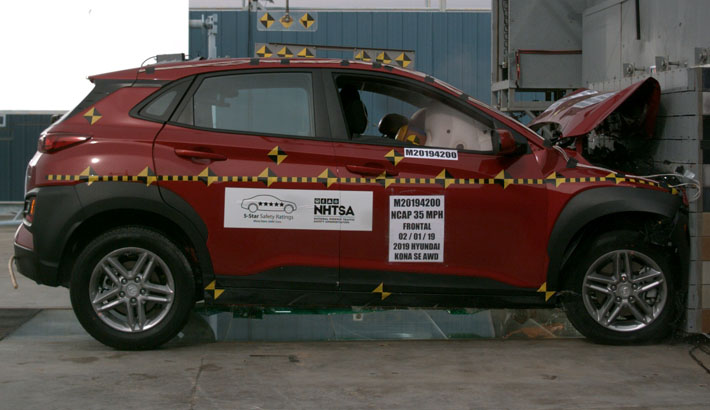
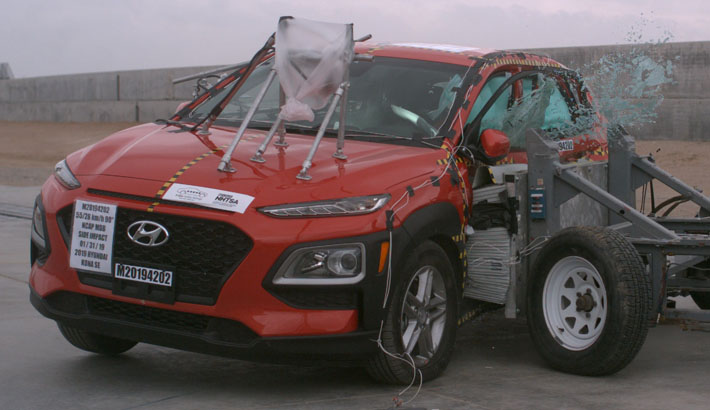
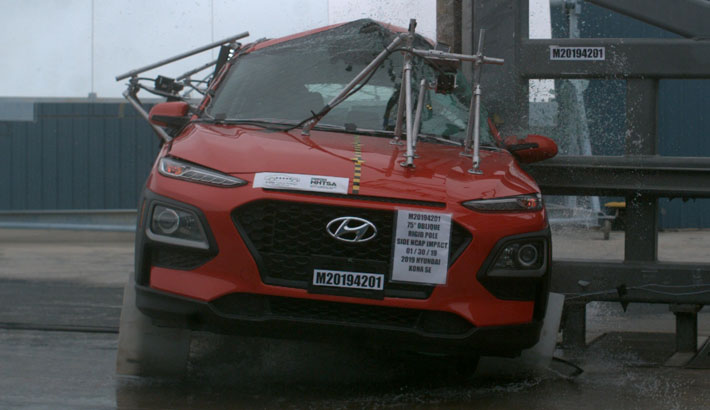
NHTSA crash tests
The agency crash-tested this model year itself. These are its own
photographs and star ratings.
Frontal crash test
Side barrier crash test
Side pole crash test
Photographs taken by NHTSA during its own New Car Assessment Program crash
tests of this model year. Public domain.
Configuration
Overall
Front
Side
Rollover
2019 Hyundai Kona SUV FWD
14.1% risk
2019 Hyundai Kona SUV AWD
13.6% risk
When owners complained
A spike years after the car went on sale usually means a part wearing
out on schedule across the whole fleet — the kind of pattern no single
owner can see from inside their own car.
Dec 2018peak 13Sep 2026
Recalls on the 2019 Hyundai Kona
A complaint is one owner's allegation. A recall is the point at which
the manufacturer or a regulator agreed the defect is real and dangerous
enough to fix for free — however old the car is.
United States — NHTSA
21V301000
ENGINE
Hyundai Motor America (Hyundai) is recalling certain 2019-2020 Elantra, 2019-2021 Kona and Veloster vehicles equipped with 2.0L Nu MPI engines. The piston oil rings may not have been properly heat-treated, which could result in engine damage.
Risk: A damaged engine may stall, increasing the risk of a crash. In addition, oil may leak onto hot exhaust components, increasing the risk of a fire.
Canada — Transport Canada
Canada runs its own recall programme, and its campaigns do not
always mirror the American ones.
Recall 2025636332,486 units in Canada
Other
Issue : Hyundai Auto Canada is conducting an extended warranty campaign for certain vehicles as water could enter the horn assembly and cause the horn's electrical contacts to corrode. As a result, the horn may not work properly or at all. Safety risk: A horn that doesn't work properly could prevent a driver from warning others of a danger and create an unsafe situation. Corrective Actions: To reduce the safety risk, Hyundai advises you to test the horn regularly. Hyundai will notify owners in writing and advise you to contact a dealership if your horn doesn't work properly. Hyundai will provide an extended warranty of 10 years/200 000 km to replace the horn for free if it fails.
Recall 2024552824,695 units in Canada
Label
Issue: On certain vehicles, the compliance label may be missing information in French. The words listed on the label for "Tires", "Rims", "Front" and "Rear" appear in English only, when they should be listed as "Tires/Pneus", "Rims/Jantes", "Front/Avant" and "Rear/Arriere". Canadian regulations require this information to be listed on the label in both English and French. Safety Risk: These small errors do not affect vehicle safety. Corrective Actions: This is not a recall. The company has corrected the compliance label for all new vehicles.
Recall 202125276,192 units in Canada
Engine
Issue: On certain vehicles, the engine's piston oil rings may be defective. This can cause engine wear that can lead to increased oil consumption. Eventually, this can create abnormal engine noise and the oil pressure warning light may turn on. If you continue to drive the vehicle with these symptoms, the engine could fail. Note: This only affects vehicles equipped with a 2.0 L Nu MPI engine. Safety Risk: A sudden loss of engine power could increase the risk of a crash. An engine failure could also create the risk of a fire. Corrective Actions: Hyundai will notify owners by mail and instruct you to take your vehicle to a dealer to inspect the engine. The engine will be replaced, if necessary. Hyundai is also developing a Piston-ring Noise Sensing System (PNSS) software update to be installed when available; it will alert the driver of potential damage before an engine failure occurs.
Reports where the owner recorded a crash, a fire, an injury or a death.
Naples, FLCrash1 injured
AIR BAGS
I am reporting this for my daughter, [XXX] , while she's recovering on pain meds. She is the owner and driver of the car. no passengers in this 1-car accident. the weather and road conditions were terrible. car skidded of side of road into a ditch. When the airbags deployed, the plastic frame on the drivers side A-pillar broke and exploded out towards the driver. it appears the sharp edge of the broken plastic frame struck driver in left eye, slicing it cornea area of her eye causing a ruptured globe. thankfully, she has no other injuries. the plastic frame on the passenger side A-pillar did not break when it's airbag deployed. reporting by [XXX] . please contact me at [XXX] . [XXX] INFORMATION REDACTED PURSUANT TO THE FREEDOM OF INFORMATION ACT (FOIA), 5 U.S.C. 552(B)(6)
NHTSA complaint #11726951 — an unverified report by a vehicle owner.
Valley Stream, NYCrash3 injured
VEHICLE SPEED CONTROL
While stopped our 2019 Kona EV at a traffic light with my foot on the brake, the car spontaneously accelerated and crashed into the car also sitting at the light about eight feet in front of us. If there wasn't a car in front of us, we would have gone through a busy intersection at very high speed. The front end of the car was destroyed and both airbags deployed. The car was towed to a collision center and is considered: "Totaled" . We tried to get it inspected for the computer system to confirm what happened, but there was no interest by any party. There was no pre-warning or issues with the vehicle before this happened. The incident happened about ten miles from our house, and we had been driving it for about 15 minutes. The temperature outside was extremely cold at about 5 degrees Fahrenheit.
NHTSA complaint #11718156 — an unverified report by a vehicle owner.
Valley Stream, NYCrash3 injured
ELECTRICAL SYSTEM
While stopped our 2019 Kona EV at a traffic light with my foot on the brake, the car spontaneously accelerated and crashed into the car also sitting at the light about eight feet in front of us. If there wasn't a car in front of us, we would have gone through a busy intersection at very high speed. The front end of the car was destroyed and both airbags deployed. The car was towed to a collision center and is considered: "Totaled" . We tried to get it inspected for the computer system to confirm what happened, but there was no interest by any party. There was no pre-warning or issues with the vehicle before this happened. The incident happened about ten miles from our house, and we had been driving it for about 15 minutes. The temperature outside was extremely cold at about 5 degrees Fahrenheit.
NHTSA complaint #11718156 — an unverified report by a vehicle owner.
Valley Stream, NYCrash3 injured
SERVICE BRAKES
While stopped our 2019 Kona EV at a traffic light with my foot on the brake, the car spontaneously accelerated and crashed into the car also sitting at the light about eight feet in front of us. If there wasn't a car in front of us, we would have gone through a busy intersection at very high speed. The front end of the car was destroyed and both airbags deployed. The car was towed to a collision center and is considered: "Totaled" . We tried to get it inspected for the computer system to confirm what happened, but there was no interest by any party. There was no pre-warning or issues with the vehicle before this happened. The incident happened about ten miles from our house, and we had been driving it for about 15 minutes. The temperature outside was extremely cold at about 5 degrees Fahrenheit.
NHTSA complaint #11718156 — an unverified report by a vehicle owner.
Albuquerque, NMCrash
AIR BAGS
I would like to file a complaint regarding a major problem with our 2019 Hyundai Kona. We currently have Case #[XXX] opened with Hyundai Corporate Customer Care [XXX] ) but are having major problems getting this air bag issue resolved as it is currently an “unrecalled vehicle,” but having the same issue with air bags as a very recent recalled vehicle list and there is a current class action lawsuit. The car was in a minor rear end accident when major air bag issues were discovered not due to the accident. We were told to file a supplemental claim with our insurance company but as to no surprise to us it was denied because it had nothing to do with this car’s air bag issues. I have included the timeline and pertinent info on this car. It is currently outside the warranty period by date only. The vehicle has less than 58,000 miles on it. The vehicle’s air bag light was not illuminated until after the accident otherwise we would have resolved the issue right away The car has been at Hyundai Glassman in Southfield, Mi., for over 2 months while we have tried to get this resolved as the repair estimate is close to $9000.00. Please review attached. Thank you! INFORMATION REDACTED PURSUANT TO THE FREEDOM OF INFORMATION ACT (FOIA), 5 U.S.C. 552(B)(6)
NHTSA complaint #11684510 — an unverified report by a vehicle owner.
Chester, MDCrash
UNKNOWN OR OTHER
Driving on the highway [XXX] ) during rain. Traffic moving stop and go slow. Before I knew what had happened, my car hit the back bumper of a Chevy Suburban. My car gave no auto warning, the windshield wipers barely worked, and I believe the electric systems had stopped. Radio and air-conditioning. [XXX] My car bumper and grill were messed up. And I received pain in my right shoulder. The Suburban had a trailer hook-up jammed inside my front bumper grill; my vehicle received all the damage. The other driver's vehicle had no harm. My vehicle damage to the car was over a thousand dollars. And I was left with a shoulder injury. Car insurance paid for the damage to my 2019 Hyundai Kona SUV's all-wheel drive, with me paying a portion. After work was completed, all the electrical systems, including air conditioning, lights, wipers, and radio, didn't work. Fuse work was checked and found, but no power was getting into the system to operate functions that required electricity. The car started up, but the side lights but not the front lights, air conditioning, and the issue of tight steering now. The car tech stated they only installed a new bumper, and the grill did not work on the areas that are now not working. Tech said the lights and wipers were working but are not working now. Driving the vehicle will be limited based on these issues. The fuses appear good, but no power is getting into the box that powers the various items that are not working. I believe this car is a Lemon, and the dealership was aware of these issues and never told me the car had recalls. According to the internet, the tech who replaced my bumper stated that these issues are what the 2019 Hyundai Kona vehicle. Today (7-22-24), I drove my car from the auto shop with a new bumper and with hesitation and fear because the wipers and lights were not working, the air conditioning was out, and it is about to rain. The tech stated they were working earlier but are not working now. INFORMATION REDACTED PURSUANT TO THE FREEDOM OF INFORMA
NHTSA complaint #11603909 — an unverified report by a vehicle owner.
The most recent complaints
In the owners' own words, exactly as filed with NHTSA.
Harrison, NY
ENGINE
Vehicle starting using extreme amounts of oil, lose acceleration and stalling while driving and making klicking noises. All symptoms point to Hyundai recall 203 (NHTSA campaign number 21V301000). Dealer and manufacturer refuse to fix it, citing lack of extended warranty and high mileage, as well as insist of oil consumption test that would require me to drive the vehicle for another 1000 miles for them to be able to determine the oil consumption. Because I don't fee it is safe to drive the vehicle, I declined the test, but was willing to allow the dealer's service employees to drive it. They refused. I ended up donating the vehicle to Kars for Kids and notified them about the situation.
NHTSA complaint #11764152 — an unverified report by a vehicle owner.
Brenham, TX
POWER TRAIN
My 2019 Hyundai Kona SE (2.0L Nu MPI/Atkinson engine) was previously subject to NHTSA Recall 21V301000 (Hyundai Recall 203) for defective piston oil rings that can chip and cause accelerated oil consumption, engine knocking, and stalling. That recall's remedy was performed under a prior owner in December 2021. In November 2025, a Hyundai dealership installed a Cylinder Noise Diagnostic System (CNDS) software update (Service Campaign 974) specifically meant to detect this defect's vibration signature before it causes engine damage. Approximately 7,000-8,000 miles and about nine months after that software update, the vehicle stalled unexpectedly while being driven on two separate occasions, with no check-engine light or other warning beforehand. A third stall left the vehicle unable to restart. It was towed to a service station, which found no engine oil and no external leak. A Hyundai dealership subsequently diagnosed cracked valves that allowed approximately 5 quarts of oil to burn through the engine, and determined the engine requires complete replacement. This is the same failure mode (oil consumption/engine damage leading to stalling) that the original recall and the 2025 software update were both meant to prevent, and the software gave no advance warning before the stalling occurred. The vehicle and dealership diagnosis are available for inspection upon request.
NHTSA complaint #11762578 — an unverified report by a vehicle owner.
Brenham, TX
ENGINE
My 2019 Hyundai Kona SE (2.0L Nu MPI/Atkinson engine) was previously subject to NHTSA Recall 21V301000 (Hyundai Recall 203) for defective piston oil rings that can chip and cause accelerated oil consumption, engine knocking, and stalling. That recall's remedy was performed under a prior owner in December 2021. In November 2025, a Hyundai dealership installed a Cylinder Noise Diagnostic System (CNDS) software update (Service Campaign 974) specifically meant to detect this defect's vibration signature before it causes engine damage. Approximately 7,000-8,000 miles and about nine months after that software update, the vehicle stalled unexpectedly while being driven on two separate occasions, with no check-engine light or other warning beforehand. A third stall left the vehicle unable to restart. It was towed to a service station, which found no engine oil and no external leak. A Hyundai dealership subsequently diagnosed cracked valves that allowed approximately 5 quarts of oil to burn through the engine, and determined the engine requires complete replacement. This is the same failure mode (oil consumption/engine damage leading to stalling) that the original recall and the 2025 software update were both meant to prevent, and the software gave no advance warning before the stalling occurred. The vehicle and dealership diagnosis are available for inspection upon request.
NHTSA complaint #11762578 — an unverified report by a vehicle owner.
Brenham, TX
FUEL/PROPULSION SYSTEM
My 2019 Hyundai Kona SE (2.0L Nu MPI/Atkinson engine) was previously subject to NHTSA Recall 21V301000 (Hyundai Recall 203) for defective piston oil rings that can chip and cause accelerated oil consumption, engine knocking, and stalling. That recall's remedy was performed under a prior owner in December 2021. In November 2025, a Hyundai dealership installed a Cylinder Noise Diagnostic System (CNDS) software update (Service Campaign 974) specifically meant to detect this defect's vibration signature before it causes engine damage. Approximately 7,000-8,000 miles and about nine months after that software update, the vehicle stalled unexpectedly while being driven on two separate occasions, with no check-engine light or other warning beforehand. A third stall left the vehicle unable to restart. It was towed to a service station, which found no engine oil and no external leak. A Hyundai dealership subsequently diagnosed cracked valves that allowed approximately 5 quarts of oil to burn through the engine, and determined the engine requires complete replacement. This is the same failure mode (oil consumption/engine damage leading to stalling) that the original recall and the 2025 software update were both meant to prevent, and the software gave no advance warning before the stalling occurred. The vehicle and dealership diagnosis are available for inspection upon request.
NHTSA complaint #11762578 — an unverified report by a vehicle owner.
La Pine, OR
VEHICLE SPEED CONTROL
The engine was spewing oil into the air filter and also out of a hose near the turbo. It was also consuming high amounts of oil, yes its available for inspection. I was driving on a busy public highway and my car lost power and would not accelerate no the problem has not been confirmed as of yet vehicle has not received official inspection yet there was zero warning lamps, messages, or any indicator of any kind that there was a problem. there still isnt
NHTSA complaint #11757596 — an unverified report by a vehicle owner.
La Pine, OR
ENGINE
The engine was spewing oil into the air filter and also out of a hose near the turbo. It was also consuming high amounts of oil, yes its available for inspection. I was driving on a busy public highway and my car lost power and would not accelerate no the problem has not been confirmed as of yet vehicle has not received official inspection yet there was zero warning lamps, messages, or any indicator of any kind that there was a problem. there still isnt
NHTSA complaint #11757596 — an unverified report by a vehicle owner.
at 81,000 milesCanton, CT
ENGINE
The contact's daughter owns a 2019 Hyundai Kona. The contact stated that while her daughter was driving 40 MPH, smoke started coming from under the hood. The vehicle lost power and came to a stop in front of a convenience store, blocking the entrance. Several unknown warning lights were illuminated. The driver called the Fire Department, and it was confirmed that the engine compartment displayed severe heating damage. There was no fire. The firemen on the scene recommended that the vehicle be towed. The vehicle was towed to an independent mechanic, and the contact was informed that the failure was a known failure and might be covered under an extended warranty program. The vehicle was towed to the dealer, where it was diagnosed and determined that the engine had seized. No electrical failure was found. The dealer initially offered to cover 95% of the cost of the repair. The manufacturer was notified of the failure and offered to cover 85% of the cost of the repair, but the contact declined. The contact stated that the Knock Sensor Detection System (KSDS) software update had previously been completed on the vehicle; however, the update failed to prevent the engine failure. The manufacturer informed the contact that the extended warranty could not be applied due to a transfer of ownership to the contact's daughter. The failure mileage was approximately 81,000.
NHTSA complaint #11757669 — an unverified report by a vehicle owner.
Houston, TX
ENGINE
The vehicle suffered a sudden, severe loss of power while driving, causing the engine to stall unexpectedly. This created an immediate hazard to myself and other motorists on the road, as I was forced to navigate a dead vehicle out of active traffic without power steering or power braking assist. Prior to the total failure, the engine exhibited severe mechanical knocking, loss of acceleration, and high oil consumption without any visible external oil leaks. This engine failure is a direct result of the manufacturing defect detailed in NHTSA Safety Recall 203 (NHTSA Campaign 21V301000) concerning improperly heat-treated piston oil rings that cause severe cylinder scuffing and engine stall. Although the software update (Campaign 974) was previously completed on this VIN, the physical defect was never mechanically repaired. The software update failed to prevent the physical, defectively manufactured components from destroying the engine. Hyundai is refusing to honor the safety campaign and replace the failed engine because the recall database incorrectly lists the recall status as "completed."
NHTSA complaint #11750800 — an unverified report by a vehicle owner.
Suffolk, VA
STRUCTURE:BODY
First notice was exterior top railing coating wearing down after just 3 years of having car. Notified dealership of this issue and was stated that my car was out of warranty. (Now 7yo) Exterior Paint is peeling off hood; exposing primer layering, as well as in some spots, the main body itself. This is a known defect caused by factory laquer coating and of which dealership states they STILL will not cover repair.
NHTSA complaint #11749136 — an unverified report by a vehicle owner.
Delray Beach, FL
ENGINE
My 2019 Hyundai Kona has been burning oil, I’ve done great upkeep on it, including topping the oil off in between services. This is because it obviously has been burning oil, well recently it started stalling, then starting/turning it over has been acting up. The RPM’s have not been stable at all an I’ve ran two diagnostic test on it, they came back as a “camshaft error” I can’t remember the exact code at the moment. However the mechanics I have questioned said it’s probably from the oil pressure being messed up from the oil burning up. Whether it be the sensor not regulating properly or the engine itself not getting enough lubricant. I have heard from others with Hyundais an it’s not just Kona’s, people are saying they burn through their oil fairly quickly compared to other cars they’ve had. With that being said, the car now stalls in traffic and the check engine light came on finally, that’s when we first ran diagnostics. Which I have had diagnostics ran at one place I go to for oil changes, a one at a Meineke, and soon to be a third at Autozone because I need to get the exact code again. I’m worried because my mom an I have been sharing this vehicle and the stalling makes it dangerous, it can be put in neutral and restarted but I have a service appointment with a dealership to see what they can do, however I feel this is happening from something caused straight from the manufacturer, not improper care or overuse. So I’m filing a complaint because if you stall while crossing traffic and could not restart, or know how to restart it, you could get in a wreck. This all seemed to start happening as well right after the vehicle rolled over 100,000 miles, go figure right? An if you needed to inspect this happening it would not be hard to do, all you would have to do is turn over the engine, then drive it for a bit an it will eventually stall, an you could also see the RPM’s bouncing and the noises it makes.
NHTSA complaint #11746808 — an unverified report by a vehicle owner.
at 113,000 milesHazlehurst, GA
ENGINE AND ENGINE COOLING
The contact owns a 2019 Hyundai Kona. The contact stated that the vehicle had experienced excessive oil consumption. The contact stated that while driving 70 MPH on the highway, the vehicle stalled. The contact was unable to pull over to the side of the road. The contact was able to restart the vehicle and continued driving. The contact stated that the failure recurred while driving into a parking lot. The battery warning light illuminated on several occasions. Additionally, the contact stated that the check engine and low oil pressure warning lights were intermittently illuminated. The vehicle was taken to Auto Zone and to an independent mechanic, where it was diagnosed and determined that the piston oil ring failure had caused low oil pressure, which resulted in the timing failure. The failure was related to NHTSA Campaign Number: 21V301000 (ENGINE). The dealer and the manufacturer were notified of the failure but denied a loaner vehicle or towing assistance to the dealer located 75 miles away. The vehicle was not repaired. The failure mileage was approximately 113,000.
NHTSA complaint #11744406 — an unverified report by a vehicle owner.
at 113,000 milesHazlehurst, GA
ENGINE
The contact owns a 2019 Hyundai Kona. The contact stated that the vehicle had experienced excessive oil consumption. The contact stated that while driving 70 MPH on the highway, the vehicle stalled. The contact was unable to pull over to the side of the road. The contact was able to restart the vehicle and continued driving. The contact stated that the failure recurred while driving into a parking lot. The battery warning light illuminated on several occasions. Additionally, the contact stated that the check engine and low oil pressure warning lights were intermittently illuminated. The vehicle was taken to Auto Zone and to an independent mechanic, where it was diagnosed and determined that the piston oil ring failure had caused low oil pressure, which resulted in the timing failure. The failure was related to NHTSA Campaign Number: 21V301000 (ENGINE). The dealer and the manufacturer were notified of the failure but denied a loaner vehicle or towing assistance to the dealer located 75 miles away. The vehicle was not repaired. The failure mileage was approximately 113,000.
NHTSA complaint #11744406 — an unverified report by a vehicle owner.
at 100,000 milesCaddo Mills, TX
ENGINE
The contact owns a 2019 Hyundai Kona. The contact stated that while driving on several occasions at various speeds, the AWD warning light illuminated and was reset each time the vehicle was restarted. The contact also stated that over a couple of months, while downshifting, stopping, or decelerating, the vehicle stalled on several occasions. Additionally, the contact stated that while driving at approximately 30 MPH, the Check Engine warning light illuminated. The vehicle was then taken to an AutoZone, where a handheld diagnostic machine retrieved diagnostic trouble codes: P0017 (crankshaft) and P0171 (system too lean), and it was observed that the oil reservoir was empty. Two quarts of oil were added to the vehicle. The contact stated that after being serviced, the vehicle was idling high and stalled while driving at unknown speeds on several occasions. The vehicle was taken to a dealer, where it was diagnosed with a sheared timing pin, and it was determined that the engine needed to be replaced. The vehicle was not repaired. The manufacturer was notified of the failure. The failure mileage was approximately 100,000.
NHTSA complaint #11742887 — an unverified report by a vehicle owner.
at 105,000 milesMemphis, TN
ENGINE AND ENGINE COOLING
The contact owns a 2019 Hyundai Kona. The contact stated that while making left turns on several occasions, the vehicle stalled. The vehicle was shifted into park (P) and restarted. The vehicle was not diagnosed or repaired. However, during routine maintenance, an independent mechanic noticed that the oil reservoir was empty, and an oil change was completed. The manufacturer was notified of the failure. The failure mileage was approximately 105,000.
NHTSA complaint #11742657 — an unverified report by a vehicle owner.
Diamond Bar, CA
ELECTRICAL SYSTEM
Vehicle (2019 Kona) is subject to Recall 203 (piston ring/bore defect). On XXX Puente Hills Hyundai refused the mandatory physcial inspection, instead attempting to charge $1,100 for 'leak repairs.' An independent inspection by Valvoline on XXX confirmed the engine is dry with no leaks, proving the dealer's claim was fraudulent. Following a recent ECU update, the vehicle triggered a P0420 code—a known symptom of the internal engine damage covered by Recall 203. My Hyundai Corporate Case (#XXX) is currently stalled as the dealer refuses to provide technician notes or perform the safety inspection. I am operating an unsafe vehicle with documented internal mechanical failure. Requesting immediate intervention for a physical cylinder inspection. Please refer to the attached document (SUMMARY OF EVENTS) for the full chronology, supporting evidence, and email correspondence related to the dealership's refusal to perform Recall 203. See attached PDF (Evidence_Email_Correspondence) for documentation of the dealership's refusal to provide technician notes and their unprofessional communication regarding this safety recall. INFORMATION REDACTED PURSUANT TO THE FREEDOM OF INFORMATION ACT (FOIA), 5 U.S.C. 552(B)(6)
NHTSA complaint #11742104 — an unverified report by a vehicle owner.
Diamond Bar, CA
ENGINE
Vehicle (2019 Kona) is subject to Recall 203 (piston ring/bore defect). On XXX Puente Hills Hyundai refused the mandatory physcial inspection, instead attempting to charge $1,100 for 'leak repairs.' An independent inspection by Valvoline on XXX confirmed the engine is dry with no leaks, proving the dealer's claim was fraudulent. Following a recent ECU update, the vehicle triggered a P0420 code—a known symptom of the internal engine damage covered by Recall 203. My Hyundai Corporate Case (#XXX) is currently stalled as the dealer refuses to provide technician notes or perform the safety inspection. I am operating an unsafe vehicle with documented internal mechanical failure. Requesting immediate intervention for a physical cylinder inspection. Please refer to the attached document (SUMMARY OF EVENTS) for the full chronology, supporting evidence, and email correspondence related to the dealership's refusal to perform Recall 203. See attached PDF (Evidence_Email_Correspondence) for documentation of the dealership's refusal to provide technician notes and their unprofessional communication regarding this safety recall. INFORMATION REDACTED PURSUANT TO THE FREEDOM OF INFORMATION ACT (FOIA), 5 U.S.C. 552(B)(6)
NHTSA complaint #11742104 — an unverified report by a vehicle owner.
at 78,000 milesHouston, TX
ENGINE
The contact owns a 2019 Hyundai Kona. The contact observed excessive oil consumption, which has progressively caused the vehicle to stall 2 to 3 times per week. While the engine can be restarted, it idles and runs roughly immediately afterward. Additionally, the contact noted a distinct smell of burning oil exiting from the exhaust system. The contact referenced NHTSA Campaign Number: 21V301000 (ENGINE) however, the VIN was not included in the recall repair. The vehicle was taken to a independent mechanic where it was diagnosed to have excessive oil consumption. The vehicle was not repaired. The manufacturer was notified of the failure. The failure mileage was 78,000.
NHTSA complaint #11739538 — an unverified report by a vehicle owner.
at 120,132 milesCasselberry, FL
ENGINE AND ENGINE COOLING
The contact owns a 2019 HYUNDAI Kona. The contact stated while driving the vehicle at an undisclosed speed, he noticed he had an engine knock, and noticed that the engine was consuming a good amount of oil with no warning lights or oil leaks. The contact pulled over to the side when the knock started and noticed the vehicle was starving of oil although a recent oil change shows it was recent. The vehicle was taken to a dealer where it was diagnosed to have poor service, and engine sludge although dealer stated there was none. The vehicle was not repaired. The manufacturer was notified of the failure. The failure mileage was 120,132.
NHTSA complaint #11739344 — an unverified report by a vehicle owner.
at 120,132 milesCasselberry, FL
ENGINE
The contact owns a 2019 HYUNDAI Kona. The contact stated while driving the vehicle at an undisclosed speed, he noticed he had an engine knock, and noticed that the engine was consuming a good amount of oil with no warning lights or oil leaks. The contact pulled over to the side when the knock started and noticed the vehicle was starving of oil although a recent oil change shows it was recent. The vehicle was taken to a dealer where it was diagnosed to have poor service, and engine sludge although dealer stated there was none. The vehicle was not repaired. The manufacturer was notified of the failure. The failure mileage was 120,132.
NHTSA complaint #11739344 — an unverified report by a vehicle owner.
Bennington, VT
POWER TRAIN
96,247 mi Engine knock and complete oil loss within 3,000 miles of last oil change Symptoms consistent with NHTSA Recall 21V301 (Hyundai Recall 203) and Warranty Extension TXXM coverage
NHTSA complaint #11739064 — an unverified report by a vehicle owner.
Clarksburg, MA
ENGINE
Vehicle frequently and quietly stalls while driving in active traffic, creating an immediate safety hazard. Vehicle is a 2019 Kona with the 2.0L Nu MPI engine, which is the exact subject of NHTSA Safety Recall 21V301 (Recall 209). Hyundai Motor America (Case #42541672) is actively refusing to honor or inspect the vehicle under the safety recall mandates, claiming a lack of dealership service history overrides a federal safety defect.
NHTSA complaint #11738963 — an unverified report by a vehicle owner.
Bennington, VT
ENGINE
96,247 mi Engine knock and complete oil loss within 3,000 miles of last oil change Symptoms consistent with NHTSA Recall 21V301 (Hyundai Recall 203) and Warranty Extension TXXM coverage
NHTSA complaint #11739064 — an unverified report by a vehicle owner.
San Francisco, CA
ENGINE
Engine blew a head gasket so had to have the engine rebuilt @ a cost of $13,000. Car only had 22,500 miles on it. I think that should instigate a recall.
NHTSA complaint #11736065 — an unverified report by a vehicle owner.
Jurupa Valley, CA
POWER TRAIN
The vehicle burns oil faster and the vehicle began to stall at highway speeds. Upon further research, a campaign recall for the same vehicle is open but only for specific VIN. Although this vehicle was not part of the recall campaign 21V301000 the vehicle shows issues aligned with the recall.
NHTSA complaint #11733599 — an unverified report by a vehicle owner.
Jurupa Valley, CA
ENGINE
The vehicle burns oil faster and the vehicle began to stall at highway speeds. Upon further research, a campaign recall for the same vehicle is open but only for specific VIN. Although this vehicle was not part of the recall campaign 21V301000 the vehicle shows issues aligned with the recall.
NHTSA complaint #11733599 — an unverified report by a vehicle owner.