Owners have filed 201 complaints
about the 2020 Hyundai Kona with NHTSA between 2020 and 2026.
The largest single group is the engine & cooling.
Across this model's run it ranks 2 of 9 worst.
The letter says how bad. This says what kind — whether this year drew
an unusual number of complaints, unusually dangerous
ones, or failures that arrived unusually early.
The dashed ring is 50 — the national norm. Further out is worse.
Complaint volume — 82
Against the median year of the Hyundai Kona. 50 means typical for this
model; 100 means roughly double.
Severity — 64
12.4% of these complaints
involved a crash, fire, injury or death, against a national rate of
9.7%.
Early failure — 100
81% of failures with a mileage on record happened under
36,000 miles, against a national rate of
29%.
Odometer readings owners gave when they filed. About half of all
complaints include one.
Under 1,000 miles
1018.9%
1,000 – 9,999 miles
1426.4%
10,000 – 24,999 miles
1630.2%
25,000 – 49,999 miles
35.7%
50,000 – 74,999 miles
47.5%
100,000 – 149,999 miles
611.3%
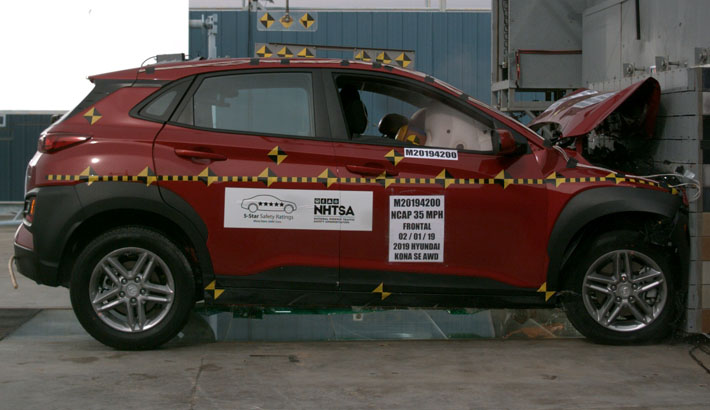
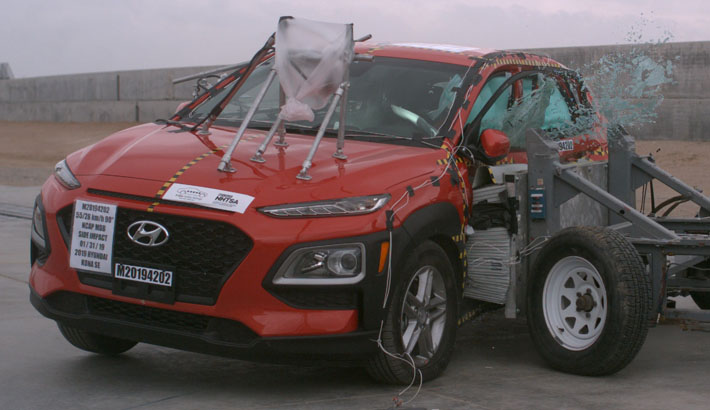
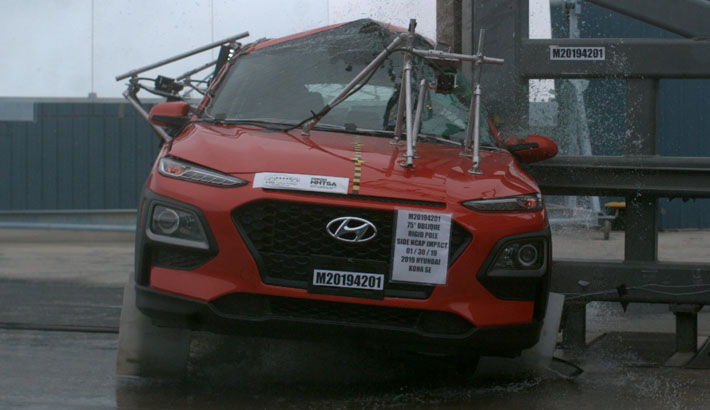
NHTSA crash tests
The agency crash-tested this model year itself. These are its own
photographs and star ratings.
Frontal crash test
Side barrier crash test
Side pole crash test
Photographs taken by NHTSA during its own New Car Assessment Program crash
tests of this model year. Public domain.
Configuration
Overall
Front
Side
Rollover
2020 Hyundai Kona SUV AWD
13.6% risk
2020 Hyundai Kona SUV FWD
14.1% risk
When owners complained
A spike years after the car went on sale usually means a part wearing
out on schedule across the whole fleet — the kind of pattern no single
owner can see from inside their own car.
Mar 2020peak 16Sep 2026
Recalls on the 2020 Hyundai Kona
A complaint is one owner's allegation. A recall is the point at which
the manufacturer or a regulator agreed the defect is real and dangerous
enough to fix for free — however old the car is.
United States — NHTSA
21V301000
ENGINE
Hyundai Motor America (Hyundai) is recalling certain 2019-2020 Elantra, 2019-2021 Kona and Veloster vehicles equipped with 2.0L Nu MPI engines. The piston oil rings may not have been properly heat-treated, which could result in engine damage.
Risk: A damaged engine may stall, increasing the risk of a crash. In addition, oil may leak onto hot exhaust components, increasing the risk of a fire.
20V022000
EQUIPMENT:OTHER:LABELS
Hyundai Motor America (Hyundai) is recalling certain 2020 Kona vehicles. The certification label may indicate incorrect Gross Axle Weight Rating (GAWR). As such, these vehicles fail to comply with the requirements of Federal Motor Vehicle Safety Standard (FMVSS) numbers 567, "Certification" and 110, "Tire Selection and Rims."
Risk: An incorrect GAWR could result in the vehicle being overloaded, increasing the risk of a crash.
Canada — Transport Canada
Canada runs its own recall programme, and its campaigns do not
always mirror the American ones.
Recall 2025636332,486 units in Canada
Other
Issue : Hyundai Auto Canada is conducting an extended warranty campaign for certain vehicles as water could enter the horn assembly and cause the horn's electrical contacts to corrode. As a result, the horn may not work properly or at all. Safety risk: A horn that doesn't work properly could prevent a driver from warning others of a danger and create an unsafe situation. Corrective Actions: To reduce the safety risk, Hyundai advises you to test the horn regularly. Hyundai will notify owners in writing and advise you to contact a dealership if your horn doesn't work properly. Hyundai will provide an extended warranty of 10 years/200 000 km to replace the horn for free if it fails.
Recall 2024552824,695 units in Canada
Label
Issue: On certain vehicles, the compliance label may be missing information in French. The words listed on the label for "Tires", "Rims", "Front" and "Rear" appear in English only, when they should be listed as "Tires/Pneus", "Rims/Jantes", "Front/Avant" and "Rear/Arriere". Canadian regulations require this information to be listed on the label in both English and French. Safety Risk: These small errors do not affect vehicle safety. Corrective Actions: This is not a recall. The company has corrected the compliance label for all new vehicles.
Recall 202125276,192 units in Canada
Engine
Issue: On certain vehicles, the engine's piston oil rings may be defective. This can cause engine wear that can lead to increased oil consumption. Eventually, this can create abnormal engine noise and the oil pressure warning light may turn on. If you continue to drive the vehicle with these symptoms, the engine could fail. Note: This only affects vehicles equipped with a 2.0 L Nu MPI engine. Safety Risk: A sudden loss of engine power could increase the risk of a crash. An engine failure could also create the risk of a fire. Corrective Actions: Hyundai will notify owners by mail and instruct you to take your vehicle to a dealer to inspect the engine. The engine will be replaced, if necessary. Hyundai is also developing a Piston-ring Noise Sensing System (PNSS) software update to be installed when available; it will alert the driver of potential damage before an engine failure occurs.
Recall 2020016529 units in Canada
Label
Issue: The compliance label on certain vehicles lists an incorrect Gross Axle Weight Rating (GAWR). This could lead to overloading of the vehicle and cause poor handling or a tire failure. Safety Risk: Poor handling or a tire failure could cause a loss of control and result in a crash. Corrective Actions: Hyundai will notify owners by mail and instruct you to take your vehicle to a dealer to install a label providing the correct GAWR.
Reports where the owner recorded a crash, a fire, an injury or a death.
Stewsrtsville, NJFire
ENGINE
The Kona was driven a 1/2 hour before parking the vehicle. The Kona was turned off. Within 5 minutes smoke began wafting from under the hood. When I opened the hood to inspect I found the engine & underside of the hood was engulfed in flames. I closed the hood immediately. The Kona fully ignited with minor explosions & burnt completely to the metal frame within 25 minutes.
NHTSA complaint #11748215 — an unverified report by a vehicle owner.
Newport, RICrash1 injured
VEHICLE SPEED CONTROL
I stopped my car foot on brake put it in park and it accelerated on its own and forced me to crash into a concrete wall still not wanting to stop
NHTSA complaint #11733726 — an unverified report by a vehicle owner.
Newport, RICrash1 injured
SERVICE BRAKES
I stopped my car foot on brake put it in park and it accelerated on its own and forced me to crash into a concrete wall still not wanting to stop
NHTSA complaint #11733726 — an unverified report by a vehicle owner.
West Nyack, NYFire
UNKNOWN OR OTHER
On 3/29/26 my Kona caught fire while parked in the front left side of the engine and burned completely within eight minutes. This is not an electric car. Prior to that I drove the car all day with no incident. It was later in the evening around 5:40 PM. I had driven from my house to a restaurant which is about 6.8 miles from my house. I parked my car and then my son-in-law noticed that my engine was smoking. My husband went to check to see if it was the radiator, but he noticed that it was fire and we called [XXX] . I know there are no recalls for my car, but I wanted to report it to you. The car only had 44,900 miles on it and was only serviced by West Nyack Hyundai. The last service was on 1/19/26. If you have any questions, you can email me at [XXX] INFORMATION REDACTED PURSUANT TO THE FREEDOM OF INFORMATION ACT (FOIA), 5 U.S.C. 552(B)(6)
NHTSA complaint #11728446 — an unverified report by a vehicle owner.
Atlanta, GACrash2 injured1 killed
SEATS
The Hyundai Kona was struck head-on by another vehicle. There was one driver and one minor passenger in the right rear seat in the Hyundai Kona. The driver had minor injuries while, unfortunately, the accident was fatal to the passenger. The impact of the collision caused the right rear seat to snap forward, fracturing the passenger's neck. The cause of death for the passenger was blunt force trauma caused by the neck fracture. If the seat had stayed in place during the impact, the passenger's neck would not have been fractured. The vehicle is no longer available for inspection. To our knowledge, the problem has not been reproduced or confirmed by a dealer or independent service center. The vehicle was inspected after the accident by the police. There was no symptom of the problem prior to the accident.
NHTSA complaint #11574843 — an unverified report by a vehicle owner.
at 13,000 milesChicago, ILFire
POWER TRAIN
The contact owns a 2020 Hyundai Kona. The contact stated while driving the vehicle stalled. The gear shifter was stuck in reverse and drive. The vehicle was taken to the local dealer who informed the contact the vehicle was working as designed. The vehicle was not diagnosed or repaired. The vehicle was towed to a local dealer where it was diagnosed the transmission needed to be replaced. The vehicle was repaired but, the failure recurred. The vehicle failed to turn on and there was an abnormal odor of fire. Additionally, The vehicle failed to start. The manufacturer was notified however, no further assistance was provided. The failure mileage was approximately 13,000. The contact mentioned a complaint was filed with the BBB.
NHTSA complaint #11448690 — an unverified report by a vehicle owner.
The most recent complaints
In the owners' own words, exactly as filed with NHTSA.
Loveland, OH
ENGINE
The contact owns a 2020 Hyundai Kona. The vehicle was taken to the dealer to be repaired under NHTSA Campaign Number: 21V301000 (Engine); however, the dealer was unable to perform the recall repair because the vehicle had not experienced a failure associated with the recall and there were no fault codes displayed or retrieved associated with the recall. However, an independent mechanic recommended that the engine be replaced. The contact provided the dealer with the fault codes and the failures that the independent mechanic had found; however, the dealer was unable to retrieve the same fault codes. The contact stated that the check engine warning light was illuminated. The manufacturer was notified of the failure and agreed with the dealer and refused additional assistance. The vehicle was not repaired.
NHTSA complaint #11763068 — an unverified report by a vehicle owner.
at 72,000 milesWinston-Salem, NC
ENGINE
The contact owns a 2020 Hyundai Kona. The contact stated that the vehicle was repaired under NHTSA Campaign Number: 21V301000 (Engine); however, the recall repair failed to prevent the failure from occurring. The contact stated that while driving at various speeds, the vehicle lost motive power and failed to restart using the ignition key. The vehicle was towed to a dealer, Capital Hyundai of Greensboro (801 E Bessemer Ave, Greensboro, NC 27405), where it remained for further diagnosis. The contact stated that during the prior recall repair, the Continuously Variable Valve Timing (CVVT) assembly, Engine Control Module (ECM), and Body Control Module (BCM) were replaced, a solenoid was installed, and the engine was inspected but not replaced. The manufacturer was notified of the failure, and a case was opened. The failure mileage was approximately 72,000.
NHTSA complaint #11760900 — an unverified report by a vehicle owner.
OAK Park, MI
POWER TRAIN
Leaking oil...burns exceptionally fast even with dealership services. Pistons not sealed, melts new spark plugs, misfire on cylinder 3
NHTSA complaint #11759906 — an unverified report by a vehicle owner.
OAK Park, MI
ENGINE
Leaking oil...burns exceptionally fast even with dealership services. Pistons not sealed, melts new spark plugs, misfire on cylinder 3
NHTSA complaint #11759906 — an unverified report by a vehicle owner.
Brandywine, MD
ENGINE
My 2020 Hyundai Kona experienced an engine-related malfunction. An authorized Hyundai dealer inspected the vehicle, confirmed diagnostic code P1327, and determined that the complete engine required replacement. Hyundai authorized the replacement, and the vehicle remained out of service for approximately two weeks. The engine defect created a safety concern because an engine malfunction could cause reduced or complete loss of motive power while driving, increasing the risk of a crash. The dealer inspected and removed the original engine; I do not know whether it remains available for further inspection, but the repair order and diagnostic records are available. I am filing this complaint so NHTSA can document this engine failure and determine whether it is related to NHTSA Campaign 21V301 / Hyundai Recall 203 and whether additional investigation or corrective action is warranted.
NHTSA complaint #11759509 — an unverified report by a vehicle owner.
Wakefield, VA
ENGINE
I received the recall, brought the Kona in had the software download. Now the engine code indicates engine issues with the safety code. Hyundai customer service representatives stars because the issue wasn't found and the software download completed this doesn't fall under the recall. I do have an appointment to bring the Kona into the dealership but because Hyundai states it is no longer under the recall I am responsible for the towing and will not be remembursed. When I initially brought the vehicle in I was told if the pistons and engine codes appears under the recall layer on towing and replacement of the engine is covered. I was also told my engine covered up to 150,000 miles. Even through I only have 65,000 Hyndai dealer and customer service stated it is not as this is only if the engine showed signs at the time of the software download. This is absolutely wrong to be treated like this and been advised by my local mechanic this does appear to be part of the recall, will deregulate, or engine could seize up causing a safety issue.
NHTSA complaint #11755635 — an unverified report by a vehicle owner.
Leander, TX
POWER TRAIN
I am filing a safety complaint against Scott Stark’s South Point Hyundai for selling me a vehicle with an active open safety recall, a blown transmission, an A/C failure, and a dry-rotted tire. Before returning the car for service under a promised 1,000-mile warranty, my sister, who has worked for Corporate Hyundai for 15 years, helped me conduct a full intake baseline inspection at her dealership. We performed a recorded 360-degree video inspection, took high-resolution photos of every square inch, and ran full computer diagnostics, which confirmed zero tool marks on any bolts under the hood or on the transmission, and all diagnostic readings were perfectly recorded. South Point Hyundai kept my vehicle for 10 days for repairs, making excuses about test drives and failing to find technicians. However, a hidden GPS tracker tucked deep under my passenger side carpet meticulously documented every single time the vehicle moved or remained completely stationary on their lot. Upon picking up the vehicle, my sister scanned the car immediately with her diagnostic computer. The readings are now completely erratic and all over the place compared to the baseline corporate readings we documented 10 days prior. Physical inspection reveals that bolts have been turned, internal components have been actively tampered with, and parts have been structurally altered. The evidence directly indicates that this dealership used my personal vehicle as an unauthorized parts donor vehicle to harvest components, severely compromising its mechanical integrity, structural reliability, and overall road safety. This severe tampering has left the vehicle completely unsafe to operate. We possess full video evidence, high-resolution photographs, GPS tracking logs, and comparative corporate Hyundai diagnostic data verifying this severe mechanical fraud. I have turned this info over to Corporate Hyundai, the DMV, and federal enforcement agencies due to safety risks.
NHTSA complaint #11754634 — an unverified report by a vehicle owner.
Leander, TX
SUSPENSION
I am filing a safety complaint against Scott Stark’s South Point Hyundai for selling me a vehicle with an active open safety recall, a blown transmission, an A/C failure, and a dry-rotted tire. Before returning the car for service under a promised 1,000-mile warranty, my sister, who has worked for Corporate Hyundai for 15 years, helped me conduct a full intake baseline inspection at her dealership. We performed a recorded 360-degree video inspection, took high-resolution photos of every square inch, and ran full computer diagnostics, which confirmed zero tool marks on any bolts under the hood or on the transmission, and all diagnostic readings were perfectly recorded. South Point Hyundai kept my vehicle for 10 days for repairs, making excuses about test drives and failing to find technicians. However, a hidden GPS tracker tucked deep under my passenger side carpet meticulously documented every single time the vehicle moved or remained completely stationary on their lot. Upon picking up the vehicle, my sister scanned the car immediately with her diagnostic computer. The readings are now completely erratic and all over the place compared to the baseline corporate readings we documented 10 days prior. Physical inspection reveals that bolts have been turned, internal components have been actively tampered with, and parts have been structurally altered. The evidence directly indicates that this dealership used my personal vehicle as an unauthorized parts donor vehicle to harvest components, severely compromising its mechanical integrity, structural reliability, and overall road safety. This severe tampering has left the vehicle completely unsafe to operate. We possess full video evidence, high-resolution photographs, GPS tracking logs, and comparative corporate Hyundai diagnostic data verifying this severe mechanical fraud. I have turned this info over to Corporate Hyundai, the DMV, and federal enforcement agencies due to safety risks.
NHTSA complaint #11754634 — an unverified report by a vehicle owner.
Leander, TX
ENGINE
I am filing a safety complaint against Scott Stark’s South Point Hyundai for selling me a vehicle with an active open safety recall, a blown transmission, an A/C failure, and a dry-rotted tire. Before returning the car for service under a promised 1,000-mile warranty, my sister, who has worked for Corporate Hyundai for 15 years, helped me conduct a full intake baseline inspection at her dealership. We performed a recorded 360-degree video inspection, took high-resolution photos of every square inch, and ran full computer diagnostics, which confirmed zero tool marks on any bolts under the hood or on the transmission, and all diagnostic readings were perfectly recorded. South Point Hyundai kept my vehicle for 10 days for repairs, making excuses about test drives and failing to find technicians. However, a hidden GPS tracker tucked deep under my passenger side carpet meticulously documented every single time the vehicle moved or remained completely stationary on their lot. Upon picking up the vehicle, my sister scanned the car immediately with her diagnostic computer. The readings are now completely erratic and all over the place compared to the baseline corporate readings we documented 10 days prior. Physical inspection reveals that bolts have been turned, internal components have been actively tampered with, and parts have been structurally altered. The evidence directly indicates that this dealership used my personal vehicle as an unauthorized parts donor vehicle to harvest components, severely compromising its mechanical integrity, structural reliability, and overall road safety. This severe tampering has left the vehicle completely unsafe to operate. We possess full video evidence, high-resolution photographs, GPS tracking logs, and comparative corporate Hyundai diagnostic data verifying this severe mechanical fraud. I have turned this info over to Corporate Hyundai, the DMV, and federal enforcement agencies due to safety risks.
NHTSA complaint #11754634 — an unverified report by a vehicle owner.
Stewsrtsville, NJFire
ENGINE
The Kona was driven a 1/2 hour before parking the vehicle. The Kona was turned off. Within 5 minutes smoke began wafting from under the hood. When I opened the hood to inspect I found the engine & underside of the hood was engulfed in flames. I closed the hood immediately. The Kona fully ignited with minor explosions & burnt completely to the metal frame within 25 minutes.
NHTSA complaint #11748215 — an unverified report by a vehicle owner.
Zirconia, NC
ENGINE
The car failed to accelerate on highway on multiple occasions, including when slowing down and then trying to accelerate when pulling out on highways.
NHTSA complaint #11745092 — an unverified report by a vehicle owner.
Zirconia, NC
FUEL/PROPULSION SYSTEM
The car failed to accelerate on highway on multiple occasions, including when slowing down and then trying to accelerate when pulling out on highways.
NHTSA complaint #11745092 — an unverified report by a vehicle owner.
at 117,000 milesDayton, OH
ENGINE
The contact owns a 2020 Hyunndai Kona. The contact stated while attempting to start the vehicle, the check engine warning light illuminated. The contact's fiance, who is an independent mechanic attached the portable diagnostic tester to the vehicle, and the failure code was P1327. The dealer was made aware of the failure but provided no assistance. The contact was informed that the repair was not covered under warranty. The contact referenced an unknown recall; however, the VIN was not associated with a recall related to the failure. The manufacturer was made aware of the failure and a case was filed. The contact as advised to take the vehicle to the dealer for diagnostic testing. The failure mileage was approximately 117,000.
NHTSA complaint #11740710 — an unverified report by a vehicle owner.
Banks, OR
SERVICE BRAKES
I am receiving an intermittent "check regenerative brake" message. The message will clear automatically and then reappear every three to four weeks. An internet search reveals this is a common error for the Kona. Most people report no repair by the dealer. In several cases, the brakes stopped working, resulting in collisions. The hydraulic breaks do not work if the regenerative brake system fails leaving you with no way to stop the car. The manufacture has no solution.
NHTSA complaint #11740362 — an unverified report by a vehicle owner.
Seattle, WA
STRUCTURE:BODY
2020 Hyundai Kona, ~36,300 miles. Driver's side door latch assembly. On or around May 9, 2026, an abnormal mechanical noise began coming from inside the driver's door whenever the key fob lock/unlock button was pressed, consistent with a failing latch actuator. I booked a service appointment, and on May 15, 2026, an authorized Hyundai dealership confirmed the defect and recommended full replacement of the driver's door latch assembly. The vehicle is available for inspection. A latch that does not reliably operate is a serious safety risk. The driver's door is the primary egress point. An intermittent or inoperative latch could prevent emergency exit, block post-collision egress, or prevent first-responder access. The vehicle regularly transports children, increasing the consequence of any failure. No dashboard warning lights, alerts, or messages preceded the failure. This is a mechanical defect that does not trigger electronic warnings. Hyundai TSB 21-BD-006H (May 2021) acknowledges this exact failure mode — door handle inoperative or requiring repeated attempts to open — on the Elantra (AD/ADa) and Tucson (TL). The remedy is full latch assembly replacement, and Hyundai extended warranty coverage on the latch to 10 years / unlimited miles on those models. The 2020 Kona is not named in 21-BD-006H despite exhibiting the identical failure mode at low mileage on a 6-year-old vehicle. The defect appears to extend to the Kona platform and is not currently covered. Vehicle has not been inspected by Hyundai corporate, police, insurance, or independent shops. Filing this complaint to record the cross-platform defect pattern and request that NHTSA evaluate whether the door latch warranty extension should be expanded to include the Kona.
NHTSA complaint #11738158 — an unverified report by a vehicle owner.
Northampton, PA
VEHICLE SPEED CONTROL
The vehicle all shut off as I slowed down for a stop sign. Put in Park turn the key off restarted it got to the next stop sign same thing. Also the red light same had to shut it off put it in put in Park shut off and then restart and step on the gas so I can get through before a car hit me. Happened several times till I finally got the car home done it started knocking loudly and shut off just as I got into my driveway. Check the oil. The oil is fine. Occasionally the oil light would come on if you put in Dr.. It is knocking really loud. The engine light keeps flashing constantly. I called Brown Dobb Hyundai in Easton Pennsylvania. They told me this recall has nothing to do with my car because of the VIN number. But everything that is happening to it is is under recall 187. But because of the VIN number they are insisting it’s not my car. What can I do before I get in an accident? I don’t have any other cars to rely on. I have a son with Autism and I am a single mother. What else can I do? I had this car not even three months.
NHTSA complaint #11737318 — an unverified report by a vehicle owner.
Northampton, PA
ENGINE
The vehicle all shut off as I slowed down for a stop sign. Put in Park turn the key off restarted it got to the next stop sign same thing. Also the red light same had to shut it off put it in put in Park shut off and then restart and step on the gas so I can get through before a car hit me. Happened several times till I finally got the car home done it started knocking loudly and shut off just as I got into my driveway. Check the oil. The oil is fine. Occasionally the oil light would come on if you put in Dr.. It is knocking really loud. The engine light keeps flashing constantly. I called Brown Dobb Hyundai in Easton Pennsylvania. They told me this recall has nothing to do with my car because of the VIN number. But everything that is happening to it is is under recall 187. But because of the VIN number they are insisting it’s not my car. What can I do before I get in an accident? I don’t have any other cars to rely on. I have a son with Autism and I am a single mother. What else can I do? I had this car not even three months.
NHTSA complaint #11737318 — an unverified report by a vehicle owner.
Northampton, PA
ENGINE
Engine light comes on starts flashing as well as the oil light occasionally. If you slow down or have to stop it completely shuts down you have to put in park and restart the car to get anywhere and start stopping in front in the middle of traffic. So if you slow down to go up a hill or anything, it just stops completely. Also making a clicking or grinding sound not sure.
NHTSA complaint #11737100 — an unverified report by a vehicle owner.
Newport, RICrash1 injured
VEHICLE SPEED CONTROL
I stopped my car foot on brake put it in park and it accelerated on its own and forced me to crash into a concrete wall still not wanting to stop
NHTSA complaint #11733726 — an unverified report by a vehicle owner.
Newport, RICrash1 injured
SERVICE BRAKES
I stopped my car foot on brake put it in park and it accelerated on its own and forced me to crash into a concrete wall still not wanting to stop
NHTSA complaint #11733726 — an unverified report by a vehicle owner.
Kenosha, WI
ENGINE
On February 27, 2026, my 2020 Hyundai Kona (Recall 203) suffered a catastrophic engine stall while driving, requiring an emergency tow. The dealership (Rosen Hyundai) and Hyundai Motor America are refusing to perform the Safety Recall 203 remedy unless I first pay $4,715.26 for a timing repair. I was also required to pay $453.05 for wiring repairs just to "enable" the recall test, yet the recall remains unaddressed because of a financial paywall. I am reporting an obstruction of a federal safety recall by the manufacturer.
NHTSA complaint #11731892 — an unverified report by a vehicle owner.
at 146,000 milesDaily City, CA
POWER TRAIN
The contact owns a 2020 Hyundai Kona. The contact stated that during a regular maintenance visit, the contact was informed that there was a leak coming from the front axle transfer case, which was initially unrepaired. The vehicle was subsequently taken to a dealer in Colorado, where the seal was replaced. However, while an oil change service was being performed later, it was discovered that the failure recurred because the previous repair was performed incorrectly. The first failure was for an inoperable seal, and the second failure was due to an improper repair. The third inspection confirmed that the seal had not been installed correctly during the prior service. The dealer was notified of the failure. The vehicle was not repaired. The manufacturer was notified of the failure. The failure mileage was 146,000.
NHTSA complaint #11730363 — an unverified report by a vehicle owner.
New York, NY
UNKNOWN OR OTHER
Basically normal driving the car stalled. It slowed to a stall. I had to restart the car. This has happened a couple to times.
NHTSA complaint #11729398 — an unverified report by a vehicle owner.
New York, NY
ENGINE
Basically normal driving the car stalled. It slowed to a stall. I had to restart the car. This has happened a couple to times.
NHTSA complaint #11729398 — an unverified report by a vehicle owner.
West Nyack, NYFire
UNKNOWN OR OTHER
On 3/29/26 my Kona caught fire while parked in the front left side of the engine and burned completely within eight minutes. This is not an electric car. Prior to that I drove the car all day with no incident. It was later in the evening around 5:40 PM. I had driven from my house to a restaurant which is about 6.8 miles from my house. I parked my car and then my son-in-law noticed that my engine was smoking. My husband went to check to see if it was the radiator, but he noticed that it was fire and we called [XXX] . I know there are no recalls for my car, but I wanted to report it to you. The car only had 44,900 miles on it and was only serviced by West Nyack Hyundai. The last service was on 1/19/26. If you have any questions, you can email me at [XXX] INFORMATION REDACTED PURSUANT TO THE FREEDOM OF INFORMATION ACT (FOIA), 5 U.S.C. 552(B)(6)
NHTSA complaint #11728446 — an unverified report by a vehicle owner.