Owners have filed 143 complaints
about the 2022 Hyundai Kona with NHTSA between 2021 and 2026.
The largest single group is the engine & cooling.
Across this model's run it ranks 7 of 9 worst.
The letter says how bad. This says what kind — whether this year drew
an unusual number of complaints, unusually dangerous
ones, or failures that arrived unusually early.
The dashed ring is 50 — the national norm. Further out is worse.
Complaint volume — 58
Against the median year of the Hyundai Kona. 50 means typical for this
model; 100 means roughly double.
Severity — 29
5.6% of these complaints
involved a crash, fire, injury or death, against a national rate of
9.7%.
Early failure — 100
71% of failures with a mileage on record happened under
36,000 miles, against a national rate of
29%.
NHTSA files every complaint against a named sub-assembly, not just a
system. This is the difference between knowing it was "the engine" and
knowing which part of it — the list to hand a mechanic.
Automatic Emergency Braking
1150.0%
Adaptive Cruise Control
418.2%
Assist
29.1%
Coil
14.5%
Rearview System Braking
14.5%
Tail Lights
14.5%
Sun/Moon Roof Assembly
14.5%
Horn
14.5%
When it fails
Odometer readings owners gave when they filed. About half of all
complaints include one.
Under 1,000 miles
17.1%
1,000 – 9,999 miles
535.7%
10,000 – 24,999 miles
321.4%
25,000 – 49,999 miles
428.6%
75,000 – 99,999 miles
17.1%
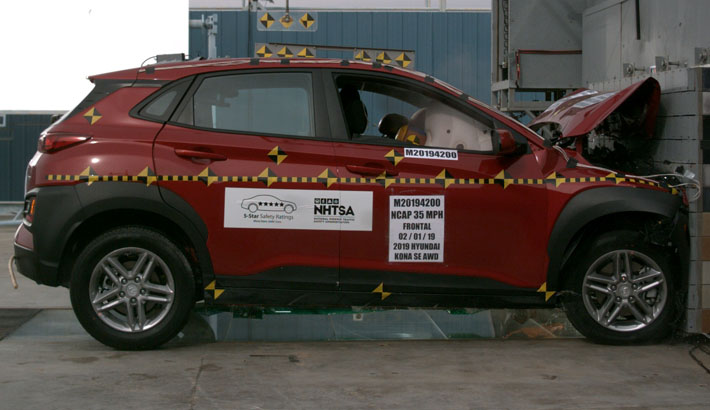
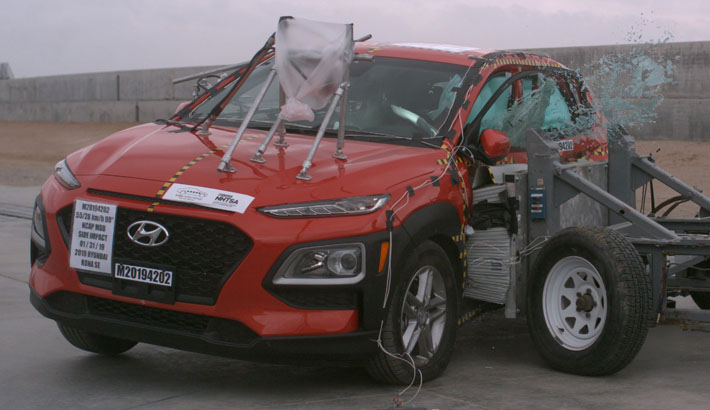
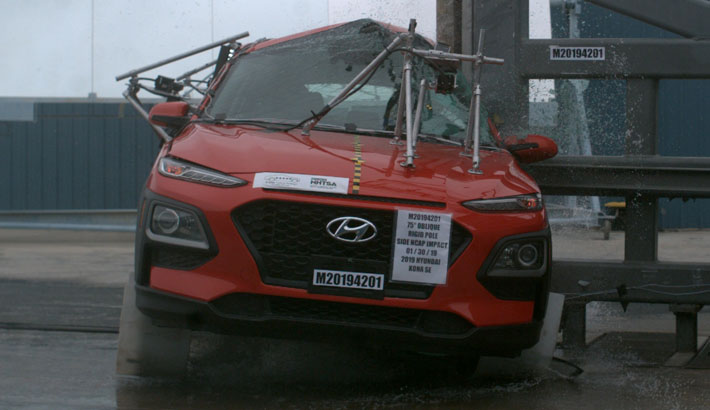
NHTSA crash tests
The agency crash-tested this model year itself. These are its own
photographs and star ratings.
Frontal crash test
Side barrier crash test
Side pole crash test
Photographs taken by NHTSA during its own New Car Assessment Program crash
tests of this model year. Public domain.
Configuration
Overall
Front
Side
Rollover
2022 Hyundai Kona SUV AWD
13.6% risk
2022 Hyundai Kona SUV FWD
14.1% risk
When owners complained
A spike years after the car went on sale usually means a part wearing
out on schedule across the whole fleet — the kind of pattern no single
owner can see from inside their own car.
Sep 2021peak 9Sep 2026
Recalls on the 2022 Hyundai Kona
A complaint is one owner's allegation. A recall is the point at which
the manufacturer or a regulator agreed the defect is real and dangerous
enough to fix for free — however old the car is.
Canada — Transport Canada
Canada runs its own recall programme, and its campaigns do not
always mirror the American ones.
Recall 2025636332,486 units in Canada
Other
Issue : Hyundai Auto Canada is conducting an extended warranty campaign for certain vehicles as water could enter the horn assembly and cause the horn's electrical contacts to corrode. As a result, the horn may not work properly or at all. Safety risk: A horn that doesn't work properly could prevent a driver from warning others of a danger and create an unsafe situation. Corrective Actions: To reduce the safety risk, Hyundai advises you to test the horn regularly. Hyundai will notify owners in writing and advise you to contact a dealership if your horn doesn't work properly. Hyundai will provide an extended warranty of 10 years/200 000 km to replace the horn for free if it fails.
Recall 2024552824,695 units in Canada
Label
Issue: On certain vehicles, the compliance label may be missing information in French. The words listed on the label for "Tires", "Rims", "Front" and "Rear" appear in English only, when they should be listed as "Tires/Pneus", "Rims/Jantes", "Front/Avant" and "Rear/Arriere". Canadian regulations require this information to be listed on the label in both English and French. Safety Risk: These small errors do not affect vehicle safety. Corrective Actions: This is not a recall. The company has corrected the compliance label for all new vehicles.
Recall 20244037,579 units in Canada
Fuel System
Issue: On certain vehicles, the high-pressure fuel pump could fail. If this happens, the engine may run rough and the check engine light may turn on. This could also cause a sudden loss of engine power while driving. Note: For the Elantra, Kona and Veloster models, this recall only affects the N performance versions. Safety Risk: A sudden loss of engine power could increase the risk of a crash. Corrective Actions: Hyundai will notify owners by mail and advise you to take your vehicle to a dealership to update the engine control module software. The high-pressure fuel pump will be replaced, if necessary.
Recall 20225689,427 units in Canada
Powertrain
Issue: On certain vehicles, a fault in the transmission oil pump can cause the vehicle to enter "fail-safe mode". When this happens, a programming error can cause a sudden loss of power to the wheels after 20-30 seconds. Note: This recall only affects certain vehicles equipped with an 8-speed dual-clutch transmission (DCT). Safety Risk: A sudden loss of power to the wheels could increase the risk of a crash. Corrective Actions: Hyundai will notify owners by mail and instruct you to take your vehicle to a dealership to inspect and, if necessary, replace the transmission. The dealer will also update the transmission control unit software.
Reports where the owner recorded a crash, a fire, an injury or a death.
Cape Coral, FLCrash
TIRES
The tread came off the tire on the highway causing me to crash off I 75. The tires were made 6 of 2025 and the pressure was 31.5 according to the highway patrol officer on scene. I have the paperwork for the tires I purchased at Sams Club in Cape Coral Florida on 7/29/25. The tires are less than 11 months old and this shouldn't have happened. The tread damaged multiple parts of my car.
NHTSA complaint #11743054 — an unverified report by a vehicle owner.
Seattle, WACrash
AIR BAGS
I was rear ended waiting for the car in front of me to turn. Driver was going between 33-40 on a residential. My air bags did not deploy.
NHTSA complaint #11512117 — an unverified report by a vehicle owner.
Bristol, RICrash1 injured
AIR BAGS
During collision, airbags did not deploy. In attempt to avoid collision, automatic breaks failed and did not stop the vehicle, cruise control continued to attempt to drive the vehicle despite collision warning and did not stop- coupled with my manual breaking, the car did not stop. Car is currently at a tow lot waiting for insurance. My safety was put at risk due to airbags not deploying during serious collision, the breaks malfunctioned. At this time, the car is in the beginning stages of insurance. My car did not display any prior failure features.
NHTSA complaint #11467487 — an unverified report by a vehicle owner.
Bristol, RICrash1 injured
SERVICE BRAKES
During collision, airbags did not deploy. In attempt to avoid collision, automatic breaks failed and did not stop the vehicle, cruise control continued to attempt to drive the vehicle despite collision warning and did not stop- coupled with my manual breaking, the car did not stop. Car is currently at a tow lot waiting for insurance. My safety was put at risk due to airbags not deploying during serious collision, the breaks malfunctioned. At this time, the car is in the beginning stages of insurance. My car did not display any prior failure features.
NHTSA complaint #11467487 — an unverified report by a vehicle owner.
During collision, airbags did not deploy. In attempt to avoid collision, automatic breaks failed and did not stop the vehicle, cruise control continued to attempt to drive the vehicle despite collision warning and did not stop- coupled with my manual breaking, the car did not stop. Car is currently at a tow lot waiting for insurance. My safety was put at risk due to airbags not deploying during serious collision, the breaks malfunctioned. At this time, the car is in the beginning stages of insurance. My car did not display any prior failure features.
NHTSA complaint #11467487 — an unverified report by a vehicle owner.
The most recent complaints
In the owners' own words, exactly as filed with NHTSA.
Blacksburg, VA
POWER TRAIN
Transmission (7 speed DCT) partial failure causing intermittent lack of acceleration, bucking, violent shifts. No warning lights are displayed. Despite being only days and about 1000 miles beyond the warranty neither Hyundai nor the dealer show interest in repairing this except at my cost, which is not feasible.
NHTSA complaint #11763673 — an unverified report by a vehicle owner.
at 27,000 milesMarlboro Township, NJ
POWER TRAIN
The contact owns a 2022 Hyundai Kona. The contact stated that while driving 65 MPH and depressing the accelerator pedal, the vehicle failed to respond as intended. No warning lights illuminated. A dealer was contacted. The vehicle was serviced under NHTSA Campaign Number: 22V746000 (POWER TRAIN); by the owner, but the remedy failed to fix the vehicle. The contact stated that the failure had occurred after the recall repair was performed. The contact stated that the failure had occurred twice. The manufacturer was notified of the failure and informed the contact that the issue would be escalated. The failure mileage was 27,000.
NHTSA complaint #11755087 — an unverified report by a vehicle owner.
Bergenfield, NJ
ELECTRICAL SYSTEM
COMPONENT/SYSTEM: Air Conditioning (HVAC) / Climate Control System and closed-loop refrigerant lines. The vehicle and all climate control components are available for immediate inspection. SAFETY RISK: Total loss of cooling in peak summer heat (90°F-95°F+) causes cabin temperatures to rapidly exceed 110°F. This sudden heat trapped in the vehicle caused me (the driver) acute heat exhaustion, culminating in a medical fainting episode. The vehicle regularly transports my newborn baby and toddler, subjecting them to severe heatstroke risks. Additionally, an ongoing 4-year chemical refrigerant leak inside an enclosed EV cabin creates an active toxic inhalation hazard for all passengers. DEALER CONFIRMATION: Yes. The failure has been repeatedly confirmed and documented by authorized Hyundai dealerships, including Paramus Hyundai, Garvey Hyundai, and Liberty Hyundai. Technicians repeatedly measured zero refrigerant charge/pressure, performed UV dye tests, and completed major repairs including AC line and radiator rebuilds without resolving the leak. INSPECTION HISTORY: Yes. Inspected multiple times by authorized Hyundai dealership technicians under official Corporate Case Nos #42549212, #41020884, and #23781133. WARNING LAMPS/SYMPTOMS: No dashboard warning lamps or error messages ever appeared. The only symptom was the AC suddenly blowing boiling hot air as refrigerant leaked out. This failure first appeared in Summer 2022 (shortly after vehicle purchase) and has recurred every summer for 4 consecutive years despite repeated warranty repair attempts.
NHTSA complaint #11753892 — an unverified report by a vehicle owner.
Bergenfield, NJ
ENGINE
COMPONENT/SYSTEM: Air Conditioning (HVAC) / Climate Control System and closed-loop refrigerant lines. The vehicle and all climate control components are available for immediate inspection. SAFETY RISK: Total loss of cooling in peak summer heat (90°F-95°F+) causes cabin temperatures to rapidly exceed 110°F. This sudden heat trapped in the vehicle caused me (the driver) acute heat exhaustion, culminating in a medical fainting episode. The vehicle regularly transports my newborn baby and toddler, subjecting them to severe heatstroke risks. Additionally, an ongoing 4-year chemical refrigerant leak inside an enclosed EV cabin creates an active toxic inhalation hazard for all passengers. DEALER CONFIRMATION: Yes. The failure has been repeatedly confirmed and documented by authorized Hyundai dealerships, including Paramus Hyundai, Garvey Hyundai, and Liberty Hyundai. Technicians repeatedly measured zero refrigerant charge/pressure, performed UV dye tests, and completed major repairs including AC line and radiator rebuilds without resolving the leak. INSPECTION HISTORY: Yes. Inspected multiple times by authorized Hyundai dealership technicians under official Corporate Case Nos #42549212, #41020884, and #23781133. WARNING LAMPS/SYMPTOMS: No dashboard warning lamps or error messages ever appeared. The only symptom was the AC suddenly blowing boiling hot air as refrigerant leaked out. This failure first appeared in Summer 2022 (shortly after vehicle purchase) and has recurred every summer for 4 consecutive years despite repeated warranty repair attempts.
NHTSA complaint #11753892 — an unverified report by a vehicle owner.
Cape Coral, FLCrash
TIRES
The tread came off the tire on the highway causing me to crash off I 75. The tires were made 6 of 2025 and the pressure was 31.5 according to the highway patrol officer on scene. I have the paperwork for the tires I purchased at Sams Club in Cape Coral Florida on 7/29/25. The tires are less than 11 months old and this shouldn't have happened. The tread damaged multiple parts of my car.
NHTSA complaint #11743054 — an unverified report by a vehicle owner.
San Diego, CA
UNKNOWN OR OTHER
Recall with car regarding coolant. Last year Hyundai apparently addressed; however, coolant light came on, despite coolant being full. Told by different dealership that with these issues, it needs to be checked and rechecked multiple times; otherwise, issues arise again (as in my case). Want this addressed by dealership. They are charging me a diagnostic fee of $198. Previously, when brought car in for recall work, equipment not always working.
NHTSA complaint #11741719 — an unverified report by a vehicle owner.
San Diego, CA
UNKNOWN OR OTHER
Charging port door will not open. Not sure if it is an issue with acuator, which employee in service dept at dealer said that is common problem. Seems like if this issue with less than 20k, perhaps should also be recall item.
NHTSA complaint #11741721 — an unverified report by a vehicle owner.
Beaverton, OR
UNKNOWN OR OTHER
The vehicle trunk doors pops open. This has been happening for several months. We’ve taken it to the dealership. They said that it was not covered and there has been no recall on this, but it’s still happening and it’s very dangerous. It’s happened on the freeway on the back roads at night it doesn’t matter it just when it feels like it wants to open up it beeps loudly and light comes on the dashboard as something is wrong and It will just pop open.
NHTSA complaint #11738915 — an unverified report by a vehicle owner.
Beaverton, OR
ELECTRICAL SYSTEM
The vehicle trunk doors pops open. This has been happening for several months. We’ve taken it to the dealership. They said that it was not covered and there has been no recall on this, but it’s still happening and it’s very dangerous. It’s happened on the freeway on the back roads at night it doesn’t matter it just when it feels like it wants to open up it beeps loudly and light comes on the dashboard as something is wrong and It will just pop open.
NHTSA complaint #11738915 — an unverified report by a vehicle owner.
Meridian, MS
ENGINE
I purchased my 2022 Hyundai Kona on August 28, 2024, and I am the first registered owner. Only 48 days after purchase, the vehicle suddenly broke down without warning while stopped at a red light in [XXX] after traveling from [XXX] . The vehicle had to be towed. Since then, the vehicle has repeatedly experienced dangerous engine and timing-related issues despite major repairs, including an engine replacement, timing chain repairs, and multiple dealership inspections. The most dangerous incidents involve sudden power loss and large clouds of smoke while driving. On January 1, 2026, while attempting to pass a semi-truck on a multi-lane highway, the vehicle suddenly lagged, lost acceleration power, and emitted a large cloud of white smoke from the exhaust. This created an extremely unsafe situation because I was actively passing traffic at highway speeds and could have been struck by surrounding vehicles. I have also experienced these failures late at night on busy highways while traveling between [XXX] and [XXX] . In March 2026, the vehicle again emitted a large cloud of smoke and resumed lagging during acceleration. On April 23, 2026, Hyundai of Meridian informed me they personally witnessed the vehicle emit another large cloud of black smoke during test driving. These smoke events can reduce visibility for surrounding drivers and create hazardous roadway conditions. The vehicle has spent approximately 149 days in repair facilities, nearly 24% of the time I have owned it. Multiple dealerships documented timing chain slack, cam timing issues, and major engine concerns. Despite the recurring failures and safety concerns, Hyundai denied replacing the engine again and denied buying back the vehicle. I no longer feel safe operating this vehicle due to the risk of sudden power loss, engine failure, and smoke emissions while driving in traffic. INFORMATION REDACTED PURSUANT TO THE FREEDOM OF INFORMATION ACT (FOIA), 5 U.S.C. 552(B)(6)
NHTSA complaint #11738820 — an unverified report by a vehicle owner.
Ridgeland, MS
ENGINE
In January 2026, my engine light illuminated and the vehicle lost power. The dealership found a sudden loss of compression across all four cylinders, requiring a total engine replacement. This occurred without warning, only two months after a routine oil change at the same facility where no issues were reported. Despite opening a case with Hyundai corporate, there has been no progress. My research indicates that while NHTSA Recall 21V301 (Safety Recall 203) specifies 2019–2021 models, the 2022 model shares the same engine design and identical reports of stalling and compression loss. My vehicle has been at the dealership for three months with no resolution. The dealership says they are running tests requested by tech line without providing documentation of the tests or the results. Although, the initial test performed indicated that it was a compression ring issue.
NHTSA complaint #11730758 — an unverified report by a vehicle owner.
San Diego, CA
POWER TRAIN
I found a lot of shaved metals when I did the oil change for the Gear Reduction. It made a lot of noises when driving or the wheel of fortune sounds whether the car is in Regenerative Braking. The sounds developed as time goes on but Hyundai failed to recall this issue. I found this has been an ongoing issue since 2019 when Hyundai make this Kona EV, but their engineers didn’t fix this type of issue and continue to manufacture the Kona EV with the same Gear Reduction Assembly and it caused a lot of noises with these shaving metals found in the oil changes. This is abnormal for a GRU to have so many metals found in the oil. Thus, it made a lot of noises. Now my car can’t even drive because of this. The GRU has been broken because of this issue that Hyundai didn’t even fix since 2019.
NHTSA complaint #11724172 — an unverified report by a vehicle owner.
San Diego, CA
ENGINE
I found a lot of shaved metals when I did the oil change for the Gear Reduction. It made a lot of noises when driving or the wheel of fortune sounds whether the car is in Regenerative Braking. The sounds developed as time goes on but Hyundai failed to recall this issue. I found this has been an ongoing issue since 2019 when Hyundai make this Kona EV, but their engineers didn’t fix this type of issue and continue to manufacture the Kona EV with the same Gear Reduction Assembly and it caused a lot of noises with these shaving metals found in the oil changes. This is abnormal for a GRU to have so many metals found in the oil. Thus, it made a lot of noises. Now my car can’t even drive because of this. The GRU has been broken because of this issue that Hyundai didn’t even fix since 2019.
NHTSA complaint #11724172 — an unverified report by a vehicle owner.
Dearborn Heights, MI
ENGINE
The vehicle displayed a warning lamp indicating a Cooling System Performance failure. The specific defect relates to the Integrated Thermal-Management Module (ITM) and the thermostat opening prematurely, corresponding to Diagnostic Trouble Code (DTC) P218100. This issue requires a repair outlined in Technical Service Bulletin 25-EM-007H, involving a spring installation and ECU update. This failure creates a serious safety concern because improper thermal management can cause the engine to overheat or force the vehicle into a reduced-power 'limp mode' without warning. A sudden loss of acceleration or engine stall while driving in traffic significantly increases the risk of a crash.
NHTSA complaint #11712162 — an unverified report by a vehicle owner.
Howard Beach, NY
UNKNOWN OR OTHER
February 2023: horn failure. Pressed the car's horn, and it FAILED to produce the loud sound that it is SUPPOSED TO make to warn others of possible danger. It continued to not work and needed to be replaced. Part 96611-J9500 was replaced.
NHTSA complaint #11704305 — an unverified report by a vehicle owner.
Howard Beach, NY
UNKNOWN OR OTHER
JANUARY 2024: HORN FAILURE. Pressed the car's horn, and it FAILED to produce the loud sound that it is SUPPOSED TO make to warn others of possible DANGER. It continued to not work and needed to be replaced. Part 96611-J9500 was replaced AGAIN.
NHTSA complaint #11704307 — an unverified report by a vehicle owner.
Howard Beach, NY
UNKNOWN OR OTHER
August 2024: Horn malfunction/failure. Pressed the car's horn, and it FAILED to produce the loud sound that it is SUPPOSED TO make to warn others of possible danger. It continued to not work and needed to be replaced for the third time. Part 96611-J9500 (Horn Assembly) was replaced for the THIRD time on this vehicle.
NHTSA complaint #11704312 — an unverified report by a vehicle owner.
Howard Beach, NY
UNKNOWN OR OTHER
December 2025: Yet ANOTHER horn failure. Pressed the vehicle's horn to alert another driver that they were drifting into my lane on the highway, and it FAILED to produce the loud sound that it is SUPPOSED TO make. It needed to be replaced again for the FOURTH time. Part 96611-J9500 was replaced—AGAIN. This is a continued safety issue that Hyundai has neglected to address and fix. Spontaneous horn failure is a HAZARD. The horn is there to warn others of possible danger.
NHTSA complaint #11704314 — an unverified report by a vehicle owner.
Howard Beach, NY
ELECTRICAL SYSTEM
February 2023: horn failure. Pressed the car's horn, and it FAILED to produce the loud sound that it is SUPPOSED TO make to warn others of possible danger. It continued to not work and needed to be replaced. Part 96611-J9500 was replaced.
NHTSA complaint #11704305 — an unverified report by a vehicle owner.
Howard Beach, NY
ELECTRICAL SYSTEM
JANUARY 2024: HORN FAILURE. Pressed the car's horn, and it FAILED to produce the loud sound that it is SUPPOSED TO make to warn others of possible DANGER. It continued to not work and needed to be replaced. Part 96611-J9500 was replaced AGAIN.
NHTSA complaint #11704307 — an unverified report by a vehicle owner.
Howard Beach, NY
ELECTRICAL SYSTEM
August 2024: Horn malfunction/failure. Pressed the car's horn, and it FAILED to produce the loud sound that it is SUPPOSED TO make to warn others of possible danger. It continued to not work and needed to be replaced for the third time. Part 96611-J9500 (Horn Assembly) was replaced for the THIRD time on this vehicle.
NHTSA complaint #11704312 — an unverified report by a vehicle owner.
Howard Beach, NY
ELECTRICAL SYSTEM
December 2025: Yet ANOTHER horn failure. Pressed the vehicle's horn to alert another driver that they were drifting into my lane on the highway, and it FAILED to produce the loud sound that it is SUPPOSED TO make. It needed to be replaced again for the FOURTH time. Part 96611-J9500 was replaced—AGAIN. This is a continued safety issue that Hyundai has neglected to address and fix. Spontaneous horn failure is a HAZARD. The horn is there to warn others of possible danger.
NHTSA complaint #11704314 — an unverified report by a vehicle owner.
Dunedin, FL
ELECTRICAL SYSTEM
Hyundai has multiple complaints regarding Horn malfunction in the Hyundai Kona. I went to use my horn today to prevent an accident and found my horn does not work. I have checked my fuses and relays and neither are blown leading to the horn to be unable for use
NHTSA complaint #11696969 — an unverified report by a vehicle owner.
Sarasota, FL
ELECTRICAL SYSTEM
Horn was going in and out of working for the first few months after purchase. Now the horn does not work at all. It is not the fuse. As seeing through other complaints this is a very common problem and should be on Hyundai to fix.
NHTSA complaint #11696653 — an unverified report by a vehicle owner.
Laurel, MD
ELECTRICAL SYSTEM
I had the radiator replaced by the Ourisman Hyundai Laurel dealership on 10/1/25. Radiator replacement was under warranty. On 10/4/25car overheated while driving. I pulled the car over and called for a tow truck. Car was leaking lots of coolant. Brought it to service center at Ourisman Hyundai Laurel, they stated “the hose to the thermostat was not all the way on. Put hose on correctly no more leaking.” On 10/15/25 multiple lights came on the dashboard including the master warning light. Took car to Ourisman Hyundai Laurel again; received the car back, dealership stated “ TECH COULD NOT DUPLICATE THE LIGHTS POPPING ON DASHBOARD. UPON FURTHER DIAGNOSIS TECH FOUND THAT THERE WAS A CONNECTOR NOT GETTING THE PROPER CONTACT TO COIL NUMBER 1 TECH RECONNECTED THE CONNECTOR AND TEST DROVE THE VEHICLE FOR 5 MILES. NO CONCERNS PRESENT AT THIS TIME.” On 10/20 I brought the car in to Ourisman Hyundai Laurel again because Electronic Stability Control light as well as ABS warning light and several other warning lights came on multiple times. Ourisman Hyundai Laurel service technician said they could not duplicate the problem and there is nothing they can do. This is a safety issue because it concerns the electronic stability control and brakes.
NHTSA complaint #11695177 — an unverified report by a vehicle owner.