Owners have filed 715 complaints
about the 2020 Hyundai Palisade with NHTSA between 2019 and 2026.
The largest single group is the engine & cooling.
Across this model's run it ranks 1 of 7 worst.
The letter says how bad. This says what kind — whether this year drew
an unusual number of complaints, unusually dangerous
ones, or failures that arrived unusually early.
The dashed ring is 50 — the national norm. Further out is worse.
Complaint volume — 76
Against the median year of the Hyundai Palisade. 50 means typical for this
model; 100 means roughly double.
Severity — 33
6.4% of these complaints
involved a crash, fire, injury or death, against a national rate of
9.7%.
Early failure — 100
84% of failures with a mileage on record happened under
36,000 miles, against a national rate of
29%.
How 2020 compares with every other Hyundai Palisade
NHTSA files every complaint against a named sub-assembly, not just a
system. This is the difference between knowing it was "the engine" and
knowing which part of it — the list to hand a mechanic.
Body
2542.4%
Warnings
1118.6%
Automatic Emergency Braking
610.2%
Sun/Moon Roof Assembly
58.5%
Windshield
46.8%
Warning
35.1%
Adaptive Cruise Control
35.1%
Warnings
23.4%
When it fails
Odometer readings owners gave when they filed. About half of all
complaints include one.
Under 1,000 miles
5124.6%
1,000 – 9,999 miles
8541.1%
10,000 – 24,999 miles
3315.9%
25,000 – 49,999 miles
115.3%
50,000 – 74,999 miles
83.9%
75,000 – 99,999 miles
136.3%
100,000 – 149,999 miles
41.9%
150,000+ miles
21.0%
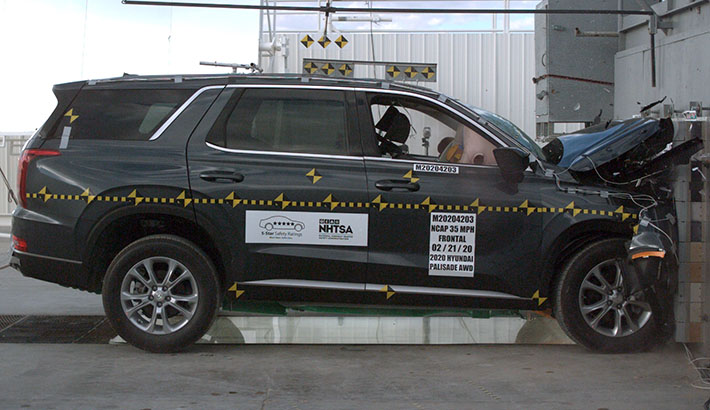
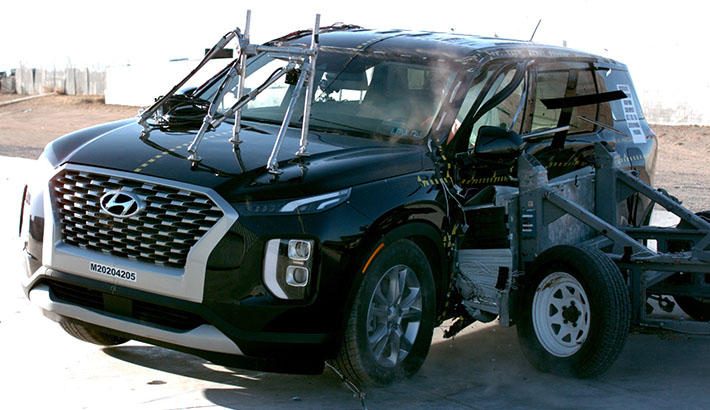
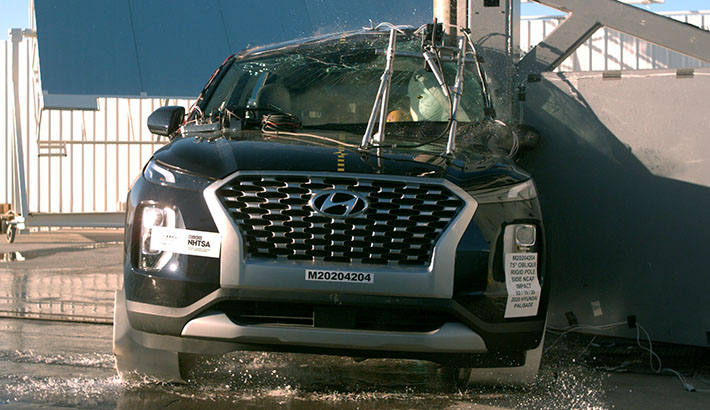
NHTSA crash tests
The agency crash-tested this model year itself. These are its own
photographs and star ratings.
Frontal crash test
Side barrier crash test
Side pole crash test
Photographs taken by NHTSA during its own New Car Assessment Program crash
tests of this model year. Public domain.
Configuration
Overall
Front
Side
Rollover
2020 Hyundai Palisade SUV AWD
14.3% risk
2020 Hyundai Palisade SUV FWD
15.9% risk
When owners complained
A spike years after the car went on sale usually means a part wearing
out on schedule across the whole fleet — the kind of pattern no single
owner can see from inside their own car.
Aug 2019peak 27Sep 2026
Recalls on the 2020 Hyundai Palisade
A complaint is one owner's allegation. A recall is the point at which
the manufacturer or a regulator agreed the defect is real and dangerous
enough to fix for free — however old the car is.
United States — NHTSA
26V034000
AIR BAGS:SIDE/WINDOW:CURTAIN
Hyundai Motor America (Hyundai) is recalling certain 2020-2025 Palisade vehicles. The side curtain air bags for third-row occupants may deploy improperly in a crash. As such, these vehicles fail to comply with the requirements of Federal Motor Vehicle Safety Standard (FMVSS) number 226, "Ejection Mitigation."
Risk: Improper side curtain air bag deployment increases the risk of injury during a crash.
25V607000
SEAT BELTS: REAR/OTHER:BUCKLE ASSEMBLY
Hyundai Motor America (Hyundai) is recalling certain 2020-2025 Palisade vehicles. The seat belt buckles in the driver, passenger, and second-row window seats may fail to latch.
Risk: Seat belt buckles that fail to latch may not properly restrain occupants in a crash, increasing the risk of injury.
22V633000
TRAILER HITCHES
Hyundai Motor America (Hyundai) is recalling 2020-2022 Palisade vehicles potentially equipped with a tow hitch harness installed as original equipment, or purchased as an accessory through a Hyundai dealership. Debris and moisture accumulation on the tow hitch harness module printed circuit board (PCB) may cause an electrical short, which can result in a fire.
Risk: A fire while parked or driving can increase the risk of injury.
22V627000
VISIBILITY:WINDSHIELD WIPER/WASHER:MOTOR
Hyundai Motor America (Hyundai) is recalling certain 2020-2021 Palisade vehicles. The windshield wiper motor may become inoperative, causing the wipers to fail.
Risk: Windshield wiper failure can reduce visibility, increasing the risk of a crash.
19V802000
AIR BAGS:SIDE/WINDOW
Hyundai Motor America (Hyundai) is recalling certain 2020 Palisade vehicles. The mounting bolts used to secure the side curtain air bags may damage the side curtain air bags during deployment.
Risk: Damaged side curtain air bags may not inflate properly in the event of a crash, increasing the risk of injury.
Canada — Transport Canada
Canada runs its own recall programme, and its campaigns do not
always mirror the American ones.
Recall 202602343,990 units in Canada
Airbag
Issue: On certain vehicles, the side curtain airbags may not deploy properly for third-row occupants in a crash. Safety Risk: A side curtain airbag that doesn't work properly could increase the risk of injury in a crash. Corrective Actions: Hyundai will notify owners in writing. The corrective actions for this recall are under development.
Recall 202547643,990 units in Canada
Seats And Restraints
Issue: On certain vehicles, the driver, front passenger and second-row outboard seat belt buckle(s) may not have been manufactured properly. As a result, the seat belt(s) may not latch correctly and could detach in a crash. Safety Risk: A seat belt that detaches in a crash could increase the risk of injury. Corrective Actions: To reduce the safety risk, Hyundai recommends to firmly latch the seat belt and pull on it after latching to ensure it's secured until the recall repairs have been completed. Hyundai will notify owners by mail and advise you to take your vehicle to a dealership to inspect and, if necessary, replace the seat belt buckle(s).
Recall 2024552824,695 units in Canada
Label
Issue: On certain vehicles, the compliance label may be missing information in French. The words listed on the label for "Tires", "Rims", "Front" and "Rear" appear in English only, when they should be listed as "Tires/Pneus", "Rims/Jantes", "Front/Avant" and "Rear/Arriere". Canadian regulations require this information to be listed on the label in both English and French. Safety Risk: These small errors do not affect vehicle safety. Corrective Actions: This is not a recall. The company has corrected the compliance label for all new vehicles.
Recall 202314824,676 units in Canada
Visual System
Issue: On certain vehicles, the windshield wiper motor may stop working when snow and/or ice builds up on the windshield. Note: This recall replaces Transport Canada Recall No. 2022-465. Vehicles that were already repaired under Hyundai recall campaign R0222 don't require this repair. Safety Risk: Windshield wipers that don't work properly could affect a driver's visibility. This could increase the risk of a crash. Corrective Actions: Hyundai will notify owners by mail and instruct you to take your vehicle to a dealer to replace the driver's windshield wiper arm. Hyundai advises that if the wipers stop working, you should clear any buildup of snow or ice before restarting the wipers.
Recall 20224724,008 units in Canada
Accessories
Issue: Certain vehicles may be equipped with a 4-pin accessory trailer wiring harness kit that could fail. Over time, this could result in a short circuit that can cause the control module to overheat. Note: This recall only affects Hyundai Genuine 4-pin tow hitch wiring harness kits with the part number S8F67AC500. These kits may have been ordered at the time of a vehicle purchase, or purchased separately from a dealer as an aftermarket accessory. Safety Risk: A short circuit could create a fire risk, even while the vehicle is parked and turned off. Corrective Actions: Hyundai will notify owners by mail and advise you to bring your vehicle to a dealership to inspect the trailer wiring harness kit. The dealer will repair or replace the trailer wiring harness, as necessary. To reduce the safety risk, Hyundai advises that you should park your vehicle outdoors, and away from other vehicles or structures until the recall repairs have been completed. Note: Hyundai advises you to bring your vehicle to a dealership for this inspection even if it doesn't have a trailer wiring harness, so that the recall campaign can be listed as completed for your vehicle.
Recall 202246512,231 units in Canada
Visual System
Issue: On certain vehicles, the windshield wiper motor may stop working when snow and/or ice builds up on the windshield. Safety Risk: Windshield wipers that don't work properly could affect a driver's visibility. This could increase the risk of a crash. Corrective Actions: Hyundai will notify owners by mail and instruct you to take your vehicle to a dealer to replace the driver's windshield wiper arm.
Recall 20195653,123 units in Canada
Airbag
Issue: On certain vehicles, when the side curtain airbags deploy in a crash, they could be damaged by the mounting bolts. As a result, the side curtain airbags may tear and not inflate properly. Safety Risk: An airbag that does not work properly could create an increased risk of injury in a crash. Corrective Actions: Hyundai will notify owners by mail and instruct you to take your vehicle to a dealer to install a protective cover over the side curtain airbag bolts.
Reports where the owner recorded a crash, a fire, an injury or a death.
Martinsburg, WVFire
ELECTRICAL SYSTEM
I believe this is related to RECALL 235, Veh was parked on the street, thank god. The Palisade then spontaniusly caught fire, fire department had to be called and insurance company says its a total loss. Fire started in the rear driver side.
NHTSA complaint #11758456 — an unverified report by a vehicle owner.
Frisco, TXFire
ENGINE
Component: Engine My 2020 Hyundai Palisade (approximately 155,856 miles) experienced a serious and dangerous engine-related failure that resulted in a vehicle fire. My 16 year old daughter was driving alone at the time of the catastrophic failure and fire. For approximately six months prior to the incident, the vehicle was consuming oil at an abnormal rate with no visible external leaks. This condition persisted without clear cause. While driving, the vehicle suddenly developed a new oil leak, and the engine failed without warning, leaving me stranded on the roadway. Immediately following the failure, the engine compartment caught fire. There were no prior indications of an active oil leak before this sudden failure. The progression from oil consumption to catastrophic failure and fire presents a serious safety concern. This incident created a dangerous situation with risk of injury or worse, and it appears to be more than normal wear and tear. I am reporting this as a potential safety defect involving engine failure and fire risk. Mileage at time of incident: approximately 155,856 miles No prior accident or external cause contributed to the fire.
NHTSA complaint #11735010 — an unverified report by a vehicle owner.
Frisco, TXFire
ENGINE
Component: Engine / Engine and Engine Cooling Description: My 2020 Hyundai Palisade (approximately 155,856 miles) experienced a serious and dangerous engine-related failure that resulted in a vehicle fire. For approximately 8 months prior to the incident, the vehicle was consuming oil at an abnormal rate with no visible external leaks. This condition persisted without clear cause. While my [XXX] daughter was driving, the vehicle suddenly developed a new oil leak, and the engine failed without warning, leaving my daughter stranded on the roadway. Immediately following the failure, the engine compartment caught fire. There were no prior indications of an active oil leak before this sudden failure. The progression from oil consumption to catastrophic failure and fire presents a serious safety concern. This incident created a dangerous situation with risk of injury or worse, and it appears to be more than normal wear and tear. I am reporting this as a potential safety defect involving engine failure and fire risk. Mileage at time of incident: approximately 155,000 miles No prior accident or external cause contributed to the fire. INFORMATION REDACTED PURSUANT TO THE FREEDOM OF INFORMATION ACT (FOIA), 5 U.S.C. 552(B)(6)
NHTSA complaint #11733631 — an unverified report by a vehicle owner.
Lebanon, OHCrash3 injured
UNKNOWN OR OTHER
I was driving through town at a low rate of speed (20-30 mph) with 2-3 car lengths between me and the next vehicle. I continued through light to next light. This distance was on an upward incline. After traveling approximately 500 ft, I noticed the traffic slowing in front of me and took my foot off the accelerator to start to slow down. This is when the car suddenly accelerated (instead of slowing down as would be expected when traveling up an incline), picking up speed quickly. The car's response happened so quickly that I was unable to swerve to avoid hitting the car in front of me. I hit the car in front of me that was slowing down at the light which then subsequently hit several other vehicles that were in front of it that were also slowing/stopped for the light. The front airbag deployed as a result of the collision, knocking my glasses off. The vehicle was still continuing in forward motion after the collision….Traffic Crash Report states, “... [witness] went up to Unit 1 [Palisade], and the tires were still spinning…” As I was in shock after the collision, a bystander came up to the vehicle to turn it off and this is when the wheels/forward motion was completely stopped. This Palisade is equipped with Forward Collision Avoidance Assist (FCA) system. There was no warning given nor did the vehicle attempt to slow down during the event so I believe that this system failed to operate which contributed to the collision. I also believe that there was a failure with the engine/electrical system, ETC, and/or transmission that caused the system to suddenly accelerate while traveling uphill AFTER I removed my foot from the gas pedal. The vehicle was totaled by my insurance company. They did say that they were sending an engineer to review the Event Data Recorder. I have not seen any results from that nor do I have the vehicle in my possession as it was totaled.
NHTSA complaint #11695696 — an unverified report by a vehicle owner.
Lebanon, OHCrash3 injured
ELECTRICAL SYSTEM
I was driving through town at a low rate of speed (20-30 mph) with 2-3 car lengths between me and the next vehicle. I continued through light to next light. This distance was on an upward incline. After traveling approximately 500 ft, I noticed the traffic slowing in front of me and took my foot off the accelerator to start to slow down. This is when the car suddenly accelerated (instead of slowing down as would be expected when traveling up an incline), picking up speed quickly. The car's response happened so quickly that I was unable to swerve to avoid hitting the car in front of me. I hit the car in front of me that was slowing down at the light which then subsequently hit several other vehicles that were in front of it that were also slowing/stopped for the light. The front airbag deployed as a result of the collision, knocking my glasses off. The vehicle was still continuing in forward motion after the collision….Traffic Crash Report states, “... [witness] went up to Unit 1 [Palisade], and the tires were still spinning…” As I was in shock after the collision, a bystander came up to the vehicle to turn it off and this is when the wheels/forward motion was completely stopped. This Palisade is equipped with Forward Collision Avoidance Assist (FCA) system. There was no warning given nor did the vehicle attempt to slow down during the event so I believe that this system failed to operate which contributed to the collision. I also believe that there was a failure with the engine/electrical system, ETC, and/or transmission that caused the system to suddenly accelerate while traveling uphill AFTER I removed my foot from the gas pedal. The vehicle was totaled by my insurance company. They did say that they were sending an engineer to review the Event Data Recorder. I have not seen any results from that nor do I have the vehicle in my possession as it was totaled.
NHTSA complaint #11695696 — an unverified report by a vehicle owner.
Lebanon, OHCrash3 injured
FORWARD COLLISION AVOIDANCE: WARNINGS
I was driving through town at a low rate of speed (20-30 mph) with 2-3 car lengths between me and the next vehicle. I continued through light to next light. This distance was on an upward incline. After traveling approximately 500 ft, I noticed the traffic slowing in front of me and took my foot off the accelerator to start to slow down. This is when the car suddenly accelerated (instead of slowing down as would be expected when traveling up an incline), picking up speed quickly. The car's response happened so quickly that I was unable to swerve to avoid hitting the car in front of me. I hit the car in front of me that was slowing down at the light which then subsequently hit several other vehicles that were in front of it that were also slowing/stopped for the light. The front airbag deployed as a result of the collision, knocking my glasses off. The vehicle was still continuing in forward motion after the collision….Traffic Crash Report states, “... [witness] went up to Unit 1 [Palisade], and the tires were still spinning…” As I was in shock after the collision, a bystander came up to the vehicle to turn it off and this is when the wheels/forward motion was completely stopped. This Palisade is equipped with Forward Collision Avoidance Assist (FCA) system. There was no warning given nor did the vehicle attempt to slow down during the event so I believe that this system failed to operate which contributed to the collision. I also believe that there was a failure with the engine/electrical system, ETC, and/or transmission that caused the system to suddenly accelerate while traveling uphill AFTER I removed my foot from the gas pedal. The vehicle was totaled by my insurance company. They did say that they were sending an engineer to review the Event Data Recorder. I have not seen any results from that nor do I have the vehicle in my possession as it was totaled.
NHTSA complaint #11695696 — an unverified report by a vehicle owner.
The most recent complaints
In the owners' own words, exactly as filed with NHTSA.
Livermore, CA
ENGINE
I do not understand how Hyundai can approve its required testing process, have the vehicle fail that test, and then deny the engine replacement resulting from those findings. This is unfair and raises serious concerns about how Hyundai is applying its warranty procedures.Hyundai’s published oil-consumption procedures establish a process for diagnosing excessive oil consumption and determining when further repairs, including engine replacement, may be warranted. I am requesting that Hyundai explain exactly what requirement my vehicle allegedly failed to meet and provide documentation supporting the denial.I am requesting that Hyundai reverse the denial and fully cover the necessary engine replacement under warranty. I also request a complete review of my maintenance history, repair records, oil-consumption test results, diagnostics, and the dealership’s submission. This vehicle has been properly maintained and has only approximately 80,000 miles. I purchased it expecting a reliable vehicle that would last many years. An engine developing excessive oil consumption at this mileage is unacceptable, and I believe Hyundai should stand behind its product and warranty obligations.
NHTSA complaint #11763426 — an unverified report by a vehicle owner.
Livermore, CA
FUEL/PROPULSION SYSTEM
I do not understand how Hyundai can approve its required testing process, have the vehicle fail that test, and then deny the engine replacement resulting from those findings. This is unfair and raises serious concerns about how Hyundai is applying its warranty procedures.Hyundai’s published oil-consumption procedures establish a process for diagnosing excessive oil consumption and determining when further repairs, including engine replacement, may be warranted. I am requesting that Hyundai explain exactly what requirement my vehicle allegedly failed to meet and provide documentation supporting the denial.I am requesting that Hyundai reverse the denial and fully cover the necessary engine replacement under warranty. I also request a complete review of my maintenance history, repair records, oil-consumption test results, diagnostics, and the dealership’s submission. This vehicle has been properly maintained and has only approximately 80,000 miles. I purchased it expecting a reliable vehicle that would last many years. An engine developing excessive oil consumption at this mileage is unacceptable, and I believe Hyundai should stand behind its product and warranty obligations.
NHTSA complaint #11763426 — an unverified report by a vehicle owner.
Fort Lauderdale, FL
UNKNOWN OR OTHER
I am reporting a serious safety defect involving the A/C system on my 2020 Hyundai Palisade. The A/C system has failed due to a manufacturer acknowledged defect in the compressor pulley and hub assembly. Hyundai has issued multiple Technical Service Bulletins (TSB 21‑HA‑003H, 24‑HA‑003H, 25‑HA‑003H / 003H‑1) documenting this exact failure pattern. These TSBs confirm Hyundai is aware of widespread A/C failures in this model. Despite acknowledging the defect in writing, Hyundai has refused to repair the vehicle, citing “time in service and mileage,” even though the failure is directly tied to a known defective component. This refusal leaves a safety‑critical defect unaddressed. This is not a comfort issue. This vehicle is used for medical transportation of a medically needy child who requires strict temperature regulation. Loss of A/C in Florida heat creates a dangerous and medically hazardous environment inside the vehicle. The cabin temperature rises rapidly, creating a risk of heat‑related medical complications. This is a clear safety hazard, not a cosmetic or convenience problem. The A/C failure is sudden, unpredictable, and cannot be mitigated by the driver. The defect results in: Complete loss of cooling in high‑heat conditions Inability to maintain medically safe cabin temperatures Documented component failure acknowledged by Hyundai Manufacturer refusal to correct a known defect Increased risk of medical harm to a vulnerable passenger Hyundai’s denial of assistance despite multiple TSBs proving the defect demonstrates a failure to address a safety related mechanical issue that directly impacts occupant health. This defect should be investigated as a potential widespread safety problem affecting 2020 Hyundai Palisade vehicles. I am requesting NHTSA’s review and investigation into this defect due to the significant safety risk, the manufacturer’s documented knowledge, and the potential for medical harm caused by the failure of the A/C system.
NHTSA complaint #11763168 — an unverified report by a vehicle owner.
Otis Orchards, WA
POWER TRAIN
On August 14, 2026, while driving and decelerating, I heard a knocking sound from the engine and the vehicle had difficulty downshifting. As the transmission shifted from second gear to first, the engine stalled immediately and the vehicle dropped into neutral while on the roadway. I lost propulsion in traffic. The vehicle behind me nearly rear-ended us due to the sudden stall. My children were in the vehicle. All dashboard warning lights illuminated at the moment of the stall. I was able to restart the engine and move the vehicle slowly, in first gear only, into a nearby parking lot. The check engine light came on at that restart and has remained on since. The vehicle sat parked and off for approximately 90 minutes. Before restarting, I checked the engine oil level and it was within the normal range. On startup, my children and I both heard a loud knocking sound and noticed an unusual smell, and the engine idled roughly while in Park. I drove approximately 15 minutes home with the rough idle continuing. On arrival the vehicle smelled hot, with a burning odor, although the temperature gauge read approximately mid-scale and was not in the high range. The check engine light remained on and the oil level was again confirmed to be within range. The vehicle has been out of service since the incident and is currently at a dealership awaiting diagnosis. This is a 2020 Hyundai Palisade with approximately 93,000 miles at the time of failure. A sudden loss of motive power in a travel lane is a safety defect.
NHTSA complaint #11762084 — an unverified report by a vehicle owner.
Otis Orchards, WA
ENGINE
On August 14, 2026, while driving and decelerating, I heard a knocking sound from the engine and the vehicle had difficulty downshifting. As the transmission shifted from second gear to first, the engine stalled immediately and the vehicle dropped into neutral while on the roadway. I lost propulsion in traffic. The vehicle behind me nearly rear-ended us due to the sudden stall. My children were in the vehicle. All dashboard warning lights illuminated at the moment of the stall. I was able to restart the engine and move the vehicle slowly, in first gear only, into a nearby parking lot. The check engine light came on at that restart and has remained on since. The vehicle sat parked and off for approximately 90 minutes. Before restarting, I checked the engine oil level and it was within the normal range. On startup, my children and I both heard a loud knocking sound and noticed an unusual smell, and the engine idled roughly while in Park. I drove approximately 15 minutes home with the rough idle continuing. On arrival the vehicle smelled hot, with a burning odor, although the temperature gauge read approximately mid-scale and was not in the high range. The check engine light remained on and the oil level was again confirmed to be within range. The vehicle has been out of service since the incident and is currently at a dealership awaiting diagnosis. This is a 2020 Hyundai Palisade with approximately 93,000 miles at the time of failure. A sudden loss of motive power in a travel lane is a safety defect.
NHTSA complaint #11762084 — an unverified report by a vehicle owner.
Murfreesboro, TN
STRUCTURE:BODY
The paint on the roof of my 2020 Hyundai Palisade is peeling off in large sheets, rather than typical chipping or wear. The peeling originates from the center of the roof and has begun spreading toward the area near the front windshield edge. This is not consistent with normal wear and tear, curb rash, or impact damage — the affected areas show clean separation of paint layers down to a lower coat/primer, consistent with a manufacturing defect in paint adhesion or application. Rust is beginning to be visible. Based on research, this appears to be a widespread issue among other 2020 Hyundai Palisade owners, many of whom report similar peeling on roofs, hoods, and wheels, suggesting a systemic paint defect rather than an isolated incident. Date first noticed July 2026 Current mileage 32,006
NHTSA complaint #11759537 — an unverified report by a vehicle owner.
Charlotte, NC
ENGINE
My 2020 Hyundai Palisade (3.8L GDI Lambda II V6) consumes engine oil at a rate that empties the crankcase between scheduled oil changes, with no warning lamp illuminating before the oil is gone. This creates a risk of engine seizure and sudden loss of motive power in traffic. The vehicle has repeatedly run rough and felt as though it would stall when slowing or stopping. On 3/10/2025 at 57,026 miles I brought it to a Hyundai dealer because it felt like it was about to stall at traffic lights. The technician found no measurable oil on the dipstick, 4.5 quarts low, and found the camshafts out of time as a result. On 11/25/2025 at 69,851 miles the oil light flickered and the engine ran rough and stuttered. The dealer checked the dipstick and again found no oil on it at all. This was only 5,614 miles after a documented oil and filter change performed by that same dealer. No warning illuminated until the crankcase was already effectively empty, which I consider inadequate warning of imminent engine failure. Consumption has continued and worsened: 1 quart low at 77,202 miles (4/22/2026), 1.5 quarts low at 81,350 (5/14/2026), and 1.2 quarts low at 82,927 (8/11/2026), the last only 1,577 miles after an oil change. Hyundai TSB 23-EM-008H sets the failure threshold at 1 quart per 1,000 miles for all gasoline engines. The dealer twice billed Hyundai operation code 21000FCC, which that bulletin defines as payable only after an initial oil consumption test result of NG (failed). Two combustion chamber cleanings were performed at Hyundai's expense (1/2026 and 5/2026). Neither resolved the consumption. On 5/14/2026 the dealer submitted a request to Hyundai Motor America to replace the engine. Hyundai denied it verbally and has provided no written decision, case number, or reason. This is our family's primary vehicle and remains in service. I must check the oil weekly to keep the engine from running dry. Complete dealer service records are available.
NHTSA complaint #11759355 — an unverified report by a vehicle owner.
West Jordan, UT
UNKNOWN OR OTHER
I am experiencing an issue with the power liftgate struts on my 2020 Hyundai Palisade SEL that appears to be a common problem among other Palisade owners. The liftgate support struts are beginning to fail, causing the liftgate to no longer stay fully open. When the liftgate is opened, it slowly falls back down instead of remaining securely in the fully open position. The struts appear to have lost their ability to properly support the weight of the liftgate and are essentially failing. This is particularly concerning because the liftgate can unexpectedly fall while someone is loading or unloading the vehicle, creating a potential safety hazard. Given the number of similar complaints from other Palisade owners, this appears to be a recurring issue with the liftgate struts. I would like Hyundai to recognize this as a potential common defect and provide a proper repair or replacement of the failing liftgate struts.
NHTSA complaint #11758600 — an unverified report by a vehicle owner.
Martinsburg, WVFire
ELECTRICAL SYSTEM
I believe this is related to RECALL 235, Veh was parked on the street, thank god. The Palisade then spontaniusly caught fire, fire department had to be called and insurance company says its a total loss. Fire started in the rear driver side.
NHTSA complaint #11758456 — an unverified report by a vehicle owner.
Statesville, NC
POWER TRAIN
This vehicle has suffered two identical, catastrophic electrical failures causing an immediate and total loss of engine power while traveling at highway speeds. The first incident occurred after the engine was replaced under a Hyundai extended warranty. The dealership service department blamed that failure on a loose engine ground strap and released the vehicle back to me. On August 3, 2026, the exact same failure occurred for a second time while driving at high speed on the highway. The vehicle lost all propulsion, leaving me exposed to oncoming traffic with zero engine power. The vehicle was towed to a Hyundai dealership. The dealership identified a blown "Sensor 4" fuse causing an intermittent dead circuit, but they have been unable to locate the short circuit after two weeks of troubleshooting. After demanding the diagnostic data logs, the dealership abruptly halted all repairs and ordered me to pick up the vehicle. Furthermore, due to excessive, repetitive diagnostic cranking and idling in 90+ degree heat while under the dealer's care, the vehicle's starter solenoid has now suffered collateral failure. The vehicle is currently completely disabled, undrivable, and the underlying highway stalling hazard remains completely unresolved. This is a recurring, severe life-safety issue that leaves the vehicle prone to sudden stall events in high-speed traffic without warning.
NHTSA complaint #11757633 — an unverified report by a vehicle owner.
Statesville, NC
ELECTRICAL SYSTEM
This vehicle has suffered two identical, catastrophic electrical failures causing an immediate and total loss of engine power while traveling at highway speeds. The first incident occurred after the engine was replaced under a Hyundai extended warranty. The dealership service department blamed that failure on a loose engine ground strap and released the vehicle back to me. On August 3, 2026, the exact same failure occurred for a second time while driving at high speed on the highway. The vehicle lost all propulsion, leaving me exposed to oncoming traffic with zero engine power. The vehicle was towed to a Hyundai dealership. The dealership identified a blown "Sensor 4" fuse causing an intermittent dead circuit, but they have been unable to locate the short circuit after two weeks of troubleshooting. After demanding the diagnostic data logs, the dealership abruptly halted all repairs and ordered me to pick up the vehicle. Furthermore, due to excessive, repetitive diagnostic cranking and idling in 90+ degree heat while under the dealer's care, the vehicle's starter solenoid has now suffered collateral failure. The vehicle is currently completely disabled, undrivable, and the underlying highway stalling hazard remains completely unresolved. This is a recurring, severe life-safety issue that leaves the vehicle prone to sudden stall events in high-speed traffic without warning.
NHTSA complaint #11757633 — an unverified report by a vehicle owner.
Statesville, NC
ENGINE
This vehicle has suffered two identical, catastrophic electrical failures causing an immediate and total loss of engine power while traveling at highway speeds. The first incident occurred after the engine was replaced under a Hyundai extended warranty. The dealership service department blamed that failure on a loose engine ground strap and released the vehicle back to me. On August 3, 2026, the exact same failure occurred for a second time while driving at high speed on the highway. The vehicle lost all propulsion, leaving me exposed to oncoming traffic with zero engine power. The vehicle was towed to a Hyundai dealership. The dealership identified a blown "Sensor 4" fuse causing an intermittent dead circuit, but they have been unable to locate the short circuit after two weeks of troubleshooting. After demanding the diagnostic data logs, the dealership abruptly halted all repairs and ordered me to pick up the vehicle. Furthermore, due to excessive, repetitive diagnostic cranking and idling in 90+ degree heat while under the dealer's care, the vehicle's starter solenoid has now suffered collateral failure. The vehicle is currently completely disabled, undrivable, and the underlying highway stalling hazard remains completely unresolved. This is a recurring, severe life-safety issue that leaves the vehicle prone to sudden stall events in high-speed traffic without warning.
NHTSA complaint #11757633 — an unverified report by a vehicle owner.
Metairie, LA
SEATS
In my 2020 Palisade with automated third and second row seats, the third row automated seat button was accidentally pushed and started to close on my grandchild who was sitting in the third row. The seat did not detect that anyone was sitting in it and kept closing. Luckily I was able to hit the button to stop it. This same problem also happened in the automated second row seat with a grandchild in it. Another [XXX] old child pushed the button on the entry side of the captain’s seat and the seat did not detect that there was someone sitting in it and began to close on them. Once again we were lucky and was standing there and able to push the button to stop it. INFORMATION REDACTED PURSUANT TO THE FREEDOM OF INFORMATION ACT (FOIA), 5 U.S.C. 552(B)(6)
NHTSA complaint #11757193 — an unverified report by a vehicle owner.
Pineville, WV
UNKNOWN OR OTHER
Sunroof was opened and a slim metal piece fell down into the car landing in the console. I wasn’t sure where it came from so I tried to close the sunroof. It would slide to close but would not go down the last inch or so on the back. I tried to open and close it a couple times to see if it was just sticking and another slim metal piece fell down. I am afraid to drive much and over 25-30 mph because I am afraid the roof may fly out. A long silver piece was flopping around (I assume a wind deflector) so I laid it in the backseat. It’s a shame that I have a vehicle that’s basically unusable on rainy or windy days and can’t drive over 30 mph because roof may fly out and hit someone. I also cannot lock and set alarm because roof shows open and horn blows. I care for my elderly parent with dementia so this is not helpful when nearest doctor visits or Hyundai dealer is minimum 45 minutes away drive.
NHTSA complaint #11757107 — an unverified report by a vehicle owner.
Metairie, LA
ELECTRICAL SYSTEM
In my 2020 Palisade with automated third and second row seats, the third row automated seat button was accidentally pushed and started to close on my grandchild who was sitting in the third row. The seat did not detect that anyone was sitting in it and kept closing. Luckily I was able to hit the button to stop it. This same problem also happened in the automated second row seat with a grandchild in it. Another [XXX] old child pushed the button on the entry side of the captain’s seat and the seat did not detect that there was someone sitting in it and began to close on them. Once again we were lucky and was standing there and able to push the button to stop it. INFORMATION REDACTED PURSUANT TO THE FREEDOM OF INFORMATION ACT (FOIA), 5 U.S.C. 552(B)(6)
NHTSA complaint #11757193 — an unverified report by a vehicle owner.
at 107,233 milesEminence, KY
VISIBILITY:SUN/MOON ROOF ASSEMBLY
The contact owns a 2020 Hyundai Palisade. The contact stated that while driving at an undisclosed speed, the accelerator pedal was depressed; however, the vehicle failed to accelerate as intended. Several unknown warning lights illuminated, and the engine seized. The contact stated that while attempting to start the vehicle, the vehicle failed to start. The vehicle was towed to the dealer; however, the failure was not duplicated. The failure reoccurred. The vehicle was towed back to the dealer, where it was diagnosed with spark plug and ignition coil failures. The contact was informed that the spark plugs and ignition coils needed to be replaced. The vehicle was repaired. In addition, the contact was informed that the oil was a quart and a half low. The contact was advised to add a quart of oil to the engine every 1,000 miles. The failure reoccurred. The vehicle was taken to the dealer, where it was diagnosed with a failed solenoid. The contact was informed that the solenoid needed to be replaced. The vehicle was repaired. In addition, the contact stated that since the vehicle was purchased, the vehicle had displayed nineteen fault codes. The contact stated that months later, while driving at an undisclosed speed, the passenger's side sunroof arm deflector detached. The vehicle was taken to the dealer, where it was confirmed that the passenger's side sunroof arm deflector had detached. In addition, the contact was informed that the driver's side sunroof arm deflector was fractured. The dealer attempted a temporary repair using tape, but the failure reoccurred. The vehicle was taken back to the dealer, and the dealer reapplied tape, but the failure reoccurred. The contact stated that the temporary application of tape and debris had detached. The force of the wind caused the driver's side sunroof arm deflector to detach. In addition, the contact stated that the loud sound and the debris from the sunroof were over the contact's head. In addition, the contact's minor child was an occupant of the vehicle at the time o
NHTSA complaint #11756952 — an unverified report by a vehicle owner.
at 107,233 milesEminence, KY
ENGINE
The contact owns a 2020 Hyundai Palisade. The contact stated that while driving at an undisclosed speed, the accelerator pedal was depressed; however, the vehicle failed to accelerate as intended. Several unknown warning lights illuminated, and the engine seized. The contact stated that while attempting to start the vehicle, the vehicle failed to start. The vehicle was towed to the dealer; however, the failure was not duplicated. The failure reoccurred. The vehicle was towed back to the dealer, where it was diagnosed with spark plug and ignition coil failures. The contact was informed that the spark plugs and ignition coils needed to be replaced. The vehicle was repaired. In addition, the contact was informed that the oil was a quart and a half low. The contact was advised to add a quart of oil to the engine every 1,000 miles. The failure reoccurred. The vehicle was taken to the dealer, where it was diagnosed with a failed solenoid. The contact was informed that the solenoid needed to be replaced. The vehicle was repaired. In addition, the contact stated that since the vehicle was purchased, the vehicle had displayed nineteen fault codes. The contact stated that months later, while driving at an undisclosed speed, the passenger's side sunroof arm deflector detached. The vehicle was taken to the dealer, where it was confirmed that the passenger's side sunroof arm deflector had detached. In addition, the contact was informed that the driver's side sunroof arm deflector was fractured. The dealer attempted a temporary repair using tape, but the failure reoccurred. The vehicle was taken back to the dealer, and the dealer reapplied tape, but the failure reoccurred. The contact stated that the temporary application of tape and debris had detached. The force of the wind caused the driver's side sunroof arm deflector to detach. In addition, the contact stated that the loud sound and the debris from the sunroof were over the contact's head. In addition, the contact's minor child was an occupant of the vehicle at the time o
NHTSA complaint #11756952 — an unverified report by a vehicle owner.
Tupelo, MS
ENGINE
Hyundai Motor America has been notified of the safety issue through the Mississippi Attorney General’s Office, which required Hyundai to provide a written response within ten business days. Hyundai has not responded to the Attorney General, has not responded to follow‑up attempts, and has not provided any guidance or corrective action. The local dealership reports that Hyundai Corporate will not authorize warranty diagnostics or repairs, leaving the vehicle in an unsafe condition with no manufacturer support.
NHTSA complaint #11754648 — an unverified report by a vehicle owner.
White Plains, NY
ENGINE
On or about XXX I brought my vehicle into the dealership as my 2020 Hyundai palisade suffered a severe, sudden engine malfunction while driving at highway speeds. The vehicle began shaking violently, losing power, and making loud mechanical noises forcing me to navigate dangerous highway traffic to get it to the dealership. Prior to the failure, in XXX, the vehicle was brought into an authorized dealership as the vehicle would not drive properly, very slow acceleration and the vehicle feeling like it was stalling causing a danger to the road. . The dealership performed an inspection on the vehicle and diagnosed "carbon buildup due to mileage and age," they performed an authorized emissions software update, changed the oil, and performed a paid fuel injection cleaning. The dealership did not issue a safety warning or advise against driving the vehicle long distance back to [XXX]. A few months after this service, the vehicle suffered total engine failure. Professional teardown of the Hyundai Lambbda ll V6 engine show that unresolved carbon buildup and software defects lead to piston ring failure, severe misfires, oil starvation, and sudden loss not motive power. Operating a vehicle experiencing severe mechanical shaking and power loss at highway speeds poses an immediate risk of an accident. INFORMATION REDACTED PURSUANT TO THE FREEDOM OF INFORMATION ACT (FOIA), 5 U.S.C. 552(B)(6)
NHTSA complaint #11754052 — an unverified report by a vehicle owner.
Denton, TX
ENGINE
When attempting to use engine braking to control descent on mountain roads, the vehicle failed to slow. Engine RPMs increased and speed increased requiring significant brake usage. Last year the vehicle performed as expected as deceleration was controlled via downshifting with much less brake usage. The only change was the application earlier this year of Hyundai service campaign 9C9.
NHTSA complaint #11751687 — an unverified report by a vehicle owner.
Denton, TX
SERVICE BRAKES
When attempting to use engine braking to control descent on mountain roads, the vehicle failed to slow. Engine RPMs increased and speed increased requiring significant brake usage. Last year the vehicle performed as expected as deceleration was controlled via downshifting with much less brake usage. The only change was the application earlier this year of Hyundai service campaign 9C9.
NHTSA complaint #11751687 — an unverified report by a vehicle owner.
Orlando, FL
SEATS
Car seat when you press to collapse the third row press it once the seat activates to collapse if my granddaughter’s in the rear seat and she’s not sitting properly, it’ll collapse on her. Causing death or injury. It won’t retract unless there’s significant pressure to make it retract again. The press and hold will prevent accidental injury.
NHTSA complaint #11749267 — an unverified report by a vehicle owner.
Fontana, CA
AIR BAGS
The contact owns a 2020 Hyundai Palisade. The contact received notification of NHTSA Campaign Number: 26V034000 (Air Bags) and would like to be removed from the recall distribution list because the recall repair was completed by an authorized dealer. The manufacturer was made aware of the issue. The contact had not experienced a failure.
NHTSA complaint #11749151 — an unverified report by a vehicle owner.
at 25,000 milesChandler, AZ
SEAT BELTS
The contact owns a 2020 Hyundai Palisade. The contact received notification of NHTSA Campaign Number: 25V607000 (Seat Belts). The contact stated that while parked on several occasions, the second-row driver-side and passenger-side seat belts buckles failed to latch and required three to four attempts to latch securely. The vehicle was taken to a dealer, where it was determined that an object might be stuck in the buckle assembly, and the seat belt buckle assembly needed to be replaced. The vehicle was repaired, but the failure recurred approximately a week later. The manufacturer was notified of the failure. The failure mileage was approximately 25,000.
NHTSA complaint #11748777 — an unverified report by a vehicle owner.
Yutan, NE
SEAT BELTS
The contact owns a 2020 Hyundai Palisade. The contact received notification of NHTSA Campaign Number: 25V607000 (SEAT BELTS); however, the part to do the recall repair was unavailable. The local dealer was contacted, and it was confirmed that the part was not available. The contact stated that the manufacturer exceeded a reasonable amount of time for the recall repair. The manufacturer was made aware of the issue. The contact had not experienced the failure.
NHTSA complaint #11748447 — an unverified report by a vehicle owner.