Owners have filed 581 complaints
about the 2004 Toyota Sequoia with NHTSA between 2004 and 2026.
The largest single group is the stability & traction control.
Across this model's run it ranks 3 of 16 worst.
The letter says how bad. This says what kind — whether this year drew
an unusual number of complaints, unusually dangerous
ones, or failures that arrived unusually early.
The dashed ring is 50 — the national norm. Further out is worse.
Complaint volume — 97
Against the median year of the Toyota Sequoia. 50 means typical for this
model; 100 means roughly double.
Severity — 35
6.7% of these complaints
involved a crash, fire, injury or death, against a national rate of
9.7%.
Early failure — 18
10% of failures with a mileage on record happened under
36,000 miles, against a national rate of
29%.
NHTSA files every complaint against a named sub-assembly, not just a
system. This is the difference between knowing it was "the engine" and
knowing which part of it — the list to hand a mechanic.
Odometer readings owners gave when they filed. About half of all
complaints include one.
Under 1,000 miles
40.9%
1,000 – 9,999 miles
112.4%
10,000 – 24,999 miles
163.5%
25,000 – 49,999 miles
5010.9%
50,000 – 74,999 miles
8719.0%
75,000 – 99,999 miles
7115.5%
100,000 – 149,999 miles
12326.9%
150,000+ miles
9520.8%
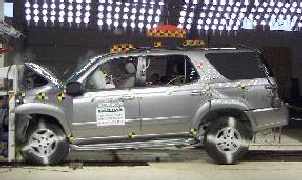
NHTSA crash tests
The agency crash-tested this model year itself. These are its own
photographs and star ratings.
These stars come from the pre-2011 crash test programme. NHTSA
rebuilt the programme for the 2011 model year and states that
ratings either side of that change are not comparable — so do
not read these against a 2011-or-newer car's stars.
Frontal crash test
Photographs taken by NHTSA during its own New Car Assessment Program crash
tests of this model year. Public domain.
Configuration
Overall
Front
Side
Rollover
2004 Toyota Sequoia 4-DR.
—
—
—
—
When owners complained
A spike years after the car went on sale usually means a part wearing
out on schedule across the whole fleet — the kind of pattern no single
owner can see from inside their own car.
Apr 2004peak 15Sep 2026
NHTSA investigations into the 2004 Toyota Sequoia
An investigation is the step before a recall: the agency has seen enough
complaints to look into a pattern itself. An open one means it thinks
something may be wrong and nothing has been fixed yet.
From 2000 through 2017, Takata produced millions of air bag inflators using two types of phase-stabilized ammonium nitrate ("PSAN") propellant -- propellant 2004 and propellant 2004L. After prolonged exposure to high temperature cycles and humidity, inflators using propellant 2004 can degrade, causing the propellant to burn too quickly when ignited. The rapid burning can cause the inflator to rupture during deployment, potentially causing serious or even fatal injury to vehicle occupants. See 2016 Blomquist Report at www.nhtsa.gov/sites/nhtsa.gov/files/documents/expert_report-hrblomquist.pdf.C...
EA15001Opened 24 Feb 2015Still openAIR BAGS:FRONTAL
Air Bag Inflator Rupture
The Office of Defects Investigation (ODI) opened PE14-016 in June 2014 based on six inflator rupture incidents involving consumer owned vehicles produced by five vehicle manufacturers.All six vehicles were operated in Florida or Puerto Rico at the time of the rupture and for the majority of their service life, and were equipped with inflators produced by Takata, a tier-one supplier of automotive air bag systems.During the course of PE14-016, ODI determined that five additional vehicle manufacturers used inflators of a similar design and vintage also supplied by Takata. No evidence of field fai...
PE14016Opened 11 Jun 2014Closed 2 Mar 2015AIR BAGS:FRONTAL
Air Bag Inflator Rupture
The Office of Defects Investigation (ODI) opened PE14-016 in June 2014 based on six inflator rupture incidents involving consumer owned vehicles produced by five vehicle manufacturers.All six vehicles were operated in Florida or Puerto Rico at the time of the rupture and for the majority of their service life, and were equipped with inflators produced by Takata, a tier-one supplier of automotive air bag systems.During the course of PE14-016, ODI determined that five additional vehicle manufacturers used inflators of a similar design and vintage also supplied by Takata. No evidence of field fai...
EA06014Opened 2 Aug 2006Closed 28 Feb 2007SUSPENSION:FRONT:CONTROL ARM:LOWER BALL JOINT
LOWER BALL JOINT FAILURE
IN A LETTER DATED JANUARY 18, 2007, TOYOTA NOTIFIED NHTSA OF A SAFETY DEFECT IN MODEL YEAR (MY) 2004 THROUGH 2006 TOYOTA TUNDRA AND MY 2004 THROUGH 2007 TOYOTA SEQUOIA VEHICLES PRODUCED BETWEEN SEPTEMBER 15, 2003 AND NOVEMBER 17, 2006 (NHTSA RECALL NO. 07V-013). ACCORDING TO TOYOTA, ?IN THE FRONT SUSPENSION LOWER BALL JOINT ON THE SUBJECT VEHICLES, DUE TO POSSIBLE IMPROPER FINISHING OF THE BALL JOINT, SUCH AS THE ASPECT OF THE BALL STUD SURFACE, SOME BALL JOINTS MAY EXPERIENCE AN INCIDENTAL DETERIORATION OF THE INTERNAL LUBRICATION. THIS MAY CAUSE THE BALL JOINT TO WEAR AND LOOSEN PREMATURELY,...
Recalls on the 2004 Toyota Sequoia
A complaint is one owner's allegation. A recall is the point at which
the manufacturer or a regulator agreed the defect is real and dangerous
enough to fix for free — however old the car is.
United States — NHTSA
22E002000
SUSPENSION:FRONT:CONTROL ARM:LOWER BALL JOINT
Tenneco Automotive (DRiV) is recalling certain aftermarket ball joints for 2004-2007 Toyota Sequoia and 2004-2006 Toyota Tundra vehicles, MOOG part number K80521, K80522, NAPA part number NCP2601633, NCP2601634, ACDelco part number 45D2344, and 45D2345. The ball joint housing may have inadequate hardness, causing premature failure.
Risk: A ball joint failure may cause a loss of control, increasing the risk of a crash.
19V741000
AIR BAGS:FRONTAL:PASSENGER SIDE:INFLATOR MODULE
Toyota Motor Engineering & Manufacturing (Toyota) is recalling certain 2010-2016 4Runner, 2003-2006 Tundra, 2003-2013 Corolla, 2009-2010 Corolla Matrix, 2004-2005 RAV4, 2002-2007 Sequoia, 2011-2013 Sienna, 2008-2012 Scion xB, 2008-2009 Lexus IS-F, 2007-2012 Yaris and Lexus ES350, 2010-2017 Lexus GX460, 2002-2010 Lexus SC430, 2006-2012 Lexus IS250 and IS350 and 2010-2015 Lexus IS250C and IS350C vehicles. These vehicles had their driver or passenger frontal air bag inflators previously replaced under a prior recall using inflators of the same design. The inflators may explode due to propellant degradation occurring after long-term exposure to high absolute humidity, temperature and temperature cycling.
Risk: An inflator explosion may result in sharp metal fragments striking the driver or other occupants resulting in serious injury or death.
18V883000
AIR BAGS:FRONTAL:PASSENGER SIDE:INFLATOR MODULE
Toyota Motor Engineering & Manufacturing (Toyota) is recalling certain 2002-2005 Lexus SC and Toyota Sequoia, 2003-2005 Toyota Corolla and Tundra, and 2003-2007 Pontiac Vibe vehicles. These vehicles are equipped with certain air bag inflators assembled as part of the passenger frontal air bag modules used as original equipment or replacement equipment. In the event of a crash necessitating deployment of the passenger frontal air bag, these inflators may explode due to propellant degradation.
Risk: An inflator explosion may result in sharp metal fragments striking the driver or other occupants resulting in serious injury or death.
15V286000
AIR BAGS
Toyota Motor Engineering & Manufacturing (Toyota) notified the agency on May 13, 2015, that they are recalling 2005-2007 Lexus SC, Toyota Corolla, Corolla Matrix, Sequoia, and Pontiac Vibe, and 2005-2006 Toyota Tundra vehicles that were originally sold, or ever registered, in Florida, along the Gulf Coast, Puerto Rico, Hawaii, the U.S. Virgin Islands, Guam, Saipan and American Samoa. On June 16, 2015 Toyota expanded the recall to cover an additional 769,055 vehicles, including certain model year 2002-2004 Lexus SC, Toyota Sequoia, 2003-2004 Toyota Corolla Matrix, Toyota Corolla, Pontiac Vibe, and Toyota Tundra vehicles, as well the vehicles covered by the May 13, 2015 notification in the portions of Georgia, Alabama, Louisiana, Mississippi and Texas that were not previously included. The inflators in the front passenger air bags are susceptible to rupture in the event of a crash necessitating the deployment of the front passenger air bag.
Risk: In the event of a crash necessitating deployment of the passenger's frontal air bag, the inflator could rupture with metal fragments striking the vehicle occupants potentially resulting in serious injury or death.
15V285000
AIR BAGS
Toyota Motor Engineering & Manufacturing (Toyota) notified the agency on May 13, 2015 that they are recalling certain model year 2004 Sequoia vehicles manufactured August 18, 2003, to August 19, 2004, and 2003-2004 Tundra vehicles manufactured March 18, 2003, to August 25, 2004. On June 16, 2015, Toyota expanded the recall to include an additional 1,270,468 vehicles, including model year 2002-2003 and 2005-2007 Sequoia, 2005-2006 Tundra, 2003-2007 Corolla, 2003-2007 Corolla Matrix, 2003-2007 Pontiac Vibe and 2002-2007 Lexus SC vehicles. This is to address a safety defect in the passenger side frontal air bag inflator which may produce excessive internal pressure causing the inflator to rupture upon deployment of the air bag. This recall addresses both the passenger side frontal air bags that were originally installed in the vehicles, as well as replacement air bags that may have been installed as replacement service parts. A replacement air bag may have been installed, as one example, if a vehicle had been in a crash necessitating the replacement of the passenger side frontal air bag.
Risk: In the event of a crash necessitating deployment of the passenger's frontal air bag, the inflator could rupture with metal fragments striking the vehicle occupants potentially resulting in serious injury or death.
07E023000
SERVICE BRAKES, HYDRAULIC:FOUNDATION COMPONENTS:MASTER CYLINDER
CERTAIN CARDONE MASTER CYLINDERS WITH PART NUMBERS 10-2925, 10-2987, 10-2987MZA, 10-3083, 11-3015, 11-3042, 11-3044, 11-3045, 11-3047, 11-3064, AND 11-3156, AND WITH DATE CODES LOWER THAN DCA7078 SOLD AS REPLACEMENT EQUIPMENT FOR USE ON THE VEHICLES LISTED ABOVE. THE SEAL ON MASTER CYLINDER CAN FAIL AND LEAK BRAKE FLUID.
Risk: LOSS OF BRAKE FLUID CAN RESULT IN POOR BRAKING PERFORMANCE, POSSIBLY RESULTING IN A VEHICLE CRASH.
07V013000
SUSPENSION:FRONT:CONTROL ARM:LOWER BALL JOINT
ON CERTAIN TRUCKS AND MINI VANS, DUE TO POSSIBLE IMPROPER FINISHING OF THE FRONT SUSPENSION LOWER BALL JOINT, SOME BALL JOINTS MAY EXPERIENCE AN INCIDENTAL DETERIORATION OF THE INTERNAL LUBRICATION. THIS MAY CAUSE THE BALL JOINT TO WEAR AND LOOSEN PREMATURELY, WHICH COULD RESULT IN INCREASED STEERING EFFORT, REDUCED VEHICLE SELF-CENTERING, AND NOISE IN THE FRONT SUSPENSION.
Risk: IN EXTREME CASES, IF THE VEHICLE IS CONTINUOUSLY OPERATED IN THIS CONDITION, THE LOWER BALL JOINT MAY SEPARATE FROM THE KNUCKLE AND COULD CAUSE A LOSS OF VEHICLE CONTROL.
06E049000
EXTERIOR LIGHTING
CERTAIN CK MOTORSPORTS COMBINATION HEADLIGHTS, CLEAR CORNER, BUMPER, AND SIDE MARKER LIGHTS SOLD AS REPLACEMENT LAMPS FOR USE ON THE PASSENGER VEHICLES LISTED ABOVE. SOME COMBINATION LAMPS THAT ARE NOT EQUIPPED WITH AMBER SIDE REFLECTORS FAIL TO CONFORM TO FEDERAL MOTOR VEHICLE SAFETY STANDARD NO. 108, LAMPS, REFLECTIVE DEVICES, AND ASSOCIATED EQUIPMENT.
Risk: WITHOUT THE AMBER REFLECTORS, THE VEHICLE WILL BE POORLY ILLUMINATED, POSSIBLY RESULTING IN A VEHICLE CRASH WITHOUT WARNING.
Canada — Transport Canada
Canada runs its own recall programme, and its campaigns do not
always mirror the American ones.
Recall 201952337,591 units in Canada
Airbag
Issue: On certain vehicles, long-term exposure to high absolute humidity and temperature, combined with high temperature cycling, may eventually degrade the propellant contained in the passenger-front airbag. This could cause the airbag to deploy with more force than normal. If the airbag inflator ruptures, fragments could be propelled toward vehicle occupants or cause damage to the airbag assembly, preventing its proper function. Safety Risk: If the vehicle is involved in a crash requiring an airbag deployment, the airbag inflator could rupture and create a risk of injury. Corrective Action: Owners will be notified by mail and instructed to take their vehicle to a dealer to have the passenger-front airbag inflator or airbag module replaced. Note: The Canadian climate results in the propellant degrading slowly. This recall is being conducted as a precaution to address future risk. It is expected that all airbag inflators will be replaced before their function would be affected. Additional Note: Vehicles may have had the original front passenger airbag inflator replaced as a "like-for-like" replacement under recall 2016-103 (Toyota Recall #'s SRC 241 & SRC 242) as a temporary remedy while evaluating a permanent remedy. These vehicles will receive the permanent remedy passenger airbag assembly under this recall.
Recall 2016103400,124 units in Canada
Airbag
On certain vehicles, the passenger (frontal) airbag inflator could produce excessive internal pressure during airbag deployment. Increased pressure may cause the inflator to rupture, which could allow fragments to be propelled toward vehicle occupants, increasing the risk of injury. This could also damage the airbag module, which could prevent proper deployment. Failure of the passenger airbag to fully deploy during a crash (where deployment is warranted) could increase the risk of personal injury to the seat occupant. Note: This recall supersedes recalls 2013113, 2014224, 2015197 and 2015269. Correction: All vehicles having not received a replacement inflator as part of the previous recall will now have a replacement inflator installed by dealers. For Matrix model vehicles, dealers may replace the front passenger airbag assembly with one equipped with a newly specified inflator.
Recall 2015269366,860 units in Canada
Airbag
On certain vehicles, the passenger (frontal) airbag inflator could produce excessive internal pressure during airbag deployment. Increased pressure may cause the inflator to rupture, which could allow fragments to be propelled toward vehicle occupants, increasing the risk of injury. This could also damage the airbag module, which could prevent proper deployment. Failure of the passenger airbag to fully deploy during a crash (where deployment is warranted) could increase the risk of personal injury to the seat occupant. Note: This recall is superseded by recall 2016103. Please see recall 2016103 for more information. <a href="http://wwwapps.tc.gc.ca/Saf-Sec-Sur/7/VRDB-BDRV/search-recherche/detail.aspx?lang=eng&&rn=2016103">Click here for more information</a>
Recall 20151974,407 units in Canada
Airbag
On certain vehicles, the passenger (frontal) airbag inflator could produce excessive internal pressure during airbag deployment. Increased pressure may cause the inflator to rupture, which could allow fragments to be propelled toward vehicle occupants, increasing the risk of injury. This could also damage the airbag module, which could prevent proper deployment. Failure of the passenger airbag to fully deploy during a crash (where deployment is warranted) could increase the risk of personal injury to the seat occupant. Note: This recall is superseded by recall 2016103. Please see recall 2016103 for more information. <a href="http://wwwapps.tc.gc.ca/Saf-Sec-Sur/7/VRDB-BDRV/search-recherche/detail.aspx?lang=eng&&rn=2016103">Click here for more information</a>
Recall 200701411,298 units in Canada
Steering
On certain vehicles, a manufacturing issue with the front lower ball joint could result in premature wear. If the vehicle is operated for an extended period of time in this condition, the ball joint may eventually experience excessive wear and looseness, resulting in increased steering effort, reduced vehicle self-centering and noise in the front suspension. In extreme cases, when the driver continues to operate the vehicle in this condition, the lower ball joint may separate from the knuckle causing a loss of vehicle steering control. Correction: Dealers will inspect and, if necessary, replace the front lower ball joints.
Recall 200515114,341 units in Canada
Suspension
On certain vehicles, a manufacturing issue with the front lower ball joint could result in premature wear. If the vehicle is operated for an extended period of time in this condition, the ball joint may eventually experience excessive wear and looseness, resulting in increased steering effort, reduced vehicle self-centering and noise in the front suspension. In extreme cases, when the driver continues to operate the vehicle in this condition, the lower ball joint may separate from the knuckle causing a loss of vehicle steering control. Correction: Dealers will inspect and, if necessary, replace the front lower ball joints.
Reports where the owner recorded a crash, a fire, an injury or a death.
at 300,000 milesFinksburg, MDCrash
AIR BAGS
THE VEHICLE WAS STATIONARY THEN THE GEARS WERE MOVED WHILE HAVING FOOT ON BRAKES HOWEVER THE BREAKS WERE STUCK AND THE VEHICLE WAS NOT ABLE TO BE STOPPED CAUSING IT TO RUN INTO THE HOUSE WHICH HAD CAUSED UNBELIEVABLE DAMAGE. NONE OF THE AIRBAGS DEPLOYED.
NHTSA complaint #11073300 — an unverified report by a vehicle owner.
at 300,000 milesFinksburg, MDCrash
SERVICE BRAKES
THE VEHICLE WAS STATIONARY THEN THE GEARS WERE MOVED WHILE HAVING FOOT ON BRAKES HOWEVER THE BREAKS WERE STUCK AND THE VEHICLE WAS NOT ABLE TO BE STOPPED CAUSING IT TO RUN INTO THE HOUSE WHICH HAD CAUSED UNBELIEVABLE DAMAGE. NONE OF THE AIRBAGS DEPLOYED.
NHTSA complaint #11073300 — an unverified report by a vehicle owner.
Salinas, CACrash
STEERING
ME AND MY FAMILY WERE DRIVING SOUTHEAST ON HIGHWAY 280 ON THE FAR RIGHT LANE TRYING TO TAKE JUNCTION 85 GILROY WHEN ALL OF A SUDDEN THROUGH TIRE ON THE FRONT DRIVER SIDE CAME OFF AND THE CAR JUST WAS LIMP ON THAT SIDE AND ALL I CAN SEE WAS SPARKS AND SMOKE MY WHOLE FAMILY WAS TERRIFIED .I WAS TRYING WITH ALL MY STRENGTH TO CONTROL THE CAR AND WITH THE WILL OF GOD I MANAGED TO SAFELY STOP THE CAR .I STEP OUT TO SEE WHAT HAPPENED AND THE TIRE WAS STUCK UNDER THE CAR AND COMPLETELY OF THE JOINT WITH THE BRECKSAME STILL CONNECTED TO THE TIRE
NHTSA complaint #10863795 — an unverified report by a vehicle owner.
Salinas, CACrash
SUSPENSION
ME AND MY FAMILY WERE DRIVING SOUTHEAST ON HIGHWAY 280 ON THE FAR RIGHT LANE TRYING TO TAKE JUNCTION 85 GILROY WHEN ALL OF A SUDDEN THROUGH TIRE ON THE FRONT DRIVER SIDE CAME OFF AND THE CAR JUST WAS LIMP ON THAT SIDE AND ALL I CAN SEE WAS SPARKS AND SMOKE MY WHOLE FAMILY WAS TERRIFIED .I WAS TRYING WITH ALL MY STRENGTH TO CONTROL THE CAR AND WITH THE WILL OF GOD I MANAGED TO SAFELY STOP THE CAR .I STEP OUT TO SEE WHAT HAPPENED AND THE TIRE WAS STUCK UNDER THE CAR AND COMPLETELY OF THE JOINT WITH THE BRECKSAME STILL CONNECTED TO THE TIRE
NHTSA complaint #10863795 — an unverified report by a vehicle owner.
at 215,444 milesCary, NC1 injured
WHEELS
LAST WEEK, (3/17/16) MY NEIGHBOR WAS TAKING HER THREE CHILDREN TO SCHOOL IN HER 2004 TOYOTA SEQUOIA. SHE WAS TRAVELING ON A NEW ROAD AT APPROXIMATELY 30 MPH WHEN THE FRONT END OF THE VEHICLE DROPPED ON DRIVER'S SIDE. SHE THOUGHT SHE HAD A FLAT TIRE SO SHE STEERED TO THE SIDE OF THE ROAD. IT APPEARS THE DRIVER'S SIDE, LOWER BALL JOINT FAILED (SEE PHOTOS). I CALLED HENDRICK TOYOTA OF APEX, NC AND TALKED WITH MR. JOHN SPECHT (919-335-1678). HE CHECKED THE VIN AND SAID THE LOWER BALL JOINTS HAD A RECALL AND WERE CHANGED ON AUG. 15, 2007. HE ALSO SUGGESTED I CONTACT TOYOTA TO REQUEST THEIR ASSISTANCE TO COVER THE COST TO REPAIR THE VEHICLE (CASE NO.[XXX]). HE ADVISED THE VEHICLE BE BROUGHT IN FOR THE AIRBAG RECALL TOO. VEHICLE WAS TOWED HOME ON A DOLLY TO PREVENT ANY DAMAGE TO THE TRANSMISSION. THE VEHICLE HAS 215,444 MILES AND WAS NOT USED FOR OFF-ROAD DRIVING. THE VEHICLE RECENTLY PASSED STATE INSPECTION WITH NO PROBLEMS NOTED ABOUT THE FRONT END. IF THE LOWER BALL JOINTS WERE ALREADY REPLACED IN A RECALL (2007) WHAT DID THEY REPLACE THEM WITH, AND HOW DID THEY CORRECT THE PROBLEM? THIS FAILURE COULD HAVE CAUSED A DEADLY ACCIDENT AT HIGHER SPEED. WHEN A LOWER BALL JOINT BREAKS, THE DRIVER CAN ONLY STEER WITH ONE WHEEL.[XXX] 'INFORMATION REDACTED PURSUANT TO THE FREEDOM OF INFORMATION ACT (FOIA), 5 U.S.C. 552(B)(6).'
NHTSA complaint #10850861 — an unverified report by a vehicle owner.
at 215,444 milesCary, NC1 injured
STEERING
LAST WEEK, (3/17/16) MY NEIGHBOR WAS TAKING HER THREE CHILDREN TO SCHOOL IN HER 2004 TOYOTA SEQUOIA. SHE WAS TRAVELING ON A NEW ROAD AT APPROXIMATELY 30 MPH WHEN THE FRONT END OF THE VEHICLE DROPPED ON DRIVER'S SIDE. SHE THOUGHT SHE HAD A FLAT TIRE SO SHE STEERED TO THE SIDE OF THE ROAD. IT APPEARS THE DRIVER'S SIDE, LOWER BALL JOINT FAILED (SEE PHOTOS). I CALLED HENDRICK TOYOTA OF APEX, NC AND TALKED WITH MR. JOHN SPECHT (919-335-1678). HE CHECKED THE VIN AND SAID THE LOWER BALL JOINTS HAD A RECALL AND WERE CHANGED ON AUG. 15, 2007. HE ALSO SUGGESTED I CONTACT TOYOTA TO REQUEST THEIR ASSISTANCE TO COVER THE COST TO REPAIR THE VEHICLE (CASE NO.[XXX]). HE ADVISED THE VEHICLE BE BROUGHT IN FOR THE AIRBAG RECALL TOO. VEHICLE WAS TOWED HOME ON A DOLLY TO PREVENT ANY DAMAGE TO THE TRANSMISSION. THE VEHICLE HAS 215,444 MILES AND WAS NOT USED FOR OFF-ROAD DRIVING. THE VEHICLE RECENTLY PASSED STATE INSPECTION WITH NO PROBLEMS NOTED ABOUT THE FRONT END. IF THE LOWER BALL JOINTS WERE ALREADY REPLACED IN A RECALL (2007) WHAT DID THEY REPLACE THEM WITH, AND HOW DID THEY CORRECT THE PROBLEM? THIS FAILURE COULD HAVE CAUSED A DEADLY ACCIDENT AT HIGHER SPEED. WHEN A LOWER BALL JOINT BREAKS, THE DRIVER CAN ONLY STEER WITH ONE WHEEL.[XXX] 'INFORMATION REDACTED PURSUANT TO THE FREEDOM OF INFORMATION ACT (FOIA), 5 U.S.C. 552(B)(6).'
NHTSA complaint #10850861 — an unverified report by a vehicle owner.
The most recent complaints
In the owners' own words, exactly as filed with NHTSA.
Brooklyn Park, MN
POWER TRAIN
I own a 2004 Toyota Sequoia and have owned it since it was built by Toyota. In 2013 Toyota had a safety recall on the frame for that vehicle because in certain Northern states they are having issues with the frame rotting and braking. I brought my vehicle in May of 2013 and Carlson Toyota in Minnesota inspected. It said that it passed and they installed a corrosion kit. This vehicle has been meticulously cared for over the years and it still looks that way on the exterior and interior. I have always had this vehicle enrolled in a car wash club so it gets washed almost daily in the winter and has for its entire life. But the frame of this vehicle is to the point now where it shouldn't be driven. It is so dangerously, rotted and breaking apart. I had the vehicle in Florida for spring break and while I was driving it there it was making some weird clunking noises. So I took it to a repair shop and the frame repair shop said that the frame was beyond repair and probably should not be driven. But it was my only vehicle and I had no choice but to drive it back to Minnesota. Since then I've had several issues when taking off and stopping with loud clunking noises, but it is my daily vehicle and I believe that Toyota should do something to fix it or replace it.
NHTSA complaint #11762470 — an unverified report by a vehicle owner.
Brooklyn Park, MN
SUSPENSION
I own a 2004 Toyota Sequoia and have owned it since it was built by Toyota. In 2013 Toyota had a safety recall on the frame for that vehicle because in certain Northern states they are having issues with the frame rotting and braking. I brought my vehicle in May of 2013 and Carlson Toyota in Minnesota inspected. It said that it passed and they installed a corrosion kit. This vehicle has been meticulously cared for over the years and it still looks that way on the exterior and interior. I have always had this vehicle enrolled in a car wash club so it gets washed almost daily in the winter and has for its entire life. But the frame of this vehicle is to the point now where it shouldn't be driven. It is so dangerously, rotted and breaking apart. I had the vehicle in Florida for spring break and while I was driving it there it was making some weird clunking noises. So I took it to a repair shop and the frame repair shop said that the frame was beyond repair and probably should not be driven. But it was my only vehicle and I had no choice but to drive it back to Minnesota. Since then I've had several issues when taking off and stopping with loud clunking noises, but it is my daily vehicle and I believe that Toyota should do something to fix it or replace it.
NHTSA complaint #11762470 — an unverified report by a vehicle owner.
Chula Vista, CA
WHEELS
Description of the Safety Crash/Informed Incident: Vehicle Information: 2004 Toyota Sequoia (VIN: [XXX]) Incident Date: [XXX] Location: [XXX] Police Agency: California Highway Patrol (Report #:[XXX]) Speed at Incident: Highway speeds (~65 MPH) Description of Defect/Failure: Structural mechanical failure leading to sudden, catastrophic wheel separation at highway speeds. Nine days prior to the incident, on [XXX], the vehicle underwent a comprehensive brake, rotor, and tire rotation service at a certified Toyota dealership (Toyota of Chula Vista, Work Order #[XXX]). While traveling on the interstate, the right rear passenger wheel assembly completely detached from the moving vehicle. As a result, the wheel flew off crossing several traffic lanes, traveling over a jersey wall on the freeway shoulder, landing into a nearby drainage ditch. The vehicle dropped onto the remaining brake/rotor assembly, generating extreme sparks, causing an immediate loss of braking pressure, and creating an imminent threat of a rollover or multi-vehicle fatal collision. Subsequent post-incident inspection on a maintenance lift revealed that all wheel studs on the right rear hub were completely sheared or stripped off. This indicates a severe technician failure to properly torque the wheel lug nuts to factory specifications during reassembly, or an un-diagnosed structural failure of the wheel mounting components following certified dealer service. INFORMATION REDACTED PURSUANT TO THE FREEDOM OF INFORMATION ACT (FOIA), 5 U.S.C. 552(B)(6)
NHTSA complaint #11747762 — an unverified report by a vehicle owner.
Chula Vista, CA
SUSPENSION
Description of the Safety Crash/Informed Incident: Vehicle Information: 2004 Toyota Sequoia (VIN: [XXX]) Incident Date: [XXX] Location: [XXX] Police Agency: California Highway Patrol (Report #:[XXX]) Speed at Incident: Highway speeds (~65 MPH) Description of Defect/Failure: Structural mechanical failure leading to sudden, catastrophic wheel separation at highway speeds. Nine days prior to the incident, on [XXX], the vehicle underwent a comprehensive brake, rotor, and tire rotation service at a certified Toyota dealership (Toyota of Chula Vista, Work Order #[XXX]). While traveling on the interstate, the right rear passenger wheel assembly completely detached from the moving vehicle. As a result, the wheel flew off crossing several traffic lanes, traveling over a jersey wall on the freeway shoulder, landing into a nearby drainage ditch. The vehicle dropped onto the remaining brake/rotor assembly, generating extreme sparks, causing an immediate loss of braking pressure, and creating an imminent threat of a rollover or multi-vehicle fatal collision. Subsequent post-incident inspection on a maintenance lift revealed that all wheel studs on the right rear hub were completely sheared or stripped off. This indicates a severe technician failure to properly torque the wheel lug nuts to factory specifications during reassembly, or an un-diagnosed structural failure of the wheel mounting components following certified dealer service. INFORMATION REDACTED PURSUANT TO THE FREEDOM OF INFORMATION ACT (FOIA), 5 U.S.C. 552(B)(6)
NHTSA complaint #11747762 — an unverified report by a vehicle owner.
Chula Vista, CA
SERVICE BRAKES
Description of the Safety Crash/Informed Incident: Vehicle Information: 2004 Toyota Sequoia (VIN: [XXX]) Incident Date: [XXX] Location: [XXX] Police Agency: California Highway Patrol (Report #:[XXX]) Speed at Incident: Highway speeds (~65 MPH) Description of Defect/Failure: Structural mechanical failure leading to sudden, catastrophic wheel separation at highway speeds. Nine days prior to the incident, on [XXX], the vehicle underwent a comprehensive brake, rotor, and tire rotation service at a certified Toyota dealership (Toyota of Chula Vista, Work Order #[XXX]). While traveling on the interstate, the right rear passenger wheel assembly completely detached from the moving vehicle. As a result, the wheel flew off crossing several traffic lanes, traveling over a jersey wall on the freeway shoulder, landing into a nearby drainage ditch. The vehicle dropped onto the remaining brake/rotor assembly, generating extreme sparks, causing an immediate loss of braking pressure, and creating an imminent threat of a rollover or multi-vehicle fatal collision. Subsequent post-incident inspection on a maintenance lift revealed that all wheel studs on the right rear hub were completely sheared or stripped off. This indicates a severe technician failure to properly torque the wheel lug nuts to factory specifications during reassembly, or an un-diagnosed structural failure of the wheel mounting components following certified dealer service. INFORMATION REDACTED PURSUANT TO THE FREEDOM OF INFORMATION ACT (FOIA), 5 U.S.C. 552(B)(6)
NHTSA complaint #11747762 — an unverified report by a vehicle owner.
at 198,000 milesWest Orange, NJ
STRUCTURE
The contact owns a 2004 Toyota Sequoia. There was an abnormal rattling sound detected in the front area. The vehicle was shaking. No warning lights were illuminated. The vehicle was taken to an independent mechanic who determined that the frame was completely rusty and unsafe to drive. The vehicle was taken to the local dealer to have the frame checked, and it was determined there was minor rust detected. The vehicle was not repaired. The contact vehicle was taken to another local dealer, Crestmont Toyota Parts · Crestmont Toyota Service, 730 NJ-23 N, Pompton Plains, NJ 07444, who determined there was rust detected but was not repaired. The contact wrote a letter to the manufacturer. The failure mileage was approximately 198,000.
NHTSA complaint #11737255 — an unverified report by a vehicle owner.
Mount Carmel, IL
STRUCTURE:BODY
Rust! Frame completely rusted, even though the CRC was applied back in 2013.
NHTSA complaint #11676855 — an unverified report by a vehicle owner.
at 203,000 milesSkippack, PA
STRUCTURE:FRAME AND MEMBERS
The contact owns a 2004 Toyota Sequoia. The contact stated that while completing an inspection and emissions test on the vehicle, the mechanic informed the contact that there was severe rust on the rear subframe of the vehicle, near the control arm, and several other areas on the subframe. The contact stated that there were several holes on the subframe caused by the extreme rust. The dealer was not contacted. The vehicle was not repaired. The manufacturer was not informed of the failure. The failure mileage was approximately 203,000.
NHTSA complaint #11674182 — an unverified report by a vehicle owner.
Belle Mead, NJ
STRUCTURE
See attached document for complaint.
NHTSA complaint #11617958 — an unverified report by a vehicle owner.
Belle Mead, NJ
STRUCTURE
See attached document for complaint.
NHTSA complaint #11611616 — an unverified report by a vehicle owner.
at 143,000 milesWoodbridge, VA
SERVICE BRAKES, HYDRAULIC
The contact owns a 2004 Toyota Sequoia. The contact stated while driving at approximately 35 MPH, the brake pedal was depressed and went to the floorboard. The contact stated that the check brakes and a traction control warning lights illuminated. The contact stated that the failure was intermittent at first but had become a recurring failure. When Toyota issued a recall for the braking issue, the contact did not receive notices, so the contact called them and was told it was a few selected 2004 Toyota Sequoia recalled for those who had complained but, it was not broadcasted like that. The contact had taken the vehicle to a local dealer, but the vehicle was not yet diagnosed. The vehicle was not repaired. The contact researched online and related the failure to NHTSA Campaign Number: 07E023000 (Service Brakes, Hydraulic). The manufacturer was informed of the failure. The failure mileage was approximately 143,000.
NHTSA complaint #11588514 — an unverified report by a vehicle owner.
at 143,000 milesWoodbridge, VA
TRACTION CONTROL SYSTEM
The contact owns a 2004 Toyota Sequoia. The contact stated while driving at approximately 35 MPH, the brake pedal was depressed and went to the floorboard. The contact stated that the check brakes and a traction control warning lights illuminated. The contact stated that the failure was intermittent at first but had become a recurring failure. When Toyota issued a recall for the braking issue, the contact did not receive notices, so the contact called them and was told it was a few selected 2004 Toyota Sequoia recalled for those who had complained but, it was not broadcasted like that. The contact had taken the vehicle to a local dealer, but the vehicle was not yet diagnosed. The vehicle was not repaired. The contact researched online and related the failure to NHTSA Campaign Number: 07E023000 (Service Brakes, Hydraulic). The manufacturer was informed of the failure. The failure mileage was approximately 143,000.
NHTSA complaint #11588514 — an unverified report by a vehicle owner.
New Castle, PA
UNKNOWN OR OTHER
Frame is rotting out
NHTSA complaint #11582378 — an unverified report by a vehicle owner.
New Castle, PA
SUSPENSION
Frame is rotting out
NHTSA complaint #11582378 — an unverified report by a vehicle owner.
Bethlehem, PA
UNKNOWN OR OTHER
TOYOTA frame is falling apart due to the use of faulty metal to manufacture those frames they ran a limited service campaign to replace some of the frames and they denied many other owners that right please help by telling TOYOTA North America to take care of this very hazardous issue thank you
NHTSA complaint #11579668 — an unverified report by a vehicle owner.
Bethlehem, PA
STRUCTURE:BODY
TOYOTA frame is falling apart due to the use of faulty metal to manufacture those frames they ran a limited service campaign to replace some of the frames and they denied many other owners that right please help by telling TOYOTA North America to take care of this very hazardous issue thank you
NHTSA complaint #11579668 — an unverified report by a vehicle owner.
New Castle, PA
UNKNOWN OR OTHER
Frame
NHTSA complaint #11552901 — an unverified report by a vehicle owner.
Fort Wayne, IN
UNKNOWN OR OTHER
The undercarriage is rotten you help my thanks
NHTSA complaint #11491571 — an unverified report by a vehicle owner.
Fort Wayne, IN
STRUCTURE:BODY
The undercarriage is rotten you help my thanks
NHTSA complaint #11491571 — an unverified report by a vehicle owner.
Fort Wayne, IN
SERVICE BRAKES
The undercarriage is rotten you help my thanks
NHTSA complaint #11491571 — an unverified report by a vehicle owner.
Lakeville, MN
UNKNOWN OR OTHER
Frame has rust issues throughout. Frame not properly treated at the factory and now I am suffering because it has virtually rusted through in front of the drivers side rear wheel which was pointed out to me at Toyota when my car was in for service.
NHTSA complaint #11477258 — an unverified report by a vehicle owner.
Mastic, NY
STRUCTURE:BODY
The frame is rusting away due to poor grade of metal that it is built from.
NHTSA complaint #11451641 — an unverified report by a vehicle owner.
Northwood, OH
UNKNOWN OR OTHER
Rotting frame!
NHTSA complaint #11449428 — an unverified report by a vehicle owner.
Memphis, TN
UNKNOWN OR OTHER
The tail gate will not open. I had the vehicle since 2018 and it was working and now it's not working. I taken it to toyota dealership and the cost is to much for at this point. I was wondering is there anything that can be done?
NHTSA complaint #11434634 — an unverified report by a vehicle owner.
at 100,000 milesST Augustine, FL
STRUCTURE:BODY
SIGNIFICANT FRAME RUST IN THE REAR LEFT AND RIGHT
NHTSA complaint #11414721 — an unverified report by a vehicle owner.