Owners have filed 241 complaints
about the 2019 Chevrolet Bolt EV with NHTSA between 2018 and 2026.
The largest single group is the electrical system.
Across this model's run it ranks 3 of 7 worst.
The letter says how bad. This says what kind — whether this year drew
an unusual number of complaints, unusually dangerous
ones, or failures that arrived unusually early.
The dashed ring is 50 — the national norm. Further out is worse.
Complaint volume — 62
Against the median year of the Chevrolet Bolt EV. 50 means typical for this
model; 100 means roughly double.
Severity — 41
7.9% of these complaints
involved a crash, fire, injury or death, against a national rate of
9.7%.
Early failure — 100
89% of failures with a mileage on record happened under
36,000 miles, against a national rate of
29%.
How 2019 compares with every other Chevrolet Bolt EV
Odometer readings owners gave when they filed. About half of all
complaints include one.
Under 1,000 miles
1222.2%
1,000 – 9,999 miles
1425.9%
10,000 – 24,999 miles
1629.6%
25,000 – 49,999 miles
916.7%
50,000 – 74,999 miles
35.6%
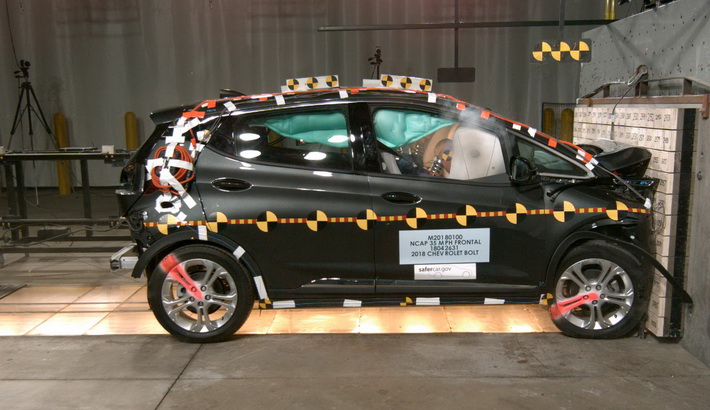
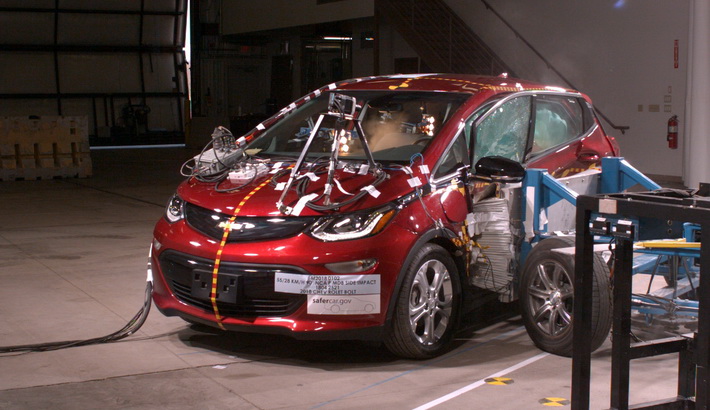
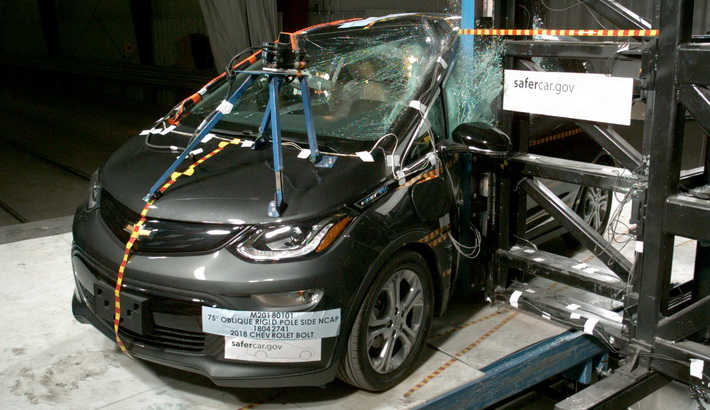
NHTSA crash tests
The agency crash-tested this model year itself. These are its own
photographs and star ratings.
Frontal crash test
Side barrier crash test
Side pole crash test
Photographs taken by NHTSA during its own New Car Assessment Program crash
tests of this model year. Public domain.
Configuration
Overall
Front
Side
Rollover
2019 Chevrolet Bolt EV 5 HB FWD
9.7% risk
When owners complained
A spike years after the car went on sale usually means a part wearing
out on schedule across the whole fleet — the kind of pattern no single
owner can see from inside their own car.
Nov 2018peak 53Jul 2026
NHTSA investigations into the 2019 Chevrolet Bolt EV
An investigation is the step before a recall: the agency has seen enough
complaints to look into a pattern itself. An open one means it thinks
something may be wrong and nothing has been fixed yet.
DP22005Opened 27 Jan 2023Closed 7 Aug 2023ELECTRICAL SYSTEM:PROPULSION SYSTEM
Pedestrian alert sounds
NHTSA received a petition on or about July 18, 2022, requesting that Federal Motor Vehicle Safety Standard (FMVSS) 141 be applied to all electric and hybrid vehicles operating in the United States. The petition can be reviewed at NHTSA.gov under ODI Number 11486072. FMVSS 141 establishes performance requirements for pedestrian alert sounds for motor vehicles. The standard applies to hybrid and electric vehicles that have a gross vehicle weight rating of 4,536 KG or less or are defined as low-speed vehicles. The standard became fully applicable to all such vehicles manufactured on or after Marc...
PE20016Opened 9 Oct 2020Closed 7 Feb 2022ELECTRICAL SYSTEM:PROPULSION SYSTEM
Electric Vehicle Battery Fires
In October 2020, the Office of Defects Investigation (ODI) opened a Preliminary Evaluation (PE) on 2017-2020 Model Year (MY) Chevrolet Bolt vehicles based on complaints received alleging that the vehicles caught fire under the seating area while parked and unattended. At the time, ODI had received 2 Vehicle Owner Questionnaires (VOQs) and several field reports. All complaints alleged vehicles caught fire during or after electrical charging.ODI's review found vehicle thermal events occurred during and/or at the end of the battery module charging cycle. The information learned from NHTSA and Gen...
Recalls on the 2019 Chevrolet Bolt EV
A complaint is one owner's allegation. A recall is the point at which
the manufacturer or a regulator agreed the defect is real and dangerous
enough to fix for free — however old the car is.
United States — NHTSA
23V845000
STRUCTURE:BODY:ROOF AND PILLARS
General Motors, LLC (GM) is recalling certain 2017-2023 Chevrolet Bolt EV vehicles. This recall includes certain vehicles previously repaired incorrectly under NHTSA recall number 22V-930. After a crash with seat belt pretensioner deployment, the pretensioner exhaust may ignite carpet fibers near the B-pillar, causing a fire.
Risk: A fire increases the risk of injury.
22V930000
STRUCTURE:BODY:ROOF AND PILLARS
General Motors, LLC (GM) is recalling certain 2017-2023 Chevrolet Bolt EV vehicles. After a crash with seat belt pretensioner deployment, the pretensioner exhaust may ignite carpet fibers near the B-pillar, causing a fire.
Risk: A vehicle fire can increase the risk of injury.
General Motors LLC (GM) is recalling certain 2017-2019 Chevrolet Bolt EV vehicles previously recalled under NHTSA recall number 20V-701. The high voltage battery could catch fire when charged to full or nearly full capacity.
Risk: A battery fire increases the risk of injury.
General Motors LLC (GM) is recalling all 2017-2018 and certain 2019 Chevrolet Bolt EV vehicles. The high voltage battery could catch fire when charged to full or nearly full capacity.
Risk: A battery fire increases the risk of injury.
20V184000
LATCHES/LOCKS/LINKAGES:DOORS:LATCH
General Motors LLC (GM) is recalling certain 2019-2020 Chevrolet Bolt EV vehicles. The door-handle cable inside the rear doors may be too long, allowing contact with the window when it is opened, possibly damaging the cable. A damaged cable may cause the rear door to open unintentionally when the rear window is opened. Additionally, it may cause the rear inside door handle to not work.
Risk: If the rear door opens while driving, or the door handle fails to open the rear door, there is an increased risk of injury to the rear passengers.
18V576000
SERVICE BRAKES, HYDRAULIC:FOUNDATION COMPONENTS:DISC:CALIPER
General Motors LLC (GM) is recalling certain 2018-2019 Chevrolet Equinox, Impala, Cruze, Volt and Bolt EV vehicles, GMC Terrain vehicles, Buick Lacrosse and Regal vehicles, Cadillac XTS and XTS Professional vehicles and 2018 Chevrolet Malibu vehicles. The rear brake caliper pistons may have an insufficient coating causing gas pockets to form, potentially reducing rear brake performance.
Risk: A reduction of braking performance can increase the risk of a crash.
Canada — Transport Canada
Canada runs its own recall programme, and its campaigns do not
always mirror the American ones.
Recall 2023664202 units in Canada
Seats And Restraints
Issue: On certain vehicles, the recall repairs may not have been completed by a General Motors dealer during recall N222383790 and/or N222383791 (Transport Canada recall number 2022-719). As a result, a second inspection is required. On certain vehicles, the carpet could catch fire after a crash where a front seat belt pretensioner deploys. Safety Risk: A fire that occurs after a crash could create an increased risk of injury. Corrective Actions: General Motors will notify owners by mail and advise you to take your vehicle to a dealership to inspect and, if necessary, install foil tape under the carpet near the front seatbelt pretensioners. On certain model year vehicles, the technician will also install seatbelt pretensioner covers.
Recall 202271919,898 units in Canada
Seats And Restraints
Issue: On certain vehicles, the carpet could catch fire after a crash where a front seat belt pretensioner deploys. Safety Risk: A fire that occurs after a crash could create an increased risk of injury. Corrective Actions: General Motors will notify owners by mail and instruct you to take your vehicle to a dealership to install foil tape under the carpet near the front seatbelt pretensioners. On certain model year vehicles, the technician will also install seatbelt pretensioner covers.
Recall 2021631628 units in Canada
Accessories
Issue: This recall is for certain driver's all-weather floor liners sold with new vehicles or as accessory parts sold at General Motors dealerships. On certain vehicles, the accelerator pedal could get stuck on the floor liner. If this happens, the vehicle may not slow down when you release the accelerator pedal. Note: If you continue to push the brake pedal, the brake-override system will allow you to stop the vehicle. Safety Risk: A stuck accelerator pedal could lead to unintended acceleration and increase the risk of a crash. Corrective Actions: General Motors will notify owners by mail and instruct you to take your vehicle to a dealer to replace the driver's all-weather floor liner. You should remove the all-weather floor liner until you receive the replacement part.
Recall 20214499,713 units in Canada
High Voltage
Issue: On certain vehicles, the high-voltage battery could overheat when it is charged to over 90% of its capacity. As a result, the battery could create smoke or heat, which can melt or damage the battery and nearby parts. Safety Risk: A battery that overheats can create a fire risk. Corrective Actions: General Motors will notify owners by mail and replace defective battery modules. Until replacement battery modules are available, General Motors recommends the following: 1. Enable "Hilltop Reserve" (for 2017-2018 models) or "Target Charge Level" (for 2019 models) using the vehicle's infotainment centre to limit the state of charge to 90%. If you are unable to make these changes, or do not feel comfortable making them, you should visit a dealer to have these adjustments completed. 2. Charge your vehicle more frequently and avoid depleting the battery below approximately 113 km (70 miles) of remaining range, where possible. 3. Out of an abundance of caution, park your vehicle outside immediately after charging and not leave vehicle charging indoors overnight. Please click here for additional information, or call 1-800-263-3777 : <a href= https://my.gm.ca/chevrolet/en/how-to-support/safety/boltevrecall> https://my.gm.ca/chevrolet/en/how-to-support/safety/boltevrecall</a> Note: All vehicles must also have Transport Canada Recall # 2020-540 completed.
Recall 2020130153 units in Canada
Structure
Issue: On certain vehicles, the rear doors may unlatch suddenly due to a damaged cable caused by repeated rear window movement. As a result of this damage, a rear door could open while driving when the window is lowered. A damaged cable may also cause the inside door handle not to work. Safety Risk: A door that opens while the vehicle is moving could create an increased risk of injury. Corrective Actions: General Motors will notify owners by mail and instruct you to take your vehicle to a dealer to replace the inside door handle cable in both rear doors. Note: Until the recall repairs are completed, you can prevent the chance of a door opening while driving by turning on the child lock feature in the rear doors.
Reports where the owner recorded a crash, a fire, an injury or a death.
Westerly, RICrash
AIR BAGS
collided with a deer at 45mph. enough force for airbag deployment. airbag attempted to deploy. I can smell igniter fumes and have smoke in the vehicle however the actual steering wheel bag did not deploy.
NHTSA complaint #11492459 — an unverified report by a vehicle owner.
Glen Ellyn, ILFire
POWER TRAIN
Vehicle was driving in DRIVE mode, and began to surge as if it was regenerating hard (Felt as if downshifted quickly in a manual), which was odd since it was in DRIVE not LOW. Pulled over and placed the car in PARK. Car began to smoke (First noticed from the front underbody). Exited the vehicle and got far away. Called 911 and gave the dispatcher the information. The car lit on fire. Called 911 let them know the fire had begun. Car fully burned by the time the fire department was able to put out the fire. -What component or system failed or malfunctioned, and is it available for inspection upon request? Unknown, and it will be available for inspection if requested. -How was your safety or the safety of others put at risk? The fire could have easily killed someone and having to stand on the shoulder of a multilane highway next to a blaze was dangerous. -Has the problem been reproduced or confirmed by a dealer or independent service center? There is no vehicle left after the fire (Total loss confirmed by insurance) -Has the vehicle or component been inspected by the manufacturer, police, insurance representatives or others? Insurance Co. has. GM will be -Were there any warning lamps, messages or other symptoms of the problem prior to the failure, and when did they first appear? No warning lights appeared at any time
NHTSA complaint #11427581 — an unverified report by a vehicle owner.
Glen Ellyn, ILFire
UNKNOWN OR OTHER
Vehicle was driving in DRIVE mode, and began to surge as if it was regenerating hard (Felt as if downshifted quickly in a manual), which was odd since it was in DRIVE not LOW. Pulled over and placed the car in PARK. Car began to smoke (First noticed from the front underbody). Exited the vehicle and got far away. Called 911 and gave the dispatcher the information. The car lit on fire. Called 911 let them know the fire had begun. Car fully burned by the time the fire department was able to put out the fire. -What component or system failed or malfunctioned, and is it available for inspection upon request? Unknown, and it will be available for inspection if requested. -How was your safety or the safety of others put at risk? The fire could have easily killed someone and having to stand on the shoulder of a multilane highway next to a blaze was dangerous. -Has the problem been reproduced or confirmed by a dealer or independent service center? There is no vehicle left after the fire (Total loss confirmed by insurance) -Has the vehicle or component been inspected by the manufacturer, police, insurance representatives or others? Insurance Co. has. GM will be -Were there any warning lamps, messages or other symptoms of the problem prior to the failure, and when did they first appear? No warning lights appeared at any time
NHTSA complaint #11427581 — an unverified report by a vehicle owner.
Glen Ellyn, ILFire
ELECTRICAL SYSTEM
Vehicle was driving in DRIVE mode, and began to surge as if it was regenerating hard (Felt as if downshifted quickly in a manual), which was odd since it was in DRIVE not LOW. Pulled over and placed the car in PARK. Car began to smoke (First noticed from the front underbody). Exited the vehicle and got far away. Called 911 and gave the dispatcher the information. The car lit on fire. Called 911 let them know the fire had begun. Car fully burned by the time the fire department was able to put out the fire. -What component or system failed or malfunctioned, and is it available for inspection upon request? Unknown, and it will be available for inspection if requested. -How was your safety or the safety of others put at risk? The fire could have easily killed someone and having to stand on the shoulder of a multilane highway next to a blaze was dangerous. -Has the problem been reproduced or confirmed by a dealer or independent service center? There is no vehicle left after the fire (Total loss confirmed by insurance) -Has the vehicle or component been inspected by the manufacturer, police, insurance representatives or others? Insurance Co. has. GM will be -Were there any warning lamps, messages or other symptoms of the problem prior to the failure, and when did they first appear? No warning lights appeared at any time
NHTSA complaint #11427581 — an unverified report by a vehicle owner.
at 27,000 milesChandler, AZFire2 injured
ELECTRICAL SYSTEM:12V/24V/48V BATTERY
The contact owned a 2019 Chevrolet Bolt EV. The contact stated that the vehicle was parked in the garage on the charger when the contact heard the vehicle's horn. The contact entered the garage and saw white smoke coming from underneath the rear of the vehicle. The contact was able to unplug the vehicle. The contact’s son called 911. The contact stated that when the fire department arrived at his home the passenger rear on fire. The fire department extinguished the fire. A fire department report was filed. The contact was treated for smoke inhalation. Additionally, while the contact’s wife was attempting to exit the residence, she broke three toes and was taken to urgent care the following day. The fire department inspected the vehicle but was unsure if the fire was due to the battery. The insurance company had the vehicle towed from the residence and deemed the vehicle a total loss. The manufacturer was made aware of the failure. The failure mileage was approximately 27,000.
NHTSA complaint #11427180 — an unverified report by a vehicle owner.
East Aurora, NYFire
ELECTRICAL SYSTEM
I currently lease a 2019 Chevrolet Bolt which is part of the recall announced today by GM. This is the second recall in less than a year for the same battery-related issue. It was supposed to have been fixed with a software update that I had completed in March. This software was supposed to identify defective batteries but it has not been successful as evidenced by the mounting number of fires that have happened after the “fix”. As such, we are now under a recall a second time. As a result of their own manufacturing issue, we are now limited to how we charge our vehicles, where we park and even the mileage range that we paid for, while GM attempts another fix. GM stated that they will again be using software to identify defective cells in our batteries and only the ones that are deternined to be defective will have those cells or battery packs replaced. As you can imagine, I no longer trust GM to be able to successfully identify whether or not my battery is defective. This is a serious safety issue. My family, my property and even people I park next to while out in public are at risk. GM must be forced to either replace the entire battery pack in every vehicle affected by this recall or replace them with newer models containing safer batteries. They must also provide loaner vehicles, or details on reimbursement for rental cars, to those who need them due to the fact that their vehicle is virtually unusable until GM provides a complete, effective solution.
NHTSA complaint #11426342 — an unverified report by a vehicle owner.
The most recent complaints
In the owners' own words, exactly as filed with NHTSA.
Swarthmore, PA
STEERING
Steering wheel does not return to center on turns when driving at low speeds.
NHTSA complaint #11749605 — an unverified report by a vehicle owner.
Los Angeles, CA
STEERING
Steering wheel does not return to center after making a turn. Over time the steering rack fails leading to a steering wheel that will not return to center even when force is applied to wheel. The dealership is charging $3-4k to fix this safety issue.
NHTSA complaint #11743944 — an unverified report by a vehicle owner.
Waxhaw, NC
STEERING
when driving my car from the airport at Bradley International in CT (parked for a week), I experienced a terrible vibration in the steering wheel which has been intermittent. The vibration went away at lower speeds. I brought the car in to the shop on 5/18/2026 with 74,000 miles on the car. They told me I had to replace rotors, brakes, calipers, brake fluid, and do a front end alignment because the rotors have failed internally. The EV doe not use braking as frequently and this was taken from the Chevy forum: ISSUE: Frozen or Seized Calipers The Issue: Because Bolt drivers heavily rely on regenerative braking, the physical brake pads and calipers are used far less frequently than in gas-powered cars. This can cause rust and debris to build up, leading to frozen calipers, uneven pad wear, or a sticking/grabbing brakes. The Fix: Have a trusted mechanic or a dealer regularly inspect and service the friction brakes. Regular preventive maintenance like flushing the brake fluid every few years is highly recommended to prevent moisture accumulation and seized calipers. The resultant failure is a safety issue and Chevy has decided to call it a PM problem. This is not acceptable and is all over the forums as an issue for these cars. I saved all parts and had them record everything on the car, except for the fluid. There are other recalls for this component. I would like it investigated and determination made on the issue. The invoices will be in my possession tonight.
NHTSA complaint #11738509 — an unverified report by a vehicle owner.
Waxhaw, NC
SERVICE BRAKES
when driving my car from the airport at Bradley International in CT (parked for a week), I experienced a terrible vibration in the steering wheel which has been intermittent. The vibration went away at lower speeds. I brought the car in to the shop on 5/18/2026 with 74,000 miles on the car. They told me I had to replace rotors, brakes, calipers, brake fluid, and do a front end alignment because the rotors have failed internally. The EV doe not use braking as frequently and this was taken from the Chevy forum: ISSUE: Frozen or Seized Calipers The Issue: Because Bolt drivers heavily rely on regenerative braking, the physical brake pads and calipers are used far less frequently than in gas-powered cars. This can cause rust and debris to build up, leading to frozen calipers, uneven pad wear, or a sticking/grabbing brakes. The Fix: Have a trusted mechanic or a dealer regularly inspect and service the friction brakes. Regular preventive maintenance like flushing the brake fluid every few years is highly recommended to prevent moisture accumulation and seized calipers. The resultant failure is a safety issue and Chevy has decided to call it a PM problem. This is not acceptable and is all over the forums as an issue for these cars. I saved all parts and had them record everything on the car, except for the fluid. There are other recalls for this component. I would like it investigated and determination made on the issue. The invoices will be in my possession tonight.
NHTSA complaint #11738509 — an unverified report by a vehicle owner.
Holland, MI
STEERING
The steering wheel takes more effort to turn than it should and does not return to center after making a turn. It has been like this since I bought the car used, and I did not realize until recently that it should not be like this. Comments on some online forums indicate that this is a common issue with Chevy Bolts, usually requiring a steering rack replacement. This is a complex operation requiring certified EV technicians (I am told) and very expensive. I am not sure if GM has addressed this issue in any way.
NHTSA complaint #11737320 — an unverified report by a vehicle owner.
Willow Grove, PA
STEERING
The steering wheel locks and stiffens on turns to the left or right refusing to come back to center on its own. In the middle of the turn the wheel locks up. Been told by multiple dealerships and forums I've read online it's a known issue with the car needing a steering gear replacement. A job that costs $4-5k per GM based on labor. There's no warning lights. GM has reproduced issue And based on this forum multiple accounts of this have happened to others [XXX] INFORMATION REDACTED PURSUANT TO THE FREEDOM OF INFORMATION ACT (FOIA), 5 U.S.C. 552(B)(6)
NHTSA complaint #11737197 — an unverified report by a vehicle owner.
Gilbert, AZ
AIR BAGS
Issue: Total failure of Frontview Camera ADAS sensor, disabling Automatic Emergency Braking (AEB), Front Pedestrian Braking, and Lane Keep Assist. Technical Evidence: GDS2 telemetry confirms a "No Communication" status for the camera hardware. Core safety modules including the Electronic Brake Control (EBCM) and the Inflatable Restraint (Airbag) Sensing Module report active communication failures (DTC U026A/U216A). These safety-critical modules are currently unable to receive the sensor data required for crash avoidance and occupant protection. Forensic Timeline: Vehicle NVRAM reveals a manual "Clear Codes" event occurred at 46,838.3 miles—exactly 0.4 miles after the sale contract was signed. The fault reappeared with a 0 km offset (immediate return) and has been active for 162 ignition cycles, proving the defect existed throughout the dealership's possession. Dealer Response: The selling dealer delivered the vehicle with an unsigned 125-Point Inspection. Despite being presented with GDS2 telemetry proof of the braking and airbag communication blackout, management refused repair, mischaracterizing the disabled emergency braking system as a "luxury feature" and claiming the vehicle is "safe" to drive. Symptoms: "Service Front Camera" warning, intermittent loss of HVAC controls, and gear display (PRNDL) blackout due to systemic serial data bus interference caused by the hardware failure.
NHTSA complaint #11736792 — an unverified report by a vehicle owner.
Gilbert, AZ
FORWARD COLLISION AVOIDANCE: WARNINGS
Issue: Total failure of Frontview Camera ADAS sensor, disabling Automatic Emergency Braking (AEB), Front Pedestrian Braking, and Lane Keep Assist. Technical Evidence: GDS2 telemetry confirms a "No Communication" status for the camera hardware. Core safety modules including the Electronic Brake Control (EBCM) and the Inflatable Restraint (Airbag) Sensing Module report active communication failures (DTC U026A/U216A). These safety-critical modules are currently unable to receive the sensor data required for crash avoidance and occupant protection. Forensic Timeline: Vehicle NVRAM reveals a manual "Clear Codes" event occurred at 46,838.3 miles—exactly 0.4 miles after the sale contract was signed. The fault reappeared with a 0 km offset (immediate return) and has been active for 162 ignition cycles, proving the defect existed throughout the dealership's possession. Dealer Response: The selling dealer delivered the vehicle with an unsigned 125-Point Inspection. Despite being presented with GDS2 telemetry proof of the braking and airbag communication blackout, management refused repair, mischaracterizing the disabled emergency braking system as a "luxury feature" and claiming the vehicle is "safe" to drive. Symptoms: "Service Front Camera" warning, intermittent loss of HVAC controls, and gear display (PRNDL) blackout due to systemic serial data bus interference caused by the hardware failure.
NHTSA complaint #11736792 — an unverified report by a vehicle owner.
Issue: Total failure of Frontview Camera ADAS sensor, disabling Automatic Emergency Braking (AEB), Front Pedestrian Braking, and Lane Keep Assist. Technical Evidence: GDS2 telemetry confirms a "No Communication" status for the camera hardware. Core safety modules including the Electronic Brake Control (EBCM) and the Inflatable Restraint (Airbag) Sensing Module report active communication failures (DTC U026A/U216A). These safety-critical modules are currently unable to receive the sensor data required for crash avoidance and occupant protection. Forensic Timeline: Vehicle NVRAM reveals a manual "Clear Codes" event occurred at 46,838.3 miles—exactly 0.4 miles after the sale contract was signed. The fault reappeared with a 0 km offset (immediate return) and has been active for 162 ignition cycles, proving the defect existed throughout the dealership's possession. Dealer Response: The selling dealer delivered the vehicle with an unsigned 125-Point Inspection. Despite being presented with GDS2 telemetry proof of the braking and airbag communication blackout, management refused repair, mischaracterizing the disabled emergency braking system as a "luxury feature" and claiming the vehicle is "safe" to drive. Symptoms: "Service Front Camera" warning, intermittent loss of HVAC controls, and gear display (PRNDL) blackout due to systemic serial data bus interference caused by the hardware failure.
NHTSA complaint #11736792 — an unverified report by a vehicle owner.
Enumclaw, WA
STEERING
What component or system failed or malfunctioned, and is it available for inspection upon request? The steering gear in this vehicle began to fail around 40K miles. It clunks at low speed, doesn't roll out of turns, and recently has begun to oscillate during straight driving. I will keep the old part for inspection once replaced. How was your safety or the safety of others put at risk? The cars steering does not return to center during a turn. Now, the steering is shaking violently during driving. It will likely seize if left unfixed. Has the problem been reproduced or confirmed by a dealer or independent service center? Yes. I also have video. Has the vehicle or component been inspected by the manufacturer, police, insurance representatives or others? No. Were there any warning lamps, messages or other symptoms of the problem prior to the failure, and when did they first appear? This is a well documented issue with Chevy steering. I will include an AI overview screenshot.
NHTSA complaint #11730090 — an unverified report by a vehicle owner.
Bow, WA
STEERING
Steering gear and torque sensor failure at 39,000 miles. Car is unsafe to drive and costs over $3500 to fix. The problem has been diagnosed at a dealership. No warning lights or codes apparent, problem is worsening and the car is becoming unsafe to drive. Steering gear or rack could be available for inspection.
NHTSA complaint #11729235 — an unverified report by a vehicle owner.
Tampa, FL
STEERING
Vehicle steering wheel fails to return to center after sweeping turn. Found it’s a common issue and is incredibly dangerous and should be recalled!
NHTSA complaint #11727201 — an unverified report by a vehicle owner.
Houston, TX
STEERING
The steering on my car is sticking and failing. When I make a turn, the steering wheel does not go back to the center on its own. I have to physically pull it back, otherwise the car will keep turning. When driving straight, the steering wheel gets "stuck." I have to use extra force to make small adjustments, which makes the car jerk. The steering also makes clunking noises. This is extremely dangerous because it makes the car very hard to control, and I could easily drift into another lane, overcorrect, or crash.
NHTSA complaint #11723297 — an unverified report by a vehicle owner.
Shelton, WA
SEAT BELTS
Water has infiltrated the lower trunk area and fried the sound amplifier. The result is no sounds can be heard from the speakers. This includes sounds and warnings from the safety systems. Seat belt, ADAS, BLIS, OnStar, Turn Signals, Radio. The rear hatch seals seem to be intact and it is unclear how water is entering this lower area as there is no evidence of water anywhere else in the rear cargo area. A google search reveals many other Bolt owners are experiencing the same issue
NHTSA complaint #11717281 — an unverified report by a vehicle owner.
Shelton, WA
ELECTRICAL SYSTEM
Water has infiltrated the lower trunk area and fried the sound amplifier. The result is no sounds can be heard from the speakers. This includes sounds and warnings from the safety systems. Seat belt, ADAS, BLIS, OnStar, Turn Signals, Radio. The rear hatch seals seem to be intact and it is unclear how water is entering this lower area as there is no evidence of water anywhere else in the rear cargo area. A google search reveals many other Bolt owners are experiencing the same issue
NHTSA complaint #11717281 — an unverified report by a vehicle owner.
Shelton, WA
LANE DEPARTURE: BLIND SPOT DETECTION
Water has infiltrated the lower trunk area and fried the sound amplifier. The result is no sounds can be heard from the speakers. This includes sounds and warnings from the safety systems. Seat belt, ADAS, BLIS, OnStar, Turn Signals, Radio. The rear hatch seals seem to be intact and it is unclear how water is entering this lower area as there is no evidence of water anywhere else in the rear cargo area. A google search reveals many other Bolt owners are experiencing the same issue
NHTSA complaint #11717281 — an unverified report by a vehicle owner.
La Puente, CA
STEERING
As with other Chevy bolts, the rack and pinion steering completely broke no longer able to steer vehicle.
NHTSA complaint #11705458 — an unverified report by a vehicle owner.
West Palm Beach, FL
STEERING
Steering will not return to center. After going around a turn, or even a curve like an exit ramp, the steering will remain locked in position and not re- center. It requires close attention and considerable force to return it to center and continue along a straight road.
NHTSA complaint #11704587 — an unverified report by a vehicle owner.
Greensboro, NC
STEERING
Steering will not return to center. After going around a turn, or even a curve like an exit ramp, the steering will remain locked in position and not re- center. It requires close attention and considerable force to return it to center and continue along a straight road.
NHTSA complaint #11697610 — an unverified report by a vehicle owner.
San Jose, CA
STEERING
The steering wheel does not return to center. This appears to be a common issue on Chevy Bolts based on various forums, for example https://www.chevybolt.org/threads/steering-wont-return-to-center-bad-steering-gear-steering-sticking-in-one-direction.42988/. One has to be very aware of the steering issue as it requires the driver to actively force the steering wheel to return to center. This can be an even bigger issue when having to react to avoid debris or sudden breaking. There are no warning lights. The manufactuer claims that this is not a prevalent issue.
NHTSA complaint #11694175 — an unverified report by a vehicle owner.
Oshawa, WI
STEERING
So I bought a used Bolt and the steering is sticking, at moderate speed (50mph) sweeping corners it lightly wants to pull harder into the corner and won't return to center if you let off the wheel, regardless of direction, you must always forcefully guide the steering wheel back to center. This is wrong, if your Bolt does this your steering rack is likely failing. This is a malfunction, in the GM service manual for the Bolt there is a diagnosis for "POOR RETURN OF STEERING WHEEL" which is described as "After completing a turn, extra steering input is required for the steering wheel to return to center."
NHTSA complaint #11677813 — an unverified report by a vehicle owner.
Rochester Hills, MI
STEERING
Steering rack is binding, not returning to center after completing a turn. Only 50,000 miles on it.
NHTSA complaint #11673407 — an unverified report by a vehicle owner.
Unionville, IN
STEERING
Steering wheel does not return to center after making sharp turns. Steering wheel must be manually returned to center to avoid crashing.
NHTSA complaint #11671085 — an unverified report by a vehicle owner.
TOA Baja, PR
STEERING
Power steering fails go return to center intermittently causing unexpected handling characteristics while turning that could cause to over/undershoot a turn. Haven't taken it to the dealer to check and there are no warnings or lights.
NHTSA complaint #11662880 — an unverified report by a vehicle owner.
San Mateo, CA
STEERING
I am filing this urgent safety complaint regarding a critical failure of the steering system in my 2019 Chevrolet Bolt EV, which began experiencing problems at approximately 40,000 miles. This is not an isolated incident; numerous identical reports exist from other Bolt EV owners on public forums like Reddit ([XXX]) and [XXX], often occurring at similarly low mileage (typically 30,000-60,000 miles). The symptoms began with distinct clicking and knocking sounds when turning the steering wheel. This has progressed rapidly to increased steering effort (stiffness) and a failure of the steering wheel to return to center smoothly after a turn. This constitutes a severe and unacceptable degradation of a primary vehicle control system. When I had the vehicle inspected I was informed that the degradation would progress and risk my ability to safely steer the vehicle, and that the car should no longer be operated without performing a repair. A repair diagnosis indicated failure of the steering gear/rack assembly, with an initial repair quote of over $7000. This exorbitant cost is nearly prohibitive and approaches the residual value of the vehicle itself. It is deeply concerning and frankly unacceptable that a fundamental safety system like the steering is failing prematurely on these vehicles. Furthermore, the extremely high repair cost creates a dangerous secondary safety risk: owners may be forced to choose between a financially crippling repair or dangerously deferring maintenance, continuing to operate vehicles with compromised steering and risking catastrophic failure on the road. Steering integrity is paramount and should not be failing at such low mileage under any normal operating conditions. This pattern of premature steering failure reported by numerous owners indicates a potential design flaw, manufacturing defect, or component quality issue with the Chevrolet Bolt EV steering system that warrants immediate investigation. INFORMATION REDACTED PURSUANT TO THE FREEDOM OF INFORMATION ACT (FOIA), 5 U.S.C. 552(B)(6)
NHTSA complaint #11655468 — an unverified report by a vehicle owner.