Owners have filed 94 complaints
about the 2022 Chevrolet Bolt EV with NHTSA between 2021 and 2026.
The largest single group is the electrical system.
Across this model's run it ranks 7 of 7 worst.
The letter says how bad. This says what kind — whether this year drew
an unusual number of complaints, unusually dangerous
ones, or failures that arrived unusually early.
The dashed ring is 50 — the national norm. Further out is worse.
Complaint volume — 24
Against the median year of the Chevrolet Bolt EV. 50 means typical for this
model; 100 means roughly double.
Severity — 27
5.3% of these complaints
involved a crash, fire, injury or death, against a national rate of
9.7%.
Early failure — 100
92% of failures with a mileage on record happened under
36,000 miles, against a national rate of
29%.
How 2022 compares with every other Chevrolet Bolt EV
Odometer readings owners gave when they filed. About half of all
complaints include one.
Under 1,000 miles
325.0%
1,000 – 9,999 miles
758.3%
25,000 – 49,999 miles
18.3%
50,000 – 74,999 miles
18.3%
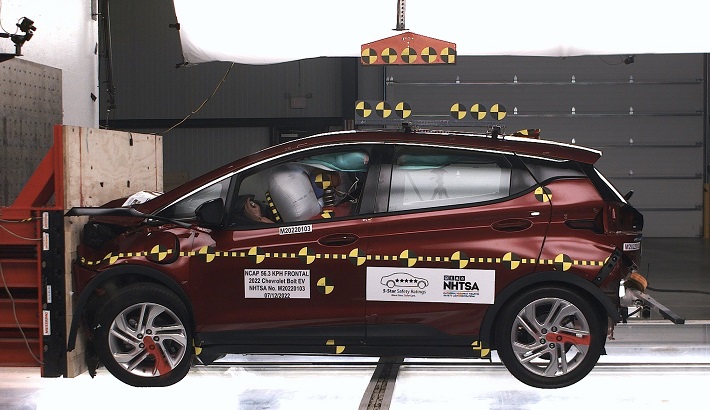
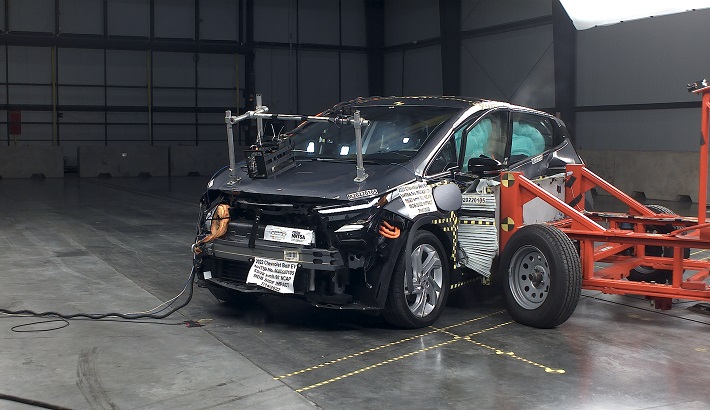
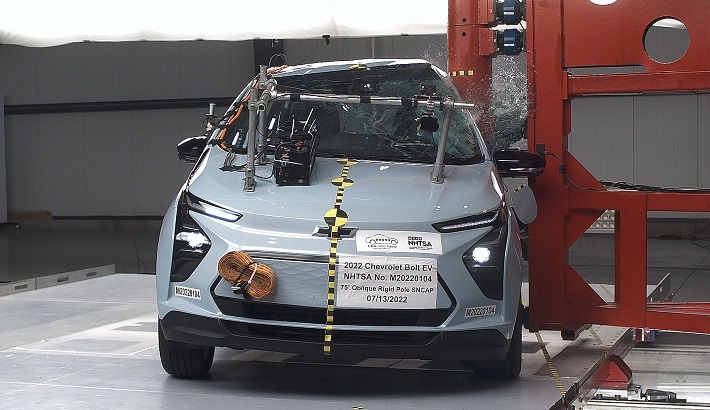
NHTSA crash tests
The agency crash-tested this model year itself. These are its own
photographs and star ratings.
Frontal crash test
Side barrier crash test
Side pole crash test
Photographs taken by NHTSA during its own New Car Assessment Program crash
tests of this model year. Public domain.
Configuration
Overall
Front
Side
Rollover
2022 Chevrolet Bolt EV 5 HB FWD
9.7% risk
When owners complained
A spike years after the car went on sale usually means a part wearing
out on schedule across the whole fleet — the kind of pattern no single
owner can see from inside their own car.
Aug 2021peak 11Jun 2026
NHTSA investigations into the 2022 Chevrolet Bolt EV
An investigation is the step before a recall: the agency has seen enough
complaints to look into a pattern itself. An open one means it thinks
something may be wrong and nothing has been fixed yet.
DP22005Opened 27 Jan 2023Closed 7 Aug 2023ELECTRICAL SYSTEM:PROPULSION SYSTEM
Pedestrian alert sounds
NHTSA received a petition on or about July 18, 2022, requesting that Federal Motor Vehicle Safety Standard (FMVSS) 141 be applied to all electric and hybrid vehicles operating in the United States. The petition can be reviewed at NHTSA.gov under ODI Number 11486072. FMVSS 141 establishes performance requirements for pedestrian alert sounds for motor vehicles. The standard applies to hybrid and electric vehicles that have a gross vehicle weight rating of 4,536 KG or less or are defined as low-speed vehicles. The standard became fully applicable to all such vehicles manufactured on or after Marc...
Recalls on the 2022 Chevrolet Bolt EV
A complaint is one owner's allegation. A recall is the point at which
the manufacturer or a regulator agreed the defect is real and dangerous
enough to fix for free — however old the car is.
General Motors, LLC (GM) is recalling certain 2020-2022 Chevrolet Bolt EV and 2022 Bolt EUV vehicles previously repaired under Recall 21V-650. The installation of advanced diagnostic software may have failed. As such, the high voltage battery could catch fire when charged to full or nearly full capacity.
Risk: A battery fire increases the risk of injury.
General Motors, LLC (GM) is recalling certain 2020-2022 Chevrolet Bolt EV and 2022 Chevrolet Bolt EUV vehicles that were previously remedied under recall number 21V-650. The advanced diagnostic software may have been incorrectly installed and fail to detect defective battery modules, possibly resulting in a battery fire.
Risk: A battery fire increases the risk of injury.
23V845000
STRUCTURE:BODY:ROOF AND PILLARS
General Motors, LLC (GM) is recalling certain 2017-2023 Chevrolet Bolt EV vehicles. This recall includes certain vehicles previously repaired incorrectly under NHTSA recall number 22V-930. After a crash with seat belt pretensioner deployment, the pretensioner exhaust may ignite carpet fibers near the B-pillar, causing a fire.
Risk: A fire increases the risk of injury.
23V567000
AIR BAGS:FRONTAL
General Motors, LLC (GM) is recalling certain 2022-2023 Chevrolet Bolt EV vehicles. The instrument panel may be missing the perforation on the underside of the panel cover that allows the passenger-side air bag to deploy properly.
Risk: An air bag that does not deploy properly in a crash increases the risk of injury.
22V930000
STRUCTURE:BODY:ROOF AND PILLARS
General Motors, LLC (GM) is recalling certain 2017-2023 Chevrolet Bolt EV vehicles. After a crash with seat belt pretensioner deployment, the pretensioner exhaust may ignite carpet fibers near the B-pillar, causing a fire.
Risk: A vehicle fire can increase the risk of injury.
General Motors, LLC (GM) is recalling certain 2020-2022 Chevrolet Bolt EV and 2022 Chevrolet Bolt EUV vehicles. The high voltage battery could catch fire when charged to full or nearly full capacity.
Risk: A battery fire increases the risk of injury.
21V517000
AIR BAGS:FRONTAL
General Motors, LLC. (GM) is recalling certain 2022 Chevrolet Bolt EV and Bolt EUV vehicles. One of the two fasteners that secure the driver's frontal air bag to the steering wheel may be missing or improperly tightened.
Risk: An improperly installed air bag may not deploy properly in a crash, increasing the risk of injury.
Canada — Transport Canada
Canada runs its own recall programme, and its campaigns do not
always mirror the American ones.
Recall 202344675 units in Canada
Airbag
Issue: On certain vehicles, the instrument panel may not have been manufactured correctly. As a result, the passenger-front airbag may not open and inflate properly in a crash. Safety Risk: An airbag that doesn't inflate properly could create an increased risk of injury in a crash. Corrective Actions: General Motors will notify owners by mail and advise you to take your vehicle to a dealership to replace the instrument panel. To reduce the safety risk until the recall repairs are completed, General Motors recommends not to transport a person in the front-passenger seat.
Recall 202271919,898 units in Canada
Seats And Restraints
Issue: On certain vehicles, the carpet could catch fire after a crash where a front seat belt pretensioner deploys. Safety Risk: A fire that occurs after a crash could create an increased risk of injury. Corrective Actions: General Motors will notify owners by mail and instruct you to take your vehicle to a dealership to install foil tape under the carpet near the front seatbelt pretensioners. On certain model year vehicles, the technician will also install seatbelt pretensioner covers.
Recall 20215249,023 units in Canada
High Voltage
Issue: On certain vehicles, the high-voltage battery could overheat when it is charged to over 90% of its capacity. As a result, the battery could create smoke or heat, which can melt or damage the battery and nearby parts. Safety Risk: A battery that overheats can create a fire risk. Corrective Actions: General Motors will notify owners by mail and advise you to take your vehicle to a dealership to install an advanced diagnostic software that will monitor the high-voltage battery and warn you if it detects a problem. If you see this warning, you should contact a dealership to arrange replacement of the affected high-voltage battery module. Please click here for additional information, including precautions to take until the recall repairs are completed, or call 1-800-263-3777 : <a href= https://my.gm.ca/chevrolet/en/how-to-support/safety/boltevrecall> https://my.gm.ca/chevrolet/en/how-to-support/safety/boltevrecall</a>
Reports where the owner recorded a crash, a fire, an injury or a death.
San Jose, CACrash
POWER TRAIN
While driving at a low speed (approx. 5–10 mph), the front passenger-side lower ball joint suffered a catastrophic structural shear without warning. This caused the wheel assembly to collapse outward and the CV axle to pull out of the transmission. The failure caused a complete loss of steering control, veering the vehicle into a curb. Physical evidence (outward axle pull and high-side rim scratches) indicates the mechanical failure preceded the impact. This occurred at only 38,155 miles on a 2022 Chevrolet Bolt EV. Outward Dislocation: Photos show the CV axle pulled OUT of the transmission and the wheel leaning OUT (positive camber). A curb impact would push these components IN. This proves the wheel fell away from the car first. Pre-Impact Grinding: The interior barrel of the rim and the brake dust shield show heavy rotational grinding and metal-on-metal scoring. This confirms the suspension collapsed while the wheel was still spinning at speed, prior to the car coming to a stop. Structural Shear: The lower ball joint stud suffered a complete transverse shear. High-resolution photos of the broken stud face show distinct "beach marks" (concentric rings), which are the physical fingerprint of a slow-growing metal fatigue crack rather than a sudden impact fracture. Rim Damage Profile: Deep gouges are located on the flat face of the wheel spokes rather than the outer lip. This confirms the wheel was already at an extreme tilt (collapsed) when it made contact with the curb. CONCLUSION: The vehicle was maintained and driven under normal conditions. This was a spontaneous, catastrophic structural failure of a safety-critical component. I am requesting that NHTSA investigate this as a potential manufacturing defect for the 2022 Chevrolet Bolt EV.
NHTSA complaint #11733483 — an unverified report by a vehicle owner.
San Jose, CACrash
STEERING
While driving at a low speed (approx. 5–10 mph), the front passenger-side lower ball joint suffered a catastrophic structural shear without warning. This caused the wheel assembly to collapse outward and the CV axle to pull out of the transmission. The failure caused a complete loss of steering control, veering the vehicle into a curb. Physical evidence (outward axle pull and high-side rim scratches) indicates the mechanical failure preceded the impact. This occurred at only 38,155 miles on a 2022 Chevrolet Bolt EV. Outward Dislocation: Photos show the CV axle pulled OUT of the transmission and the wheel leaning OUT (positive camber). A curb impact would push these components IN. This proves the wheel fell away from the car first. Pre-Impact Grinding: The interior barrel of the rim and the brake dust shield show heavy rotational grinding and metal-on-metal scoring. This confirms the suspension collapsed while the wheel was still spinning at speed, prior to the car coming to a stop. Structural Shear: The lower ball joint stud suffered a complete transverse shear. High-resolution photos of the broken stud face show distinct "beach marks" (concentric rings), which are the physical fingerprint of a slow-growing metal fatigue crack rather than a sudden impact fracture. Rim Damage Profile: Deep gouges are located on the flat face of the wheel spokes rather than the outer lip. This confirms the wheel was already at an extreme tilt (collapsed) when it made contact with the curb. CONCLUSION: The vehicle was maintained and driven under normal conditions. This was a spontaneous, catastrophic structural failure of a safety-critical component. I am requesting that NHTSA investigate this as a potential manufacturing defect for the 2022 Chevrolet Bolt EV.
NHTSA complaint #11733483 — an unverified report by a vehicle owner.
San Jose, CACrash
SUSPENSION
While driving at a low speed (approx. 5–10 mph), the front passenger-side lower ball joint suffered a catastrophic structural shear without warning. This caused the wheel assembly to collapse outward and the CV axle to pull out of the transmission. The failure caused a complete loss of steering control, veering the vehicle into a curb. Physical evidence (outward axle pull and high-side rim scratches) indicates the mechanical failure preceded the impact. This occurred at only 38,155 miles on a 2022 Chevrolet Bolt EV. Outward Dislocation: Photos show the CV axle pulled OUT of the transmission and the wheel leaning OUT (positive camber). A curb impact would push these components IN. This proves the wheel fell away from the car first. Pre-Impact Grinding: The interior barrel of the rim and the brake dust shield show heavy rotational grinding and metal-on-metal scoring. This confirms the suspension collapsed while the wheel was still spinning at speed, prior to the car coming to a stop. Structural Shear: The lower ball joint stud suffered a complete transverse shear. High-resolution photos of the broken stud face show distinct "beach marks" (concentric rings), which are the physical fingerprint of a slow-growing metal fatigue crack rather than a sudden impact fracture. Rim Damage Profile: Deep gouges are located on the flat face of the wheel spokes rather than the outer lip. This confirms the wheel was already at an extreme tilt (collapsed) when it made contact with the curb. CONCLUSION: The vehicle was maintained and driven under normal conditions. This was a spontaneous, catastrophic structural failure of a safety-critical component. I am requesting that NHTSA investigate this as a potential manufacturing defect for the 2022 Chevrolet Bolt EV.
NHTSA complaint #11733483 — an unverified report by a vehicle owner.
SAN Jose, CACrash
AIR BAGS
I was was traveling at 68 mph, then rear ended and pushed into the center divide. The entire front drivers tire + assembly was destroyed. The airbags didn't deploy. The cab did fill with a white 'smoke'. A little bit later I received a message from the Chevy app that there was a problem with my airbags and I should seek service. My insurance has deemed the car a total loss and picked up the car and taken it to their lot for inspection. I don't know the status of this and the incident has not been reported to the manufacturer/dealer.
NHTSA complaint #11687130 — an unverified report by a vehicle owner.
at 29,000 milesHopkins, MNCrash
VEHICLE SPEED CONTROL
The contact owns a 2022 Chevrolet Bolt EV. The contact stated that while in the process of parking the vehicle on the side of a street, the vehicle unintendedly accelerated, and the front end of the vehicle crashed into an unoccupied parked vehicle, which crashed into a second occupied vehicle parked in front of it. No property damage was reported. The vehicle came to a stop upon impact. The air bags did not deploy. The vehicle did not need to be towed. No warning lights were illuminated. A police report was not filed. The first vehicle the contact's vehicle had crashed into was totaled due to front and rear end damages. The occupant of the second vehicle confirmed that the vehicle was not damaged, and there was no injury sustained. No injuries were reported. The vehicle was taken to a local dealer to be diagnosed, but the failure could not be duplicated. The manufacturer had sent engineers who were in the process of diagnosing the vehicle at the dealer. The vehicle was not diagnosed or repaired. The manufacturer was notified of the failure. The failure mileage was approximately 29,000.
NHTSA complaint #11679095 — an unverified report by a vehicle owner.
The most recent complaints
In the owners' own words, exactly as filed with NHTSA.
Mchenry, IL
STEERING
Steering rack started to fail after only 15000 miles
NHTSA complaint #11741396 — an unverified report by a vehicle owner.
San Jose, CACrash
POWER TRAIN
While driving at a low speed (approx. 5–10 mph), the front passenger-side lower ball joint suffered a catastrophic structural shear without warning. This caused the wheel assembly to collapse outward and the CV axle to pull out of the transmission. The failure caused a complete loss of steering control, veering the vehicle into a curb. Physical evidence (outward axle pull and high-side rim scratches) indicates the mechanical failure preceded the impact. This occurred at only 38,155 miles on a 2022 Chevrolet Bolt EV. Outward Dislocation: Photos show the CV axle pulled OUT of the transmission and the wheel leaning OUT (positive camber). A curb impact would push these components IN. This proves the wheel fell away from the car first. Pre-Impact Grinding: The interior barrel of the rim and the brake dust shield show heavy rotational grinding and metal-on-metal scoring. This confirms the suspension collapsed while the wheel was still spinning at speed, prior to the car coming to a stop. Structural Shear: The lower ball joint stud suffered a complete transverse shear. High-resolution photos of the broken stud face show distinct "beach marks" (concentric rings), which are the physical fingerprint of a slow-growing metal fatigue crack rather than a sudden impact fracture. Rim Damage Profile: Deep gouges are located on the flat face of the wheel spokes rather than the outer lip. This confirms the wheel was already at an extreme tilt (collapsed) when it made contact with the curb. CONCLUSION: The vehicle was maintained and driven under normal conditions. This was a spontaneous, catastrophic structural failure of a safety-critical component. I am requesting that NHTSA investigate this as a potential manufacturing defect for the 2022 Chevrolet Bolt EV.
NHTSA complaint #11733483 — an unverified report by a vehicle owner.
San Jose, CACrash
STEERING
While driving at a low speed (approx. 5–10 mph), the front passenger-side lower ball joint suffered a catastrophic structural shear without warning. This caused the wheel assembly to collapse outward and the CV axle to pull out of the transmission. The failure caused a complete loss of steering control, veering the vehicle into a curb. Physical evidence (outward axle pull and high-side rim scratches) indicates the mechanical failure preceded the impact. This occurred at only 38,155 miles on a 2022 Chevrolet Bolt EV. Outward Dislocation: Photos show the CV axle pulled OUT of the transmission and the wheel leaning OUT (positive camber). A curb impact would push these components IN. This proves the wheel fell away from the car first. Pre-Impact Grinding: The interior barrel of the rim and the brake dust shield show heavy rotational grinding and metal-on-metal scoring. This confirms the suspension collapsed while the wheel was still spinning at speed, prior to the car coming to a stop. Structural Shear: The lower ball joint stud suffered a complete transverse shear. High-resolution photos of the broken stud face show distinct "beach marks" (concentric rings), which are the physical fingerprint of a slow-growing metal fatigue crack rather than a sudden impact fracture. Rim Damage Profile: Deep gouges are located on the flat face of the wheel spokes rather than the outer lip. This confirms the wheel was already at an extreme tilt (collapsed) when it made contact with the curb. CONCLUSION: The vehicle was maintained and driven under normal conditions. This was a spontaneous, catastrophic structural failure of a safety-critical component. I am requesting that NHTSA investigate this as a potential manufacturing defect for the 2022 Chevrolet Bolt EV.
NHTSA complaint #11733483 — an unverified report by a vehicle owner.
San Jose, CACrash
SUSPENSION
While driving at a low speed (approx. 5–10 mph), the front passenger-side lower ball joint suffered a catastrophic structural shear without warning. This caused the wheel assembly to collapse outward and the CV axle to pull out of the transmission. The failure caused a complete loss of steering control, veering the vehicle into a curb. Physical evidence (outward axle pull and high-side rim scratches) indicates the mechanical failure preceded the impact. This occurred at only 38,155 miles on a 2022 Chevrolet Bolt EV. Outward Dislocation: Photos show the CV axle pulled OUT of the transmission and the wheel leaning OUT (positive camber). A curb impact would push these components IN. This proves the wheel fell away from the car first. Pre-Impact Grinding: The interior barrel of the rim and the brake dust shield show heavy rotational grinding and metal-on-metal scoring. This confirms the suspension collapsed while the wheel was still spinning at speed, prior to the car coming to a stop. Structural Shear: The lower ball joint stud suffered a complete transverse shear. High-resolution photos of the broken stud face show distinct "beach marks" (concentric rings), which are the physical fingerprint of a slow-growing metal fatigue crack rather than a sudden impact fracture. Rim Damage Profile: Deep gouges are located on the flat face of the wheel spokes rather than the outer lip. This confirms the wheel was already at an extreme tilt (collapsed) when it made contact with the curb. CONCLUSION: The vehicle was maintained and driven under normal conditions. This was a spontaneous, catastrophic structural failure of a safety-critical component. I am requesting that NHTSA investigate this as a potential manufacturing defect for the 2022 Chevrolet Bolt EV.
NHTSA complaint #11733483 — an unverified report by a vehicle owner.
Doral, FL
STEERING
I have a faulty electric power steering, it prevents the steering wheel to return to center.
NHTSA complaint #11716390 — an unverified report by a vehicle owner.
Weston, MA
POWER TRAIN
I was driving on the highway above 60 mph, and I suddenly got a "propulsion power reduced" alert, along with a yellow indicator light. I almost immediately thereafter got a message saying "speed reduced to 50 mph" and then "speed reduced to 30 mph." I got no acceleration when I depressed the accelerator pedal. In fact, it felt like the car had engaged the regenerative braking to actively slow me down. This is a life-threatening safety flaw, as it was difficult to get to the breakdown lane. The only reason there was no collision was that there was relatively light traffic. I managed to get to a breakdown lane and then, after restarting the car, to get off the highway and into a parking lot, where I called for a tow. The car was towed to the dealer I bought it from and, the next day, they inspected the car and determined that the auxiliary transmission fluid pump had failed and needed to be replaced. I've seen many reports on reddit that this part fails on chevy bolts. What makes this truly unsafe is that there was no warning whatsoever that something was wrong. Everything seemed fine (after I got a new battery under the big bolt battery recall) until the car suddenly cut power and slowed me down in the middle of the highway. This car needs to be recalled again.
NHTSA complaint #11710387 — an unverified report by a vehicle owner.
Weston, MA
VEHICLE SPEED CONTROL
I was driving on the highway above 60 mph, and I suddenly got a "propulsion power reduced" alert, along with a yellow indicator light. I almost immediately thereafter got a message saying "speed reduced to 50 mph" and then "speed reduced to 30 mph." I got no acceleration when I depressed the accelerator pedal. In fact, it felt like the car had engaged the regenerative braking to actively slow me down. This is a life-threatening safety flaw, as it was difficult to get to the breakdown lane. The only reason there was no collision was that there was relatively light traffic. I managed to get to a breakdown lane and then, after restarting the car, to get off the highway and into a parking lot, where I called for a tow. The car was towed to the dealer I bought it from and, the next day, they inspected the car and determined that the auxiliary transmission fluid pump had failed and needed to be replaced. I've seen many reports on reddit that this part fails on chevy bolts. What makes this truly unsafe is that there was no warning whatsoever that something was wrong. Everything seemed fine (after I got a new battery under the big bolt battery recall) until the car suddenly cut power and slowed me down in the middle of the highway. This car needs to be recalled again.
NHTSA complaint #11710387 — an unverified report by a vehicle owner.
Weston, MA
FUEL/PROPULSION SYSTEM
I was driving on the highway above 60 mph, and I suddenly got a "propulsion power reduced" alert, along with a yellow indicator light. I almost immediately thereafter got a message saying "speed reduced to 50 mph" and then "speed reduced to 30 mph." I got no acceleration when I depressed the accelerator pedal. In fact, it felt like the car had engaged the regenerative braking to actively slow me down. This is a life-threatening safety flaw, as it was difficult to get to the breakdown lane. The only reason there was no collision was that there was relatively light traffic. I managed to get to a breakdown lane and then, after restarting the car, to get off the highway and into a parking lot, where I called for a tow. The car was towed to the dealer I bought it from and, the next day, they inspected the car and determined that the auxiliary transmission fluid pump had failed and needed to be replaced. I've seen many reports on reddit that this part fails on chevy bolts. What makes this truly unsafe is that there was no warning whatsoever that something was wrong. Everything seemed fine (after I got a new battery under the big bolt battery recall) until the car suddenly cut power and slowed me down in the middle of the highway. This car needs to be recalled again.
NHTSA complaint #11710387 — an unverified report by a vehicle owner.
at 65,000 milesAnaheim, CA
ELECTRICAL SYSTEM
The contact owns a 2022 Chevrolet Bolt EV. The contact stated that while driving at various speeds, the vehicle lost automotive power, and the digital screen failed to display as intended. The Battery warning light was occasionally illuminated during rainy weather. The local dealer was contacted. The vehicle was not diagnosed or repaired. The manufacturer was not made aware of the failure. The failure mileage was approximately 65,000.
NHTSA complaint #11700254 — an unverified report by a vehicle owner.
SAN Jose, CACrash
AIR BAGS
I was was traveling at 68 mph, then rear ended and pushed into the center divide. The entire front drivers tire + assembly was destroyed. The airbags didn't deploy. The cab did fill with a white 'smoke'. A little bit later I received a message from the Chevy app that there was a problem with my airbags and I should seek service. My insurance has deemed the car a total loss and picked up the car and taken it to their lot for inspection. I don't know the status of this and the incident has not been reported to the manufacturer/dealer.
NHTSA complaint #11687130 — an unverified report by a vehicle owner.
Cincinnati, OH
FUEL/PROPULSION SYSTEM
I am filing this complaint regarding my 2022 Chevrolet Bolt, which has been awaiting battery replacement at McCluskey Chevrolet for over 30 days, creating significant safety concerns and violating federal warranty requirements. Safety Concerns: The vehicle's safety systems detected a battery defect serious enough to automatically restrict functionality. This demonstrates GM recognized an immediate safety risk. Despite this urgency, my vehicle remains inoperable after 30 days with no completion date provided. This delay indicates systemic failures in GM's remedy program for known battery defects. GM has known about this issue for years and has yet to source replacement batteries within a reasonable timeframe for drivers awaiting a replacement. Federal Law Violations: This situation violates the Magnuson-Moss Warranty Act, which requires warranty repairs be completed within a reasonable time period. Thirty days for a safety-critical component replacement, particularly after the vehicle self-diagnosed a dangerous condition, exceeds any reasonable standard. Requested NHTSA Actions: Investigate GM's compliance with recall remedy requirements and parts availability Assess whether GM's battery replacement program meets federal safety standards Determine if GM is violating the Magnuson-Moss Warranty Act through excessive repair delays Consider enforcement action to ensure timely remediation of safety defects Require GM to provide loaner vehicles during extended safety-related repairs Documentation Available: I request NHTSA's immediate intervention to address both the individual and systematic failures of GM in handling these repairs.
NHTSA complaint #11683726 — an unverified report by a vehicle owner.
at 29,000 milesHopkins, MNCrash
VEHICLE SPEED CONTROL
The contact owns a 2022 Chevrolet Bolt EV. The contact stated that while in the process of parking the vehicle on the side of a street, the vehicle unintendedly accelerated, and the front end of the vehicle crashed into an unoccupied parked vehicle, which crashed into a second occupied vehicle parked in front of it. No property damage was reported. The vehicle came to a stop upon impact. The air bags did not deploy. The vehicle did not need to be towed. No warning lights were illuminated. A police report was not filed. The first vehicle the contact's vehicle had crashed into was totaled due to front and rear end damages. The occupant of the second vehicle confirmed that the vehicle was not damaged, and there was no injury sustained. No injuries were reported. The vehicle was taken to a local dealer to be diagnosed, but the failure could not be duplicated. The manufacturer had sent engineers who were in the process of diagnosing the vehicle at the dealer. The vehicle was not diagnosed or repaired. The manufacturer was notified of the failure. The failure mileage was approximately 29,000.
NHTSA complaint #11679095 — an unverified report by a vehicle owner.
Fairfield, TX, TX
VEHICLE SPEED CONTROL
I was driving 72 mph, and went to accelerate to 75 mph to set my cruise control. As soon as I stepped on the accelerator pedal, my 2022 Chevy Bolt EUV jerked violently and immediately applied braking to car to take it from 72 mph to about 30 mph within 1 second. Had someone been behind me I would have been rear ended. I was able to pull over to the shoulder of the road, and put my car into park. I was unable to turn off the vehicle or shift into any gears (reverse, neutral, drive). The car displayed a warning on dash "power drive train malfunction pull over safely". There was no warning for the sudden deceleration and is a serious safety risk and concern.
NHTSA complaint #11569705 — an unverified report by a vehicle owner.
Fairfield, TX, TX
ELECTRICAL SYSTEM
I was driving 72 mph, and went to accelerate to 75 mph to set my cruise control. As soon as I stepped on the accelerator pedal, my 2022 Chevy Bolt EUV jerked violently and immediately applied braking to car to take it from 72 mph to about 30 mph within 1 second. Had someone been behind me I would have been rear ended. I was able to pull over to the shoulder of the road, and put my car into park. I was unable to turn off the vehicle or shift into any gears (reverse, neutral, drive). The car displayed a warning on dash "power drive train malfunction pull over safely". There was no warning for the sudden deceleration and is a serious safety risk and concern.
NHTSA complaint #11569705 — an unverified report by a vehicle owner.
Fairfield, TX, TX
SERVICE BRAKES
I was driving 72 mph, and went to accelerate to 75 mph to set my cruise control. As soon as I stepped on the accelerator pedal, my 2022 Chevy Bolt EUV jerked violently and immediately applied braking to car to take it from 72 mph to about 30 mph within 1 second. Had someone been behind me I would have been rear ended. I was able to pull over to the shoulder of the road, and put my car into park. I was unable to turn off the vehicle or shift into any gears (reverse, neutral, drive). The car displayed a warning on dash "power drive train malfunction pull over safely". There was no warning for the sudden deceleration and is a serious safety risk and concern.
NHTSA complaint #11569705 — an unverified report by a vehicle owner.
Santa Clara, CA
ELECTRICAL SYSTEM
About 1 month ago I picked up my daughter from school. Just as we exited the parking lot, there was nothing in front and the brakes came on and the car turned off and would not restart for a few minutes. The same day, we were on the way home I was traveling about 35mph. All of a sudden the brakes came on again. This time there was nothing in front but many cars behind, so I floored the accelerator the car tires screeched. I was less than a mile from home and made it without incident. The dealership is unable to reproduce or review the logs because the vehicle stopped logging everything since December 4th. The car is in my driveway and I don't trust it can safely be driven. The dealership is not helpful by telling me to just monitor the situation and bring it in if it happens again. I am seeing on the internet that there are many people experiencing this exact problem.
NHTSA complaint #11562166 — an unverified report by a vehicle owner.
Santa Clara, CA
SERVICE BRAKES
About 1 month ago I picked up my daughter from school. Just as we exited the parking lot, there was nothing in front and the brakes came on and the car turned off and would not restart for a few minutes. The same day, we were on the way home I was traveling about 35mph. All of a sudden the brakes came on again. This time there was nothing in front but many cars behind, so I floored the accelerator the car tires screeched. I was less than a mile from home and made it without incident. The dealership is unable to reproduce or review the logs because the vehicle stopped logging everything since December 4th. The car is in my driveway and I don't trust it can safely be driven. The dealership is not helpful by telling me to just monitor the situation and bring it in if it happens again. I am seeing on the internet that there are many people experiencing this exact problem.
NHTSA complaint #11562166 — an unverified report by a vehicle owner.
About 1 month ago I picked up my daughter from school. Just as we exited the parking lot, there was nothing in front and the brakes came on and the car turned off and would not restart for a few minutes. The same day, we were on the way home I was traveling about 35mph. All of a sudden the brakes came on again. This time there was nothing in front but many cars behind, so I floored the accelerator the car tires screeched. I was less than a mile from home and made it without incident. The dealership is unable to reproduce or review the logs because the vehicle stopped logging everything since December 4th. The car is in my driveway and I don't trust it can safely be driven. The dealership is not helpful by telling me to just monitor the situation and bring it in if it happens again. I am seeing on the internet that there are many people experiencing this exact problem.
NHTSA complaint #11562166 — an unverified report by a vehicle owner.
Tumwater, WA
STEERING
2022 Chevy Bolt, less than 10,000 miles. Problem began 11/24/23. Steering wheel locks up at low speeds, gives warning "Steering Assistance reduced" at higher speeds. At low speeds, steering wheel turns only a small amount before it clicks and stops. Very dangerous in tight parking lots or trying to turn left or right from a stop - takes multiple tries to get steering wheel to turn, and sometimes it jerks back in the opposite direction. Took it to dealer, they said steering column needs to be replaced. Did not have an accident or hit anything prior - I think the column is defective.
NHTSA complaint #11560134 — an unverified report by a vehicle owner.
Cambridge, WI
UNKNOWN OR OTHER
When I use the windshield washer fluid some of the vapors gets in the cabin. The fluid contains methanol and it is highly toxic.
NHTSA complaint #11558682 — an unverified report by a vehicle owner.
Cambridge, WI
VISIBILITY/WIPER
When I use the windshield washer fluid some of the vapors gets in the cabin. The fluid contains methanol and it is highly toxic.
NHTSA complaint #11558682 — an unverified report by a vehicle owner.
at 200 milesRockledge, FL
ELECTRICAL SYSTEM
The contact owns a 2022 Chevrolet Bolt EV. The contact stated while attempting to charge the vehicle, the charging system failed to charge the vehicle adequately. The contact stated that shortly after beginning to charge the vehicle, the vehicle overheated after 30 minutes, and the charging light turned from blue to red. The contact then had to disconnect the charger. The vehicle was taken to the dealer who was unable to determine the cause of the failure with the charging unit. The vehicle had not been repaired. The manufacturer was made aware of the failure. The approximate failure mileage was 200.
NHTSA complaint #11551557 — an unverified report by a vehicle owner.
Sausalito, CA
POWER TRAIN
Vehicle stopped while driving down the road lost power threw up multiple codes and was stuck in the middle of the roadway!
NHTSA complaint #11548160 — an unverified report by a vehicle owner.
Sausalito, CA
ENGINE
Vehicle stopped while driving down the road lost power threw up multiple codes and was stuck in the middle of the roadway!
NHTSA complaint #11548160 — an unverified report by a vehicle owner.
Sausalito, CA
FUEL/PROPULSION SYSTEM
Vehicle stopped while driving down the road lost power threw up multiple codes and was stuck in the middle of the roadway!
NHTSA complaint #11548160 — an unverified report by a vehicle owner.