Owners have filed 31 complaints
about the 2020 Audi Q7 with NHTSA between 2020 and 2026.
The largest single group is the electrical system.
Across this model's run it ranks 9 of 17 worst.
The letter says how bad. This says what kind — whether this year drew
an unusual number of complaints, unusually dangerous
ones, or failures that arrived unusually early.
The dashed ring is 50 — the national norm. Further out is worse.
Complaint volume — 19
Against the median year of the Audi Q7. 50 means typical for this
model; 100 means roughly double.
Severity — 33
6.5% of these complaints
involved a crash, fire, injury or death, against a national rate of
9.7%.
Early failure — 100
71% of failures with a mileage on record happened under
36,000 miles, against a national rate of
29%.
Odometer readings owners gave when they filed. About half of all
complaints include one.
1,000 – 9,999 miles
342.9%
10,000 – 24,999 miles
228.6%
50,000 – 74,999 miles
228.6%
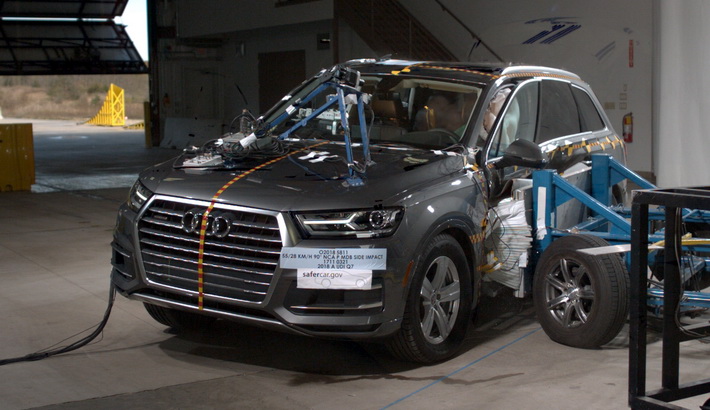
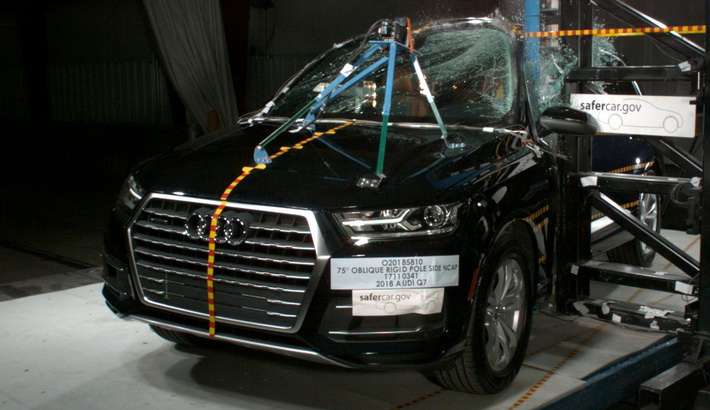
NHTSA crash tests
The agency crash-tested this model year itself. These are its own
photographs and star ratings.
Side barrier crash test
Side pole crash test
Photographs taken by NHTSA during its own New Car Assessment Program crash
tests of this model year. Public domain.
Configuration
Overall
Front
Side
Rollover
2020 Audi Q7 SUV AWD
—
—
15.7% risk
When owners complained
A spike years after the car went on sale usually means a part wearing
out on schedule across the whole fleet — the kind of pattern no single
owner can see from inside their own car.
May 2020peak 3Jul 2026
Recalls on the 2020 Audi Q7
A complaint is one owner's allegation. A recall is the point at which
the manufacturer or a regulator agreed the defect is real and dangerous
enough to fix for free — however old the car is.
United States — NHTSA
25V900000
BACK OVER PREVENTION: SENSING SYSTEM: CAMERA
Volkswagen Group of America, Inc. (Audi) is recalling certain 2019-2026 vehicles. Please see the recall report for a complete list of models. A software error may prevent the rearview camera image from displaying as intended. As such, these vehicles fail to comply with the requirements of Federal Motor Vehicle Safety Standard number 111, "Rear Visibility."
Risk: A rearview image that does not display reduces the driver's view behind the vehicle, increasing the risk of a crash.
23V212000
FORWARD COLLISION AVOIDANCE: SENSING SYSTEM: CAMERA
Volkswagen Group of America, Inc. (Audi) is recalling certain 2020 Q7 vehicles. Incompatibility between the front camera control software and the heating element used for the front camera on the windshield may cause the heating element to overheat.
Risk: An overheated heating element can increase the risk of a fire.
22V516000
FUEL SYSTEM, GASOLINE:DELIVERY:FUEL PUMP
Volkswagen Group of America, Inc. (Volkswagen) is recalling certain 2019-2021 Audi Q8, and 2020-2021 Audi Q7 vehicles. A component inside the fuel pump may break, causing the fuel pump to fail.
Risk: Fuel pump failure can cause an engine stall, increasing the risk of a crash.
21V078000
AIR BAGS: AIR BAG/RESTRAINT CONTROL MODULE:SOFTWARE
Volkswagen Group of America, Inc. (Audi) is recalling certain 2020-2021 Audi Q7 vehicles. The air bag control module may deploy the second stage of the front passenger air bag too quickly after the first stage when the seat is occupied by an unbelted child. As such, these vehicles fail to comply with the requirements of Federal Motor Vehicle Safety Standard (FMVSS) number 208, "Occupant Crash Protection."
Risk: During a crash necessitating the deployment of the passenger air bag, the second stage may deploy too quickly when a child is in the front passenger seat, increasing the risk of injury.
20V658000
STRUCTURE:BODY:ROOF AND PILLARS
Volkswagen Group of America, Inc. (Audi) is recalling certain 2018-2020 Audi Q7 vehicles. The padding on the vehicle's C-pillar may not absorb enough impact in the event of a crash.
Risk: In the event of a crash, an unbelted occupant's head may impact the vehicle's C-pillar padding, increasing the risk of injury.
Canada — Transport Canada
Canada runs its own recall programme, and its campaigns do not
always mirror the American ones.
Recall 202571330,276 units in Canada
Visual System
Issue: On certain vehicles, a software problem could cause the rearview camera image not to appear on the display. Canadian regulations require the rearview image to display when the transmission is shifted into reverse gear. Safety Risk: A rearview camera image that doesn't display could reduce a driver's ability to see behind the vehicle while backing up. This could increase the risk of a crash. Corrective Actions: Audi will notify owners by mail and advise you to take your vehicle to a dealership to update the rearview camera software.
Recall 20223846,100 units in Canada
Fuel System
Issue: On certain vehicles, the fuel delivery module inside the fuel tank could fail. If this happens, the engine may run rough or may not start. This could also result in a sudden loss of engine power while driving. Note: This problem could cause the emission control system warning light to turn on. Safety Risk: A sudden loss of engine power could increase the risk of a crash. Corrective Actions: Audi will contact owners by mail and instruct you to bring your vehicle to a dealership to replace the fuel delivery module.
Recall 20210672,314 units in Canada
Airbag
Issue: Certain vehicles do not meet a performance requirement of Canadian regulations for crash protection. In particular, the vehicles do not meet the minimum testing requirements for an out of position 6-year old child located on the front passenger seat. Safety Risk: An airbag system that does not meet the performance requirements of Canadian regulations could create an increased risk of injury in a crash. Corrective Actions: Audi will notify owners by mail and instruct you to take your vehicle to a dealer to update the airbag control module.
Reports where the owner recorded a crash, a fire, an injury or a death.
Missouri City, TXFire
ELECTRICAL SYSTEM
I am filing a complaint concerning serious safety risks associated with my 2020 Audi Q7 (VIN: [XXX] ) purchased as a Certified Pre-Owned vehicle from Audi Dominion San Antonio. It is currently under service at Audi Central Houston, where multiple concerning events occurred. Timeline and Issues: - Initial diagnosis identified a fire-damaged electrical harness, estimated at $1,400 for replacement. - After repair attempts, the vehicle began smoking, and the diagnosis expanded to include additional compromised electrical lines. The revised quote skyrocketed to $4,700 (later reduced to $3,100). - After nearly two months in service, I was informed that the AC compressor is now deemed "bad" due to debris from the harness, an issue not mentioned in previous inspections. Safety Concerns: 1. Inconsistent Diagnosis: There was no mention of compressor damage during initial assessments. This late-stage discovery indicates negligence or potential additional damage during servicing. 2. Risky AC Activation: A technician attempted to clean the compromised AC compressor and activated the system, a procedure that is dangerous given the debris. This could lead to refrigerant leaks and electrical shorts. 3. Conflicting Statements: Audi Central Houston claims the compressor was previously damaged but also attempted to restore it. Such contradictions raise serious concerns about service integrity. 4. Certified Pre-Owned Credibility: The emergence of these costly issues questions the reliability guarantees of vehicles sold under Audi's Certified Pre-Owned program. Given that the vehicle began smoking shortly after being parked and had not undergone prior electrical work, I underscore the severe safety risks posed by potential electrical fires and undisclosed damage. These issues could endanger lives and property if not properly addressed. I strongly urge Audi USA and the NHTSA to investigate this matter for potential technical service bulletins or recalls, especially fo INFORMATION REDACTED PURSUANT TO THE FREEDOM OF INFORMATION A
NHTSA complaint #11678646 — an unverified report by a vehicle owner.
Anacortes, WA1 injured
UNKNOWN OR OTHER
Panoramic sunroof imploded while traveling at freeway speeds (70mph) during normal conditions (no rain, hail, snow, etc. and 60* temp) causing a large amount of glass to be blown into the cab of vehicle, striking the driver and passenger. With this loud implosion and visibility obstructed by flying glass debris it put the driver in a unsafe environment. This also put the passenger and other drivers on the road at a huge risk of an accident. Throughout the automotive industry, this has been a known issue over the past several years and even at the local Audi dealership in Bellingham, WA. After conversation with dealership there was no known contributing factors to the implosion and was suspected to be a manufacturing defect.
NHTSA complaint #11622755 — an unverified report by a vehicle owner.
The most recent complaints
In the owners' own words, exactly as filed with NHTSA.
Chicago, IL
UNKNOWN OR OTHER
Dashboard leather is bubbling, separating, and delaminating near the center windshield vents. This is a known manufacturing defect, Audi has issued a warranty extension (bulletin AWA-23-11) for this identical issue on the Q8, e-tron quattro, and R8 models, but not the Q7, despite the dashboard part number (4M8857001S33A) being identical across the Q7 and Q8. This appears to be a widespread issue affecting multiple Audi models sharing this dashboard component
NHTSA complaint #11752459 — an unverified report by a vehicle owner.
River Falls, WI
ENGINE
the first indication of an issue was oil consumption. It was using more oil than usual around the 70K mile mark. Then it started misfiring, and soon after a knocking noise coming from the engine. There are no check engine light on, after bringing it in for diagnostics, it read that it was a spark plug, once they got into the engine they discovered the cylinder had been stripped from the piston. Yes the diagnostics came from our foreign car mechanic. no, it has not been inspected by the manufacturer or police. Just the symptoms. sometimes the light would come on, and then it would go off. At this point it is off. All of this started in the fall of 2025.
NHTSA complaint #11737769 — an unverified report by a vehicle owner.
Lansdale, PA
ENGINE
While my vehicle was in for the Audi piston issue, they stated my water pump needed to be replaced and isn’t covered by a recall (yet). My vehicle had less than 42,000 mile on it. I was lead to believe that this problem is coming up more often and they believe a class action lawsuit will come about. I needed to pay over $1,700 out of pocket and was told I was saving so much money because they already had the engine apart because of the piston recall. This is unacceptable.
NHTSA complaint #11737715 — an unverified report by a vehicle owner.
at 70,000 milesMiami, FL
ENGINE AND ENGINE COOLING
The contact owns a 2020 Audi Q7. The contact stated that while driving at an undisclosed speed, the transmission unexpectedly downshifted while the accelerator pedal was depressed. The check engine warning light was illuminated. The vehicle was taken to a local dealer, where the water pump, coolant pump, vacuum line, and vacuum reservoir were replaced. The manufacturer was made aware of the failure. The failure mileage was approximately 70,000.
NHTSA complaint #11724096 — an unverified report by a vehicle owner.
Buckeye, AZ
ENGINE
I discovered this item while researching another issue. There was a class action law suit against VW/Audi for the Water Pump and coolant leaking into the system. The class action covered the year and model for my Audi (2020 Q7) but my VIN was not included. The class action ended in 2024. On 8/4/25, My water pump went out because of coolant going into system. A $6,000 repair. I brought the issue up with Audi. No response.
NHTSA complaint #11720200 — an unverified report by a vehicle owner.
Buckeye, AZ
FUEL/PROPULSION SYSTEM
My 2020 Audi Q7 with 49,500 miles had a complete engine shut down while driving. Towed to Audi. Fuel Pump was recalled and replaced on 1/2023. Audi stated it was the jet suction pump inside the saddle fuel tank. Research discovered that this saddle tank has been problem for this model and year. Audi only covered a portion of the cost. The entire fuel tank had to be replaced. 16 days to complete.
NHTSA complaint #11720193 — an unverified report by a vehicle owner.
Missouri City, TXFire
ELECTRICAL SYSTEM
I am filing a complaint concerning serious safety risks associated with my 2020 Audi Q7 (VIN: [XXX] ) purchased as a Certified Pre-Owned vehicle from Audi Dominion San Antonio. It is currently under service at Audi Central Houston, where multiple concerning events occurred. Timeline and Issues: - Initial diagnosis identified a fire-damaged electrical harness, estimated at $1,400 for replacement. - After repair attempts, the vehicle began smoking, and the diagnosis expanded to include additional compromised electrical lines. The revised quote skyrocketed to $4,700 (later reduced to $3,100). - After nearly two months in service, I was informed that the AC compressor is now deemed "bad" due to debris from the harness, an issue not mentioned in previous inspections. Safety Concerns: 1. Inconsistent Diagnosis: There was no mention of compressor damage during initial assessments. This late-stage discovery indicates negligence or potential additional damage during servicing. 2. Risky AC Activation: A technician attempted to clean the compromised AC compressor and activated the system, a procedure that is dangerous given the debris. This could lead to refrigerant leaks and electrical shorts. 3. Conflicting Statements: Audi Central Houston claims the compressor was previously damaged but also attempted to restore it. Such contradictions raise serious concerns about service integrity. 4. Certified Pre-Owned Credibility: The emergence of these costly issues questions the reliability guarantees of vehicles sold under Audi's Certified Pre-Owned program. Given that the vehicle began smoking shortly after being parked and had not undergone prior electrical work, I underscore the severe safety risks posed by potential electrical fires and undisclosed damage. These issues could endanger lives and property if not properly addressed. I strongly urge Audi USA and the NHTSA to investigate this matter for potential technical service bulletins or recalls, especially fo INFORMATION REDACTED PURSUANT TO THE FREEDOM OF INFORMATION A
NHTSA complaint #11678646 — an unverified report by a vehicle owner.
Niceville, FL
ENGINE
I’m having to replace my REPLACE WATER PUMP AND VACUUM LINES WITH RESERVOIR at 41k miles or it risk overheating the engine. It is a significant repair at a premature time. After researching, it has been reported there are historical issues with this and faulty parts.
NHTSA complaint #11670473 — an unverified report by a vehicle owner.
Dripping Springs, TX
ENGINE
I urgently request a NHTSA investigation into systemic coolant leaks, a dangerous safety defect in Audi vehicles with the 3.0L turbocharged V6 (EA839) engine. Affected models include the Q7 (my 2020 Q7 55 TFSI, VIN: [XXX] ), S4, S5, SQ5, A6/A7, Q8. These defects risk engine damage, sudden power loss, and catastrophic engine failure, endangering all road users. Many owners report premature failures of cooling components (water pump, thermostat, PCV system). Failures often occur post-warranty, costing owners over $3,000 for repairs. Online forums (AudiWorld, Audizine, Reddit) document these widespread defects. The class action [XXX] et al. v. Volkswagen Group of America, Inc. alleges water pump defects in EA839-equipped Audis (incl. Q7 up to 2022). Critical Safety Concerns: The primary safety risk from these coolant leaks involves: Coolant Ingestion: Coolant enters vacuum lines, mixes with oil (faulty PCV), or enters intake (failing intercoolers). Engine Malfunction: Ingestion causes misfires, drivability issues, and sudden power loss during operation. Catastrophic Engine Failure: Severe coolant ingestion can cause catastrophic engine failure, risking loss of control and collisions if the engine seizes/fails at speed. Sudden engine malfunction/failure while driving due to this systemic defect warrants immediate NHTSA investigation. Audi of America is aware. My contact (Mike, Ext. 43252) confirmed Audi is not addressing this widespread failure. Audi's inaction necessitates NHTSA intervention for consumer and road safety. Affected owners urge NHTSA to: Initiate a formal investigation into systemic coolant leak issues and component failures in EA839-equipped Audi vehicles. Assess the safety risks, including potential engine failure and loss of vehicle control. If warranted, issue a safety recall for affected vehicles to prevent accidents and injuries. Public safety is paramount. Evidence indicates a defect compromising vehicle safety and reliability. INFORMATION REDACTED PURSUANT TO THE FREEDOM OF INFORMATION
NHTSA complaint #11662153 — an unverified report by a vehicle owner.
Roanoke, VA
POWER TRAIN
In July 2023, my 2020 Audi Q7 experienced a complete electrical failure at highway speeds due to a Belt Starter Generator (BSG) malfunction. Audi replaced the BSG with the same faulty part. Months later, I noticed increased oil consumption and loud engine noise. Despite multiple service visits and reporting these issues, Audi failed to properly diagnose the problem. In January 2025, despite a clear check engine light indicating a problem, Audi dismissed my concerns. Just weeks later, in February 2025, the engine catastrophically failed due to undiagnosed internal damage. Audi repeatedly ignored diagnostic warnings and failed to address my complaints, putting my safety at risk. Audi consistently dismissed my concerns, attributing engine noise and oil consumption to normal wear. The failures posed safety risks, including sudden loss of power while driving. Despite documented defects, Audi refused to take responsibility or perform proper diagnostics, resulting in continued safety hazards. I am formally requesting NHTSA to investigate the widespread issues affecting the 2020 Audi Q7, including the BSG system and excessive oil consumption leading to engine failure.” Additional Details: •Component/System Failure: The 48V Belt Starter Generator (BSG) and the engine failed. The vehicle is available for inspection upon request. •Safety Risks: The electrical failure at highway speeds caused a sudden loss of power. The engine failure posed a risk of the vehicle shutting down unexpectedly while driving. •Problem Confirmation: The Audi dealership confirmed the engine failure and acknowledged the presence of metal shavings in the oil, indicating severe internal damage. •Inspections: The vehicle has been inspected by the Audi dealership, and Audi representatives acknowledged the issue. •Warning Signs: The check engine light illuminated in January 2025. Additional symptoms included loud engine noise (‘tractor-like’) and increased oil consumption, which Audi dismissed.
NHTSA complaint #11652576 — an unverified report by a vehicle owner.
Roanoke, VA
ELECTRICAL SYSTEM
In July 2023, my 2020 Audi Q7 experienced a complete electrical failure at highway speeds due to a Belt Starter Generator (BSG) malfunction. Audi replaced the BSG with the same faulty part. Months later, I noticed increased oil consumption and loud engine noise. Despite multiple service visits and reporting these issues, Audi failed to properly diagnose the problem. In January 2025, despite a clear check engine light indicating a problem, Audi dismissed my concerns. Just weeks later, in February 2025, the engine catastrophically failed due to undiagnosed internal damage. Audi repeatedly ignored diagnostic warnings and failed to address my complaints, putting my safety at risk. Audi consistently dismissed my concerns, attributing engine noise and oil consumption to normal wear. The failures posed safety risks, including sudden loss of power while driving. Despite documented defects, Audi refused to take responsibility or perform proper diagnostics, resulting in continued safety hazards. I am formally requesting NHTSA to investigate the widespread issues affecting the 2020 Audi Q7, including the BSG system and excessive oil consumption leading to engine failure.” Additional Details: •Component/System Failure: The 48V Belt Starter Generator (BSG) and the engine failed. The vehicle is available for inspection upon request. •Safety Risks: The electrical failure at highway speeds caused a sudden loss of power. The engine failure posed a risk of the vehicle shutting down unexpectedly while driving. •Problem Confirmation: The Audi dealership confirmed the engine failure and acknowledged the presence of metal shavings in the oil, indicating severe internal damage. •Inspections: The vehicle has been inspected by the Audi dealership, and Audi representatives acknowledged the issue. •Warning Signs: The check engine light illuminated in January 2025. Additional symptoms included loud engine noise (‘tractor-like’) and increased oil consumption, which Audi dismissed.
NHTSA complaint #11652576 — an unverified report by a vehicle owner.
Roanoke, VA
ENGINE
In July 2023, my 2020 Audi Q7 experienced a complete electrical failure at highway speeds due to a Belt Starter Generator (BSG) malfunction. Audi replaced the BSG with the same faulty part. Months later, I noticed increased oil consumption and loud engine noise. Despite multiple service visits and reporting these issues, Audi failed to properly diagnose the problem. In January 2025, despite a clear check engine light indicating a problem, Audi dismissed my concerns. Just weeks later, in February 2025, the engine catastrophically failed due to undiagnosed internal damage. Audi repeatedly ignored diagnostic warnings and failed to address my complaints, putting my safety at risk. Audi consistently dismissed my concerns, attributing engine noise and oil consumption to normal wear. The failures posed safety risks, including sudden loss of power while driving. Despite documented defects, Audi refused to take responsibility or perform proper diagnostics, resulting in continued safety hazards. I am formally requesting NHTSA to investigate the widespread issues affecting the 2020 Audi Q7, including the BSG system and excessive oil consumption leading to engine failure.” Additional Details: •Component/System Failure: The 48V Belt Starter Generator (BSG) and the engine failed. The vehicle is available for inspection upon request. •Safety Risks: The electrical failure at highway speeds caused a sudden loss of power. The engine failure posed a risk of the vehicle shutting down unexpectedly while driving. •Problem Confirmation: The Audi dealership confirmed the engine failure and acknowledged the presence of metal shavings in the oil, indicating severe internal damage. •Inspections: The vehicle has been inspected by the Audi dealership, and Audi representatives acknowledged the issue. •Warning Signs: The check engine light illuminated in January 2025. Additional symptoms included loud engine noise (‘tractor-like’) and increased oil consumption, which Audi dismissed.
NHTSA complaint #11652576 — an unverified report by a vehicle owner.
Anacortes, WA1 injured
UNKNOWN OR OTHER
Panoramic sunroof imploded while traveling at freeway speeds (70mph) during normal conditions (no rain, hail, snow, etc. and 60* temp) causing a large amount of glass to be blown into the cab of vehicle, striking the driver and passenger. With this loud implosion and visibility obstructed by flying glass debris it put the driver in a unsafe environment. This also put the passenger and other drivers on the road at a huge risk of an accident. Throughout the automotive industry, this has been a known issue over the past several years and even at the local Audi dealership in Bellingham, WA. After conversation with dealership there was no known contributing factors to the implosion and was suspected to be a manufacturing defect.
NHTSA complaint #11622755 — an unverified report by a vehicle owner.
Menifee, CA
POWER TRAIN
Central control module failure. Item is under recall for various Q5 models. Q7 is essentially the same car with same water intrusion problem. Why isn’t it included in recall. Very dangerous stall.
NHTSA complaint #11616150 — an unverified report by a vehicle owner.
Olathe, KS
UNKNOWN OR OTHER
The Audi 2020 q7 experiences an SOS Emergency contact communication failure when it goes of cell service range and in certain circumstances, it does not reset itself Or allow reconnection to the communication module after it goes back in range within cell service. This is a know issue, similar to Audi service Bulletin 90T2 in which the NHTSA issued a recall (The Q7 model is not covered under That recall, but several other models within the same year are covered). As a result of this software bug, in certain circumstances, it the communication module may not be able to contact emergency services. Audi America dealerships require payment and charge consumers $276 for drivers to update the MMI system To correct the software “bug.” Due to the fact that it is a Software issue, which requires updating by the dealership, Extended warranties do not cover fees associated.
NHTSA complaint #11611838 — an unverified report by a vehicle owner.
Arlington, VA
ENGINE
Turbo charger failure at approximately 30,000 miles
NHTSA complaint #11609572 — an unverified report by a vehicle owner.
Morrisville, NC
SERVICE BRAKES
Often gets warning about Parking Brake malfunction. Dealership already checked once and could not find the problem. Warning comes on speedometer as follows: "Parking brake: malfunction! Please contact Service."
NHTSA complaint #11600536 — an unverified report by a vehicle owner.
Richmond, VA
ELECTRICAL SYSTEM
while driving the vehicle, I received a warning that there was an electrical system failure. Then the entire care shut off in the middle of the highway. There was no way to get the vehicle into neutral to push it to a safer location out of traffic. I was in the vehicle with my two children. This left us stranded in the middle of the highway with a significant amount of traffic. There was no way to get the vehicle back on. This seems to be a known issue with Audi and they have notified the dealerships about it but have not issued a recall. Please expedite this as a recall. There could not have been a more dangerous situation for me and my children.
NHTSA complaint #11592205 — an unverified report by a vehicle owner.
at 70,000 milesFort Lauderdale, FL
ELECTRICAL SYSTEM:ALTERNATOR/GENERATOR/REGULATOR
The contact owns a 2020 Audi Q7. The contact stated that while driving approximately 55 MPH, the messages "Electrical Malfunction" and "Stop Vehicle" were displayed. The contact stated that moments later the vehicle shut off and failed to restart. The vehicle was towed to the residence and later examined by an independent mechanic who diagnosed that the alternator was faulty and needed to be replaced. The vehicle was not yet repaired. The manufacturer and local dealer were contacted regarding the failure, but no assistance was provided. The failure mileage was 70,000.
NHTSA complaint #11584456 — an unverified report by a vehicle owner.
Redwood City, CA
ELECTRICAL SYSTEM
Our 2020 Audi Q7 (50,100 miles) suffered a catastrophic electrical failure while traveling on the freeway at 65+MPH. Suddenly the engine warning light went on, and then seconds later the entire interior lit up like a Christmas tree before it succumbed to a complete and catastrophic electrical failure. EVERYTHING failed – the car had zero power. No acceleration, brakes, steering, SOS, hazards / turn signals, brake lights, airbags, door locks, etc. My wife and child sat there in a steel box traveling at a high rate of speed while obstacles navigated around them; had they been hit, the air bags would not have deployed. This car nearly cost me my family. Audi replaced the alternator and the battery, and denied my buy-back claim because the incident hasn’t happened multiple times, and therefore doesn’t qualify for the lemon law. We continue to experience problems with the car – most recently: acceleration hesitation and recent warning lights saying 1. camera sensor failure (only to have them start working again), 2. tire pressure warnings (despite all the tire pressures being normal), and 3. warnings notifying me that lights are out (despite all lights operating normally). I believe Audi is underestimating the severity of the situation. We were fortunate that the initial failure on the freeway did not result in injuries or fatalities. I cannot fathom the idea of waiting for the vehicle to fail multiple times before taking it off the road, potentially putting lives at risk. The car has only been serviced at Audi dealerships. My family and I no longer feel safe in this car. While selling it is an option, I cannot, in good conscience, endanger someone else's life by not disclosing the vehicle's history and the well-known electrical defects Audi has.
NHTSA complaint #11563287 — an unverified report by a vehicle owner.
Arlington, VA
ELECTRICAL SYSTEM
Emergency battery light came on with a description of power malfunction. The light went from yellow to red then shortly stopped in the road while driving with complete power outage.
NHTSA complaint #11561563 — an unverified report by a vehicle owner.
Chula Vista, CA
ELECTRICAL SYSTEM
While driving, Forward Collision Warning appears without any reason. My understanding is that the car will brake itself if it senses frontal collosion and I am concerned that it might brake suddenly without my knowledge and cause an accident.
NHTSA complaint #11560590 — an unverified report by a vehicle owner.
Chula Vista, CA
FORWARD COLLISION AVOIDANCE: WARNINGS
While driving, Forward Collision Warning appears without any reason. My understanding is that the car will brake itself if it senses frontal collosion and I am concerned that it might brake suddenly without my knowledge and cause an accident.
NHTSA complaint #11560590 — an unverified report by a vehicle owner.
New Bern, NC
ELECTRICAL SYSTEM
Received a yellow "electrical failure" warning while driving, instructing me to call Audi for service. Audi indicated that the car remained safe to drive, and offered a service appointment greater than one month later. Driving the car the next day, the electrical failure icon converted to red and a message said to pull over immediately. The car was able to make it to a local repair shop, with electrical systems failing one-by-one (starting with heating and progressing from there). On reaching the shop, the car was no longer driveable and had to be pushed into the garage to be assessed. The problem could not be identified at the local shop, so the car was towed to Audi dealer. Problem was found to be the generator. Have been waiting on replacement part for greater than 30 days, with no ETA as of today. Primary safety concern is that the car became undriveable within minutes of the red warning. Had I been on a highway or in heavy traffic, my car could have stalled in the middle of a busy roadway. Even if I had pulled off onto the shoulder, the risk to my family would have been quite high.
NHTSA complaint #11505771 — an unverified report by a vehicle owner.
Auburn, WA
FUEL SYSTEM, GASOLINE
The contact owns a 2020 Audi Q7. The contact received notification of NHTSA Campaign Number: 22V516000 (Fuel System, Gasoline); however, the contact was informed by local dealers that parts were on backorder. The manufacturer was not made aware of the issue. The contact had not experienced a failure. Parts distribution disconnect.
NHTSA complaint #11500134 — an unverified report by a vehicle owner.