Owners have filed 1,078 complaints
about the 2017 Hyundai Elantra with NHTSA between 2016 and 2026.
The largest single group is the engine & cooling.
Across this model's run it ranks 4 of 33 worst.
The letter says how bad. This says what kind — whether this year drew
an unusual number of complaints, unusually dangerous
ones, or failures that arrived unusually early.
The dashed ring is 50 — the national norm. Further out is worse.
Complaint volume — 100
Against the median year of the Hyundai Elantra. 50 means typical for this
model; 100 means roughly double.
Severity — 46
8.8% of these complaints
involved a crash, fire, injury or death, against a national rate of
9.7%.
Early failure — 73
43% of failures with a mileage on record happened under
36,000 miles, against a national rate of
29%.
How 2017 compares with every other Hyundai Elantra
NHTSA files every complaint against a named sub-assembly, not just a
system. This is the difference between knowing it was "the engine" and
knowing which part of it — the list to hand a mechanic.
Body
12869.9%
Latch
4021.9%
Lock
42.2%
Door
42.2%
Automatic Emergency Braking
31.6%
Warning
21.1%
Key/Sender
10.5%
Engine Control Module (Ecu/Ecm)
10.5%
When it fails
Odometer readings owners gave when they filed. About half of all
complaints include one.
Under 1,000 miles
256.0%
1,000 – 9,999 miles
4711.3%
10,000 – 24,999 miles
4911.8%
25,000 – 49,999 miles
11628.0%
50,000 – 74,999 miles
7919.0%
75,000 – 99,999 miles
5012.0%
100,000 – 149,999 miles
4510.8%
150,000+ miles
41.0%
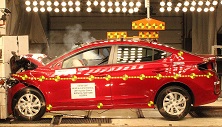
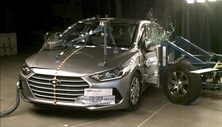
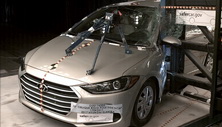
NHTSA crash tests
The agency crash-tested this model year itself. These are its own
photographs and star ratings.
Frontal crash test
Side barrier crash test
Side pole crash test
Photographs taken by NHTSA during its own New Car Assessment Program crash
tests of this model year. Public domain.
Configuration
Overall
Front
Side
Rollover
2017 Hyundai Elantra 4 DR FWD Later Release
10.7% risk
2017 Hyundai Elantra 4 DR FWD Early Release
10.7% risk
When owners complained
A spike years after the car went on sale usually means a part wearing
out on schedule across the whole fleet — the kind of pattern no single
owner can see from inside their own car.
Jul 2016peak 24Sep 2026
NHTSA investigations into the 2017 Hyundai Elantra
An investigation is the step before a recall: the agency has seen enough
complaints to look into a pattern itself. An open one means it thinks
something may be wrong and nothing has been fixed yet.
DP22003Opened 12 Sep 2022Closed 12 Dec 2023ENGINE
Loss of Motive Power
The National Highway Traffic Safety Administration (NHTSA) received a letter dated July 13, 2022, petitioning the Agency to initiate a safety defect investigation into loss of motive power allegations attributed to oil drain pan assembly failures on certain Hyundai Motor America, Inc. and Kia America, Inc. vehicles spanning Model Years (MY) 2005-2021. The Petitioners cited examples of complaints indicating that the subject vehicles were experiencing rapid loss of engine oil due to oil drain plug back outs, resulting in loss of motive power and/or catastrophic engine damage. Additional complain...
Recalls on the 2017 Hyundai Elantra
A complaint is one owner's allegation. A recall is the point at which
the manufacturer or a regulator agreed the defect is real and dangerous
enough to fix for free — however old the car is.
United States — NHTSA
17V213000
STEERING:ELECTRIC POWER ASSIST SYSTEM
Hyundai Motor America (Hyundai) is recalling certain 2017 Elantra vehicles. The affected vehicles may have a damaged Electronic Power Steering (MDPS) connector resulting in a loss of electric power steering assistance.
Risk: Loss of power steering assist would require higher steering effort, especially at lower speeds, which may increase the risk of a crash.
17V063000
SERVICE BRAKES, HYDRAULIC:POWER ASSIST:HYDRAULIC
Hyundai Motor Company (Hyundai) is recalling certain 2017 Elantra vehicles. In the affected vehicles, the brake booster may fail, resulting in a loss of power brake assist.
Risk: A loss of power brake assist can lengthen the distance needed to stop the vehicle, increasing the risk of a crash.
16V956000
AIR BAGS:FRONTAL:DRIVER SIDE:INFLATOR MODULE
Hyundai Motor Company (Hyundai) is recalling certain model year 2017 Hyundai Elantra vehicles manufactured April 15, 2016, to September 13, 2016, and Sonata vehicles manufactured May 27, 2016 to September 16, 2016. In these vehicles, the end seal for the driver's frontal air bag inflator may not have been properly installed, possibly resulting in reduced inflation of the frontal air bag in the event of a crash.
Risk: In the event of a crash, an air bag that does not inflate fully increases the risk of injury.
16V232000
AIR BAGS:FRONTAL
Hyundai Motor Company (Hyundai) is recalling certain model year 2015-2016 Sonata vehicles manufactured May 29, 2014 to February 11, 2016, 2017 Elantra vehicles manufactured January 12, 2016 to February 22, 2016, and one 2016 Sonata Hybrid vehicle manufactured October 15, 2015. In these vehicles, the driver's frontal air bag may be missing a chemical enhancer required for the second stage air bag deployment, resulting in the second stage not deploying in certain crashes. The primary stage will deploy as intended.
Risk: An air bag that does not inflate increases the risk of injury.
Canada — Transport Canada
Canada runs its own recall programme, and its campaigns do not
always mirror the American ones.
Recall 201719365 units in Canada
Steering
On certain vehicles, a connection at the electric power steering (EPS) motor may have been damaged at time of assembly. This could lead to a loss of the steering assist. A loss of power steering assist could unexpectedly increase steering effort which would increase the risk of a crash causing injury and/or damage to property. Correction: Dealers will replace the EPS motor.
Recall 20170553,039 units in Canada
Brakes
On certain vehicles, the diaphragm in brake booster may unseat due to a manufacturing defect. This could result in a vacuum leak in the brake system and a reduction or loss in power brake assist, which would increase pedal effort, and extend stopping distances, which could increase the risk of a crash causing injury and/or damage to property. Correction: Dealers will replace the vehicle brake system’s booster assembly.
Recall 20161744 units in Canada
Airbag
On certain vehicles, a manufacturing error could cause the second stage of the driver’s frontal airbag to fail to deploy. This would increase the risk of injury to the driver in a crash severe enough to warrant the deployment of the airbag`s second stage. Correction: Dealers will replace the driver’s frontal airbag module.
Reports where the owner recorded a crash, a fire, an injury or a death.
Goodyear, AZ, AZCrash1 injured
AIR BAGS
AIRBAGS FAILED
NHTSA complaint #11754599 — an unverified report by a vehicle owner.
Hanover Park, ILFire
UNKNOWN OR OTHER
Component or system failed: The electrical and/or engine system failed spontaneously. Gray smoke originated from under the hood, followed by black smoke and an intense fire. The vehicle is NOT available for inspection as it was declared a total loss and scrapped 30 days after the incident. Safety risk: My safety was at immediate risk as I was inside the vehicle when the fire began. Public safety was also threatened; the Bloomingdale Fire Department had to evacuate a Wendy’s restaurant and its customers for two hours due to the intensity of the fire and smoke. Confirmation of problem: The problem was confirmed as a Total Loss due to fire by the Bloomingdale Fire and Police Departments on the scene. Inspections: The vehicle was inspected at the scene by police and fire officials. No manufacturer or dealer inspection was possible because the fire occurred only 7 days after purchase and the vehicle was destroyed. Warning symptoms: There were no warning lamps, messages, or symptoms prior to the failure. The smoke appeared suddenly while the vehicle was parked and idling.
NHTSA complaint #11730591 — an unverified report by a vehicle owner.
Hanover Park, ILFire
ELECTRICAL SYSTEM
Component or system failed: The electrical and/or engine system failed spontaneously. Gray smoke originated from under the hood, followed by black smoke and an intense fire. The vehicle is NOT available for inspection as it was declared a total loss and scrapped 30 days after the incident. Safety risk: My safety was at immediate risk as I was inside the vehicle when the fire began. Public safety was also threatened; the Bloomingdale Fire Department had to evacuate a Wendy’s restaurant and its customers for two hours due to the intensity of the fire and smoke. Confirmation of problem: The problem was confirmed as a Total Loss due to fire by the Bloomingdale Fire and Police Departments on the scene. Inspections: The vehicle was inspected at the scene by police and fire officials. No manufacturer or dealer inspection was possible because the fire occurred only 7 days after purchase and the vehicle was destroyed. Warning symptoms: There were no warning lamps, messages, or symptoms prior to the failure. The smoke appeared suddenly while the vehicle was parked and idling.
NHTSA complaint #11730591 — an unverified report by a vehicle owner.
Hanover Park, ILFire
ENGINE
Component or system failed: The electrical and/or engine system failed spontaneously. Gray smoke originated from under the hood, followed by black smoke and an intense fire. The vehicle is NOT available for inspection as it was declared a total loss and scrapped 30 days after the incident. Safety risk: My safety was at immediate risk as I was inside the vehicle when the fire began. Public safety was also threatened; the Bloomingdale Fire Department had to evacuate a Wendy’s restaurant and its customers for two hours due to the intensity of the fire and smoke. Confirmation of problem: The problem was confirmed as a Total Loss due to fire by the Bloomingdale Fire and Police Departments on the scene. Inspections: The vehicle was inspected at the scene by police and fire officials. No manufacturer or dealer inspection was possible because the fire occurred only 7 days after purchase and the vehicle was destroyed. Warning symptoms: There were no warning lamps, messages, or symptoms prior to the failure. The smoke appeared suddenly while the vehicle was parked and idling.
NHTSA complaint #11730591 — an unverified report by a vehicle owner.
Chesapeake, VAFire
ENGINE
Driving on the highway in the far left lane. Check engine light came on, car stopped accelerating. Car came to a stop, car shut off. Smoke was coming out from under the hood and flames were seen underneath the car. Police and fire department arrived. Report states an electrical fire. Had car towed to Hyundai. Hyundai stated that the engine seized followed by the starter catching on fire. Car was only 2,000 miles in from last oil change. Was up to date on maintenance and safety inspection. Hyundai also stated there was a hole in the engine block. No prior issues with the car. The car would need roughly $16,000 in work done, confirmed by Hyundai. Car is now totaled. Car only had 121,000 miles on it.
NHTSA complaint #11716106 — an unverified report by a vehicle owner.
Mesquite, TXCrash
ENGINE
Excessive oil consumption/ vehicle dies while driving.
NHTSA complaint #11707284 — an unverified report by a vehicle owner.
The most recent complaints
In the owners' own words, exactly as filed with NHTSA.
Gloucester, VA
ENGINE
I bought my 2017 Hyundai Elantra SE earlier this year with about 119,000 miles. It had good maintenance records when I bought it, and it now has about 128,000 miles. Since buying it, I've had two oil changes done along with new spark plugs, coils, front brake pads, and tires. About two days before the engine failed, I noticed the car had suddenly burned through a significant amount of oil. There was no visible oil leak. The car stopped running, so I had it towed instead of continuing to drive it. Oil was added, and afterward it started and seemed to be running fine.The next day, I was driving approximately 70 mph on the interstate when the car suddenly lost acceleration and warning lights came on. There was smoke while I was driving, including smoke/fumes coming into the car. Afterward, there was oil everywhere. The car had to be towed again and is no longer drivable.What concerns me most is how quickly this happened. The car went from suddenly consuming oil with no visible leak to losing acceleration and experiencing a major engine failure while I was traveling 70 mph on the interstate. Losing power at that speed was dangerous, and the amount of oil and smoke also made me concerned about the possibility of a fire. Hyundai has told me the vehicle is no longer under warranty. I have not paid for an extensive engine teardown yet. My grandfather looked and he said it appears the engine threw a connecting rod through the side of the engine block. With the valve cover off, the engine looked brand new. I'm filing this complaint because an engine suddenly losing power at interstate speeds, along with oil and smoke, is a serious safety concern, especially with the potential for a fire. I hope NHTSA will compare this incident with other complaints involving engine failure and excessive oil consumption in 2017 Hyundai Elantras. Currently, it's available for inspection.
NHTSA complaint #11763633 — an unverified report by a vehicle owner.
Nampa, ID
UNKNOWN OR OTHER
All four rear/side door latch mechanisms have exhibited intermittent failure to release the door from the interior and/or exterior handle. Repeated operation or increased force can sometimes cause the door to release. This creates a potential safety hazard because an occupant may be unable to exit the vehicle through an affected door during an emergency. The manufacturer has previously issued an extended warranty/TSB addressing this latch failure, but the vehicle is now beyond the 10-year extension period.
NHTSA complaint #11762346 — an unverified report by a vehicle owner.
Nampa, ID
STRUCTURE:BODY
All four rear/side door latch mechanisms have exhibited intermittent failure to release the door from the interior and/or exterior handle. Repeated operation or increased force can sometimes cause the door to release. This creates a potential safety hazard because an occupant may be unable to exit the vehicle through an affected door during an emergency. The manufacturer has previously issued an extended warranty/TSB addressing this latch failure, but the vehicle is now beyond the 10-year extension period.
NHTSA complaint #11762346 — an unverified report by a vehicle owner.
St. Augustine, FL
STRUCTURE:BODY
Doors are not unlocking on open from the outside both front doors from inside and out do not open unless you pull three or four times the rear doors the passenger side rear door does not open at all. It’s like it doesn’t unlock and the driver side rear door only opens if you pull a handle like four or five times.
NHTSA complaint #11760662 — an unverified report by a vehicle owner.
at 108,404 milesBethany, OK
ENGINE
The contact owns a 2017 Hyundai Elantra. The contact stated that while driving 50 MPH, there was an abnormal knocking sound coming from the engine. The contact pulled over to the right side of the road, turned off and restarted the vehicle, and the vehicle operated as intended. No warning light was illuminated. An independent mechanic was contacted. The vehicle was taken to an independent mechanic where it was diagnosed and determined that the engine needed to be replaced. The engine was replaced, and the vehicle was repaired. The manufacturer was not notified of the failure and referred the contact to the BBB to report the issue. The approximate failure mileage was 108,404.
NHTSA complaint #11757404 — an unverified report by a vehicle owner.
New Egypt, NJ
ENGINE
Vehicle stalled while driving on a highway without warning. The car was able to start back up, would go a few feet and stall again. Had it towed to a Hyundai dealership to repair. They replaced the exhaust camshaft and timing components. They released the car, saying it was fixed. Less than 12 hours later, the car stalled again while driving through Washington DC. Once again, it would start up again but stall every few feet. We took it to another Hyundai dealership. They replaced the oil pump (saying the oil pressure was too high). That did not fix the issue and the dealership stated that the intake camshaft needed to be repaired. The third party warranty company would not approve that repair, as they are saying the engine needs to be completely replaced. We bought the car in March. The first incident occurred in June and the second incident was 12 hours later. The car has been at the dealership for 'repairs' ever since.
NHTSA complaint #11756274 — an unverified report by a vehicle owner.
Okemos, MI
ENGINE
Car wouldn't start. Makes clicking sound. Mechanic diagnosed it and said timing chain is broken, valves are bent and pistons broken.
NHTSA complaint #11755070 — an unverified report by a vehicle owner.
Goodyear, AZ, AZCrash1 injured
AIR BAGS
AIRBAGS FAILED
NHTSA complaint #11754599 — an unverified report by a vehicle owner.
Sunnyvale, CA
POWER TRAIN
While operating my 2017 Hyundai Elantra under normal driving conditions at approximately 70,000 miles, the engine suffered a sudden, catastrophic loss of motive power and stalled completely while moving in active traffic without any prior warning. This severe stalling event occurred despite the vehicle being strictly and meticulously maintained according to all manufacturer guidelines and scheduled service intervals. Prior to the stall, the Check Engine Light illuminated. A comprehensive diagnostic scan completed at an authorized Hyundai dealership confirmed active trouble codes P0014 (Exhaust Camshaft Position Timing Over-Advanced) and P0017 (Crankshaft-Camshaft Position Correlation Error). The internal physical engine timing assembly and Variable Valve Timing (VVT) components slipped out of synchronization, forcing an abrupt, automatic engine shutdown while navigating active roadways. This failure created an immediate, severe safety hazard and high collision risk due to the sudden loss of vehicle propulsion, power steering assist, and vacuum brake booster pressure, leaving me vulnerable in traffic. This structural timing deviation caused chronic engine misfires and forced raw, unburned fuel directly into the exhaust stream. This unburned fuel completely fouled and destroyed the primary Oxygen (O2) Sensor due to heavy carbon contamination and extreme thermal stress. The failed sensor and incorrect valve timing totally disrupted the electronic control unit's air-fuel management, inducing the unpredictable stalling hazard and causing an immediate, automatic state emissions/smog inspection failure. Repairing this underlying manufacturing and metallurgical defect at the official Hyundai dealership required an extensive mechanical teardown and replacement of the timing components, costing approximately $2,500 out of pocket. This exact failure pattern, cascading O2 sensor damage, and diagnostic trouble codes match hundreds of existing complaints with NHTSA.
NHTSA complaint #11747095 — an unverified report by a vehicle owner.
Sunnyvale, CA
ELECTRICAL SYSTEM
While operating my 2017 Hyundai Elantra under normal driving conditions at approximately 70,000 miles, the engine suffered a sudden, catastrophic loss of motive power and stalled completely while moving in active traffic without any prior warning. This severe stalling event occurred despite the vehicle being strictly and meticulously maintained according to all manufacturer guidelines and scheduled service intervals. Prior to the stall, the Check Engine Light illuminated. A comprehensive diagnostic scan completed at an authorized Hyundai dealership confirmed active trouble codes P0014 (Exhaust Camshaft Position Timing Over-Advanced) and P0017 (Crankshaft-Camshaft Position Correlation Error). The internal physical engine timing assembly and Variable Valve Timing (VVT) components slipped out of synchronization, forcing an abrupt, automatic engine shutdown while navigating active roadways. This failure created an immediate, severe safety hazard and high collision risk due to the sudden loss of vehicle propulsion, power steering assist, and vacuum brake booster pressure, leaving me vulnerable in traffic. This structural timing deviation caused chronic engine misfires and forced raw, unburned fuel directly into the exhaust stream. This unburned fuel completely fouled and destroyed the primary Oxygen (O2) Sensor due to heavy carbon contamination and extreme thermal stress. The failed sensor and incorrect valve timing totally disrupted the electronic control unit's air-fuel management, inducing the unpredictable stalling hazard and causing an immediate, automatic state emissions/smog inspection failure. Repairing this underlying manufacturing and metallurgical defect at the official Hyundai dealership required an extensive mechanical teardown and replacement of the timing components, costing approximately $2,500 out of pocket. This exact failure pattern, cascading O2 sensor damage, and diagnostic trouble codes match hundreds of existing complaints with NHTSA.
NHTSA complaint #11747095 — an unverified report by a vehicle owner.
Sunnyvale, CA
ENGINE
While operating my 2017 Hyundai Elantra under normal driving conditions at approximately 70,000 miles, the engine suffered a sudden, catastrophic loss of motive power and stalled completely while moving in active traffic without any prior warning. This severe stalling event occurred despite the vehicle being strictly and meticulously maintained according to all manufacturer guidelines and scheduled service intervals. Prior to the stall, the Check Engine Light illuminated. A comprehensive diagnostic scan completed at an authorized Hyundai dealership confirmed active trouble codes P0014 (Exhaust Camshaft Position Timing Over-Advanced) and P0017 (Crankshaft-Camshaft Position Correlation Error). The internal physical engine timing assembly and Variable Valve Timing (VVT) components slipped out of synchronization, forcing an abrupt, automatic engine shutdown while navigating active roadways. This failure created an immediate, severe safety hazard and high collision risk due to the sudden loss of vehicle propulsion, power steering assist, and vacuum brake booster pressure, leaving me vulnerable in traffic. This structural timing deviation caused chronic engine misfires and forced raw, unburned fuel directly into the exhaust stream. This unburned fuel completely fouled and destroyed the primary Oxygen (O2) Sensor due to heavy carbon contamination and extreme thermal stress. The failed sensor and incorrect valve timing totally disrupted the electronic control unit's air-fuel management, inducing the unpredictable stalling hazard and causing an immediate, automatic state emissions/smog inspection failure. Repairing this underlying manufacturing and metallurgical defect at the official Hyundai dealership required an extensive mechanical teardown and replacement of the timing components, costing approximately $2,500 out of pocket. This exact failure pattern, cascading O2 sensor damage, and diagnostic trouble codes match hundreds of existing complaints with NHTSA.
NHTSA complaint #11747095 — an unverified report by a vehicle owner.
Queen Creek, AZ
STEERING
While driving and turning, the car loses power steering. This has happened multiple times to my wife at lower driving speeds. These disconcerting safety incidents have randomly occurred without warning since the first week of May. The incident was first reported and taken to the Hyundai dealership on May 6th. The dealer looked at the car and stated no issues with steering. It has occurred multiple times since then. The last incident occurred on June 9th at 4pm at Phoenix Sky Harbor Airport. The car lost power steering control, a warning light briefly flashed and the engine shut off. I recovered the car and restarted it. The power steering reset itself. The car was taken a few days later to a Hyundai Dealer who has had the car since attempting to diagnose the issue. The dealer is now stating we should just replace the entire steering column assembly.
NHTSA complaint #11745972 — an unverified report by a vehicle owner.
Indianapolis, IN
UNKNOWN OR OTHER
I am reporting an active odometer fraud case on a 2017 Hyundai Elantra, VIN: [XXX]. The seller listed this vehicle on Facebook Marketplace claiming it had 65,000 miles and was in like-new condition. Upon running a CARFAX report, the vehicle shows over 300,000 actual miles. The CARFAX also shows the vehicle already had 98,000 miles recorded in 2018, making the current 65,000-mile claim impossible. When I confronted the seller about the discrepancy, they claimed they purchased the vehicle from a mechanic and were unaware of the mileage history. They then immediately blocked me and deleted their Facebook listing. Shortly after, a second listing appeared under what appears to be the seller's wife's account advertising the same vehicle. The vehicle appears to have originated from Illinois and is being sold in Indiana, making this a cross-state fraud. The seller operates as a title-free flipper, never placing the title in their name, which appears to be an intentional strategy to avoid a paper trail. I have documentation including screenshots of the original listing, the CARFAX report, and records of my communications with the seller. I am prepared to provide all of this upon request. INFORMATION REDACTED PURSUANT TO THE FREEDOM OF INFORMATION ACT (FOIA), 5 U.S.C. 552(B)(6)
NHTSA complaint #11746048 — an unverified report by a vehicle owner.
Stafford, VA
POWER TRAIN
1. The engine architecture suffered a catastrophic mechanical failure. Specifically, severe, systemic internal oil consumption/vaporization starved the hydraulic timing chain tensioner of critical hydrostatic pressure. This caused the tensioner to collapse, creating slack in the steel timing chain, which then "jumped time" (skipped a tooth on the camshaft sprockets), causing the engine to instantly seize and lose all motive power. The vehicle and engine are fully intact and available for inspection at Pohanka Hyundai of Fredericksburg. 2. The vehicle suffered a sudden, complete loss of motive power and engine seizure while being driven at night on an unlit, dark secondary roadway. The driver (my daughter) was left suddenly stranded without power in a highly vulnerable, pitch-black location with passing traffic, presenting an immediate collision hazard and a severe personal safety risk before emergency assistance could arrive. 3. Yes. The vehicle was towed to an authorized Hyundai dealership (Pohanka Hyundai of Fredericksburg), where service technicians officially diagnosed that the engine had "jumped timing" and suffered a complete failure of the timing system, alongside a noted lack of engine oil volume due to vaporization. 4. The vehicle has been formally inspected and diagnosed by the authorized Hyundai dealership service department under Hyundai Motor America Corporate Case #[XXX]. No police or insurance inspections were required as no collision occurred. 5. No dash lights or warnings before failure. However, for a year prior, the engine exhibited severe internal oil vaporization, requiring constant top-offs between scheduled oil changes to maintain safe levels. There were zero external fluid leaks on the engine or ground; oil burned entirely internally. This chronic volumetric oil loss directly caused the sudden drop in pressure, hydraulic tensioner collapse, and catastrophic engine seizure. INFORMATION REDACTED PURSUANT TO THE FREEDOM OF INFORMATION ACT (FOIA), 5 U.S.C. 552(B)(6)
NHTSA complaint #11741872 — an unverified report by a vehicle owner.
Stafford, VA
ENGINE
1. The engine architecture suffered a catastrophic mechanical failure. Specifically, severe, systemic internal oil consumption/vaporization starved the hydraulic timing chain tensioner of critical hydrostatic pressure. This caused the tensioner to collapse, creating slack in the steel timing chain, which then "jumped time" (skipped a tooth on the camshaft sprockets), causing the engine to instantly seize and lose all motive power. The vehicle and engine are fully intact and available for inspection at Pohanka Hyundai of Fredericksburg. 2. The vehicle suffered a sudden, complete loss of motive power and engine seizure while being driven at night on an unlit, dark secondary roadway. The driver (my daughter) was left suddenly stranded without power in a highly vulnerable, pitch-black location with passing traffic, presenting an immediate collision hazard and a severe personal safety risk before emergency assistance could arrive. 3. Yes. The vehicle was towed to an authorized Hyundai dealership (Pohanka Hyundai of Fredericksburg), where service technicians officially diagnosed that the engine had "jumped timing" and suffered a complete failure of the timing system, alongside a noted lack of engine oil volume due to vaporization. 4. The vehicle has been formally inspected and diagnosed by the authorized Hyundai dealership service department under Hyundai Motor America Corporate Case #[XXX]. No police or insurance inspections were required as no collision occurred. 5. No dash lights or warnings before failure. However, for a year prior, the engine exhibited severe internal oil vaporization, requiring constant top-offs between scheduled oil changes to maintain safe levels. There were zero external fluid leaks on the engine or ground; oil burned entirely internally. This chronic volumetric oil loss directly caused the sudden drop in pressure, hydraulic tensioner collapse, and catastrophic engine seizure. INFORMATION REDACTED PURSUANT TO THE FREEDOM OF INFORMATION ACT (FOIA), 5 U.S.C. 552(B)(6)
NHTSA complaint #11741872 — an unverified report by a vehicle owner.
Newark, NJ
STRUCTURE:BODY
Both passenger-side doors won't open without tugging on the handle when unlocking them. The front seat passenger door opens from the inside but has trouble opening from the outside. The backseat passenger does not open from the inside at all and has a hard time opening from the outside. Once we get the door open and the car remains unlocked, the doors open fine (except for the back seat door). But once we lock and unlock the car, we get the same issue. I'm also experiencing paint chippng and rust on the roof of my car and the creases of the trunk.
NHTSA complaint #11741300 — an unverified report by a vehicle owner.
Omaha, NE
POWER TRAIN
What component or system failed or malfunctioned, and is it available for inspection upon request? How was your safety or the safety of others put at risk? The ignition coil in my 2017 Hyundai Elantra Limited has failed multiple times over the past several years. This recurring issue has caused the vehicle to malfunction unexpectedly, creating safety concerns due to reduced engine performance, misfiring, and the potential for sudden loss of power while driving, which puts both myself and others on the road at risk. The failed component is available for inspection upon request. Has the problem been reproduced or confirmed by a dealer or independent service center? This issue has occurred multiple times with my vehicle. After researching online consumer reports and owner complaints, I found that ignition coil failures appear to be a common and recurring issue reported by other 2017 Hyundai Elantra Limited owners. Based on these repeated failures and similar reports, this appears to be a known issue affecting this model. Has the vehicle or component been inspected by the manufacturer, police, insurance representatives, or others? I have reported this issue to Hyundai multiple times. Rather than addressing the root cause or issuing a recall for this recurring defect, Hyundai has repeatedly provided credits to assist with repair costs when the ignition coil fails. Despite the repeated failures and safety concerns, the underlying issue has not been permanently resolved. Were there any warning lamps, messages, or other symptoms of the problem prior to the failure, and when did they first appear? Prior to failure, the vehicle would experience rough starts, engine misfires, and poor performance. After these symptoms began, the check engine light would eventually illuminate. Once the warning light appeared, the vehicle became increasingly unreliable and would stall or shut off unexpectedly. On one occasion, the vehicle shut off completely while I was driving.
NHTSA complaint #11739603 — an unverified report by a vehicle owner.
Eagle, CO
VEHICLE SPEED CONTROL
I own a Hyundai Elantra with approximately 103,000 miles. The vehicle has developed an intermittent issue where the engine will suddenly stall while driving. This most often occurs when I am decelerating and turning, such as when entering or navigating roundabouts. At the time of the stall, multiple warning indicators appear simultaneously, including the check engine light, battery warning light, and a “no key detected” message. There are no prior warning signs before the failure occurs—no unusual noises, no loss of power leading up to the event, and no dashboard warnings in advance. The stall is sudden and unexpected. When the vehicle stalls, I must quickly shift into park and restart the engine. The car restarts immediately without hesitation, and all warning lights disappear. The vehicle then operates normally again until the issue randomly reoccurs. This has happened multiple times. This issue creates a safety risk because the vehicle loses power unexpectedly while in motion, particularly during low-speed turns and in roundabouts, which could increase the risk of a collision due to sudden loss of propulsion and reduced control. The problem has not yet been formally diagnosed by a dealer or independent repair shop, but based on research and similar reported cases, it may be related to an intermittent engine or electrical signal failure. The issue has not yet been inspected by the manufacturer, police, or insurance representatives. UNKNOWN as to the exact failed component, but the failure appears to involve a sudden loss of engine operation without warning, followed by immediate recovery upon restart.
NHTSA complaint #11733041 — an unverified report by a vehicle owner.
Eagle, CO
ELECTRICAL SYSTEM
I own a Hyundai Elantra with approximately 103,000 miles. The vehicle has developed an intermittent issue where the engine will suddenly stall while driving. This most often occurs when I am decelerating and turning, such as when entering or navigating roundabouts. At the time of the stall, multiple warning indicators appear simultaneously, including the check engine light, battery warning light, and a “no key detected” message. There are no prior warning signs before the failure occurs—no unusual noises, no loss of power leading up to the event, and no dashboard warnings in advance. The stall is sudden and unexpected. When the vehicle stalls, I must quickly shift into park and restart the engine. The car restarts immediately without hesitation, and all warning lights disappear. The vehicle then operates normally again until the issue randomly reoccurs. This has happened multiple times. This issue creates a safety risk because the vehicle loses power unexpectedly while in motion, particularly during low-speed turns and in roundabouts, which could increase the risk of a collision due to sudden loss of propulsion and reduced control. The problem has not yet been formally diagnosed by a dealer or independent repair shop, but based on research and similar reported cases, it may be related to an intermittent engine or electrical signal failure. The issue has not yet been inspected by the manufacturer, police, or insurance representatives. UNKNOWN as to the exact failed component, but the failure appears to involve a sudden loss of engine operation without warning, followed by immediate recovery upon restart.
NHTSA complaint #11733041 — an unverified report by a vehicle owner.
Eagle, CO
ENGINE
I own a Hyundai Elantra with approximately 103,000 miles. The vehicle has developed an intermittent issue where the engine will suddenly stall while driving. This most often occurs when I am decelerating and turning, such as when entering or navigating roundabouts. At the time of the stall, multiple warning indicators appear simultaneously, including the check engine light, battery warning light, and a “no key detected” message. There are no prior warning signs before the failure occurs—no unusual noises, no loss of power leading up to the event, and no dashboard warnings in advance. The stall is sudden and unexpected. When the vehicle stalls, I must quickly shift into park and restart the engine. The car restarts immediately without hesitation, and all warning lights disappear. The vehicle then operates normally again until the issue randomly reoccurs. This has happened multiple times. This issue creates a safety risk because the vehicle loses power unexpectedly while in motion, particularly during low-speed turns and in roundabouts, which could increase the risk of a collision due to sudden loss of propulsion and reduced control. The problem has not yet been formally diagnosed by a dealer or independent repair shop, but based on research and similar reported cases, it may be related to an intermittent engine or electrical signal failure. The issue has not yet been inspected by the manufacturer, police, or insurance representatives. UNKNOWN as to the exact failed component, but the failure appears to involve a sudden loss of engine operation without warning, followed by immediate recovery upon restart.
NHTSA complaint #11733041 — an unverified report by a vehicle owner.
North Port, FL
ENGINE
Car is burning oil. Replaced timing chain and it continues to burn oil.
NHTSA complaint #11733102 — an unverified report by a vehicle owner.
Hanover Park, ILFire
UNKNOWN OR OTHER
Component or system failed: The electrical and/or engine system failed spontaneously. Gray smoke originated from under the hood, followed by black smoke and an intense fire. The vehicle is NOT available for inspection as it was declared a total loss and scrapped 30 days after the incident. Safety risk: My safety was at immediate risk as I was inside the vehicle when the fire began. Public safety was also threatened; the Bloomingdale Fire Department had to evacuate a Wendy’s restaurant and its customers for two hours due to the intensity of the fire and smoke. Confirmation of problem: The problem was confirmed as a Total Loss due to fire by the Bloomingdale Fire and Police Departments on the scene. Inspections: The vehicle was inspected at the scene by police and fire officials. No manufacturer or dealer inspection was possible because the fire occurred only 7 days after purchase and the vehicle was destroyed. Warning symptoms: There were no warning lamps, messages, or symptoms prior to the failure. The smoke appeared suddenly while the vehicle was parked and idling.
NHTSA complaint #11730591 — an unverified report by a vehicle owner.
Hanover Park, ILFire
ELECTRICAL SYSTEM
Component or system failed: The electrical and/or engine system failed spontaneously. Gray smoke originated from under the hood, followed by black smoke and an intense fire. The vehicle is NOT available for inspection as it was declared a total loss and scrapped 30 days after the incident. Safety risk: My safety was at immediate risk as I was inside the vehicle when the fire began. Public safety was also threatened; the Bloomingdale Fire Department had to evacuate a Wendy’s restaurant and its customers for two hours due to the intensity of the fire and smoke. Confirmation of problem: The problem was confirmed as a Total Loss due to fire by the Bloomingdale Fire and Police Departments on the scene. Inspections: The vehicle was inspected at the scene by police and fire officials. No manufacturer or dealer inspection was possible because the fire occurred only 7 days after purchase and the vehicle was destroyed. Warning symptoms: There were no warning lamps, messages, or symptoms prior to the failure. The smoke appeared suddenly while the vehicle was parked and idling.
NHTSA complaint #11730591 — an unverified report by a vehicle owner.
Hanover Park, ILFire
ENGINE
Component or system failed: The electrical and/or engine system failed spontaneously. Gray smoke originated from under the hood, followed by black smoke and an intense fire. The vehicle is NOT available for inspection as it was declared a total loss and scrapped 30 days after the incident. Safety risk: My safety was at immediate risk as I was inside the vehicle when the fire began. Public safety was also threatened; the Bloomingdale Fire Department had to evacuate a Wendy’s restaurant and its customers for two hours due to the intensity of the fire and smoke. Confirmation of problem: The problem was confirmed as a Total Loss due to fire by the Bloomingdale Fire and Police Departments on the scene. Inspections: The vehicle was inspected at the scene by police and fire officials. No manufacturer or dealer inspection was possible because the fire occurred only 7 days after purchase and the vehicle was destroyed. Warning symptoms: There were no warning lamps, messages, or symptoms prior to the failure. The smoke appeared suddenly while the vehicle was parked and idling.
NHTSA complaint #11730591 — an unverified report by a vehicle owner.
Garland, TX
ELECTRICAL SYSTEM
I am filing a formal complaint regarding my 2017 Hyundai Elantra SE (VIN: [XXX] ). The vehicle is currently experiencing severe safety issues, including unexpected engine stalling and loud mechanical rattling, alongside a P0014 diagnostic code. These symptoms align directly with the defects described in Recall 203 (NHTSA 21V301000) involving improper piston ring heat treatment and Service Campaign 966regarding engine bearing wear. As a consumer, I am extremely concerned about the risk of a crash due to sudden loss of power. I am really concerned for my son and I as I drive my vehicle. I am requesting: 1. An immediate inspection and confirmation of eligibility for an engine replacement at no cost to me. 2. Verification of the lifetime long-block warranty extension associated with the KSDS (Campaign 966) update. 3. Provision of a loaner vehicle or rental reimbursement while my primary vehicle is unsafe to operate. Please assign a case manager to this matter and provide a timeline for resolution. INFORMATION REDACTED PURSUANT TO THE FREEDOM OF INFORMATION ACT (FOIA), 5 U.S.C. 552(B)(6)
NHTSA complaint #11725959 — an unverified report by a vehicle owner.