Owners have filed 544 complaints
about the 2012 Toyota Prius with NHTSA between 2011 and 2026.
The largest single group is the brakes.
Across this model's run it ranks 7 of 25 worst.
The letter says how bad. This says what kind — whether this year drew
an unusual number of complaints, unusually dangerous
ones, or failures that arrived unusually early.
The dashed ring is 50 — the national norm. Further out is worse.
Complaint volume — 44
Against the median year of the Toyota Prius. 50 means typical for this
model; 100 means roughly double.
Severity — 100
22.2% of these complaints
involved a crash, fire, injury or death, against a national rate of
9.7%.
Early failure — 79
47% of failures with a mileage on record happened under
36,000 miles, against a national rate of
29%.
NHTSA files every complaint against a named sub-assembly, not just a
system. This is the difference between knowing it was "the engine" and
knowing which part of it — the list to hand a mechanic.
Body
2060.6%
Automatic Emergency Braking
39.1%
ABS Warning Light
39.1%
Speedometer/Odometer
26.1%
Inverter
26.1%
Driver Clockspring/Spiral Cassette
13.0%
Blind Spot Detection
13.0%
Control Unit/Module
13.0%
When it fails
Odometer readings owners gave when they filed. About half of all
complaints include one.
Under 1,000 miles
309.5%
1,000 – 9,999 miles
5818.4%
10,000 – 24,999 miles
3410.8%
25,000 – 49,999 miles
4514.2%
50,000 – 74,999 miles
299.2%
75,000 – 99,999 miles
4213.3%
100,000 – 149,999 miles
4614.6%
150,000+ miles
3210.1%
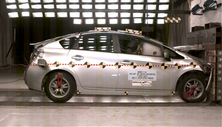
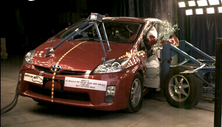
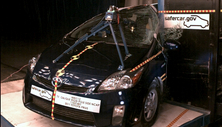
NHTSA crash tests
The agency crash-tested this model year itself. These are its own
photographs and star ratings.
Frontal crash test
Side barrier crash test
Side pole crash test
Photographs taken by NHTSA during its own New Car Assessment Program crash
tests of this model year. Public domain.
Configuration
Overall
Front
Side
Rollover
2012 Toyota Prius 5 HB FWD
12.1% risk
When owners complained
A spike years after the car went on sale usually means a part wearing
out on schedule across the whole fleet — the kind of pattern no single
owner can see from inside their own car.
Dec 2011peak 11Aug 2026
NHTSA investigations into the 2012 Toyota Prius
An investigation is the step before a recall: the agency has seen enough
complaints to look into a pattern itself. An open one means it thinks
something may be wrong and nothing has been fixed yet.
1
investigation is
still open.
DP23005Opened 22 Nov 2023Still openSERVICE BRAKES, HYDRAULIC:FOUNDATION COMPONENTS
Brake Actuator Valve Wear
The Office of Defects Investigation (ODI) has received a petition dated September 19, 2023 from the owner of a 2012 Toyota Prius V requesting that ODI reevaluate its decision to deny DP19-004. In the letter, the petitioner reported experiencing an unexpected and complete loss of brake power while driving, accompanied by multiple dashboard warning lights. This petition is based on the petitioner's direct experience and assessment that ODI closed DP19-004 because its prompting petition was withdrawn by that petitioner. ODI will review the work conducted during DP19-004 and a review of any additi...
DP22005Opened 27 Jan 2023Closed 7 Aug 2023ELECTRICAL SYSTEM:PROPULSION SYSTEM
Pedestrian alert sounds
NHTSA received a petition on or about July 18, 2022, requesting that Federal Motor Vehicle Safety Standard (FMVSS) 141 be applied to all electric and hybrid vehicles operating in the United States. The petition can be reviewed at NHTSA.gov under ODI Number 11486072. FMVSS 141 establishes performance requirements for pedestrian alert sounds for motor vehicles. The standard applies to hybrid and electric vehicles that have a gross vehicle weight rating of 4,536 KG or less or are defined as low-speed vehicles. The standard became fully applicable to all such vehicles manufactured on or after Marc...
DP19004Opened 30 Sep 2019Closed 21 Jan 2021SERVICE BRAKES, HYDRAULIC:POWER ASSIST
Brake Actuator Valve Wear
On September 19, 2019, the Office of Defects Investigation (ODI) received a defect petition from Mr. Roger Hogan requesting that the Agency investigate and recall certain Toyota Prius, Prius PHV, Camry Hybrid and Avalon Hybrid vehicles for a brake actuator valve wear condition covered under Toyota Customer Support Programs ZJB and ZKK (subject CSP?s). In support of his request, the petitioner identified 117 NHTSA complaints allegedly related to the subject CSP condition, including 60 reporting crashes. On September 30, 2019, ODI opened Defect Petition DP19-004 to evaluate the petitioner?s requ...
Recalls on the 2012 Toyota Prius
A complaint is one owner's allegation. A recall is the point at which
the manufacturer or a regulator agreed the defect is real and dangerous
enough to fix for free — however old the car is.
United States — NHTSA
18V684000
HYBRID PROPULSION SYSTEM
Toyota Motor Engineering & Manufacturing (Toyota) is recalling certain 2010-2014 Toyota Prius and 2012-2014 Toyota Prius V vehicles. Excessive voltage in the Intelligent Power Module (IPM) within the inverter may cause the hybrid system to shut down, causing the vehicle to stall while being driven.
Risk: If the hybrid system shuts down unexpectedly, it can increase the risk of a crash.
16V487000
AIR BAGS:SIDE/WINDOW
Toyota Motor Engineering & Manufacturing (Toyota) is recalling certain model year 2010-2012 Toyota Prius, 2010 and 2012 Toyota Prius Plug-in Hybrid, and 2011-2012 Lexus CT200h vehicles. A weld in the curtain shield air bag inflator may crack causing one or both portions of the inflator to eject into the passenger cabin.
Risk: If either portion of the curtain shield air bag inflator ejects into the passenger cabin, there is an increased risk of injury to vehicle occupants.
16V396000
SEATS:FRONT ASSEMBLY:SEAT HEATER/COOLER
Southeast Toyota Distributors, LLC (SET) is recalling certain 2005-2011 4Runner, Highlander, Sequoia, and Sienna, 2005-2010 Avalon and Tundra, 2006-2008 Camry Solara, 2006-2010 Highlander hybrid, 2006-2011 Rav4 and Tacoma, 2007-2010 FJ Cruiser, 2007-2011 Camry hybrid, 2009-2010 Venza, 2010-2012 Prius, 1988-1990 and 2005-2010 Camry, and 1989 and 2009-2010 Corolla vehicles equipped with aftermarket accessory seat heaters with a copper strand heating element. The electrical wiring in the seat heaters may be damaged when the seat cushion is compressed.
Risk: If damaged, the copper strand heating element may short circuit, increasing the risk of a fire.
14V053000
HYBRID PROPULSION SYSTEM: INVERTER
Toyota is recalling certain model year 2010 through 2014 Prius vehicles. In the affected vehicles, the Intelligent Power Module (IPM) inside the inverter module (a component of the hybrid system) contains transistors that may become damaged from high operating temperatures. If this occurs, various warning lamps will be illuminated on the instrument panel and the vehicle will have reduced power allowing it to only drive a short distance.
Risk: The vehicle may enter a fail-safe/limp-home mode that limits the drivability of the vehicle. The hybrid system could also shut down completely resulting in a vehicle stall, increasing the risk of a crash.
13V123000
EQUIPMENT:OTHER:LABELS
Southeast Toyota is recalling certain model year 2008 and 2010-2013 Toyota Tundra, 2010-2012 Rav4, 2012 Toyota Sequoia, 2010-2011 Toyota Corolla, 2010-2011 Toyota Camry and Camry Hybrid, 2010-2013 Toyota Highlander and Highlander Hybrid, 2010-2013 Toyota FJ Cruiser, 2011 Toyota Land Cruiser, 2010-2013 Toyota Venza, 2010-2011 Toyota 4Runner, 2010-2013 Toyota Tacoma, 2011-2012 Toyota Sienna, 2012 Toyota Prius, 2013 Scion FR-S, 2011 Scion XD, 2011 Scion XB, and 2012 Scion TC vehicles. These vehicles were sold with labels that were outside the allowable one percent of accuracy of actual weight added. Thus, these vehicles fail to comply with the requirements of Federal Motor Vehicle Safety Standard (FMVSS) Number 110, "Tire Selection and Rims."
Risk: An inaccurate label could lead to owners overloading their vehicles and tires. An overloaded vehicle can result in a tire failure which may result in a vehicle crash, personal injury, or property damage.
13V014000
AIR BAGS:FRONTAL:SENSOR/CONTROL MODULE-INACTIVE
Southeast Toyota Distributors, LLC (SET) is recalling certain models interspersed through model years 2009 through 2013 as follows: model year 2009-2012 Tacoma, 4Runner, Camry, Camry Hybrid, Prius, and RAV4; model year 2009-2010 Avalon, FJ Cruiser, and Highlander Hybrid; model year 2010-2013 model year Corolla, Sienna and Tundra; model year 2009-2013 Highlander and Venza; model year 2012 Prius V; and model year 2010-2012 Sequoia. During modification by SET to include accessories such as leather seat covers, seat heaters or headrest DVD systems, these vehicles may not have had the passenger seat occupant sensing system calibration tested. Without passing the calibration test, the occupant sensing system may not operate as designed.
Risk: If the front passenger seat occupant sensing system is out of calibration, the front passenger airbags may not deploy or they may deploy inappropriately for the passenger's size and position. This could increase the risk of personal injury during the event of a vehicle crash necessitating airbag deployment.
Canada — Transport Canada
Canada runs its own recall programme, and its campaigns do not
always mirror the American ones.
Recall 202172355,683 units in Canada
Electrical
Issue: This recall is for certain block heater kits installed on certain vehicles or sold as accessories at Toyota or Lexus dealerships. On certain vehicles, the engine block heater cable may not have enough heat protection and could be damaged by high temperatures. If this happens, the cable could short circuit while plugged in, and cause the wiring to overheat or melt. Note: This recall only affects the following block heater/cord part numbers: C014003034 PK5A408J09 PU14000904 C014003151 PK5A408J13 PU14000905 C014000885 PK5A489J11 PU14000907 C014000888 PK5A489J22 PU14000909 C014000907 PK5A410H00 PU14000911 C014100904 PU14000900 PU14000913 C014100907 PU14000901 PU14003571 C014100911 PU14000902 PK5A489J14 PK5A408J05 PU14000903 Safety Risk: Engine block heater wiring that overheats or melts could create the risk of a fire. Corrective Actions: Toyota recommends that you should stop using the engine block heater immediately. Toyota will notify owners by mail and instruct you to take your vehicle to a dealer to disable the engine block heater. For some vehicles, the corrective actions for this recall are under development. For others, a new engine block heater cannot be installed, and the owner will receive a refund of the purchase price of the engine block heater.
Recall 20194205,327 units in Canada
Other
Issue: This recall is for aftermarket replacement rear window glass produced by Vitro Automotriz. Certain rear window glass may not have been properly tempered. If the window breaks, the glass may separate into large pieces instead of very small ones. Note: This is a voluntary recall that is not being conducted under the requirements of the Motor Vehicle Safety Act. Safety Risk: Glass that breaks in to large pieces could create a risk of injury. Corrective Actions: The company will notify consumers by mail and instruct them to inspect the designation code marked on the rear window glass. Products affected by this recall have the designation “DOT 287” along with the lettering “VMR” (Replacement Market) and a date code that is before July 2019. This information is printed on the bottom corner of the glass. Consumers should contact Vitro's customer service at 1-412-995-6457 or [email protected] to arrange for replacement of the glass.
Recall 201854623,125 units in Canada
Powertrain
On certain vehicles, the Intelligent Power Module (IPM), which is part of the hybrid drive system, could become damaged under certain driving conditions. This could cause various warning lights to illuminate on the instrument panel of the vehicle and cause a reduction or loss of motive power, increasing the risk of a crash causing injury and/or property damage. Correction: Dealers will update motor/generator and hybrid control ECU software and affect repairs as necessary. Note: This recall supersedes recalls 2014-042 and 2015-312. Vehicles repaired under the previous recall(s) will require repair.
Recall 2017558363 units in Canada
Powertrain
On certain plug-in hybrid vehicles, the electric vehicle (EV) hybrid battery's fuse could be subjected to excessive thermal stress and potentially fracture if the vehicle is operated by the electric motor under high-load driving conditions, such as during a long ascent. This would illuminate warning lights and warning messages in the instrument cluster, and in some cases cause the vehicle to enter a fail-safe mode resulting in reduced motive power. In other cases, the hybrid system could shut down, resulting in loss of motive power, which could increase the risk of a crash causing injury and/or property damage. Correction: Dealers will replace the EV fuse with a new one of an improved design.
Recall 201633512,926 units in Canada
Airbag
On certain vehicles, a defect in the curtain shield airbags could cause the inflator to fail, releasing pressurized gas into the airbag, partially inflating it. If this occurs, parts of the inflator could also separate from the vehicle structure, entering the interior of the vehicle. Should this occur when occupants are in the vehicle, unintended airbag deployment could startle the driver, and airbag inflator parts could come into contact with the occupants, increasing the risk of injury and a crash. Correction: Dealers will install a retention bracket which will prevent the inflator parts from entering the vehicle interior.
Recall 201404213,791 units in Canada
Powertrain
On certain vehicles, the Intelligent Power Module (IPM), which is part of the hybrid system inverter assembly, could become damaged under certain driving conditions. This could cause various warning lights to illuminate in the instrument panel of the vehicle and cause a reduction or loss of motive power, increasing the risk of a crash causing injury and/or property damage. Correction: Dealers will update motor/generator and hybrid control ECU software and affect repairs as necessary. Note: This recall is superseded by recall 2018546. Please see <a href="http://wwwapps.tc.gc.ca/Saf-Sec-Sur/7/VRDB-BDRV/search-recherche/detail.aspx?lang=eng&&rn=2018546">recall 2018546</a> for more information.
Reports where the owner recorded a crash, a fire, an injury or a death.
at 140,000 milesMurray, UTCrash2 injured
AIR BAGS
The contact owned a 2012 Toyota Prius. The contact stated that while making a left turn at 10 MPH, another vehicle crashed into the vehicle and t-boned the front passenger's side door of the vehicle. The air bags did not deploy. There was no warning light illuminated. After the impact, the front windshield slowly cracked. A Police report was filed. The contact and her husband were transported by ambulance to the hospital. The contact suffered a fractured sternum, five fractured ribs, a crushed left wrist, and two fractured bones in the left ankle. The contact's husband had a fractured neck and five fractured ribs. The vehicle was towed to a tow yard and was declared a total loss by the insurance company. The manufacturer was not made aware of the failure. The failure mileage was approximately 140,000.
NHTSA complaint #11757721 — an unverified report by a vehicle owner.
Bethesda, MDCrash
UNKNOWN OR OTHER
While pulling out of a parallel parking spot going slightly uphill, I braked as I looked around the back of a double parked truck. I saw a car coming, braked hard, and suddenly my car surged forward across the street and hit a parked car. I looked down and saw that my foot was squarely on the brake pedal pressing down as hard as I could. The parked car was unoccupied, and I was uninjured. There were no warning lamps, messages, or other symptoms of the problem. I turned my car into the dealer for repairs and a fix to the sudden unexpected acceleration. They could offer no fix until a Toyota representative examined the car. On August 14, by an emailed letter, Toyota claimed it found no defects and it must be the result of driver error, specifically, my mistakenly hitting the accelerator. This is gaslighting denialism. (a) The EDR data sent to me does not indicate that I hit the accelerator unless that data is in the page of hexadecimal numbers. (b) Toyota's claim that I hit the breaks at "-0.2 seconds prior to the collision" is physically impossible. No one can move their foot from the accelerator to the brake that fast. (c) Toyota's claim is contrary to what I experienced and observed.
NHTSA complaint #11681161 — an unverified report by a vehicle owner.
Bethesda, MDCrash
SERVICE BRAKES
While pulling out of a parallel parking spot going slightly uphill, I braked as I looked around the back of a double parked truck. I saw a car coming, braked hard, and suddenly my car surged forward across the street and hit a parked car. I looked down and saw that my foot was squarely on the brake pedal pressing down as hard as I could. The parked car was unoccupied, and I was uninjured. There were no warning lamps, messages, or other symptoms of the problem. I turned my car into the dealer for repairs and a fix to the sudden unexpected acceleration. They could offer no fix until a Toyota representative examined the car. On August 14, by an emailed letter, Toyota claimed it found no defects and it must be the result of driver error, specifically, my mistakenly hitting the accelerator. This is gaslighting denialism. (a) The EDR data sent to me does not indicate that I hit the accelerator unless that data is in the page of hexadecimal numbers. (b) Toyota's claim that I hit the breaks at "-0.2 seconds prior to the collision" is physically impossible. No one can move their foot from the accelerator to the brake that fast. (c) Toyota's claim is contrary to what I experienced and observed.
NHTSA complaint #11681161 — an unverified report by a vehicle owner.
Boston, MACrash
UNKNOWN OR OTHER
I have had a 2012 Prius since 2016. The entire time I've had it, it occasionally "hydroplanes" but without any water. It happens in wet or dry (but mostly dry) conditions. Usually at slower speeds so, though it makes me very uncomfortable, it doesn't happen with any regularity. I've taken it multiple times to my mechanic who always says "Prius' just do that", which is not reassuring. I know there was a recall and I was told my car did not fall under that umbrella. On Wednesday of this week, 10/25/23, I finally had an accident because of this. The brake lockup had been happening more frequently in the past week and in this instance I saw the car in front of me suddenly slow down - I had about 2/3 of a cars distance between me and the car ahead. I hit the brakes and nothing happened. I was pushing down on them long enough to think, "Ok, this is it. They aren't responding at all and I'm going to hit this car in front of me." I did and it crushed the passenger side of the car. Luckily I wasn't hurt. There were no warnings from the car at all that this was going to happen, as there never are. I took it in for possible repair today (the mechanic is not sure but thinks it may be a total loss). This car did everything they describe in the recall cases and I want to know if there's anyway to be repaid from the company for this as there was nothing I could do to stop this accident? Why wasn't my car included in the recall?
NHTSA complaint #11552233 — an unverified report by a vehicle owner.
Boston, MACrash
SERVICE BRAKES
I have had a 2012 Prius since 2016. The entire time I've had it, it occasionally "hydroplanes" but without any water. It happens in wet or dry (but mostly dry) conditions. Usually at slower speeds so, though it makes me very uncomfortable, it doesn't happen with any regularity. I've taken it multiple times to my mechanic who always says "Prius' just do that", which is not reassuring. I know there was a recall and I was told my car did not fall under that umbrella. On Wednesday of this week, 10/25/23, I finally had an accident because of this. The brake lockup had been happening more frequently in the past week and in this instance I saw the car in front of me suddenly slow down - I had about 2/3 of a cars distance between me and the car ahead. I hit the brakes and nothing happened. I was pushing down on them long enough to think, "Ok, this is it. They aren't responding at all and I'm going to hit this car in front of me." I did and it crushed the passenger side of the car. Luckily I wasn't hurt. There were no warnings from the car at all that this was going to happen, as there never are. I took it in for possible repair today (the mechanic is not sure but thinks it may be a total loss). This car did everything they describe in the recall cases and I want to know if there's anyway to be repaid from the company for this as there was nothing I could do to stop this accident? Why wasn't my car included in the recall?
NHTSA complaint #11552233 — an unverified report by a vehicle owner.
Crystal Lake, IL1 injured
UNKNOWN OR OTHER
The glass sunroof spontaneously exploded or imploded. There was a loud popping sound and I looked up at the sunroof, and it was shattered. glass started falling on me as I was driving on the highway. There have been many reported cases of this happening found online. https://topclassactions.com/lawsuit-settlements/lawsuit-news/toyota-owners-should-be-aware-of-reported-exploding-sunroof-risk/ It has not been inspected yet. no warning messages.
NHTSA complaint #11526364 — an unverified report by a vehicle owner.
The most recent complaints
In the owners' own words, exactly as filed with NHTSA.
at 140,000 milesMurray, UTCrash2 injured
AIR BAGS
The contact owned a 2012 Toyota Prius. The contact stated that while making a left turn at 10 MPH, another vehicle crashed into the vehicle and t-boned the front passenger's side door of the vehicle. The air bags did not deploy. There was no warning light illuminated. After the impact, the front windshield slowly cracked. A Police report was filed. The contact and her husband were transported by ambulance to the hospital. The contact suffered a fractured sternum, five fractured ribs, a crushed left wrist, and two fractured bones in the left ankle. The contact's husband had a fractured neck and five fractured ribs. The vehicle was towed to a tow yard and was declared a total loss by the insurance company. The manufacturer was not made aware of the failure. The failure mileage was approximately 140,000.
NHTSA complaint #11757721 — an unverified report by a vehicle owner.
Iowa City, IA
SERVICE BRAKES
Brake warning lights on, buzzing sound every 10 seconds. Likely a known actuator and master cylinder issue
NHTSA complaint #11750980 — an unverified report by a vehicle owner.
Batonrouge, LA
SERVICE BRAKES
Brake lights icons stay on mechanic at Toyota dealership state need new brak master cylinder and booster
NHTSA complaint #11751225 — an unverified report by a vehicle owner.
Chicago, IL
VEHICLE SPEED CONTROL
Unknown. There were a multitude of codes that appeared on the diagnostics causing problems with engine. The temperature, brake, tire sensor lights are all on. The cruise control is not working. White smoke emitting from tail pipe and engine. Main engine coolant leaking. Car overheating rapidly.
NHTSA complaint #11748670 — an unverified report by a vehicle owner.
Chicago, IL
WHEELS
Unknown. There were a multitude of codes that appeared on the diagnostics causing problems with engine. The temperature, brake, tire sensor lights are all on. The cruise control is not working. White smoke emitting from tail pipe and engine. Main engine coolant leaking. Car overheating rapidly.
NHTSA complaint #11748670 — an unverified report by a vehicle owner.
Chicago, IL
ENGINE
Unknown. There were a multitude of codes that appeared on the diagnostics causing problems with engine. The temperature, brake, tire sensor lights are all on. The cruise control is not working. White smoke emitting from tail pipe and engine. Main engine coolant leaking. Car overheating rapidly.
NHTSA complaint #11748670 — an unverified report by a vehicle owner.
Lahaina, HI
SERVICE BRAKES
My 2012 Toyota Prius is experiencing brake actuator pump failure, presenting diagnostic trouble codes C1253 (brake actuator pump motor stuck/locked) and C1256 (brake actuator pump motor overcurrent). These codes trigger ABS, brake, and VSC warning lights and disable ABS and stability control. Toyota previously acknowledged this exact defect under Customer Support Program ZJB, which covered 2010-2015 Prius vehicles for brake booster and brake booster pump assembly failures triggered by these specific codes. I am the original owner of this vehicle, purchased new in 2012. I never received notification of CSP ZJB despite being the registered owner at the time notifications were distributed in 2019-2021. My current mileage is under 150,000 miles, within the secondary coverage mileage limit established by the program. Toyota has declined to provide goodwill coverage citing program expiration. This is a known safety defect that reduces braking effectiveness and disables ABS — it should have been addressed through a mandatory recall rather than a voluntary program with an expiration date that left original owners without recourse due to failed notification.
NHTSA complaint #11748062 — an unverified report by a vehicle owner.
Springfield, OR
SERVICE BRAKES
The power brake unit and actuator are failing.
NHTSA complaint #11744357 — an unverified report by a vehicle owner.
Santa Clarita, CA
SERVICE BRAKES
Almost had an accident due to the brake master, actuator and booster pump assemblies, failing. There were no warning lights alerting me to an issue. Just lost ability to break and car shut off completely while in motion.
NHTSA complaint #11740616 — an unverified report by a vehicle owner.
Concord, NC
SERVICE BRAKES
The brake booster and brake booster pump assembly (also referred to as the Accumulater or Accentuater) have failed in my vehicle the same as Toyota's known defect that was mentioned in their Customer Support Program 20TE07 (part numbers can be found within the filing of their CSP 20TE07). I am reporting that this issue appears to have affected more than their initial estimate of ~118,960 states impacted vehicles.l because Toyota is declaring my vehicle is outside of their CSP 20TE07 although their defect endangers my safety (and the safety of others) and attempts to put their defective vehicle brake parts as my financial burden. This issue should have been/should be a larger recall. Thank you.
NHTSA complaint #11736344 — an unverified report by a vehicle owner.
West Covina, CA
SERVICE BRAKES
2012 Prius with 174,344 miles in great condition, with regularly scheduled oil changes. ABS/Break Actuator failure on freeway with no warning other than a beep a few seconds before the breaks disappeared completely. Break pads changed 4 months ago and new wheels installed as well. This is a known problem with Toyota under the TSB002419 where Break booster actuator was put on a customer service program to be fixed by the dealerships, but has since expired since 2022. The cars are still known to have their breaks go out due to this malfunction but it is now not covered by Toyota and cost $4K-$5K to fix which is more than the market value of the car today. This needs to be fixed and regulated.
NHTSA complaint #11734136 — an unverified report by a vehicle owner.
Odometer Fraud. The contact purchased a 2012 Toyota Prius. The contact stated that while attempting to register the vehicle, it was discovered that there was a mileage discrepancy. The vehicle was a dealer sale. At the time of purchase, the vehicle mileage was 187,000, and at the time of registration, it was discovered that the mileage was 227,000.
NHTSA complaint #11730416 — an unverified report by a vehicle owner.
at 175,000 milesValley Stream, NY
SERVICE BRAKES, HYDRAULIC
The contact owns a 2012 Toyota Prius. The contact stated while driving at an undisclosed speed, several unknown warning lights illuminated, with an abnormal sound coming from the vehicle. The vehicle was taken to the dealer where it was diagnosed with brake booster failure. The contact was informed that the brake booster pump needed to be replaced. The vehicle was not repaired. The contact stated that the failure was a known failure with the vehicle. The manufacturer was made aware of the failure. The contact was informed that an undisclosed Extended Warranty Program had expired. In addition, the contact was informed that the repair was not covered. The failure mileage was approximately 175,000.
NHTSA complaint #11722029 — an unverified report by a vehicle owner.
San Jose, CA
SERVICE BRAKES
My Brake Booster/Actuator failed on me while on the freeway with out any warnings. It made it really hard to stop the car. I didn't find out what it was untill I took it into a repair shop and they told me it was the Brake Booster/Actuator.
NHTSA complaint #11719694 — an unverified report by a vehicle owner.
Baltimore, MD
SERVICE BRAKES
The vehicle is experiencing a suspected brake actuator / brake booster failure. Multiple warning lights appeared simultaneously, including ABS, Brake, Traction Control, and Master Warning lights. The vehicle produces a frequent buzzing noise from the brake system, especially at low speeds or when stopped. The noise occurs repeatedly when pressing the brake pedal, indicating the system is struggling to maintain hydraulic pressure. This condition raises serious safety concerns because it may reduce braking performance and increase stopping distance. Brake system failures present a significant risk to vehicle occupants and others on the road. After researching the issue, I learned this appears to be a common failure in Toyota Prius vehicles of similar model years, and Toyota previously issued extended warranty coverage for the brake booster/actuator assemblies. However, many vehicles now exceed the coverage limits despite the safety nature of the defect. I am submitting this complaint because a failing brake system is a critical safety hazard, and this issue appears widespread.
NHTSA complaint #11717956 — an unverified report by a vehicle owner.
San Diego, CA
SERVICE BRAKES
Vehicle check engine code C1391 (Antilock Brake System - abnormal leak in accumulator) came up on 2/5/2026. Recommended repair is to replace the Brake Booster Pump and Assembly, Brake Booster - over $1000 in parts alone. This WAS covered by an Extended Warranty by Toyota (10 years / 150K miles). I only have 120K miles at this time but am past the 10 year mark. However, it seems that this part will fail in every Prius given time and encourage NHTSA to monitor these failures and hold Toyota accountable to address post the 10 year / 150K mile mark.
NHTSA complaint #11716476 — an unverified report by a vehicle owner.
Affton, MO
SERVICE BRAKES
Vehicle: 2012 Toyota Prius Mileage: Approximately 217,000 miles While driving normally in traffic, the vehicle experienced a sudden and unexpected brake system failure. Multiple warning lights illuminated simultaneously, including the red BRAKE warning light, ABS warning light, traction control light, and warning symbol (!). Shortly after, the vehicle began emitting an audible warning/beeping, and there was a sudden loss of power brake assist. The brake pedal behavior changed abruptly: the pedal became very soft initially, then became suddenly hard halfway through travel, This failure occurred while approaching another vehicle in traffic, and I narrowly avoided rear-ending the vehicle in front of me. The unexpected loss of brake assist created an immediate and dangerous situation, as the vehicle did not decelerate as expected when the brake pedal was applied. Due to the seriousness of the brake failure and safety risk, the vehicle was removed from service and towed. This incident represents a critical safety defect, as sudden loss of braking assist while driving poses a significant risk to vehicle occupants and other road users. I am reporting this incident to document the hazard and request investigation into the reliability and safety of the brake system design. I am requesting you to please issue a recall and reimburse me , as these parts are very expensive , it affected my financial situation, Thanks
NHTSA complaint #11713170 — an unverified report by a vehicle owner.
Matthews, NC
SERVICE BRAKES
My 2012 Toyota Prius plug in hybrid had just passed state inspections and was even looked at by a dealership a year ago with no reported issues. I brought up a whirring issue at the dealership when breaking but the dealership said that’s normal for a hybrid. In a matter of minutes while driving, the traction light, brake light, and ABS light came on as well as a groaning, whirring sound when breaking. Over time, the breaks failed and I could not stop the car, almost causing a wreck because I could not stop without putting all my body weight on the break pedal. When taking it to the Toyota dealership for a whole diagnostic, they said it was a break actuator and break booster failure that is known to happen with Prius’s. They quoted me $3000 for a repair and then marked my breaks as yellow not red on their sheet implying I could still drive it despite the dangerous situation of driving without functioning breaks. When looking into it, this seems to be a known and common problem with Prius’s due to a faulty manufactured part. Codes were c1391, wc1256, and c1252. I believe this part should be recalled and Toyota should fix these faulty parts, especially considering they inspected my car and did not mention it as an issue despite it being a known issue. I got a second opinion from Mavis Tires and they concurred with the diagnosis but could not fix it.
NHTSA complaint #11707166 — an unverified report by a vehicle owner.
Brooklyn, NY
ELECTRICAL SYSTEM
While driving, the vehicle experienced a sudden brake system malfunction without prior warning or gradual degradation. The vehicle was being operated under normal driving, road, and weather conditions. No recent brake service, repairs, or aftermarket modifications had been performed prior to the failure. Multiple warning lights illuminated on the dashboard, including the ABS warning light, brake warning light, and traction control warning light. Shortly after the warning lights appeared, the vehicle began emitting continuous warning beeps. Audible buzzing or pumping noises were also present from the brake system during the malfunction. During this event, brake performance was reduced and braking felt inconsistent. The brake pedal became hard at times and spongy at other times, requiring increased effort to slow the vehicle and resulting in unpredictable braking response. This created a safety concern while the vehicle was in motion. The driver was forced to alter driving behavior and exercise extreme caution due to reduced braking confidence and unpredictable pedal feel. The malfunction has occurred intermittently during normal driving. The condition temporarily resolves on its own and later reoccurs without corrective action. The suspected failed component is the brake actuator / ABS actuator assembly. A diagnostic scan retrieved fault codes C1252 (Brake Booster Pump Motor ON Time Abnormally Long), C1253 (Pump Motor Relay Malfunction), and C1256 (Accumulator Low Pressure), which are consistent with brake actuator malfunction. The failure occurred at approximately 154,000 miles. This vehicle model and generation have a documented history of premature brake actuator failures with similar safety-related symptoms reported by other owners. The condition places the driver and others at risk due to unpredictable braking behavior, reduced braking effectiveness, and repeated warning alarms while driving. Warning lamps and audible alerts continue intermittently.
NHTSA complaint #11707029 — an unverified report by a vehicle owner.
Brooklyn, NY
SERVICE BRAKES
While driving, the vehicle experienced a sudden brake system malfunction without prior warning or gradual degradation. The vehicle was being operated under normal driving, road, and weather conditions. No recent brake service, repairs, or aftermarket modifications had been performed prior to the failure. Multiple warning lights illuminated on the dashboard, including the ABS warning light, brake warning light, and traction control warning light. Shortly after the warning lights appeared, the vehicle began emitting continuous warning beeps. Audible buzzing or pumping noises were also present from the brake system during the malfunction. During this event, brake performance was reduced and braking felt inconsistent. The brake pedal became hard at times and spongy at other times, requiring increased effort to slow the vehicle and resulting in unpredictable braking response. This created a safety concern while the vehicle was in motion. The driver was forced to alter driving behavior and exercise extreme caution due to reduced braking confidence and unpredictable pedal feel. The malfunction has occurred intermittently during normal driving. The condition temporarily resolves on its own and later reoccurs without corrective action. The suspected failed component is the brake actuator / ABS actuator assembly. A diagnostic scan retrieved fault codes C1252 (Brake Booster Pump Motor ON Time Abnormally Long), C1253 (Pump Motor Relay Malfunction), and C1256 (Accumulator Low Pressure), which are consistent with brake actuator malfunction. The failure occurred at approximately 154,000 miles. This vehicle model and generation have a documented history of premature brake actuator failures with similar safety-related symptoms reported by other owners. The condition places the driver and others at risk due to unpredictable braking behavior, reduced braking effectiveness, and repeated warning alarms while driving. Warning lamps and audible alerts continue intermittently.
NHTSA complaint #11707029 — an unverified report by a vehicle owner.
Brooklyn, NY
FUEL/PROPULSION SYSTEM
While driving, the vehicle experienced a sudden brake system malfunction without prior warning or gradual degradation. The vehicle was being operated under normal driving, road, and weather conditions. No recent brake service, repairs, or aftermarket modifications had been performed prior to the failure. Multiple warning lights illuminated on the dashboard, including the ABS warning light, brake warning light, and traction control warning light. Shortly after the warning lights appeared, the vehicle began emitting continuous warning beeps. Audible buzzing or pumping noises were also present from the brake system during the malfunction. During this event, brake performance was reduced and braking felt inconsistent. The brake pedal became hard at times and spongy at other times, requiring increased effort to slow the vehicle and resulting in unpredictable braking response. This created a safety concern while the vehicle was in motion. The driver was forced to alter driving behavior and exercise extreme caution due to reduced braking confidence and unpredictable pedal feel. The malfunction has occurred intermittently during normal driving. The condition temporarily resolves on its own and later reoccurs without corrective action. The suspected failed component is the brake actuator / ABS actuator assembly. A diagnostic scan retrieved fault codes C1252 (Brake Booster Pump Motor ON Time Abnormally Long), C1253 (Pump Motor Relay Malfunction), and C1256 (Accumulator Low Pressure), which are consistent with brake actuator malfunction. The failure occurred at approximately 154,000 miles. This vehicle model and generation have a documented history of premature brake actuator failures with similar safety-related symptoms reported by other owners. The condition places the driver and others at risk due to unpredictable braking behavior, reduced braking effectiveness, and repeated warning alarms while driving. Warning lamps and audible alerts continue intermittently.
NHTSA complaint #11707029 — an unverified report by a vehicle owner.
at 196,347 milesManassas, VA
SUSPENSION
The contact owns a 2012 Toyota Prius. The contact stated that while reversing, the driver's side rear wheel flipped over. The vehicle was towed to the dealer, where it was diagnosed with a corroded I-Beam assembly on the rear wheel. The contact was informed that the driver's side rear hub and the BRG assembly, rear suspension, and bolts needed to be replaced. The vehicle was repaired. The manufacturer was made aware of the failure. The failure mileage was approximately 196,347.
NHTSA complaint #11704752 — an unverified report by a vehicle owner.
Odometer Fraud. The contact’s son recently purchased a 2012 Toyota Prius. The vehicle was a private sale. After the purchase, it was discovered that there was a mileage discrepancy based on the Carfax report. At the time of purchase, the vehicle displayed 137,000 miles. However, the Carfax report listed the mileage as 281,586 miles, and the current mileage on the vehicle was 151,103.
NHTSA complaint #11702529 — an unverified report by a vehicle owner.
Loma Linda, CA
SERVICE BRAKES
While driving on a city road below the speed limit, braking was compromised leading to loss of traction and failure of the ABS system. During the incident, the brake, ABS, and engine warning lights all turned on and a collision was only avoided due to pumping of the brakes. Further investigation by a mechanic revealed a failure of the brake actuator system. Failure of this system has increased the stopping distance of the vehicle considerably and makes braking unreliable and unpredictable.
NHTSA complaint #11701919 — an unverified report by a vehicle owner.
Charlotte, NC
ELECTRICAL SYSTEM
The hybrid system fails to enter “Ready” mode with no SMR engagement audible from the junction box. Dashboard displays ABS, brake, engine, and master warning lights. OBD codes include U0142, U0155, and previously U0073 . Rear brake lights function normally when pedal is pressed. Dealer said to pay 250$ for diagnostic and diagnosed incorrect voltage from brake light switch and quoted $348.94 to replace, but refused to proceed with open safety recall J0V / 18V684 (NHTSA 18V684000) citing inability to achieve “Ready” mode. Recall covers inverter failure leading to loss of motive power. Dealer declined to jump 12V battery or use external power to perform required software update and inverter inspection. Vehicle remains inoperable and poses safety risk due to sudden power loss potential. Component (inverter G9200-47141) available for inspection. Problem confirmed by dealer diagnostics. No police or insurance inspection. Warning lamps appeared after 12V battery replacement three months ago.
NHTSA complaint #11697829 — an unverified report by a vehicle owner.