Owners have filed 143 complaints
about the 2018 Hyundai Santa FE with NHTSA between 2018 and 2026.
The largest single group is the engine & cooling.
Across this model's run it ranks 14 of 26 worst.
The letter says how bad. This says what kind — whether this year drew
an unusual number of complaints, unusually dangerous
ones, or failures that arrived unusually early.
The dashed ring is 50 — the national norm. Further out is worse.
Complaint volume — 18
Against the median year of the Hyundai Santa FE. 50 means typical for this
model; 100 means roughly double.
Severity — 94
18.2% of these complaints
involved a crash, fire, injury or death, against a national rate of
9.7%.
Early failure — 100
70% of failures with a mileage on record happened under
36,000 miles, against a national rate of
29%.
How 2018 compares with every other Hyundai Santa FE
Odometer readings owners gave when they filed. About half of all
complaints include one.
Under 1,000 miles
919.1%
1,000 – 9,999 miles
1021.3%
10,000 – 24,999 miles
919.1%
25,000 – 49,999 miles
714.9%
50,000 – 74,999 miles
510.6%
75,000 – 99,999 miles
24.3%
100,000 – 149,999 miles
510.6%
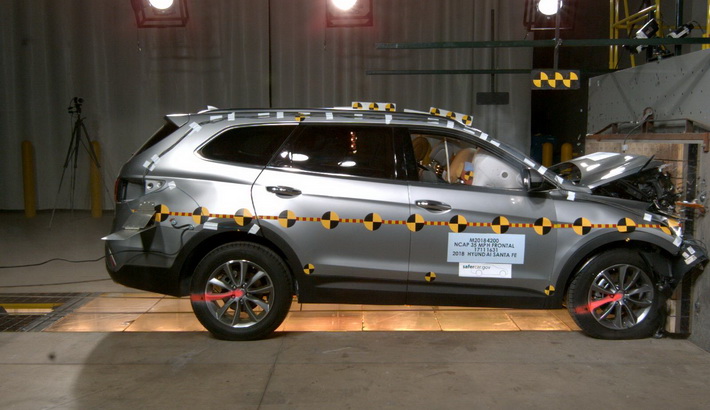
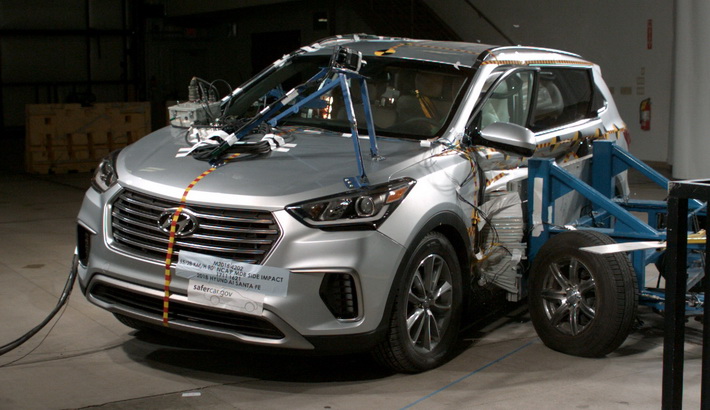
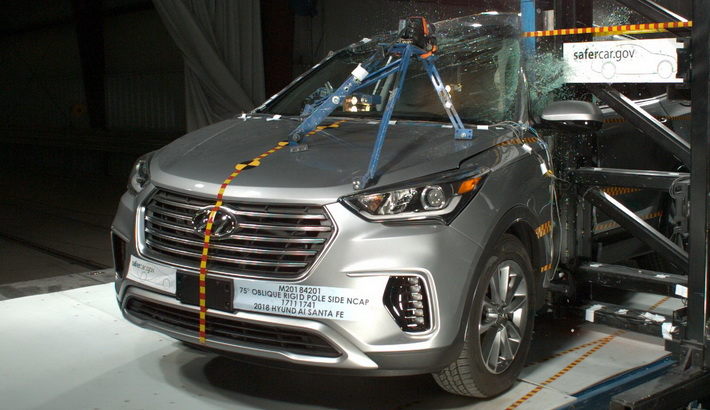
NHTSA crash tests
The agency crash-tested this model year itself. These are its own
photographs and star ratings.
Frontal crash test
Side barrier crash test
Side pole crash test
Photographs taken by NHTSA during its own New Car Assessment Program crash
tests of this model year. Public domain.
Configuration
Overall
Front
Side
Rollover
2018 Hyundai Santa Fe SUV AWD
15.7% risk
2018 Hyundai Santa Fe SUV FWD
15% risk
When owners complained
A spike years after the car went on sale usually means a part wearing
out on schedule across the whole fleet — the kind of pattern no single
owner can see from inside their own car.
Mar 2018peak 8Jun 2026
NHTSA investigations into the 2018 Hyundai Santa FE
An investigation is the step before a recall: the agency has seen enough
complaints to look into a pattern itself. An open one means it thinks
something may be wrong and nothing has been fixed yet.
The Office of Defects Investigation (ODI) has received eight Hyundai Motor America (Hyundai) and eight Kia America, Inc. (Kia) Part 573 Recall Reports between 2016 and 2023. The combined 16 safety recalls all involve the antilock braking system (ABS) modules or Hydraulic Electronic Control Units (HECU) manufactured by the equipment supplier Mando. The Part 573 Recall Reports contain varying defect descriptions and differing remedy descriptions for the same or similar equipment supplied by Mando. Safety recalls included in this Audit Query (AQ) review include: Hyundai recalls 20V-520, 20V-543,...
DP22003Opened 12 Sep 2022Closed 12 Dec 2023ENGINE
Loss of Motive Power
The National Highway Traffic Safety Administration (NHTSA) received a letter dated July 13, 2022, petitioning the Agency to initiate a safety defect investigation into loss of motive power allegations attributed to oil drain pan assembly failures on certain Hyundai Motor America, Inc. and Kia America, Inc. vehicles spanning Model Years (MY) 2005-2021. The Petitioners cited examples of complaints indicating that the subject vehicles were experiencing rapid loss of engine oil due to oil drain plug back outs, resulting in loss of motive power and/or catastrophic engine damage. Additional complain...
Recalls on the 2018 Hyundai Santa FE
A complaint is one owner's allegation. A recall is the point at which
the manufacturer or a regulator agreed the defect is real and dangerous
enough to fix for free — however old the car is.
United States — NHTSA
22V056000
SERVICE BRAKES, HYDRAULIC:ANTILOCK/TRACTION CONTROL/ELECTRONIC LIMITED SLIP:CONTROL UNIT/MODULE
Hyundai Motor America (Hyundai) is recalling certain 2016-2018 Santa Fe, 2017-2018 Santa Fe Sport, 2019 Santa Fe XL, and 2014-2015 Tucson vehicles. The Anti-Lock Brake System (ABS) module could malfunction and cause an electrical short, which could result in an engine compartment fire.
Risk: An engine compartment fire while parked or driving can increase the risk of injury.
18V118000
STEERING: STEERING WHEEL/HANDLE BAR
Hyundai Motor America (Hyundai) is recalling certain 2018 Hyundai Santa Fe and Santa Fe Sport vehicles. The steering wheel assembly may break, possibly resulting in the steering wheel separating from the steering column while driving.
Risk: A steering wheel separation while driving can cause a loss of vehicle control and increase the risk of a crash.
Canada — Transport Canada
Canada runs its own recall programme, and its campaigns do not
always mirror the American ones.
Recall 2024552824,695 units in Canada
Label
Issue: On certain vehicles, the compliance label may be missing information in French. The words listed on the label for "Tires", "Rims", "Front" and "Rear" appear in English only, when they should be listed as "Tires/Pneus", "Rims/Jantes", "Front/Avant" and "Rear/Arriere". Canadian regulations require this information to be listed on the label in both English and French. Safety Risk: These small errors do not affect vehicle safety. Corrective Actions: This is not a recall. The company has corrected the compliance label for all new vehicles.
Recall 2023125404,543 units in Canada
Brakes
Issue: Hyundai is conducting a special service campaign that provides anti-corrosion treatment to certain underbody components. Over time, components under the vehicle, including brake lines could corrode. If this happens, a brake line could fail and leak. A brake fluid leak can result in reduced braking. Safety Risk: Reduced braking can cause an extended stopping distance and increase the risk of a crash. Corrective Actions: Hyundai will notify owners by mail and advise you to take your vehicle to a dealership to inspect the underbody, including the brake lines. The dealer will apply an anti-corrosion treatment to certain parts, and replace the brake lines if necessary.
Recall 202261686,599 units in Canada
Brakes
Issue: On certain vehicles, the control module for the antilock brake system (ABS) could short circuit. Note: This recall doesn't affect vehicles equipped with smart cruise control (SCC). This recall replaces Transport Canada recall 2022-046. Vehicles that were already repaired under Hyundai recall R0208 don't require this repair. Safety Risk: A short circuit could create a fire risk, even while the vehicle is parked and turned off. Corrective Actions: Hyundai will notify owners by mail and instruct you to take your vehicle to a dealer to replace the ABS multi-fuse. Hyundai advises that you may continue to drive your vehicle, however recommends that you should park it outdoors and away from other vehicles or structures until the recall repairs have been completed.
Recall 202204674,169 units in Canada
Brakes
This recall was replaced by Transport Canada Recall No. 2022-616 due to increase in the number of recalled vehicles. Issue: On certain vehicles, the control module for the antilock brake system (ABS) could short circuit. Note: This recall does not affect vehicles equipped with smart cruise control (SCC). Safety Risk: A short circuit could create a fire risk. Corrective Actions: Hyundai will notify owners by mail and instruct you to take your vehicle to a dealer to replace the ABS multi-fuse. Hyundai advises that you may continue to drive your vehicle, however recommends that you should park it outdoors and away from other vehicles or structures until the recall repairs have been completed.
Recall 20181058,456 units in Canada
Steering
On certain vehicles, the steering wheel assembly may contain manufacturing defect, and could separate from the steering column while driving. This could result in a crash causing injury and/or damage to property. Correction: Dealers will inspect and if necessary install a revised steering wheel assembly.
Reports where the owner recorded a crash, a fire, an injury or a death.
Orange Park, FLCrash1 injured
POWER TRAIN
On April 13, 2026, I arrived home and parked the vehicle, engaging the traditional shifter into the "Park" position and turning off the engine. After exiting and standing on the ground to retrieve a purse from the cabin, the vehicle spontaneously and rapidly began reversing. As the vehicle gained momentum, I was struck by the driver-side door, which knocked me down and resulted in the vehicle running over me. The vehicle only stopped its rearward movement once it collided with a neighbor's parked car. Only after the vehicle began moving did the horn begin blaring, indicating a delayed rollaway alert. This incident resulted in a fractured ankle that required surgical intervention. Despite the traditional shifter being placed in "Park" and the engine being off, the vehicle failed to remain stationary, representing a catastrophic failure of the parking pawl or transmission engagement.
NHTSA complaint #11735250 — an unverified report by a vehicle owner.
Orange Park, FLCrash1 injured
SERVICE BRAKES
On April 13, 2026, I arrived home and parked the vehicle, engaging the traditional shifter into the "Park" position and turning off the engine. After exiting and standing on the ground to retrieve a purse from the cabin, the vehicle spontaneously and rapidly began reversing. As the vehicle gained momentum, I was struck by the driver-side door, which knocked me down and resulted in the vehicle running over me. The vehicle only stopped its rearward movement once it collided with a neighbor's parked car. Only after the vehicle began moving did the horn begin blaring, indicating a delayed rollaway alert. This incident resulted in a fractured ankle that required surgical intervention. Despite the traditional shifter being placed in "Park" and the engine being off, the vehicle failed to remain stationary, representing a catastrophic failure of the parking pawl or transmission engagement.
NHTSA complaint #11735250 — an unverified report by a vehicle owner.
Providence Forge, VAFire
UNKNOWN OR OTHER
In September 2024, my 2018 Hyundai Santa Fe experienced an unexpected engine lock-up while driving, creating an immediate safety hazard. Vehicle lost power, began smoking, and posed a potential fire risk. Fire department responded to prevent the engine from catching fire and had to spray the engine compartment with high-pressure water. Following this incident, vehicle remained in Hyundai’s possession for ~9 months for engine-related repairs. When we picked up the vehicle after the prolonged repair period, front-facing camera had completely stopped functioning. This camera has always worked prior to the engine lock-up and was functioning the day of the incident. This was reported to the dealership, Hyundai Motor America. A case manager (Nemesh) took the case. Very supportive, helpful and provided a thorough process for investigating the situation. However, all the sudden case was assigned a new case manager (Bryan) and the process immediately changed and the claim was denied. Given the timing and circumstances, the camera failure appears to be the result of electrical or component damage caused during the engine failure/fire-prevention event. The dealership also confirmed that no independent inspector ever assessed the vehicle for secondary damage despite my repeated requests. Hyundai later denied responsibility without conducting any physical inspection of the damage. This sequence of events — sudden engine failure, required fire-response intervention, prolonged repair, and subsequent electrical component failure — raises significant concerns about safety and the potential for related electrical or wiring issues caused by the engine incident. I am reporting this because the underlying engine failure and fire-risk conditions represent a serious safety defect, and related component failures may indicate broader issues with damage resulting from these events. Also Hyundai not letting the independent inspector assess gives me great concern something was missed.
NHTSA complaint #11699482 — an unverified report by a vehicle owner.
Providence Forge, VAFire
ELECTRICAL SYSTEM
In September 2024, my 2018 Hyundai Santa Fe experienced an unexpected engine lock-up while driving, creating an immediate safety hazard. Vehicle lost power, began smoking, and posed a potential fire risk. Fire department responded to prevent the engine from catching fire and had to spray the engine compartment with high-pressure water. Following this incident, vehicle remained in Hyundai’s possession for ~9 months for engine-related repairs. When we picked up the vehicle after the prolonged repair period, front-facing camera had completely stopped functioning. This camera has always worked prior to the engine lock-up and was functioning the day of the incident. This was reported to the dealership, Hyundai Motor America. A case manager (Nemesh) took the case. Very supportive, helpful and provided a thorough process for investigating the situation. However, all the sudden case was assigned a new case manager (Bryan) and the process immediately changed and the claim was denied. Given the timing and circumstances, the camera failure appears to be the result of electrical or component damage caused during the engine failure/fire-prevention event. The dealership also confirmed that no independent inspector ever assessed the vehicle for secondary damage despite my repeated requests. Hyundai later denied responsibility without conducting any physical inspection of the damage. This sequence of events — sudden engine failure, required fire-response intervention, prolonged repair, and subsequent electrical component failure — raises significant concerns about safety and the potential for related electrical or wiring issues caused by the engine incident. I am reporting this because the underlying engine failure and fire-risk conditions represent a serious safety defect, and related component failures may indicate broader issues with damage resulting from these events. Also Hyundai not letting the independent inspector assess gives me great concern something was missed.
NHTSA complaint #11699482 — an unverified report by a vehicle owner.
Providence Forge, VAFire
ENGINE
In September 2024, my 2018 Hyundai Santa Fe experienced an unexpected engine lock-up while driving, creating an immediate safety hazard. Vehicle lost power, began smoking, and posed a potential fire risk. Fire department responded to prevent the engine from catching fire and had to spray the engine compartment with high-pressure water. Following this incident, vehicle remained in Hyundai’s possession for ~9 months for engine-related repairs. When we picked up the vehicle after the prolonged repair period, front-facing camera had completely stopped functioning. This camera has always worked prior to the engine lock-up and was functioning the day of the incident. This was reported to the dealership, Hyundai Motor America. A case manager (Nemesh) took the case. Very supportive, helpful and provided a thorough process for investigating the situation. However, all the sudden case was assigned a new case manager (Bryan) and the process immediately changed and the claim was denied. Given the timing and circumstances, the camera failure appears to be the result of electrical or component damage caused during the engine failure/fire-prevention event. The dealership also confirmed that no independent inspector ever assessed the vehicle for secondary damage despite my repeated requests. Hyundai later denied responsibility without conducting any physical inspection of the damage. This sequence of events — sudden engine failure, required fire-response intervention, prolonged repair, and subsequent electrical component failure — raises significant concerns about safety and the potential for related electrical or wiring issues caused by the engine incident. I am reporting this because the underlying engine failure and fire-risk conditions represent a serious safety defect, and related component failures may indicate broader issues with damage resulting from these events. Also Hyundai not letting the independent inspector assess gives me great concern something was missed.
NHTSA complaint #11699482 — an unverified report by a vehicle owner.
at 142,732 milesWilliamston, NCFire
ENGINE
The contact owns a 2018 Hyundai Santa Fe. The contact stated while driving 55 MPH, the vehicle made an abnormal rattling sound and there was fire coming from underneath the hood. There was no warning light illuminated. The contact stated that she immediately veered to the side of the road and exited the vehicle with her son. The contact stated that the fire died out before the fire department arrived. A fire department report was filed. There was no police report filed. There was no injury sustained. The vehicle was towed to the dealer, where it was diagnosed that a fractured rod in the engine block had caused the engine to explode, and the engine needed to be replaced. The dealer also informed the contact the fire had burned the electrical wiring. The vehicle was not repaired. The manufacturer was notified of the failure and offered to cover half of the repair. The failure mileage was approximately 142,732.
NHTSA complaint #11540580 — an unverified report by a vehicle owner.
The most recent complaints
In the owners' own words, exactly as filed with NHTSA.
Shillington, PA
ENGINE
See attached letter for complaint
NHTSA complaint #11744400 — an unverified report by a vehicle owner.
Shillington, PA
ENGINE AND ENGINE COOLING:ENGINE:OIL/LUBRICATION:SUMP/TANK:DRAIN PLUG
See attached letter for complaint
NHTSA complaint #11744400 — an unverified report by a vehicle owner.
Orange Park, FLCrash1 injured
POWER TRAIN
On April 13, 2026, I arrived home and parked the vehicle, engaging the traditional shifter into the "Park" position and turning off the engine. After exiting and standing on the ground to retrieve a purse from the cabin, the vehicle spontaneously and rapidly began reversing. As the vehicle gained momentum, I was struck by the driver-side door, which knocked me down and resulted in the vehicle running over me. The vehicle only stopped its rearward movement once it collided with a neighbor's parked car. Only after the vehicle began moving did the horn begin blaring, indicating a delayed rollaway alert. This incident resulted in a fractured ankle that required surgical intervention. Despite the traditional shifter being placed in "Park" and the engine being off, the vehicle failed to remain stationary, representing a catastrophic failure of the parking pawl or transmission engagement.
NHTSA complaint #11735250 — an unverified report by a vehicle owner.
Orange Park, FLCrash1 injured
SERVICE BRAKES
On April 13, 2026, I arrived home and parked the vehicle, engaging the traditional shifter into the "Park" position and turning off the engine. After exiting and standing on the ground to retrieve a purse from the cabin, the vehicle spontaneously and rapidly began reversing. As the vehicle gained momentum, I was struck by the driver-side door, which knocked me down and resulted in the vehicle running over me. The vehicle only stopped its rearward movement once it collided with a neighbor's parked car. Only after the vehicle began moving did the horn begin blaring, indicating a delayed rollaway alert. This incident resulted in a fractured ankle that required surgical intervention. Despite the traditional shifter being placed in "Park" and the engine being off, the vehicle failed to remain stationary, representing a catastrophic failure of the parking pawl or transmission engagement.
NHTSA complaint #11735250 — an unverified report by a vehicle owner.
Sleepy Hollow, NY
ENGINE
My wife was driving the vehicle by the left lane on route 9A northbound on elmsford at a speed around 35 mph. The vehicle suddenly came to stop completely while driving. My wife tried to start it but it didn't start. We called the police to come help us due to the ongoing traffic while the towing was on its way. Our mechanic told us the engine was seized and needs a replacement. The vehicle is a 2018 and has only 118000 miles. We do oil changes periodically every 3000 miles.
NHTSA complaint #11730527 — an unverified report by a vehicle owner.
Lancaster, PA
ENGINE
Catastrophic Engine Failure - Cam phasers blew apart and severely cracked the valve covers. This occurred with no prior warning lights. Minutes before failure, there was engine hesitation and noise and then severely reduced power, causing a safety issue while driving. Vehicle was towed to local Hyundai dealer who identified the cam phaser failure ausing external engine damage of the valve covers and complete loss of oil. This occurred only 3,000 miles after an oil change.
NHTSA complaint #11724023 — an unverified report by a vehicle owner.
Ooltewah, TN
ENGINE
Engine Issues: A week ago, on two separate occasions, my Santa Fe cutoff while driving suddenly. A day later, I noticed a rhythmic knocking upon starting my vehicle. The knocking would increase during acceleration and decrease when I let off. I am only at 83,000 miles on this 2018 vehicle. I took the vehicle in for an oil change and they didn't notice anything off about the oil. Afterwards it slightly improved; however, once I was able to get it to the shop they said there were metal shavings in the engine/oil and it was a complete engine failure costing $12,000 to replace. There were no indicators that there was an issue on the dash.
NHTSA complaint #11715002 — an unverified report by a vehicle owner.
Radcliff, KY
POWER TRAIN
Was driving and car turn off on me and wouldn't start I got it towed to Hyundai and they said my engine went out it had oil and everything we don't know why can stopped working has been sitting in my drive way for 3 years because we don't have 13000 that Hyundai told us
NHTSA complaint #11701775 — an unverified report by a vehicle owner.
Radcliff, KY
ELECTRICAL SYSTEM
Was driving and car turn off on me and wouldn't start I got it towed to Hyundai and they said my engine went out it had oil and everything we don't know why can stopped working has been sitting in my drive way for 3 years because we don't have 13000 that Hyundai told us
NHTSA complaint #11701775 — an unverified report by a vehicle owner.
Radcliff, KY
ENGINE
Was driving and car turn off on me and wouldn't start I got it towed to Hyundai and they said my engine went out it had oil and everything we don't know why can stopped working has been sitting in my drive way for 3 years because we don't have 13000 that Hyundai told us
NHTSA complaint #11701775 — an unverified report by a vehicle owner.
Providence Forge, VAFire
UNKNOWN OR OTHER
In September 2024, my 2018 Hyundai Santa Fe experienced an unexpected engine lock-up while driving, creating an immediate safety hazard. Vehicle lost power, began smoking, and posed a potential fire risk. Fire department responded to prevent the engine from catching fire and had to spray the engine compartment with high-pressure water. Following this incident, vehicle remained in Hyundai’s possession for ~9 months for engine-related repairs. When we picked up the vehicle after the prolonged repair period, front-facing camera had completely stopped functioning. This camera has always worked prior to the engine lock-up and was functioning the day of the incident. This was reported to the dealership, Hyundai Motor America. A case manager (Nemesh) took the case. Very supportive, helpful and provided a thorough process for investigating the situation. However, all the sudden case was assigned a new case manager (Bryan) and the process immediately changed and the claim was denied. Given the timing and circumstances, the camera failure appears to be the result of electrical or component damage caused during the engine failure/fire-prevention event. The dealership also confirmed that no independent inspector ever assessed the vehicle for secondary damage despite my repeated requests. Hyundai later denied responsibility without conducting any physical inspection of the damage. This sequence of events — sudden engine failure, required fire-response intervention, prolonged repair, and subsequent electrical component failure — raises significant concerns about safety and the potential for related electrical or wiring issues caused by the engine incident. I am reporting this because the underlying engine failure and fire-risk conditions represent a serious safety defect, and related component failures may indicate broader issues with damage resulting from these events. Also Hyundai not letting the independent inspector assess gives me great concern something was missed.
NHTSA complaint #11699482 — an unverified report by a vehicle owner.
Providence Forge, VAFire
ELECTRICAL SYSTEM
In September 2024, my 2018 Hyundai Santa Fe experienced an unexpected engine lock-up while driving, creating an immediate safety hazard. Vehicle lost power, began smoking, and posed a potential fire risk. Fire department responded to prevent the engine from catching fire and had to spray the engine compartment with high-pressure water. Following this incident, vehicle remained in Hyundai’s possession for ~9 months for engine-related repairs. When we picked up the vehicle after the prolonged repair period, front-facing camera had completely stopped functioning. This camera has always worked prior to the engine lock-up and was functioning the day of the incident. This was reported to the dealership, Hyundai Motor America. A case manager (Nemesh) took the case. Very supportive, helpful and provided a thorough process for investigating the situation. However, all the sudden case was assigned a new case manager (Bryan) and the process immediately changed and the claim was denied. Given the timing and circumstances, the camera failure appears to be the result of electrical or component damage caused during the engine failure/fire-prevention event. The dealership also confirmed that no independent inspector ever assessed the vehicle for secondary damage despite my repeated requests. Hyundai later denied responsibility without conducting any physical inspection of the damage. This sequence of events — sudden engine failure, required fire-response intervention, prolonged repair, and subsequent electrical component failure — raises significant concerns about safety and the potential for related electrical or wiring issues caused by the engine incident. I am reporting this because the underlying engine failure and fire-risk conditions represent a serious safety defect, and related component failures may indicate broader issues with damage resulting from these events. Also Hyundai not letting the independent inspector assess gives me great concern something was missed.
NHTSA complaint #11699482 — an unverified report by a vehicle owner.
Providence Forge, VAFire
ENGINE
In September 2024, my 2018 Hyundai Santa Fe experienced an unexpected engine lock-up while driving, creating an immediate safety hazard. Vehicle lost power, began smoking, and posed a potential fire risk. Fire department responded to prevent the engine from catching fire and had to spray the engine compartment with high-pressure water. Following this incident, vehicle remained in Hyundai’s possession for ~9 months for engine-related repairs. When we picked up the vehicle after the prolonged repair period, front-facing camera had completely stopped functioning. This camera has always worked prior to the engine lock-up and was functioning the day of the incident. This was reported to the dealership, Hyundai Motor America. A case manager (Nemesh) took the case. Very supportive, helpful and provided a thorough process for investigating the situation. However, all the sudden case was assigned a new case manager (Bryan) and the process immediately changed and the claim was denied. Given the timing and circumstances, the camera failure appears to be the result of electrical or component damage caused during the engine failure/fire-prevention event. The dealership also confirmed that no independent inspector ever assessed the vehicle for secondary damage despite my repeated requests. Hyundai later denied responsibility without conducting any physical inspection of the damage. This sequence of events — sudden engine failure, required fire-response intervention, prolonged repair, and subsequent electrical component failure — raises significant concerns about safety and the potential for related electrical or wiring issues caused by the engine incident. I am reporting this because the underlying engine failure and fire-risk conditions represent a serious safety defect, and related component failures may indicate broader issues with damage resulting from these events. Also Hyundai not letting the independent inspector assess gives me great concern something was missed.
NHTSA complaint #11699482 — an unverified report by a vehicle owner.
Bordentown, NJ
POWER TRAIN
•Year/Make/Model: 2018 Hyundai Santa Fe •Mileage: ~91,502 •Date Purchased: April 2023 Description of Problem / Safety Concern: I am reporting a safety-related engine defect in my 2018 Hyundai Santa Fe. The vehicle has developed engine knocking, metal shavings in the oil, and potential timing chain/bearing failure, all of which create a serious risk of engine failure while driving. The vehicle was purchased at 50,855 miles and currently has 91,502 miles, demonstrating that these serious engine defects developed at relatively low mileage. I have attempted to have the issue addressed under Hyundai’s extended warranty, referencing the TXX8 Service Bulletin which provides specific instructions for inspecting, diagnosing, and submitting claims for this type of engine defect. Despite this, two Hyundai dealers have refused to inspect the vehicle or submit a warranty claim: •Hyundai of Trenton refused to inspect or submit any claim. •A second Hyundai dealer demanded nearly $2,000 in fees ($195 diagnostic, $550 additional, $1,200 bearing test) and then denied coverage citing “no codes,” even after acknowledging metal flakes in the oil filter and noisy valve train. I have also contacted Hyundai Corporate three times (two online complaints, one phone call), but the company continues to direct me back to the dealers without resolving the issue. Safety Risk: The ongoing engine defects jeopardize vehicle safety and could result in catastrophic engine failure while driving. Based on research and reports from other owners, these issues may affect other 2018 Hyundai Santa Fe vehicles with similar Theta II engines
NHTSA complaint #11697883 — an unverified report by a vehicle owner.
Bordentown, NJ
ENGINE
•Year/Make/Model: 2018 Hyundai Santa Fe •Mileage: ~91,502 •Date Purchased: April 2023 Description of Problem / Safety Concern: I am reporting a safety-related engine defect in my 2018 Hyundai Santa Fe. The vehicle has developed engine knocking, metal shavings in the oil, and potential timing chain/bearing failure, all of which create a serious risk of engine failure while driving. The vehicle was purchased at 50,855 miles and currently has 91,502 miles, demonstrating that these serious engine defects developed at relatively low mileage. I have attempted to have the issue addressed under Hyundai’s extended warranty, referencing the TXX8 Service Bulletin which provides specific instructions for inspecting, diagnosing, and submitting claims for this type of engine defect. Despite this, two Hyundai dealers have refused to inspect the vehicle or submit a warranty claim: •Hyundai of Trenton refused to inspect or submit any claim. •A second Hyundai dealer demanded nearly $2,000 in fees ($195 diagnostic, $550 additional, $1,200 bearing test) and then denied coverage citing “no codes,” even after acknowledging metal flakes in the oil filter and noisy valve train. I have also contacted Hyundai Corporate three times (two online complaints, one phone call), but the company continues to direct me back to the dealers without resolving the issue. Safety Risk: The ongoing engine defects jeopardize vehicle safety and could result in catastrophic engine failure while driving. Based on research and reports from other owners, these issues may affect other 2018 Hyundai Santa Fe vehicles with similar Theta II engines
NHTSA complaint #11697883 — an unverified report by a vehicle owner.
Streetsboro, OH
ENGINE
Engine stopped abruptly without warning while driving vehicle.
NHTSA complaint #11684647 — an unverified report by a vehicle owner.
Durham, NC
POWER TRAIN
I am writing to formally request your review and potential intervention regarding a serious and potentially widespread mechanical issue involving Hyundai vehicles, along with the manufacturer’s refusal to honor their well-advertised 100,000-mile powertrain warranty for subsequent (non-original) owners. I am the current owner of a 2018 Hyundai Santa Fe (VIN: [XXX] ) that is experiencing a Continuous Variable Valve Timing (CVVT) system failure, which has led to a critical engine malfunction. The estimated cost of repairs exceeds $7,000, an unexpected and significant financial burden. Despite the vehicle being well within the 100,000-mile threshold, Hyundai has denied warranty coverage solely on the grounds that I am not the original owner. This policy effectively strips coverage from second-hand buyers and, in my view, is misleading given Hyundai’s extensive advertising of the 10-year/100,000-mile powertrain warranty. It creates a false sense of long-term reliability and warranty protection. This is not an isolated case. Numerous complaints have surfaced from Hyundai owners experiencing similar catastrophic engine and powertrain failures—including CVVT malfunctions, rod bearing issues, and engine seizure—raising serious questions about: The safety and reliability of Hyundai's engine systems; The fairness and transparency of Hyundai’s warranty terms and advertising; Potentially systemic manufacturing or design flaws impacting thousands of vehicles on U.S. roads. I respectfully urge the NTSB to review whether such defects present broader safety implications and to assess whether Hyundai’s current warranty practices reflect responsible corporate and consumer protection standards. Please let me know if additional information is required, including repair estimates, maintenance records, or correspondence with Hyundai representatives. I appreciate your time and attention to this matter that is affecting many vehicle owners beyond my individual case. INFORMATION REDACTED PURSUANT TO THE FREEDOM OF INFORMATION ACT (FO
NHTSA complaint #11677701 — an unverified report by a vehicle owner.
Durham, NC
ENGINE
I am writing to formally request your review and potential intervention regarding a serious and potentially widespread mechanical issue involving Hyundai vehicles, along with the manufacturer’s refusal to honor their well-advertised 100,000-mile powertrain warranty for subsequent (non-original) owners. I am the current owner of a 2018 Hyundai Santa Fe (VIN: [XXX] ) that is experiencing a Continuous Variable Valve Timing (CVVT) system failure, which has led to a critical engine malfunction. The estimated cost of repairs exceeds $7,000, an unexpected and significant financial burden. Despite the vehicle being well within the 100,000-mile threshold, Hyundai has denied warranty coverage solely on the grounds that I am not the original owner. This policy effectively strips coverage from second-hand buyers and, in my view, is misleading given Hyundai’s extensive advertising of the 10-year/100,000-mile powertrain warranty. It creates a false sense of long-term reliability and warranty protection. This is not an isolated case. Numerous complaints have surfaced from Hyundai owners experiencing similar catastrophic engine and powertrain failures—including CVVT malfunctions, rod bearing issues, and engine seizure—raising serious questions about: The safety and reliability of Hyundai's engine systems; The fairness and transparency of Hyundai’s warranty terms and advertising; Potentially systemic manufacturing or design flaws impacting thousands of vehicles on U.S. roads. I respectfully urge the NTSB to review whether such defects present broader safety implications and to assess whether Hyundai’s current warranty practices reflect responsible corporate and consumer protection standards. Please let me know if additional information is required, including repair estimates, maintenance records, or correspondence with Hyundai representatives. I appreciate your time and attention to this matter that is affecting many vehicle owners beyond my individual case. INFORMATION REDACTED PURSUANT TO THE FREEDOM OF INFORMATION ACT (FO
NHTSA complaint #11677701 — an unverified report by a vehicle owner.
Grand Rapids, MI
POWER TRAIN
At 118,000 miles Downhill brake, transmission and 4 wheel drive were damaged from the hyundai dealership not fullfilling warranty. They disconnected my tow hitch and my transmission was burning .. smelled like a bon fire. Took me 1 year to repair and have transmission changed through warranty but they didnt change the other components that were damaged due to negligence from the hyundai dealership. The dealership was very rude and didnt dedication their attention or care to truly finding what was wrong with my vehicle.
NHTSA complaint #11676848 — an unverified report by a vehicle owner.
Grand Rapids, MI
STEERING
At 118,000 miles Downhill brake, transmission and 4 wheel drive were damaged from the hyundai dealership not fullfilling warranty. They disconnected my tow hitch and my transmission was burning .. smelled like a bon fire. Took me 1 year to repair and have transmission changed through warranty but they didnt change the other components that were damaged due to negligence from the hyundai dealership. The dealership was very rude and didnt dedication their attention or care to truly finding what was wrong with my vehicle.
NHTSA complaint #11676848 — an unverified report by a vehicle owner.
Grand Rapids, MI
SERVICE BRAKES
At 118,000 miles Downhill brake, transmission and 4 wheel drive were damaged from the hyundai dealership not fullfilling warranty. They disconnected my tow hitch and my transmission was burning .. smelled like a bon fire. Took me 1 year to repair and have transmission changed through warranty but they didnt change the other components that were damaged due to negligence from the hyundai dealership. The dealership was very rude and didnt dedication their attention or care to truly finding what was wrong with my vehicle.
NHTSA complaint #11676848 — an unverified report by a vehicle owner.
SAN Antonio, TX
ELECTRICAL SYSTEM
The oil pressure switch has a faulty seal causing oil to leak out onto the engine block. This causes oil on the underbody and ground, smoke amd smell from oil on got surfaces, knocking noises from the engine, reduced power or hesitation, illumination or the check engine light and oil pressure light, high speed stall, and will also cause fire in the engine compartment resulting in death or sever injury. I have taken my car to the Red McCombs Hyundai dealership in San Antonio TX for repair and they have confirmed that it is the oil pressure switch seal that failed. The oil leak has also damaged electrical components causing a malfunction in the dash cluster and steering wheel control.
NHTSA complaint #11675128 — an unverified report by a vehicle owner.
SAN Antonio, TX
ENGINE
The oil pressure switch has a faulty seal causing oil to leak out onto the engine block. This causes oil on the underbody and ground, smoke amd smell from oil on got surfaces, knocking noises from the engine, reduced power or hesitation, illumination or the check engine light and oil pressure light, high speed stall, and will also cause fire in the engine compartment resulting in death or sever injury. I have taken my car to the Red McCombs Hyundai dealership in San Antonio TX for repair and they have confirmed that it is the oil pressure switch seal that failed. The oil leak has also damaged electrical components causing a malfunction in the dash cluster and steering wheel control.
NHTSA complaint #11675128 — an unverified report by a vehicle owner.
SAN Antonio, TX
FUEL/PROPULSION SYSTEM
The oil pressure switch has a faulty seal causing oil to leak out onto the engine block. This causes oil on the underbody and ground, smoke amd smell from oil on got surfaces, knocking noises from the engine, reduced power or hesitation, illumination or the check engine light and oil pressure light, high speed stall, and will also cause fire in the engine compartment resulting in death or sever injury. I have taken my car to the Red McCombs Hyundai dealership in San Antonio TX for repair and they have confirmed that it is the oil pressure switch seal that failed. The oil leak has also damaged electrical components causing a malfunction in the dash cluster and steering wheel control.
NHTSA complaint #11675128 — an unverified report by a vehicle owner.
North Middletown, NJ
ENGINE
Q: What component or system failed or malfunctioned, and is it available for inspection upon request? A: Two fuel injectors on bank 2 are failing intermittently causing the engine light to flash and stay on (P0300 errors) and the car loses power. Q: How was your safety or the safety of others put at risk? A: Driving to Newark airport on [XXX] the car suddenly lost power and was quickly coming to a halt. LUCKILY I was was in the middle lane and was able to get to the shoulder without incident. This also happened to my daughter when she was in WA state, driving to work on the highway (the car was serviced but the fuel injectors were not replaced - see attached receipt). Q: Has the problem been reproduced or confirmed by a dealer or independent service center? A: Yes. An independent service center performed a injector value load test which determines the amount of blocked pressure the injector is performing under load. The values and the math show that more than 1 injector on bank 2 are failing. Q: Has the vehicle or component been inspected by the manufacturer, police, insurance representatives or others? A: I had the vehicle in the Hyundai dealer but they did not do the injector load test and only wanted to replace all the coil packs and plugs. I had two other independent service facilities confirm the issue is with fault fuel injectors. Hyundai has the parts on hold and is not releasing any due to this issue. I do NOT understand how this is not a recall circumstance. I am fortunate that in both instances an accident did not occur. Q: Were there any warning lamps, messages or other symptoms of the problem prior to the failure, and when did they first appear? A: Yes, the engine light comes on - at first blinking, then steady. INFORMATION REDACTED PURSUANT TO THE FREEDOM OF INFORMATION ACT (FOIA), 5 U.S.C. 552(B)(6)
NHTSA complaint #11669452 — an unverified report by a vehicle owner.