Owners have filed 283 complaints
about the 2019 Hyundai Santa FE with NHTSA between 2018 and 2026.
The largest single group is the engine & cooling.
Across this model's run it ranks 10 of 26 worst.
The letter says how bad. This says what kind — whether this year drew
an unusual number of complaints, unusually dangerous
ones, or failures that arrived unusually early.
The dashed ring is 50 — the national norm. Further out is worse.
Complaint volume — 35
Against the median year of the Hyundai Santa FE. 50 means typical for this
model; 100 means roughly double.
Severity — 84
16.3% of these complaints
involved a crash, fire, injury or death, against a national rate of
9.7%.
Early failure — 100
78% of failures with a mileage on record happened under
36,000 miles, against a national rate of
29%.
How 2019 compares with every other Hyundai Santa FE
NHTSA files every complaint against a named sub-assembly, not just a
system. This is the difference between knowing it was "the engine" and
knowing which part of it — the list to hand a mechanic.
Body
1441.2%
Automatic Emergency Braking
617.6%
Warnings
514.7%
Assist
25.9%
Adaptive Cruise Control
25.9%
Blind Spot Detection
25.9%
Sun/Moon Roof Assembly
25.9%
Key/Sender
12.9%
When it fails
Odometer readings owners gave when they filed. About half of all
complaints include one.
Under 1,000 miles
1819.1%
1,000 – 9,999 miles
3133.0%
10,000 – 24,999 miles
1819.1%
25,000 – 49,999 miles
1414.9%
50,000 – 74,999 miles
11.1%
75,000 – 99,999 miles
1212.8%
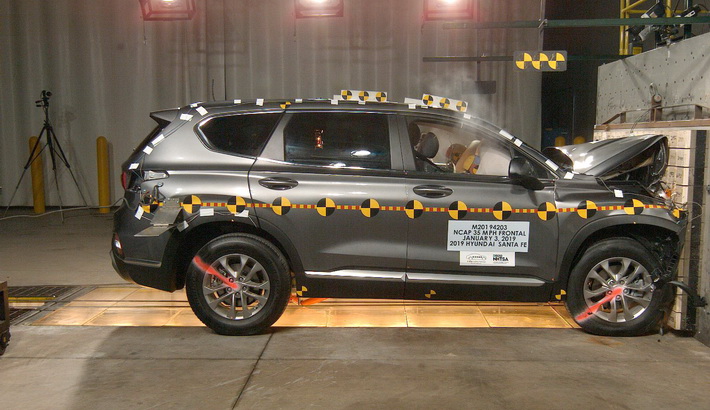
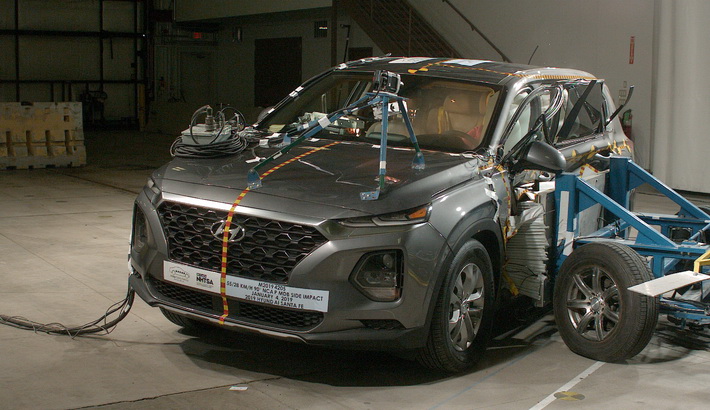
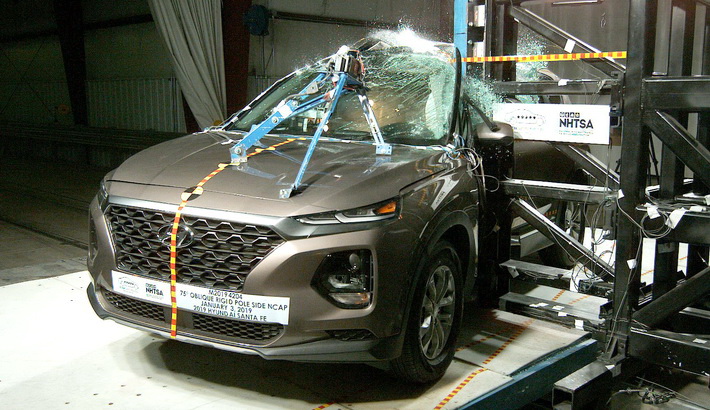
NHTSA crash tests
The agency crash-tested this model year itself. These are its own
photographs and star ratings.
Frontal crash test
Side barrier crash test
Side pole crash test
Photographs taken by NHTSA during its own New Car Assessment Program crash
tests of this model year. Public domain.
Configuration
Overall
Front
Side
Rollover
2019 Hyundai Santa Fe SUV AWD
14.6% risk
2019 Hyundai Santa Fe SUV FWD
15.5% risk
When owners complained
A spike years after the car went on sale usually means a part wearing
out on schedule across the whole fleet — the kind of pattern no single
owner can see from inside their own car.
Oct 2018peak 11Sep 2026
NHTSA investigations into the 2019 Hyundai Santa FE
An investigation is the step before a recall: the agency has seen enough
complaints to look into a pattern itself. An open one means it thinks
something may be wrong and nothing has been fixed yet.
DP22003Opened 12 Sep 2022Closed 12 Dec 2023ENGINE
Loss of Motive Power
The National Highway Traffic Safety Administration (NHTSA) received a letter dated July 13, 2022, petitioning the Agency to initiate a safety defect investigation into loss of motive power allegations attributed to oil drain pan assembly failures on certain Hyundai Motor America, Inc. and Kia America, Inc. vehicles spanning Model Years (MY) 2005-2021. The Petitioners cited examples of complaints indicating that the subject vehicles were experiencing rapid loss of engine oil due to oil drain plug back outs, resulting in loss of motive power and/or catastrophic engine damage. Additional complain...
Recalls on the 2019 Hyundai Santa FE
A complaint is one owner's allegation. A recall is the point at which
the manufacturer or a regulator agreed the defect is real and dangerous
enough to fix for free — however old the car is.
United States — NHTSA
23V181000
TRAILER HITCHES
Hyundai Motor America (Hyundai) is recalling certain 2019-2023 Santa Fe, 2021-2023 Santa Fe HEV, 2022-2023 Santa Fe Plug-in HEV and Santa Cruz vehicles potentially equipped with a tow hitch harness installed as original equipment, or purchased as an accessory through a Hyundai dealership. Water accumulation on the tow hitch harness module printed circuit board (PCB) may cause an electrical short, which can result in a fire.
Risk: A fire while parked or driving can increase the risk of injury.
18V715000
AIR BAGS:SIDE/WINDOW
Hyundai Motor America (Hyundai) is recalling certain 2019 Hyundai Santa Fe vehicles. The Side Curtain Air Bag (SCAB) mounting bolts may interfere with and damage the air bags during deployment.
Risk: In the event of a crash, if the air bags become damaged during deployment they may not inflate properly, increasing the risk of injury.
Canada — Transport Canada
Canada runs its own recall programme, and its campaigns do not
always mirror the American ones.
Recall 2024552824,695 units in Canada
Label
Issue: On certain vehicles, the compliance label may be missing information in French. The words listed on the label for "Tires", "Rims", "Front" and "Rear" appear in English only, when they should be listed as "Tires/Pneus", "Rims/Jantes", "Front/Avant" and "Rear/Arriere". Canadian regulations require this information to be listed on the label in both English and French. Safety Risk: These small errors do not affect vehicle safety. Corrective Actions: This is not a recall. The company has corrected the compliance label for all new vehicles.
Recall 20231471,897 units in Canada
Electrical
Issue: Certain vehicles may be equipped with a 4-pin accessory trailer wiring harness kit that could fail. Over time, this could result in a short circuit that can cause the control module to overheat. Note: This recall only affects Hyundai Genuine 4-pin tow hitch wiring harness kits with the part number S2F67-AC401. These kits may have been ordered at the time of a vehicle purchase or purchased separately from a dealer as an aftermarket accessory. Safety Risk: A short circuit can create a fire risk, even while the vehicle is parked and turned off. Corrective Actions: Hyundai will notify owners by mail and instruct you to bring your vehicle to a dealership to inspect the vehicle for a trailer wiring harness kit. If necessary, the dealer will install a 15A fuse and a wire extension kit. Hyundai advises that if your vehicle has a tow hitch harness installed, you should park it outdoors, and away from other vehicles or structures until the recall repairs have been completed.
Recall 2019640275,533 units in Canada
Engine
Issue: Hyundai Auto Canada is conducting a Product Improvement Campaign that provides an update to the engine control module to detect potential problems before an engine fails. An engine failure would cause a sudden loss of power with an inability to restart. Note: This affects Sonata and Santa Fe Sport equipped with a 2.4 L GDI or 2.0 L Turbo GDI engine, as well as Tucson equipped with a 2.4 L GDI engine. Safety Risk: A sudden loss of engine power could increase the risk of an accident. Corrective Actions: The company will notify owners by mail. Owners will be instructed to take their vehicle to a dealer to update the software for the engine control module. Note: Vehicles previously repaired under Product Improvement Campaign R0153 (TC # 2019-130) do not require this software update. Owners can find additional information at <a href="http://www.hyundaiengineinfo.ca">www.hyundaiengineinfo.ca</a>.
Recall 2018581990 units in Canada
Airbag
On certain vehicles equipped with side curtain airbags, the installation bolts could damage the airbags when they deploy. In the event of a crash requiring deployment of the side curtain airbags, the airbags may not inflate properly, which could increase the risk of injury to vehicle occupants. Correction: Dealers will install a protective cover over the side curtain airbag installation bolts.
Reports where the owner recorded a crash, a fire, an injury or a death.
Jenkintown, PA, PAFire
ENGINE
2019 Santa Fe with 80,000 miles showed signs of excessive oil consumption. Service was scheduled with licensed Hyundai franchise service center. Known oil consumption issues on Theta II engines for that year. Testing requires 3 steps. First step is to change the oil and document levels. Engine is tested for 1000 miles then returned to service center. After 1000 miles, service center reports 2.5 qts of oil per 1000 miles. Hyundai corporate was contacted where they approved warranty work for the vehicle. Step two requires Combustion Chamber Cleaning. During this portion of the work, service center calls about fire that took place immediately after a test drive. Dealership states engine and components destroyed.
NHTSA complaint #11763606 — an unverified report by a vehicle owner.
Bethany, CTFire
ENGINE
Yesterday afternoon after running errands, my car was off and in my driveway. Within 15 minutes I noticed it was smoking. When I opened the hood. The engine was on fire. I attempted to put it out but was unsuccessful. 911 was called and responded to put the flame out. The car was destroyed. I recently had my engine resealed and turbo replaced at a Hyundai dealership. I picked up my car following repairs on April 18th.
NHTSA complaint #11658806 — an unverified report by a vehicle owner.
at 77,200 milesCalifornia, PACrashFire1 injured
SERVICE BRAKES
The contact owned a 2019 Hyundai Santa Fe. The contact stated that as his daughter was driving at 20 MPH on the highway, she depressed the brake pedal, the brakes failed to respond, and the vehicle started to smoke from the engine and into the cabin. There were no warning lights illuminated. The contact's daughter then tried to depress the brake pedal again, and the contact's daughter then jumped out of the vehicle on the ramp. The vehicle was coming down on the intersection unoccupied, engulfed in smoke, initially hitting a stop sign and then another unknown sign and sequentially coming to a stop. The contact then saw the vehicle at the hillside engulfed with fire and smoke and tried to break a window, however, the contact heard his daughter and stopped. The Fire Department and Police Department were on scene and extinguished the remaining of the fire and the hillside. The origin of the fire was on the engine. The manufacturer was not made aware of the failure. The vehicle was consumed by the fire and the remainder were taken to Lenzi Automotive. The contact was the only occupant in the vehicle and sustained scrapes and bruises to her elbow, finger, right thigh, buttocks, and back rib that require medical attention. The failure mileage was approximately 77,200.
NHTSA complaint #11648747 — an unverified report by a vehicle owner.
Washington, MOFire
ELECTRICAL SYSTEM
Fire while driving - Electrical - No Warnings Reference NHTSA Recall 23V181000 Fire Extinguished once by fire extinguisher (civilian) then again by Union, MO fire department. Hyundai had the vehicle towed to their inspection facility. Inspection report being withheld. Claim has been denied. Hyundai now refusing to return vehicle.
NHTSA complaint #11576743 — an unverified report by a vehicle owner.
Cantonment, FLCrashFire1 injured
UNKNOWN OR OTHER
On June 28th at approximately 1130pm, my son was involved in a single vehicle accident. Upon impact with the tree the car immediately burst into flames
NHTSA complaint #11530021 — an unverified report by a vehicle owner.
Cantonment, FLCrashFire1 injured
FIRERELATED
On June 28th at approximately 1130pm, my son was involved in a single vehicle accident. Upon impact with the tree the car immediately burst into flames
NHTSA complaint #11530021 — an unverified report by a vehicle owner.
The most recent complaints
In the owners' own words, exactly as filed with NHTSA.
Jenkintown, PA, PAFire
ENGINE
2019 Santa Fe with 80,000 miles showed signs of excessive oil consumption. Service was scheduled with licensed Hyundai franchise service center. Known oil consumption issues on Theta II engines for that year. Testing requires 3 steps. First step is to change the oil and document levels. Engine is tested for 1000 miles then returned to service center. After 1000 miles, service center reports 2.5 qts of oil per 1000 miles. Hyundai corporate was contacted where they approved warranty work for the vehicle. Step two requires Combustion Chamber Cleaning. During this portion of the work, service center calls about fire that took place immediately after a test drive. Dealership states engine and components destroyed.
NHTSA complaint #11763606 — an unverified report by a vehicle owner.
East Aurora, NY
FUEL/PROPULSION SYSTEM
My vehicle had a very strong gas smell inside and outside of the car. I found a gas puddle under the car coming from the back of the vehicle. Car was hesitating when I stepped on the gas. I was afraid it may stall. I drove the vehicle to my regular service station. Vehicle has an active fuel leak and this is a fire hazard. I was very concerned whether the vehicle would stall and cause an accident. Warranty coverage was denied.
NHTSA complaint #11762546 — an unverified report by a vehicle owner.
Sterling, VA
POWER TRAIN
Update Re: ODI Complaint Number: 11759237 Subsequent Actions and Manufacturer Refusal to Remediate Safety Defect: Following the [XXX], acute safety incident—where the vehicle lost motive power and entered severe limp mode on [XXX] immediately upon release from Sheehy Hyundai of Chantilly—the vehicle remained in dealer custody for 11 days (August 20–August 31, 2026). Failure to Diagnose Core Defect: Despite recurring total power loss, active diagnostic trouble code P00AF00 (Turbocharger Boost Control Module Performance), and four consecutive turbocharger destructions within 20,000 miles, the authorized dealership refused to conduct internal engine diagnostics, drop the oil pan, inspect the oil filter, or perform borescope checks. Physical Contamination Documented: On August 29, 2026, an on-site physical inspection confirmed sparkling metallic particulate suspended in the engine oil on the dipstick and substantial oil blow-by/intrusion into the turbocharger air intake line. Formal Denial of Safety/Warranty Coverage: On August 31, 2026, dealership management and Hyundai Motor America (Consumer Affairs Case #[XXX]) formally denied warranty assistance and refused engine teardown under the Theta II Lifetime Engine Warranty Settlement. Coverage was declined citing "outside influence" due to an aftermarket turbocharger assembly, while Hyundai refused to investigate the underlying engine failure contaminating and destroying the forced-induction system. Evidence Preservation: On August 31, 2026, the vehicle was towed to an independent facility to mitigate road hazards, conduct teardown diagnostics, and preserve the engine oil/filter for ISO-accredited spectrographic laboratory analysis. The manufacturer released an unsafe vehicle into traffic on August 20, 2026, and subsequently refused to investigate or remedy a documented internal engine failure that creates sudden, recurring loss of motive power. INFORMATION REDACTED PURSUANT TO THE FREEDOM OF INFORMATION ACT (FOIA), 5 U.S.C. 552(B)(6)
NHTSA complaint #11761505 — an unverified report by a vehicle owner.
Sterling, VA
ENGINE
Update Re: ODI Complaint Number: 11759237 Subsequent Actions and Manufacturer Refusal to Remediate Safety Defect: Following the [XXX], acute safety incident—where the vehicle lost motive power and entered severe limp mode on [XXX] immediately upon release from Sheehy Hyundai of Chantilly—the vehicle remained in dealer custody for 11 days (August 20–August 31, 2026). Failure to Diagnose Core Defect: Despite recurring total power loss, active diagnostic trouble code P00AF00 (Turbocharger Boost Control Module Performance), and four consecutive turbocharger destructions within 20,000 miles, the authorized dealership refused to conduct internal engine diagnostics, drop the oil pan, inspect the oil filter, or perform borescope checks. Physical Contamination Documented: On August 29, 2026, an on-site physical inspection confirmed sparkling metallic particulate suspended in the engine oil on the dipstick and substantial oil blow-by/intrusion into the turbocharger air intake line. Formal Denial of Safety/Warranty Coverage: On August 31, 2026, dealership management and Hyundai Motor America (Consumer Affairs Case #[XXX]) formally denied warranty assistance and refused engine teardown under the Theta II Lifetime Engine Warranty Settlement. Coverage was declined citing "outside influence" due to an aftermarket turbocharger assembly, while Hyundai refused to investigate the underlying engine failure contaminating and destroying the forced-induction system. Evidence Preservation: On August 31, 2026, the vehicle was towed to an independent facility to mitigate road hazards, conduct teardown diagnostics, and preserve the engine oil/filter for ISO-accredited spectrographic laboratory analysis. The manufacturer released an unsafe vehicle into traffic on August 20, 2026, and subsequently refused to investigate or remedy a documented internal engine failure that creates sudden, recurring loss of motive power. INFORMATION REDACTED PURSUANT TO THE FREEDOM OF INFORMATION ACT (FOIA), 5 U.S.C. 552(B)(6)
NHTSA complaint #11761505 — an unverified report by a vehicle owner.
Sterling, VA
FUEL/PROPULSION SYSTEM
Update Re: ODI Complaint Number: 11759237 Subsequent Actions and Manufacturer Refusal to Remediate Safety Defect: Following the [XXX], acute safety incident—where the vehicle lost motive power and entered severe limp mode on [XXX] immediately upon release from Sheehy Hyundai of Chantilly—the vehicle remained in dealer custody for 11 days (August 20–August 31, 2026). Failure to Diagnose Core Defect: Despite recurring total power loss, active diagnostic trouble code P00AF00 (Turbocharger Boost Control Module Performance), and four consecutive turbocharger destructions within 20,000 miles, the authorized dealership refused to conduct internal engine diagnostics, drop the oil pan, inspect the oil filter, or perform borescope checks. Physical Contamination Documented: On August 29, 2026, an on-site physical inspection confirmed sparkling metallic particulate suspended in the engine oil on the dipstick and substantial oil blow-by/intrusion into the turbocharger air intake line. Formal Denial of Safety/Warranty Coverage: On August 31, 2026, dealership management and Hyundai Motor America (Consumer Affairs Case #[XXX]) formally denied warranty assistance and refused engine teardown under the Theta II Lifetime Engine Warranty Settlement. Coverage was declined citing "outside influence" due to an aftermarket turbocharger assembly, while Hyundai refused to investigate the underlying engine failure contaminating and destroying the forced-induction system. Evidence Preservation: On August 31, 2026, the vehicle was towed to an independent facility to mitigate road hazards, conduct teardown diagnostics, and preserve the engine oil/filter for ISO-accredited spectrographic laboratory analysis. The manufacturer released an unsafe vehicle into traffic on August 20, 2026, and subsequently refused to investigate or remedy a documented internal engine failure that creates sudden, recurring loss of motive power. INFORMATION REDACTED PURSUANT TO THE FREEDOM OF INFORMATION ACT (FOIA), 5 U.S.C. 552(B)(6)
NHTSA complaint #11761505 — an unverified report by a vehicle owner.
Waukesha, WI
POWER TRAIN
My vehicle recently received the Hyundai 9c2 emissions upgrade they required and since then the vehicle has had predictable acceleration issues for the first several minutes after the vehicle. While trying to slowly accelerate the vehicle with unpredictably lurch forward. Many people have been reporting this.
NHTSA complaint #11760439 — an unverified report by a vehicle owner.
Waukesha, WI
ENGINE
My vehicle recently received the Hyundai 9c2 emissions upgrade they required and since then the vehicle has had predictable acceleration issues for the first several minutes after the vehicle. While trying to slowly accelerate the vehicle with unpredictably lurch forward. Many people have been reporting this.
NHTSA complaint #11760439 — an unverified report by a vehicle owner.
Waukesha, WI
FUEL/PROPULSION SYSTEM
My vehicle recently received the Hyundai 9c2 emissions upgrade they required and since then the vehicle has had predictable acceleration issues for the first several minutes after the vehicle. While trying to slowly accelerate the vehicle with unpredictably lurch forward. Many people have been reporting this.
NHTSA complaint #11760439 — an unverified report by a vehicle owner.
Sterling, VA
POWER TRAIN
The vehicle suffers from recurring, sudden loss of motive power and transitions into engine "limp mode" while driving in active, heavy traffic. This severe drivability defect has occurred on four separate occasions under Diagnostic Trouble Code (DTC) P00AF00 (Turbocharger/Supercharger Boost Control "A" Module Performance) and related boost/MAP faults (P0234). During these episodes, the vehicle abruptly loses acceleration capability without warning, creating an acute collision risk when navigating highway traffic and intersections. The turbocharger assembly has required replacement three separate times due to recurring oil contamination from the engine crankcase. Despite meticulous maintenance (documented synthetic oil changes every 3,000–5,000 miles since new), the manufacturer and dealership have repeatedly blamed peripheral turbo components rather than diagnosing or repairing the root cause (I suspect excessive engine crankcase pressure/piston ring blow-by based on the significant oil deposition on the turbo, map sensor, and pooling in the intake line).
NHTSA complaint #11759237 — an unverified report by a vehicle owner.
Sterling, VA
ENGINE
The vehicle suffers from recurring, sudden loss of motive power and transitions into engine "limp mode" while driving in active, heavy traffic. This severe drivability defect has occurred on four separate occasions under Diagnostic Trouble Code (DTC) P00AF00 (Turbocharger/Supercharger Boost Control "A" Module Performance) and related boost/MAP faults (P0234). During these episodes, the vehicle abruptly loses acceleration capability without warning, creating an acute collision risk when navigating highway traffic and intersections. The turbocharger assembly has required replacement three separate times due to recurring oil contamination from the engine crankcase. Despite meticulous maintenance (documented synthetic oil changes every 3,000–5,000 miles since new), the manufacturer and dealership have repeatedly blamed peripheral turbo components rather than diagnosing or repairing the root cause (I suspect excessive engine crankcase pressure/piston ring blow-by based on the significant oil deposition on the turbo, map sensor, and pooling in the intake line).
NHTSA complaint #11759237 — an unverified report by a vehicle owner.
Sterling, VA
FUEL/PROPULSION SYSTEM
The vehicle suffers from recurring, sudden loss of motive power and transitions into engine "limp mode" while driving in active, heavy traffic. This severe drivability defect has occurred on four separate occasions under Diagnostic Trouble Code (DTC) P00AF00 (Turbocharger/Supercharger Boost Control "A" Module Performance) and related boost/MAP faults (P0234). During these episodes, the vehicle abruptly loses acceleration capability without warning, creating an acute collision risk when navigating highway traffic and intersections. The turbocharger assembly has required replacement three separate times due to recurring oil contamination from the engine crankcase. Despite meticulous maintenance (documented synthetic oil changes every 3,000–5,000 miles since new), the manufacturer and dealership have repeatedly blamed peripheral turbo components rather than diagnosing or repairing the root cause (I suspect excessive engine crankcase pressure/piston ring blow-by based on the significant oil deposition on the turbo, map sensor, and pooling in the intake line).
NHTSA complaint #11759237 — an unverified report by a vehicle owner.
Huntington, NY
POWER TRAIN
Transmission was replaced under warranty by Hyundai in Nov 2024. Engine was replaced at 100600 miles in Nov 2025. Issues with the transmission were happening at that time but ignored by dealership as issues related to failing engine. Our mechanic confirmed in April that transmission was failing and told us to go to Hyundai. We went to dealer in April 2026. They confirmed transmission needed to be replaced. They were going to contact Hyundai USA. We received no updates despite many calls to the dealer. We had to call Hyundai USA directly. They opened a case. Dealer finally called and took car in and requested good faith repair by Hyundai USA. Hyundai USA responded 2 weeks later and is not covering anything. They replaced our transmission in Nov 2024 with a refurbished transmission that they NO LONGER MAKE. Clearly due to the fact that the refurbished part doesn’t work. They now want me to pay $8000 to repair transmission. My car has been maintained on schedule by my mechanic. All paperwork available. I have had Toyotas, Hondas and chevys that have lasted close to 20 years. This has been a horribly disappointing experience. And I now need to buy a new car for my 17 year old instead of handing down. I will NEVER buy another Hyundai. I want everyone to be aware of my experience. Disgusting customer service by Hyundai USA.
NHTSA complaint #11752203 — an unverified report by a vehicle owner.
Macon, GA
POWER TRAIN
COMPLAINT SUMMARY: [XXX] / ENGINE THERMAL FIRE RISK / WARRANTY DECEPTION My 2019 Hyundai Santa Fe (2.4L GDI Engine) is experiencing severe powertrain degradation under the known Theta II engine defect class-action framework. On November 7, 2025, the vehicle logged a Permanent Diagnostic Trouble Code (DTC) P1326 via an independent scan, indicating catastrophic internal rod bearing wear. On XXX, the vehicle was brought to Hyundai of Milledgeville for safety recall verification. Instead of executing the mandatory corporate-directed Bearing Clearance Test (BCT) to replace the failing engine block, the service department committed technical campaign malpractice. The technician forced the 9C2 ECU Software Update directly over the locked mechanical fault to suppress the dashboard warning lights and alter the vehicle's ROM ID parameter limits. When caught via a photograph of their active GDS diagnostic tablet showing 7 historical system faults, the service manager provided a truncated printed report hiding Page 1 and omitting the critical P1326 powertrain code count to evade a warranty engine replacement. Due to these unmitigated delays, the vehicle has suffered severe consequential safety damage. The advanced engine degradation and oil consumption have flooded the exhaust system, melting the catalytic converter substrate and triggering a new DTC P042000 (Catalyst Efficiency) fault immediately after the dealer visit. The extreme engine vibrations have also damaged the transmission's torque converter clutch (DTC P074100). The dealership refused a service loaner and knowingly sent a disabled consumer and an elderly passenger away in an active, failing vehicle that presents a sudden stall-on-highway hazard and a severe thermal exhaust fire risk under extreme summer heat conditions. Hyundai Motor America Corporate has failed to provide emergency towing or alternative mobility accommodations despite a registered corporate case file. INFORMATION REDACTED PURSUANT TO THE FREEDOM OF INFORMATION ACT (FOIA), 5 U.S.C. 552(B)(
NHTSA complaint #11749805 — an unverified report by a vehicle owner.
Macon, GA
ENGINE
COMPLAINT SUMMARY: [XXX] / ENGINE THERMAL FIRE RISK / WARRANTY DECEPTION My 2019 Hyundai Santa Fe (2.4L GDI Engine) is experiencing severe powertrain degradation under the known Theta II engine defect class-action framework. On November 7, 2025, the vehicle logged a Permanent Diagnostic Trouble Code (DTC) P1326 via an independent scan, indicating catastrophic internal rod bearing wear. On XXX, the vehicle was brought to Hyundai of Milledgeville for safety recall verification. Instead of executing the mandatory corporate-directed Bearing Clearance Test (BCT) to replace the failing engine block, the service department committed technical campaign malpractice. The technician forced the 9C2 ECU Software Update directly over the locked mechanical fault to suppress the dashboard warning lights and alter the vehicle's ROM ID parameter limits. When caught via a photograph of their active GDS diagnostic tablet showing 7 historical system faults, the service manager provided a truncated printed report hiding Page 1 and omitting the critical P1326 powertrain code count to evade a warranty engine replacement. Due to these unmitigated delays, the vehicle has suffered severe consequential safety damage. The advanced engine degradation and oil consumption have flooded the exhaust system, melting the catalytic converter substrate and triggering a new DTC P042000 (Catalyst Efficiency) fault immediately after the dealer visit. The extreme engine vibrations have also damaged the transmission's torque converter clutch (DTC P074100). The dealership refused a service loaner and knowingly sent a disabled consumer and an elderly passenger away in an active, failing vehicle that presents a sudden stall-on-highway hazard and a severe thermal exhaust fire risk under extreme summer heat conditions. Hyundai Motor America Corporate has failed to provide emergency towing or alternative mobility accommodations despite a registered corporate case file. INFORMATION REDACTED PURSUANT TO THE FREEDOM OF INFORMATION ACT (FOIA), 5 U.S.C. 552(B)(
NHTSA complaint #11749805 — an unverified report by a vehicle owner.
Macon, GA
FUEL/PROPULSION SYSTEM
COMPLAINT SUMMARY: [XXX] / ENGINE THERMAL FIRE RISK / WARRANTY DECEPTION My 2019 Hyundai Santa Fe (2.4L GDI Engine) is experiencing severe powertrain degradation under the known Theta II engine defect class-action framework. On November 7, 2025, the vehicle logged a Permanent Diagnostic Trouble Code (DTC) P1326 via an independent scan, indicating catastrophic internal rod bearing wear. On XXX, the vehicle was brought to Hyundai of Milledgeville for safety recall verification. Instead of executing the mandatory corporate-directed Bearing Clearance Test (BCT) to replace the failing engine block, the service department committed technical campaign malpractice. The technician forced the 9C2 ECU Software Update directly over the locked mechanical fault to suppress the dashboard warning lights and alter the vehicle's ROM ID parameter limits. When caught via a photograph of their active GDS diagnostic tablet showing 7 historical system faults, the service manager provided a truncated printed report hiding Page 1 and omitting the critical P1326 powertrain code count to evade a warranty engine replacement. Due to these unmitigated delays, the vehicle has suffered severe consequential safety damage. The advanced engine degradation and oil consumption have flooded the exhaust system, melting the catalytic converter substrate and triggering a new DTC P042000 (Catalyst Efficiency) fault immediately after the dealer visit. The extreme engine vibrations have also damaged the transmission's torque converter clutch (DTC P074100). The dealership refused a service loaner and knowingly sent a disabled consumer and an elderly passenger away in an active, failing vehicle that presents a sudden stall-on-highway hazard and a severe thermal exhaust fire risk under extreme summer heat conditions. Hyundai Motor America Corporate has failed to provide emergency towing or alternative mobility accommodations despite a registered corporate case file. INFORMATION REDACTED PURSUANT TO THE FREEDOM OF INFORMATION ACT (FOIA), 5 U.S.C. 552(B)(
NHTSA complaint #11749805 — an unverified report by a vehicle owner.
Philadelphia, PA
POWER TRAIN
My 2019 Hyundai Santa Fe 2.4L (VIN: [XXX]) is experiencing a severe safety defect involving rapid engine oil starvation. The vehicle recently failed an official oil consumption test conducted by Fred Beans Hyundai of Abington, where it was documented that the engine consumed 1 quart of oil in just 881 miles (PA Request #XXX). This vehicle is equipped with the Theta II engine, which currently has active warranty extensions (TXXC and TXXI) specifically covering connecting rod bearing failure. Despite the documented severe oil loss—which is the primary known cause of connecting rod bearing wear and sudden engine seizure—Hyundai Corporate (Case #XXX) is refusing to evaluate the vehicle under these warranties. They have improperly classified my claim as a denied "goodwill" request and are refusing to perform a connecting rod bearing clearance test to determine if the bearings have been damaged by this starvation. Because Hyundai refuses to perform the required diagnostic safety protocols, the vehicle must be driven in an oil-starved condition. This poses an imminent and severe safety risk of sudden engine seizure, stalling, and complete loss of motive power at highway speeds without warning, which could result in a catastrophic crash. The manufacturer is ignoring their own failure thresholds and putting driver safety at risk. INFORMATION REDACTED PURSUANT TO THE FREEDOM OF INFORMATION ACT (FOIA), 5 U.S.C. 552(B)(6)
NHTSA complaint #11742308 — an unverified report by a vehicle owner.
Pikesville, MD
POWER TRAIN
On March 04, 2026, I took my 2019 Hyundai Santa Fe to the local dealer for oil change service. As part of that service visit, they performed Hyundai recall 9C1 which was supposed to lower tailpipe emissions. The next morning, and ever since, my vehicle ran differently. The engine had several 1000rpm surges and was sluggish at other times. This behavior has continued. Particularly when I first start out in the morning and the engine is cold. Never after the engine is warmed up. A visit to the Hyundai forum shows a growing list of other Hyundai owners who are experiencing the same issues. This recall is defective and should be corrected.
NHTSA complaint #11742383 — an unverified report by a vehicle owner.
Philadelphia, PA
ENGINE
My 2019 Hyundai Santa Fe 2.4L (VIN: [XXX]) is experiencing a severe safety defect involving rapid engine oil starvation. The vehicle recently failed an official oil consumption test conducted by Fred Beans Hyundai of Abington, where it was documented that the engine consumed 1 quart of oil in just 881 miles (PA Request #XXX). This vehicle is equipped with the Theta II engine, which currently has active warranty extensions (TXXC and TXXI) specifically covering connecting rod bearing failure. Despite the documented severe oil loss—which is the primary known cause of connecting rod bearing wear and sudden engine seizure—Hyundai Corporate (Case #XXX) is refusing to evaluate the vehicle under these warranties. They have improperly classified my claim as a denied "goodwill" request and are refusing to perform a connecting rod bearing clearance test to determine if the bearings have been damaged by this starvation. Because Hyundai refuses to perform the required diagnostic safety protocols, the vehicle must be driven in an oil-starved condition. This poses an imminent and severe safety risk of sudden engine seizure, stalling, and complete loss of motive power at highway speeds without warning, which could result in a catastrophic crash. The manufacturer is ignoring their own failure thresholds and putting driver safety at risk. INFORMATION REDACTED PURSUANT TO THE FREEDOM OF INFORMATION ACT (FOIA), 5 U.S.C. 552(B)(6)
NHTSA complaint #11742308 — an unverified report by a vehicle owner.
Pikesville, MD
ENGINE
On March 04, 2026, I took my 2019 Hyundai Santa Fe to the local dealer for oil change service. As part of that service visit, they performed Hyundai recall 9C1 which was supposed to lower tailpipe emissions. The next morning, and ever since, my vehicle ran differently. The engine had several 1000rpm surges and was sluggish at other times. This behavior has continued. Particularly when I first start out in the morning and the engine is cold. Never after the engine is warmed up. A visit to the Hyundai forum shows a growing list of other Hyundai owners who are experiencing the same issues. This recall is defective and should be corrected.
NHTSA complaint #11742383 — an unverified report by a vehicle owner.
Pikesville, MD
FUEL/PROPULSION SYSTEM
On March 04, 2026, I took my 2019 Hyundai Santa Fe to the local dealer for oil change service. As part of that service visit, they performed Hyundai recall 9C1 which was supposed to lower tailpipe emissions. The next morning, and ever since, my vehicle ran differently. The engine had several 1000rpm surges and was sluggish at other times. This behavior has continued. Particularly when I first start out in the morning and the engine is cold. Never after the engine is warmed up. A visit to the Hyundai forum shows a growing list of other Hyundai owners who are experiencing the same issues. This recall is defective and should be corrected.
NHTSA complaint #11742383 — an unverified report by a vehicle owner.
Farmingdale, NY
POWER TRAIN
In December 2025, a Hyundai dealer performed Service Campaign 9C2 (TSB 25-01-087H), an ECU software update for the 2.4L GDI Theta II engine, during a routine annual NY state emissions inspection. Immediately following this update, the vehicle began exhibiting an RPM flare of approximately 1,200-1,500 RPM during upshifting under light acceleration. This behavior did not exist prior to the update. The condition occurs when ambient temperature is above 50°F and the vehicle has been parked 2+ hours after a prior drive. No warning lamps or fault codes have been present at any point. The issue has been confirmed across four dealer visits at two Hyundai dealerships over five months. Attempted remedies included transmission ECU updates and adaptive resets — none resolved the condition. On the fourth visit, the technician personally experienced the issue and identified reinstalling the pre-update ECU calibration as the likely fix, but stated the prior software version was unavailable. The repair order was nonetheless closed as "vehicle operating as designed." The case has been escalated to Hyundai Motor America National Consumer Affairs and forwarded to Hyundai engineering with no resolution to date. Multiple other 2019-2020 Santa Fe owners report identical post-9C2 symptoms on public forums, indicating a pattern associated with this campaign's ECU calibration. The unexpected RPM surge and erratic shifting during acceleration creates an unpredictable driving experience that could cause hesitation in traffic situations requiring smooth acceleration.
NHTSA complaint #11741031 — an unverified report by a vehicle owner.
Tulsa, OK
UNKNOWN OR OTHER
Vehicle: 2019 Hyundai Santa Fe, VIN [XXX] , exterior Quartz White Pearl. Component: Exterior factory paint (paint/trim). Complaint: This vehicle exhibits a systemic, progressive factory paint defect — excessive peeling and bubbling of the white finish that spreads from one body panel to the next. This is a known defect across this vehicle generation; Hyundai acknowledged it by issuing Warranty Extension Z05 (TSB 25-BD-004H), which extends paint coverage to 10 years/unlimited miles for affected white-paint vehicles including the 2019 Santa Fe. Hyundai repaired the hood under this warranty in 2025, during which the vehicle was out of service for 77 consecutive days. Since that repair, the defect has migrated to the adjacent fender and has also appeared on a door, demonstrating that it is spreading across the vehicle. Hyundai has offered to repaint only the single currently-visible panel rather than addressing the systemic defect. I am filing this complaint to document the defect and its progression, and to support the public record regarding factory paint failure on these vehicles. No crash, injury, or fire has resulted. The vehicle is owned by my spouse; I am submitting as authorized representative. INFORMATION REDACTED PURSUANT TO THE FREEDOM OF INFORMATION ACT (FOIA), 5 U.S.C. 552(B)(6)
NHTSA complaint #11739369 — an unverified report by a vehicle owner.
Buda, TX
UNKNOWN OR OTHER
Hyundai recently had a service campaign that was issued to address an emissions related issue in CA. The service campaign was 9C2 and the TSB was 25-01-087H. After this software update was applied to my vehicle the engine is now sluggish on a cold start and the transmission is shifting differently at low speeds and low gears. It appears that the performance of my vehicle has been compromised. There is a Hyundai forum where many Santa Fe owners are experiencing the same issues after the software update. I have notified the service advisor at my local Hyundai dealership.
NHTSA complaint #11737086 — an unverified report by a vehicle owner.
Pine Bush, NY
SUSPENSION
Engine is burning a tremendous amount of motor oil. Dealer does acknowledge engine is burning oil. No warning lights on. Told burning motor oil is normal for a hyundai engine. Engine can seize during driving with no warning and is a safety issue. Front struts are also failing. No warning and is a safety issue: Currently trying to get dealer to cover defective components under warranty. Nothing has been repaired or resolved as of yet.
NHTSA complaint #11736151 — an unverified report by a vehicle owner.
Pine Bush, NY
ENGINE
Engine is burning a tremendous amount of motor oil. Dealer does acknowledge engine is burning oil. No warning lights on. Told burning motor oil is normal for a hyundai engine. Engine can seize during driving with no warning and is a safety issue. Front struts are also failing. No warning and is a safety issue: Currently trying to get dealer to cover defective components under warranty. Nothing has been repaired or resolved as of yet.
NHTSA complaint #11736151 — an unverified report by a vehicle owner.