Owners have filed 82 complaints
about the 2021 Nissan Leaf with NHTSA between 2021 and 2026.
The largest single group is the electrical system.
Across this model's run it ranks 5 of 14 worst.
The letter says how bad. This says what kind — whether this year drew
an unusual number of complaints, unusually dangerous
ones, or failures that arrived unusually early.
The dashed ring is 50 — the national norm. Further out is worse.
Complaint volume — 38
Against the median year of the Nissan Leaf. 50 means typical for this
model; 100 means roughly double.
Severity — 100
19.5% of these complaints
involved a crash, fire, injury or death, against a national rate of
9.7%.
Early failure — 100
67% of failures with a mileage on record happened under
36,000 miles, against a national rate of
29%.
Odometer readings owners gave when they filed. About half of all
complaints include one.
10,000 – 24,999 miles
116.7%
25,000 – 49,999 miles
466.7%
50,000 – 74,999 miles
116.7%
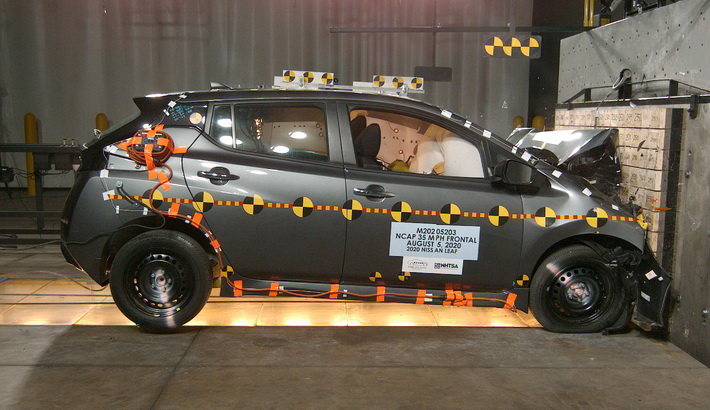
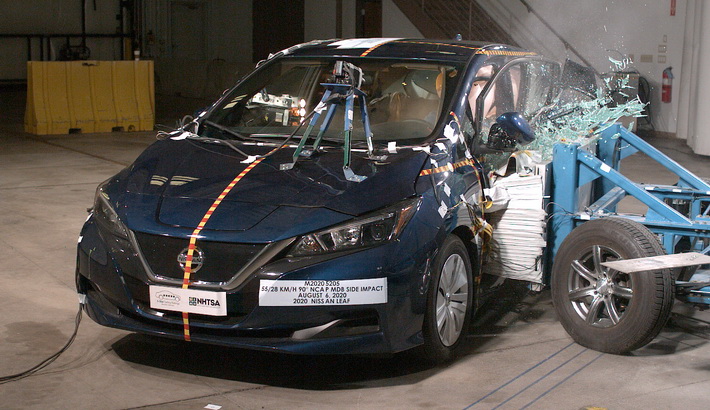
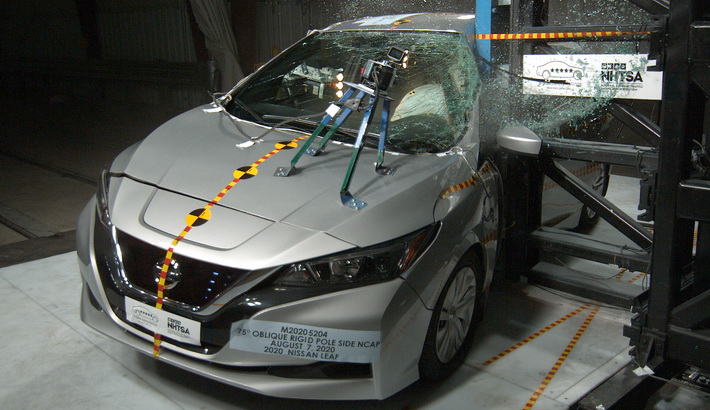
NHTSA crash tests
The agency crash-tested this model year itself. These are its own
photographs and star ratings.
Frontal crash test
Side barrier crash test
Side pole crash test
Photographs taken by NHTSA during its own New Car Assessment Program crash
tests of this model year. Public domain.
Configuration
Overall
Front
Side
Rollover
2021 Nissan LEAF (40 KWh Battery) 5 HB FWD
10.7% risk
When owners complained
A spike years after the car went on sale usually means a part wearing
out on schedule across the whole fleet — the kind of pattern no single
owner can see from inside their own car.
Jun 2021peak 10Sep 2026
NHTSA investigations into the 2021 Nissan Leaf
An investigation is the step before a recall: the agency has seen enough
complaints to look into a pattern itself. An open one means it thinks
something may be wrong and nothing has been fixed yet.
DP22005Opened 27 Jan 2023Closed 7 Aug 2023ELECTRICAL SYSTEM:PROPULSION SYSTEM
Pedestrian alert sounds
NHTSA received a petition on or about July 18, 2022, requesting that Federal Motor Vehicle Safety Standard (FMVSS) 141 be applied to all electric and hybrid vehicles operating in the United States. The petition can be reviewed at NHTSA.gov under ODI Number 11486072. FMVSS 141 establishes performance requirements for pedestrian alert sounds for motor vehicles. The standard applies to hybrid and electric vehicles that have a gross vehicle weight rating of 4,536 KG or less or are defined as low-speed vehicles. The standard became fully applicable to all such vehicles manufactured on or after Marc...
Recalls on the 2021 Nissan Leaf
A complaint is one owner's allegation. A recall is the point at which
the manufacturer or a regulator agreed the defect is real and dangerous
enough to fix for free — however old the car is.
Nissan North America, Inc. (Nissan) is recalling certain 2021-2022 LEAF vehicles equipped with a Level 3 quick charging port. The lithium-ion battery may overheat during Level 3 charging.
Risk: A quick charging battery that overheats increases the risk of a fire.
24V071000
BACK OVER PREVENTION: SENSING SYSTEM: CAMERA
Nissan North America, Inc. (Nissan) is recalling certain 2018-2022 LEAF vehicles. Damage to the camera harness can cause distortion or loss of the rearview camera display image. As such, these vehicles fail to comply with the requirements of Federal Motor Vehicle Safety Standard number 111, "Rear Visibility."
Risk: A rearview camera that does not properly display an image can reduce the driver's rear view, increasing the risk of a crash.
23V494000
VEHICLE SPEED CONTROL
Nissan North America, Inc. (Nissan) is recalling certain 2018-2023 LEAF vehicles. The vehicle may accelerate unintentionally if the driving mode is changed ("D" to "B"; e-Pedal "On"; or "ECO" mode) after disengaging the cruise control.
Risk: Unintentional acceleration can increase the risk of a crash.
23V048000
EQUIPMENT:OTHER:OWNERS/SERVICE/OTHER MANUAL
Nissan North America, Inc. (Nissan) is recalling certain 2018-2023 LEAF vehicles. The Owner's Manual instructions for defroster operation are incorrect, and may result in reduced defroster performance under specific conditions. As such, these vehicles fail to comply with the requirements of Federal Motor Vehicle Safety Standard number 103, "Windshield Defrosting and Defogging Systems."
Risk: Reduced defroster performance can limit visibility out of the windshield, increasing the risk of a crash.
Canada — Transport Canada
Canada runs its own recall programme, and its campaigns do not
always mirror the American ones.
Recall 20255231,355 units in Canada
High Voltage
Issue: On certain vehicles, the high-voltage battery could overheat while using level 3 quick charging. As a result, the battery could create smoke or heat, which can melt or damage the battery and nearby parts. Note: This recall is an expansion of Transport Canada recall 2024-542. Safety Risk: A battery that overheats can create a fire risk. Corrective Actions: To reduce the safety risk, Nissan recommends not to use the level 3 quick charging until the recall repairs have been completed. Nissan will notify owners by mail and advise you to take your vehicle to a dealership to update the vehicle software.
Recall 202406811,985 units in Canada
Visual System
Issue: On certain vehicles, the rearview camera wiring harness could be damaged by movement and vibrations. If this happens, the rearview camera image may not display correctly or may not display at all. Canadian regulations require the rearview image to display when reversing. Safety Risk: A rearview camera image that doesn't display could reduce a driver's ability to see behind the vehicle while backing up. This could increase the risk of a crash. Corrective Actions: Nissan will notify owners by mail and advise you to take your vehicle to a dealership to inspect and secure the rearview camera wiring harness. The dealer will replace the rearview camera and wiring harness, if necessary.
Recall 202339713,390 units in Canada
Powertrain
Issue: Under certain conditions, the vehicle may not slow down after you release the accelerator pedal. This problem can only happen after a specific series of actions is performed in a short period of time, including disengaging the cruise control, changing the drive mode, and applying and releasing the accelerator pedal. If this happens, and you don't apply the brakes, the vehicle may not slow down as expected. Safety Risk: A vehicle that doesn't slow down as expected could increase the risk of a crash. Corrective Actions: Nissan will notify owners by mail and advise you to bring your vehicle to a dealership to reprogram the vehicle control module (VCM).
Recall 202304513,108 units in Canada
Heater And Defroster
Issue: When the temperature is below -10° C, the defroster may not work properly if you follow the instructions in the owner's manual and use the maximum fan speed. As a result, you may not be able to defrost the windshield. Safety Risk: A windshield that cannot be defogged or defrosted can reduce visibility and increase the risk of a crash. Corrective Actions: Nissan will notify owners by mail and supply an addendum to the owner's manual that provides the correct settings for using the defroster when the temperature is below -10° C.
Reports where the owner recorded a crash, a fire, an injury or a death.
at 25,000 milesSnellville, GAFire
ENGINE
The contact owned a 2021 Nissan Leaf. The contact received notification of NHTSA Campaign Number: 25V655000 (Electrical System). The contact stated that while at a dealer charging the vehicle for approximately 15- 20 minutes, there was a fire coming from the front of the vehicle. The fire was extinguished by the fire department after several hours. A Police report was not filed. No injuries, medical attention, or damages were reported. The vehicle was towed to a tow lot and was deemed a total loss. The manufacturer was not notified of the failure. The failure mileage was 25,000.
NHTSA complaint #11761027 — an unverified report by a vehicle owner.
Locust Grove, VAFire
UNKNOWN OR OTHER
Our vehicle was affected by recall 25V655 for defective battery. The vehicle was serviced at the Nissan dealer and the software update to resolve the recall was applied. Yesterday the vehicle spontaneously combusted during DC fast charging despite the software update. It appears that the software update was ineffective at mitigating the fire hazard.
NHTSA complaint #11752892 — an unverified report by a vehicle owner.
Farmington, UTFire
UNKNOWN OR OTHER
*High Voltage Battery defect/failure - this is what was believed to be the issue when it was towed to the dealership. What is left of it is available for inspection at the dealership for now, however the insurance may take it to a salvage yard since the fire department finished their investigation. *While at the dealership after they spent the day trying to recreate what happened they parked it and planned to try again the next day, then someone walked by and saw smoke coming from the car and called 911. They called it a thermal runaway and it burned for hours before being moved to a safer, emptier lot where it was covered in thousands of pounds of sand. The night before the mileage range dropped roughly 70%, unaware of the recall in our mail that hadn't been opened we stopped to try to charge so we could get home. Thankfully none of the chargers worked since the recall was for a potential fire if plugged into a level 3 charger. We tried to drive home only to end up on the side of the road in total system failure. Police sent incident management to get us to safety. If we had made it home we are told this could have caught our home on fire and would likely have blown up our house and taken neighbors houses out as well. It could hurt more people or structures while they tried to recreate the problem. I understand the dealership had $20K in damages from the fire on top of which my car is clearly a total loss. Homes & Businesses nearby had to be evacuated. *Yes, what is left of the car has been inspected by the county fire marshall, insurance co. Police were called, but no investigation. When I called consumer affairs at Nissan, I spoke to 3 different people who said there was nothing they could do. *We had one other time 3 weeks earlier that the range dropped significant, we got home plugged it in and it seemed fine. The only warnings said we were low on miles and to stop to charge which would have made things worse, could have killed us if they had worked.
NHTSA complaint #11705179 — an unverified report by a vehicle owner.
Farmington, UTFire
ELECTRICAL SYSTEM
*High Voltage Battery defect/failure - this is what was believed to be the issue when it was towed to the dealership. What is left of it is available for inspection at the dealership for now, however the insurance may take it to a salvage yard since the fire department finished their investigation. *While at the dealership after they spent the day trying to recreate what happened they parked it and planned to try again the next day, then someone walked by and saw smoke coming from the car and called 911. They called it a thermal runaway and it burned for hours before being moved to a safer, emptier lot where it was covered in thousands of pounds of sand. The night before the mileage range dropped roughly 70%, unaware of the recall in our mail that hadn't been opened we stopped to try to charge so we could get home. Thankfully none of the chargers worked since the recall was for a potential fire if plugged into a level 3 charger. We tried to drive home only to end up on the side of the road in total system failure. Police sent incident management to get us to safety. If we had made it home we are told this could have caught our home on fire and would likely have blown up our house and taken neighbors houses out as well. It could hurt more people or structures while they tried to recreate the problem. I understand the dealership had $20K in damages from the fire on top of which my car is clearly a total loss. Homes & Businesses nearby had to be evacuated. *Yes, what is left of the car has been inspected by the county fire marshall, insurance co. Police were called, but no investigation. When I called consumer affairs at Nissan, I spoke to 3 different people who said there was nothing they could do. *We had one other time 3 weeks earlier that the range dropped significant, we got home plugged it in and it seemed fine. The only warnings said we were low on miles and to stop to charge which would have made things worse, could have killed us if they had worked.
NHTSA complaint #11705179 — an unverified report by a vehicle owner.
Farmington, UTFire
ENGINE
*High Voltage Battery defect/failure - this is what was believed to be the issue when it was towed to the dealership. What is left of it is available for inspection at the dealership for now, however the insurance may take it to a salvage yard since the fire department finished their investigation. *While at the dealership after they spent the day trying to recreate what happened they parked it and planned to try again the next day, then someone walked by and saw smoke coming from the car and called 911. They called it a thermal runaway and it burned for hours before being moved to a safer, emptier lot where it was covered in thousands of pounds of sand. The night before the mileage range dropped roughly 70%, unaware of the recall in our mail that hadn't been opened we stopped to try to charge so we could get home. Thankfully none of the chargers worked since the recall was for a potential fire if plugged into a level 3 charger. We tried to drive home only to end up on the side of the road in total system failure. Police sent incident management to get us to safety. If we had made it home we are told this could have caught our home on fire and would likely have blown up our house and taken neighbors houses out as well. It could hurt more people or structures while they tried to recreate the problem. I understand the dealership had $20K in damages from the fire on top of which my car is clearly a total loss. Homes & Businesses nearby had to be evacuated. *Yes, what is left of the car has been inspected by the county fire marshall, insurance co. Police were called, but no investigation. When I called consumer affairs at Nissan, I spoke to 3 different people who said there was nothing they could do. *We had one other time 3 weeks earlier that the range dropped significant, we got home plugged it in and it seemed fine. The only warnings said we were low on miles and to stop to charge which would have made things worse, could have killed us if they had worked.
NHTSA complaint #11705179 — an unverified report by a vehicle owner.
Norwalk, CAFire
ELECTRICAL SYSTEM
Took car to dealership to charge. Got home and an hour later the battery ignited into a fire. Car was engulfed with smoke ,fire in front of our house. After 4 hours with fire dept trying to put out the fire within battery... it still continued to smoke. Hazmat team came out as well. Total loss after having car less than 30 days that I purchased as dealership.
NHTSA complaint #11689478 — an unverified report by a vehicle owner.
The most recent complaints
In the owners' own words, exactly as filed with NHTSA.
Brooklyn, NY
ELECTRICAL SYSTEM
Incident Summary & Ineffective Recall Remedy: I am reporting an acute high-voltage battery cell collapse on my 2021 Nissan LEAF (VIN: [XXX]). The vehicle previously received the software update for NHTSA Recall #25V655 (Nissan Recall #R25C8) at Kings Nissan. The software patch failed to repair the underlying defective battery hardware. Following a second service visit on XXX where Kings Nissan tested only the auxiliary 12V lead-acid battery to dismiss my complaint, I purchased an independent CAN-bus diagnostic tool. On XXX (63,702 miles), LeafSpy telemetry confirmed Cell #31 is severely degraded, exhibiting a 191–307 mV voltage collapse. This causes sudden dashboard state-of-charge drops from 70%+ down to 42–45% on active highways, forcing emergency power limits ("limp mode"). Refusal of Post-Remedy Service: Despite active Corporate Case #XXX with Nissan Consumer Affairs, authorized dealers (Kings Nissan, Nissan of Queens and Nissan of Staten Island) refuse to intake, scan, or ground the vehicle, leaving a severe hardware hazard active on public roads. INFORMATION REDACTED PURSUANT TO THE FREEDOM OF INFORMATION ACT (FOIA), 5 U.S.C. 552(B)(6)
NHTSA complaint #11763960 — an unverified report by a vehicle owner.
Brooklyn, NY
FUEL/PROPULSION SYSTEM
Incident Summary & Ineffective Recall Remedy: I am reporting an acute high-voltage battery cell collapse on my 2021 Nissan LEAF (VIN: [XXX]). The vehicle previously received the software update for NHTSA Recall #25V655 (Nissan Recall #R25C8) at Kings Nissan. The software patch failed to repair the underlying defective battery hardware. Following a second service visit on XXX where Kings Nissan tested only the auxiliary 12V lead-acid battery to dismiss my complaint, I purchased an independent CAN-bus diagnostic tool. On XXX (63,702 miles), LeafSpy telemetry confirmed Cell #31 is severely degraded, exhibiting a 191–307 mV voltage collapse. This causes sudden dashboard state-of-charge drops from 70%+ down to 42–45% on active highways, forcing emergency power limits ("limp mode"). Refusal of Post-Remedy Service: Despite active Corporate Case #XXX with Nissan Consumer Affairs, authorized dealers (Kings Nissan, Nissan of Queens and Nissan of Staten Island) refuse to intake, scan, or ground the vehicle, leaving a severe hardware hazard active on public roads. INFORMATION REDACTED PURSUANT TO THE FREEDOM OF INFORMATION ACT (FOIA), 5 U.S.C. 552(B)(6)
NHTSA complaint #11763960 — an unverified report by a vehicle owner.
at 25,000 milesSnellville, GAFire
ENGINE
The contact owned a 2021 Nissan Leaf. The contact received notification of NHTSA Campaign Number: 25V655000 (Electrical System). The contact stated that while at a dealer charging the vehicle for approximately 15- 20 minutes, there was a fire coming from the front of the vehicle. The fire was extinguished by the fire department after several hours. A Police report was not filed. No injuries, medical attention, or damages were reported. The vehicle was towed to a tow lot and was deemed a total loss. The manufacturer was not notified of the failure. The failure mileage was 25,000.
NHTSA complaint #11761027 — an unverified report by a vehicle owner.
Phoenix, AZ
UNKNOWN OR OTHER
A recall fix was done for the back up camera about a year ago. That was a national recall for an issue with the system. My car started the same exact issue about 3 weeks ago. No back up camera, pink or blue screen, glitchy. I contacted Nissan about it and it didn't seem like they wanted to make the repair again or fix the issue at no cost. I was wondering if other owners have had the same issue and if you can intervene. Thank you
NHTSA complaint #11759079 — an unverified report by a vehicle owner.
Phoenix, AZ
BACK OVER PREVENTION: WARNINGS
A recall fix was done for the back up camera about a year ago. That was a national recall for an issue with the system. My car started the same exact issue about 3 weeks ago. No back up camera, pink or blue screen, glitchy. I contacted Nissan about it and it didn't seem like they wanted to make the repair again or fix the issue at no cost. I was wondering if other owners have had the same issue and if you can intervene. Thank you
NHTSA complaint #11759079 — an unverified report by a vehicle owner.
Locust Grove, VAFire
UNKNOWN OR OTHER
Our vehicle was affected by recall 25V655 for defective battery. The vehicle was serviced at the Nissan dealer and the software update to resolve the recall was applied. Yesterday the vehicle spontaneously combusted during DC fast charging despite the software update. It appears that the software update was ineffective at mitigating the fire hazard.
NHTSA complaint #11752892 — an unverified report by a vehicle owner.
Philadelphia, PA
ELECTRICAL SYSTEM
Recall for FAST CHARGE LEVEL 3 CHADEMO has been issued for over 6 months. I am advised not to fast charge due to risk of devastating fire. Very dangerous to continue to use this car in an urban setting. Buyback was denied and told to wait for a fix. No fix yet! I can't get out of Philadelphia in this car. Tesla wouldn't let this happen!
NHTSA complaint #11745738 — an unverified report by a vehicle owner.
Philadelphia, PA
ENGINE
Recall for FAST CHARGE LEVEL 3 CHADEMO has been issued for over 6 months. I am advised not to fast charge due to risk of devastating fire. Very dangerous to continue to use this car in an urban setting. Buyback was denied and told to wait for a fix. No fix yet! I can't get out of Philadelphia in this car. Tesla wouldn't let this happen!
NHTSA complaint #11745738 — an unverified report by a vehicle owner.
Diamond Bar, CA
ELECTRICAL SYSTEM
Level 3 quick charging was not working, and only Level 2 charging is working now. That creates a risk of not working if Level 2 charging does not work as well. Nissan issued the letter on 3/18/2026 to recall but not yet provided the detailed repair plan as of today. Please advise. [XXX] INFORMATION REDACTED PURSUANT TO THE FREEDOM OF INFORMATION ACT (FOIA), 5 U.S.C. 552(B)(6)
NHTSA complaint #11743472 — an unverified report by a vehicle owner.
Denver, CO
UNKNOWN OR OTHER
I own a 2021 Nissan Leaf with an open safety recall (NHTSA Recall 25V-655, Nissan Recall R25C8) issued on September 30, 2025. The recall involves a battery defect that creates a safety risk during DC fast charging (Level 3). As a result, I am unable to use public fast-charging networks such as EVgo. The recall currently has no remedy available and has been unresolved for over 7 months. I do not have access to home charging, and without fast charging, the vehicle cannot be used in a practical or reasonable way for daily transportation. This has resulted in a complete loss of use of my vehicle and has impacted my ability to work. Nissan has not provided a timeline for repair or an alternative solution such as a loaner or rental reimbursement. This delay is not reasonable, and I am requesting investigation into the lack of remedy and the impact on vehicle usability.
NHTSA complaint #11735427 — an unverified report by a vehicle owner.
Denver, CO
ELECTRICAL SYSTEM
I own a 2021 Nissan Leaf with an open safety recall (NHTSA Recall 25V-655, Nissan Recall R25C8) issued on September 30, 2025. The recall involves a battery defect that creates a safety risk during DC fast charging (Level 3). As a result, I am unable to use public fast-charging networks such as EVgo. The recall currently has no remedy available and has been unresolved for over 7 months. I do not have access to home charging, and without fast charging, the vehicle cannot be used in a practical or reasonable way for daily transportation. This has resulted in a complete loss of use of my vehicle and has impacted my ability to work. Nissan has not provided a timeline for repair or an alternative solution such as a loaner or rental reimbursement. This delay is not reasonable, and I am requesting investigation into the lack of remedy and the impact on vehicle usability.
NHTSA complaint #11735427 — an unverified report by a vehicle owner.
Las Vegas, NV
ELECTRICAL SYSTEM
The contact owns a 2021 Nissan Leaf. The contact received notification of NHTSA Campaign Number: 25V655000 (Electrical System); however, the part to do the recall repair was not yet available. The contact stated that the manufacturer had exceeded a reasonable amount of time for the recall repair. The dealer was not made aware of the issue. The manufacturer was not made aware of the issue. The contact had not experienced a failure.
NHTSA complaint #11733592 — an unverified report by a vehicle owner.
West Chester, PA
ELECTRICAL SYSTEM
I own a 2021 Nissan Leaf subject to open recall R25C8 (NHTSA Campaign 25V655) for fire risk during Level 3 DC fast charging. The recall was issued October 2025. Nissan’s stated remedy target was late March 2026. As of today, April 6, 2026, no remedy has been provided. The affected component is the lithium-ion battery pack and its charging system. The vehicle is equipped with a CHAdeMO DC fast charging port, which I cannot safely use due to the documented fire risk. I am not avoiding this feature by choice – I am avoiding it because Nissan’s own recall identified it as a safety hazard. On April 6, 2026, I encountered a DC fast charging station and chose not to attempt charging due to the active recall warning, and due to reports that charging networks have begun refusing sessions on recalled vehicles. Diagnostic software shows my battery’s internal resistance index (Hx) at 71%, disproportionately low relative to State of Health at 87.5%. The vehicle is also consuming battery charge at an accelerated rate during highway driving, with approximately 50% of charge depleted over 30 to 40 miles. I am concerned that a software-only remedy will be inadequate for a battery with this level of internal resistance degradation, as software cannot compensate for the absence of active thermal management hardware. No dealer has confirmed the condition. I am filing to document loss of vehicle functionality, Nissan’s missed remedy deadline, and concern about remedy adequacy.
NHTSA complaint #11729569 — an unverified report by a vehicle owner.
West Chester, PA
FUEL/PROPULSION SYSTEM
I own a 2021 Nissan Leaf subject to open recall R25C8 (NHTSA Campaign 25V655) for fire risk during Level 3 DC fast charging. The recall was issued October 2025. Nissan’s stated remedy target was late March 2026. As of today, April 6, 2026, no remedy has been provided. The affected component is the lithium-ion battery pack and its charging system. The vehicle is equipped with a CHAdeMO DC fast charging port, which I cannot safely use due to the documented fire risk. I am not avoiding this feature by choice – I am avoiding it because Nissan’s own recall identified it as a safety hazard. On April 6, 2026, I encountered a DC fast charging station and chose not to attempt charging due to the active recall warning, and due to reports that charging networks have begun refusing sessions on recalled vehicles. Diagnostic software shows my battery’s internal resistance index (Hx) at 71%, disproportionately low relative to State of Health at 87.5%. The vehicle is also consuming battery charge at an accelerated rate during highway driving, with approximately 50% of charge depleted over 30 to 40 miles. I am concerned that a software-only remedy will be inadequate for a battery with this level of internal resistance degradation, as software cannot compensate for the absence of active thermal management hardware. No dealer has confirmed the condition. I am filing to document loss of vehicle functionality, Nissan’s missed remedy deadline, and concern about remedy adequacy.
NHTSA complaint #11729569 — an unverified report by a vehicle owner.
Vancouver, WA
POWER TRAIN
This vehicle is subject to NHTSA Recall 25V-655 involving the high-voltage traction battery. The recall restricts the vehicle from using DC fast charging (Level 3), which significantly limits the safe and practical operation of the vehicle for its intended use. My household must routinely complete 300+ mile one-way trips on a weekly basis. Without DC fast charging capability, the vehicle cannot reliably complete these trips, creating a risk of being stranded or unable to safely reach destinations. Reliance on Level 2 charging requires extended delays of 6+ hours, which makes the vehicle impractical for its intended use and inconsistent with reasonable consumer expectations for normal operation. I contacted Nissan North America Consumer Affairs and was directed to work with the local dealer. I then contacted Dick Hannah Nissan in Gladstone, OR, who redirected me back to Consumer Affairs. As a result, no party is taking responsibility and no remedy or interim solution has been provided. The manufacturer has issued a safety recall but is unable to provide a repair, timeline, or mitigation. The vehicle’s primary propulsion system is effectively restricted, and the vehicle cannot be used as intended for necessary travel. I have requested a loaner or comparable replacement vehicle while awaiting a remedy, but this has not been provided. This unresolved recall creates an ongoing safety and usability issue, and the manufacturer has failed to provide a reasonable interim solution.
NHTSA complaint #11728129 — an unverified report by a vehicle owner.
Vancouver, WA
ELECTRICAL SYSTEM
This vehicle is subject to NHTSA Recall 25V-655 involving the high-voltage traction battery. The recall restricts the vehicle from using DC fast charging (Level 3), which significantly limits the safe and practical operation of the vehicle for its intended use. My household must routinely complete 300+ mile one-way trips on a weekly basis. Without DC fast charging capability, the vehicle cannot reliably complete these trips, creating a risk of being stranded or unable to safely reach destinations. Reliance on Level 2 charging requires extended delays of 6+ hours, which makes the vehicle impractical for its intended use and inconsistent with reasonable consumer expectations for normal operation. I contacted Nissan North America Consumer Affairs and was directed to work with the local dealer. I then contacted Dick Hannah Nissan in Gladstone, OR, who redirected me back to Consumer Affairs. As a result, no party is taking responsibility and no remedy or interim solution has been provided. The manufacturer has issued a safety recall but is unable to provide a repair, timeline, or mitigation. The vehicle’s primary propulsion system is effectively restricted, and the vehicle cannot be used as intended for necessary travel. I have requested a loaner or comparable replacement vehicle while awaiting a remedy, but this has not been provided. This unresolved recall creates an ongoing safety and usability issue, and the manufacturer has failed to provide a reasonable interim solution.
NHTSA complaint #11728129 — an unverified report by a vehicle owner.
Vancouver, WA
FUEL/PROPULSION SYSTEM
This vehicle is subject to NHTSA Recall 25V-655 involving the high-voltage traction battery. The recall restricts the vehicle from using DC fast charging (Level 3), which significantly limits the safe and practical operation of the vehicle for its intended use. My household must routinely complete 300+ mile one-way trips on a weekly basis. Without DC fast charging capability, the vehicle cannot reliably complete these trips, creating a risk of being stranded or unable to safely reach destinations. Reliance on Level 2 charging requires extended delays of 6+ hours, which makes the vehicle impractical for its intended use and inconsistent with reasonable consumer expectations for normal operation. I contacted Nissan North America Consumer Affairs and was directed to work with the local dealer. I then contacted Dick Hannah Nissan in Gladstone, OR, who redirected me back to Consumer Affairs. As a result, no party is taking responsibility and no remedy or interim solution has been provided. The manufacturer has issued a safety recall but is unable to provide a repair, timeline, or mitigation. The vehicle’s primary propulsion system is effectively restricted, and the vehicle cannot be used as intended for necessary travel. I have requested a loaner or comparable replacement vehicle while awaiting a remedy, but this has not been provided. This unresolved recall creates an ongoing safety and usability issue, and the manufacturer has failed to provide a reasonable interim solution.
NHTSA complaint #11728129 — an unverified report by a vehicle owner.
Santa Fe, NM
FUEL/PROPULSION SYSTEM
The 62kWh High-Voltage Lithium-Ion Battery Pack. The vehicle is currently in my possession in Santa Fe, NM, and is available for inspection. It exhibits physical degradation (40.07% Hx) directly linked to the cell defects described in Recall 25V655. The vehicle is a documented fire risk. Per Recall 25V655, internal lithium deposits create resistance that leads to thermal incidents. Because my battery already shows terminal degradation (40.07% Hx and 3.18V sag), the risk of a fire during charging or operation is imminent. Furthermore, Nissan has banned Level 3 Fast Charging, which leaves me with no way to safely recharge the vehicle during necessary travel, creating a risk of being stranded in unsafe conditions. A terminal battery failure was officially diagnosed by an authorized Nissan dealer in Albuquerque in August 2025 at 108,000 miles. However, my local dealer (Fiesta Nissan in Santa Fe) has since refused to intake the vehicle for the recall because they are not EV-certified. Yes, by an authorized Nissan Dealer. As noted, the failure was confirmed in August 2025. Additionally, the vehicle is subject to a formal manufacturer safety recall (25V655 / R25C8) specifically for this battery defect. Symptoms appeared in August 2025 including severe range loss and power turtle mode. LeafSpy Pro diagnostics confirm a terminal 40.07% Hx rating and a dangerous 3.18V cell sag under load. Nissan's March 2026 recall notice confirms there is no current remedy to address these physical symptoms, and the proposed software 'fix' only monitors for failure rather than repairing the defective cells. Car immediately shut down on me on the Highway(around 55mph) and I was able to coast out of traffic and onto the shoulder. Car indicated having battery percentage around 58%(30KWH) still remaining. car also would not shift into neutral because battery was too low so towing was difficult. no neutral overide on car if battery is "dead".
NHTSA complaint #11727594 — an unverified report by a vehicle owner.
Sioux City, IA
ELECTRICAL SYSTEM
As described in recall 25V-655, lithium deposited have accumulated in the HV battery of my 2021 Nissan Leaf. I haven't used L3 charging since I received the recall notice, but the car often won't charge even on L1 charging. The state of health of the HV battery is still 86% but the internal resistance of the HV battery is down to 44% due to the lithium deposits. The local Nissan dealership won't touch it because Nissan hasn't provided a remedy. It has been over 5 months since I received the recall notice. That doesn't seem very timely.
NHTSA complaint #11726970 — an unverified report by a vehicle owner.
Fremont, CA
UNKNOWN OR OTHER
The high-voltage battery on my 2022 Nissan Leaf is subject to Recall 25V655. The recall notice states that the battery cells can develop excessive lithium deposits, which increases electrical resistance and can cause rapid battery heating during Level 3 fast charging. Nissan instructs owners not to use Level 3 charging at all until a “remedy” is available. The issue is that the remedy described by Nissan is not an actual repair of the battery defect. Nissan states it will install software that monitors for “state-of-charge fluctuation” and, if detected, will prevent the vehicle from restarting or recharging in order to avoid a thermal incident. This means the defect inside the battery cells is still present, and the car may disable itself if the defect begins to appear. The recall materials also state there is no warning before overheating occurs. This creates multiple safety concerns: • The underlying battery defect remains uncorrected. • The vehicle can become immobilized (unable to restart or recharge) if the software detects the condition. • Loss of Level 3 charging capability affects the ability to travel safely or plan charging when needed. • A battery fire risk exists during Level 3 charging if the defect is not detected in time. Nissan’s documents state that the software is meant only to prevent the “progression” of a thermal incident, not to repair the defective battery. I am concerned that my vehicle contains a known hazardous defect that has not been physically repaired and that the software-only response is inadequate to ensure safety. I am filing this complaint so NHTSA is aware that the remedy being offered does not address the internal battery defect itself and may leave owners exposed to continued safety and reliability risks.
NHTSA complaint #11726727 — an unverified report by a vehicle owner.
Sacramento, CA
ELECTRICAL SYSTEM
The battery has had a recall since October 2025 with no repair update at all. The battery degeneration has cause serious issues and has almost left me stranded multiple times. I haven’t been able to charge at most charging stations due to the limiting of fast chargers and it is very time consuming when I do.
NHTSA complaint #11725123 — an unverified report by a vehicle owner.
Mount Vernon, WA
ELECTRICAL SYSTEM
See attached document for complaint. I purchased a certified pre-owned Nissan Leaf SV Plus on [XXX] specifically for the larger battery capacity and the ability to use a DC fast charger, as this would allow me to drive my electric vehicle wherever I needed to go, including regular trips to Seattle from Mount Vernon. I was notified by Nissan in September 2024 that, due to the possibility that the battery could catch fire while using a DC fast charger, that my vehicle’s battery had been recalled and was instructed not to use a DC charger. They stated a remedy would be available in October 2024. When the date came and went, I contacted Nissan about the issue and the date was pushed to November 2024. Then December 2024, then spring 2025, then fall 2025. After numerous contact attempts to replace my battery, I initiated a buyback with Nissan on 10/16/25. I unexpectedly required medical treatment in October and contacted the Nissan rep on 10/28/25 to inform them of my medical issue and asked they contact my husband. My husband also attempted to contact the rep w/ no response. After coming back home, I found out that my claim was closed—Nissan said I failed to respond. Now, my doctors want me to receive further medical treatments in Seattle 3-5 times per week. At this time, my vehicle cannot transport me to the required appointments since I cannot use the fast charger. My medical treatment is delayed until Nissan resolves this! INFORMATION REDACTED PURSUANT TO THE FREEDOM OF INFORMATION ACT (FOIA), 5 U.S.C. 552(B)(6)
NHTSA complaint #11723651 — an unverified report by a vehicle owner.
Guilford, CT
ENGINE
Car is under a recall-no level 3 charging due to risk of fire since October of 2025 with no remedy in place. The car is not able to be used as advertized-cannot travel outside of 200 miles from my home as level 3 charging is not possible and level 2 charging not feasible for travelling. Of note-the battery in my car is a NEW battery -it was replaced in December of 2025 due to repeated prior failures -including suddenly slowing down drastically on highway which was a safety hazard. Aftee repeated efforts to get this addressed Nissan agreed to replace the battery but the repacement IS UNDER RECALL and the car is not usable for my purposes.
NHTSA complaint #11721845 — an unverified report by a vehicle owner.
Guilford, CT
FUEL/PROPULSION SYSTEM
Car is under a recall-no level 3 charging due to risk of fire since October of 2025 with no remedy in place. The car is not able to be used as advertized-cannot travel outside of 200 miles from my home as level 3 charging is not possible and level 2 charging not feasible for travelling. Of note-the battery in my car is a NEW battery -it was replaced in December of 2025 due to repeated prior failures -including suddenly slowing down drastically on highway which was a safety hazard. Aftee repeated efforts to get this addressed Nissan agreed to replace the battery but the repacement IS UNDER RECALL and the car is not usable for my purposes.
NHTSA complaint #11721845 — an unverified report by a vehicle owner.
Peoria, AZ
ELECTRICAL SYSTEM
I want to be clear about why I opened this case. Per Nissan’s own recall documents, the software update does not repair the defective battery cells, it only detects the issue and may disable the vehicle to prevent a thermal event. Level 3 charging remains unusable, and the underlying defect is still present. Because of this, I am requesting a repurchase or a replacement vehicle. If they say the software will “fully correct the condition”
NHTSA complaint #11717042 — an unverified report by a vehicle owner.