Owners have filed 223 complaints
about the 2020 Nissan Leaf with NHTSA between 2020 and 2026.
The largest single group is the electrical system.
Across this model's run it ranks 4 of 14 worst.
The letter says how bad. This says what kind — whether this year drew
an unusual number of complaints, unusually dangerous
ones, or failures that arrived unusually early.
The dashed ring is 50 — the national norm. Further out is worse.
Complaint volume — 100
Against the median year of the Nissan Leaf. 50 means typical for this
model; 100 means roughly double.
Severity — 7
1.3% of these complaints
involved a crash, fire, injury or death, against a national rate of
9.7%.
Early failure — 100
71% of failures with a mileage on record happened under
36,000 miles, against a national rate of
29%.
Odometer readings owners gave when they filed. About half of all
complaints include one.
Under 1,000 miles
29.5%
1,000 – 9,999 miles
838.1%
10,000 – 24,999 miles
523.8%
25,000 – 49,999 miles
314.3%
50,000 – 74,999 miles
29.5%
75,000 – 99,999 miles
14.8%
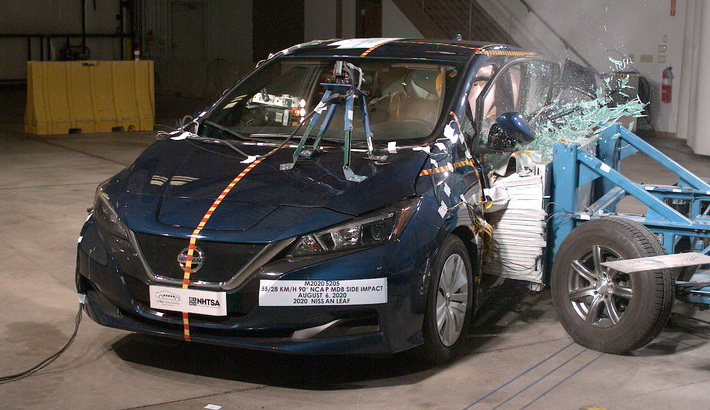
NHTSA crash tests
The agency crash-tested this model year itself. These are its own
photographs and star ratings.
Frontal crash test
Side barrier crash test
Side pole crash test
Photographs taken by NHTSA during its own New Car Assessment Program crash
tests of this model year. Public domain.
Configuration
Overall
Front
Side
Rollover
2020 Nissan LEAF (40 KWh Battery) 5 HB FWD
10.7% risk
When owners complained
A spike years after the car went on sale usually means a part wearing
out on schedule across the whole fleet — the kind of pattern no single
owner can see from inside their own car.
Sep 2020peak 24Sep 2026
NHTSA investigations into the 2020 Nissan Leaf
An investigation is the step before a recall: the agency has seen enough
complaints to look into a pattern itself. An open one means it thinks
something may be wrong and nothing has been fixed yet.
DP22005Opened 27 Jan 2023Closed 7 Aug 2023ELECTRICAL SYSTEM:PROPULSION SYSTEM
Pedestrian alert sounds
NHTSA received a petition on or about July 18, 2022, requesting that Federal Motor Vehicle Safety Standard (FMVSS) 141 be applied to all electric and hybrid vehicles operating in the United States. The petition can be reviewed at NHTSA.gov under ODI Number 11486072. FMVSS 141 establishes performance requirements for pedestrian alert sounds for motor vehicles. The standard applies to hybrid and electric vehicles that have a gross vehicle weight rating of 4,536 KG or less or are defined as low-speed vehicles. The standard became fully applicable to all such vehicles manufactured on or after Marc...
Recalls on the 2020 Nissan Leaf
A complaint is one owner's allegation. A recall is the point at which
the manufacturer or a regulator agreed the defect is real and dangerous
enough to fix for free — however old the car is.
Nissan North America, Inc. (Nissan) is recalling certain 2019-2020 LEAF vehicles equipped with a Level 3 quick charging port. The lithium-ion battery may overheat during Level 3 charging.
Risk: A quick charging battery that overheats increases the risk of a fire.
24V071000
BACK OVER PREVENTION: SENSING SYSTEM: CAMERA
Nissan North America, Inc. (Nissan) is recalling certain 2018-2022 LEAF vehicles. Damage to the camera harness can cause distortion or loss of the rearview camera display image. As such, these vehicles fail to comply with the requirements of Federal Motor Vehicle Safety Standard number 111, "Rear Visibility."
Risk: A rearview camera that does not properly display an image can reduce the driver's rear view, increasing the risk of a crash.
23V494000
VEHICLE SPEED CONTROL
Nissan North America, Inc. (Nissan) is recalling certain 2018-2023 LEAF vehicles. The vehicle may accelerate unintentionally if the driving mode is changed ("D" to "B"; e-Pedal "On"; or "ECO" mode) after disengaging the cruise control.
Risk: Unintentional acceleration can increase the risk of a crash.
23V048000
EQUIPMENT:OTHER:OWNERS/SERVICE/OTHER MANUAL
Nissan North America, Inc. (Nissan) is recalling certain 2018-2023 LEAF vehicles. The Owner's Manual instructions for defroster operation are incorrect, and may result in reduced defroster performance under specific conditions. As such, these vehicles fail to comply with the requirements of Federal Motor Vehicle Safety Standard number 103, "Windshield Defrosting and Defogging Systems."
Risk: Reduced defroster performance can limit visibility out of the windshield, increasing the risk of a crash.
20V570000
VISIBILITY:GLASS, SIDE/REAR
Nissan North America, Inc. (Nissan) is recalling certain 2020 Altima, Maxima and Leaf vehicles. The rear window glass may not remain properly secured to the vehicle.
Risk: Rear window glass that separates from the vehicle can increase the risk of a crash.
20V412000
BACK OVER PREVENTION: SENSING SYSTEM: CAMERA
Nissan North America, Inc. (Nissan) is recalling certain 2020 LEAF electric vehicles. Under certain circumstances, the images for the back-up camera can disappear while in reverse. As such, these vehicles fail to comply with Federal Motor Vehicle Safety Standard (FMVSS) number 111, "Rear Visibility."
Risk: The lack of an image in the back-up camera display increases the risk of a crash.
Canada — Transport Canada
Canada runs its own recall programme, and its campaigns do not
always mirror the American ones.
Recall 20245426,188 units in Canada
High Voltage
Issue: On certain vehicles, the high-voltage battery could overheat while using level 3 quick charging. As a result, the battery could create smoke or heat, which can melt or damage the battery and nearby parts. Safety Risk: A battery that overheats can create a fire risk. Corrective Actions: To reduce the safety risk, Nissan recommends not to use the level 3 quick charging until the recall repairs have been completed. Nissan will notify owners by mail and advise you to take your vehicle to a dealership to update the vehicle software.
Recall 202406811,985 units in Canada
Visual System
Issue: On certain vehicles, the rearview camera wiring harness could be damaged by movement and vibrations. If this happens, the rearview camera image may not display correctly or may not display at all. Canadian regulations require the rearview image to display when reversing. Safety Risk: A rearview camera image that doesn't display could reduce a driver's ability to see behind the vehicle while backing up. This could increase the risk of a crash. Corrective Actions: Nissan will notify owners by mail and advise you to take your vehicle to a dealership to inspect and secure the rearview camera wiring harness. The dealer will replace the rearview camera and wiring harness, if necessary.
Recall 202339713,390 units in Canada
Powertrain
Issue: Under certain conditions, the vehicle may not slow down after you release the accelerator pedal. This problem can only happen after a specific series of actions is performed in a short period of time, including disengaging the cruise control, changing the drive mode, and applying and releasing the accelerator pedal. If this happens, and you don't apply the brakes, the vehicle may not slow down as expected. Safety Risk: A vehicle that doesn't slow down as expected could increase the risk of a crash. Corrective Actions: Nissan will notify owners by mail and advise you to bring your vehicle to a dealership to reprogram the vehicle control module (VCM).
Recall 202304513,108 units in Canada
Heater And Defroster
Issue: When the temperature is below -10° C, the defroster may not work properly if you follow the instructions in the owner's manual and use the maximum fan speed. As a result, you may not be able to defrost the windshield. Safety Risk: A windshield that cannot be defogged or defrosted can reduce visibility and increase the risk of a crash. Corrective Actions: Nissan will notify owners by mail and supply an addendum to the owner's manual that provides the correct settings for using the defroster when the temperature is below -10° C.
Recall 20203291,800 units in Canada
Visual System
Issue: Under certain conditions, a software problem could cause the rearview camera image to disappear on the display. Canadian regulations require the rearview image to display while the transmission is in reverse gear. Safety Risk: A rearview camera image that does not display could reduce a driver's ability to see behind the vehicle while backing up. This could increase the risk of a crash. Corrective Actions: Nissan will notify owners by mail and instruct you to take your vehicle to a dealer to update the head unit software.
Reports where the owner recorded a crash, a fire, an injury or a death.
at 2,300 milesLaguna Niguel, CACrash
UNKNOWN OR OTHER
"AUTOMATIC BRAKING SYSTEM FAILED TO ENGAGE" ON A OFFRAMP LANE FROM FREEWAY 5 SOUTHBOUND TO CROWN VALLEY PARKWAY OFF RAMP WHILE TRAVELING APPROXIMATELY 25MPH I REAR ENDED A VEHICLE THAT WAS AT DEAD STOP AND THAT VEHICLE REAR ENDED A SECOND VEHICLE. CALIFORNIA HIGHWAY PATROL WAS CALLED AND REPORT WAS DOCUMENTED WHICH IS ATTACHED. THIS HAPPENED ON DECEMBER 22,2020 AT ABOUT 7PM, DARK CLEAR EVENING IN THE CITY OF MISSION VIEJO. IT WAS ON THE STRAIGHT FREEWAY LANE LEADING TO THE OFFRAMP WITH OTHER LANES ON THE FREEWAY MOVING FREELY. UPON DISCUSSION WITH NISSAN INVESTIGATION (CLAIM NO. 42994813) 615 725 7590, THEY SUMMARIZED 10 PAGE DISCLAIMER FROM OWNERS MANUAL STATING THAT BRAKING SYSTEM IS NOT 100%. ITS UNDERSTANDABLE IF THE VEHICLE WAS OLD BUT THIS IS A NEW VEHICLE WITH WHAT IS ADVERTISED AS A AUTOMATIC BRAKING SYSTEM AND THAT SYSTEM DID NOT WORK. I MANUALLY BRAKED TO A CRASH.
NHTSA complaint #11395644 — an unverified report by a vehicle owner.
at 2,300 milesLaguna Niguel, CACrash
STRUCTURE:BODY
"AUTOMATIC BRAKING SYSTEM FAILED TO ENGAGE" ON A OFFRAMP LANE FROM FREEWAY 5 SOUTHBOUND TO CROWN VALLEY PARKWAY OFF RAMP WHILE TRAVELING APPROXIMATELY 25MPH I REAR ENDED A VEHICLE THAT WAS AT DEAD STOP AND THAT VEHICLE REAR ENDED A SECOND VEHICLE. CALIFORNIA HIGHWAY PATROL WAS CALLED AND REPORT WAS DOCUMENTED WHICH IS ATTACHED. THIS HAPPENED ON DECEMBER 22,2020 AT ABOUT 7PM, DARK CLEAR EVENING IN THE CITY OF MISSION VIEJO. IT WAS ON THE STRAIGHT FREEWAY LANE LEADING TO THE OFFRAMP WITH OTHER LANES ON THE FREEWAY MOVING FREELY. UPON DISCUSSION WITH NISSAN INVESTIGATION (CLAIM NO. 42994813) 615 725 7590, THEY SUMMARIZED 10 PAGE DISCLAIMER FROM OWNERS MANUAL STATING THAT BRAKING SYSTEM IS NOT 100%. ITS UNDERSTANDABLE IF THE VEHICLE WAS OLD BUT THIS IS A NEW VEHICLE WITH WHAT IS ADVERTISED AS A AUTOMATIC BRAKING SYSTEM AND THAT SYSTEM DID NOT WORK. I MANUALLY BRAKED TO A CRASH.
NHTSA complaint #11395644 — an unverified report by a vehicle owner.
"AUTOMATIC BRAKING SYSTEM FAILED TO ENGAGE" ON A OFFRAMP LANE FROM FREEWAY 5 SOUTHBOUND TO CROWN VALLEY PARKWAY OFF RAMP WHILE TRAVELING APPROXIMATELY 25MPH I REAR ENDED A VEHICLE THAT WAS AT DEAD STOP AND THAT VEHICLE REAR ENDED A SECOND VEHICLE. CALIFORNIA HIGHWAY PATROL WAS CALLED AND REPORT WAS DOCUMENTED WHICH IS ATTACHED. THIS HAPPENED ON DECEMBER 22,2020 AT ABOUT 7PM, DARK CLEAR EVENING IN THE CITY OF MISSION VIEJO. IT WAS ON THE STRAIGHT FREEWAY LANE LEADING TO THE OFFRAMP WITH OTHER LANES ON THE FREEWAY MOVING FREELY. UPON DISCUSSION WITH NISSAN INVESTIGATION (CLAIM NO. 42994813) 615 725 7590, THEY SUMMARIZED 10 PAGE DISCLAIMER FROM OWNERS MANUAL STATING THAT BRAKING SYSTEM IS NOT 100%. ITS UNDERSTANDABLE IF THE VEHICLE WAS OLD BUT THIS IS A NEW VEHICLE WITH WHAT IS ADVERTISED AS A AUTOMATIC BRAKING SYSTEM AND THAT SYSTEM DID NOT WORK. I MANUALLY BRAKED TO A CRASH.
NHTSA complaint #11395644 — an unverified report by a vehicle owner.
The most recent complaints
In the owners' own words, exactly as filed with NHTSA.
Los Angeles, CA
FUEL/PROPULSION SYSTEM
We were asked by Nissan corporate to bring in the vehicle for a safety recall related to the battery. The Nissan dealership updated the battery software then gave the vehicle back to us. However, as soon as we drove away the dash lit up with warning lights. We were on the freeway so we pulled over. It was a dangerous situation. We called the dealership and they required us to bring the car back. So we slowly and carefully drove the car a few miles back to the dealership. In their analysis, they decided the battery must be replaced. However, they no longer make that kind of battery, the stocks were on back order for up to a year, and the software update could not be reversed. So they initiated a buyback. We were not interested in selling the vehicle -- we simply wanted the recall issue fixed -- but we had no choice. The procedure for determining a buyback dollar amount has been extremely frustrating and manipulative. From our perspective, it's unlikely we'll be able to buy a working used EV for the amount they're offering. We have searched and it's difficult-to-impossible. No one informed us this situation was a possibility. We asked for a higher dollar amount, only enough to actually buy an equivalent replacement vehicle. They tell us they require the original Bill of Sale for the vehicle. But we don't have that and can't get it. We sent it to DMV after the purchase. We did get certified copies from DMV at a cost but Nissan insists they must have the original Bill of Sale in order to make us an offer greater than Kelly Blue Book value + 40%, which is insufficient as noted. Obviously, this is an arbitrary demand. If they can offer us one amount without the Bill of Sale, they can offer us any amount. But they refuse to discuss or negotiate.
NHTSA complaint #11761248 — an unverified report by a vehicle owner.
Hudson, NH
FUEL/PROPULSION SYSTEM
My 2020 Nissan LEAF is subject to open safety recall 24V700 / R24B2 for a high-voltage lithium-ion battery defect that poses a fire risk during Level 3 quick charging. On [XXX], I brought the vehicle to an authorized Nissan dealer for the recall remedy. Three days later, on [XXX], while driving from New Hampshire to Connecticut, the vehicle displayed a "Service EV" warning and entered a reduced-power (limp) state on the highway, creating a hazardous condition in traffic. A separate authorized Nissan dealer diagnosed a fault in the high-voltage battery pack. The vehicle is now undrivable and cannot be charged. Nissan has been unable to supply a replacement battery and has indicated the vehicle will likely be repurchased because the recall remedy is unavailable. As a result, I am the owner of a vehicle that is undrivable due to an unremedied federal safety recall, with no available remedy and no timeline for one. The mileage at diagnosis was 99,100, within the vehicle's battery warranty period. I am filing this complaint because the recall remedy for 24V700 was not effective in my case, the vehicle failed dangerously shortly after the recall service was performed, and Nissan is currently unable to remedy the recall. I am also documenting the manufacturer's failure to provide interim transportation while the recall remains unremedied. INFORMATION REDACTED PURSUANT TO THE FREEDOM OF INFORMATION ACT (FOIA), 5 U.S.C. 552(B)(6)
NHTSA complaint #11759797 — an unverified report by a vehicle owner.
at 80,000 milesEasr Setauket, NY
ELECTRICAL SYSTEM
The contact owns a 2020 Nissan Leaf. The contact stated that the vehicle was taken to the local dealer to be repaired under NHTSA Campaign Number: 24V700000 (Electrical System). The contact stated that 100 miles of using the ED system, the power reduced message was displayed. The contact stated that the battery became disabled. The vehicle was taken back to the local dealer, but the vehicle was not diagnosed or repaired after a week. The manufacturer was contacted, and a case was opened, but no further assistance was provided. The failure mileage was approximately 80,000.
NHTSA complaint #11757377 — an unverified report by a vehicle owner.
Meridian, ID
ELECTRICAL SYSTEM
SAFETY COMPLAINT / INCIDENT DESCRIPTION Vehicle presented to Dennis Dillon Nissan on June 20 2026 for a factory high voltage battery recall software update intended to fix Level 3 fast charging safety risks. The software update rendered the vehicle completely inoperable by disabling standard Level 2 charging. The vehicle has been held in continuous dealer custody for 58 consecutive days without a working repair. Nissan failed to disclose that the recall patch could brick a functioning EV. Loaner support was revoked prematurely forcing 850 in out of pocket rental costs. Inadequate buyback offer via Morley Companies was rejected. Factory recall update rendered vehicle useless and unsafe to operate.
NHTSA complaint #11757287 — an unverified report by a vehicle owner.
Meridian, ID
ENGINE
SAFETY COMPLAINT / INCIDENT DESCRIPTION Vehicle presented to Dennis Dillon Nissan on June 20 2026 for a factory high voltage battery recall software update intended to fix Level 3 fast charging safety risks. The software update rendered the vehicle completely inoperable by disabling standard Level 2 charging. The vehicle has been held in continuous dealer custody for 58 consecutive days without a working repair. Nissan failed to disclose that the recall patch could brick a functioning EV. Loaner support was revoked prematurely forcing 850 in out of pocket rental costs. Inadequate buyback offer via Morley Companies was rejected. Factory recall update rendered vehicle useless and unsafe to operate.
NHTSA complaint #11757287 — an unverified report by a vehicle owner.
Meridian, ID
FUEL/PROPULSION SYSTEM
SAFETY COMPLAINT / INCIDENT DESCRIPTION Vehicle presented to Dennis Dillon Nissan on June 20 2026 for a factory high voltage battery recall software update intended to fix Level 3 fast charging safety risks. The software update rendered the vehicle completely inoperable by disabling standard Level 2 charging. The vehicle has been held in continuous dealer custody for 58 consecutive days without a working repair. Nissan failed to disclose that the recall patch could brick a functioning EV. Loaner support was revoked prematurely forcing 850 in out of pocket rental costs. Inadequate buyback offer via Morley Companies was rejected. Factory recall update rendered vehicle useless and unsafe to operate.
NHTSA complaint #11757287 — an unverified report by a vehicle owner.
Richardson, TX
POWER TRAIN
Regarding Nissan Safety Recall 24V-700 / Campaign R24B2. After the recall remedy was performed on my 2020 LEAF in June I experienced the "Service EV System" message during normal highway driving on 8/1/26. I have an invoice from the dealership that documented logged safety recall code P33ED along with EV system codes P317E-97 and P3180-97. The dealership improperly cleared the recall safety codes, charged me a diagnostic fee, and released a vehicle that is subject to an active safety hold under Recall 24V-700 / Campaign R24B2. The dealership released an unsafe vehicle back to me that remains a documented thermal and fire risk. The Nissan Nissan Safety Recall 24V-700 / Campaign R24B2 states that vehicles that experience this situation after the recall remedy was performed will have the battery replaced or vehicle repurchased.
NHTSA complaint #11756009 — an unverified report by a vehicle owner.
Manteca, CA
ELECTRICAL SYSTEM
See attached document for complaint.
NHTSA complaint #11752391 — an unverified report by a vehicle owner.
Madison, WI
ELECTRICAL SYSTEM
This recall appointment does not take 2 hours to complete. The dealer quoted me 1-2 days with an inability to offer a loaner vehicle. Several Leaf owners have completed the recall appointment and subsequently been left stranded because the car went into an undrivable mode leaving the owner stranded and incurring towing and rental fees for weeks without resolution. Nissan Consumer Affairs has denied to consider a buyback without taking the vehicle in for the recall notice even though the recall notice successfully being applied does not guarantee the car will not stop abruptly after that visit. Without the recall appointment, Nissan has limited my ability to safely fast‑charge, preventing me from using the full functionality of the vehicle. Nissan is conditioning buyback eligibility on my willingness to undergo the recall inspection, even though the recall remedy has repeatedly resulted in battery failure and sudden loss of power for other Leaf owners. This effectively forces me to expose myself to a known safety hazard in order to qualify for a remedy Nissan itself acknowledges may be required. I am being denied both safe vehicle operation and access to the promised buyback unless I accept a repair that may leave me stranded or without a functioning battery. Nissan recognizes the potential risk of the recall remedy by issuing a second notice dated 6/17/2026 that if the vehicle experiences this battery specific condition within 12 months after the date the software reprogram remedy was completed on the vehicle. Nissan will replace the battery or offer to re-purchase the car. Nissan has also recognized that batteries are rare at this time. I thought that a manufacturer must offer a remedy that was deemed Safe and this does not seem like it’s guaranteeing safety.
NHTSA complaint #11748187 — an unverified report by a vehicle owner.
Eugene, OR
ELECTRICAL SYSTEM
We have a vehicle with a recall, NHTSA ID: 24V-700, NISSAN ID: R24B2, the dealer is unable to schedule a service appointment and the Nissan Corporate Case Manager no longer responds to communications, of which I have sent many. I currently have no known way of getting this safety recall resolved. I called Nissan Corporate Affairs (6/25) and all they could do was send a message that I called to the case worker Jonnita Amonette.
NHTSA complaint #11746519 — an unverified report by a vehicle owner.
Longmont, CO
ELECTRICAL SYSTEM
My Nissan Leaf was affected in the NHTSA Recall 24V-700. We took it into the Valley Nissan of Longmont, where we initially purchased the car, on 6/19/2026. The dealership checked it out and told us it was fine, so we took the car home that day. We drove it around on 6/20/2026 and received an urgent EV service warning. The car went into turtle mode while we were driving on the highway. We called the dealer, and they said it was the code that indicated our battery was actually degraded. So, they gave us back a car that was unsafe to drive. They weren't able to look at it again til 6/22/2026, but they refused to provide us with a rental or loaner car for the weekend, despite this being our only car, and the recall specifically having a stop-drive order on affected vehicles. On 6/22/2026, we took the car in again, and they confirmed the battery was actually degraded due to the recall. Again, they refused to get us a rental or loaner car. Since Monday, the car has been sitting at the dealer, and as of 6/25/2026, we still have no information about when we will get the car back, if we can get a battery replacement, or what our options are. They have provided us with no information and no alternative vehicle, despite our car being undriveable. They said we could rent a car but refused to confirm if this would be reimbursed as part of the recall. We called Nissan Customer Affairs, and they have also been unhelpful and not provided any further information on a battery replacement or loaner vehicle. We have been calling multiple times this week to no avail. We want to have the battery fixed, but we have heard from other Leaf owners that this can take many months, and this was our only vehicle. We would not be able to have the battery replaced at no cost to us without a provided loaner vehicle. Since this comes as a result of a stop drive order recall, I think that should be provided from Nissan through direct payment rather than reimbursement.
NHTSA complaint #11746554 — an unverified report by a vehicle owner.
at 43,000 milesQueen Village, NY
ELECTRICAL SYSTEM
The contact owns a 2020 Nissan Leaf. The contact received notification of NHTSA Campaign Number: 24V700000 (ELECTRICAL SYSTEM); however, the local dealer stated that the part for the recall repair was not available. The contact stated that the manufacturer had exceeded a reasonable amount of time for the recall repair. The manufacturer was made aware of the issue. The contact stated that while operating the vehicle, the message "Service EV System - Power Reduced" was displayed. The failure mileage was approximately 43,000.
NHTSA complaint #11745851 — an unverified report by a vehicle owner.
New Haven, CT
FORWARD COLLISION AVOIDANCE: ADAPTIVE CRUISE CONTROL
While driving with cruise control set to a certain speed (i do not recall the exact speed it was set to) I pressed the button that lowers the current speed it is set to, but instead of lowring by one mph it raised the speed, pressing again raised the speed again. this continued a few times until i turned off cruise control. The system has been buggy in the past, for example not responding to a button or raising by 2 or 3 mph instead of one (the Leaf goes one by one, not jumps like some vehicles). But this was the first time i saw it actually raise speed in response to a button that should lower it and that seems dangerous. The problem has not been reproduced or confirmed by a dealer or service center. It has not been inspected by anyone since the incident occurred. There were no warning lamps or messages. The overall bugginess has been noticeable for a long time (perhaps always?) but this occurred (raising the speed instead of lowering it) for the first time yesterday.
NHTSA complaint #11746000 — an unverified report by a vehicle owner.
San Diego, CA
FUEL/PROPULSION SYSTEM
I own a 2020 Nissan Leaf affected by recall 24V-700 (Nissan R24B2). The recall opened in September 2024 because the high-voltage battery can overheat and catch fire during Level 3 fast charging. Owners were told not to use fast charging until a remedy is available. The recall has been open since September 2024 and there is still no available remedy. Nissan has pushed the fix date repeatedly, first to November 2024, then Spring 2025, and now an unspecified point in 2026, with no firm date and no working repair at the dealer. I bought this vehicle more recently and understood there was an open recall, but a recall is supposed to mean a fix is coming, not a safety defect left unresolved for over a year and a half. In the meantime I am paying for a vehicle whose fast-charging capability I cannot safely use. This is well past any reasonable time to remedy a known safety defect. I am asking NHTSA to hold Nissan accountable for delivering an actual fix on a real timeline.
NHTSA complaint #11745152 — an unverified report by a vehicle owner.
Orlando, FL
POWER TRAIN
My 2020 Nissan Leaf is affected by recall R24B2 / NHTSA recall 24V-700 involving the high-voltage battery and Level 3 DC fast charging system (CHAdeMO). Nissan and NHTSA instructed owners not to use Level 3 quick charging because the battery may rapidly overheat and potentially create a fire risk. The recall remains incomplete and the remedy is still unavailable. This issue has existed for a prolonged period and materially impacts the vehicle’s usability, charging capability, long-distance travel capability, and safety confidence. The vehicle’s Level 3/DC fast charging capability was effectively removed or severely restricted due to the recall. Nissan dealerships confirmed the recall status and lack of available repair remedy. The issue was documented during service visits and remains unresolved. The battery system and charging system are available for inspection upon request.
NHTSA complaint #11738000 — an unverified report by a vehicle owner.
Orlando, FL
ELECTRICAL SYSTEM
My 2020 Nissan Leaf is affected by recall R24B2 / NHTSA recall 24V-700 involving the high-voltage battery and Level 3 DC fast charging system (CHAdeMO). Nissan and NHTSA instructed owners not to use Level 3 quick charging because the battery may rapidly overheat and potentially create a fire risk. The recall remains incomplete and the remedy is still unavailable. This issue has existed for a prolonged period and materially impacts the vehicle’s usability, charging capability, long-distance travel capability, and safety confidence. The vehicle’s Level 3/DC fast charging capability was effectively removed or severely restricted due to the recall. Nissan dealerships confirmed the recall status and lack of available repair remedy. The issue was documented during service visits and remains unresolved. The battery system and charging system are available for inspection upon request.
NHTSA complaint #11738000 — an unverified report by a vehicle owner.
Orlando, FL
FUEL/PROPULSION SYSTEM
My 2020 Nissan Leaf is affected by recall R24B2 / NHTSA recall 24V-700 involving the high-voltage battery and Level 3 DC fast charging system (CHAdeMO). Nissan and NHTSA instructed owners not to use Level 3 quick charging because the battery may rapidly overheat and potentially create a fire risk. The recall remains incomplete and the remedy is still unavailable. This issue has existed for a prolonged period and materially impacts the vehicle’s usability, charging capability, long-distance travel capability, and safety confidence. The vehicle’s Level 3/DC fast charging capability was effectively removed or severely restricted due to the recall. Nissan dealerships confirmed the recall status and lack of available repair remedy. The issue was documented during service visits and remains unresolved. The battery system and charging system are available for inspection upon request.
NHTSA complaint #11738000 — an unverified report by a vehicle owner.
Denver, CO
UNKNOWN OR OTHER
My electric vehicle is subject to an active battery recall (NHTSA ID: 24V-700) involving excessive lithium deposits within battery cells, which may increase electrical resistance, cause dangerous battery overheating, and create fire risk during Level 3 DC fast charging. Due to this defect, Nissan has instructed owners not to use Level 3 quick charging (CHAdeMO), removing a core function of the vehicle and rendering it effectively unusable for normal EV operation, reliable long-distance travel, relocation, and essential transportation. Nissan’s guidance assumes owners can rely on Level 2 charging, which for my vehicle requires approximately 7–8 hours for a full charge under ideal conditions. Because I do not have residential Level 2 access, the loss of Level 3 charging renders the vehicle functionally unusable for my living situation. This defect severely compromises both my safety and mobility by forcing me into an impossible choice: either risk using the charging method associated with battery overheating and potential fire, or lose access to essential transportation. The defect also forces prolonged public Level 2 charging sessions simply to maintain vehicle operation, creating significant daily hardship. Without safe fast charging capability, the vehicle cannot reasonably support long-distance travel or interstate relocation, leaving me effectively unable to move out of state without major financial and logistical burden. I have pursued resolution directly with Nissan and through BBB Auto Line. Nissan acknowledged the recall but declined buyback or meaningful relief, instead advising continued waiting for a future remedy. After approximately two years without timely corrective action, the vehicle remains subject to serious safety restrictions, diminished value, loss of core functionality, and ongoing consumer harm.
NHTSA complaint #11737653 — an unverified report by a vehicle owner.
Denver, CO
ELECTRICAL SYSTEM
My electric vehicle is subject to an active battery recall (NHTSA ID: 24V-700) involving excessive lithium deposits within battery cells, which may increase electrical resistance, cause dangerous battery overheating, and create fire risk during Level 3 DC fast charging. Due to this defect, Nissan has instructed owners not to use Level 3 quick charging (CHAdeMO), removing a core function of the vehicle and rendering it effectively unusable for normal EV operation, reliable long-distance travel, relocation, and essential transportation. Nissan’s guidance assumes owners can rely on Level 2 charging, which for my vehicle requires approximately 7–8 hours for a full charge under ideal conditions. Because I do not have residential Level 2 access, the loss of Level 3 charging renders the vehicle functionally unusable for my living situation. This defect severely compromises both my safety and mobility by forcing me into an impossible choice: either risk using the charging method associated with battery overheating and potential fire, or lose access to essential transportation. The defect also forces prolonged public Level 2 charging sessions simply to maintain vehicle operation, creating significant daily hardship. Without safe fast charging capability, the vehicle cannot reasonably support long-distance travel or interstate relocation, leaving me effectively unable to move out of state without major financial and logistical burden. I have pursued resolution directly with Nissan and through BBB Auto Line. Nissan acknowledged the recall but declined buyback or meaningful relief, instead advising continued waiting for a future remedy. After approximately two years without timely corrective action, the vehicle remains subject to serious safety restrictions, diminished value, loss of core functionality, and ongoing consumer harm.
NHTSA complaint #11737653 — an unverified report by a vehicle owner.
Winter Haven, FL
ELECTRICAL SYSTEM
The contact owns a 2020 Nissan Leaf. The contact received notification of NHTSA Campaign Number: 24V700000 (Electrical System) however, the part to do the recall repair was not yet available. The dealer was contacted. The vehicle was not diagnosed or repaired. The dealer confirmed that the remedy parts were not yet available and referred the contact to the manufacturer for further assistance. The manufacturer was made aware of the issue. The contact stated that the manufacturer had exceeded a reasonable amount of time for the recall repair. The contact had not experienced a failure.
NHTSA complaint #11737657 — an unverified report by a vehicle owner.
Orlando, FL
ELECTRICAL SYSTEM
The vehicle is affected by an unrepaired safety recall involving the high-voltage battery during Level 3 quick charging. The recall states that affected vehicles may develop excessive lithium deposits in battery cells, increasing electrical resistance and potentially causing rapid battery heating while Level 3 quick charging. The recall also states that if quick charging continues, a battery fire may occur, increasing the risk of injury. The recall status remains incomplete with the remedy not yet available. Owners are instructed not to use Level 3 quick charging through the CHAdeMO connector until the remedy is completed. This removes the vehicle’s fast-charging capability and leaves the vehicle subject to an unresolved battery safety recall. The vehicle is available for inspection upon request. The issue is confirmed by the active NHTSA recall record and manufacturer recall number R24B2 / NHTSA recall number 24V-700.
NHTSA complaint #11737683 — an unverified report by a vehicle owner.
Denver, CO
FUEL/PROPULSION SYSTEM
My electric vehicle is subject to an active battery recall (NHTSA ID: 24V-700) involving excessive lithium deposits within battery cells, which may increase electrical resistance, cause dangerous battery overheating, and create fire risk during Level 3 DC fast charging. Due to this defect, Nissan has instructed owners not to use Level 3 quick charging (CHAdeMO), removing a core function of the vehicle and rendering it effectively unusable for normal EV operation, reliable long-distance travel, relocation, and essential transportation. Nissan’s guidance assumes owners can rely on Level 2 charging, which for my vehicle requires approximately 7–8 hours for a full charge under ideal conditions. Because I do not have residential Level 2 access, the loss of Level 3 charging renders the vehicle functionally unusable for my living situation. This defect severely compromises both my safety and mobility by forcing me into an impossible choice: either risk using the charging method associated with battery overheating and potential fire, or lose access to essential transportation. The defect also forces prolonged public Level 2 charging sessions simply to maintain vehicle operation, creating significant daily hardship. Without safe fast charging capability, the vehicle cannot reasonably support long-distance travel or interstate relocation, leaving me effectively unable to move out of state without major financial and logistical burden. I have pursued resolution directly with Nissan and through BBB Auto Line. Nissan acknowledged the recall but declined buyback or meaningful relief, instead advising continued waiting for a future remedy. After approximately two years without timely corrective action, the vehicle remains subject to serious safety restrictions, diminished value, loss of core functionality, and ongoing consumer harm.
NHTSA complaint #11737653 — an unverified report by a vehicle owner.
Orlando, FL
FUEL/PROPULSION SYSTEM
The vehicle is affected by an unrepaired safety recall involving the high-voltage battery during Level 3 quick charging. The recall states that affected vehicles may develop excessive lithium deposits in battery cells, increasing electrical resistance and potentially causing rapid battery heating while Level 3 quick charging. The recall also states that if quick charging continues, a battery fire may occur, increasing the risk of injury. The recall status remains incomplete with the remedy not yet available. Owners are instructed not to use Level 3 quick charging through the CHAdeMO connector until the remedy is completed. This removes the vehicle’s fast-charging capability and leaves the vehicle subject to an unresolved battery safety recall. The vehicle is available for inspection upon request. The issue is confirmed by the active NHTSA recall record and manufacturer recall number R24B2 / NHTSA recall number 24V-700.
NHTSA complaint #11737683 — an unverified report by a vehicle owner.
Port Ludlow, WA
ELECTRICAL SYSTEM
The contact owns a 2020 Nissan Leaf. The contact received notification of NHTSA Campaign Number: 24V700000 (Electrical System); however, the part to do the recall repair was not yet available. The local dealer was contacted. The contact stated that the manufacturer had exceeded a reasonable amount of time for the recall repair. The manufacturer was not made aware of the issue. The contact had not experienced a failure.
NHTSA complaint #11734821 — an unverified report by a vehicle owner.
When my battery range falls below ~125 miles, I have extreme range fluctuations especially at freeway speeds with any hills. Because I drive over a mountain range to commute to work, I can't safely drive the car. This is a known issue related to the recall from 2024 that has not been fixed. When I first encountered the issue in December 2025, I did not know about the recall. I took it to the Nissan dealer (Stevens Creek Nissan) and they did not tell me that there was a recall on the battery and that I shouldn't fast charge. At the time, I was fast charging to get the range safely above 120 miles so that I could make it home without complete battery failure.
NHTSA complaint #11732605 — an unverified report by a vehicle owner.