Owners have filed 1,710 complaints
about the 2018 Tesla Model 3 with NHTSA between 2018 and 2026.
The largest single group is the driver assist & collision avoidance.
Across this model's run it ranks 1 of 10 worst.
The letter says how bad. This says what kind — whether this year drew
an unusual number of complaints, unusually dangerous
ones, or failures that arrived unusually early.
The dashed ring is 50 — the national norm. Further out is worse.
Complaint volume — 100
Against the median year of the Tesla Model 3. 50 means typical for this
model; 100 means roughly double.
Severity — 82
16% of these complaints
involved a crash, fire, injury or death, against a national rate of
9.7%.
Early failure — 100
74% of failures with a mileage on record happened under
36,000 miles, against a national rate of
29%.
NHTSA files every complaint against a named sub-assembly, not just a
system. This is the difference between knowing it was "the engine" and
knowing which part of it — the list to hand a mechanic.
Adaptive Cruise Control
13132.6%
Automatic Emergency Braking
11628.9%
Body
5212.9%
Warnings
389.5%
Assist
246.0%
Blind Spot Detection
225.5%
Warning
143.5%
Warnings
51.2%
When it fails
Odometer readings owners gave when they filed. About half of all
complaints include one.
Under 1,000 miles
236.8%
1,000 – 9,999 miles
8625.4%
10,000 – 24,999 miles
10230.2%
25,000 – 49,999 miles
6619.5%
50,000 – 74,999 miles
3410.1%
75,000 – 99,999 miles
226.5%
100,000 – 149,999 miles
51.5%
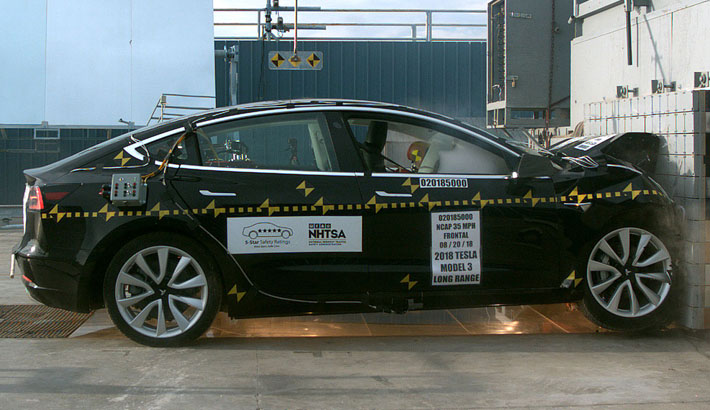
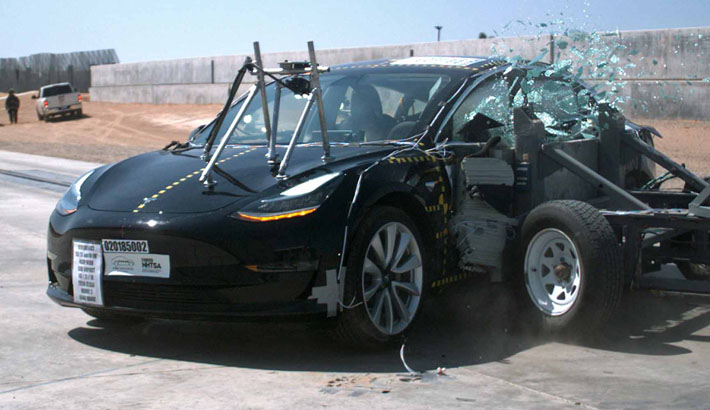
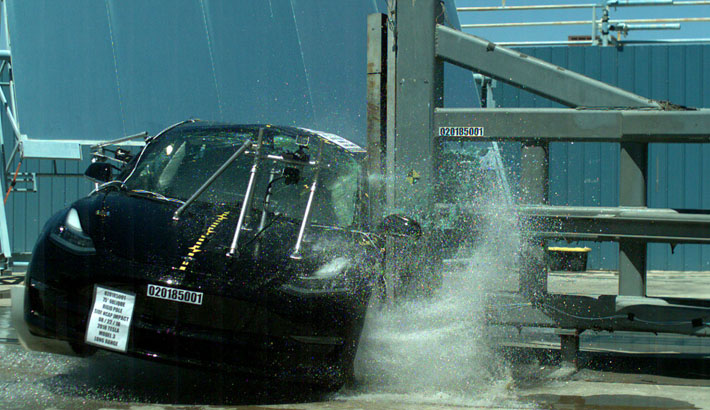
NHTSA crash tests
The agency crash-tested this model year itself. These are its own
photographs and star ratings.
Frontal crash test
Side barrier crash test
Side pole crash test
Photographs taken by NHTSA during its own New Car Assessment Program crash
tests of this model year. Public domain.
Configuration
Overall
Front
Side
Rollover
2018 Tesla Model 3 4 DR RWD
6.6% risk
2018 Tesla Model 3 4 DR AWD
—
—
6.6% risk
When owners complained
A spike years after the car went on sale usually means a part wearing
out on schedule across the whole fleet — the kind of pattern no single
owner can see from inside their own car.
May 2018peak 99Sep 2026
Recalls on the 2018 Tesla Model 3
A complaint is one owner's allegation. A recall is the point at which
the manufacturer or a regulator agreed the defect is real and dangerous
enough to fix for free — however old the car is.
United States — NHTSA
26V507000
EXTERIOR LIGHTING:HEADLIGHTS
Tesla, Inc. (Tesla) is recalling certain 2017-2023 Model 3 and 2020-2023 Model Y vehicles. The headlight low beams may be too bright and exceed the maximum light output. As such, these vehicles fail to comply with the requirements of Federal Motor Vehicle Safety Standard (FMVSS) number 108, "Lamps, Reflective Devices, and Associated Equipment."
Risk: Headlight low beams that are too bright can reduce visibility for oncoming drivers, increasing the risk of a crash.
24V935000
TIRES:PRESSURE MONITORING AND REGULATING SYSTEMS
Tesla, Inc. (Tesla) is recalling certain 2024 Cybertruck, 2017-2025 Model 3, and 2020-2025 Model Y vehicles. The tire pressure monitoring system (TPMS) warning light may not remain illuminated between drive cycles, failing to warn the driver of low tire pressure. As such, these vehicles fail to comply with the requirements of Federal Motor Vehicle Safety Standard number 138, "Tire Pressure Monitoring Systems."
Risk: Driving with improperly inflated tires increases the risk of a crash.
24V376000
SEAT BELTS:FRONT:WARNING LIGHT/DEVICES
Tesla, Inc. (Tesla) is recalling certain 2012-2024 Model S, 2015-2024 Model X, 2017-2023 Model 3, and 2020-2023 Model Y vehicles. In the event of an unbelted driver, the seat belt warning light and audible chime may not activate as intended. As such, these vehicles fail to comply with the requirements of Federal Motor Vehicle Safety Standard number 208, "Occupant Crash Protection."
Risk: A seat belt warning system that fails to alert occupants of an unbelted seat belt can increase the risk of injury during a crash.
Tesla, Inc. (Tesla) is recalling certain 2013, 2018-2021 Model S, 2020-2021 Model X, 2018-2022 Model 3, and 2020-2022 Model Y vehicles. A factory reset muted the Pedestrian Warning System (PWS) sounds. As such, these vehicles fail to comply with the requirements of Federal Motor Vehicle Safety Standard number 141, "Minimum Sound Requirements for Hybrid and Electric Vehicles."
Risk: Pedestrians may be unaware of an approaching vehicle if the PWS sounds are muted, increasing the risk of a crash.
24V051000
ELECTRICAL SYSTEM: INSTRUMENT CLUSTER/PANEL
Tesla, Inc. (Tesla) is recalling certain 2012-2023 Model S, 2016-2024 Model X, 2017-2023 Model 3, 2019-2024 Model Y, and 2024 Cybertruck vehicles. An incorrect font size is displayed on the instrument panel for the Brake, Park, and Antilock Brake System (ABS) warning lights. As such, these vehicles fail to comply with the requirements of Federal Motor Vehicle Safety Standard number 105, "Hydraulic and Electric Brake Systems" and 135, "Light Vehicle Brake Systems."
Risk: Warning lights with a smaller font size can make critical safety information on the instrument panel difficult to read, increasing the risk of a crash.
Tesla, Inc. (Tesla) is recalling 2012-2023 Model S, 2016-2023 Model X, 2017-2023 Model 3, and 2020-2023 Model Y vehicles equipped with all versions of Autosteer leading up to the version(s) that contains the recall remedy. In certain circumstances when Autosteer is engaged, the prominence and scope of the feature's controls may not be sufficient to prevent driver misuse of the SAE Level 2 advanced driver-assistance feature.
Risk: In certain circumstances when Autosteer is engaged, and the driver does not maintain responsibility for vehicle operation and is unprepared to intervene as necessary or fails to recognize when Autosteer is canceled or not engaged, there may be an increased risk of a crash.
23V235000
SUSPENSION:FRONT
Tesla, Inc. (Tesla) is recalling certain 2018-2019 Model 3 vehicles. The front suspension lateral link fasteners may loosen, allowing the lateral link to separate from the sub-frame.
Risk: A lateral link separation could shift the wheel alignment, causing instability and increasing the risk of a crash.
23V085000
STEERING:AUTOMATED/ADAPTIVE STEERING
Tesla, Inc. (Tesla) is recalling certain 2016-2023 Model S, Model X, 2017-2023 Model 3, and 2020-2023 Model Y vehicles equipped with Full Self-Driving Beta (FSD Beta) software or pending installation. The FSD Beta system may allow the vehicle to act unsafe around intersections, such as traveling straight through an intersection while in a turn-only lane, entering a stop sign-controlled intersection without coming to a complete stop, or proceeding into an intersection during a steady yellow traffic signal without due caution. In addition, the system may respond insufficiently to changes in posted speed limits or not adequately account for the driver's adjustment of the vehicle's speed to exceed posted speed limits.
Risk: FSD Beta software that allows a vehicle to exceed speed limits or travel through intersections in an unlawful or unpredictable manner increases the risk of a crash.
Canada — Transport Canada
Canada runs its own recall programme, and its campaigns do not
always mirror the American ones.
Recall 2026401454 units in Canada
Lights And Instruments
Issue: On certain vehicles, the low beam headlights may be too bright. Canadian regulations specify a maximum brightness for low beam headlights. Safety Risk: Low beam headlights that are too bright could cause reduced visibility for the driver and/or glare for oncoming drivers and increase the risk of a crash. Corrective Actions: Tesla will notify owners by email. The corrective actions for this recall are under development.
Recall 20242989,435 units in Canada
Seats And Restraints
Issue: On certain vehicles, the seat belt reminder chime and visual warning may not work when you start the vehicle and your seat belt is not buckled. Canadian regulations require both a seat belt reminder sound and visual telltale when a driver is not wearing their seat belt. Safety Risk: A seat belt warning that doesn't work correctly may not remind you to buckle your seat belt. Not wearing your seat belt can increase the risk of injury in a crash. Corrective Actions: Tesla will notify owners by email and supply an over-the-air software update to activate the seat belt reminder chime and visual warning.
Recall 2024283109,791 units in Canada
Lights And Instruments
Issue: A previous over-the-air (OTA) software update could cause the vehicle not to display the correct visual warning indicators when there are problems with the brake system or when the parking brake is applied. As a result, the BRAKE, PARK, and antilock brake system (ABS) visual indicators would display as text instead of symbols. Safety Risk: While there is a low risk to safety, Canadian regulations require visual warnings to use common symbols, instead of words, to avoid driver confusion. Corrective Actions: Tesla will notify affected owners by email. Tesla has released an over-the-air software update to fix this problem. There is no further action required if your vehicle has software release 2024.3.25, 2024.14.5, or a release later than 2024.14.5.
Recall 2023657192,769 units in Canada
Accessories
Issue: On vehicles equipped with the Autosteer advanced driver-assistance feature, when using the feature, the vehicle may not provide strong enough warnings or monitor the driver closely enough to prevent misuse of the feature. Safety Risk: A driver that doesn't pay close attention while using the Autosteer feature or who doesn't react quickly when Autosteer is canceled could have an increased risk of a crash. Corrective Actions: Tesla will notify owners by email and supply an over-the-air software update to improve driver monitoring and alerts while using the Autosteer feature. Tesla advises that you must always pay attention and be ready to take control of the vehicle at any time while using the Autosteer advanced driver-assistance feature.
Recall 202319424 units in Canada
Suspension
Issue: On certain vehicles, the bolts that attach the front suspension lateral links to the sub-frame could loosen over time and the lateral links could separate from the sub-frame. If this happens, there could be sudden changes in wheel alignment and a loss of vehicle stability. Note: This is an expansion of Transport Canada recall 2021-649. Safety Risk: A loss of vehicle stability could cause a loss of control and increase the risk of a crash. Corrective Actions: Tesla will notify owners by e-mail and arrange for an inspection the front lateral link bolts. Tesla Service will tighten or replace the bolts, as necessary.
Recall 202306320,667 units in Canada
Accessories
Issue: In certain traffic situations, when the FSD Beta advanced driver assistance feature is engaged, the vehicle may perform maneuvers that break certain traffic laws, if the driver doesn't intervene and take control. Note: This recall only affects vehicles equipped with the FSD Beta feature. Safety Risk: Certain maneuvers performed by the FSD Beta advanced driver assistance feature may break traffic laws. This could increase the risk of a crash if the driver doesn't intervene. Corrective Actions: Tesla will notify owners by email and supply an over-the-air software update to improve how the FSD Beta feature maneuvers the vehicle in certain traffic situations. Tesla reminds that FSD Beta is only an advanced driver assistance feature, and the driver must pay attention and be ready to take control at all times when the feature is engaged.
Recall 20226044,247 units in Canada
Seats And Restraints
Issue: On certain vehicles, the bolt attaching the left-rear seat belt buckle and center-rear seat belt anchorage may not have been reassembled correctly after previous service repair. As a result, the seat belts may not work properly in a crash. Safety Risk: A seat belt that moves or detaches in a crash could create an increased risk of injury. Corrective Actions: Tesla will notify owners by email and advise you to contact Tesla Service to arrange for an inspection of the left-rear seat belt buckle and center-rear seat belt anchorage bolt. The bolt will be re-tightened, if necessary.
Recall 2022528114,536 units in Canada
Visual System
Issue: The window automatic reversal system may not react correctly after detecting an obstruction. This could cause the window to close with too much force before it stops and retracts. Also, the window may not retract enough after detecting an obstruction. As a result, the power windows do not pass certain tests under Canadian safety regulations. Safety Risk: A window that closes with excessive force could pinch a person and create a risk of injury. Corrective Actions: Tesla will email a notice to owners and provide an over-the-air firmware update to fix this condition.
Reports where the owner recorded a crash, a fire, an injury or a death.
Baltimore, MDCrash
UNKNOWN OR OTHER
Tesla Full Self Driving (FSD) failed us, resulting in a side swipe with a tractor trailer and the likely total loss of our Model 3. We were under FSD for much of our trip from [XXX] to [XXX]. We were in [XXX], traveling north on [XXX] in the right lane with a tractor trailer in the center lane. The car made a sudden, violent turn to the right. The startled driver grabbed the wheel to bring the car back to the lane center, which resulted in a major grinding noise. The driver then brought the car to a safe stop on the shoulder. It became clear the left side of our vehicle had contacted the trucks right front wheel. The truck left the scene. I believe the truck either came close to its lane right line or actually was changing lanes. The car took evasive action. However, the car failed to communicate the situation to the driver, which is the reason for filing this report. It is possible that had FSD activated the horn, both driers would have acted more appropriately and the loss of our car might have been avoided. Other possibilities are for FSD to have some method to communicate what was happening or had refused to permit the driver to bring the car into contact with the truck. It may be beneficial for NHTSA to request a copy of the car’s data before it is deleted after the car is declared a total loss; especially since there isn’t any Dash Cam video of the incident. The dash cam’s most recent video was several weeks previous and includes GB of video taken in our garage. But nothing from the trip. I believe Tesla will record this as driver fault rather than FSD’s fault. Technically, at the time of contact, the driver was in control because, from the drivers point of view, FSD acted randomly. The real cause, in my opinion, was a failure of communication and poor handoff of control. There is a Pennsylvanian State Police report and we have filed with our insurance company, but I don’t expect either to investigate FSDing’s role in this incident. INFORMATION REDACTED PURSUANT TO THE FREEDOM OF INFORMATION ACT (FOI
NHTSA complaint #11763503 — an unverified report by a vehicle owner.
Vancouver, WA1 injured
STRUCTURE:BODY
The exterior door handles are made of a thin metal top cover over a plastic door handle. The exterior door handle metal begins to peel, and does so in a manner that isn't clear to see. This has resulted in me cutting my hand on the door handle. I had to remove the metal from the door handles to prevent my family from also being injured. I asked Tesla to fix it, and they quoted $1,275 to fix the issue on all four doors.
NHTSA complaint #11763160 — an unverified report by a vehicle owner.
New York, NYCrash1 injured
FORWARD COLLISION AVOIDANCE: ADAPTIVE CRUISE CONTROL
Adaptive cruise control was on, i was driving on the highway, traffic was speeding up and slowing down, and the tesla was braking accordingly. I was paying attention to the road and noticed, all of a sudden, that the tesla was not braking as traffic in front of us slowed. I immediately slammed my foot on the brake as hard as i could, yet there wasn't enough time or distance, and my car collided with the one in front of me. I wasn't injured, but there's a chance someone in the other car was. The emergency brake did not kick in whatsoever, and the adaptive cruise control completely failed, leading to an accident.
NHTSA complaint #11758301 — an unverified report by a vehicle owner.
Adaptive cruise control was on, i was driving on the highway, traffic was speeding up and slowing down, and the tesla was braking accordingly. I was paying attention to the road and noticed, all of a sudden, that the tesla was not braking as traffic in front of us slowed. I immediately slammed my foot on the brake as hard as i could, yet there wasn't enough time or distance, and my car collided with the one in front of me. I wasn't injured, but there's a chance someone in the other car was. The emergency brake did not kick in whatsoever, and the adaptive cruise control completely failed, leading to an accident.
NHTSA complaint #11758301 — an unverified report by a vehicle owner.
Covington, GA1 injured
STRUCTURE:BODY
The door handles have a defect. The chrome peels off unexpectedly, outside of normal wear and tear, and may cause a deep cut to a person’s finger. It cut my son’s finger, causing bleeding. After researching, I found online that that this has happened to many other people.
NHTSA complaint #11740487 — an unverified report by a vehicle owner.
Dublin, CA1 injured
STRUCTURE:BODY
The chrome trim on exterior door handle on driver side failed, peeling back to create a sharp, blade-like edge. When i tried opening the door, it sliced my finger causing bleeding and a trip to urgent care. Aparently many other consumers are facing the same problem. [XXX] INFORMATION REDACTED PURSUANT TO THE FREEDOM OF INFORMATION ACT (FOIA), 5 U.S.C. 552(B)(6)
NHTSA complaint #11727386 — an unverified report by a vehicle owner.
The most recent complaints
In the owners' own words, exactly as filed with NHTSA.
Petaluma, CA
SUSPENSION
My 2018 Tesla Model 3 suffered a catastrophic detachment of the right front lower lateral link from the subframe, while merging on the freeway, causing an immediate risk of a collision or injury. My VIN is not listed under the Recall 23V235000, but this failure matches the exact safety risk currently being investigated by the Office of Defects Investigation under Active Investigation PE26006. The manufacturer must extend the recall coverage to this VIN block.
NHTSA complaint #11763975 — an unverified report by a vehicle owner.
Dublin, CA
SEAT BELTS
Driving tghe 2018 Model 3 with around 75K miles, the warning "FRONT LEFT SAFETY RESTRAINT SYSTEM ISSUE" keeps popping up and staying on the center console. Tesla said car is out of warranty and have to pay upto $2000 to fix it.
NHTSA complaint #11763805 — an unverified report by a vehicle owner.
Dublin, CA
AIR BAGS
Driving tghe 2018 Model 3 with around 75K miles, the warning "FRONT LEFT SAFETY RESTRAINT SYSTEM ISSUE" keeps popping up and staying on the center console. Tesla said car is out of warranty and have to pay upto $2000 to fix it.
NHTSA complaint #11763805 — an unverified report by a vehicle owner.
Dublin, CA
UNKNOWN OR OTHER
Driving tghe 2018 Model 3 with around 75K miles, the warning "FRONT LEFT SAFETY RESTRAINT SYSTEM ISSUE" keeps popping up and staying on the center console. Tesla said car is out of warranty and have to pay upto $2000 to fix it.
NHTSA complaint #11763805 — an unverified report by a vehicle owner.
Baltimore, MDCrash
UNKNOWN OR OTHER
Tesla Full Self Driving (FSD) failed us, resulting in a side swipe with a tractor trailer and the likely total loss of our Model 3. We were under FSD for much of our trip from [XXX] to [XXX]. We were in [XXX], traveling north on [XXX] in the right lane with a tractor trailer in the center lane. The car made a sudden, violent turn to the right. The startled driver grabbed the wheel to bring the car back to the lane center, which resulted in a major grinding noise. The driver then brought the car to a safe stop on the shoulder. It became clear the left side of our vehicle had contacted the trucks right front wheel. The truck left the scene. I believe the truck either came close to its lane right line or actually was changing lanes. The car took evasive action. However, the car failed to communicate the situation to the driver, which is the reason for filing this report. It is possible that had FSD activated the horn, both driers would have acted more appropriately and the loss of our car might have been avoided. Other possibilities are for FSD to have some method to communicate what was happening or had refused to permit the driver to bring the car into contact with the truck. It may be beneficial for NHTSA to request a copy of the car’s data before it is deleted after the car is declared a total loss; especially since there isn’t any Dash Cam video of the incident. The dash cam’s most recent video was several weeks previous and includes GB of video taken in our garage. But nothing from the trip. I believe Tesla will record this as driver fault rather than FSD’s fault. Technically, at the time of contact, the driver was in control because, from the drivers point of view, FSD acted randomly. The real cause, in my opinion, was a failure of communication and poor handoff of control. There is a Pennsylvanian State Police report and we have filed with our insurance company, but I don’t expect either to investigate FSDing’s role in this incident. INFORMATION REDACTED PURSUANT TO THE FREEDOM OF INFORMATION ACT (FOI
NHTSA complaint #11763503 — an unverified report by a vehicle owner.
Vancouver, WA1 injured
STRUCTURE:BODY
The exterior door handles are made of a thin metal top cover over a plastic door handle. The exterior door handle metal begins to peel, and does so in a manner that isn't clear to see. This has resulted in me cutting my hand on the door handle. I had to remove the metal from the door handles to prevent my family from also being injured. I asked Tesla to fix it, and they quoted $1,275 to fix the issue on all four doors.
NHTSA complaint #11763160 — an unverified report by a vehicle owner.
San Jose, CA
SUSPENSION
During a routine inspection by an independent mechanic, it was discovered that the front lower compliance link (control arm) bushings are severely cracked on both the left and right sides of my 2018 Tesla Model 3. Both the compliance links and the lateral links require immediate replacement to prevent a catastrophic structural failure. Tesla Service has provided a repair estimate of $2,012.00 to fix the issue, which they are refusing to cover under warranty or past recalls. Safety Consequence: Cracked and failing compliance link bushings compromise the structural integrity of the front suspension. If these suspension links completely separate or fail while driving at highway speeds, it could cause an immediate loss of steering control, severe wheel misalignment, or a wheel detachment, creating an extreme risk of a high-speed crash. Relevance to Active Investigations: I am filing this complaint specifically to be included in the NHTSA's active Preliminary Evaluation (PE26006) regarding front lower suspension link detachments on 2018–2020 Model 3 vehicles. The failure of my vehicle's compliance links demonstrates that the front suspension components on early Model 3 production units are experiencing premature structural degradation and wear that goes well beyond the scope of Tesla's previously limited lateral link recalls (23V-235 and 21V-835).
NHTSA complaint #11762903 — an unverified report by a vehicle owner.
Oneonta, AL
POWER TRAIN
While my wife was driving, the high-voltage battery failed and the car went into reduced power/limp mode. Tesla later determined that coolant had gotten into the high-voltage battery and caused it to fail. My main concern is that we had no warning that there was a coolant leak or that coolant was getting into the battery. There was no low-coolant warning or anything telling my wife that there was a serious problem developing. By the time the car started giving high-voltage and reduced-power warnings, the damage had already occurred and Tesla said the battery needed to be replaced. What concerns me even more was what happened after Tesla received the car. Tesla removed the battery and quarantined it in the parking lot. They told us in writing that it was removed because of coolant ingress as a safety precaution and that a specialized technician had to determine whether the battery was safe to discharge. During a phone call, a Tesla employee also told me they quarantined it because there was a possibility the battery could explode and they did not want anyone injured or anything damaged if that happened. That was alarming because my wife had just been driving this car, and afterward it sat in our driveway while we waited for it to be taken to Tesla. At no point were we told that the battery could be dangerous or that the vehicle should be kept away from people or property. We had no idea Tesla would consider the condition serious enough to quarantine the battery once they received it. Tesla later confirmed in writing that coolant ingress was the root cause of the battery failure. I would like NHTSA to look into why this condition was able to get this far without warning the driver and whether other vehicles could have the same issue.
NHTSA complaint #11762441 — an unverified report by a vehicle owner.
Oneonta, AL
VEHICLE SPEED CONTROL
While my wife was driving, the high-voltage battery failed and the car went into reduced power/limp mode. Tesla later determined that coolant had gotten into the high-voltage battery and caused it to fail. My main concern is that we had no warning that there was a coolant leak or that coolant was getting into the battery. There was no low-coolant warning or anything telling my wife that there was a serious problem developing. By the time the car started giving high-voltage and reduced-power warnings, the damage had already occurred and Tesla said the battery needed to be replaced. What concerns me even more was what happened after Tesla received the car. Tesla removed the battery and quarantined it in the parking lot. They told us in writing that it was removed because of coolant ingress as a safety precaution and that a specialized technician had to determine whether the battery was safe to discharge. During a phone call, a Tesla employee also told me they quarantined it because there was a possibility the battery could explode and they did not want anyone injured or anything damaged if that happened. That was alarming because my wife had just been driving this car, and afterward it sat in our driveway while we waited for it to be taken to Tesla. At no point were we told that the battery could be dangerous or that the vehicle should be kept away from people or property. We had no idea Tesla would consider the condition serious enough to quarantine the battery once they received it. Tesla later confirmed in writing that coolant ingress was the root cause of the battery failure. I would like NHTSA to look into why this condition was able to get this far without warning the driver and whether other vehicles could have the same issue.
NHTSA complaint #11762441 — an unverified report by a vehicle owner.
Oneonta, AL
ELECTRICAL SYSTEM
While my wife was driving, the high-voltage battery failed and the car went into reduced power/limp mode. Tesla later determined that coolant had gotten into the high-voltage battery and caused it to fail. My main concern is that we had no warning that there was a coolant leak or that coolant was getting into the battery. There was no low-coolant warning or anything telling my wife that there was a serious problem developing. By the time the car started giving high-voltage and reduced-power warnings, the damage had already occurred and Tesla said the battery needed to be replaced. What concerns me even more was what happened after Tesla received the car. Tesla removed the battery and quarantined it in the parking lot. They told us in writing that it was removed because of coolant ingress as a safety precaution and that a specialized technician had to determine whether the battery was safe to discharge. During a phone call, a Tesla employee also told me they quarantined it because there was a possibility the battery could explode and they did not want anyone injured or anything damaged if that happened. That was alarming because my wife had just been driving this car, and afterward it sat in our driveway while we waited for it to be taken to Tesla. At no point were we told that the battery could be dangerous or that the vehicle should be kept away from people or property. We had no idea Tesla would consider the condition serious enough to quarantine the battery once they received it. Tesla later confirmed in writing that coolant ingress was the root cause of the battery failure. I would like NHTSA to look into why this condition was able to get this far without warning the driver and whether other vehicles could have the same issue.
NHTSA complaint #11762441 — an unverified report by a vehicle owner.
Pittsford, NY
SERVICE BRAKES
The break line ruptured causing loss of hydraulic pressure. The root cause was corrosion of the break line. This caused a major safety risk as I was unable to stop/slow the car down and had to coast to a stop. This is a known problem as addressed in Tesla's service bulletin SB-26-33-001. Tesla chose not to do a recall nor inform it's customers to get it inspected. The cost to replace the break line with corrosion resistant parts (as should have been done in the original design given that these cars as sold in the north east) is significant.
NHTSA complaint #11761910 — an unverified report by a vehicle owner.
San Diego, CA
STEERING
This is a follow-up to a previously submitted complaint regarding the same issue. I am submitting this update to reference NHTSA's recently opened investigation into 2018-2019 Tesla Model 3 suspension failures. Previous complaint ID is 11732882.
NHTSA complaint #11761140 — an unverified report by a vehicle owner.
San Diego, CA
SUSPENSION
This is a follow-up to a previously submitted complaint regarding the same issue. I am submitting this update to reference NHTSA's recently opened investigation into 2018-2019 Tesla Model 3 suspension failures. Previous complaint ID is 11732882.
NHTSA complaint #11761140 — an unverified report by a vehicle owner.
Frisco, TX
SUSPENSION
2018 Tesla Model 3, VIN [XXX], approximately 58,736 miles. Front lower suspension lateral link (fore link) separated from the subframe on the right (passenger) front. The fastener that attaches the link to the subframe backed out and is missing. The link is hanging down and the right front wheel sits at a visibly different angle compared to the left, indicating the alignment has shifted. I discovered the hanging component while the vehicle was parked; there was no impact or off-road use. The vehicle is not being driven and is being towed to service. This is the same failure mode addressed in NHTSA recalls [XXX] and [XXX] (Tesla [XXX]) and currently under investigation in [XXX]. My VIN is not included in either recall per the NHTSA VIN lookup. Photos of the separated link and wheel angle are attached. INFORMATION REDACTED PURSUANT TO THE FREEDOM OF INFORMATION ACT (FOIA), 5 U.S.C. 552(B)(6)
NHTSA complaint #11759927 — an unverified report by a vehicle owner.
at 64,402 milesHayward, CA
STRUCTURE:BODY:DOOR:HANDLE:EXTERIOR
The contact owns a 2018 Tesla Model 3. While a passenger was attempting to enter the vehicle, the contact sustained a cut to the hand, which was caused by the exterior door handle. The contact stated that over time, the edges of the flush door handles had degraded and become progressively sharper and posed a threat to anyone attempting to open the doors. The dealer was notified of the failure. The vehicle was not repaired. The manufacturer was notified of the failure. The failure mileage was 64,402.
NHTSA complaint #11759555 — an unverified report by a vehicle owner.
Denver, CO
UNKNOWN OR OTHER
I was driving normally and drove in a dip in the road. The vehicle went completely into auto drive, leaving me helpless behind the wheel. It spun and swerved wildly for 30-45 seconds on a neighborhood street resulting in the left rear tire and the rim being mangled. When it was spinning out of control, the left rear tire was seemingly stuck, dragging in whichever direction it chose. Thankfully, no one, pedestrians or other vehicles were injured or damaged. This was a truly terrifying experience.
NHTSA complaint #11758873 — an unverified report by a vehicle owner.
Denver, CO
SUSPENSION
I was driving normally and drove in a dip in the road. The vehicle went completely into auto drive, leaving me helpless behind the wheel. It spun and swerved wildly for 30-45 seconds on a neighborhood street resulting in the left rear tire and the rim being mangled. When it was spinning out of control, the left rear tire was seemingly stuck, dragging in whichever direction it chose. Thankfully, no one, pedestrians or other vehicles were injured or damaged. This was a truly terrifying experience.
NHTSA complaint #11758873 — an unverified report by a vehicle owner.
West Hollywood, CA
SEAT BELTS
My 2018 Tesla Model 3 displayed alert RCM_a056, “Front Passenger Safety Restraint System Fault.” The warning may affect correct detection of a passenger and operation of the passenger restraint/airbag system. Tesla quoted approximately $705 but has not identified the failed component or explained whether the condition is related to known front-seat wiring or occupant-classification failures. Tesla Repair Bulletin SB-21-17-005 recognizes that electrical harnesses in 2017–2019 Model 3 front seats can be damaged through repeated seat movement and trigger restraint-system alerts, although that bulletin specifically lists codes RCM_a021 and RCM_a022. I am reporting RCM_a056 because it affects the same general front-passenger safety-restraint system and appears to be reported by other early Model 3 owners. I am concerned that an occupant may not be properly classified or protected in a collision.
NHTSA complaint #11758611 — an unverified report by a vehicle owner.
West Hollywood, CA
AIR BAGS
My 2018 Tesla Model 3 displayed alert RCM_a056, “Front Passenger Safety Restraint System Fault.” The warning may affect correct detection of a passenger and operation of the passenger restraint/airbag system. Tesla quoted approximately $705 but has not identified the failed component or explained whether the condition is related to known front-seat wiring or occupant-classification failures. Tesla Repair Bulletin SB-21-17-005 recognizes that electrical harnesses in 2017–2019 Model 3 front seats can be damaged through repeated seat movement and trigger restraint-system alerts, although that bulletin specifically lists codes RCM_a021 and RCM_a022. I am reporting RCM_a056 because it affects the same general front-passenger safety-restraint system and appears to be reported by other early Model 3 owners. I am concerned that an occupant may not be properly classified or protected in a collision.
NHTSA complaint #11758611 — an unverified report by a vehicle owner.
Park Forest, IL
VISIBILITY/WIPER
Incident / Safety Defect Summary: A certified Tesla mobile service technician improperly calibrated the low-beam headlights on my 2018 Tesla Model 3, causing a severe reduction in forward night visibility and creating an immediate roadway crash hazard in direct violation of FMVSS 108 illumination standards. Detailed Description of the Safety Failure: Improper Calibration Environment: The technician attempted to perform the headlight alignment procedure inside a closed residential garage with approximately 12 inches of clearance between the front bumper and the garage door. Standard automotive and manufacturer procedures require either a level 25-foot standoff from an aiming target or a dedicated optical aiming tool. At 12 inches, optical beam geometry and cutoff steps cannot be evaluated. Extreme Downward Misadjustment: The technician bypassed standard cutoff alignment and manually adjusted both headlights down to their absolute lowest mechanical limit using the vehicle interface. Safety Impact: The usable beam throw is now restricted to only a few feet in front of the vehicle's bumper. At standard driving speeds, especially during early morning and nighttime commutes, the vehicle completely overdrives the low beams, rendering road hazards, lane markings, and pedestrians invisible until impact is imminent. Manufacturer Failure to Triage Safety Rework: When reported to Tesla Service as an urgent safety-critical failure caused directly by their technician, the service center refused immediate safety triage/rework and scheduled resolution days out, leaving an unsafe vehicle in service.
NHTSA complaint #11758477 — an unverified report by a vehicle owner.
Los Altos, CA
SEATS
My Tesla Model 3 has a persistent RCM_a056 alert indicating a problem with the front passenger occupancy detection system. The unresolved fault affects the operation of the front passenger airbag system. I paid Tesla approximately $1,000 for a repair intended to resolve this problem. Tesla replaced multiple components associated with the passenger seat/occupancy detection system, including the sensor, wiring, and other safety-system components. The repair did not resolve the problem. The RCM_a056 alert remained unchanged after the repair. I returned the vehicle to Tesla for further diagnosis. Tesla tested the individual components and documented that they found “no issues present,” but the RCM_a056 alert remained. Tesla then recommended replacing the entire passenger seat assembly at a cost of approximately $3,000. When I asked what diagnostic evidence indicated that the seat assembly was defective, I was told that they had no specific evidence that replacing the seat would resolve the problem. They were unable to identify a failed component and indicated that replacing the entire seat was the only remaining repair they could suggest. I am concerned that this represents an unresolved safety-system defect. I have already paid approximately $1,000 for a repair that did not resolve the fault, and Tesla is now recommending another $3,000 repair without identifying the cause of the failure. The vehicle remains unavailable for normal use because of the unresolved passenger restraint/airbag-system fault. I am requesting that NHTSA document and investigate this potential safety defect, particularly if other Tesla Model 3 vehicles are experiencing the same persistent occupancy-detection failure.
NHTSA complaint #11758370 — an unverified report by a vehicle owner.
Los Altos, CA
AIR BAGS
My Tesla Model 3 has a persistent RCM_a056 alert indicating a problem with the front passenger occupancy detection system. The unresolved fault affects the operation of the front passenger airbag system. I paid Tesla approximately $1,000 for a repair intended to resolve this problem. Tesla replaced multiple components associated with the passenger seat/occupancy detection system, including the sensor, wiring, and other safety-system components. The repair did not resolve the problem. The RCM_a056 alert remained unchanged after the repair. I returned the vehicle to Tesla for further diagnosis. Tesla tested the individual components and documented that they found “no issues present,” but the RCM_a056 alert remained. Tesla then recommended replacing the entire passenger seat assembly at a cost of approximately $3,000. When I asked what diagnostic evidence indicated that the seat assembly was defective, I was told that they had no specific evidence that replacing the seat would resolve the problem. They were unable to identify a failed component and indicated that replacing the entire seat was the only remaining repair they could suggest. I am concerned that this represents an unresolved safety-system defect. I have already paid approximately $1,000 for a repair that did not resolve the fault, and Tesla is now recommending another $3,000 repair without identifying the cause of the failure. The vehicle remains unavailable for normal use because of the unresolved passenger restraint/airbag-system fault. I am requesting that NHTSA document and investigate this potential safety defect, particularly if other Tesla Model 3 vehicles are experiencing the same persistent occupancy-detection failure.
NHTSA complaint #11758370 — an unverified report by a vehicle owner.
New York, NYCrash1 injured
FORWARD COLLISION AVOIDANCE: ADAPTIVE CRUISE CONTROL
Adaptive cruise control was on, i was driving on the highway, traffic was speeding up and slowing down, and the tesla was braking accordingly. I was paying attention to the road and noticed, all of a sudden, that the tesla was not braking as traffic in front of us slowed. I immediately slammed my foot on the brake as hard as i could, yet there wasn't enough time or distance, and my car collided with the one in front of me. I wasn't injured, but there's a chance someone in the other car was. The emergency brake did not kick in whatsoever, and the adaptive cruise control completely failed, leading to an accident.
NHTSA complaint #11758301 — an unverified report by a vehicle owner.
Adaptive cruise control was on, i was driving on the highway, traffic was speeding up and slowing down, and the tesla was braking accordingly. I was paying attention to the road and noticed, all of a sudden, that the tesla was not braking as traffic in front of us slowed. I immediately slammed my foot on the brake as hard as i could, yet there wasn't enough time or distance, and my car collided with the one in front of me. I wasn't injured, but there's a chance someone in the other car was. The emergency brake did not kick in whatsoever, and the adaptive cruise control completely failed, leading to an accident.
NHTSA complaint #11758301 — an unverified report by a vehicle owner.
Valencia, CA
SUSPENSION
On July 10, 2026, while driving, I started to hear a rattling metal noise coming from under the right front side of the car. When making turns, the noise gets louder, less when driving straight. When I got home, I looked under the car and found a large metal piece hanging down adjacent to the right front tire. When the Tow Truck came to pick up the car, the right front tire started to get loose aiming to the right. Took the car to a Tesla Service Center and a new Correction Links - Lateral - Lower Front - Pair (Remove & Replace) Remove and Replace.
NHTSA complaint #11758101 — an unverified report by a vehicle owner.