Owners have filed 739 complaints
about the 2023 Tesla Model 3 with NHTSA between 2022 and 2026.
The largest single group is the driver assist & collision avoidance.
Across this model's run it ranks 6 of 10 worst.
The letter says how bad. This says what kind — whether this year drew
an unusual number of complaints, unusually dangerous
ones, or failures that arrived unusually early.
The dashed ring is 50 — the national norm. Further out is worse.
Complaint volume — 48
Against the median year of the Tesla Model 3. 50 means typical for this
model; 100 means roughly double.
Severity — 100
30.9% of these complaints
involved a crash, fire, injury or death, against a national rate of
9.7%.
Early failure — 100
79% of failures with a mileage on record happened under
36,000 miles, against a national rate of
29%.
NHTSA files every complaint against a named sub-assembly, not just a
system. This is the difference between knowing it was "the engine" and
knowing which part of it — the list to hand a mechanic.
Adaptive Cruise Control
11237.2%
Automatic Emergency Braking
9631.9%
Warnings
3110.3%
Body
217.0%
Assist
155.0%
Warning
144.7%
Warnings
62.0%
Blind Spot Detection
62.0%
When it fails
Odometer readings owners gave when they filed. About half of all
complaints include one.
Under 1,000 miles
1528.3%
1,000 – 9,999 miles
1834.0%
10,000 – 24,999 miles
713.2%
25,000 – 49,999 miles
815.1%
50,000 – 74,999 miles
47.5%
100,000 – 149,999 miles
11.9%
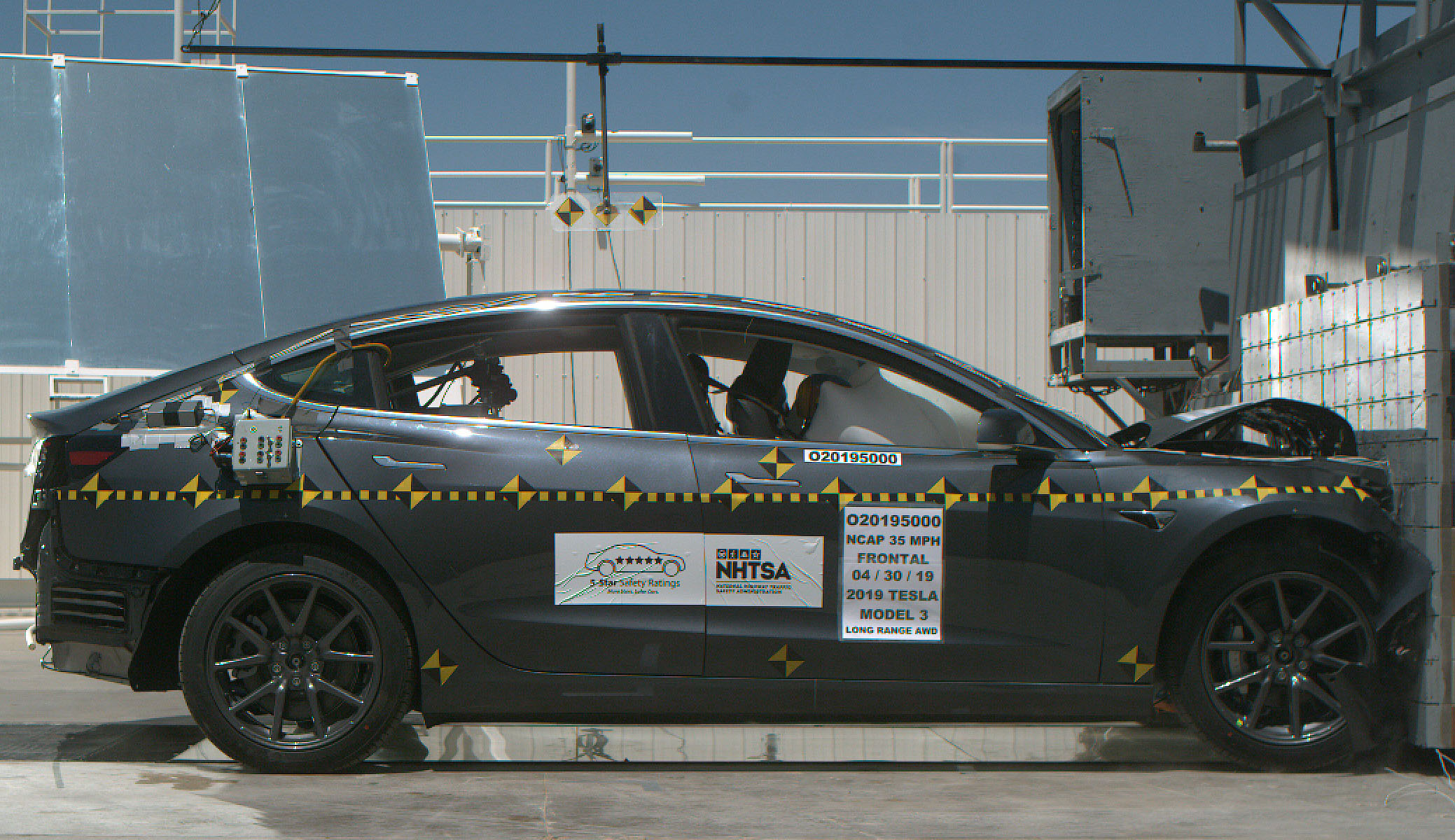
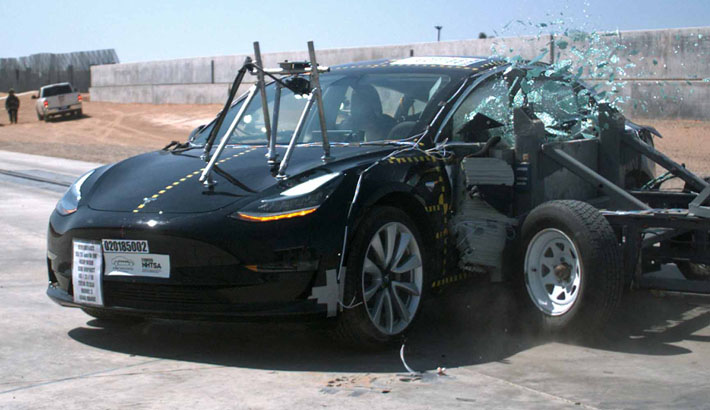
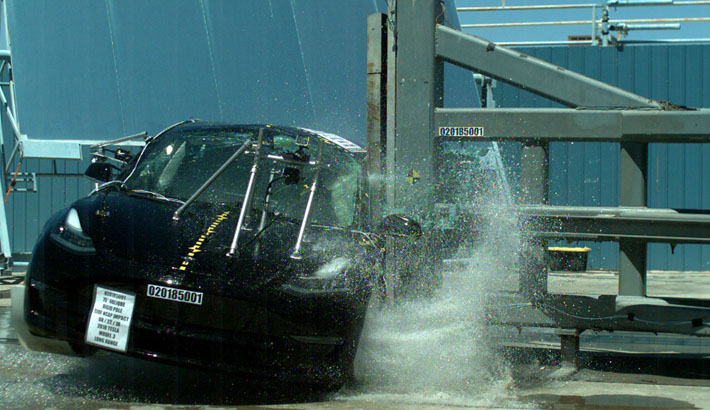
NHTSA crash tests
The agency crash-tested this model year itself. These are its own
photographs and star ratings.
Frontal crash test
Side barrier crash test
Side pole crash test
Photographs taken by NHTSA during its own New Car Assessment Program crash
tests of this model year. Public domain.
Configuration
Overall
Front
Side
Rollover
2023 Tesla Model 3 4 DR AWD
6.6% risk
2023 Tesla Model 3 4 DR RWD
6.6% risk
When owners complained
A spike years after the car went on sale usually means a part wearing
out on schedule across the whole fleet — the kind of pattern no single
owner can see from inside their own car.
Nov 2022peak 70Sep 2026
Recalls on the 2023 Tesla Model 3
A complaint is one owner's allegation. A recall is the point at which
the manufacturer or a regulator agreed the defect is real and dangerous
enough to fix for free — however old the car is.
United States — NHTSA
26V507000
EXTERIOR LIGHTING:HEADLIGHTS
Tesla, Inc. (Tesla) is recalling certain 2017-2023 Model 3 and 2020-2023 Model Y vehicles. The headlight low beams may be too bright and exceed the maximum light output. As such, these vehicles fail to comply with the requirements of Federal Motor Vehicle Safety Standard (FMVSS) number 108, "Lamps, Reflective Devices, and Associated Equipment."
Risk: Headlight low beams that are too bright can reduce visibility for oncoming drivers, increasing the risk of a crash.
26V283000
BACK OVER PREVENTION:SOFTWARE
Tesla, Inc. (Tesla) is recalling certain 2017, 2021-2023 Model 3, 2020-2023 Model Y, 2021-2023 Model S, and Model X vehicles operating software version 2026.8.6. The rearview camera image may be delayed when the vehicle is placed in reverse. As such, these vehicles fail to comply with the requirements of Federal Motor Vehicle Safety Standard number 111, "Rear Visibility."
Risk: A delayed rearview image reduces the driver's view behind the vehicle, increasing the risk of a crash.
25V092000
STEERING:ELECTRIC POWER ASSIST SYSTEM
Tesla, Inc. (Tesla) is recalling certain 2023 Model 3 and Model Y vehicles operating software prior to 2023.38.4. The printed circuit board for the electronic power steering assist may experience an overstress condition, causing a loss of power steering assist when the vehicle reaches a stop and then accelerates again.
Risk: A loss of power steering assist can require greater steering effort, especially at low speeds, increasing the risk of a crash.
24V935000
TIRES:PRESSURE MONITORING AND REGULATING SYSTEMS
Tesla, Inc. (Tesla) is recalling certain 2024 Cybertruck, 2017-2025 Model 3, and 2020-2025 Model Y vehicles. The tire pressure monitoring system (TPMS) warning light may not remain illuminated between drive cycles, failing to warn the driver of low tire pressure. As such, these vehicles fail to comply with the requirements of Federal Motor Vehicle Safety Standard number 138, "Tire Pressure Monitoring Systems."
Risk: Driving with improperly inflated tires increases the risk of a crash.
24V554000
LATCHES/LOCKS/LINKAGES:HOOD:LATCH
Tesla, Inc. (Tesla) is recalling certain 2021-2024 Model 3, Model S, Model X, and 2020-2024 Model Y vehicles. The hood latch assembly may fail to detect an unlatched hood condition after the hood has been opened.
Risk: An unlatched hood can fully open, obstructing the driver's view and increasing the risk of a crash.
24V376000
SEAT BELTS:FRONT:WARNING LIGHT/DEVICES
Tesla, Inc. (Tesla) is recalling certain 2012-2024 Model S, 2015-2024 Model X, 2017-2023 Model 3, and 2020-2023 Model Y vehicles. In the event of an unbelted driver, the seat belt warning light and audible chime may not activate as intended. As such, these vehicles fail to comply with the requirements of Federal Motor Vehicle Safety Standard number 208, "Occupant Crash Protection."
Risk: A seat belt warning system that fails to alert occupants of an unbelted seat belt can increase the risk of injury during a crash.
24V051000
ELECTRICAL SYSTEM: INSTRUMENT CLUSTER/PANEL
Tesla, Inc. (Tesla) is recalling certain 2012-2023 Model S, 2016-2024 Model X, 2017-2023 Model 3, 2019-2024 Model Y, and 2024 Cybertruck vehicles. An incorrect font size is displayed on the instrument panel for the Brake, Park, and Antilock Brake System (ABS) warning lights. As such, these vehicles fail to comply with the requirements of Federal Motor Vehicle Safety Standard number 105, "Hydraulic and Electric Brake Systems" and 135, "Light Vehicle Brake Systems."
Risk: Warning lights with a smaller font size can make critical safety information on the instrument panel difficult to read, increasing the risk of a crash.
Tesla, Inc. (Tesla) is recalling 2012-2023 Model S, 2016-2023 Model X, 2017-2023 Model 3, and 2020-2023 Model Y vehicles equipped with all versions of Autosteer leading up to the version(s) that contains the recall remedy. In certain circumstances when Autosteer is engaged, the prominence and scope of the feature's controls may not be sufficient to prevent driver misuse of the SAE Level 2 advanced driver-assistance feature.
Risk: In certain circumstances when Autosteer is engaged, and the driver does not maintain responsibility for vehicle operation and is unprepared to intervene as necessary or fails to recognize when Autosteer is canceled or not engaged, there may be an increased risk of a crash.
Canada — Transport Canada
Canada runs its own recall programme, and its campaigns do not
always mirror the American ones.
Recall 202622113,846 units in Canada
Visual System
Issue: On certain vehicles, a software problem could delay the rearview camera image from displaying when the transmission is shifted into reverse shortly after the vehicle is started. Canadian regulations require the rearview image to display within 2 seconds of shifting the transmission into reverse gear. Safety Risk: A rearview camera image that doesn't display could reduce a driver's ability to see behind the vehicle while backing up. This could increase the risk of a crash. Corrective Actions: Tesla will notify owners by email. Tesla has released an over-the-air software update to fix this problem. There is no further action required if your vehicle has software release 2026.8.6.1 or a later release.
Recall 202503438,601 units in Canada
Steering
Issue: On certain vehicles, a software problem could cause damage to the electronic power-assisted steering (EPAS) circuit board. If this happens, there could be a loss of power steering assist when the vehicle is stopped. Note: This problem would cause a warning message to display on the user interface. Safety Risk: A loss of power steering assist can cause a sudden increase in steering effort and create the risk of a crash. Corrective Actions: Tesla will notify affected owners by email. Tesla has released an over-the-air software update to fix this issue. There is no further action required if your vehicle has software release 2023.38.4 or a later release.
Recall 2024427179,752 units in Canada
Electrical
Issue: On certain vehicles, the hood latch assembly could fail and cause the unlatched hood warning not to display on the instrument panel. As a result, you may not be aware that the hood isn't latched properly. If this happens, the hood could open suddenly while driving. Safety Risk: A hood that opens suddenly while driving can block the driver's view and increase the risk of a crash. Corrective Actions: Tesla will notify affected owners by email. Tesla has released an over-the-air software update to fix this issue. There is no further action required if your vehicle has software release 2024.20.3 or a later release.
Recall 20242989,435 units in Canada
Seats And Restraints
Issue: On certain vehicles, the seat belt reminder chime and visual warning may not work when you start the vehicle and your seat belt is not buckled. Canadian regulations require both a seat belt reminder sound and visual telltale when a driver is not wearing their seat belt. Safety Risk: A seat belt warning that doesn't work correctly may not remind you to buckle your seat belt. Not wearing your seat belt can increase the risk of injury in a crash. Corrective Actions: Tesla will notify owners by email and supply an over-the-air software update to activate the seat belt reminder chime and visual warning.
Recall 2024283109,791 units in Canada
Lights And Instruments
Issue: A previous over-the-air (OTA) software update could cause the vehicle not to display the correct visual warning indicators when there are problems with the brake system or when the parking brake is applied. As a result, the BRAKE, PARK, and antilock brake system (ABS) visual indicators would display as text instead of symbols. Safety Risk: While there is a low risk to safety, Canadian regulations require visual warnings to use common symbols, instead of words, to avoid driver confusion. Corrective Actions: Tesla will notify affected owners by email. Tesla has released an over-the-air software update to fix this problem. There is no further action required if your vehicle has software release 2024.3.25, 2024.14.5, or a release later than 2024.14.5.
Recall 2023657192,769 units in Canada
Accessories
Issue: On vehicles equipped with the Autosteer advanced driver-assistance feature, when using the feature, the vehicle may not provide strong enough warnings or monitor the driver closely enough to prevent misuse of the feature. Safety Risk: A driver that doesn't pay close attention while using the Autosteer feature or who doesn't react quickly when Autosteer is canceled could have an increased risk of a crash. Corrective Actions: Tesla will notify owners by email and supply an over-the-air software update to improve driver monitoring and alerts while using the Autosteer feature. Tesla advises that you must always pay attention and be ready to take control of the vehicle at any time while using the Autosteer advanced driver-assistance feature.
Reports where the owner recorded a crash, a fire, an injury or a death.
Colorado Springs, COCrash
POWER TRAIN
I have a group of individuals that are hacking all of my accounts and trying to steal my car. They first hacked my emails then my Tesla account and now they are actually on the Teslas computer system and have been in the vehicle accessing the screen. After they hacked the system and stopped updates the car started having a bunch of safety concerns and alerts.The breaks were not working and the vehicle would freely roll when full pressure was applied. The collision system in the car was not working properly. Thinking it was possibly going to be hit by another car it would avoid nothing and jerk me out of the lane and nothing was around at all potentially causing an accident. Then the collision system stopped working all together. The steering system would not communicate properly with the system and kept requesting to be reconfigured with the system. The power train system kept throwing alerts. The tire pressure sensors stopped working and will not retrain now. They keep stopping the software updates now and have an IT admin portal device management program on the system and have complete control of the car’s system. Recently they were checking into enrolling in to fleet developer API to interact with the vehicle at code level. I have tried everything to get them off the account and they live at my apartment building. They are using illegal hacking tools and devices to gain access spyware and malware on all my devices.Tesla has done little to nothing to fix this problem and reports have been made. This is a major safety concern.
NHTSA complaint #11764076 — an unverified report by a vehicle owner.
Colorado Springs, COCrash
SERVICE BRAKES
I have a group of individuals that are hacking all of my accounts and trying to steal my car. They first hacked my emails then my Tesla account and now they are actually on the Teslas computer system and have been in the vehicle accessing the screen. After they hacked the system and stopped updates the car started having a bunch of safety concerns and alerts.The breaks were not working and the vehicle would freely roll when full pressure was applied. The collision system in the car was not working properly. Thinking it was possibly going to be hit by another car it would avoid nothing and jerk me out of the lane and nothing was around at all potentially causing an accident. Then the collision system stopped working all together. The steering system would not communicate properly with the system and kept requesting to be reconfigured with the system. The power train system kept throwing alerts. The tire pressure sensors stopped working and will not retrain now. They keep stopping the software updates now and have an IT admin portal device management program on the system and have complete control of the car’s system. Recently they were checking into enrolling in to fleet developer API to interact with the vehicle at code level. I have tried everything to get them off the account and they live at my apartment building. They are using illegal hacking tools and devices to gain access spyware and malware on all my devices.Tesla has done little to nothing to fix this problem and reports have been made. This is a major safety concern.
NHTSA complaint #11764076 — an unverified report by a vehicle owner.
Colorado Springs, COCrash
FORWARD COLLISION AVOIDANCE: WARNINGS
I have a group of individuals that are hacking all of my accounts and trying to steal my car. They first hacked my emails then my Tesla account and now they are actually on the Teslas computer system and have been in the vehicle accessing the screen. After they hacked the system and stopped updates the car started having a bunch of safety concerns and alerts.The breaks were not working and the vehicle would freely roll when full pressure was applied. The collision system in the car was not working properly. Thinking it was possibly going to be hit by another car it would avoid nothing and jerk me out of the lane and nothing was around at all potentially causing an accident. Then the collision system stopped working all together. The steering system would not communicate properly with the system and kept requesting to be reconfigured with the system. The power train system kept throwing alerts. The tire pressure sensors stopped working and will not retrain now. They keep stopping the software updates now and have an IT admin portal device management program on the system and have complete control of the car’s system. Recently they were checking into enrolling in to fleet developer API to interact with the vehicle at code level. I have tried everything to get them off the account and they live at my apartment building. They are using illegal hacking tools and devices to gain access spyware and malware on all my devices.Tesla has done little to nothing to fix this problem and reports have been made. This is a major safety concern.
NHTSA complaint #11764076 — an unverified report by a vehicle owner.
Valley Village, CACrash
FORWARD COLLISION AVOIDANCE: ADAPTIVE CRUISE CONTROL
On 8/24/2026 at approximately 12:02pm, my 2023 Model 3 was parked in my assigned space in a covered apartment carport, with a concrete support pillar approximately one to two feet from the passenger side. I entered a destination and activated FSD (Supervised) from Park, a Tesla-designed feature. Vehicle telemetry recorded in the dashcam clips shows FSD shifted into Drive, activated the right turn signal, turned the steering wheel to near full right lock, and accelerated to 3 mph, contacting the pillar with the passenger mirror and front door approximately 1.5 seconds after first movement. No accelerator or brake input was recorded from me before the collision. I applied the brake within one second of the impact beginning, and FSD disengaged. The pillar was within view of the vehicle's side cameras throughout. No warning was given. Damage to the passenger door; no injuries. Dashcam video with telemetry overlay and photos available.
NHTSA complaint #11759274 — an unverified report by a vehicle owner.
Surprise, AZ1 injured
STRUCTURE:BODY
Vehicle: Tesla Model 3 Issue: Power trunk failed to detect obstruction Date of incident: July 5, 2026 Location: Surprise, AZ During normal use of the vehicle, my child pressed the “close trunk” button while I was leaning into the trunk area. The powered trunk began closing and did not stop when it made contact with my head. Instead of reversing direction, the trunk continued applying downward force until I moved out of the way. This indicates a failure of the trunk’s obstruction detection system, which is supposed to prevent injury by stopping or reversing when an object or person is detected. This malfunction poses a significant safety risk, especially to children who may accidentally activate the trunk or to adults loading items. A powered trunk should not be able to continue closing on a person’s head. I request that NHTSA investigate whether this is a defect in the Tesla Model 3 trunk sensor system and whether similar incidents have been reported.
NHTSA complaint #11748682 — an unverified report by a vehicle owner.
Sunny Isles Beach, FLCrashFire1 killed
AIR BAGS
A fatal crash occurred involving a 2023 Tesla Model 3. The vehicle departed the roadway, impacted a guardrail, struck a utility pole on the driver’s side, rolled down an embankment, and came to rest upright. The crash resulted in catastrophic intrusion into the driver’s compartment and a fatal injury to the driver. I am requesting that NHTSA investigate the crashworthiness and occupant protection performance of this vehicle, including the structural integrity of the occupant compartment, airbag deployment and effectiveness, and the performance of any advanced driver assistance systems, including collision warnings and automatic emergency braking. I am also requesting review and preservation of all available vehicle data, including Event Data Recorder (EDR) information, vehicle telemetry, driver assistance system status, warning notifications, braking data, steering data, and any other information recorded before and during the crash. At this time, I do not know whether a vehicle defect or system malfunction occurred. My concern is whether the vehicle’s safety systems and occupant protection systems functioned as intended and whether additional vehicle data may help determine if any safety-related issues contributed to the severity of the crash.
NHTSA complaint #11746034 — an unverified report by a vehicle owner.
The most recent complaints
In the owners' own words, exactly as filed with NHTSA.
Colorado Springs, COCrash
POWER TRAIN
I have a group of individuals that are hacking all of my accounts and trying to steal my car. They first hacked my emails then my Tesla account and now they are actually on the Teslas computer system and have been in the vehicle accessing the screen. After they hacked the system and stopped updates the car started having a bunch of safety concerns and alerts.The breaks were not working and the vehicle would freely roll when full pressure was applied. The collision system in the car was not working properly. Thinking it was possibly going to be hit by another car it would avoid nothing and jerk me out of the lane and nothing was around at all potentially causing an accident. Then the collision system stopped working all together. The steering system would not communicate properly with the system and kept requesting to be reconfigured with the system. The power train system kept throwing alerts. The tire pressure sensors stopped working and will not retrain now. They keep stopping the software updates now and have an IT admin portal device management program on the system and have complete control of the car’s system. Recently they were checking into enrolling in to fleet developer API to interact with the vehicle at code level. I have tried everything to get them off the account and they live at my apartment building. They are using illegal hacking tools and devices to gain access spyware and malware on all my devices.Tesla has done little to nothing to fix this problem and reports have been made. This is a major safety concern.
NHTSA complaint #11764076 — an unverified report by a vehicle owner.
Colorado Springs, COCrash
SERVICE BRAKES
I have a group of individuals that are hacking all of my accounts and trying to steal my car. They first hacked my emails then my Tesla account and now they are actually on the Teslas computer system and have been in the vehicle accessing the screen. After they hacked the system and stopped updates the car started having a bunch of safety concerns and alerts.The breaks were not working and the vehicle would freely roll when full pressure was applied. The collision system in the car was not working properly. Thinking it was possibly going to be hit by another car it would avoid nothing and jerk me out of the lane and nothing was around at all potentially causing an accident. Then the collision system stopped working all together. The steering system would not communicate properly with the system and kept requesting to be reconfigured with the system. The power train system kept throwing alerts. The tire pressure sensors stopped working and will not retrain now. They keep stopping the software updates now and have an IT admin portal device management program on the system and have complete control of the car’s system. Recently they were checking into enrolling in to fleet developer API to interact with the vehicle at code level. I have tried everything to get them off the account and they live at my apartment building. They are using illegal hacking tools and devices to gain access spyware and malware on all my devices.Tesla has done little to nothing to fix this problem and reports have been made. This is a major safety concern.
NHTSA complaint #11764076 — an unverified report by a vehicle owner.
Colorado Springs, COCrash
FORWARD COLLISION AVOIDANCE: WARNINGS
I have a group of individuals that are hacking all of my accounts and trying to steal my car. They first hacked my emails then my Tesla account and now they are actually on the Teslas computer system and have been in the vehicle accessing the screen. After they hacked the system and stopped updates the car started having a bunch of safety concerns and alerts.The breaks were not working and the vehicle would freely roll when full pressure was applied. The collision system in the car was not working properly. Thinking it was possibly going to be hit by another car it would avoid nothing and jerk me out of the lane and nothing was around at all potentially causing an accident. Then the collision system stopped working all together. The steering system would not communicate properly with the system and kept requesting to be reconfigured with the system. The power train system kept throwing alerts. The tire pressure sensors stopped working and will not retrain now. They keep stopping the software updates now and have an IT admin portal device management program on the system and have complete control of the car’s system. Recently they were checking into enrolling in to fleet developer API to interact with the vehicle at code level. I have tried everything to get them off the account and they live at my apartment building. They are using illegal hacking tools and devices to gain access spyware and malware on all my devices.Tesla has done little to nothing to fix this problem and reports have been made. This is a major safety concern.
NHTSA complaint #11764076 — an unverified report by a vehicle owner.
Louisville, KY
FORWARD COLLISION AVOIDANCE: ADAPTIVE CRUISE CONTROL
Im using full self driving (fsd) and it scans the lot and chose to pull into an empty spot half way in and reverse almost smacking a car in the rear. It didnt appear it was gonna stop even though the car was showing on the screen. I do have the dash cam from where i had to step on the break for it to disengage.
NHTSA complaint #11764243 — an unverified report by a vehicle owner.
Louisville, KY
BACK OVER PREVENTION: WARNINGS
Im using full self driving (fsd) and it scans the lot and chose to pull into an empty spot half way in and reverse almost smacking a car in the rear. It didnt appear it was gonna stop even though the car was showing on the screen. I do have the dash cam from where i had to step on the break for it to disengage.
NHTSA complaint #11764243 — an unverified report by a vehicle owner.
San Jose, CA
SUSPENSION
I am filing an official safety complaint regarding a severe, premature failure of the front lower suspension system on my 2023 Tesla Model 3. While operating the vehicle, the front lower compliance links (Part numbers: 2188359-10-B, 2188354-10-B) and the lower lateral links (Part number: 1044341-00-G) suffered critical mechanical bushing degradation and structural wear, rendering the front suspension unsafe and compromised.This mechanical breakdown occurred at only 63,584 miles on a three-year-old vehicle under completely normal, standard highway and suburban driving conditions. There has been absolutely no external impact, wheel strike, curb strike, or collision to explain a simultaneous, symmetrical breakdown of multiple heavy suspension components on both the left and right sides of the vehicle. My tires show zero sidewall damage and the wheels have no structural bends, proving the issue is an inherent component lifecycle defect rather than a road hazard.This issue directly correlates with NHTSA Preliminary Evaluation PE26006, which investigates nearly 1.2 million Tesla Model 3 and Model Y vehicles for front lower lateral and compliance link failures. When seeking service, Tesla Service Center personnel attempted to classify this wear due to structural degradation but deny warranty or goodwill coverage. This component vulnerability represents an acute safety risk, as a total failure or detachment of these specific lower links while traveling at high speeds could cause a catastrophic, immediate loss of steering control. I request that the NHTSA include this vehicle in its ongoing investigation to push for a mandatory safety recall.
NHTSA complaint #11763517 — an unverified report by a vehicle owner.
Oklahoma City, OK
STEERING
OKC Tesla Service Center replaced the steering wheel due to delamination over the weekend. The car was dropped off on Friday the 4th of September 2026. I picked the car up on Monday the 7th. On Wednesday the 9th after getting on the highway and getting up to speed the steering wheel came out of the steering column and was physically disconnected from the car. I was able to temporarily get it back into place enough to get the car to a save location to be towed.
NHTSA complaint #11763241 — an unverified report by a vehicle owner.
Atlanta, GA
SERVICE BRAKES
I was driving with plenty of distance between me and the car in front of me. The car in front of me had stopped and the Automatic Emergency Braking System on my car went on. Thankfully, there was no car behind me, otherwise, I would have been hit. The sudden stopping has caused me significant lower back pain.
NHTSA complaint #11762969 — an unverified report by a vehicle owner.
I was driving with plenty of distance between me and the car in front of me. The car in front of me had stopped and the Automatic Emergency Braking System on my car went on. Thankfully, there was no car behind me, otherwise, I would have been hit. The sudden stopping has caused me significant lower back pain.
NHTSA complaint #11762969 — an unverified report by a vehicle owner.
Statesboro, GA
VEHICLE SPEED CONTROL
On XXX at around 3:30 PM EST, I was driving my 2023 Tesla Model 3 on [XXX] about 10 miles outside of [XXX]. I had the adaptive cruise control set at 75 mph. I was driving in the right lane of the two available lanes of travel in that direction. I noticed an unattended car on the right shoulder about a 1/4 mile up the road and continued my drive as normal. The car was at least 5' to 6' off the highway. As i got about 30 yards from the car, my car suddenly slammed on the brakes automatically, which forced me to react in a corrective manner. Thankfully there was nobody behind me or the severity of the braking would have likely caused a rear end collision. To my understanding, this phantom braking is a known issue with Teslas, so I wanted to document my experience to add to the record. INFORMATION REDACTED PURSUANT TO THE FREEDOM OF INFORMATION ACT (FOIA), 5 U.S.C. 552(B)(6)
NHTSA complaint #11759922 — an unverified report by a vehicle owner.
Statesboro, GA
SERVICE BRAKES
On XXX at around 3:30 PM EST, I was driving my 2023 Tesla Model 3 on [XXX] about 10 miles outside of [XXX]. I had the adaptive cruise control set at 75 mph. I was driving in the right lane of the two available lanes of travel in that direction. I noticed an unattended car on the right shoulder about a 1/4 mile up the road and continued my drive as normal. The car was at least 5' to 6' off the highway. As i got about 30 yards from the car, my car suddenly slammed on the brakes automatically, which forced me to react in a corrective manner. Thankfully there was nobody behind me or the severity of the braking would have likely caused a rear end collision. To my understanding, this phantom braking is a known issue with Teslas, so I wanted to document my experience to add to the record. INFORMATION REDACTED PURSUANT TO THE FREEDOM OF INFORMATION ACT (FOIA), 5 U.S.C. 552(B)(6)
NHTSA complaint #11759922 — an unverified report by a vehicle owner.
Statesboro, GA
FORWARD COLLISION AVOIDANCE: ADAPTIVE CRUISE CONTROL
On XXX at around 3:30 PM EST, I was driving my 2023 Tesla Model 3 on [XXX] about 10 miles outside of [XXX]. I had the adaptive cruise control set at 75 mph. I was driving in the right lane of the two available lanes of travel in that direction. I noticed an unattended car on the right shoulder about a 1/4 mile up the road and continued my drive as normal. The car was at least 5' to 6' off the highway. As i got about 30 yards from the car, my car suddenly slammed on the brakes automatically, which forced me to react in a corrective manner. Thankfully there was nobody behind me or the severity of the braking would have likely caused a rear end collision. To my understanding, this phantom braking is a known issue with Teslas, so I wanted to document my experience to add to the record. INFORMATION REDACTED PURSUANT TO THE FREEDOM OF INFORMATION ACT (FOIA), 5 U.S.C. 552(B)(6)
NHTSA complaint #11759922 — an unverified report by a vehicle owner.
Valley Village, CACrash
FORWARD COLLISION AVOIDANCE: ADAPTIVE CRUISE CONTROL
On 8/24/2026 at approximately 12:02pm, my 2023 Model 3 was parked in my assigned space in a covered apartment carport, with a concrete support pillar approximately one to two feet from the passenger side. I entered a destination and activated FSD (Supervised) from Park, a Tesla-designed feature. Vehicle telemetry recorded in the dashcam clips shows FSD shifted into Drive, activated the right turn signal, turned the steering wheel to near full right lock, and accelerated to 3 mph, contacting the pillar with the passenger mirror and front door approximately 1.5 seconds after first movement. No accelerator or brake input was recorded from me before the collision. I applied the brake within one second of the impact beginning, and FSD disengaged. The pillar was within view of the vehicle's side cameras throughout. No warning was given. Damage to the passenger door; no injuries. Dashcam video with telemetry overlay and photos available.
NHTSA complaint #11759274 — an unverified report by a vehicle owner.
Pikesville, MD
UNKNOWN OR OTHER
I am writing to report several safety incidents that occurred while using Full Self-Driving (FSD) mode on my 2023 Model 3. Below are the details of the specific behaviors observed: - Right turn on red almost crashed into an oncoming car from the left - Hard emergency brake due to a bird that was in the opposite lane - Additional emergency brake around 10 seconds later for no reason - Running a red light by more than a second
NHTSA complaint #11756205 — an unverified report by a vehicle owner.
Washington, UT
FORWARD COLLISION AVOIDANCE: ADAPTIVE CRUISE CONTROL
Two separate incidents occurred on July 10th and July 12th 2026 involving adaptive cruise control. While adaptive cruise control was engaged my car slammed on the brakes for no reason. There was nothing in the roadway to cause abrupt braking. The second time it occurred my car was close to being rear ended by a vehicle driving behind me. I took the car which is still under warranty to Tesla who confirmed there is a known firmware issue. No time frame was provided as to when the issue will be fixed.
NHTSA complaint #11755758 — an unverified report by a vehicle owner.
Roscoe, IL
VEHICLE SPEED CONTROL
Whilst driving on highways which feature multiple speed limits - eg. 70 cars, 65 Trucks, 60 Buses. If full self driving more or when in adaptive cruise control - the car systems fail to recognize the restriction linked to the lower speed limits. As a result, you can be driving on Full Self Drive at 75mpm, the car sees a 65 followed by a 60 speed limit (neither applicable to cars), but the car brakes hard dropping the speed from 75 to 62 almost instantly and, on more than one occasion, a closely following car has almost collided with me. Until such time as the Tesla system can recognize the 'sub text' on a speed limit - the FSD and Adaptive cruise should not be certified. I also drive a BMW i4 and this reads all signs correctly, only applying those applicable to a car to the vehicle.
NHTSA complaint #11754804 — an unverified report by a vehicle owner.
Roscoe, IL
FORWARD COLLISION AVOIDANCE: ADAPTIVE CRUISE CONTROL
Whilst driving on highways which feature multiple speed limits - eg. 70 cars, 65 Trucks, 60 Buses. If full self driving more or when in adaptive cruise control - the car systems fail to recognize the restriction linked to the lower speed limits. As a result, you can be driving on Full Self Drive at 75mpm, the car sees a 65 followed by a 60 speed limit (neither applicable to cars), but the car brakes hard dropping the speed from 75 to 62 almost instantly and, on more than one occasion, a closely following car has almost collided with me. Until such time as the Tesla system can recognize the 'sub text' on a speed limit - the FSD and Adaptive cruise should not be certified. I also drive a BMW i4 and this reads all signs correctly, only applying those applicable to a car to the vehicle.
NHTSA complaint #11754804 — an unverified report by a vehicle owner.
Williams, IN
STEERING
The steering rack in my 2023 Tesla Model 3 is defective and I can show it for inspection. 1.5 years ago it failed and the torque sensor in the rack is showing that there is a constant demand (even when parked and my hands off the wheel) to turn the wheel to the right that you can see in the cars diagnostics menu. I took it in and showed the service advisor the raw data and took a drive with the tech who both acknowledged the data and the car wanting to drive off the road. They did an alignment on the car but the issue still persists even after I told them the night I drove it home in their survey. I live on very narrow country roads with little run off room and often times less than foot between cars as they pass. Several times I would get the 'corrective steering applied' warning as the car falsely thinking I was turning to drive off the road on the right and applied steering to pull the car left. A few of these times it was right as a oncoming car was approaching almost causing me to run into other cars multiple times because you have to get close to the edge of the road to make room for other cars to pass. I took it to a independent service center who confirmed that the steering rack torque sensor is at fault. I took it back again this week, showing them that the car is turning to the right 30-45% easier than to the left and they did another alignment with the same exact outcome. The car wants to drive right off the road.
NHTSA complaint #11750955 — an unverified report by a vehicle owner.
San Jose, CA
UNKNOWN OR OTHER
i was using FSD and my vehicle braked suddenly, with nothing in front of me, on the highway going over 50mph with a car close behind. the car to my right was swerving into my lane, so it was trying to help, but my vehicle should have veered left - not brake hard in the fast lane.
NHTSA complaint #11749288 — an unverified report by a vehicle owner.
Surprise, AZ1 injured
STRUCTURE:BODY
Vehicle: Tesla Model 3 Issue: Power trunk failed to detect obstruction Date of incident: July 5, 2026 Location: Surprise, AZ During normal use of the vehicle, my child pressed the “close trunk” button while I was leaning into the trunk area. The powered trunk began closing and did not stop when it made contact with my head. Instead of reversing direction, the trunk continued applying downward force until I moved out of the way. This indicates a failure of the trunk’s obstruction detection system, which is supposed to prevent injury by stopping or reversing when an object or person is detected. This malfunction poses a significant safety risk, especially to children who may accidentally activate the trunk or to adults loading items. A powered trunk should not be able to continue closing on a person’s head. I request that NHTSA investigate whether this is a defect in the Tesla Model 3 trunk sensor system and whether similar incidents have been reported.
NHTSA complaint #11748682 — an unverified report by a vehicle owner.
Fair Oaks, CA
FORWARD COLLISION AVOIDANCE: ADAPTIVE CRUISE CONTROL
My 2023 Tesla Model 3 (VIN [XXX]) has a recurring safety defect in its driver-assistance system involving two unsafe behaviors. First, “phantom braking”: while driving with Autopilot/FSD engaged, the vehicle decelerates suddenly and without warning when there is no obstacle or threat in its path, creating a rear-end collision risk. This was first reported within the vehicle’s warranty period and has recurred. Second, on the most recent occurrence, with a Tesla service technician riding along to witness the issue, Full Self Driving (Supervised) failed to proceed safely through the intersection of [XXX] and [XXX]. The vehicle stopped mid-turn while another vehicle approached from the opposite direction. I had to take manual control to complete the turn and avoid a hazard. The Tesla technician witnessed this directly, and the service summary states FSD “did not proceed through the intersection properly.” The vehicle has been to a Tesla service center twice for this defect. It has not been resolved. The behavior occurs without warning and is unpredictable. INFORMATION REDACTED PURSUANT TO THE FREEDOM OF INFORMATION ACT (FOIA), 5 U.S.C. 552(B)(6)
NHTSA complaint #11747048 — an unverified report by a vehicle owner.
Menlo Park, CA
UNKNOWN OR OTHER
I was driving today in California, to TopGolf. I had to cross a railway crossing around [XXX] I think, or [XXX] - one of those 2, between [XXX] and [XXX] pm.. I was using Tesla's FSD driving to go on a local road. I was not distracted or occupied - the vehicle was going at a fairly high speed like maybe 35 or so, and in a couple of seconds, it broke the red and white safety gate at a railway crossing, inspite of it being down and the train being on the tracks - I WAS IN SHOCK. The car completely missed the red and white gate, and just blew past it, damaging my windshield completely to smithereens and throwing glass all over the car. I was in such SHOCK and TRAUMA that I literaly wanted to exit the car and sit down somewhere, but i gathered my composure and drove quickly to the nearest safest place I could stop, and got into some office parking garage. I then called the cops and reported it. This was such a shock, and thank the Almighty God that I wasnt hurt and that the train didn't just hit me. This HAS to be recalled, and there is no way this should be allowed on the roads. I used FSD a Lot and i will never use it again. INFORMATION REDACTED PURSUANT TO THE FREEDOM OF INFORMATION ACT (FOIA), 5 U.S.C. 552(B)(6)
NHTSA complaint #11746850 — an unverified report by a vehicle owner.
Menlo Park, CA
FORWARD COLLISION AVOIDANCE: WARNINGS
I was driving today in California, to TopGolf. I had to cross a railway crossing around [XXX] I think, or [XXX] - one of those 2, between [XXX] and [XXX] pm.. I was using Tesla's FSD driving to go on a local road. I was not distracted or occupied - the vehicle was going at a fairly high speed like maybe 35 or so, and in a couple of seconds, it broke the red and white safety gate at a railway crossing, inspite of it being down and the train being on the tracks - I WAS IN SHOCK. The car completely missed the red and white gate, and just blew past it, damaging my windshield completely to smithereens and throwing glass all over the car. I was in such SHOCK and TRAUMA that I literaly wanted to exit the car and sit down somewhere, but i gathered my composure and drove quickly to the nearest safest place I could stop, and got into some office parking garage. I then called the cops and reported it. This was such a shock, and thank the Almighty God that I wasnt hurt and that the train didn't just hit me. This HAS to be recalled, and there is no way this should be allowed on the roads. I used FSD a Lot and i will never use it again. INFORMATION REDACTED PURSUANT TO THE FREEDOM OF INFORMATION ACT (FOIA), 5 U.S.C. 552(B)(6)
NHTSA complaint #11746850 — an unverified report by a vehicle owner.
Sunny Isles Beach, FLCrashFire1 killed
AIR BAGS
A fatal crash occurred involving a 2023 Tesla Model 3. The vehicle departed the roadway, impacted a guardrail, struck a utility pole on the driver’s side, rolled down an embankment, and came to rest upright. The crash resulted in catastrophic intrusion into the driver’s compartment and a fatal injury to the driver. I am requesting that NHTSA investigate the crashworthiness and occupant protection performance of this vehicle, including the structural integrity of the occupant compartment, airbag deployment and effectiveness, and the performance of any advanced driver assistance systems, including collision warnings and automatic emergency braking. I am also requesting review and preservation of all available vehicle data, including Event Data Recorder (EDR) information, vehicle telemetry, driver assistance system status, warning notifications, braking data, steering data, and any other information recorded before and during the crash. At this time, I do not know whether a vehicle defect or system malfunction occurred. My concern is whether the vehicle’s safety systems and occupant protection systems functioned as intended and whether additional vehicle data may help determine if any safety-related issues contributed to the severity of the crash.
NHTSA complaint #11746034 — an unverified report by a vehicle owner.
Sunny Isles Beach, FLCrashFire1 killed
STRUCTURE:BODY
A fatal crash occurred involving a 2023 Tesla Model 3. The vehicle departed the roadway, impacted a guardrail, struck a utility pole on the driver’s side, rolled down an embankment, and came to rest upright. The crash resulted in catastrophic intrusion into the driver’s compartment and a fatal injury to the driver. I am requesting that NHTSA investigate the crashworthiness and occupant protection performance of this vehicle, including the structural integrity of the occupant compartment, airbag deployment and effectiveness, and the performance of any advanced driver assistance systems, including collision warnings and automatic emergency braking. I am also requesting review and preservation of all available vehicle data, including Event Data Recorder (EDR) information, vehicle telemetry, driver assistance system status, warning notifications, braking data, steering data, and any other information recorded before and during the crash. At this time, I do not know whether a vehicle defect or system malfunction occurred. My concern is whether the vehicle’s safety systems and occupant protection systems functioned as intended and whether additional vehicle data may help determine if any safety-related issues contributed to the severity of the crash.
NHTSA complaint #11746034 — an unverified report by a vehicle owner.