Owners have filed 1,061 complaints
about the 2019 Tesla Model 3 with NHTSA between 2019 and 2026.
The largest single group is the driver assist & collision avoidance.
Across this model's run it ranks 4 of 10 worst.
The letter says how bad. This says what kind — whether this year drew
an unusual number of complaints, unusually dangerous
ones, or failures that arrived unusually early.
The dashed ring is 50 — the national norm. Further out is worse.
Complaint volume — 69
Against the median year of the Tesla Model 3. 50 means typical for this
model; 100 means roughly double.
Severity — 69
13.4% of these complaints
involved a crash, fire, injury or death, against a national rate of
9.7%.
Early failure — 100
84% of failures with a mileage on record happened under
36,000 miles, against a national rate of
29%.
NHTSA files every complaint against a named sub-assembly, not just a
system. This is the difference between knowing it was "the engine" and
knowing which part of it — the list to hand a mechanic.
Adaptive Cruise Control
12536.9%
Automatic Emergency Braking
7722.7%
Assist
6017.7%
Warnings
247.1%
Body
226.5%
Warning
185.3%
Blind Spot Detection
82.4%
Camera
51.5%
When it fails
Odometer readings owners gave when they filed. About half of all
complaints include one.
Under 1,000 miles
73.4%
1,000 – 9,999 miles
9245.1%
10,000 – 24,999 miles
5225.5%
25,000 – 49,999 miles
3014.7%
50,000 – 74,999 miles
136.4%
75,000 – 99,999 miles
83.9%
100,000 – 149,999 miles
21.0%
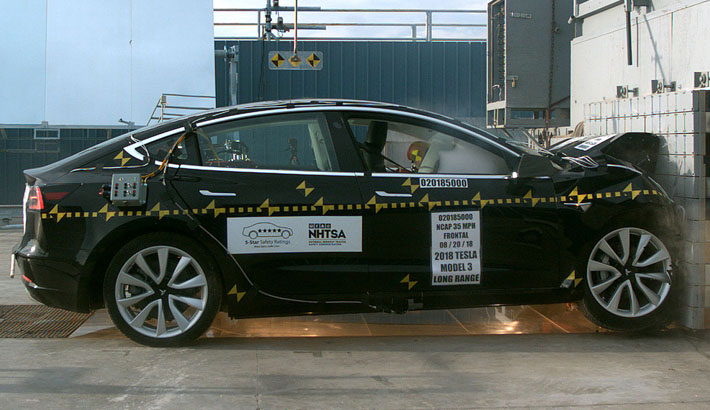
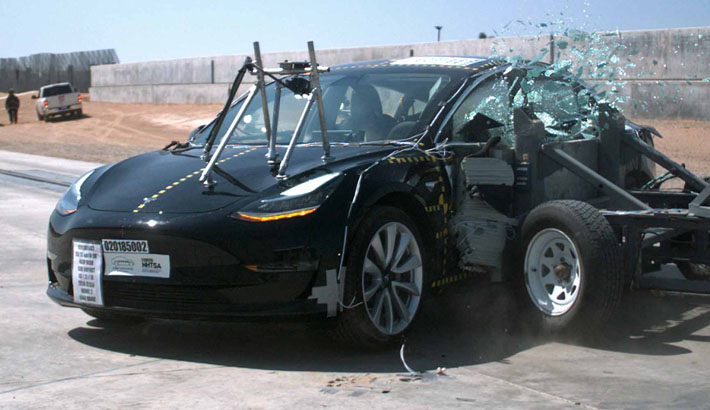
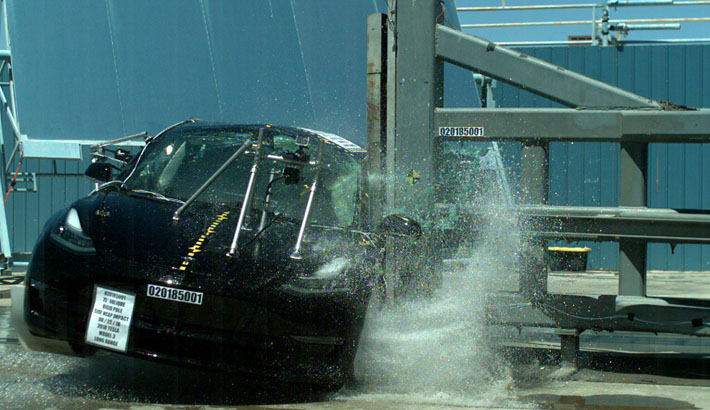
NHTSA crash tests
The agency crash-tested this model year itself. These are its own
photographs and star ratings.
Frontal crash test
Side barrier crash test
Side pole crash test
Photographs taken by NHTSA during its own New Car Assessment Program crash
tests of this model year. Public domain.
Configuration
Overall
Front
Side
Rollover
2019 Tesla Model 3 4 DR RWD
6.6% risk
2019 Tesla Model 3 4 DR AWD
6.6% risk
When owners complained
A spike years after the car went on sale usually means a part wearing
out on schedule across the whole fleet — the kind of pattern no single
owner can see from inside their own car.
Apr 2019peak 72Sep 2026
Recalls on the 2019 Tesla Model 3
A complaint is one owner's allegation. A recall is the point at which
the manufacturer or a regulator agreed the defect is real and dangerous
enough to fix for free — however old the car is.
United States — NHTSA
26V507000
EXTERIOR LIGHTING:HEADLIGHTS
Tesla, Inc. (Tesla) is recalling certain 2017-2023 Model 3 and 2020-2023 Model Y vehicles. The headlight low beams may be too bright and exceed the maximum light output. As such, these vehicles fail to comply with the requirements of Federal Motor Vehicle Safety Standard (FMVSS) number 108, "Lamps, Reflective Devices, and Associated Equipment."
Risk: Headlight low beams that are too bright can reduce visibility for oncoming drivers, increasing the risk of a crash.
24V935000
TIRES:PRESSURE MONITORING AND REGULATING SYSTEMS
Tesla, Inc. (Tesla) is recalling certain 2024 Cybertruck, 2017-2025 Model 3, and 2020-2025 Model Y vehicles. The tire pressure monitoring system (TPMS) warning light may not remain illuminated between drive cycles, failing to warn the driver of low tire pressure. As such, these vehicles fail to comply with the requirements of Federal Motor Vehicle Safety Standard number 138, "Tire Pressure Monitoring Systems."
Risk: Driving with improperly inflated tires increases the risk of a crash.
24V376000
SEAT BELTS:FRONT:WARNING LIGHT/DEVICES
Tesla, Inc. (Tesla) is recalling certain 2012-2024 Model S, 2015-2024 Model X, 2017-2023 Model 3, and 2020-2023 Model Y vehicles. In the event of an unbelted driver, the seat belt warning light and audible chime may not activate as intended. As such, these vehicles fail to comply with the requirements of Federal Motor Vehicle Safety Standard number 208, "Occupant Crash Protection."
Risk: A seat belt warning system that fails to alert occupants of an unbelted seat belt can increase the risk of injury during a crash.
Tesla, Inc. (Tesla) is recalling certain 2013, 2018-2021 Model S, 2020-2021 Model X, 2018-2022 Model 3, and 2020-2022 Model Y vehicles. A factory reset muted the Pedestrian Warning System (PWS) sounds. As such, these vehicles fail to comply with the requirements of Federal Motor Vehicle Safety Standard number 141, "Minimum Sound Requirements for Hybrid and Electric Vehicles."
Risk: Pedestrians may be unaware of an approaching vehicle if the PWS sounds are muted, increasing the risk of a crash.
24V051000
ELECTRICAL SYSTEM: INSTRUMENT CLUSTER/PANEL
Tesla, Inc. (Tesla) is recalling certain 2012-2023 Model S, 2016-2024 Model X, 2017-2023 Model 3, 2019-2024 Model Y, and 2024 Cybertruck vehicles. An incorrect font size is displayed on the instrument panel for the Brake, Park, and Antilock Brake System (ABS) warning lights. As such, these vehicles fail to comply with the requirements of Federal Motor Vehicle Safety Standard number 105, "Hydraulic and Electric Brake Systems" and 135, "Light Vehicle Brake Systems."
Risk: Warning lights with a smaller font size can make critical safety information on the instrument panel difficult to read, increasing the risk of a crash.
Tesla, Inc. (Tesla) is recalling 2012-2023 Model S, 2016-2023 Model X, 2017-2023 Model 3, and 2020-2023 Model Y vehicles equipped with all versions of Autosteer leading up to the version(s) that contains the recall remedy. In certain circumstances when Autosteer is engaged, the prominence and scope of the feature's controls may not be sufficient to prevent driver misuse of the SAE Level 2 advanced driver-assistance feature.
Risk: In certain circumstances when Autosteer is engaged, and the driver does not maintain responsibility for vehicle operation and is unprepared to intervene as necessary or fails to recognize when Autosteer is canceled or not engaged, there may be an increased risk of a crash.
23V235000
SUSPENSION:FRONT
Tesla, Inc. (Tesla) is recalling certain 2018-2019 Model 3 vehicles. The front suspension lateral link fasteners may loosen, allowing the lateral link to separate from the sub-frame.
Risk: A lateral link separation could shift the wheel alignment, causing instability and increasing the risk of a crash.
23V085000
STEERING:AUTOMATED/ADAPTIVE STEERING
Tesla, Inc. (Tesla) is recalling certain 2016-2023 Model S, Model X, 2017-2023 Model 3, and 2020-2023 Model Y vehicles equipped with Full Self-Driving Beta (FSD Beta) software or pending installation. The FSD Beta system may allow the vehicle to act unsafe around intersections, such as traveling straight through an intersection while in a turn-only lane, entering a stop sign-controlled intersection without coming to a complete stop, or proceeding into an intersection during a steady yellow traffic signal without due caution. In addition, the system may respond insufficiently to changes in posted speed limits or not adequately account for the driver's adjustment of the vehicle's speed to exceed posted speed limits.
Risk: FSD Beta software that allows a vehicle to exceed speed limits or travel through intersections in an unlawful or unpredictable manner increases the risk of a crash.
Canada — Transport Canada
Canada runs its own recall programme, and its campaigns do not
always mirror the American ones.
Recall 2026401454 units in Canada
Lights And Instruments
Issue: On certain vehicles, the low beam headlights may be too bright. Canadian regulations specify a maximum brightness for low beam headlights. Safety Risk: Low beam headlights that are too bright could cause reduced visibility for the driver and/or glare for oncoming drivers and increase the risk of a crash. Corrective Actions: Tesla will notify owners by email. The corrective actions for this recall are under development.
Recall 20242989,435 units in Canada
Seats And Restraints
Issue: On certain vehicles, the seat belt reminder chime and visual warning may not work when you start the vehicle and your seat belt is not buckled. Canadian regulations require both a seat belt reminder sound and visual telltale when a driver is not wearing their seat belt. Safety Risk: A seat belt warning that doesn't work correctly may not remind you to buckle your seat belt. Not wearing your seat belt can increase the risk of injury in a crash. Corrective Actions: Tesla will notify owners by email and supply an over-the-air software update to activate the seat belt reminder chime and visual warning.
Recall 2024283109,791 units in Canada
Lights And Instruments
Issue: A previous over-the-air (OTA) software update could cause the vehicle not to display the correct visual warning indicators when there are problems with the brake system or when the parking brake is applied. As a result, the BRAKE, PARK, and antilock brake system (ABS) visual indicators would display as text instead of symbols. Safety Risk: While there is a low risk to safety, Canadian regulations require visual warnings to use common symbols, instead of words, to avoid driver confusion. Corrective Actions: Tesla will notify affected owners by email. Tesla has released an over-the-air software update to fix this problem. There is no further action required if your vehicle has software release 2024.3.25, 2024.14.5, or a release later than 2024.14.5.
Recall 2024130340 units in Canada
Other
Issue: On certain vehicles, a software problem could cause the pedestrian warning system not to work. As a result, the vehicle may not produce enough sound to be detected by other road users. New Canadian regulations require electric vehicles to make a minimum sound level when operating at low speeds. Safety Risk: A pedestrian warning system that doesn't work could create an increased risk of injury for other road users. Corrective Actions: Tesla will notify affected owners by email. Tesla has released an over-the-air software update to fix this problem. There is no further action required if your vehicle has software release 2023.44.30.14 or a software deployed after 2023.44.30.14.
Recall 2023657192,769 units in Canada
Accessories
Issue: On vehicles equipped with the Autosteer advanced driver-assistance feature, when using the feature, the vehicle may not provide strong enough warnings or monitor the driver closely enough to prevent misuse of the feature. Safety Risk: A driver that doesn't pay close attention while using the Autosteer feature or who doesn't react quickly when Autosteer is canceled could have an increased risk of a crash. Corrective Actions: Tesla will notify owners by email and supply an over-the-air software update to improve driver monitoring and alerts while using the Autosteer feature. Tesla advises that you must always pay attention and be ready to take control of the vehicle at any time while using the Autosteer advanced driver-assistance feature.
Recall 202319424 units in Canada
Suspension
Issue: On certain vehicles, the bolts that attach the front suspension lateral links to the sub-frame could loosen over time and the lateral links could separate from the sub-frame. If this happens, there could be sudden changes in wheel alignment and a loss of vehicle stability. Note: This is an expansion of Transport Canada recall 2021-649. Safety Risk: A loss of vehicle stability could cause a loss of control and increase the risk of a crash. Corrective Actions: Tesla will notify owners by e-mail and arrange for an inspection the front lateral link bolts. Tesla Service will tighten or replace the bolts, as necessary.
Recall 202306320,667 units in Canada
Accessories
Issue: In certain traffic situations, when the FSD Beta advanced driver assistance feature is engaged, the vehicle may perform maneuvers that break certain traffic laws, if the driver doesn't intervene and take control. Note: This recall only affects vehicles equipped with the FSD Beta feature. Safety Risk: Certain maneuvers performed by the FSD Beta advanced driver assistance feature may break traffic laws. This could increase the risk of a crash if the driver doesn't intervene. Corrective Actions: Tesla will notify owners by email and supply an over-the-air software update to improve how the FSD Beta feature maneuvers the vehicle in certain traffic situations. Tesla reminds that FSD Beta is only an advanced driver assistance feature, and the driver must pay attention and be ready to take control at all times when the feature is engaged.
Recall 20226044,247 units in Canada
Seats And Restraints
Issue: On certain vehicles, the bolt attaching the left-rear seat belt buckle and center-rear seat belt anchorage may not have been reassembled correctly after previous service repair. As a result, the seat belts may not work properly in a crash. Safety Risk: A seat belt that moves or detaches in a crash could create an increased risk of injury. Corrective Actions: Tesla will notify owners by email and advise you to contact Tesla Service to arrange for an inspection of the left-rear seat belt buckle and center-rear seat belt anchorage bolt. The bolt will be re-tightened, if necessary.
Reports where the owner recorded a crash, a fire, an injury or a death.
Supply, NC1 injured
SEATS
I am writing to report a serious safety incident involving my 2019 Tesla Model 3. My goal is not to assign blame, but to make Tesla aware of an incident that I believe warrants review from a safety perspective. While the vehicle was parked, my children were sitting inside watching TV, we were standing 5 ft from the vehicle. My younger son was seated in the front passenger seat, and my older son, not realizing his brother had leaned over the top of the seat, adjusted the passenger seat upward. As the seat moved up, it trapped my younger son's neck against the seat and obstructed his airway. Fortunately, we were a couple of feet away and heard the sound of glass breaking. We were able to free him, and he began breathing again and no serious injury occurs. It was an extremely frightening situation that could have had a much more serious outcome. During the incident, the panoramic glass roof also shattered from the pressure of my youngest son's head. I understand this may have occurred because of the force involved, but I wanted to include it as part of the overall event. I recognize that children should not play inside vehicles unsupervised, but they are 8 and 10 and were not rough housing just watching Netflix in the Telsa. However, this incident made me question whether additional safeguards could help prevent a similar situation in the future. Specifically, I wonder if there are opportunities to improve obstruction detection or pinch protection when a seat encounters resistance near a person's head or neck or making the seat unable to get so close to the ceiling an continue to rise. I wanted to bring this incident to your attention so safety teams can review it. If there is any additional information that would be helpful, including photographs, the vehicle VIN, or other details, I would be happy to provide them.
NHTSA complaint #11754413 — an unverified report by a vehicle owner.
Saratoga, CA1 injured
STRUCTURE:BODY
Component: Exterior Door Handle (Front Passenger) Incident Description: A latent manufacturing defect resulted in the structural delamination of the interior chrome plating on the front passenger door handle. This failure occurred after the last use of the handle, creating a razor-sharp metallic edge that was not visible during a normal approach to the vehicle. Upon contacting the handle to open the door, a passenger sustained a deep laceration from this jagged metallic blade. Safety Hazard: The defect transforms a primary vehicle touchpoint into a concealed cutting hazard. The chrome skin peels and curls into a sharp edge without warning or visible signs of wear, posing an ongoing risk of serious physical injury to any occupant. Manufacturer Response: Tesla Service (Los Gatos) was provided with photographic evidence of the razor edge and the resulting injury. While acknowledging the injury, Tesla refused a safety-based "goodwill" repair, citing the vehicle’s age (2019) and the absence of a formal recall. Tesla further attempted to attribute this structural material failure to cleaning products, despite the vehicle being garage-kept and maintained only with pH-neutral enthusiast-grade soaps. Tesla has since refused further discussion. Request: This defect poses an ongoing risk of serious physical injury to any occupant using the handles. I am reporting this to assist in identifying a trend of material failure in 2017–2020 Model 3 chrome door handles.
NHTSA complaint #11737862 — an unverified report by a vehicle owner.
Santa Fe, NMCrash
UNKNOWN OR OTHER
There was a failure of a rear camera to detect the proximity of a closed garage door when in reverse in a driveway. The result was hitting the garage door and damaging the garage door as a result. This could be dangerous as there was no warning on the backup camera screen and no audible warning. This was a very expensive repair given the garage door was a unique color and design.
NHTSA complaint #11736150 — an unverified report by a vehicle owner.
Santa Fe, NMCrash
BACK OVER PREVENTION: WARNINGS
There was a failure of a rear camera to detect the proximity of a closed garage door when in reverse in a driveway. The result was hitting the garage door and damaging the garage door as a result. This could be dangerous as there was no warning on the backup camera screen and no audible warning. This was a very expensive repair given the garage door was a unique color and design.
NHTSA complaint #11736150 — an unverified report by a vehicle owner.
Queen Creek, AZCrash3 injured
SERVICE BRAKES
The Tesla was hit on the passenger side by a Honda civic that ran a red light traveling more than 25 mph The Tesla spun 180 degrees after impact. No airbags deployed. Immediately after impact the Tesla turned on hazard lights. However the vehicle would not come to a stop after pressing on the brakes. After impact the vehicle was coasting backwards at probably less than 5-6 mph. It would not respond to brake presses. Oddly the vehicle had regen braking enabled which should have brought it to a stop, but it didn’t. The vehicle kept coasting backwards as if it was in neutral for about 20 meters until it hit a curb and stopped. BRAKES WOULD NOT WORK!!!
NHTSA complaint #11734115 — an unverified report by a vehicle owner.
Grants Pass, OR1 injured
STRUCTURE:BODY
The chrome lamination/sticker is peeling from the underside of the door handles. This peeling causes an extremely sharp edge that cut my finger. This issue is noted rather constantly over the internet. The sharp edge is hidden by the retracting mechanism of the door handles, and so you don’t see it until you grab it and cut yourself.
NHTSA complaint #11732300 — an unverified report by a vehicle owner.
The most recent complaints
In the owners' own words, exactly as filed with NHTSA.
Austin, TX
UNKNOWN OR OTHER
Tesla FSD made Left Turn on Red Left-Turn arrow: On August 12, 2026, at approximately 4:30 PM, my 2019 Tesla Model 3 was operating in Full Self-Driving (FSD) mode at the intersection of US-71 West and Pedernales Summit Parkway in Austin, Texas, 78738. The vehicle proceeded to make a left turn while the left-turn traffic signal was displaying a red arrow. This was an unsafe traffic-control violation and created a potential collision risk. I had to monitor the vehicle and be prepared to intervene. I am reporting this as a safety issue with the vehicle’s automated driving/Full Self-Driving system. I also reported this issue to the Tesla through my Tesla APP but no action was taken from them. They have not even called and asked for this issue. I would request you to investigate this matter promptly and provide a detailed report on how this simple mistake could happen with the software.
NHTSA complaint #11763911 — an unverified report by a vehicle owner.
Los Angeles, CA
SEATS
The Restraint Control Module (RCM) fault code RCM_a056 intermittently appears and disappears on the vehicle's display. This code indicates a fault in the front passenger Occupant Classification System (OCS) — the sensor responsible for detecting passenger presence and weight to determine whether and how the passenger airbag deploys in a crash. Because the OCS sensor is malfunctioning, the passenger airbag may fail to deploy, deploy incorrectly, or deploy with wrong force in a collision, putting any front passenger at serious risk of injury or death. The fault is intermittent — it appears and disappears without any change in vehicle configuration or seating — which is consistent with a failing OCS sensor or degraded wiring harness connection under the passenger seat. No collision or injury has occurred. The vehicle has not yet been inspected by a dealer or service center. No independent inspection has been performed. Tesla has issued Service Bulletin SB-23-20-002, which has been revised at least seven times, acknowledging a known OCS sensor defect across multiple Model 3 vehicles. Despite this, no safety recall has been issued. The repair cost quoted by Tesla service is approximately $800–$2,000 out of pocket for what appears to be a widespread manufacturing defect in a critical safety system. Numerous other Model 3 owners have reported the identical fault code. The component is available for inspection upon request.
NHTSA complaint #11763478 — an unverified report by a vehicle owner.
Los Angeles, CA
AIR BAGS
The Restraint Control Module (RCM) fault code RCM_a056 intermittently appears and disappears on the vehicle's display. This code indicates a fault in the front passenger Occupant Classification System (OCS) — the sensor responsible for detecting passenger presence and weight to determine whether and how the passenger airbag deploys in a crash. Because the OCS sensor is malfunctioning, the passenger airbag may fail to deploy, deploy incorrectly, or deploy with wrong force in a collision, putting any front passenger at serious risk of injury or death. The fault is intermittent — it appears and disappears without any change in vehicle configuration or seating — which is consistent with a failing OCS sensor or degraded wiring harness connection under the passenger seat. No collision or injury has occurred. The vehicle has not yet been inspected by a dealer or service center. No independent inspection has been performed. Tesla has issued Service Bulletin SB-23-20-002, which has been revised at least seven times, acknowledging a known OCS sensor defect across multiple Model 3 vehicles. Despite this, no safety recall has been issued. The repair cost quoted by Tesla service is approximately $800–$2,000 out of pocket for what appears to be a widespread manufacturing defect in a critical safety system. Numerous other Model 3 owners have reported the identical fault code. The component is available for inspection upon request.
NHTSA complaint #11763478 — an unverified report by a vehicle owner.
Wilbraham, MA
SEATS
Safety restraint system tsb technical service bulletin, a known problem with my 2019 Tesla model three
NHTSA complaint #11762312 — an unverified report by a vehicle owner.
Wilbraham, MA
SEAT BELTS
Safety restraint system tsb technical service bulletin, a known problem with my 2019 Tesla model three
NHTSA complaint #11762312 — an unverified report by a vehicle owner.
Wilbraham, MA
AIR BAGS
Safety restraint system tsb technical service bulletin, a known problem with my 2019 Tesla model three
NHTSA complaint #11762312 — an unverified report by a vehicle owner.
Raleigh, NC
SEATS
Alert RCM_a021pretenLapFrontLeft. Caused by the seat harness wires being pinched and stretched when moving the seat back/forward/up/down. Eventually the wires are damaged by the seat movement. Tesla has touted a feature called "Easy Entry" which moves the seat to a preset position to allow the driver to get in and out of the car more easily. This moves the seat lower and farther back and then moves the seat back up to the driver's position when ready to drive. This increased seat movement, every time the driver gets in and out of the car, causes the wires to wear prematurely and the above fault to trigger. In the event of an accident the driver side airbag may not deploy and/or the seat belt pretensioner may fail to lock the seat belt in place, leaving the driver exposed to serious potential injury risk. This issue can be seen in 2019 Tesla Model 3s and I believe an investigation by the NHTSA is warranted, at the very least.
NHTSA complaint #11759451 — an unverified report by a vehicle owner.
Raleigh, NC
SEAT BELTS
Alert RCM_a021pretenLapFrontLeft. Caused by the seat harness wires being pinched and stretched when moving the seat back/forward/up/down. Eventually the wires are damaged by the seat movement. Tesla has touted a feature called "Easy Entry" which moves the seat to a preset position to allow the driver to get in and out of the car more easily. This moves the seat lower and farther back and then moves the seat back up to the driver's position when ready to drive. This increased seat movement, every time the driver gets in and out of the car, causes the wires to wear prematurely and the above fault to trigger. In the event of an accident the driver side airbag may not deploy and/or the seat belt pretensioner may fail to lock the seat belt in place, leaving the driver exposed to serious potential injury risk. This issue can be seen in 2019 Tesla Model 3s and I believe an investigation by the NHTSA is warranted, at the very least.
NHTSA complaint #11759451 — an unverified report by a vehicle owner.
Woodland Hills, CA
SEAT BELTS
Front passenger safety restraint system issue requiring replacement of Occupant Classification System and updating front passenger airbag to maintain compatibility with front passenger seat. Costing almost $2000. Many others have reported of multiple repairs
NHTSA complaint #11759459 — an unverified report by a vehicle owner.
Raleigh, NC
AIR BAGS
Alert RCM_a021pretenLapFrontLeft. Caused by the seat harness wires being pinched and stretched when moving the seat back/forward/up/down. Eventually the wires are damaged by the seat movement. Tesla has touted a feature called "Easy Entry" which moves the seat to a preset position to allow the driver to get in and out of the car more easily. This moves the seat lower and farther back and then moves the seat back up to the driver's position when ready to drive. This increased seat movement, every time the driver gets in and out of the car, causes the wires to wear prematurely and the above fault to trigger. In the event of an accident the driver side airbag may not deploy and/or the seat belt pretensioner may fail to lock the seat belt in place, leaving the driver exposed to serious potential injury risk. This issue can be seen in 2019 Tesla Model 3s and I believe an investigation by the NHTSA is warranted, at the very least.
NHTSA complaint #11759451 — an unverified report by a vehicle owner.
Woodland Hills, CA
AIR BAGS
Front passenger safety restraint system issue requiring replacement of Occupant Classification System and updating front passenger airbag to maintain compatibility with front passenger seat. Costing almost $2000. Many others have reported of multiple repairs
NHTSA complaint #11759459 — an unverified report by a vehicle owner.
Eugene, OR
SEAT BELTS
To Whom It May Concern, I am logging a safety defect complaint regarding my 2019 Tesla Model 3, which displays active fault code RCM_a056 – Front passenger safety restraint system fault. This error deactivates the front passenger airbag and seatbelt pretensioners, creating an immediate, severe safety hazard. The Defect: The failure involves the Occupant Classification System (OCS) seat sensor and affects passengers in two ways: 1. Children (Current Stage): The fault triggers primarily when a child sits in the front seat. The degraded sensor mat cannot process lighter weight accurately, throwing an "implausible voltage" error that disables the airbag system. 2. Adults (Advanced Stage): online data shows this same code eventually locks out for adults due to internal wiring harness fraying or sensor circuit failure. Manufacturer Response: Tesla is aware of this fleet-wide defect and issued Service Bulletin SB-23-20-002 to address it. However, because my vehicle is out of warranty, Tesla refuses to cover this critical safety repair. Service centers are quoting owners $1,300 to $1,500+ out-of-pocket to fix an inherent manufacturing flaw in a federally mandated safety system. I urge the NHTSA to investigate the 2019 Tesla Model 3 OCS system and compel Tesla to issue a safety recall to fix this hazard at no cost to consumers. Sincerely, [XXX] INFORMATION REDACTED PURSUANT TO THE FREEDOM OF INFORMATION ACT (FOIA), 5 U.S.C. 552(B)(6)
NHTSA complaint #11756690 — an unverified report by a vehicle owner.
Eugene, OR
AIR BAGS
To Whom It May Concern, I am logging a safety defect complaint regarding my 2019 Tesla Model 3, which displays active fault code RCM_a056 – Front passenger safety restraint system fault. This error deactivates the front passenger airbag and seatbelt pretensioners, creating an immediate, severe safety hazard. The Defect: The failure involves the Occupant Classification System (OCS) seat sensor and affects passengers in two ways: 1. Children (Current Stage): The fault triggers primarily when a child sits in the front seat. The degraded sensor mat cannot process lighter weight accurately, throwing an "implausible voltage" error that disables the airbag system. 2. Adults (Advanced Stage): online data shows this same code eventually locks out for adults due to internal wiring harness fraying or sensor circuit failure. Manufacturer Response: Tesla is aware of this fleet-wide defect and issued Service Bulletin SB-23-20-002 to address it. However, because my vehicle is out of warranty, Tesla refuses to cover this critical safety repair. Service centers are quoting owners $1,300 to $1,500+ out-of-pocket to fix an inherent manufacturing flaw in a federally mandated safety system. I urge the NHTSA to investigate the 2019 Tesla Model 3 OCS system and compel Tesla to issue a safety recall to fix this hazard at no cost to consumers. Sincerely, [XXX] INFORMATION REDACTED PURSUANT TO THE FREEDOM OF INFORMATION ACT (FOIA), 5 U.S.C. 552(B)(6)
NHTSA complaint #11756690 — an unverified report by a vehicle owner.
Santa Clara, CA
STEERING
Tesla recently introduced auto parking as part of its FSD technology (Software 2026.20.6.11). Whenever we set the car destination to “home”, the auto parking has been able to gradually maneuver the car and self park in our garage. On 8/11, around 8:30pm, the car made a mistake during the auto parking. During the auto reverse into garage, the car came too close to the side of the garage and the driver side mirror hit the wall and partially broke. The driver was monitoring the car. If the car has kept its angle, it would have made it through correctly. But looks like it miscalculated and in a fraction of a second, the car’s side mirror hit the garage wall. Given the “ park” feature is new, looks like it hasn’t been tested well. It should be recalled until it is fixed and impacted drivers should be compensated for their repairs.
NHTSA complaint #11756615 — an unverified report by a vehicle owner.
Supply, NC1 injured
SEATS
I am writing to report a serious safety incident involving my 2019 Tesla Model 3. My goal is not to assign blame, but to make Tesla aware of an incident that I believe warrants review from a safety perspective. While the vehicle was parked, my children were sitting inside watching TV, we were standing 5 ft from the vehicle. My younger son was seated in the front passenger seat, and my older son, not realizing his brother had leaned over the top of the seat, adjusted the passenger seat upward. As the seat moved up, it trapped my younger son's neck against the seat and obstructed his airway. Fortunately, we were a couple of feet away and heard the sound of glass breaking. We were able to free him, and he began breathing again and no serious injury occurs. It was an extremely frightening situation that could have had a much more serious outcome. During the incident, the panoramic glass roof also shattered from the pressure of my youngest son's head. I understand this may have occurred because of the force involved, but I wanted to include it as part of the overall event. I recognize that children should not play inside vehicles unsupervised, but they are 8 and 10 and were not rough housing just watching Netflix in the Telsa. However, this incident made me question whether additional safeguards could help prevent a similar situation in the future. Specifically, I wonder if there are opportunities to improve obstruction detection or pinch protection when a seat encounters resistance near a person's head or neck or making the seat unable to get so close to the ceiling an continue to rise. I wanted to bring this incident to your attention so safety teams can review it. If there is any additional information that would be helpful, including photographs, the vehicle VIN, or other details, I would be happy to provide them.
NHTSA complaint #11754413 — an unverified report by a vehicle owner.
Washington, DC
SUSPENSION
Over a period of several weeks, the front suspension increasingly made noise (squeaking and groaning) and felt loose when turning and going over bumps. The front control arms were replaced 10/31/24. The problem has begun recurring over the last few months, with the same noise occurring and progressively worsening.
NHTSA complaint #11754415 — an unverified report by a vehicle owner.
Duncanville, TX
SUSPENSION
Noise came from front left wheel while driving around a turn. Later the same day another noise when turning the wheel when leaving a parking spot. Steering felt strange. It was late at night, so left the vehicle until the morning. In the morning, discovered a large bolt in front of the vehicle. The front left wheel was turned differently than the right front wheel. Had to spend almost $400 to get the vehicle towed to a Tesla service center. They later confirmed, "The cause was detached links from the bushings and bolts. Technician replaced the front lower lateral links, front lower compliance links, and front stabilizer bar bushing brackets. Total cost for those repairs was $1,902.90. This could easily have resulted in an accident and even a fatality if we were not so lucky.
NHTSA complaint #11754524 — an unverified report by a vehicle owner.
Spokane Valley, WA
SUSPENSION
The vehicle has quite a bit of noise coming from the suspension during normal driving. Creaks and groans.
NHTSA complaint #11754233 — an unverified report by a vehicle owner.
Birmingham, AL
SUSPENSION
About one month ago, my 2019 Tesla Model 3 developed a suspension issue that caused a noticeable vibration in the rear of the vehicle whenever I drove above 40 mph. At first, we suspected the problem was related to a tire. However, after the technicians at the Tesla Service Center lifted the vehicle for inspection, they discovered a much more serious issue. They brought me into the service area to show me that the right rear suspension was being held together by only the front portion of a bolt. The retaining nut had completely come off, leaving the bolt barely in place. Had that bolt shifted even a few millimeters while I was driving, it could have resulted in a catastrophic suspension failure and a serious accident. Tesla determined that the loose bolt had caused damage to the right rear (passenger-side) suspension assembly. The necessary repairs totaled approximately $1,800, which I paid to restore the vehicle to safe operating condition.
NHTSA complaint #11754048 — an unverified report by a vehicle owner.
Chula Vista, CA
SUSPENSION
Honestly since I took delivery the vehicle I did notice a clunking sound every time I would turn into a steep driveway. I reported the problem to Tesla on multiple occasions and they either could not replicate the sound or find the problem when they inspected the vehicle. So I lived with the on and off clunking sound. Years later while driving on the freeway I heard a really hard clunk and I began to lose control of the car luckily I was close to home and I was able to make it to my street. Upon arrival my tires completely fell off the control arm and I could move the steering wheel at all. I had to get it towed to the body shop. Long story short the lower control arm bolt completely fell off. I just happy this didn’t result in a major accident. But I had to get the car towed. I am pretty upset that Tesla pretty much said there is no issue. My family has Teslas and in all of them I hear the same clunking sound.
NHTSA complaint #11754053 — an unverified report by a vehicle owner.
Blaine, WA
SUSPENSION
Between 2023 and 2026, I have had several clunking and creaking sounds from the suspension. These were then found isolated to "lateral and compliance link detachments" and Tesla noted these were "serious safety issues" and fixed them out of warranty at a cost of roughly $2500. When I pointed out that vehicles within this model range (manufactured April 2019 at the Fremont, CA plant) were flagged for a recall, they mentioned my vehicle was outside that range and insisted on an out-of-pocket repair. Further, I have similarly had to have the front left driver's side seat belt harness replaced because of a restraint control module failure. I have owned 3 other vehicles and have never had a restraint control module/seatbelt fail over just 82000 miles of use.
NHTSA complaint #11754101 — an unverified report by a vehicle owner.
Huntsville, AL
SERVICE BRAKES
My brake lines have corroded to the point where half a liter of brake fluid has leaked out rendering the vehicle unsafe. Tesla admits that this is a design flaw but says that it does not affect this particular VIN number but the damage is exactly as described: [XXX] INFORMATION REDACTED PURSUANT TO THE FREEDOM OF INFORMATION ACT (FOIA), 5 U.S.C. 552(B)(6)
NHTSA complaint #11753838 — an unverified report by a vehicle owner.
Redmond, WA
SEATS
The Front Passenger Safety Restraint System failed prematurely on my 2019 Tesla Model 3 at only 23,105 miles, triggering the alert 'Alerts - Seats - Front passenger safety restraint system issue/Service is required' and disabling passenger airbag functionality. Upon inspection, Tesla Service quoted $1,285.13 out-of-pocket to repair the system. While the root failure involves a $12 occupant occupancy sensor (Part #1099592-00-F), Tesla's mandatory service procedures require a full subsystem revision cascade to fix it. Specifically, under 'Replace Occupant Classification System (OCS) of Front Passenger Seat while Servicing Subcomponents' and 'Update Front Passenger Airbag to Maintain Compatibility with Front Passenger Seat,' Tesla requires replacing the right-hand seat harness assembly (Part #1489060-03-G) and the complete Front Passenger Airbag (Part #1077823-00-G) solely to maintain hardware compatibility with the revised sensor. Because Tesla redesigned subcomponent hardware without offering a backwards-compatible replacement sensor for earlier Model 3 production units, restoring a critical primary safety system creates an exorbitant financial barrier, forcing the vehicle to be operated with disabled airbags.
NHTSA complaint #11753364 — an unverified report by a vehicle owner.
Redmond, WA
AIR BAGS
The Front Passenger Safety Restraint System failed prematurely on my 2019 Tesla Model 3 at only 23,105 miles, triggering the alert 'Alerts - Seats - Front passenger safety restraint system issue/Service is required' and disabling passenger airbag functionality. Upon inspection, Tesla Service quoted $1,285.13 out-of-pocket to repair the system. While the root failure involves a $12 occupant occupancy sensor (Part #1099592-00-F), Tesla's mandatory service procedures require a full subsystem revision cascade to fix it. Specifically, under 'Replace Occupant Classification System (OCS) of Front Passenger Seat while Servicing Subcomponents' and 'Update Front Passenger Airbag to Maintain Compatibility with Front Passenger Seat,' Tesla requires replacing the right-hand seat harness assembly (Part #1489060-03-G) and the complete Front Passenger Airbag (Part #1077823-00-G) solely to maintain hardware compatibility with the revised sensor. Because Tesla redesigned subcomponent hardware without offering a backwards-compatible replacement sensor for earlier Model 3 production units, restoring a critical primary safety system creates an exorbitant financial barrier, forcing the vehicle to be operated with disabled airbags.
NHTSA complaint #11753364 — an unverified report by a vehicle owner.
Nampa, ID
UNKNOWN OR OTHER
Tesla rolled out FSD 14 Lite to hardware, including to my vehicle and it’s become extremely unsafe.The past several days the vehicle will suddenly slow down/break causing people to almost crash into me, make sudden and indecisive lane changes, and constantly rocking the steering wheel left and right. I hope someone takes this seriously and has Tesla revert back to the old software or make changes before someone is killed.
NHTSA complaint #11753390 — an unverified report by a vehicle owner.