Owners have filed 1,506 complaints
about the 2022 Tesla Model 3 with NHTSA between 2021 and 2026.
The largest single group is the driver assist & collision avoidance.
Across this model's run it ranks 2 of 10 worst.
The letter says how bad. This says what kind — whether this year drew
an unusual number of complaints, unusually dangerous
ones, or failures that arrived unusually early.
The dashed ring is 50 — the national norm. Further out is worse.
Complaint volume — 98
Against the median year of the Tesla Model 3. 50 means typical for this
model; 100 means roughly double.
Severity — 55
10.6% of these complaints
involved a crash, fire, injury or death, against a national rate of
9.7%.
Early failure — 100
88% of failures with a mileage on record happened under
36,000 miles, against a national rate of
29%.
NHTSA files every complaint against a named sub-assembly, not just a
system. This is the difference between knowing it was "the engine" and
knowing which part of it — the list to hand a mechanic.
Adaptive Cruise Control
38945.7%
Automatic Emergency Braking
30636.0%
Warnings
9110.7%
Assist
293.4%
Blind Spot Detection
131.5%
Warning
91.1%
Body
91.1%
Autonomous/Self Driving
50.6%
When it fails
Odometer readings owners gave when they filed. About half of all
complaints include one.
Under 1,000 miles
1821.4%
1,000 – 9,999 miles
3541.7%
10,000 – 24,999 miles
1214.3%
25,000 – 49,999 miles
1214.3%
50,000 – 74,999 miles
33.6%
75,000 – 99,999 miles
11.2%
100,000 – 149,999 miles
33.6%
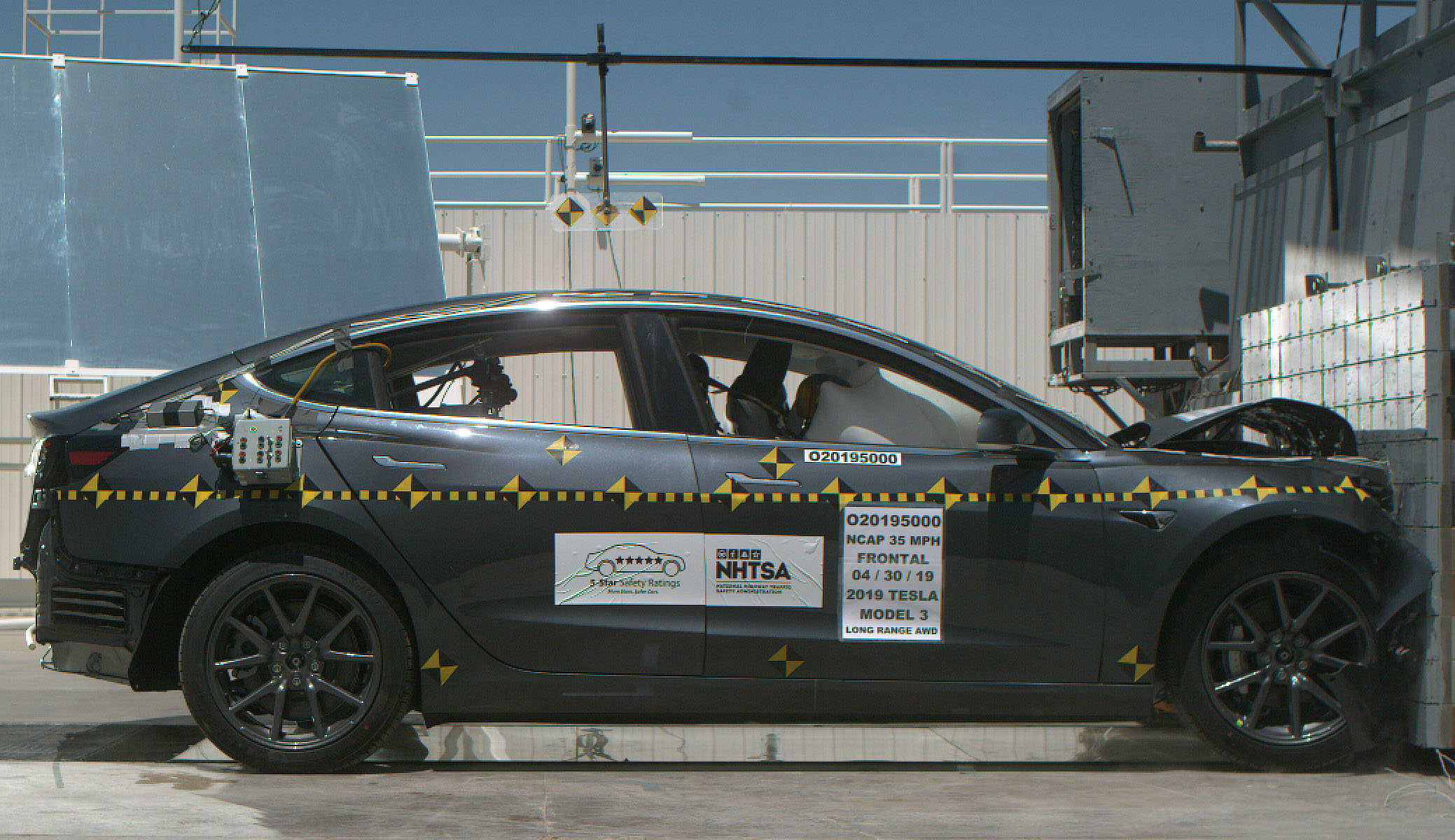
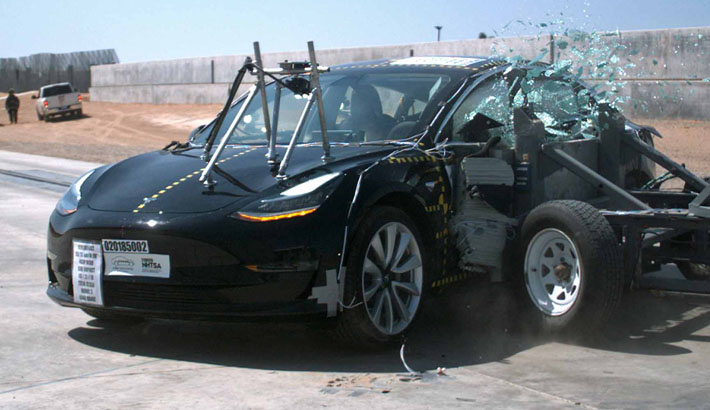
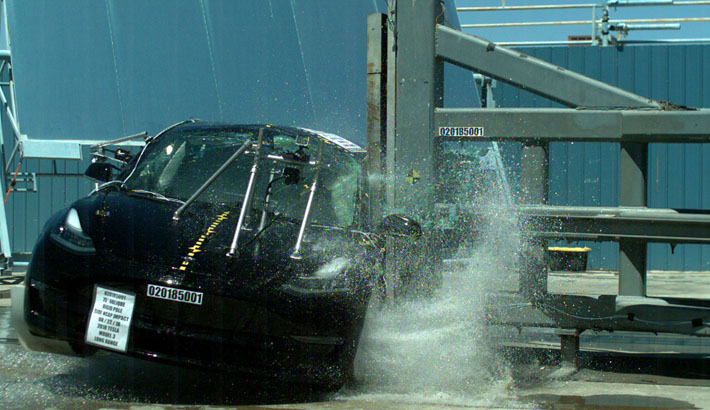
NHTSA crash tests
The agency crash-tested this model year itself. These are its own
photographs and star ratings.
Frontal crash test
Side barrier crash test
Side pole crash test
Photographs taken by NHTSA during its own New Car Assessment Program crash
tests of this model year. Public domain.
Configuration
Overall
Front
Side
Rollover
2022 Tesla Model 3 4 DR AWD
6.6% risk
2022 Tesla Model 3 4 DR RWD
6.6% risk
When owners complained
A spike years after the car went on sale usually means a part wearing
out on schedule across the whole fleet — the kind of pattern no single
owner can see from inside their own car.
Dec 2021peak 303Sep 2026
Recalls on the 2022 Tesla Model 3
A complaint is one owner's allegation. A recall is the point at which
the manufacturer or a regulator agreed the defect is real and dangerous
enough to fix for free — however old the car is.
United States — NHTSA
26V507000
EXTERIOR LIGHTING:HEADLIGHTS
Tesla, Inc. (Tesla) is recalling certain 2017-2023 Model 3 and 2020-2023 Model Y vehicles. The headlight low beams may be too bright and exceed the maximum light output. As such, these vehicles fail to comply with the requirements of Federal Motor Vehicle Safety Standard (FMVSS) number 108, "Lamps, Reflective Devices, and Associated Equipment."
Risk: Headlight low beams that are too bright can reduce visibility for oncoming drivers, increasing the risk of a crash.
26V283000
BACK OVER PREVENTION:SOFTWARE
Tesla, Inc. (Tesla) is recalling certain 2017, 2021-2023 Model 3, 2020-2023 Model Y, 2021-2023 Model S, and Model X vehicles operating software version 2026.8.6. The rearview camera image may be delayed when the vehicle is placed in reverse. As such, these vehicles fail to comply with the requirements of Federal Motor Vehicle Safety Standard number 111, "Rear Visibility."
Risk: A delayed rearview image reduces the driver's view behind the vehicle, increasing the risk of a crash.
24V935000
TIRES:PRESSURE MONITORING AND REGULATING SYSTEMS
Tesla, Inc. (Tesla) is recalling certain 2024 Cybertruck, 2017-2025 Model 3, and 2020-2025 Model Y vehicles. The tire pressure monitoring system (TPMS) warning light may not remain illuminated between drive cycles, failing to warn the driver of low tire pressure. As such, these vehicles fail to comply with the requirements of Federal Motor Vehicle Safety Standard number 138, "Tire Pressure Monitoring Systems."
Risk: Driving with improperly inflated tires increases the risk of a crash.
24V554000
LATCHES/LOCKS/LINKAGES:HOOD:LATCH
Tesla, Inc. (Tesla) is recalling certain 2021-2024 Model 3, Model S, Model X, and 2020-2024 Model Y vehicles. The hood latch assembly may fail to detect an unlatched hood condition after the hood has been opened.
Risk: An unlatched hood can fully open, obstructing the driver's view and increasing the risk of a crash.
24V376000
SEAT BELTS:FRONT:WARNING LIGHT/DEVICES
Tesla, Inc. (Tesla) is recalling certain 2012-2024 Model S, 2015-2024 Model X, 2017-2023 Model 3, and 2020-2023 Model Y vehicles. In the event of an unbelted driver, the seat belt warning light and audible chime may not activate as intended. As such, these vehicles fail to comply with the requirements of Federal Motor Vehicle Safety Standard number 208, "Occupant Crash Protection."
Risk: A seat belt warning system that fails to alert occupants of an unbelted seat belt can increase the risk of injury during a crash.
Tesla, Inc. (Tesla) is recalling certain 2013, 2018-2021 Model S, 2020-2021 Model X, 2018-2022 Model 3, and 2020-2022 Model Y vehicles. A factory reset muted the Pedestrian Warning System (PWS) sounds. As such, these vehicles fail to comply with the requirements of Federal Motor Vehicle Safety Standard number 141, "Minimum Sound Requirements for Hybrid and Electric Vehicles."
Risk: Pedestrians may be unaware of an approaching vehicle if the PWS sounds are muted, increasing the risk of a crash.
24V051000
ELECTRICAL SYSTEM: INSTRUMENT CLUSTER/PANEL
Tesla, Inc. (Tesla) is recalling certain 2012-2023 Model S, 2016-2024 Model X, 2017-2023 Model 3, 2019-2024 Model Y, and 2024 Cybertruck vehicles. An incorrect font size is displayed on the instrument panel for the Brake, Park, and Antilock Brake System (ABS) warning lights. As such, these vehicles fail to comply with the requirements of Federal Motor Vehicle Safety Standard number 105, "Hydraulic and Electric Brake Systems" and 135, "Light Vehicle Brake Systems."
Risk: Warning lights with a smaller font size can make critical safety information on the instrument panel difficult to read, increasing the risk of a crash.
Tesla, Inc. (Tesla) is recalling 2012-2023 Model S, 2016-2023 Model X, 2017-2023 Model 3, and 2020-2023 Model Y vehicles equipped with all versions of Autosteer leading up to the version(s) that contains the recall remedy. In certain circumstances when Autosteer is engaged, the prominence and scope of the feature's controls may not be sufficient to prevent driver misuse of the SAE Level 2 advanced driver-assistance feature.
Risk: In certain circumstances when Autosteer is engaged, and the driver does not maintain responsibility for vehicle operation and is unprepared to intervene as necessary or fails to recognize when Autosteer is canceled or not engaged, there may be an increased risk of a crash.
Canada — Transport Canada
Canada runs its own recall programme, and its campaigns do not
always mirror the American ones.
Recall 2026401454 units in Canada
Lights And Instruments
Issue: On certain vehicles, the low beam headlights may be too bright. Canadian regulations specify a maximum brightness for low beam headlights. Safety Risk: Low beam headlights that are too bright could cause reduced visibility for the driver and/or glare for oncoming drivers and increase the risk of a crash. Corrective Actions: Tesla will notify owners by email. The corrective actions for this recall are under development.
Recall 202622113,846 units in Canada
Visual System
Issue: On certain vehicles, a software problem could delay the rearview camera image from displaying when the transmission is shifted into reverse shortly after the vehicle is started. Canadian regulations require the rearview image to display within 2 seconds of shifting the transmission into reverse gear. Safety Risk: A rearview camera image that doesn't display could reduce a driver's ability to see behind the vehicle while backing up. This could increase the risk of a crash. Corrective Actions: Tesla will notify owners by email. Tesla has released an over-the-air software update to fix this problem. There is no further action required if your vehicle has software release 2026.8.6.1 or a later release.
Recall 2024427179,752 units in Canada
Electrical
Issue: On certain vehicles, the hood latch assembly could fail and cause the unlatched hood warning not to display on the instrument panel. As a result, you may not be aware that the hood isn't latched properly. If this happens, the hood could open suddenly while driving. Safety Risk: A hood that opens suddenly while driving can block the driver's view and increase the risk of a crash. Corrective Actions: Tesla will notify affected owners by email. Tesla has released an over-the-air software update to fix this issue. There is no further action required if your vehicle has software release 2024.20.3 or a later release.
Recall 20242989,435 units in Canada
Seats And Restraints
Issue: On certain vehicles, the seat belt reminder chime and visual warning may not work when you start the vehicle and your seat belt is not buckled. Canadian regulations require both a seat belt reminder sound and visual telltale when a driver is not wearing their seat belt. Safety Risk: A seat belt warning that doesn't work correctly may not remind you to buckle your seat belt. Not wearing your seat belt can increase the risk of injury in a crash. Corrective Actions: Tesla will notify owners by email and supply an over-the-air software update to activate the seat belt reminder chime and visual warning.
Recall 2024283109,791 units in Canada
Lights And Instruments
Issue: A previous over-the-air (OTA) software update could cause the vehicle not to display the correct visual warning indicators when there are problems with the brake system or when the parking brake is applied. As a result, the BRAKE, PARK, and antilock brake system (ABS) visual indicators would display as text instead of symbols. Safety Risk: While there is a low risk to safety, Canadian regulations require visual warnings to use common symbols, instead of words, to avoid driver confusion. Corrective Actions: Tesla will notify affected owners by email. Tesla has released an over-the-air software update to fix this problem. There is no further action required if your vehicle has software release 2024.3.25, 2024.14.5, or a release later than 2024.14.5.
Recall 2024130340 units in Canada
Other
Issue: On certain vehicles, a software problem could cause the pedestrian warning system not to work. As a result, the vehicle may not produce enough sound to be detected by other road users. New Canadian regulations require electric vehicles to make a minimum sound level when operating at low speeds. Safety Risk: A pedestrian warning system that doesn't work could create an increased risk of injury for other road users. Corrective Actions: Tesla will notify affected owners by email. Tesla has released an over-the-air software update to fix this problem. There is no further action required if your vehicle has software release 2023.44.30.14 or a software deployed after 2023.44.30.14.
Recall 2023657192,769 units in Canada
Accessories
Issue: On vehicles equipped with the Autosteer advanced driver-assistance feature, when using the feature, the vehicle may not provide strong enough warnings or monitor the driver closely enough to prevent misuse of the feature. Safety Risk: A driver that doesn't pay close attention while using the Autosteer feature or who doesn't react quickly when Autosteer is canceled could have an increased risk of a crash. Corrective Actions: Tesla will notify owners by email and supply an over-the-air software update to improve driver monitoring and alerts while using the Autosteer feature. Tesla advises that you must always pay attention and be ready to take control of the vehicle at any time while using the Autosteer advanced driver-assistance feature.
Recall 202306320,667 units in Canada
Accessories
Issue: In certain traffic situations, when the FSD Beta advanced driver assistance feature is engaged, the vehicle may perform maneuvers that break certain traffic laws, if the driver doesn't intervene and take control. Note: This recall only affects vehicles equipped with the FSD Beta feature. Safety Risk: Certain maneuvers performed by the FSD Beta advanced driver assistance feature may break traffic laws. This could increase the risk of a crash if the driver doesn't intervene. Corrective Actions: Tesla will notify owners by email and supply an over-the-air software update to improve how the FSD Beta feature maneuvers the vehicle in certain traffic situations. Tesla reminds that FSD Beta is only an advanced driver assistance feature, and the driver must pay attention and be ready to take control at all times when the feature is engaged.
Reports where the owner recorded a crash, a fire, an injury or a death.
at 33,000 milesBay Point, CAFire2 injured
ELECTRICAL SYSTEM
The contact owned a 2022 Tesla Model 3. The contact stated that while the vehicle was unoccupied, the vehicle independently started while parked in the driveway and caught on fire. No warning lights were illuminated prior to the failure. The contact stated that the fire spread to the residence and the residence burned down. The contact's daughter and her significant other were able to exit the residence safely. The local Fire Department arrived on the scene to extinguish the fire. The contact stated that the fire had started near the charging port. A Police Report was not filed. In addition, the contact stated that his daughter and her significant other suffered severe mental distress. Medical attention was not sought. A Fire Report was filed. The local dealer was not contacted. The vehicle was deemed a total loss by the insurance company. The manufacturer was not made aware of the failure. The failure mileage was approximately 33,000.
NHTSA complaint #11755495 — an unverified report by a vehicle owner.
Chula Vista, CACrash
VEHICLE SPEED CONTROL
U.S. registered Tesla operating in [XXX]. Full Self-Driving engaged. Dark, nighttime conditions. Vehicle was traveling toward low traffic zones near the edge of [XXX] when the system made a severe mistake. The car went off the main road. Driver was forced to take control off-road after the system lost control. Damage to the rims occurred. At the time of this incident, manual speed control was still available. The driver could cap the speed. That capability has since been removed by a software update. The current version is more dangerous. If the same incident happened today, the driver would have no way to limit speed or prevent the system from repeating the error. The defect is the progressive removal of driver control from the Full Self-Driving system. Earlier versions allowed manual speed caps. Current software does not. This vehicle is U.S. registered and runs U.S. software on American roads. The same defect that caused this off-road incident in Mexico now exists without the safety net of manual speed control. The software is dangerous. The removal of driver overrides makes it worse. INFORMATION REDACTED PURSUANT TO THE FREEDOM OF INFORMATION ACT (FOIA), 5 U.S.C. 552(B)(6)
NHTSA complaint #11754099 — an unverified report by a vehicle owner.
Chula Vista, CACrash
STEERING
U.S. registered Tesla operating in [XXX]. Full Self-Driving engaged. Dark, nighttime conditions. Vehicle was traveling toward low traffic zones near the edge of [XXX] when the system made a severe mistake. The car went off the main road. Driver was forced to take control off-road after the system lost control. Damage to the rims occurred. At the time of this incident, manual speed control was still available. The driver could cap the speed. That capability has since been removed by a software update. The current version is more dangerous. If the same incident happened today, the driver would have no way to limit speed or prevent the system from repeating the error. The defect is the progressive removal of driver control from the Full Self-Driving system. Earlier versions allowed manual speed caps. Current software does not. This vehicle is U.S. registered and runs U.S. software on American roads. The same defect that caused this off-road incident in Mexico now exists without the safety net of manual speed control. The software is dangerous. The removal of driver overrides makes it worse. INFORMATION REDACTED PURSUANT TO THE FREEDOM OF INFORMATION ACT (FOIA), 5 U.S.C. 552(B)(6)
NHTSA complaint #11754099 — an unverified report by a vehicle owner.
Chula Vista, CACrash
FORWARD COLLISION AVOIDANCE: ADAPTIVE CRUISE CONTROL
U.S. registered Tesla operating in [XXX]. Full Self-Driving engaged. Dark, nighttime conditions. Vehicle was traveling toward low traffic zones near the edge of [XXX] when the system made a severe mistake. The car went off the main road. Driver was forced to take control off-road after the system lost control. Damage to the rims occurred. At the time of this incident, manual speed control was still available. The driver could cap the speed. That capability has since been removed by a software update. The current version is more dangerous. If the same incident happened today, the driver would have no way to limit speed or prevent the system from repeating the error. The defect is the progressive removal of driver control from the Full Self-Driving system. Earlier versions allowed manual speed caps. Current software does not. This vehicle is U.S. registered and runs U.S. software on American roads. The same defect that caused this off-road incident in Mexico now exists without the safety net of manual speed control. The software is dangerous. The removal of driver overrides makes it worse. INFORMATION REDACTED PURSUANT TO THE FREEDOM OF INFORMATION ACT (FOIA), 5 U.S.C. 552(B)(6)
NHTSA complaint #11754099 — an unverified report by a vehicle owner.
Katy, TXCrash1 injured
VEHICLE SPEED CONTROL
My wife had a collission on June 25th at 2 30PM CST while she was parking her vehicle in her office parking spot. The car suddenty sped and hit a tree. We suspect it be a misfire in Tesla.
NHTSA complaint #11747194 — an unverified report by a vehicle owner.
Katy, TXCrash1 injured
STEERING
My wife had a collission on June 25th at 2 30PM CST while she was parking her vehicle in her office parking spot. The car suddenty sped and hit a tree. We suspect it be a misfire in Tesla.
NHTSA complaint #11747194 — an unverified report by a vehicle owner.
The most recent complaints
In the owners' own words, exactly as filed with NHTSA.
Charlotte, NC
UNKNOWN OR OTHER
At approximately 32,916 miles, the powered trunk lift strut on my 2022 Tesla Model 3 separated from its mounting ball stud during normal use. There was no collision or external impact. When the strut separated, it struck the rear glass and caused the glass to break. Tesla inspected and repaired the vehicle. Tesla’s final service invoice states: “Strut failure was responsible for breaking back glass.” I am concerned that failure of the powered trunk strut attachment on a relatively low-mileage vehicle can cause broken glass and may create a safety risk.
NHTSA complaint #11762112 — an unverified report by a vehicle owner.
Charlotte, NC
STRUCTURE:BODY
At approximately 32,916 miles, the powered trunk lift strut on my 2022 Tesla Model 3 separated from its mounting ball stud during normal use. There was no collision or external impact. When the strut separated, it struck the rear glass and caused the glass to break. Tesla inspected and repaired the vehicle. Tesla’s final service invoice states: “Strut failure was responsible for breaking back glass.” I am concerned that failure of the powered trunk strut attachment on a relatively low-mileage vehicle can cause broken glass and may create a safety risk.
NHTSA complaint #11762112 — an unverified report by a vehicle owner.
Charlotte, NC
VISIBILITY/WIPER
At approximately 32,916 miles, the powered trunk lift strut on my 2022 Tesla Model 3 separated from its mounting ball stud during normal use. There was no collision or external impact. When the strut separated, it struck the rear glass and caused the glass to break. Tesla inspected and repaired the vehicle. Tesla’s final service invoice states: “Strut failure was responsible for breaking back glass.” I am concerned that failure of the powered trunk strut attachment on a relatively low-mileage vehicle can cause broken glass and may create a safety risk.
NHTSA complaint #11762112 — an unverified report by a vehicle owner.
Denver, CO
ELECTRICAL SYSTEM
My 2022 Tesla Model 3 Long Range has developed a failure of the Autopilot/ADAS computer. The AP computer remains installed in the vehicle and is available for inspection. The vehicle operated normally before software update 2026.26.6. Following the update, Driving Visualization and Autopilot began going offline, along with automatic headlights, automatic turn signals, emergency braking, collision and traffic warnings. The failures have continued despite software/firmware reinstall, DAS reset, camera calibration, and hard reset. Tesla Service inspected the vehicle and confirmed that the AP computer is defective and recommended replacement at approximately $2,600. I paid $120 for Tesla's diagnostic assessment. Service Mode has recorded repeated AP watchdog/kernel-panic events, including APS_w169_TurboA_SCS_LKUP, APS_w134_appMIA, APS_w135_appCritical, and PM_a041_dasMIA. The vehicle has also recorded simultaneous exits of multiple camera streams, sometimes causing camera feeds to go black while driving. Service Mode has shown the AP ECU in Coreboot/INIT, intermittent loss of communication between the AP ECU and infotainment ECU, missing GNSS Ethernet communication, and unavailable AP temperature telemetry. This creates a safety concern because multiple safety-related driver-assistance and camera-dependent systems can unexpectedly become unavailable while driving. The vehicle remains manually drivable, but the driver must unexpectedly operate without previously available functions. The failure can also affect automatic headlights and turn signals, requiring manual operation. I am reporting this as a potential safety defect because multiple ADAS/camera systems fail simultaneously and the AP computer repeatedly crashes/reboots. The failure began after a software update, although Tesla has stated that some alerts predated the update. Due to the GPS board contacting the autopilot first before the infotainment, precise location is off and navigation is unavailable.
NHTSA complaint #11760929 — an unverified report by a vehicle owner.
Denver, CO
FORWARD COLLISION AVOIDANCE: ADAPTIVE CRUISE CONTROL
My 2022 Tesla Model 3 Long Range has developed a failure of the Autopilot/ADAS computer. The AP computer remains installed in the vehicle and is available for inspection. The vehicle operated normally before software update 2026.26.6. Following the update, Driving Visualization and Autopilot began going offline, along with automatic headlights, automatic turn signals, emergency braking, collision and traffic warnings. The failures have continued despite software/firmware reinstall, DAS reset, camera calibration, and hard reset. Tesla Service inspected the vehicle and confirmed that the AP computer is defective and recommended replacement at approximately $2,600. I paid $120 for Tesla's diagnostic assessment. Service Mode has recorded repeated AP watchdog/kernel-panic events, including APS_w169_TurboA_SCS_LKUP, APS_w134_appMIA, APS_w135_appCritical, and PM_a041_dasMIA. The vehicle has also recorded simultaneous exits of multiple camera streams, sometimes causing camera feeds to go black while driving. Service Mode has shown the AP ECU in Coreboot/INIT, intermittent loss of communication between the AP ECU and infotainment ECU, missing GNSS Ethernet communication, and unavailable AP temperature telemetry. This creates a safety concern because multiple safety-related driver-assistance and camera-dependent systems can unexpectedly become unavailable while driving. The vehicle remains manually drivable, but the driver must unexpectedly operate without previously available functions. The failure can also affect automatic headlights and turn signals, requiring manual operation. I am reporting this as a potential safety defect because multiple ADAS/camera systems fail simultaneously and the AP computer repeatedly crashes/reboots. The failure began after a software update, although Tesla has stated that some alerts predated the update. Due to the GPS board contacting the autopilot first before the infotainment, precise location is off and navigation is unavailable.
NHTSA complaint #11760929 — an unverified report by a vehicle owner.
My 2022 Tesla Model 3 Long Range has developed a failure of the Autopilot/ADAS computer. The AP computer remains installed in the vehicle and is available for inspection. The vehicle operated normally before software update 2026.26.6. Following the update, Driving Visualization and Autopilot began going offline, along with automatic headlights, automatic turn signals, emergency braking, collision and traffic warnings. The failures have continued despite software/firmware reinstall, DAS reset, camera calibration, and hard reset. Tesla Service inspected the vehicle and confirmed that the AP computer is defective and recommended replacement at approximately $2,600. I paid $120 for Tesla's diagnostic assessment. Service Mode has recorded repeated AP watchdog/kernel-panic events, including APS_w169_TurboA_SCS_LKUP, APS_w134_appMIA, APS_w135_appCritical, and PM_a041_dasMIA. The vehicle has also recorded simultaneous exits of multiple camera streams, sometimes causing camera feeds to go black while driving. Service Mode has shown the AP ECU in Coreboot/INIT, intermittent loss of communication between the AP ECU and infotainment ECU, missing GNSS Ethernet communication, and unavailable AP temperature telemetry. This creates a safety concern because multiple safety-related driver-assistance and camera-dependent systems can unexpectedly become unavailable while driving. The vehicle remains manually drivable, but the driver must unexpectedly operate without previously available functions. The failure can also affect automatic headlights and turn signals, requiring manual operation. I am reporting this as a potential safety defect because multiple ADAS/camera systems fail simultaneously and the AP computer repeatedly crashes/reboots. The failure began after a software update, although Tesla has stated that some alerts predated the update. Due to the GPS board contacting the autopilot first before the infotainment, precise location is off and navigation is unavailable.
NHTSA complaint #11760929 — an unverified report by a vehicle owner.
Hermitage, TN
FORWARD COLLISION AVOIDANCE: ADAPTIVE CRUISE CONTROL
With its latest upgrade, 2026.20.6.11 with full self-driving V14 Light, Tesla no longer allows users to set a max speed. This is very dangerous, especially in school zones where the vehicle, with Full Self-Driving, consistently misreads the speed limit. There is no way to revert this "upgrade." Many people have posted about this concern, but Tesla is ignoring it.
NHTSA complaint #11760774 — an unverified report by a vehicle owner.
San Antonio, TX
WHEELS
The Tesla service center in San Antonio Texas installed new tires and a new wheel on my vehicle and one of the tires was installed inside out based on the manufacturer’s specifications. I’ve been driving this vehicle for about 4 months /5k miles with the risk of this tire malfunctioning and causing an accident.
NHTSA complaint #11759883 — an unverified report by a vehicle owner.
Boynton Beach, FL
UNKNOWN OR OTHER
To Whom It May Concern, I am reporting what I believe is a foreseeable child-safety risk involving Tesla’s Toybox feature. Tesla allows parents to PIN-restrict Arcade, Theater, and the web browser, but Toybox remains accessible. Recently, I briefly went inside my home to use the bathroom, and my child slipped outside and climbed into my parked Tesla specifically to use the touchscreen and Toybox. Fortunately, I discovered him quickly. In hot weather, however, a child remaining unnoticed inside a parked vehicle could face serious injury or death, particularly if climate control were disabled, changed, or failed. Tesla already has the software infrastructure to restrict entertainment features. Adding Toybox to Parental Controls appears to be a straightforward safety improvement. I believe this omission creates an unnecessary and foreseeable risk to children and warrants review as a potential vehicle safety concern. Sincerely, [XXX] Tesla Model 3 Owner INFORMATION REDACTED PURSUANT TO THE FREEDOM OF INFORMATION ACT (FOIA), 5 U.S.C. 552(B)(6)
NHTSA complaint #11759469 — an unverified report by a vehicle owner.
Jackson, NJ
STEERING
My 2022 Tesla Model 3 has experienced recurring intermittent loss/reduction of power steering assistance. The vehicle displays “Steering assist reduced – Steering may require increased effort.” The problem has occurred multiple times over a period of months and may disappear after the vehicle is power cycled or the alert clears. Tesla previously evaluated the vehicle for this condition. On July 8, 2026, Tesla documented the steering-assist-reduced complaint and recommended replacement of the RWD steering rack/steering gear, with an estimated repair cost of approximately $3,018. On August 20, 2026, the warning occurred again. Tesla Service Mode recorded fault EPAS3S_a005_sent2Mia, described as “Torque Sensor 2 signal not received,” with the potential impact listed as “Steering assist reduced.” The vehicle simultaneously generated UI_a020_SteeringReduced. The warning subsequently cleared again, but this is a recurring intermittent failure involving the vehicle’s electronic power-assisted steering system. I am concerned that the steering assistance could become reduced or unavailable while driving. Tesla has already determined that replacement of the steering rack is required, but the repair is customer-pay. I am reporting this because this appears to be a recurring safety-related steering defect and I am concerned that other vehicles may experience the same failure.
NHTSA complaint #11758289 — an unverified report by a vehicle owner.
Saint Petersburg, FL
SUSPENSION
the suspension lower lateral links bushings are wearing down without much usage. my car had 31k miles and the bushings already need to be replaced. this is very dangerous.
NHTSA complaint #11756922 — an unverified report by a vehicle owner.
La Plata, MD
STEERING
I am the owner of a 2022 Tesla Model 3. The front control arms on this vehicle are defective as manufactured. From the factory, these components have demonstrated premature failure, abnormal noise, loosening, and/or separation risk that is not consistent with normal wear on a low-mileage vehicle of this age. Symptoms experienced include [describe your exact symptoms clearly and factually — examples: progressive clicking, clunking, popping, or creaking from the front suspension/wheel area; especially noticeable during low-speed turns, reverse, or over bumps; any feeling of looseness, pull, or change in handling; any actual detachment or near-detachment]. These symptoms began at approximately 75000 miles on July 27th 2026. This is not isolated wear. Front control-arm and related suspension-link failures (including lower lateral links that can detach from the subframe) have been the subject of multiple owner complaints, prior Tesla recalls (including NHTSA campaign 21V-835 for improperly torqued lateral-link fasteners on certain Model 3/Y vehicles and the later 23V-235 expansion), technical service bulletins addressing water intrusion and noise in upper control arms, and a current NHTSA preliminary evaluation (opened 2026) into front lower lateral-link detachment on a large population of Model 3 and Model Y vehicles. Owners report that failures can occur with little or no prior dashboard warning, only possible audible cues, and can render the vehicle undrivable or cause sudden changes in alignment and directional control. A sudden separation or failure of a front control arm/lateral link while the vehicle is in motion creates an unreasonable risk of loss of vehicle control, crash, or injury to the driver, passengers, and other road users. Because the condition appears to originate from factory assembly, design, or component durability issues rather than owner abuse or ordinary high-mileage wear, and because similar failures are widely reported across Tesla owners.
NHTSA complaint #11756842 — an unverified report by a vehicle owner.
La Plata, MD
SUSPENSION
I am the owner of a 2022 Tesla Model 3. The front control arms on this vehicle are defective as manufactured. From the factory, these components have demonstrated premature failure, abnormal noise, loosening, and/or separation risk that is not consistent with normal wear on a low-mileage vehicle of this age. Symptoms experienced include [describe your exact symptoms clearly and factually — examples: progressive clicking, clunking, popping, or creaking from the front suspension/wheel area; especially noticeable during low-speed turns, reverse, or over bumps; any feeling of looseness, pull, or change in handling; any actual detachment or near-detachment]. These symptoms began at approximately 75000 miles on July 27th 2026. This is not isolated wear. Front control-arm and related suspension-link failures (including lower lateral links that can detach from the subframe) have been the subject of multiple owner complaints, prior Tesla recalls (including NHTSA campaign 21V-835 for improperly torqued lateral-link fasteners on certain Model 3/Y vehicles and the later 23V-235 expansion), technical service bulletins addressing water intrusion and noise in upper control arms, and a current NHTSA preliminary evaluation (opened 2026) into front lower lateral-link detachment on a large population of Model 3 and Model Y vehicles. Owners report that failures can occur with little or no prior dashboard warning, only possible audible cues, and can render the vehicle undrivable or cause sudden changes in alignment and directional control. A sudden separation or failure of a front control arm/lateral link while the vehicle is in motion creates an unreasonable risk of loss of vehicle control, crash, or injury to the driver, passengers, and other road users. Because the condition appears to originate from factory assembly, design, or component durability issues rather than owner abuse or ordinary high-mileage wear, and because similar failures are widely reported across Tesla owners.
NHTSA complaint #11756842 — an unverified report by a vehicle owner.
Austin, TX
STEERING
My car randomly gave me alerts that my steering alignment fault then came the following two days later Automatic Emergency Braking is unavailable Feature may be restored on next drive 20:55 | DI_a246 Automatic vehicle hold disabled Use brake pedal when stopping 20:55 | DI_a223 Traction control disabled Drive with caution 20:55 | APP_W264 Lane Departure Avoidance features unavailable Features may be restored on next drive 20:55 | DI_a222 Stability control disabled. I take my car to a mechanic and they show me that my lower control arms are damaged. Tesla is more than 2 weeks out for something that has caused my car to act completely unsafe and not normal.
NHTSA complaint #11755384 — an unverified report by a vehicle owner.
West Hartford, CT
UNKNOWN OR OTHER
The horn on the steering wheel rarely works UNLESS it is pressed directly in the middle. I have tried to honk the horn when there is a safety event but it rarely works. This is definitely a safety issue. This has been going on since I bought the car June 2022. Full self drive is also unsafe and it will make sudden turns, accelerate too quickly, or have phantom braking. This can be unsafe for other drivers. I heard that this is improved with newer models, but if it is unsafe for older models like my 2022, it should not be available.
NHTSA complaint #11755527 — an unverified report by a vehicle owner.
at 100,000 milesSpringfield, OR
EXTERIOR LIGHTING
The contact owns a 2022 Tesla Model 3. The contact stated that the vehicle experienced a loss of camera and safety feature functionality for eight hours daily. The message "Adaptive Headlights Feature Unavailable" was displayed. The manufacturer was notified of the failure, and a complaint was filed. The contact was referred to a service center that was over an hour away. The vehicle was not diagnosed or repaired due to the cost. The failure mileage was approximately 100,000.
NHTSA complaint #11755531 — an unverified report by a vehicle owner.
Austin, TX
SUSPENSION
My car randomly gave me alerts that my steering alignment fault then came the following two days later Automatic Emergency Braking is unavailable Feature may be restored on next drive 20:55 | DI_a246 Automatic vehicle hold disabled Use brake pedal when stopping 20:55 | DI_a223 Traction control disabled Drive with caution 20:55 | APP_W264 Lane Departure Avoidance features unavailable Features may be restored on next drive 20:55 | DI_a222 Stability control disabled. I take my car to a mechanic and they show me that my lower control arms are damaged. Tesla is more than 2 weeks out for something that has caused my car to act completely unsafe and not normal.
NHTSA complaint #11755384 — an unverified report by a vehicle owner.
at 33,000 milesBay Point, CAFire2 injured
ELECTRICAL SYSTEM
The contact owned a 2022 Tesla Model 3. The contact stated that while the vehicle was unoccupied, the vehicle independently started while parked in the driveway and caught on fire. No warning lights were illuminated prior to the failure. The contact stated that the fire spread to the residence and the residence burned down. The contact's daughter and her significant other were able to exit the residence safely. The local Fire Department arrived on the scene to extinguish the fire. The contact stated that the fire had started near the charging port. A Police Report was not filed. In addition, the contact stated that his daughter and her significant other suffered severe mental distress. Medical attention was not sought. A Fire Report was filed. The local dealer was not contacted. The vehicle was deemed a total loss by the insurance company. The manufacturer was not made aware of the failure. The failure mileage was approximately 33,000.
NHTSA complaint #11755495 — an unverified report by a vehicle owner.
at 100,000 milesSpringfield, OR
ELECTRICAL SYSTEM
The contact owns a 2022 Tesla Model 3. The contact stated that the vehicle experienced a loss of camera and safety feature functionality for eight hours daily. The message "Adaptive Headlights Feature Unavailable" was displayed. The manufacturer was notified of the failure, and a complaint was filed. The contact was referred to a service center that was over an hour away. The vehicle was not diagnosed or repaired due to the cost. The failure mileage was approximately 100,000.
NHTSA complaint #11755531 — an unverified report by a vehicle owner.
West Hartford, CT
FORWARD COLLISION AVOIDANCE: ADAPTIVE CRUISE CONTROL
The horn on the steering wheel rarely works UNLESS it is pressed directly in the middle. I have tried to honk the horn when there is a safety event but it rarely works. This is definitely a safety issue. This has been going on since I bought the car June 2022. Full self drive is also unsafe and it will make sudden turns, accelerate too quickly, or have phantom braking. This can be unsafe for other drivers. I heard that this is improved with newer models, but if it is unsafe for older models like my 2022, it should not be available.
NHTSA complaint #11755527 — an unverified report by a vehicle owner.
My car randomly gave me alerts that my steering alignment fault then came the following two days later Automatic Emergency Braking is unavailable Feature may be restored on next drive 20:55 | DI_a246 Automatic vehicle hold disabled Use brake pedal when stopping 20:55 | DI_a223 Traction control disabled Drive with caution 20:55 | APP_W264 Lane Departure Avoidance features unavailable Features may be restored on next drive 20:55 | DI_a222 Stability control disabled. I take my car to a mechanic and they show me that my lower control arms are damaged. Tesla is more than 2 weeks out for something that has caused my car to act completely unsafe and not normal.
NHTSA complaint #11755384 — an unverified report by a vehicle owner.
Moorpark, CA
SEATS
I own a 2022 Tesla Model 3 that is just past the 5-year/60,000-mile warranty. I bought it used from Tesla inventory and picked up my vehicle on June 1st, 2026 with ~32,000 miles on the odometer. The front passenger safety restraint system alert (RCM2_a636) first appeared on June 5, 2026. On June 15 at 64,008 miles, Tesla Service confirmed the airbag alert and front passenger OCS issue. They found the occupant classification system module damaged and exposed, replaced it, and noted the passenger-side module shorting was also causing a driver-side error. Both cleared after the repair and test drive. Cost: $363.23. The same alert came back. On July 30 at 66,475 miles they found an open in the passenger seat cushion self-capacitance trace wire and the driver occupancy sensor voltage out of range. They replaced the front passenger seat cushion trim and the driver seat occupancy sensor. Alerts cleared and the self-driving button now worked from park again which never did prior showing the issue was never fixed the first time. Cost: $930.36. No crash or injury, but this is a real safety risk. The restraint system may not work as designed and airbags could fail to deploy properly. This exact RCM2_a636/OCS fault keeps happening to other Model 3 owners both before and after warranty on forums, and Tesla has service bulletins on the same parts, yet people still end up paying for the repairs who are out of warranty and also have their safety and life at risk. Please investigate this as this is a severe safety defect.
NHTSA complaint #11754191 — an unverified report by a vehicle owner.
Moorpark, CA
AIR BAGS
I own a 2022 Tesla Model 3 that is just past the 5-year/60,000-mile warranty. I bought it used from Tesla inventory and picked up my vehicle on June 1st, 2026 with ~32,000 miles on the odometer. The front passenger safety restraint system alert (RCM2_a636) first appeared on June 5, 2026. On June 15 at 64,008 miles, Tesla Service confirmed the airbag alert and front passenger OCS issue. They found the occupant classification system module damaged and exposed, replaced it, and noted the passenger-side module shorting was also causing a driver-side error. Both cleared after the repair and test drive. Cost: $363.23. The same alert came back. On July 30 at 66,475 miles they found an open in the passenger seat cushion self-capacitance trace wire and the driver occupancy sensor voltage out of range. They replaced the front passenger seat cushion trim and the driver seat occupancy sensor. Alerts cleared and the self-driving button now worked from park again which never did prior showing the issue was never fixed the first time. Cost: $930.36. No crash or injury, but this is a real safety risk. The restraint system may not work as designed and airbags could fail to deploy properly. This exact RCM2_a636/OCS fault keeps happening to other Model 3 owners both before and after warranty on forums, and Tesla has service bulletins on the same parts, yet people still end up paying for the repairs who are out of warranty and also have their safety and life at risk. Please investigate this as this is a severe safety defect.
NHTSA complaint #11754191 — an unverified report by a vehicle owner.
Moorpark, CA
ELECTRICAL SYSTEM
I own a 2022 Tesla Model 3 that is just past the 5-year/60,000-mile warranty. I bought it used from Tesla inventory and picked up my vehicle on June 1st, 2026 with ~32,000 miles on the odometer. The front passenger safety restraint system alert (RCM2_a636) first appeared on June 5, 2026. On June 15 at 64,008 miles, Tesla Service confirmed the airbag alert and front passenger OCS issue. They found the occupant classification system module damaged and exposed, replaced it, and noted the passenger-side module shorting was also causing a driver-side error. Both cleared after the repair and test drive. Cost: $363.23. The same alert came back. On July 30 at 66,475 miles they found an open in the passenger seat cushion self-capacitance trace wire and the driver occupancy sensor voltage out of range. They replaced the front passenger seat cushion trim and the driver seat occupancy sensor. Alerts cleared and the self-driving button now worked from park again which never did prior showing the issue was never fixed the first time. Cost: $930.36. No crash or injury, but this is a real safety risk. The restraint system may not work as designed and airbags could fail to deploy properly. This exact RCM2_a636/OCS fault keeps happening to other Model 3 owners both before and after warranty on forums, and Tesla has service bulletins on the same parts, yet people still end up paying for the repairs who are out of warranty and also have their safety and life at risk. Please investigate this as this is a severe safety defect.
NHTSA complaint #11754191 — an unverified report by a vehicle owner.
Chula Vista, CA
VEHICLE SPEED CONTROL
Tesla software update 2026.20.6.11 v14 Lite NA-2025.44 removed manual speed control for Full Self-Driving. The driver can no longer set a maximum speed. The vehicle chooses its own speed and it is frequently wrong and dangerous. Curves are the worst failure. The car enters curves too fast. It accelerates through curves. It does not slow to a safe speed before the curve begins. The driver has no way to cap the speed. The scroll wheel is dead. There is no override. Posted speed limits are ignored. The vehicle uses bad map data instead of reading visible signs. It will do 65 in a 55. It will not slow down when the sign says 55. The driver cannot force it to obey the posted limit. Speed control is gone. The driver is a passenger watching the car make bad decisions. This is not safe. This is not driver assistance. This is loss of control. NHTSA must require Tesla to return manual speed control immediately. A human driver must be able to cap the speed at all times. The current software removes that ability and creates a clear safety hazard.
NHTSA complaint #11754093 — an unverified report by a vehicle owner.