Owners have filed 633 complaints
about the 2019 Toyota Highlander with NHTSA between 2018 and 2026.
The largest single group is the transmission & drivetrain.
Across this model's run it ranks 2 of 25 worst.
The letter says how bad. This says what kind — whether this year drew
an unusual number of complaints, unusually dangerous
ones, or failures that arrived unusually early.
The dashed ring is 50 — the national norm. Further out is worse.
Complaint volume — 100
Against the median year of the Toyota Highlander. 50 means typical for this
model; 100 means roughly double.
Severity — 48
9.3% of these complaints
involved a crash, fire, injury or death, against a national rate of
9.7%.
Early failure — 100
80% of failures with a mileage on record happened under
36,000 miles, against a national rate of
29%.
How 2019 compares with every other Toyota Highlander
NHTSA files every complaint against a named sub-assembly, not just a
system. This is the difference between knowing it was "the engine" and
knowing which part of it — the list to hand a mechanic.
Body
1238.7%
Automatic Emergency Braking
619.4%
Adaptive Cruise Control
412.9%
Sun/Moon Roof Assembly
39.7%
Warnings
26.5%
Fuel Pump
26.5%
Crank/Camshaft Position Sensor
13.2%
Electronic Lock/Latch Actuator
13.2%
When it fails
Odometer readings owners gave when they filed. About half of all
complaints include one.
Under 1,000 miles
2211.0%
1,000 – 9,999 miles
7437.0%
10,000 – 24,999 miles
5326.5%
25,000 – 49,999 miles
168.0%
50,000 – 74,999 miles
157.5%
75,000 – 99,999 miles
126.0%
100,000 – 149,999 miles
73.5%
150,000+ miles
10.5%
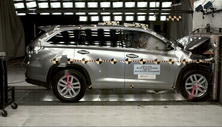
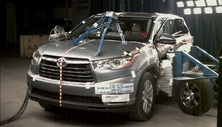
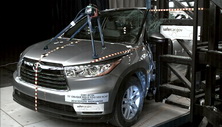
NHTSA crash tests
The agency crash-tested this model year itself. These are its own
photographs and star ratings.
Frontal crash test
Side barrier crash test
Side pole crash test
Photographs taken by NHTSA during its own New Car Assessment Program crash
tests of this model year. Public domain.
Configuration
Overall
Front
Side
Rollover
2019 Toyota Highlander SUV FWD
16.9% risk
2019 Toyota Highlander SUV AWD
18.5% risk
When owners complained
A spike years after the car went on sale usually means a part wearing
out on schedule across the whole fleet — the kind of pattern no single
owner can see from inside their own car.
Nov 2018peak 27Sep 2026
Recalls on the 2019 Toyota Highlander
A complaint is one owner's allegation. A recall is the point at which
the manufacturer or a regulator agreed the defect is real and dangerous
enough to fix for free — however old the car is.
Risk: If the fuel pump fails, the engine can stall while driving, increasing the risk of a crash.
20V012000
FUEL SYSTEM, GASOLINE:DELIVERY:FUEL PUMP
Toyota Motor Engineering & Manufacturing (Toyota) recalled certain 2018-2019 4Runner, Highlander, Camry, Land Cruiser, Sequoia, Sienna, Tacoma and Tundra, and Lexus RC 300, RC 350, GS 350, GX 460, IS 300, LC 500, LS 500, LX 570, RX 350L, and 2019 Toyota Avalon and Corolla, and certain Lexus NX 300, and ES 350 vehicles on January 13, 2020. On March 4, 2020, Toyota expanded the recall to include certain 2014-2015 Toyota 4Runner and Land Cruiser, 2018 Avalon, Corolla, 2014 FJ Cruiser, 2017 Sienna and Lexus 2018 ES 350, 2018-2019 GS 300, 2013-2014 GS350, 2014-2015 GX 460, IS 350 and LX 570, 2014 IS F, 2018-2019 IS 350, LC 500H and LS 500H, 2013-2015 LS 460, 2015 NX 200T and RC350, 2017 RC 200T and RX 350. Toyota also removed the 2018-2019 Toyota 4Runner and Land Cruiser and 2018-2019 Lexus GX 460 and LX 570 and 2019 NX300 from inclusion in this recall. On March 19, 2020, Toyota expanded the recall to include 2015 Lexus GS350 vehicles. The low-pressure fuel pump inside the fuel tank may fail.
Risk: If the fuel pump fails, the engine can stall while driving, increasing the risk of a crash.
19V244000
EQUIPMENT:OTHER:LABELS
Gulf States Toyota (GST) is recalling certain 2019 C-HR, 4Runner, Avalon, Avalon Hybrid, Camry, Camry Hybrid, Highlander, Land Cruiser, Prius, RAV4, Sequoia, Tacoma, Sienna, Tundra and Yaris vehicles. The text on the load capacity label may become illegible. As such, these vehicles fail to comply with the requirements of Federal Motor Vehicle Safety Standard (FMVSS) number 110, "Tire Selection and Rims."
Risk: If the driver cannot read the label, they may unknowingly overload the vehicle, increasing the risk of a crash.
Canada — Transport Canada
Canada runs its own recall programme, and its campaigns do not
always mirror the American ones.
Recall 202172355,683 units in Canada
Electrical
Issue: This recall is for certain block heater kits installed on certain vehicles or sold as accessories at Toyota or Lexus dealerships. On certain vehicles, the engine block heater cable may not have enough heat protection and could be damaged by high temperatures. If this happens, the cable could short circuit while plugged in, and cause the wiring to overheat or melt. Note: This recall only affects the following block heater/cord part numbers: C014003034 PK5A408J09 PU14000904 C014003151 PK5A408J13 PU14000905 C014000885 PK5A489J11 PU14000907 C014000888 PK5A489J22 PU14000909 C014000907 PK5A410H00 PU14000911 C014100904 PU14000900 PU14000913 C014100907 PU14000901 PU14003571 C014100911 PU14000902 PK5A489J14 PK5A408J05 PU14000903 Safety Risk: Engine block heater wiring that overheats or melts could create the risk of a fire. Corrective Actions: Toyota recommends that you should stop using the engine block heater immediately. Toyota will notify owners by mail and instruct you to take your vehicle to a dealer to disable the engine block heater. For some vehicles, the corrective actions for this recall are under development. For others, a new engine block heater cannot be installed, and the owner will receive a refund of the purchase price of the engine block heater.
Recall 2020514126,597 units in Canada
Fuel System
Issue: On certain vehicles, the low-pressure fuel pump could fail. If this happens, then engine may run rough or may not start and the check engine light may turn on. This could also result in a sudden loss of engine power while driving. Note: This recall is an expansion of recalls SRC R95/SRC R96 and SRC RA2/SRC RA3 (Transport Canada Recall Numbers 2020-005 and 2020-088). Safety Risk: A sudden loss of engine power could increase the risk of a crash. Corrective Actions: The company will notify owners by mail and instruct you to take your vehicle to a dealer to replace the fuel pump.
Recall 2020088111,835 units in Canada
Fuel System
Issue: On certain vehicles, the low-pressure fuel pump could fail. If this happens, then engine may run rough or may not start and the check engine light may turn on. This could also result in a sudden loss of engine power while driving. Note: This recall is an expansion of recall SRC R95/SRC R96 (Transport Canada Recall No. 2020-005) Safety Risk: A sudden loss of engine power could increase the risk of a crash. Corrective Actions: The company will notify owners by mail and instruct you to take your vehicle to a dealer to replace the fuel pump.
Recall 202000546,733 units in Canada
Fuel System
Issue: On certain vehicles, the low-pressure fuel pump could fail. If this happens, then engine may run rough or may not start and the check engine light may turn on. This could also result in a sudden loss of engine power while driving. Safety Risk: A sudden loss of engine power could increase the risk of a crash. Corrective Actions: The company will notify owners by mail and instruct you to take your vehicle to a dealer to replace the fuel pump.
Recall 2019428327,373 units in Canada
Accessories
Issue: On certain vehicles, the hook and loop material used to attach the carpet to its underpadding may not be flame resistant. As a result, when it is tested alone, the loop fasteners do not meet the requirements of Canadian regulations. Safety Risk: As the carpet is always assembled, and the loop fasteners are very small, this problem does not create a safety risk. Corrective Action: This is not a recall. The company has made production changes to ensure that all new vehicles meet the requirements of Canadian regulations.
Reports where the owner recorded a crash, a fire, an injury or a death.
Fort Collins, COCrash1 injured
VEHICLE SPEED CONTROL
I had just driven up a steep driveway and made a slightly sharper than 90 degree turn at a very low speed to pull into a home parking spot when the car lunged forward suddenly and slammed into the stone wall of the house at a high speed. The section of this driveway after the turn is only 2.5 car lengths, but the car picked up enough speed to smash the front of the car in. The car was totaled and driver and side curtain airbags all deployed. I do not know why this happened as there is no way I would have hit the gas hard while pulling up to a building to stop. I also would not have slammed on the gas thinking it was the brake since there would have been no reason to slam on the brake when I was only going 5-10 miles per hour max around the tight turn. My shoe was not caught on a pedal, both sandals were still on my feet after the accident. I am not a two footed driver. I feel that it was an accelerator malfunction, as the gas pedal had always been a little strange with a delayed response, but may have also involved the transmission after driving up the steep hill and then returning to a short but flat stretch leading up to the house. I was very bruised up, particularly my shins and ankles. Two months later, I still have some visible bruising. I also had injuries from the seat belt on my chest and what appeared to be a powder burn from the airbags. I was quite traumatized by the sudden acceleration and violence of the crash and not understanding how or why it happened. If someone had been standing in front of the house to greet me on my return, they would have been killed. The car was towed away and totaled by the insurance company, so the problem hasn't been reproduced or confirmed. There were no warning lamps or messages that I'm aware of prior to the incident, except that the gas pedal has always felt inconsistent concerning when it engages. My phone self-dialed 911 and law enforcement came out to do an accident report.
NHTSA complaint #11678769 — an unverified report by a vehicle owner.
Fort Collins, COCrash1 injured
SERVICE BRAKES
I had just driven up a steep driveway and made a slightly sharper than 90 degree turn at a very low speed to pull into a home parking spot when the car lunged forward suddenly and slammed into the stone wall of the house at a high speed. The section of this driveway after the turn is only 2.5 car lengths, but the car picked up enough speed to smash the front of the car in. The car was totaled and driver and side curtain airbags all deployed. I do not know why this happened as there is no way I would have hit the gas hard while pulling up to a building to stop. I also would not have slammed on the gas thinking it was the brake since there would have been no reason to slam on the brake when I was only going 5-10 miles per hour max around the tight turn. My shoe was not caught on a pedal, both sandals were still on my feet after the accident. I am not a two footed driver. I feel that it was an accelerator malfunction, as the gas pedal had always been a little strange with a delayed response, but may have also involved the transmission after driving up the steep hill and then returning to a short but flat stretch leading up to the house. I was very bruised up, particularly my shins and ankles. Two months later, I still have some visible bruising. I also had injuries from the seat belt on my chest and what appeared to be a powder burn from the airbags. I was quite traumatized by the sudden acceleration and violence of the crash and not understanding how or why it happened. If someone had been standing in front of the house to greet me on my return, they would have been killed. The car was towed away and totaled by the insurance company, so the problem hasn't been reproduced or confirmed. There were no warning lamps or messages that I'm aware of prior to the incident, except that the gas pedal has always felt inconsistent concerning when it engages. My phone self-dialed 911 and law enforcement came out to do an accident report.
NHTSA complaint #11678769 — an unverified report by a vehicle owner.
Fort Collins, COCrash1 injured
FUEL/PROPULSION SYSTEM
I had just driven up a steep driveway and made a slightly sharper than 90 degree turn at a very low speed to pull into a home parking spot when the car lunged forward suddenly and slammed into the stone wall of the house at a high speed. The section of this driveway after the turn is only 2.5 car lengths, but the car picked up enough speed to smash the front of the car in. The car was totaled and driver and side curtain airbags all deployed. I do not know why this happened as there is no way I would have hit the gas hard while pulling up to a building to stop. I also would not have slammed on the gas thinking it was the brake since there would have been no reason to slam on the brake when I was only going 5-10 miles per hour max around the tight turn. My shoe was not caught on a pedal, both sandals were still on my feet after the accident. I am not a two footed driver. I feel that it was an accelerator malfunction, as the gas pedal had always been a little strange with a delayed response, but may have also involved the transmission after driving up the steep hill and then returning to a short but flat stretch leading up to the house. I was very bruised up, particularly my shins and ankles. Two months later, I still have some visible bruising. I also had injuries from the seat belt on my chest and what appeared to be a powder burn from the airbags. I was quite traumatized by the sudden acceleration and violence of the crash and not understanding how or why it happened. If someone had been standing in front of the house to greet me on my return, they would have been killed. The car was towed away and totaled by the insurance company, so the problem hasn't been reproduced or confirmed. There were no warning lamps or messages that I'm aware of prior to the incident, except that the gas pedal has always felt inconsistent concerning when it engages. My phone self-dialed 911 and law enforcement came out to do an accident report.
NHTSA complaint #11678769 — an unverified report by a vehicle owner.
Alexandria, VACrash
STRUCTURE:BODY
.
NHTSA complaint #11674001 — an unverified report by a vehicle owner.
at 41,000 milesKingman, AZCrash2 injured
AIR BAGS
The contact owned a 2019 Toyota Highlander. The contact stated that while his wife was driving at low speeds in a parking area, she briefly lost control only coming to a stop after colliding with a light pole. The air bags did not deploy. No warning lights were illuminated. The vehicle was towed to a tow yard and deemed a total loss by the contact's insurance provider. A police report was filed, and injuries were reported. The contact and his wife were both transported to an area hospital by EMT. The driver was treated for injuries to her left hand and thumb, and the contact was treated for non-descript injuries to his head, face, and chest trauma. After investigating the failure, the contact related the failure to NHTSA Campaign Number: 23V865000 (Air Bags), but the VIN was not included. The manufacturer was notified of the failure, and a case was opened. The contact was informed that the manufacturer intended to inspect the vehicle but had yet to receive an update. The failure mileage was 41,000.
NHTSA complaint #11646013 — an unverified report by a vehicle owner.
at 96,200 milesBurke, VAFire
ENGINE AND ENGINE COOLING
The contact owns a 2019 Toyota Highlander. The contact stated that while driving approximately 65 MPH the vehicle began to loose automotive power and stalled. During the incident, several warning messages were activated which included the check engine light and the ABS warning. While inspecting the vehicle smoke and fire began to stream from under the engine hood and moments later the frontend of the vehicle became engulfed in flames. The fire department was called to the scene and extinguished the flames. During the incident, the vehicle was destroyed and later towed away. A police report was taken at the scene. The cause of the failure was not determined. The manufacturer was notified of the failure. The local dealer was not contacted. The failure mileage was 96,200.
NHTSA complaint #11608736 — an unverified report by a vehicle owner.
The most recent complaints
In the owners' own words, exactly as filed with NHTSA.
Ballwin, MO
POWER TRAIN
My 2019 Highlander was driving totally normal, when all of a sudden the transmission started slipping and then would no longer accelerate. I was on a windy back road in Alaska with no service, so after letting it sit for a bit I tried to drive it again. It then drove maybe 1/2 more miles before slipping completely and no longer accelerating. No check engine lights came up. I got it towed to my house where a mechanic took a quick scan and said there was a number of transmission codes popping up.
NHTSA complaint #11764218 — an unverified report by a vehicle owner.
Ballwin, MO
ELECTRICAL SYSTEM
My 2019 Highlander was driving totally normal, when all of a sudden the transmission started slipping and then would no longer accelerate. I was on a windy back road in Alaska with no service, so after letting it sit for a bit I tried to drive it again. It then drove maybe 1/2 more miles before slipping completely and no longer accelerating. No check engine lights came up. I got it towed to my house where a mechanic took a quick scan and said there was a number of transmission codes popping up.
NHTSA complaint #11764218 — an unverified report by a vehicle owner.
Lake Mary, FL
UNKNOWN OR OTHER
About two weeks ago I was driving and the car made a whinny noise and felt like it was shaking and slipping out of no where so I stop in a complex to check it out when I went to reverse the car wouldn’t move forward or backwards I had to turn off and on only to have the car not go pass 20 miles havnt been able to drive it since I got two different check where they say it’s the transmission that the UA80E has that same issue but since there no recall Toyota says it’s not their problem
NHTSA complaint #11763526 — an unverified report by a vehicle owner.
Scotts, MI
POWER TRAIN
UA80 Transmission failure. Was driving on highway when the transmission failed and lost power to the vehicle. Car was taken to Sunshine Toyota (Batte Creek MI) in 2022 and the transmission was recommended to be replaced due to a defect at 67,000 miles. The car was then sold off, and I acquired it through another dealer.
NHTSA complaint #11762738 — an unverified report by a vehicle owner.
at 69,000 milesRose Hill, KS
SERVICE BRAKES
The contact owns a 2019 Toyota Highlander. The contact stated that while attempting to depress the brake pedal, the brakes failed to operate as intended. The contact stated that after taking the foot off the brake pedal, the brakes started working as intended. The vehicle was drivable. The vehicle was driven to the residence, and the contact researched and became aware that there were several owners who had the same failure. The failure mileage was 69,000.
NHTSA complaint #11762734 — an unverified report by a vehicle owner.
Hooksett, NH
POWER TRAIN
The transmission (power train) in this vehicle shows symptoms of a known defect in Toyota's UA80 8-speed. Since approximately (Aug 2026/~70k mileage), it has produced shining/grinding noised at increasing speed. these symptoms match failure patterns described in Toyota's own Tech Service Bulletin for transmission, which have led to documented cases of sudden power loss, gear slippage, and complete failure in other owners of this and related models. I have not yet experienced complete loss of propulsion, but given the documented failure patterns, there is a foreseeable risk this could occur without warning while driving, including traffic or while merging, creating a safety hazard. I took the vehicle to Toyota of Manchester, NH dealership on [XXX] and requested repair given the known TSB coverage. Toyota denied repair assistance, citing lack of dealer service records, despite transmission fluid being a lifetime-fill component unrelated to this failure mode. I am filing this proactively due to the documented risk of sudden failure, and because Toyota denied to address a known, symptomatic defect before it progresses and declined to take responsibility for the repairs or repair assistance for this defect. INFORMATION REDACTED PURSUANT TO THE FREEDOM OF INFORMATION ACT (FOIA), 5 U.S.C. 552(B)(6)
NHTSA complaint #11762379 — an unverified report by a vehicle owner.
Mount Airy, MD
POWER TRAIN
The UA80 8-speed automatic transmission failed at 87,896 miles. Symptoms began as slipping in 1st and 2nd gears and harsh jerking when accelerating from a stop, with the engine revving while the vehicle failed to move. This is a loss of motive power that can occur without warning in traffic. On 8/31/2026 a Toyota dealer diagnosed a failed transaxle requiring complete replacement, with a whine traced to the differential inside the transmission, and quoted $11,126.81. This matches the failure mode in Toyota TSB T-SB-0160-18, which Toyota addressed for some 2017-2018 VINs under Customer Support Program ZJC. My 2019 has the same UA80 unit but falls outside that program. The replacement part is backordered with no ETA per Toyota's own case portal. The vehicle is maintained on schedule and available for inspection. Toyota declined goodwill assistance and refused to provide the denial in writing.
NHTSA complaint #11761588 — an unverified report by a vehicle owner.
Dublin, OH
POWER TRAIN
The component that malfunctioned is the vehicle’s automatic transmission. The transmission developed a progressively worsening humming/whining noise during acceleration. The transmission is no longer available for inspection because the vehicle has been taken to an independent transmission repair shop for diagnosis and repair. The problem creates a safety concern because the transmission developed significant internal wear or damage and could potentially worsen or fail while the vehicle is being driven. A transmission failure could result in loss of power or unexpected changes in vehicle operation, increasing the risk of an accident, particularly while accelerating or merging into traffic. The problem was reproduced and confirmed by a Toyota dealership. The dealership diagnosed the noise as coming from the transmission and determined that the transmission requires replacement. The dealership recommended replacing the transmission rather than repairing the specific internal component causing the noise. The vehicle was inspected by the Toyota dealership. It is now at an independent transmission repair shop for repair. No police or insurance inspection was involved. There were no warning lights or warning messages on the dashboard before the problem. The first symptom was an unusual whining noise from the transmission area. The noise later changed into a more noticeable humming sound that increases with acceleration and vehicle speed. The vehicle continued to operate, but the abnormal transmission noise persisted and progressively became more concerning.
NHTSA complaint #11759249 — an unverified report by a vehicle owner.
Sandpoint, ID
POWER TRAIN
My 2019 Toyota Highlander AWD vehicle started making a whining noise around 85,000 miles. This high pitched whining sound occurred while accelerating and became louder and louder with time. I researched the issue and found out that the same issue had occurred on 2018 Highlanders and Toyota issued a Customer Service Bulletin T-SB-0160-18, which addressed the repair and replacement of these UA80 transmissions regardless if the warranty had expired or not. After visiting my local Toyota dealer, they confirmed that the high pitch whine was the final drive noise with the UA80 transmission and the exact same issue as the 2018 Highlander. If left unchecked, my transmission would eventually fail. Since my 2019 Highlander is not part of any recall, and at the moment, not part of the Customer Service Bulletin T-SB-0160-18, I was left to take care of the repair on my own. I contacted Toyota Corporate and requested financial assistance on the the approximate $7,000 charge to replace my transmission. Toyota told me that my car was not under warranty, but they could pay for my 50% of my cost to replace my transmission. I had to pay $3,535 (half of the total cost) to repair my transmission. Since this issue is a manufactured flaw with the assembly of the transmission, I believe the entire repair should be covered 100% by Toyota; therefore, a recall should be issued or the 2019 Highlanders should also be included in the Customer Service Bulletin T-SB-0160-18.
NHTSA complaint #11758885 — an unverified report by a vehicle owner.
Riverside, CA
POWER TRAIN
Winning on acceleration,
NHTSA complaint #11757101 — an unverified report by a vehicle owner.
Leominster, MA
UNKNOWN OR OTHER
UA8OF transmission went. Vehicle was making whining noise when purchased and was told was normal. Driving the car as normal when traveling through intersection when car would not drive.
NHTSA complaint #11756369 — an unverified report by a vehicle owner.
Bloomington, IL
UNKNOWN OR OTHER
The back passenger door (passenger side) will not unlock when using the remote or the button on the front door panels. The only way to open the door is to push the button manually on the car door. The child lock is NOT ON!!! I called the Toyota dealer in my town and they said there are no recalls and it would be $200 to do a diagnostic test on it. This is not ok. To not be able to unlock the door from the remote or the front door panel is not acceptable.
NHTSA complaint #11755612 — an unverified report by a vehicle owner.
Salem, NH
POWER TRAIN
My 2019 Toyota Highlander has the same UA80 transmission that Toyota was required to fix under CUSTOMER SUPPORT PROGRAM ZJC, which covers 2017-2018, the transmission has the same whining noise and shifting issues. Toyota must accept responsibility for their manufacturing error where the washer tab was not bent properly, allowing a nut to loosen leading to the whining noise. I expect the NHTS to require them to cover their 2019's as well, as a consumer we are getting screwed here.
NHTSA complaint #11754310 — an unverified report by a vehicle owner.
Franklin, OH
POWER TRAIN
In April of 2026 started hearing a whining noise in the engine of my 2019 Toyota Highlander. The vehicle has 110471 miles. Have had it checked at the dealership twice and a mechanic twice. All have said the transmission is going out. I have had the transmission fluid replaced, but it did not help. Apparently, Toyota knew about this problem and still sold the car. I am unable to drive car because I am afraid it is going to break down. The dealership said they could replace the transmission for 8762.64 dollars. Toyota has since stopped making UA80 eight speed auto transmission.
NHTSA complaint #11753890 — an unverified report by a vehicle owner.
Lexington, KY
POWER TRAIN
I have a 2019 Highlander XLE AWD that had 85000 miles when the transmission started whining. It got worse pretty quickly so iI took it to a transmission shop. They rebuilt it for $6700.00. I drove it for another 9-10 thousand miles and the whine is back. I'm not sinking another $6700.00 into another transmission. I've talked to several transmission shops and I'm being told there isn't a true fix. Rebuild it and it will come back, guaranteed. What recourse do I have? The car only has 102,000 miles which is typically nothing for a Toyota. But it all started at 85000. Something needs to be done. I see programs for the 2017 and 2018 models but not the 2019. It's the same transmission. The issues crop up after the vehicle has gone out of warranty.
NHTSA complaint #11752267 — an unverified report by a vehicle owner.
Frederick, MD
ENGINE
I am writing to formally document a series of unresolved mechanical issues with my vehicle, culminating in a complete transmission failure, and to request assistance in resolving this matter. The timeline of events is detailed below: *Winter 2024: I first noticed a persistent buzzing sound originating from the engine compartment. Because this symptom primarily occurred during low ambient temperatures, I initially attributed it to the cold weather. The mileage on this vehicle was around 50k miles. *Spring 2024: I contacted the dealership to report the noise. I was advised that the issue was likely related to a worn belt. Subsequent inspection, however, proved this diagnosis to be incorrect, and the root cause of the noise remained unresolved. *Fall 2024: The engine buzzing returned. Concurrently, a severe driveability issue emerged. On multiple occasions after shifting from Park to Drive, the vehicle failed to engage the gear properly, behaving as though it were in Neutral and preventing any acceleration. This would occur while driving and stopped at redlights, which posed a major safety concern as I was transporting my newborn and young child with me. * February 2025: The vehicle became entirely inoperable. Unfortunately, this failure occurred around 62k miles, AFTER my 60k mile warranty expired, (which i was unaware of). Given that these symptoms began during the winter of 2024 and were reported to the dealership early on, it is clear that the initial diagnostics failed to identify a developing and critical transmission defect. I conducted research and discovered this is a recurring issue with Toyota Highlanders, and other vehicles with the model UA80 transmission. Toyota posted a service bulletin, extending vehicles from 2017 & 2018 but have yet to address the 2019 through current models to date with reports of the same transmission issues.
NHTSA complaint #11751157 — an unverified report by a vehicle owner.
Amherst, MA
ENGINE
The car is was a 2019 Toyota Highlander with approximately 125,000 miles. White Smoke started appearing in the exhaust. Quickly after that, the check engine light appeared and started blinking, meaning the engine was misfiring. We brought to the dealership, and they found that cylinder 4 of the engine was damaged (scoring on the inside of the cylinder wall). The engine was releasing metal particles in the oil. Further, the cylinder would not hold oil or coolant pressure, and was burning both oil and coolant. The only fix was to replace or rebuild the engine.
NHTSA complaint #11749690 — an unverified report by a vehicle owner.
Flower Mound, TX
POWER TRAIN
Hundreds of thousands of 2017–2022 gas-powered Toyota Highlanders (equipped with UA80E/UA80F 8-speed transmissions) are experiencing high-pitched whining noises, hard or erratic shifting, and sudden hesitation. This is caused by a factory defect where a retaining nut and locking tab in the counter drive gear sub-assembly were improperly installed, causing premature internal wear and gear movement
NHTSA complaint #11749409 — an unverified report by a vehicle owner.
Custer, WA
POWER TRAIN
I have the high pitch whine coming from transmission. It is a known issue with Toyota but they refuse to look into it since my VIN falls outside their recall list. This is the same transmission as previous years and has the exact same issues. This is a safety issue that needs to be addressed immediately.
NHTSA complaint #11749132 — an unverified report by a vehicle owner.
Bellevue, WA
VEHICLE SPEED CONTROL
Whining sound can be heard while accelerating the vehicle. Maintenance crew is reporting an issue with transmission. UA80F 8 speed transmission on V6 engine in Toyota Highlander has this failure noise. Given that the transmission can fail anytime. It is dangerous to operate the vehicle. No action is taken from Toyota yet.
NHTSA complaint #11747859 — an unverified report by a vehicle owner.
Black Mountain, NC
UNKNOWN OR OTHER
Since October 2025 I have had intermittent issues where the car battery suddenly loses power when driving. I have had to pull over on highway medians and shoulders. A few seconds before it loses power, multiple dash alerts go off: pre-collision malfunction, hybrid system malfunction, check engine. It has been seen now by multiple mechanics including Toyota dealership. It is now on its third battery. Replaced yesterday and lost power on highway today. Please investigate this issue.
NHTSA complaint #11747050 — an unverified report by a vehicle owner.
West Columbia, SC
UNKNOWN OR OTHER
The dealership recommended transmission fluid exchange services for my 2019 Highlander SE after the recommended mileage for this service. I wasn’t able to get this service completed because of timing, however later on the service was completed and after three weeks the vehicle started jerking upon acceleration. Took the Benchley back to the mechanic to diagnose the problem. Per the diagnostic test the issue was determined by this code transmission P0745-7F | Pressure Control Solenoid "A" Actuator Stuck Off - Pending DTC.
NHTSA complaint #11745180 — an unverified report by a vehicle owner.
North Smithfield, RI
POWER TRAIN
My car has been making a whining noise upon acceleration. It stops whining as soon as you release the acceleration I had a mechanic look at it who verified transmission failure.
NHTSA complaint #11743683 — an unverified report by a vehicle owner.
North Smithfield, RI
POWER TRAIN
My Toyota Highlander 2019 began to produce a whining noise that orginates in the transmission at about 89000 miles. An independent mechanic examined the vehicle and deteremined that the noise is well documented. After conducting research, I found that the issue is caused by improper assembly and the only repair is a complete replacement of the transmission. I also discovered that there is a recall on the 2017-2019 Toyota Highlander due to the 8 speed transmission which is also used in my vehicle. The idea that the 2019-2022 Toyota Highlanders are NOT included in this recall is completely unreasonable. These vehicles utilize the same 8-speed transmission and the whining noise tends to surface after 60, 000 miles - about four to five years based on useage. The whining noise began without warning or symptoms. The vehicle drove without issues and we intended on driving this vehicle into retirement considering the reputation Toyota had on building reliable vehicles. I will never purchase or recommend the purchase of a Toyota vehicle! The idea that repeated transmission failures, without an univeral recall for all years affected, shows that the comsumer is not respected. I would enjoy understanding the logic and data that enabled Toyota to limit the recall to just three production year when the 8-speed transmission spanned six years of production (2017-2022). I am now forced to look into replacing the transmission with potentionally another faulty, improperly assembled 8-speed transmission.
NHTSA complaint #11743535 — an unverified report by a vehicle owner.
Warwick, NY
UNKNOWN OR OTHER
The rear air conditioning refrigerant lines on a 2019 Toyota Highlander SE failed due to excessive rust/corrosion, causing the A/C system to leak refrigerant and stop holding a charge. The failure affected the rear A/C lines that run to the rear of the vehicle. The problem was first diagnosed by an independent repair shop and then confirmed by a Toyota dealer. The Toyota dealer documented that the rear A/C lines were leaking due to excessive rust/corrosion. The dealer recommended replacing the rear A/C lines/cooling lines as a set, evacuating and recharging the A/C system, adding dye, and checking system operation. The repair was completed by the Toyota dealer but not covered or reimbursed. The vehicle/component was inspected by an independent service center and by a Toyota dealer. Toyota corporate customer support was also informed of the dealer diagnosis. The failed component may no longer be available for inspection because the repair has been completed, but repair records, dealer diagnosis, invoice, and related documentation are available. Safety concern: The A/C system failure can affect occupant safety and visibility because air conditioning is used for windshield defogging/defrosting and cabin humidity control. Loss of A/C can reduce the ability to clear the windshield in humid or rainy conditions. It can also create a risk to rear passengers, including children, during hot weather because the rear A/C system is no longer functioning as designed. The failure also involved leaking refrigerant from corroded lines. Toyota will not accept that this is a premature and dangerous parts failure. There were no warning lamps or dashboard messages before the failure. The symptom was that the A/C stopped cooling and would not hold refrigerant. The cause was later confirmed, by Toyota, as leaking rear A/C lines due to excessive rust/corrosion. Toyota has refused goodwill repair even after NUMEROUS persons have reported the same issue online.
NHTSA complaint #11743516 — an unverified report by a vehicle owner.