Owners have filed 282 complaints
about the 2018 Toyota Tacoma with NHTSA between 2018 and 2026.
The largest single group is the fuel & propulsion.
Across this model's run it ranks 26 of 32 worst.
The letter says how bad. This says what kind — whether this year drew
an unusual number of complaints, unusually dangerous
ones, or failures that arrived unusually early.
The dashed ring is 50 — the national norm. Further out is worse.
Complaint volume — 42
Against the median year of the Toyota Tacoma. 50 means typical for this
model; 100 means roughly double.
Severity — 24
4.6% of these complaints
involved a crash, fire, injury or death, against a national rate of
9.7%.
Early failure — 100
84% of failures with a mileage on record happened under
36,000 miles, against a national rate of
29%.
NHTSA files every complaint against a named sub-assembly, not just a
system. This is the difference between knowing it was "the engine" and
knowing which part of it — the list to hand a mechanic.
Body
1339.4%
Automatic Emergency Braking
618.2%
Adaptive Cruise Control
515.2%
Warnings
412.1%
Speedometer/Odometer
26.1%
Warning
13.0%
Blind Spot Detection
13.0%
Accelerator Pedal
13.0%
When it fails
Odometer readings owners gave when they filed. About half of all
complaints include one.
Under 1,000 miles
1913.6%
1,000 – 9,999 miles
4431.4%
10,000 – 24,999 miles
4129.3%
25,000 – 49,999 miles
2115.0%
50,000 – 74,999 miles
53.6%
75,000 – 99,999 miles
21.4%
100,000 – 149,999 miles
42.9%
150,000+ miles
42.9%
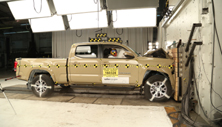
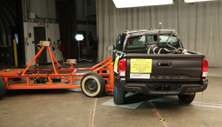
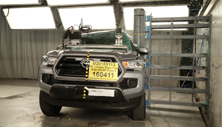
NHTSA crash tests
The agency crash-tested this model year itself. These are its own
photographs and star ratings.
Frontal crash test
Side barrier crash test
Side pole crash test
Photographs taken by NHTSA during its own New Car Assessment Program crash
tests of this model year. Public domain.
Configuration
Overall
Front
Side
Rollover
2018 Toyota Tacoma PU/CC 2WD
14.7% risk
2018 Toyota Tacoma PU/CC 4WD
19.1% risk
2018 Toyota Tacoma PU/EC 4WD
—
—
—
19.1% risk
2018 Toyota Tacoma PU/EC 2WD
—
—
—
14.7% risk
When owners complained
A spike years after the car went on sale usually means a part wearing
out on schedule across the whole fleet — the kind of pattern no single
owner can see from inside their own car.
Mar 2018peak 17Sep 2026
NHTSA investigations into the 2018 Toyota Tacoma
An investigation is the step before a recall: the agency has seen enough
complaints to look into a pattern itself. An open one means it thinks
something may be wrong and nothing has been fixed yet.
EA19001Opened 19 Apr 2019Closed 19 Sep 2024AIR BAGS: AIR BAG/RESTRAINT CONTROL MODULE
Electrical overstress
The Office of Defects Investigation (ODI) opened this investigation to determine if the failure of airbags to deploy during severe crashes, in certain vehicles, was the result of a safety related defect. During the investigation a complex failure was studied that can result in non-deployment of subject vehicle air bags and other restraint system devices in severe crash events. The subject vehicles may be equipped with an airbag control unit (ACU) for the supplemental restraint system (SRS) Electronic Control Unit (ECU) manufactured by ZF-TRW. The ECU receives signals from crash sensors mount...
Recalls on the 2018 Toyota Tacoma
A complaint is one owner's allegation. A recall is the point at which
the manufacturer or a regulator agreed the defect is real and dangerous
enough to fix for free — however old the car is.
Risk: If the fuel pump fails, the engine can stall while driving, increasing the risk of a crash.
20V012000
FUEL SYSTEM, GASOLINE:DELIVERY:FUEL PUMP
Toyota Motor Engineering & Manufacturing (Toyota) recalled certain 2018-2019 4Runner, Highlander, Camry, Land Cruiser, Sequoia, Sienna, Tacoma and Tundra, and Lexus RC 300, RC 350, GS 350, GX 460, IS 300, LC 500, LS 500, LX 570, RX 350L, and 2019 Toyota Avalon and Corolla, and certain Lexus NX 300, and ES 350 vehicles on January 13, 2020. On March 4, 2020, Toyota expanded the recall to include certain 2014-2015 Toyota 4Runner and Land Cruiser, 2018 Avalon, Corolla, 2014 FJ Cruiser, 2017 Sienna and Lexus 2018 ES 350, 2018-2019 GS 300, 2013-2014 GS350, 2014-2015 GX 460, IS 350 and LX 570, 2014 IS F, 2018-2019 IS 350, LC 500H and LS 500H, 2013-2015 LS 460, 2015 NX 200T and RC350, 2017 RC 200T and RX 350. Toyota also removed the 2018-2019 Toyota 4Runner and Land Cruiser and 2018-2019 Lexus GX 460 and LX 570 and 2019 NX300 from inclusion in this recall. On March 19, 2020, Toyota expanded the recall to include 2015 Lexus GS350 vehicles. The low-pressure fuel pump inside the fuel tank may fail.
Risk: If the fuel pump fails, the engine can stall while driving, increasing the risk of a crash.
18V888000
SERVICE BRAKES, HYDRAULIC:FOUNDATION COMPONENTS:MASTER CYLINDER
Toyota Motor Engineering & Manufacturing (Toyota) is recalling certain 2018-2019 Toyota Tacoma vehicles. Improper machining of the brake master cylinder may result in internal damage of one of the seals, affecting brake performance.
Risk: Reduced brake performance can lengthen the distance needed to stop the vehicle, increasing the risk of a crash.
Canada — Transport Canada
Canada runs its own recall programme, and its campaigns do not
always mirror the American ones.
Recall 202172355,683 units in Canada
Electrical
Issue: This recall is for certain block heater kits installed on certain vehicles or sold as accessories at Toyota or Lexus dealerships. On certain vehicles, the engine block heater cable may not have enough heat protection and could be damaged by high temperatures. If this happens, the cable could short circuit while plugged in, and cause the wiring to overheat or melt. Note: This recall only affects the following block heater/cord part numbers: C014003034 PK5A408J09 PU14000904 C014003151 PK5A408J13 PU14000905 C014000885 PK5A489J11 PU14000907 C014000888 PK5A489J22 PU14000909 C014000907 PK5A410H00 PU14000911 C014100904 PU14000900 PU14000913 C014100907 PU14000901 PU14003571 C014100911 PU14000902 PK5A489J14 PK5A408J05 PU14000903 Safety Risk: Engine block heater wiring that overheats or melts could create the risk of a fire. Corrective Actions: Toyota recommends that you should stop using the engine block heater immediately. Toyota will notify owners by mail and instruct you to take your vehicle to a dealer to disable the engine block heater. For some vehicles, the corrective actions for this recall are under development. For others, a new engine block heater cannot be installed, and the owner will receive a refund of the purchase price of the engine block heater.
Recall 2020514126,597 units in Canada
Fuel System
Issue: On certain vehicles, the low-pressure fuel pump could fail. If this happens, then engine may run rough or may not start and the check engine light may turn on. This could also result in a sudden loss of engine power while driving. Note: This recall is an expansion of recalls SRC R95/SRC R96 and SRC RA2/SRC RA3 (Transport Canada Recall Numbers 2020-005 and 2020-088). Safety Risk: A sudden loss of engine power could increase the risk of a crash. Corrective Actions: The company will notify owners by mail and instruct you to take your vehicle to a dealer to replace the fuel pump.
Recall 2020088111,835 units in Canada
Fuel System
Issue: On certain vehicles, the low-pressure fuel pump could fail. If this happens, then engine may run rough or may not start and the check engine light may turn on. This could also result in a sudden loss of engine power while driving. Note: This recall is an expansion of recall SRC R95/SRC R96 (Transport Canada Recall No. 2020-005) Safety Risk: A sudden loss of engine power could increase the risk of a crash. Corrective Actions: The company will notify owners by mail and instruct you to take your vehicle to a dealer to replace the fuel pump.
Recall 202000546,733 units in Canada
Fuel System
Issue: On certain vehicles, the low-pressure fuel pump could fail. If this happens, then engine may run rough or may not start and the check engine light may turn on. This could also result in a sudden loss of engine power while driving. Safety Risk: A sudden loss of engine power could increase the risk of a crash. Corrective Actions: The company will notify owners by mail and instruct you to take your vehicle to a dealer to replace the fuel pump.
Recall 20187052,603 units in Canada
Brakes
On certain vehicles, the brake master cylinder may contain a defect which could allow an internal brake fluid leak. This could reduce the performance of the front brakes, increasing stopping distances, which could result in a crash causing injury and/or damage to property. Correction: Dealers will replace the defective brake master cylinder.
Reports where the owner recorded a crash, a fire, an injury or a death.
Miami Beach, FLCrash1 injured
AIR BAGS
I was traveling southbound on I-25 when the flatbed truck in front of me came to a sudden stop. I was unable to stop in time to avoid rear-ending the truck. The airbags did not deploy upon impact.
NHTSA complaint #11749079 — an unverified report by a vehicle owner.
Miami Beach, FLCrash1 injured
UNKNOWN OR OTHER
I was traveling southbound on I-25 when the flatbed truck in front of me came to a sudden stop. I was unable to stop in time to avoid rear-ending the truck. The airbags did not deploy upon impact.
NHTSA complaint #11749079 — an unverified report by a vehicle owner.
Lafayette, INCrash
SERVICE BRAKES
Pulling vehicle into the garage on a cold morning (15 deg F). Hydraulic booster/brake master cylinder suddenly stopped providing boost pressure and brake pedal dropped to the floor. With no braking effort able to be applied the vehicle was driven into the house at slow speed. No hydraulic leaks are noted and pedal height and brake performance seems to have returned. There is fluid in the master cylinder reservoir and it doesn't appear to be contaminated. Braking capability returned after placing the vehicle in park and then reversing. Waiting for insurance follow up to select a collision repair shop and have the vehicle towed for repair. Dash cam video of the incident is available and clearly shows braking occurring and then the vehicle speeding up or failing to stop. Was unable to upload the video due to size. Photos are also available showing the damage and dry garage floors where the accident occurred. Vehicle is equipped with WeatherTech floor mats and I've verified there are no issues with mats and unattended acceleration with photographic documentation. I was the driver during the incident, am ASE Master Certified, and have taught automotive courses at the local community college for the last 12 years, worked as an automotive technician for 10 years prior, and work professionally as a Mechanical Engineer. Leveraging my experience, there is clearly a present concern with the hydraulic brake booster/master cylinder, particularly at cold temperatures.
NHTSA complaint #11512521 — an unverified report by a vehicle owner.
Norfolk, VACrash
AIR BAGS
I got in a car accident another car hit me T-bone right between the driver a d passenger door sideairbags weren’t deployed at all the incident cause me to jump into de sidewalk run over a sign and neither of the frontbags were deployed either the hit cause me to hit my head to the side window reason I got a concussion and been having headeaches since the day of the accident October 13th 2021 the car that hit me run a red light and must have been over 25 miles per hour cause the other car end it up been flipped over
NHTSA complaint #11437594 — an unverified report by a vehicle owner.
at 23,500 milesLOS Angeles, CACrash
SERVICE BRAKES
I WAS INVOKED IN A FRONT END COLLISION MY BRAKES DIDN'T STOP FAST ENOUGH MY PEDAL WENT DOWN TO THE BOTTOM FLOOR AND MY TPS RADAR COLLISION WARNING DIDN'T ACTIVATE WHAT CAN I DO ?
NHTSA complaint #11390591 — an unverified report by a vehicle owner.
at 23,500 milesLOS Angeles, CACrash
FORWARD COLLISION AVOIDANCE: WARNINGS
I WAS INVOKED IN A FRONT END COLLISION MY BRAKES DIDN'T STOP FAST ENOUGH MY PEDAL WENT DOWN TO THE BOTTOM FLOOR AND MY TPS RADAR COLLISION WARNING DIDN'T ACTIVATE WHAT CAN I DO ?
NHTSA complaint #11390591 — an unverified report by a vehicle owner.
The most recent complaints
In the owners' own words, exactly as filed with NHTSA.
Bountiful, UT
STRUCTURE:BODY
I own a 2018 Toyota Tacoma SR, manufactured 11/2017, with factory paint code 1G3 Magnetic Gray Metallic. The factory clear coat is experiencing extensive delamination/failure on the hood and roof. This isn't isolated stone damage or normal cosmetic wear. The clear coat is failing extensively across the horizontal panels. I'm aware Toyota has previously acknowledged clear-coat peeling on Tacoma vehicles through T-SB-0004-20 and Customer Support Program 20TE02, and that there are documented complaints involving 2018 Tacomas experiencing clear-coat failure on the hood and roof. I understand my VIN may not currently fall within those programs, but I'm requesting that Toyota inspect and document the condition and consider goodwill assistance toward repainting the affected factory-painted panels. I'd also like a Toyota case number assigned to the paint failure.
NHTSA complaint #11762790 — an unverified report by a vehicle owner.
Reno, NV
UNKNOWN OR OTHER
Vehicle hits a bump in the road and the check engine light comes on, followed by the gas pedal being non-responsive and an error code on the instrument panel saying “Brake Override System Malfunction. Check with dealer.” and “Pre-collision System Malfunction. Visit your dealer. ” When this occurs, have to coast the vehicle to a safe place, turn off and wiggle the Radar Control piece attached to the front grill sometimes multiple times before the truck will clear the code and accelerate. Been an ongoing issue for several months. Have replaced the front grill sensor and plate and the issue persists.
NHTSA complaint #11752269 — an unverified report by a vehicle owner.
Deridder, LA
UNKNOWN OR OTHER
The cab vents failed causing water to soak the carpet and pad from the back wall to the front of the cab. Mold was growing through out the the cab. Carpet & pad had to be removed. This is a known problem by dealerships and owners of Toyota Tacoma. Because the water was under the seats, trim and weather mats it went undetected exposing us to mold. Problem was reported to Toyota dealership and Toyota Corporation. A case was logged 07/10/2026 as Case # 260710001840. The resolution offered was ordering and replacing parts. All parts required for repair and on backorder. Hundreds of orders for these parts in their system. Carpet and under mat had been replaced 05/02/2025 due to a Toyota recall campaign 21TD03.
NHTSA complaint #11751422 — an unverified report by a vehicle owner.
Deridder, LA
STRUCTURE:BODY
The cab vents failed causing water to soak the carpet and pad from the back wall to the front of the cab. Mold was growing through out the the cab. Carpet & pad had to be removed. This is a known problem by dealerships and owners of Toyota Tacoma. Because the water was under the seats, trim and weather mats it went undetected exposing us to mold. Problem was reported to Toyota dealership and Toyota Corporation. A case was logged 07/10/2026 as Case # 260710001840. The resolution offered was ordering and replacing parts. All parts required for repair and on backorder. Hundreds of orders for these parts in their system. Carpet and under mat had been replaced 05/02/2025 due to a Toyota recall campaign 21TD03.
NHTSA complaint #11751422 — an unverified report by a vehicle owner.
Whiteford, MD
STRUCTURE:BODY
WHAT FAILED: The clear coat finish on the exterior paint of my 2018 Toyota Tacoma has failed (cracking) in two separate locations on the same vehicle, indicating a manufacturing defect rather than normal wear. In late 2024, I discovered clear coat cracking on the roof and hood. I reported this to Toyota (Toyota case #241028000714) and paid approximately $2,000 out of pocket to have an independent body shop repaint the affected panels, as Toyota corporate declined to assist after the repair had already been performed. The clear coat is now cracking again at approximately 48,925 miles, this time on the cab in the pillar/trim area between the tops of the doors and the roofline. The vehicle and affected areas are available for inspection upon request. SAFETY IMPACT: This is a cosmetic exterior paint/clear coat defect. I have not identified any impact on vehicle operation, structural integrity, or visibility, and I am not aware of any safety risk to myself or others resulting from this issue to date. I am reporting it to document a recurring defect pattern on this vehicle. REPRODUCED/CONFIRMED BY A DEALER OR SERVICE CENTER: The 2024 occurrence was inspected and repaired by an independent body shop (not a Toyota dealer). The current occurrence has been reported to Toyota corporate (Toyota Brand Engagement Center) along with photographs, but has not been physically inspected by a Toyota dealer. INSPECTED BY MANUFACTURER, POLICE, OR INSURANCE: Toyota corporate reviewed photographic evidence of the current issue through my correspondence with the Toyota Brand Engagement Center, which I have asked to be linked to prior case #241028000714. Toyota has not physically inspected the vehicle. This is not a crash-related issue, so no police or insurance inspection has occurred. WARNING LAMPS OR PRIOR SYMPTOMS: Not applicable. This is a cosmetic paint/clear coat defect rather than a mechanical or electronic system issue, so there were no dashboard warning lamps or system messages
NHTSA complaint #11750035 — an unverified report by a vehicle owner.
Miami Beach, FLCrash1 injured
AIR BAGS
I was traveling southbound on I-25 when the flatbed truck in front of me came to a sudden stop. I was unable to stop in time to avoid rear-ending the truck. The airbags did not deploy upon impact.
NHTSA complaint #11749079 — an unverified report by a vehicle owner.
Miami Beach, FLCrash1 injured
UNKNOWN OR OTHER
I was traveling southbound on I-25 when the flatbed truck in front of me came to a sudden stop. I was unable to stop in time to avoid rear-ending the truck. The airbags did not deploy upon impact.
NHTSA complaint #11749079 — an unverified report by a vehicle owner.
Navarre, FL
STRUCTURE:BODY
The cabin pressure vents, located at the rear of the cab below the rear window on the body frame have failed. The seal on the exterior of the vents has dry rotted. This has caused an extensive amount of water intrusion that is undetectable until it has been present long enough to cause mildew issues. Being that water enters below the vehicle carpet and padding you cannot see it, your first warning sign is smell. When I began to assess the issue I pulled up my carpet to find standing water and mold. This is supposed to be a safe environment where I can transport myself and my family and I now I have to be concerned about mold inhalation each time my toddler sits in my truck. Toyota needs to do an immediate recall to the cabin vents and replace them with a product that can actually with stand the elements. Additionally they need to replace all the carpet, twill, and padding that has been compromised.
NHTSA complaint #11747530 — an unverified report by a vehicle owner.
at 144,000 milesOpelousas, LA
STRUCTURE
The contact owns a 2018 Toyota Tacoma. The contact stated that while the vehicle was parked, there was an abnormal odor coming from the inside of the vehicle. While the vehicle was being serviced, the dealer discovered that the inner padding on the front passenger side, the rear passenger side, and the rear driver side was soaked with water, and due to the water accumulation, there was mold forming on the floor. The contact had placed towels to soak up the water while driving; however, the contact later discovered that the mold had spread to the towels as well. No warning lights were illuminated. The dealer diagnosed the vehicle and stated that the rear cabin pressure bin needed to be replaced. The vehicle was not repaired. The manufacturer was notified of the failure. The failure mileage was approximately 144,000.
NHTSA complaint #11746680 — an unverified report by a vehicle owner.
Beaufort, SC
STRUCTURE:BODY
Paint has been peeling from door handles and front bumper
NHTSA complaint #11741027 — an unverified report by a vehicle owner.
Taylors, SC
STEERING
am filing this complaint regarding a power steering rack leak on my [2018] Toyota Tacoma with [83,000] miles, which I purchased used three months ago from Fred Anderson Toyota of Greer in South Carolina. The dealer represented the vehicle as having passed a 160-point inspection and implied CPO-level standards, but it was not actually Certified Pre-Owned. The steering rack is now leaking power steering fluid, with visible accumulation in the boots, despite stable fluid levels in the reservoir during my ownership. This issue appeared very shortly after purchase, raising concerns that it was a pre-existing defect. Power steering leaks can lead to loss of assist and increase crash risk if they worsen. I request that NHTSA investigate whether this represents a safety defect affecting Toyota Tacomas, as similar complaints appear common in owner forums
NHTSA complaint #11740010 — an unverified report by a vehicle owner.
at 77,000 milesMorrero, LA
SERVICE BRAKES, HYDRAULIC
The contact owns a 2018 Toyota Tacoma. The contact stated that the brake pedal was spongy while depressed. There was no warning light illuminated. The failure persisted, and the contact discovered oil on the bottom of his shoe before discovering oil in the driver’s side footwell. Upon inspection, the contact discovered that oil was leaking from the engine firewall onto the brake pedal. The dealer was notified of the failure, and the contact was initially informed that the VIN was included in NHTSA Campaign Number: 18V888000 (Service Brakes, Hydraulic). The vehicle was taken to the dealer, and the contact was informed that the VIN was not associated with the recall. The contact was provided with an estimate for the repair. The manufacturer was notified of the failure and confirmed that the VIN was not under recall. The vehicle was not repaired. The failure mileage was approximately 77,000.
NHTSA complaint #11733984 — an unverified report by a vehicle owner.
Frederick, MD
ENGINE
The engine in my 2018 Toyota Tacoma failed at 39000 miles and Toyota is refusing to cover the repair costs. I have records of all regularly scheduled maintenance performed and I have never done anything that would put additional stress on the engine such as off-roading or towing. This engine is defective and should be recalled. There are numerous reports online of the same issue.
NHTSA complaint #11729880 — an unverified report by a vehicle owner.
Jamesville, NY
UNKNOWN OR OTHER
The vacuum pump. This vehicle was inspected by Dunn Tire. Yes, the vehicle is available for inspection. The safety issue that occurs is the loss of power assist to your brake system, and if not repaired, can impact the camshaft or the oiling system. (Please see attachment).
NHTSA complaint #11728861 — an unverified report by a vehicle owner.
Jamesville, NY
SERVICE BRAKES
The vacuum pump. This vehicle was inspected by Dunn Tire. Yes, the vehicle is available for inspection. The safety issue that occurs is the loss of power assist to your brake system, and if not repaired, can impact the camshaft or the oiling system. (Please see attachment).
NHTSA complaint #11728861 — an unverified report by a vehicle owner.
Bell, CA
SERVICE BRAKES
The Break booster has failed or started since the break fluid is leaking inside the cab. And other trucks from the same year as my truck did have a recall for the break master cylinder failing. My breaks could potentially go out fully and I wont be able to stop. My problem has been confirmed by my independent service center. And also there's alot of other people having the same issue online. Since the floor mats show oil stains just like how I found out I was having a issue.It hasn't been confirmed by the manufacturer but I will be taking it soon to be inspection but since a recurring issue with multiple trucks online. I wanted to report it here so the recall could be extended to other trucks from same recall year. I noticed i was having a problem when I had to press down the breaks really hard to come to a stop. Then thats when I stopped and saw the oil on the floor mats. And my truck has really low mileage for the year and its safety concern to me and being that the replacement is really expensive just the part is around 1200.
NHTSA complaint #11722232 — an unverified report by a vehicle owner.
Canton, OH
FUEL/PROPULSION SYSTEM
Truck has strong smell of fuel in the cab
NHTSA complaint #11711048 — an unverified report by a vehicle owner.
Kingman, KS
ENGINE
While driving I can here a ticking sound coming from the motor and it gets worse while I pick up speed
NHTSA complaint #11704749 — an unverified report by a vehicle owner.
Pioneer, CA
SERVICE BRAKES
The brake actuator assembly is leaking brake fluid and is dripping onto the brake lever and onto the floorboard. This concern has been inspected and confirmed by a local Toyota dealership. This problem is a known safety recall by Toyota (Safety Recall J06).
NHTSA complaint #11701669 — an unverified report by a vehicle owner.
Nashville, TN
SERVICE BRAKES
The brake master cylinder seal is broken and causing brake fluid to leak into the floorboard of the cab near the brake pedal.
NHTSA complaint #11699815 — an unverified report by a vehicle owner.
Kailua, HI
UNKNOWN OR OTHER
The 3rd generation Tacomas rear cabin vents (2 vents) allow water to enter the cabin because they are not tight to the body or sealed properly. The water leaks down the back wall and forward onto the floor soaking the carpet and padding underneath. The water in the carpet/padding has yielded mildew/mold throughout (water goes all the way to the front of the truck). The water also leaks through a floor grommet into a section where the cab mount bolts are and significant rust develops. Not only is the exposure to mold a health hazard, but the corrosion/rust on the cab mount bolts is a significant structural concern. There are many online posts with this problem, and i have just recently found this on my Tacoma. My vehicle has had the 3rd brake light recall, and this issue is completely separate from that recall. Toyota has a history on these vehicles not sealing them as they should. 1. The 2 rear cabin vents fail to keep water from entering the cab. I am happy to provide the vehicle for inspection. 2. Exposure to toxic mold is a health concern. Significant structural damage to the cab mount bolts is a concern if the vehicle were to be in an accident. 3. Numerous people online have confirmed this issue, and they have indicated dealerships are well aware of the issue. I put a garden hose to the back of my truck myself and saw water entering the vehicle. 4. Vehicle has not been inspected by manufacturer, police, insurance, etc. 5. Unknown when water leak first started. In the past 2 years i have started to notice a mildew smell after a rainy day. I am happy to provide additional photos, but the internet is full of this very issue. Please see the following sites with photos/videos/descriptions of other Tacoma owners having the exact same issue. Thank you very much for your time. [XXX] [XXX] INFORMATION REDACTED PURSUANT TO THE FREEDOM OF INFORMATION ACT (FOIA), 5 U.S.C. 552(B)(6)
NHTSA complaint #11699187 — an unverified report by a vehicle owner.
Kailua, HI
STRUCTURE:BODY
The 3rd generation Tacomas rear cabin vents (2 vents) allow water to enter the cabin because they are not tight to the body or sealed properly. The water leaks down the back wall and forward onto the floor soaking the carpet and padding underneath. The water in the carpet/padding has yielded mildew/mold throughout (water goes all the way to the front of the truck). The water also leaks through a floor grommet into a section where the cab mount bolts are and significant rust develops. Not only is the exposure to mold a health hazard, but the corrosion/rust on the cab mount bolts is a significant structural concern. There are many online posts with this problem, and i have just recently found this on my Tacoma. My vehicle has had the 3rd brake light recall, and this issue is completely separate from that recall. Toyota has a history on these vehicles not sealing them as they should. 1. The 2 rear cabin vents fail to keep water from entering the cab. I am happy to provide the vehicle for inspection. 2. Exposure to toxic mold is a health concern. Significant structural damage to the cab mount bolts is a concern if the vehicle were to be in an accident. 3. Numerous people online have confirmed this issue, and they have indicated dealerships are well aware of the issue. I put a garden hose to the back of my truck myself and saw water entering the vehicle. 4. Vehicle has not been inspected by manufacturer, police, insurance, etc. 5. Unknown when water leak first started. In the past 2 years i have started to notice a mildew smell after a rainy day. I am happy to provide additional photos, but the internet is full of this very issue. Please see the following sites with photos/videos/descriptions of other Tacoma owners having the exact same issue. Thank you very much for your time. [XXX] [XXX] INFORMATION REDACTED PURSUANT TO THE FREEDOM OF INFORMATION ACT (FOIA), 5 U.S.C. 552(B)(6)
NHTSA complaint #11699187 — an unverified report by a vehicle owner.
Odometer Fraud. The contact purchased a 2018 Toyota Tacoma. The contact stated that upon retrieving the Carfax report after purchasing the vehicle, it was discovered that there was a mileage discrepancy, and the vehicle seller was not the title holder. The vehicle was a private sale. At the time of purchase, the vehicle mileage was 32,000, and the contact later discovered that the mileage was over 200,000 through the Carfax report.
NHTSA complaint #11692398 — an unverified report by a vehicle owner.
Golden Valley, AZ
FUEL/PROPULSION SYSTEM
The fuel pump as stopped working the vehicle will not start and the 4x4 is showing that it is not working. The vehicle is available for inspection. Thankfully this happened while the vehicle was sitting over night but we had driven it the evening before it just stopped running. the Fuel system could have failed while we were driving anywhere. It has not been inspected by anyone else. it is sitting in our driveway and my husband has done a lot of trouble shooting as to what could be wrong and all arrows point to the fuel pump. there have been no check engine light or nothing this came out of nowhere.
NHTSA complaint #11690804 — an unverified report by a vehicle owner.
Navarre, FL
ELECTRICAL SYSTEM
The master cylinder is leaking brake fluid into the cab and is dripping behind the brake pedal. There is brake fluid in the wiring harness that goes to the brake switch as well. This is a known fire hazard from other vehicle manufacturers.
NHTSA complaint #11685491 — an unverified report by a vehicle owner.