Owners have filed 122 complaints
about the 2025 Toyota Tacoma with NHTSA between 2025 and 2026.
The largest single group is the body & structure.
Across this model's run it ranks 17 of 32 worst.
The letter says how bad. This says what kind — whether this year drew
an unusual number of complaints, unusually dangerous
ones, or failures that arrived unusually early.
The dashed ring is 50 — the national norm. Further out is worse.
Complaint volume — 18
Against the median year of the Toyota Tacoma. 50 means typical for this
model; 100 means roughly double.
Severity — 93
18% of these complaints
involved a crash, fire, injury or death, against a national rate of
9.7%.
Early failure — 100
100% of failures with a mileage on record happened under
36,000 miles, against a national rate of
29%.
NHTSA files every complaint against a named sub-assembly, not just a
system. This is the difference between knowing it was "the engine" and
knowing which part of it — the list to hand a mechanic.
Interior
3470.8%
Automatic Emergency Braking
48.3%
Body
36.3%
Warning
24.2%
Adaptive Cruise Control
24.2%
Exterior
12.1%
Oven/Stove/Cooktop
12.1%
Assist
12.1%
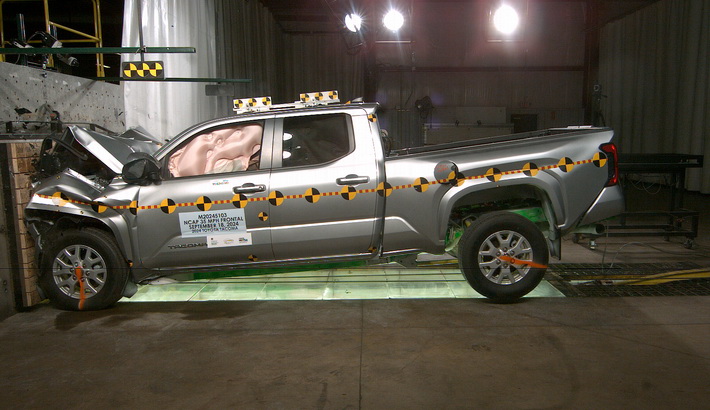
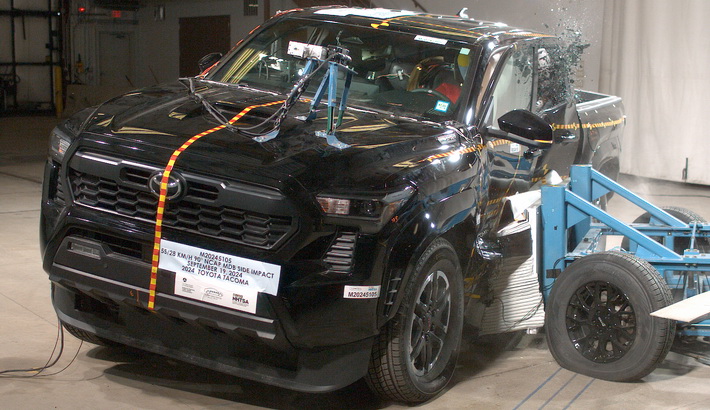
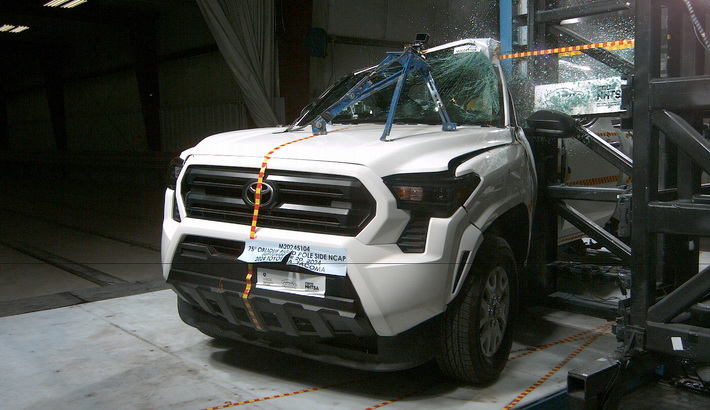
NHTSA crash tests
The agency crash-tested this model year itself. These are its own
photographs and star ratings.
Frontal crash test
Side barrier crash test
Side pole crash test
Photographs taken by NHTSA during its own New Car Assessment Program crash
tests of this model year. Public domain.
Configuration
Overall
Front
Side
Rollover
2025 Toyota TACOMA PU/CC 4WD
18.5% risk
2025 Toyota TACOMA PU/CC RWD
19.8% risk
2025 Toyota TACOMA PU/EC 4WD
—
—
—
18.5% risk
2025 Toyota TACOMA PU/EC RWD
—
—
—
19.8% risk
When owners complained
A spike years after the car went on sale usually means a part wearing
out on schedule across the whole fleet — the kind of pattern no single
owner can see from inside their own car.
Apr 2025peak 14Sep 2026
Recalls on the 2025 Toyota Tacoma
A complaint is one owner's allegation. A recall is the point at which
the manufacturer or a regulator agreed the defect is real and dangerous
enough to fix for free — however old the car is.
United States — NHTSA
26V514000
SUSPENSION:REAR:SHOCK ABSORBER
Toyota Motor Engineering & Manufacturing (Toyota) is recalling certain 2024 Tacoma Hybrid and 2024-2025 Tacoma vehicles. The metal flange on the front and rear shock absorbers may corrode and fail, resulting in detachment of the external oil reservoir.
Risk: An oil reservoir that detaches can create a road hazard, increasing the risk of a crash.
26V179000
EQUIPMENT:OTHER:LABELS
Toyota Motor Engineering & Manufacturing (Toyota) is recalling certain 2024-2025 Toyota Tundra, Tacoma Hybrid, Tacoma, RAV4 Hybrid, Land Cruiser Hybrid, Lexus GX550, 2024-2026 Tundra Hybrid, 2025 Sequoia Hybrid, Crown Signia, Grand Highlander, Lexus TX500 Hybrid, Lexus NX350 Hybrid, 2025-2026 Grand Highlander Hybrid, and Lexus TX350 vehicles. The load carrying capacity modification label may display inaccurate added weight values. As such, these vehicles fail to comply with the requirements of Federal Motor Vehicle Safety Standard number 110, "Tire Selection and Rims."
Risk: A vehicle with an incorrect maximum capacity weight value may be overloaded, which can increase the risk of a crash.
25V656000
POWER TRAIN:DRIVELINE:DRIVESHAFT
Toyota Motor Engineering & Manufacturing (Toyota) is recalling certain 2025 Tacoma and Tacoma Hybrid vehicles. The front driveshaft constant-velocity (CV) joint may deform and break.
Risk: A broken driveshaft can impair steering. Vehicles with full-time 4WD may experience a vehicle rollaway while parked without the parking brake applied. Both scenarios increase the risk of a crash.
25V595000
ELECTRICAL SYSTEM: INSTRUMENT CLUSTER/PANEL
Toyota Motor Engineering & Manufacturing (Toyota) is recalling certain 2023-2024 Toyota Venza, 2023-2025 RAV4 Prime, RAV4, Highlander, GR Corolla, Crown, 2024-2025 Lexus TX, LS, Toyota Tacoma, Grand Highlander, and 2025 Lexus RX, Toyota Crown Signia, Camry, RAV 4 Plug-in Hybrid (PHEV), and 4 Runner vehicles. Due to an error in the instrument panel software at vehicle startup, the instrument panel may fail to display vehicle speed, brake system, and tire pressure warning lights.
Risk: An instrument panel display that does not show critical information can increase the risk of a crash or injury.
25V058000
SERVICE BRAKES, HYDRAULIC:FOUNDATION COMPONENTS:HOSES, LINES/PIPING, AND FITTINGS
Toyota Motor Engineering & Manufacturing (Toyota) is recalling certain 2024-2025 Tacoma 4-wheel drive vehicles. The rear brake hoses can be damaged if mud and dirt builds up inside the rear wheels. This can result in a brake fluid leak.
Risk: A brake fluid leak can reduce braking ability and increase the risk of a crash.
Canada — Transport Canada
Canada runs its own recall programme, and its campaigns do not
always mirror the American ones.
Recall 2025521362 units in Canada
Powertrain
Issue: On certain trucks, the front axle shaft(s) may not have been manufactured properly. As a result, the axle shaft(s) could break and prevent you from fully turning the steering wheel. Additionally, if the truck is parked and the parking brake isn't applied, the truck could roll away. Safety Risk: A steering wheel that can't be turned completely could increase the risk of a crash. A parked vehicle that rolls away could create the risk of an injury or a crash. Corrective Actions: Toyota will notify owners by mail and advise you to take your truck to a dealership to inspect and, if necessary, replace the front axle shaft assemblies.
Recall 202536311,086 units in Canada
Brakes
Issue: Under certain conditions, the rear brake hoses could become damaged. Over time, the brake hoses could fail and cause a brake fluid leak. If this happens, there could be reduced braking. Note: This recall only affects certain 4WD vehicles equipped with 16-inch brakes and 17-inch or 18-inch Toyota wheels. This recall replaces Transport Canada recall 2025-051. Vehicles that were repaired under that recall don't require this repair. Safety Risk: Reduced braking can cause extended stopping distances and increase the risk of a crash. Corrective Actions: Toyota will notify owners by mail and advise you to take your vehicle to a dealership to replace the rear brake hoses.
Recall 20250515,149 units in Canada
Brakes
This recall was replaced by Transport Canada recall no. 2025-363. Issue: Under certain conditions, the rear brake hoses could become damaged. Over time, the brake hoses could fail and cause a brake fluid leak. If this happens, there could be reduced braking. Note: This recall only affects certain 4WD vehicles equipped with 16-inch brakes and 17-inch Toyota wheels. Safety Risk: Reduced braking can cause extended stopping distances and increase the risk of a crash. Corrective Actions: Toyota will notify owners by mail and advise you to take your vehicle to a dealership to replace the rear brake hoses.
Reports where the owner recorded a crash, a fire, an injury or a death.
Aptos, CAFire
EQUIPMENT:RECREATIONAL VEHICLE/TRAILER
We rented a vehicle consisting of the identified Toyota Tacoma with an installed cab-over camper (Travel Lite 550U-XS, VIN: [XXX]). While driving this rental vehicle on a two-lane highway with our family, including two young children (ages [XXX] and [XXX]), a fire ignited in the vehicle's built-in propane/gas stove system. We were not alerted to the fire by any onboard safety equipment, though the camper was equipped with a smoke alarm. We were alerted only by a passing motorist. The vehicle's smoke alarm did not activate until several minutes after the fire had already been extinguished by us using the vehicle's fire extinguisher, and after the smoke inside the camper had already dissipated. The smoke alarm sustained visible smoke damage and its exterior housing was melted, which we believe indicates the alarm was exposed to significant heat/smoke without triggering, or triggered only very late in that exposure. We believe this represents a serious safety equipment failure: a smoke/fire detection system that did not provide any early warning during an active fire, in a small space. This delay in detection could have resulted in serious injury or death. Additionally, we received no safety briefing regarding the hazards of the propane system at the time of vehicle handover. The vehicle overview video provided to us contained no safety information regarding the gas system, and we later discovered it depicted a different vehicle unit than the one we were actually provided, raising questions about whether this vehicle's specific gas/stove configuration and safety equipment had been properly reviewed or tested prior to rental. We made a best guess at cause in speaking with the responder fire department, but we cannot know for sure. To be clear, there was no issue with the Toyota Tacoma itself. We are submitting this complaint to ensure NHTSA is aware of this potential safety defect in the smoke alarm system and/or propane stove. INFORMATION REDACTED PURSUANT TO THE FREEDOM OF INFORMATION ACT (FOIA), 5 U.S.C. 552(
NHTSA complaint #11753398 — an unverified report by a vehicle owner.
Aptos, CAFire
EQUIPMENT:RECREATIONAL VEHICLE/TRAILER:LPG SYSTEMS
We rented a vehicle consisting of the identified Toyota Tacoma with an installed cab-over camper (Travel Lite 550U-XS, VIN: [XXX]). While driving this rental vehicle on a two-lane highway with our family, including two young children (ages [XXX] and [XXX]), a fire ignited in the vehicle's built-in propane/gas stove system. We were not alerted to the fire by any onboard safety equipment, though the camper was equipped with a smoke alarm. We were alerted only by a passing motorist. The vehicle's smoke alarm did not activate until several minutes after the fire had already been extinguished by us using the vehicle's fire extinguisher, and after the smoke inside the camper had already dissipated. The smoke alarm sustained visible smoke damage and its exterior housing was melted, which we believe indicates the alarm was exposed to significant heat/smoke without triggering, or triggered only very late in that exposure. We believe this represents a serious safety equipment failure: a smoke/fire detection system that did not provide any early warning during an active fire, in a small space. This delay in detection could have resulted in serious injury or death. Additionally, we received no safety briefing regarding the hazards of the propane system at the time of vehicle handover. The vehicle overview video provided to us contained no safety information regarding the gas system, and we later discovered it depicted a different vehicle unit than the one we were actually provided, raising questions about whether this vehicle's specific gas/stove configuration and safety equipment had been properly reviewed or tested prior to rental. We made a best guess at cause in speaking with the responder fire department, but we cannot know for sure. To be clear, there was no issue with the Toyota Tacoma itself. We are submitting this complaint to ensure NHTSA is aware of this potential safety defect in the smoke alarm system and/or propane stove. INFORMATION REDACTED PURSUANT TO THE FREEDOM OF INFORMATION ACT (FOIA), 5 U.S.C. 552(
NHTSA complaint #11753398 — an unverified report by a vehicle owner.
Aptos, CAFire
EQUIPMENT:APPLIANCE:OVEN/STOVE/COOKTOP
We rented a vehicle consisting of the identified Toyota Tacoma with an installed cab-over camper (Travel Lite 550U-XS, VIN: [XXX]). While driving this rental vehicle on a two-lane highway with our family, including two young children (ages [XXX] and [XXX]), a fire ignited in the vehicle's built-in propane/gas stove system. We were not alerted to the fire by any onboard safety equipment, though the camper was equipped with a smoke alarm. We were alerted only by a passing motorist. The vehicle's smoke alarm did not activate until several minutes after the fire had already been extinguished by us using the vehicle's fire extinguisher, and after the smoke inside the camper had already dissipated. The smoke alarm sustained visible smoke damage and its exterior housing was melted, which we believe indicates the alarm was exposed to significant heat/smoke without triggering, or triggered only very late in that exposure. We believe this represents a serious safety equipment failure: a smoke/fire detection system that did not provide any early warning during an active fire, in a small space. This delay in detection could have resulted in serious injury or death. Additionally, we received no safety briefing regarding the hazards of the propane system at the time of vehicle handover. The vehicle overview video provided to us contained no safety information regarding the gas system, and we later discovered it depicted a different vehicle unit than the one we were actually provided, raising questions about whether this vehicle's specific gas/stove configuration and safety equipment had been properly reviewed or tested prior to rental. We made a best guess at cause in speaking with the responder fire department, but we cannot know for sure. To be clear, there was no issue with the Toyota Tacoma itself. We are submitting this complaint to ensure NHTSA is aware of this potential safety defect in the smoke alarm system and/or propane stove. INFORMATION REDACTED PURSUANT TO THE FREEDOM OF INFORMATION ACT (FOIA), 5 U.S.C. 552(
NHTSA complaint #11753398 — an unverified report by a vehicle owner.
Spencer, MAFire1 injured
ELECTRICAL SYSTEM
The driver's side window switch panel failed and caught on fire. It is available for inspection.It will be towed to a toyota dealership tomorrow. Nobody was in the vehicle when the fire started. The problem has not been confirmed or reproduced by a dealer. The vehicle has not been inspected, is going in for inspection tomorrow. There was no warning or indication prior to the fire starting.
NHTSA complaint #11735950 — an unverified report by a vehicle owner.
My 2025 Toyota Tacoma engaged the emergency braking/pre-collision system system while my vehicle was going under 10 mph on a steep road in winter conditions. My vehicle was completely under control before the system engaged and there was no risk of a collision with any vehicles in front of me. The emergency braking system engaged and rendered my vehicle completely out of control. I tried desperately to pump the brakes in hopes I could regain control of the vehicle, but the brakes were fully locked. Had the brakes dis-engaged, I could have easily avoided the collision. The car not only did not decelerate, it accelerated down the hill while the brakes were locked for several seconds. My vehicle eventually slid into another vehicle that had been parked on the side of the road. From doing extensive research I believe a perfect storm of events caused this malfunction. Previously on this day, several inches of snow had fallen. The road had not been plowed and cars were parked on the side of the road. There was also a curve in the road near my vehicle's collision where the other vehicle was parked. My windshield was also still defrosting in the uppermost section near the rear view mirror. It is also possible the radar block on the front of the vehicle had snow or ice on it. It was also actively snowing. From what I have read, any of the above factors can cause a malfunction in the emergency braking pre-collision system. I had never been in an accident in over 20 years of driving and my vehicle did the least safe maneuver it could have in the given situation. There is no circumstance where one would purposefully slam the brakes on a snowy/icy down hill road if they know how to drive in the snow (even if you were going under 10mph as I was). At the most basic level of failure, I can't imagine this system should ever engage if going as slow as I was. Also, the system is designed to decelerate (was accelerating) and I was pumping brakes in effort to disengage
NHTSA complaint #11729275 — an unverified report by a vehicle owner.
Saint Maries, IDCrash1 injured1 killed
LANE DEPARTURE: ASSIST
Due to my husband driving the vehicle, ISP states it looks like he crossed into an oncoming semi-chip truck trailer, causing a fatal accident and killing him instantly. The 2025 Toyota Tacoma's Safety Sense obviously failed since my husband is now dead. We had the 2025 Tacoma in the prior week due to my complaints that the lane assist was not working properly and the screen did not respond to my touch to turn it on. After the fatal accident, ISP removed the black box to download information for the accident report. I am now waiting for isp report. No jaws of life was used to extract husband they didn't need it Tacoma metal already peeled back like a tuna can.
NHTSA complaint #11726018 — an unverified report by a vehicle owner.
The most recent complaints
In the owners' own words, exactly as filed with NHTSA.
Moundridge, KS
STRUCTURE:BODY
The interior door handle snapped and failed completely under normal operation, causing an immediate loss of driver egress. The handle went limp, leaving the door impossible to open from inside the cabin and creating an entrapment hazard in the event of an emergency. Exiting the vehicle requires the window to be rolled down to access the exterior handle. The failure occurred suddenly with no prior warning or indication of potential failure. The vehicle was taken to an authorized Toyota dealership, which confirmed internal component failure and ordered a replacement assembly under warranty. The dealership noted the replacement part is currently on national backorder due to high replacement volume.
NHTSA complaint #11764169 — an unverified report by a vehicle owner.
Southampton, PA
STRUCTURE:BODY:DOOR:HANDLE:INTERIOR
While attempting to exit my vehicle the inner door handle on the driver side felt loose. I attempted to open the door and the door would not open. I carefully attempted to manually move the lock on the door from unlocked to locked back to unlocked and again tried to carefully exit the vehicle but the inner door handle was inoperable. I am now forced to roll my window down and open my vehicle door from the outside to use the door
NHTSA complaint #11763988 — an unverified report by a vehicle owner.
Kalona, IA
STRUCTURE:BODY:DOOR:HANDLE:INTERIOR
Driver side interior door handle broke under normal use not allowing me to exit my truck without rolling down window and using the exterior door handle.
NHTSA complaint #11763948 — an unverified report by a vehicle owner.
Montclair, NJ
STRUCTURE:BODY:DOOR:HANDLE:INTERIOR
Driver side door cannot be open from the inside ,driver have to put the window down and open from the outside 2025 Toyota Tacoma only have 4,700 Miles
NHTSA complaint #11763181 — an unverified report by a vehicle owner.
Wilmington, DE
UNKNOWN OR OTHER
Fourth generation Toyota Tacoma interior door handles -- 2024, 2025, 2026 -- suffer from an engineering or manufacturing defect. These handles are breaking during normal use, by the thousands. This is a serious safety risk, as drivers with limited mobility, or even fully-abled drivers can be entrapped within the vehicle during an emergency. A regular pull, let alone a hard pull, routinely snaps the mechanism. Toyota dealer has 1000+ backlog of repairs. This is a serious safety risk and a recall is critical. Drivers will die if this is not addressed; it is merely a matter of time.
NHTSA complaint #11762035 — an unverified report by a vehicle owner.
Fort Worth, TX
STRUCTURE:BODY:DOOR:HANDLE:INTERIOR
Few months back, the driver side door handle "broke" on the inside. There is some plastic piece/mechanism that attaches the door handle to the cable on the inside of the door that allows the user to open the door, with resistance from the cable. That piece broke, so it made the handle loose and flimsy, unable to open the door from the inside. Toyota said that was a known issue and that the parts were on backorder, so they just swapped the handle from my back passenger driver side door with my front driver side door. Well last week, the swapped handle also broke. So, I have to roll my window down and open the door from outside to get out as neither of my left side door handles work. Toyota still doesn't have an eta of when parts will ship to replace the pieces, and they aren't offering me a resolution in the meantime.
NHTSA complaint #11761814 — an unverified report by a vehicle owner.
Loganville, GA
STRUCTURE:BODY:DOOR:HANDLE:INTERIOR
The inside driver-side door handle broke, leaving me unable to open the door from inside the truck. I had to crawl across the truck and exit through another door. This is a serious and immediate safety hazard. The driver must be able to exit the vehicle quickly in an emergency. If there were a fire, accident, or other emergency, a broken interior door handle could trap the driver inside the vehicle and potentially result in serious injury or death.
NHTSA complaint #11761503 — an unverified report by a vehicle owner.
Edinburg, TX
STRUCTURE:BODY:DOOR:HANDLE:INTERIOR
Equipment Failure. The interior driver-side door handle mechanism failed and snapped completely off during normal operation while trying to exit stationary vehicle. The plastic hinge pin/bell-crank component fractured internally under standard hand pressure. This component failure completely prevents the driver from exiting the cabin from the inside, creating an immediate emergency entrapment and life-safety hazard. The manufacturer (Toyota) currently has the replacement door handle assembly on a national backorder with no available ETA, forcing consumers to operate a vehicle with a compromised emergency exit route. The vehicle currently approximately 3429 miles
NHTSA complaint #11761560 — an unverified report by a vehicle owner.
Tonawanda, NY
STRUCTURE:BODY:DOOR:HANDLE:INTERIOR
Drive door handle broke became loose floppy, took to dealer, they took apart.... been waiting for parts 2 weeks.... today handle , went full failure and wont engage lock to open, can't open door from inside, have to open window to use outside handle to open door while inside, safety issue... called dealer, clam waiting on part..... Toyota knows of the issue, seen in the Toyota forum that the issue is know and both door drivers and passenger side can have this issue....really don't like that feeling of being trapped. Toyota should have a replacement upgrade to fit safety margins....i've only own my truck 1 year.....this issue start a few weeks ago...hoping the part gets to the dealer fast and the right fixes meet safety standards...
NHTSA complaint #11761075 — an unverified report by a vehicle owner.
New Bedford, MA
ELECTRICAL SYSTEM
Windshield wiper motor squeals causing distraction every time wipers are turned on.
NHTSA complaint #11760632 — an unverified report by a vehicle owner.
Scott Township, PA
STRUCTURE:BODY:DOOR:HANDLE:INTERIOR
The driver side door latch failed. This prevented the driver side door from opening from the inside. To open the door, the window is rolled down, and the outside door latch is used. The mechanic said the plastic mechanism on the latch causing the failure. In the event when the driver has to exit the vehicle, he wouldn't be able to open the door. Online postings say this is a common problem with Toyota Tacoma trucks.
NHTSA complaint #11760254 — an unverified report by a vehicle owner.
Franklin, TN
STRUCTURE:BODY:DOOR:HANDLE:INTERIOR
Drivers Door latch assembly is not functional, slowly degrading to current state in that driver’s door does not open from the inside or outside. Warranty repair order at Cool Springs Toyota submitted 4 weeks ago. Part on order. Per Facebook group postings this is a frequent failure yet no recall in place to address safety concerns.
NHTSA complaint #11759280 — an unverified report by a vehicle owner.
Topsham, ME
STRUCTURE:BODY:DOOR:HANDLE:INTERIOR
The interior driver's-side door handle assembly on my 2025 Toyota Tacoma failed during normal use while attempting to open the door from inside the vehicle. There was no excessive force, impact, accident, or other damage that caused the failure. There were no warning lights, messages, or noticeable symptoms prior to the handle failing. The failure creates a safety concern because the driver's door can no longer be opened normally from inside the vehicle using the interior door handle. In an emergency where rapid exit from the vehicle was necessary, such as a collision or vehicle fire, the inability to use the driver's interior door release could delay or prevent the driver from exiting through that door. The vehicle was brought to an authorized Toyota dealership, which inspected and confirmed the failed interior door handle assembly. The dealership determined that the assembly requires replacement and is covering the repair under the Toyota factory warranty. The replacement assembly has been ordered; however, I was informed that the part is currently on backorder with no estimated date of availability. The failed component remains installed in the vehicle and is available for inspection if requested. The vehicle remains in use while awaiting the replacement part. I am submitting this complaint because the failure involves the mechanism used to exit the vehicle and therefore appears to present a potential safety issue rather than simply a cosmetic or convenience-related defect.
NHTSA complaint #11757860 — an unverified report by a vehicle owner.
at 6,000 milesSt Inigoes, MD
STRUCTURE:BODY:DOOR:HANDLE:INTERIOR
The contact owns a 2025 Toyota Tacoma. The contact stated that while the vehicle was parked, the inside driver’s side door handle fractured and was flopping. The contact was unable to exit the vehicle through the driver’s side door and was concerned that in the event of a crash or an emergency, the door would fail open as intended. The vehicle was not diagnosed or repaired. The dealer informed the contact over the phone that the part to repair the vehicle was on back order. The manufacturer was not notified of the failure. The failure mileage was approximately 6,000.
NHTSA complaint #11757966 — an unverified report by a vehicle owner.
Shoreham, NY
STRUCTURE:BODY:DOOR:HANDLE:INTERIOR
The front passenger door handle does not open the door. Door must be opened from the outside only. Part is on back order
NHTSA complaint #11757314 — an unverified report by a vehicle owner.
Hemet, CA
STRUCTURE:BODY:DOOR:HANDLE:INTERIOR
Both the inside and outside front door handles on the driver side stopped working. This blocks the driver from exiting from the front door. The dealer has ordered a new part, but it is on back order. The dealer has not inspected the vehicle, but they seem aware of this issue. The vehicle has not been inspected by others and there were no indicators that the part was going to fail. The vehicle is available for inspection upon request.
NHTSA complaint #11757331 — an unverified report by a vehicle owner.
Hemet, CA
STRUCTURE:BODY:DOOR:HANDLE:EXTERIOR
Both the inside and outside front door handles on the driver side stopped working. This blocks the driver from exiting from the front door. The dealer has ordered a new part, but it is on back order. The dealer has not inspected the vehicle, but they seem aware of this issue. The vehicle has not been inspected by others and there were no indicators that the part was going to fail. The vehicle is available for inspection upon request.
NHTSA complaint #11757331 — an unverified report by a vehicle owner.
Odenville, AL
STRUCTURE:BODY:DOOR:HANDLE:INTERIOR
The driver back passenger door stopped opening from the inside. Upon further inspection the mechanism inside the door is broken. The plastic housing snapped. This results in a safety risk in case of an emergency. The door can be opened fine from the outside.
NHTSA complaint #11757037 — an unverified report by a vehicle owner.
Golden, CO
STRUCTURE:BODY:DOOR:HANDLE:INTERIOR
The driver side inner door handle mechanism has broken. The part is on back order with no E.T.A. (from my local Toyota dealership). I can't easily exit my vehicle in an emergency.
NHTSA complaint #11756582 — an unverified report by a vehicle owner.
Renton, WA
STRUCTURE:BODY:DOOR:HANDLE:INTERIOR
The interior door handle on my vehicle broke, and this creates a safety risk because occupants — including passengers, especially children in rear seats who may not know an alternate way out — may be unable to open the door and exit from inside. This is particularly dangerous in an emergency such as a collision, fire, or submersion, or in a situation where a passenger needs to exit quickly for personal safety, such as during an abduction or assault. This defect could also delay first responders during an extraction. The door broke again immediately after picking up the vehicle.
NHTSA complaint #11754110 — an unverified report by a vehicle owner.
Springfield, MO
STRUCTURE:BODY:DOOR:HANDLE:INTERIOR
At 10,000 miles the interior door handle has stopped working. I’m not able to open the door anymore having Toyota take a look. The handle itself had busted on the inside. They have ordered the parts for replacement with a backorder for 2 to 3 months because they’re having a lot of reports.
NHTSA complaint #11753474 — an unverified report by a vehicle owner.
Centennial, CO
STRUCTURE:BODY:DOOR:HANDLE:INTERIOR
Unable to open my driver's door from the inside. In order to get out of the vehicle, I need to put the driver's window down and open the door using the outside door handle. I took it to the dealership on July 29, 2026 for a warranty repair. I was informed that this is a known issue and there are currently 1,600 door handle mechanisms on a national back order. Unknown when the part will come in. This could be a very serious safety issue if there is an accident and a driver is unable to open the door to get out, especially in the situation in which getting out of the car is a life or death situation, such as a vehicle fire.
NHTSA complaint #11753584 — an unverified report by a vehicle owner.
Aptos, CAFire
EQUIPMENT:RECREATIONAL VEHICLE/TRAILER
We rented a vehicle consisting of the identified Toyota Tacoma with an installed cab-over camper (Travel Lite 550U-XS, VIN: [XXX]). While driving this rental vehicle on a two-lane highway with our family, including two young children (ages [XXX] and [XXX]), a fire ignited in the vehicle's built-in propane/gas stove system. We were not alerted to the fire by any onboard safety equipment, though the camper was equipped with a smoke alarm. We were alerted only by a passing motorist. The vehicle's smoke alarm did not activate until several minutes after the fire had already been extinguished by us using the vehicle's fire extinguisher, and after the smoke inside the camper had already dissipated. The smoke alarm sustained visible smoke damage and its exterior housing was melted, which we believe indicates the alarm was exposed to significant heat/smoke without triggering, or triggered only very late in that exposure. We believe this represents a serious safety equipment failure: a smoke/fire detection system that did not provide any early warning during an active fire, in a small space. This delay in detection could have resulted in serious injury or death. Additionally, we received no safety briefing regarding the hazards of the propane system at the time of vehicle handover. The vehicle overview video provided to us contained no safety information regarding the gas system, and we later discovered it depicted a different vehicle unit than the one we were actually provided, raising questions about whether this vehicle's specific gas/stove configuration and safety equipment had been properly reviewed or tested prior to rental. We made a best guess at cause in speaking with the responder fire department, but we cannot know for sure. To be clear, there was no issue with the Toyota Tacoma itself. We are submitting this complaint to ensure NHTSA is aware of this potential safety defect in the smoke alarm system and/or propane stove. INFORMATION REDACTED PURSUANT TO THE FREEDOM OF INFORMATION ACT (FOIA), 5 U.S.C. 552(
NHTSA complaint #11753398 — an unverified report by a vehicle owner.
Aptos, CAFire
EQUIPMENT:RECREATIONAL VEHICLE/TRAILER:LPG SYSTEMS
We rented a vehicle consisting of the identified Toyota Tacoma with an installed cab-over camper (Travel Lite 550U-XS, VIN: [XXX]). While driving this rental vehicle on a two-lane highway with our family, including two young children (ages [XXX] and [XXX]), a fire ignited in the vehicle's built-in propane/gas stove system. We were not alerted to the fire by any onboard safety equipment, though the camper was equipped with a smoke alarm. We were alerted only by a passing motorist. The vehicle's smoke alarm did not activate until several minutes after the fire had already been extinguished by us using the vehicle's fire extinguisher, and after the smoke inside the camper had already dissipated. The smoke alarm sustained visible smoke damage and its exterior housing was melted, which we believe indicates the alarm was exposed to significant heat/smoke without triggering, or triggered only very late in that exposure. We believe this represents a serious safety equipment failure: a smoke/fire detection system that did not provide any early warning during an active fire, in a small space. This delay in detection could have resulted in serious injury or death. Additionally, we received no safety briefing regarding the hazards of the propane system at the time of vehicle handover. The vehicle overview video provided to us contained no safety information regarding the gas system, and we later discovered it depicted a different vehicle unit than the one we were actually provided, raising questions about whether this vehicle's specific gas/stove configuration and safety equipment had been properly reviewed or tested prior to rental. We made a best guess at cause in speaking with the responder fire department, but we cannot know for sure. To be clear, there was no issue with the Toyota Tacoma itself. We are submitting this complaint to ensure NHTSA is aware of this potential safety defect in the smoke alarm system and/or propane stove. INFORMATION REDACTED PURSUANT TO THE FREEDOM OF INFORMATION ACT (FOIA), 5 U.S.C. 552(
NHTSA complaint #11753398 — an unverified report by a vehicle owner.
Aptos, CAFire
EQUIPMENT:APPLIANCE:OVEN/STOVE/COOKTOP
We rented a vehicle consisting of the identified Toyota Tacoma with an installed cab-over camper (Travel Lite 550U-XS, VIN: [XXX]). While driving this rental vehicle on a two-lane highway with our family, including two young children (ages [XXX] and [XXX]), a fire ignited in the vehicle's built-in propane/gas stove system. We were not alerted to the fire by any onboard safety equipment, though the camper was equipped with a smoke alarm. We were alerted only by a passing motorist. The vehicle's smoke alarm did not activate until several minutes after the fire had already been extinguished by us using the vehicle's fire extinguisher, and after the smoke inside the camper had already dissipated. The smoke alarm sustained visible smoke damage and its exterior housing was melted, which we believe indicates the alarm was exposed to significant heat/smoke without triggering, or triggered only very late in that exposure. We believe this represents a serious safety equipment failure: a smoke/fire detection system that did not provide any early warning during an active fire, in a small space. This delay in detection could have resulted in serious injury or death. Additionally, we received no safety briefing regarding the hazards of the propane system at the time of vehicle handover. The vehicle overview video provided to us contained no safety information regarding the gas system, and we later discovered it depicted a different vehicle unit than the one we were actually provided, raising questions about whether this vehicle's specific gas/stove configuration and safety equipment had been properly reviewed or tested prior to rental. We made a best guess at cause in speaking with the responder fire department, but we cannot know for sure. To be clear, there was no issue with the Toyota Tacoma itself. We are submitting this complaint to ensure NHTSA is aware of this potential safety defect in the smoke alarm system and/or propane stove. INFORMATION REDACTED PURSUANT TO THE FREEDOM OF INFORMATION ACT (FOIA), 5 U.S.C. 552(
NHTSA complaint #11753398 — an unverified report by a vehicle owner.