Owners have filed 291 complaints
about the 2019 Toyota Corolla with NHTSA between 2019 and 2026.
The largest single group is the transmission & drivetrain.
Across this model's run it ranks 14 of 34 worst.
The letter says how bad. This says what kind — whether this year drew
an unusual number of complaints, unusually dangerous
ones, or failures that arrived unusually early.
The dashed ring is 50 — the national norm. Further out is worse.
Complaint volume — 35
Against the median year of the Toyota Corolla. 50 means typical for this
model; 100 means roughly double.
Severity — 100
21% of these complaints
involved a crash, fire, injury or death, against a national rate of
9.7%.
Early failure — 100
80% of failures with a mileage on record happened under
36,000 miles, against a national rate of
29%.
NHTSA files every complaint against a named sub-assembly, not just a
system. This is the difference between knowing it was "the engine" and
knowing which part of it — the list to hand a mechanic.
Body
628.6%
Automatic Emergency Braking
523.8%
Warnings
314.3%
Speedometer/Odometer
29.5%
Fuel Pump
29.5%
Warning
14.8%
Pressure Monitoring AND Regulating Systems
14.8%
Accelerator Pedal
14.8%
When it fails
Odometer readings owners gave when they filed. About half of all
complaints include one.
Under 1,000 miles
1012.2%
1,000 – 9,999 miles
2732.9%
10,000 – 24,999 miles
2631.7%
25,000 – 49,999 miles
1214.6%
50,000 – 74,999 miles
33.7%
75,000 – 99,999 miles
33.7%
100,000 – 149,999 miles
11.2%
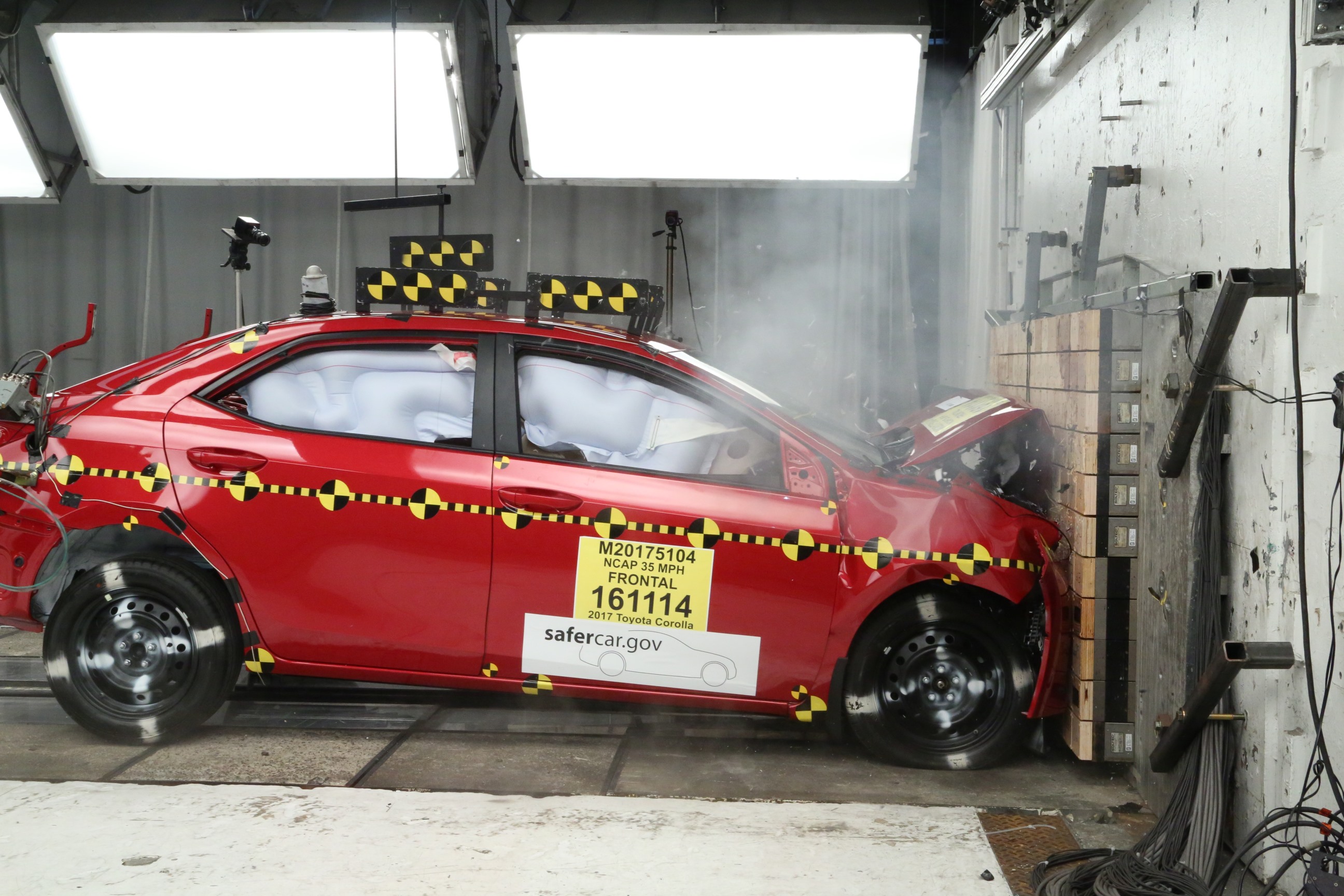
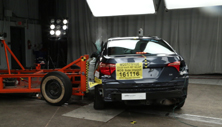
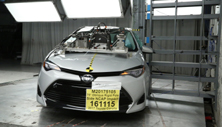
NHTSA crash tests
The agency crash-tested this model year itself. These are its own
photographs and star ratings.
Frontal crash test
Side barrier crash test
Side pole crash test
Photographs taken by NHTSA during its own New Car Assessment Program crash
tests of this model year. Public domain.
Configuration
Overall
Front
Side
Rollover
2019 Toyota Corolla 4 DR FWD
11.8% risk
2019 Toyota Corolla 5 HB FWD
10.4% risk
When owners complained
A spike years after the car went on sale usually means a part wearing
out on schedule across the whole fleet — the kind of pattern no single
owner can see from inside their own car.
Jan 2019peak 14Sep 2026
NHTSA investigations into the 2019 Toyota Corolla
An investigation is the step before a recall: the agency has seen enough
complaints to look into a pattern itself. An open one means it thinks
something may be wrong and nothing has been fixed yet.
EA19001Opened 19 Apr 2019Closed 19 Sep 2024AIR BAGS: AIR BAG/RESTRAINT CONTROL MODULE
Electrical overstress
The Office of Defects Investigation (ODI) opened this investigation to determine if the failure of airbags to deploy during severe crashes, in certain vehicles, was the result of a safety related defect. During the investigation a complex failure was studied that can result in non-deployment of subject vehicle air bags and other restraint system devices in severe crash events. The subject vehicles may be equipped with an airbag control unit (ACU) for the supplemental restraint system (SRS) Electronic Control Unit (ECU) manufactured by ZF-TRW. The ECU receives signals from crash sensors mount...
Recalls on the 2019 Toyota Corolla
A complaint is one owner's allegation. A recall is the point at which
the manufacturer or a regulator agreed the defect is real and dangerous
enough to fix for free — however old the car is.
United States — NHTSA
20V024000
AIR BAGS: AIR BAG/RESTRAINT CONTROL MODULE
Toyota Motor Engineering & Manufacturing (Toyota) is recalling certain 2011-2019 Corolla, 2011-2013 Matrix, 2012-2018 Avalon, and 2013-2018 Avalon Hybrid vehicles. During certain crashes, the air bag electronic control unit (ECU) may malfunction, possibly disabling the deployment of the air bags and/or seat belt pretensioners.
Risk: In the event of a crash, air bags and/or seat belt pretensioners that do not deploy as intended may increase the risk of injury.
20V012000
FUEL SYSTEM, GASOLINE:DELIVERY:FUEL PUMP
Toyota Motor Engineering & Manufacturing (Toyota) recalled certain 2018-2019 4Runner, Highlander, Camry, Land Cruiser, Sequoia, Sienna, Tacoma and Tundra, and Lexus RC 300, RC 350, GS 350, GX 460, IS 300, LC 500, LS 500, LX 570, RX 350L, and 2019 Toyota Avalon and Corolla, and certain Lexus NX 300, and ES 350 vehicles on January 13, 2020. On March 4, 2020, Toyota expanded the recall to include certain 2014-2015 Toyota 4Runner and Land Cruiser, 2018 Avalon, Corolla, 2014 FJ Cruiser, 2017 Sienna and Lexus 2018 ES 350, 2018-2019 GS 300, 2013-2014 GS350, 2014-2015 GX 460, IS 350 and LX 570, 2014 IS F, 2018-2019 IS 350, LC 500H and LS 500H, 2013-2015 LS 460, 2015 NX 200T and RC350, 2017 RC 200T and RX 350. Toyota also removed the 2018-2019 Toyota 4Runner and Land Cruiser and 2018-2019 Lexus GX 460 and LX 570 and 2019 NX300 from inclusion in this recall. On March 19, 2020, Toyota expanded the recall to include 2015 Lexus GS350 vehicles. The low-pressure fuel pump inside the fuel tank may fail.
Risk: If the fuel pump fails, the engine can stall while driving, increasing the risk of a crash.
19V503000
EQUIPMENT:OTHER:LABELS
Southeast Toyota Distributors, LLC (SET) is recalling certain 2017-2019 Toyota Camry, Corolla, Rav4, Sienna, and Yaris iA vehicles equipped with factory-installed floor mats. The load carrying capacity modification label may be incorrect. As such, these vehicles fail to comply with the requirements of Federal Motor Vehicle Safety Standard (FMVSS) number 110, "Tire Selection and Rims."
Risk: An incorrect label may lead to unintentionally overloading the vehicle, increasing the risk of a crash.
19V244000
EQUIPMENT:OTHER:LABELS
Gulf States Toyota (GST) is recalling certain 2019 C-HR, 4Runner, Avalon, Avalon Hybrid, Camry, Camry Hybrid, Highlander, Land Cruiser, Prius, RAV4, Sequoia, Tacoma, Sienna, Tundra and Yaris vehicles. The text on the load capacity label may become illegible. As such, these vehicles fail to comply with the requirements of Federal Motor Vehicle Safety Standard (FMVSS) number 110, "Tire Selection and Rims."
Risk: If the driver cannot read the label, they may unknowingly overload the vehicle, increasing the risk of a crash.
18V901000
POWER TRAIN:AUTOMATIC TRANSMISSION:TORQUE CONVERTER
Toyota Motor Engineering & Manufacturing (Toyota) is recalling certain 2019 Toyota Corolla hatchback vehicles equipped with Continuously Variable Transmissions (CVT). The pump impeller blades within the torque converter may detach, especially when driven under high load, potentially causing a vehicle stall.
Risk: A vehicle stall, especially when driving a high rate of speed, can increase the risk of a crash.
Canada — Transport Canada
Canada runs its own recall programme, and its campaigns do not
always mirror the American ones.
Recall 2020514126,597 units in Canada
Fuel System
Issue: On certain vehicles, the low-pressure fuel pump could fail. If this happens, then engine may run rough or may not start and the check engine light may turn on. This could also result in a sudden loss of engine power while driving. Note: This recall is an expansion of recalls SRC R95/SRC R96 and SRC RA2/SRC RA3 (Transport Canada Recall Numbers 2020-005 and 2020-088). Safety Risk: A sudden loss of engine power could increase the risk of a crash. Corrective Actions: The company will notify owners by mail and instruct you to take your vehicle to a dealer to replace the fuel pump.
Recall 2020088111,835 units in Canada
Fuel System
Issue: On certain vehicles, the low-pressure fuel pump could fail. If this happens, then engine may run rough or may not start and the check engine light may turn on. This could also result in a sudden loss of engine power while driving. Note: This recall is an expansion of recall SRC R95/SRC R96 (Transport Canada Recall No. 2020-005) Safety Risk: A sudden loss of engine power could increase the risk of a crash. Corrective Actions: The company will notify owners by mail and instruct you to take your vehicle to a dealer to replace the fuel pump.
Recall 2020013407,318 units in Canada
Airbag
Issue: On certain vehicles, the circuits within the airbag control module could be damaged in a crash. This could cause the airbags and seat belt pretensioners to not deploy in certain crashes. Safety Risk: Airbags or seat belts that do not work properly in a crash could create an increased risk of injury. Corrective Actions: Toyota will notify owners by mail and instruct you to take your vehicle to a dealer to install an electrical noise filter to prevent damage to the airbag control module.
Recall 202000546,733 units in Canada
Fuel System
Issue: On certain vehicles, the low-pressure fuel pump could fail. If this happens, then engine may run rough or may not start and the check engine light may turn on. This could also result in a sudden loss of engine power while driving. Safety Risk: A sudden loss of engine power could increase the risk of a crash. Corrective Actions: The company will notify owners by mail and instruct you to take your vehicle to a dealer to replace the fuel pump.
Recall 2018712973 units in Canada
Powertrain
On certain Corolla hatchback models, the torque converter for the Continuously Variable Transmission (CVT) may have not been properly assembled. If the vehicle were operated frequently under higher load conditions, such as under rapid acceleration from a low speed, the torque converter could fail. This may result in a loss of motive power, and create an increased the risk of a crash causing injury and/or damage to property. Correction: Dealers will replace the transmission and torque converter.
Reports where the owner recorded a crash, a fire, an injury or a death.
Deland, FLCrash
AIR BAGS
I was driving on a two lane state road. Two vehicles we traveling in front of me in the left lane. The further vehicle in left decide to make a sudden stop at a traffic light. The silver sedan behind that vehicle was traveling too close to react appropriately. The sedan avoid the vehicle in front of it and impeded into my lane and collide with my vehicle. My airbags in my 2019 Corolla failed to deploy.
NHTSA complaint #11735650 — an unverified report by a vehicle owner.
Palm Springs, FLFire
SEATS
While the vehicle was parked and powered off, a fire originated inside the driver seat area. There was no collision, no aftermarket electrical equipment installed, and no heated seat or accessory usage at the time of the incident. The vehicle was stationary when the fire began. The fire damage was concentrated within the driver seat assembly, consistent with a suspected electrical failure involving seat wiring, seat-mounted components, or associated harnesses. This is not consistent with owner misuse or external ignition sources. The insurer (Allstate Insurance Company) declared the vehicle a total loss but declined further fire-origin or electrical defect investigation. The vehicle is at risk of being sold or dismantled through a salvage auction, which would destroy critical evidence related to a potential manufacturer defect. The vehicle is currently listed on Copart (Lot# 99091095 highlighted as ‘Run and Drive’) I have completed a Power of Attorney (HSMV 82053) per Allstate requirement, along with a limited conditions notification for evidence preservation however Allstate is refusing to accept the conditions stating their intent to sell it as salvage. This incident presents a serious safety concern involving spontaneous ignition within the passenger compartment. Similar failures pose a risk of injury, death, or property damage, particularly if ignition occurs while occupied. I am requesting that NHTSA review this incident for potential electrical system or seat assembly defects and preserve this complaint as part of any pattern or trend analysis involving Toyota vehicles.
NHTSA complaint #11708439 — an unverified report by a vehicle owner.
Palm Springs, FLFire
SEAT BELTS
While the vehicle was parked and powered off, a fire originated inside the driver seat area. There was no collision, no aftermarket electrical equipment installed, and no heated seat or accessory usage at the time of the incident. The vehicle was stationary when the fire began. The fire damage was concentrated within the driver seat assembly, consistent with a suspected electrical failure involving seat wiring, seat-mounted components, or associated harnesses. This is not consistent with owner misuse or external ignition sources. The insurer (Allstate Insurance Company) declared the vehicle a total loss but declined further fire-origin or electrical defect investigation. The vehicle is at risk of being sold or dismantled through a salvage auction, which would destroy critical evidence related to a potential manufacturer defect. The vehicle is currently listed on Copart (Lot# 99091095 highlighted as ‘Run and Drive’) I have completed a Power of Attorney (HSMV 82053) per Allstate requirement, along with a limited conditions notification for evidence preservation however Allstate is refusing to accept the conditions stating their intent to sell it as salvage. This incident presents a serious safety concern involving spontaneous ignition within the passenger compartment. Similar failures pose a risk of injury, death, or property damage, particularly if ignition occurs while occupied. I am requesting that NHTSA review this incident for potential electrical system or seat assembly defects and preserve this complaint as part of any pattern or trend analysis involving Toyota vehicles.
NHTSA complaint #11708439 — an unverified report by a vehicle owner.
Palm Springs, FLFire
ELECTRICAL SYSTEM
While the vehicle was parked and powered off, a fire originated inside the driver seat area. There was no collision, no aftermarket electrical equipment installed, and no heated seat or accessory usage at the time of the incident. The vehicle was stationary when the fire began. The fire damage was concentrated within the driver seat assembly, consistent with a suspected electrical failure involving seat wiring, seat-mounted components, or associated harnesses. This is not consistent with owner misuse or external ignition sources. The insurer (Allstate Insurance Company) declared the vehicle a total loss but declined further fire-origin or electrical defect investigation. The vehicle is at risk of being sold or dismantled through a salvage auction, which would destroy critical evidence related to a potential manufacturer defect. The vehicle is currently listed on Copart (Lot# 99091095 highlighted as ‘Run and Drive’) I have completed a Power of Attorney (HSMV 82053) per Allstate requirement, along with a limited conditions notification for evidence preservation however Allstate is refusing to accept the conditions stating their intent to sell it as salvage. This incident presents a serious safety concern involving spontaneous ignition within the passenger compartment. Similar failures pose a risk of injury, death, or property damage, particularly if ignition occurs while occupied. I am requesting that NHTSA review this incident for potential electrical system or seat assembly defects and preserve this complaint as part of any pattern or trend analysis involving Toyota vehicles.
NHTSA complaint #11708439 — an unverified report by a vehicle owner.
Redding, CACrash1 killed
SEAT BELTS
Vehicle was involved in a fatal head-on collision. Upon inspection of the driver restraint system, the driver restraint webbing was torn. The airbags and pretensioners deployed in the collision. The maximum recorded longitudinal delta-v was -41.4 miles per hour (with recorded clipping).
NHTSA complaint #11693190 — an unverified report by a vehicle owner.
Sherman, TXCrash
STEERING
I hit a deer going roughly 65mph on my way to work. The hit crushed the radiator into the engine, destroyed the airbox, folded the hood, and practically vaporized the headlight. The airbag, however, did not deploy- not in the wheel or in the side curtain. I wasn't injured but thought it was strange the because the crash totalled the car (~$16k of damage) and was at a high speed. The car had one accident prior, hitting a concrete pillar at a low speed (less than 10mph) and had been repaired two years earlier. I kept every maintainence record for the car and never had any airbag lights on or service done. Because the airbags didn't deploy, the car didn't initiate the Safety Connect call to 911 or anyone else. I recently saw Toyota settled with many owners of 2019 Corolla sedans but the hatch wasn't included, but I have (anecdotally) heard of similar stories from other hatch owners. I now own a 2023 Corolla hatch and feel a bit concerned the same issue could present.
NHTSA complaint #11687461 — an unverified report by a vehicle owner.
The most recent complaints
In the owners' own words, exactly as filed with NHTSA.
Shelton, WA
POWER TRAIN
Slave cylinder on clutch failed and leaked fluid in to clutch and flywheel. Clutch pedal would not rebound after being pressed in to shift gear, stuck in middle of road trying to get vehicle in first gear. Had vehicle towed to dealership, estimate of $5800 to repair. Apparently this is a known problem with this manual transmission, many others have experienced similar failure at around 60,000 miles.
NHTSA complaint #11763432 — an unverified report by a vehicle owner.
Odometer Fraud. The contact purchased a 2019 Toyota Corolla. The contact stated that while attempting to register the vehicle, it was discovered that there was a mileage discrepancy. The vehicle was a dealer sale. At the time of purchase, the vehicle mileage was 45,709, and at the time of registration, it was discovered that the mileage listed on the title was 46,091. Additionally, the contact later became aware that the vehicle was a salvaged vehicle. The seller was contacted several times but blocked all communications.
NHTSA complaint #11754726 — an unverified report by a vehicle owner.
at 75,000 milesSanta Ana, CA
ELECTRICAL SYSTEM
The contact owns a 2019 Toyota Corolla. The contact stated that while driving at an undisclosed speed, the low tire pressure warning light illuminated, with several other unknown warning lights illuminated. The vehicle was taken to an independent mechanic to be diagnosed. However, the independent mechanic stated that the tire pressures were not low, and that the cause of the failure was not determined. The vehicle was not repaired. The manufacturer was not notified of the failure. The failure mileage was approximately 75,000.
NHTSA complaint #11744710 — an unverified report by a vehicle owner.
at 75,000 milesSanta Ana, CA
TIRES:PRESSURE MONITORING AND REGULATING SYSTEMS
The contact owns a 2019 Toyota Corolla. The contact stated that while driving at an undisclosed speed, the low tire pressure warning light illuminated, with several other unknown warning lights illuminated. The vehicle was taken to an independent mechanic to be diagnosed. However, the independent mechanic stated that the tire pressures were not low, and that the cause of the failure was not determined. The vehicle was not repaired. The manufacturer was not notified of the failure. The failure mileage was approximately 75,000.
NHTSA complaint #11744710 — an unverified report by a vehicle owner.
Deland, FLCrash
AIR BAGS
I was driving on a two lane state road. Two vehicles we traveling in front of me in the left lane. The further vehicle in left decide to make a sudden stop at a traffic light. The silver sedan behind that vehicle was traveling too close to react appropriately. The sedan avoid the vehicle in front of it and impeded into my lane and collide with my vehicle. My airbags in my 2019 Corolla failed to deploy.
NHTSA complaint #11735650 — an unverified report by a vehicle owner.
Warrensburg, MO
POWER TRAIN
Premature slave cylinder failure at ~70k miles. Suddenly started leaking brake fluid profusely. Inspected and confirmed by Toyota dealership. No symptoms prior to failure. Clutch stopped functioning, unable to shift while driving. Pulled over to inspect and all of the brake fluid had leaked out. Refilled brake fluid and bled system, reservoir leaked to minimum fill line within 24 hours.
NHTSA complaint #11730580 — an unverified report by a vehicle owner.
Beaver Falls, PA
POWER TRAIN
DESCRIPTION OF SAFETY ISSUE: The Concentric Slave Cylinder (CSC) on my 2019 Toyota Corolla Hatchback 6-speed manual failed during normal driving at around 60mph, creating an immediate and uncontrolled safety hazard. The clutch pedal depressed fully to the floor while I was shifting from 5th gear to 6th gear and the vehicle became unable to be shifted out of gear, leaving me unable to properly control vehicle speed or movement. The only way to release the transmission was to physically reach down and lift the clutch pedal up with my foot while attempting to drive. CRITICAL SAFETY CONCERN - SHARED BRAKE AND CLUTCH FLUID RESERVOIR: On this vehicle, the brake fluid reservoir and clutch hydraulic system share a single reservoir. When the CSC fails and leaks fluid, brake fluid is consumed directly from the same reservoir that supplies the braking system. A CSC failure does not only result in loss of clutch function — it results in loss of brake fluid, and with sufficient fluid loss, partial or complete brake failure. This is not a theoretical risk. This vehicle can fail in a way that simultaneously removes the driver's ability to control vehicle speed via the transmission AND reduces or eliminates braking capability — both at the same time, without warning I am requesting that NHTSA investigate this as a safety defect and consider whether a recall or service campaign is warranted given the risk of simultaneous clutch and brake failure on these vehicles.
NHTSA complaint #11729790 — an unverified report by a vehicle owner.
Jersey City, NJ
POWER TRAIN
6 speed manual transmission. 79K miles. Vehicle was checked at a dealer due to a sluggish clutch. Dealer found low brake fluid, but no problems with the clutch. The next day the clutch failed completely and car had to be towed off the highway. Slave cylinder for the clutch is a design flaw on these vehicles.
NHTSA complaint #11728777 — an unverified report by a vehicle owner.
Bethel Park, PA
POWER TRAIN
Clutch release bearing/slave cylinder failed at 29,900 miles. Without warning or unusual symptoms, clutch pedal stuck to floor and was unable to shift gears without manually pulling clutch pedal up.
NHTSA complaint #11727668 — an unverified report by a vehicle owner.
Brush Prairie, WA
POWER TRAIN
The clutch slave cylinder in my 2019 Toyota Corolla Hatchback failed, causing brake fluid to leak out. The leaking fluid contaminated the clutch assembly, resulting in both the slave cylinder and clutch needing replacement. The failed components should be available for inspection from the repair facility upon request. The failure led to a loss of proper clutch operation, which made it difficult to shift gears and control the vehicle. This created a risk of stalling in traffic or being unable to accelerate when needed, increasing the potential for a collision, especially in busy or high-speed driving conditions. Yes, the issue was diagnosed and confirmed by the dealership. They identified the failed slave cylinder and verified that brake fluid leakage caused contamination of the clutch, requiring replacement of both components. The vehicle has been inspected by a service technician/mechanic at the Toyota dealership. Prior to the failure, there were no warning lights or dashboard messages indicating a problem. The issue appeared suddenly when the clutch began to malfunction due to the fluid leak causing me to not be able to shift gears and the clutch pedal not returning.
NHTSA complaint #11727599 — an unverified report by a vehicle owner.
Newbury, VT
UNKNOWN OR OTHER
Error message that said 'drive start control malfunction. Took 6 mos and numerous attempts to resolve. Replaced numerous parts including the fuel pump because the plastic it's made out of was just disintegrating and and cracking. This has cost thousands of dollars in parts and labor. Also getting a msg on info screen 'connected device not supported' now. Apparently toyota did an update and there was a bug in the program yet I have to pay to fix their error to the dcm.
NHTSA complaint #11724036 — an unverified report by a vehicle owner.
Newbury, VT
ENGINE
Error message that said 'drive start control malfunction. Took 6 mos and numerous attempts to resolve. Replaced numerous parts including the fuel pump because the plastic it's made out of was just disintegrating and and cracking. This has cost thousands of dollars in parts and labor. Also getting a msg on info screen 'connected device not supported' now. Apparently toyota did an update and there was a bug in the program yet I have to pay to fix their error to the dcm.
NHTSA complaint #11724036 — an unverified report by a vehicle owner.
Newbury, VT
FUEL/PROPULSION SYSTEM
Error message that said 'drive start control malfunction. Took 6 mos and numerous attempts to resolve. Replaced numerous parts including the fuel pump because the plastic it's made out of was just disintegrating and and cracking. This has cost thousands of dollars in parts and labor. Also getting a msg on info screen 'connected device not supported' now. Apparently toyota did an update and there was a bug in the program yet I have to pay to fix their error to the dcm.
NHTSA complaint #11724036 — an unverified report by a vehicle owner.
Rancho Cucamonga, CA
POWER TRAIN
2019 Toyota Corolla hatchback. Complete transmission failure.
NHTSA complaint #11722973 — an unverified report by a vehicle owner.
Bullsgap, TN
UNKNOWN OR OTHER
The slave cylinder failed l3aving me stranded in a parking lot. Luckily I wasnt driving down the highway as the slave cylinder is also part of the brake system they use the shared brake fluid reservoir. This is a very common problem and is a 4k plus cost to fix. Not including the time that has to go into fighting the warranty companies and dealers.
NHTSA complaint #11721047 — an unverified report by a vehicle owner.
Bullsgap, TN
ENGINE
The slave cylinder failed l3aving me stranded in a parking lot. Luckily I wasnt driving down the highway as the slave cylinder is also part of the brake system they use the shared brake fluid reservoir. This is a very common problem and is a 4k plus cost to fix. Not including the time that has to go into fighting the warranty companies and dealers.
NHTSA complaint #11721047 — an unverified report by a vehicle owner.
at 1,488 milesLynn, MA
STEERING
The contact owns a 2019 Toyota Corolla. The contact stated that while driving at various speeds, the steering wheel became difficult to turn in either direction. The hazard, power steering, and LDA warning lights were illuminated. The message "Lane Departure Alert Malfunction - Visit your Dealer" was displayed. The contact stated that when the LDA was deactivated, a red power steering warning light was intermittently illuminated. The vehicle was taken to a local dealer, where a battery replacement was performed. The vehicle was repaired; however, the failure reoccurred. The vehicle was taken back to the same local dealer; however, the vehicle was not diagnosed or repaired due to the cost. The vehicle was towed to a local independent mechanic, where it remained for further investigation. The manufacturer was not made aware of the failure. The failure mileage was approximately 1,488.
NHTSA complaint #11714135 — an unverified report by a vehicle owner.
Palm Springs, FLFire
SEATS
While the vehicle was parked and powered off, a fire originated inside the driver seat area. There was no collision, no aftermarket electrical equipment installed, and no heated seat or accessory usage at the time of the incident. The vehicle was stationary when the fire began. The fire damage was concentrated within the driver seat assembly, consistent with a suspected electrical failure involving seat wiring, seat-mounted components, or associated harnesses. This is not consistent with owner misuse or external ignition sources. The insurer (Allstate Insurance Company) declared the vehicle a total loss but declined further fire-origin or electrical defect investigation. The vehicle is at risk of being sold or dismantled through a salvage auction, which would destroy critical evidence related to a potential manufacturer defect. The vehicle is currently listed on Copart (Lot# 99091095 highlighted as ‘Run and Drive’) I have completed a Power of Attorney (HSMV 82053) per Allstate requirement, along with a limited conditions notification for evidence preservation however Allstate is refusing to accept the conditions stating their intent to sell it as salvage. This incident presents a serious safety concern involving spontaneous ignition within the passenger compartment. Similar failures pose a risk of injury, death, or property damage, particularly if ignition occurs while occupied. I am requesting that NHTSA review this incident for potential electrical system or seat assembly defects and preserve this complaint as part of any pattern or trend analysis involving Toyota vehicles.
NHTSA complaint #11708439 — an unverified report by a vehicle owner.
Palm Springs, FLFire
SEAT BELTS
While the vehicle was parked and powered off, a fire originated inside the driver seat area. There was no collision, no aftermarket electrical equipment installed, and no heated seat or accessory usage at the time of the incident. The vehicle was stationary when the fire began. The fire damage was concentrated within the driver seat assembly, consistent with a suspected electrical failure involving seat wiring, seat-mounted components, or associated harnesses. This is not consistent with owner misuse or external ignition sources. The insurer (Allstate Insurance Company) declared the vehicle a total loss but declined further fire-origin or electrical defect investigation. The vehicle is at risk of being sold or dismantled through a salvage auction, which would destroy critical evidence related to a potential manufacturer defect. The vehicle is currently listed on Copart (Lot# 99091095 highlighted as ‘Run and Drive’) I have completed a Power of Attorney (HSMV 82053) per Allstate requirement, along with a limited conditions notification for evidence preservation however Allstate is refusing to accept the conditions stating their intent to sell it as salvage. This incident presents a serious safety concern involving spontaneous ignition within the passenger compartment. Similar failures pose a risk of injury, death, or property damage, particularly if ignition occurs while occupied. I am requesting that NHTSA review this incident for potential electrical system or seat assembly defects and preserve this complaint as part of any pattern or trend analysis involving Toyota vehicles.
NHTSA complaint #11708439 — an unverified report by a vehicle owner.
Palm Springs, FLFire
ELECTRICAL SYSTEM
While the vehicle was parked and powered off, a fire originated inside the driver seat area. There was no collision, no aftermarket electrical equipment installed, and no heated seat or accessory usage at the time of the incident. The vehicle was stationary when the fire began. The fire damage was concentrated within the driver seat assembly, consistent with a suspected electrical failure involving seat wiring, seat-mounted components, or associated harnesses. This is not consistent with owner misuse or external ignition sources. The insurer (Allstate Insurance Company) declared the vehicle a total loss but declined further fire-origin or electrical defect investigation. The vehicle is at risk of being sold or dismantled through a salvage auction, which would destroy critical evidence related to a potential manufacturer defect. The vehicle is currently listed on Copart (Lot# 99091095 highlighted as ‘Run and Drive’) I have completed a Power of Attorney (HSMV 82053) per Allstate requirement, along with a limited conditions notification for evidence preservation however Allstate is refusing to accept the conditions stating their intent to sell it as salvage. This incident presents a serious safety concern involving spontaneous ignition within the passenger compartment. Similar failures pose a risk of injury, death, or property damage, particularly if ignition occurs while occupied. I am requesting that NHTSA review this incident for potential electrical system or seat assembly defects and preserve this complaint as part of any pattern or trend analysis involving Toyota vehicles.
NHTSA complaint #11708439 — an unverified report by a vehicle owner.
Dallas, TX
POWER TRAIN
Clutch stopped working while driving. Car has 61,000 miles.
NHTSA complaint #11707251 — an unverified report by a vehicle owner.
Rio Rancho, NM
POWER TRAIN
My 2019 hatchback clutch failed Clutch Release Bearing and Slave Cylinder Assembly is leaking. Toyota part # 31400-19027
NHTSA complaint #11701613 — an unverified report by a vehicle owner.
Rio Rancho, NM
UNKNOWN OR OTHER
My 2019 hatchback clutch failed Clutch Release Bearing and Slave Cylinder Assembly is leaking. Toyota part # 31400-19027
NHTSA complaint #11701613 — an unverified report by a vehicle owner.
Akron, OH
POWER TRAIN
rattle in transmission. Car hesitates to accelerate randomly leading to unpredictable acceleration sometimes. Transmission is failing.
NHTSA complaint #11700673 — an unverified report by a vehicle owner.
Elmwood Park, IL
POWER TRAIN
All 2019-2022 Toyota Corolla 6 Speed Manual Transmission cars are affected. The slave cylinder is a defective part that fails prematurely anywhere between the 20,000-70,000 mile range. The slave cylinder on this car is made out of plastic and is located inside of the transmission, when the slave cylinder fails, it leaks brake fluid all over causing the car to lock into gear and not be able to shift which is a major safety risk when there is no signs of failure. My car locked up in the middle of a busy highway and had to be pushed off the side of the road. Not only is this a safety risk, but since the part is located inside of the transmission, which is not normal, it leaks brake fluid all over the clutch and flywheel, which will all need replacement. The dealership quotes between 4-5 thousand dollars to repair, and is not covered under warranty. Toyota knows that this part is a defective part because the new models received an updated slave cylinder made out of metal, rather than plastic, but no cars have been recalled. The car was towed to my local dealership and it is currently being worked on. The incident was reported to Toyota Corporate and a case was opened to investigate this issue. Every single model made between those years are effected and has caused thousands of people to be left with an expensive repair that is unavoidable.
NHTSA complaint #11698600 — an unverified report by a vehicle owner.