Owners have filed 646 complaints
about the 2022 Toyota Tundra with NHTSA between 2022 and 2026.
The largest single group is the engine & cooling.
Across this model's run it ranks 5 of 27 worst.
The letter says how bad. This says what kind — whether this year drew
an unusual number of complaints, unusually dangerous
ones, or failures that arrived unusually early.
The dashed ring is 50 — the national norm. Further out is worse.
Complaint volume — 92
Against the median year of the Toyota Tundra. 50 means typical for this
model; 100 means roughly double.
Severity — 14
2.8% of these complaints
involved a crash, fire, injury or death, against a national rate of
9.7%.
Early failure — 95
56% of failures with a mileage on record happened under
36,000 miles, against a national rate of
29%.
NHTSA files every complaint against a named sub-assembly, not just a
system. This is the difference between knowing it was "the engine" and
knowing which part of it — the list to hand a mechanic.
Automatic Emergency Braking
1435.9%
Body
1025.6%
Warnings
512.8%
Warnings
37.7%
Warning
25.1%
Blind Spot Detection
25.1%
Tread/Belt
25.1%
Camera/Sensor
12.6%
When it fails
Odometer readings owners gave when they filed. About half of all
complaints include one.
Under 1,000 miles
11.6%
1,000 – 9,999 miles
1015.9%
10,000 – 24,999 miles
1727.0%
25,000 – 49,999 miles
2031.7%
50,000 – 74,999 miles
1219.0%
75,000 – 99,999 miles
34.8%
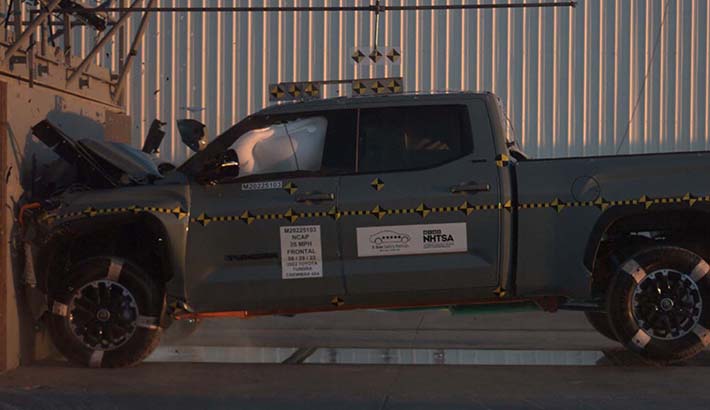
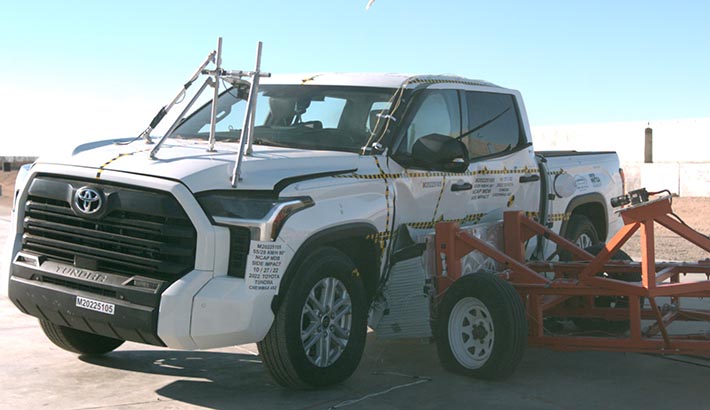
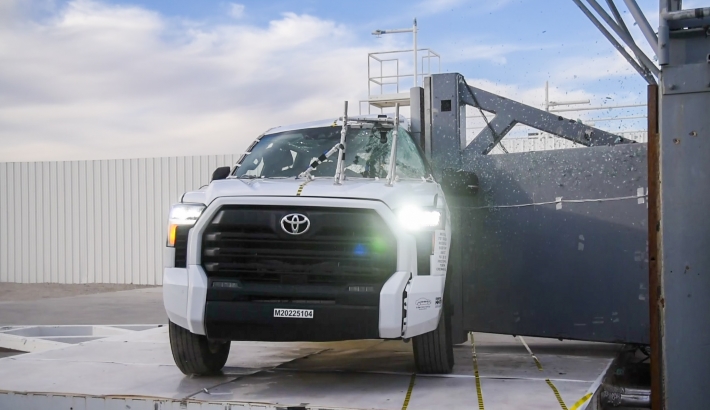
NHTSA crash tests
The agency crash-tested this model year itself. These are its own
photographs and star ratings.
Frontal crash test
Side barrier crash test
Side pole crash test
Photographs taken by NHTSA during its own New Car Assessment Program crash
tests of this model year. Public domain.
Configuration
Overall
Front
Side
Rollover
2022 Toyota TUNDRA PU/CC 4WD
18.5% risk
2022 Toyota TUNDRA PU/CC 2WD
—
—
2022 Toyota TUNDRA PU/EC 4WD
—
—
—
18.5% risk
2022 Toyota TUNDRA PU/EC 2WD
—
—
—
—
When owners complained
A spike years after the car went on sale usually means a part wearing
out on schedule across the whole fleet — the kind of pattern no single
owner can see from inside their own car.
Jan 2022peak 51Sep 2026
Recalls on the 2022 Toyota Tundra
A complaint is one owner's allegation. A recall is the point at which
the manufacturer or a regulator agreed the defect is real and dangerous
enough to fix for free — however old the car is.
United States — NHTSA
25V767000
ENGINE AND ENGINE COOLING:ENGINE:HARD PARTS INTERNAL/MECHANICAL
Toyota Motor Engineering & Manufacturing (Toyota) is recalling certain 2022-2024 Toyota Tundra, Lexus LX, and 2024 Lexus GX vehicles equipped with a V35A engine. Debris from the manufacturing process may contaminate the engine and cause the main bearings to fail, which can result in an engine stall and loss of drive power.
Risk: A loss of drive power increases the risk of a crash.
25V657000
BACK OVER PREVENTION:SOFTWARE
Toyota Motor Engineering & Manufacturing (Toyota) is recalling certain 2022-2025 Tundra, Tundra Hybrid, and 2023-2025 Sequoia Hybrid vehicles. A software error may cause the rearview image not to display when the vehicle is placed in reverse. As such, these vehicles fail to comply with the requirements of Federal Motor Vehicle Safety Standard (FMVSS) number 111, "Rear Visibility."
Risk: A rearview image that does not display reduces the driver's view behind the vehicle, increasing the risk of a crash.
25V322000
EXTERIOR LIGHTING:BACK UP LIGHTS
Toyota Motor Engineering & Manufacturing (Toyota) is recalling certain 2022-2025 Toyota Tundra and Tundra Hybrid vehicles. Moisture may enter the reverse light assemblies and cause a light failure.
Risk: Reverse light failure may reduce visibility, and not alert pedestrians and other drivers that the vehicle is backing up, increasing the risk of a crash.
24V381000
ENGINE AND ENGINE COOLING:ENGINE:HARD PARTS INTERNAL/MECHANICAL
Toyota Motor Engineering & Manufacturing (Toyota) is recalling certain 2022-2023 Tundra and Lexus LX600 vehicles equipped with a V35A engine. Debris from the manufacturing process may contaminate the engine and cause the main bearings to fail, which can result in an engine stall and loss of drive power.
Risk: A loss of drive power increases the risk of a crash.
24V125000
POWER TRAIN:AUTOMATIC TRANSMISSION
Toyota Motor Engineering & Manufacturing (Toyota) is recalling certain 2022-2024 Tundra, Tundra Hybrid, Lexus LX600, and 2023-2024 Sequoia Hybrid vehicles. Unexpected vehicle movement may occur when the vehicle is in neutral and the brakes are not applied.
Risk: Unexpected vehicle movement can increase the risk of a crash.
23V757000
EQUIPMENT:OTHER:LABELS
Southeast Toyota Distributors, LLC (SET) is recalling certain 2022-2024 Toyota Tundra vehicles. The load carrying capacity modification label states the incorrect load carrying capacity, which can result in an overloaded vehicle. As such, these vehicles fail to comply with the requirements of Federal Motor Vehicle Safety Standard number 110, "Tire Selection and Rims."
Risk: An overloaded vehicle increases the risk of a crash.
23V566000
FUEL SYSTEM, GASOLINE:DELIVERY:HOSES, LINES/PIPING, AND FITTINGS
Toyota Motor Engineering & Manufacturing (Toyota) is recalling certain 2022-2023 Tundra and Tundra Hybrid vehicles. The plastic fuel tube routed near metallic brake lines may chafe against the brake lines and become damaged, possibly resulting in a fuel leak.
Risk: A fuel leak in the presence of an ignition source can increase the risk of a fire.
23V142000
STRUCTURE:BODY
Toyota Motor Engineering & Manufacturing (Toyota) is recalling certain 2022-2023 Tundra and Tundra Hybrid vehicles that may be equipped with a Toyota genuine accessory tonneau cover. The tonneau cover attachment joints may come loose and allow the cover to detach.
Risk: A tonneau cover that detaches while driving can become a road hazard, increasing the risk of a crash.
Canada — Transport Canada
Canada runs its own recall programme, and its campaigns do not
always mirror the American ones.
Recall 202552232,733 units in Canada
Visual System
Issue: Under certain conditions, a problem with the rearview camera could cause the rearview camera image not to display correctly or at all. Canadian regulations require the rearview image to display when the vehicle is reversing. Note: This recall only affects vehicles equipped with a 14-inch multimedia display. For the Tundra model, this recall affects both Tundra and Tundra hybrid models. Safety Risk: A rearview camera image that doesn't display correctly could reduce a driver's ability to see behind the vehicle while backing up. This could increase the risk of a crash. Corrective Actions: Toyota will notify owners in writing and advise you to take your vehicle to a dealership to update the multimedia display software.
Recall 202526345,684 units in Canada
Lights And Instruments
Issue: On certain trucks, the reverse lamp assemblies may not be sealed correctly. As a result, over time, water could leak into the lamp(s) and cause them not to work. Note: This recall affects both Tundra and Tundra Hybrid models. Safety Risk: Reverse lamps that don't work could cause others not to recognize when a vehicle is backing up, and increase the risk of a crash. Corrective Actions: Toyota will notify owners by mail and advise you to take your truck to a dealership to inspect and, if necessary, replace both reverse lamp assemblies. Additionally, the dealer will inspect and, if necessary, repair the wiring for the reverse lamps.
Recall 20243049,979 units in Canada
Engine
Issue: On certain vehicles, the engine may not have been manufactured properly. As a result, metal debris could cause the crankshaft bearings to fail. If this happens, the engine may run rough or may not start. This could also cause the engine to stall while driving. Note: This recall only affects certain vehicles equipped with a 3.4L twin-turbo engine. Safety Risk: A sudden loss of power to the wheels could increase the risk of a crash. Corrective Actions: The company will notify owners by mail and advise you to take your vehicle to a dealership to replace the engine.
Recall 202410928,061 units in Canada
Powertrain
Issue: On certain vehicles, a problem with the transmission could cause the vehicle to move forward when the driver shifts to the ''N''(Neutral) position and the brakes or parking brake aren't applied. Note: For the Tundra model, this recall affects both Tundra and Tundra Hybrid models. For the Sequoia model, only the Sequoia Hybrid model is affected by this recall. Safety Risk: A vehicle that moves suddenly could create the risk of an injury or a crash. Corrective Actions: The company will notify owners by mail and advise you to take your vehicle to a dealership to update the transmission control unit software.
Recall 202344517,299 units in Canada
Fuel System
Issue: On certain trucks, a plastic fuel tube on the top of the fuel tank may not be secured correctly. As a result, the fuel tube could be damaged by contact with the brake lines and create a fuel leak. Safety Risk: A fuel leak can create the risk of a fire. Corrective Actions: Toyota will notify owners by mail and advise you to take your truck to a dealership for an interim repair. Once replacement parts are available, you will need to return to the dealership to replace the fuel tube with an improved part and have additional clamps installed.
Recall 202311213,556 units in Canada
Accessories
Issue: On certain trucks, the bed-cover could come loose while driving and detach from the truck. Note: This recall affects Tundra and Tundra Hybrid models equipped with an optional Toyota genuine accessory tri-fold hard tonneau cover that was installed before delivery or sold as a dealer accessory. Safety Risk: A tonneau cover that separates from a moving vehicle could create a hazard for other drivers and nearby people. Corrective Actions: Toyota will notify owners by mail and advise you to remove the tonneau cover. The corrective actions for this recall are under development. Toyota will send you a second notice when a final repair is available.
Recall 2023084794 units in Canada
Visual System
Issue: On certain trucks, a software problem could cause the instrument cluster display to go blank while driving. As a result, you may not be able to see certain information about the vehicle, including the gauges, warnings, and malfunction tell-tale graphics. Note: This recall affects Tundra and Tundra Hybrid models. Safety Risk: Warnings and malfunction tell-tale information that do not display could increase the risk of a crash. Corrective Actions: Toyota will notify owners by mail and instruct you to take your vehicle to a dealership to update the combination meter electronic control unit software.
Recall 20224939,585 units in Canada
Brakes
Issue: On certain vehicles, a programming error could cause the parking brake system to malfunction. If this happens, a warning light will turn on and the message "Parking Brake Malfunction, Visit Your Dealer" will display. Also, you may not be able to apply the parking brake, and if the vehicle isn't in park, it could roll away. Safety Risk: A parked vehicle that moves unexpectedly could increase the risk of an injury or a crash. Corrective Actions: The company will notify owners by mail and instruct you to take your vehicle to a dealership to reprogram the skid control ECU.
Reports where the owner recorded a crash, a fire, an injury or a death.
Missoula, MTCrash
ELECTRICAL SYSTEM
I am 99% sure my vehicle is compromised via a cybersecurity incident. My emergency brake will sometimes slam for no reason, no multi media system updates have occurred for over two years, and the vehicle will randomly beep on its own, unlocking the doors. Another major issue is a recent electric harness failure that the mechanics have no idea how it happened. It cost me over 8,000. Warning lights also turn on for no apparent reason such as parking, sensors, and other traction control. I am extremely concerned with my safety. I also believe the odometer has been altered to register higher mileage.
NHTSA complaint #11758940 — an unverified report by a vehicle owner.
Missoula, MTCrash
ENGINE
I am 99% sure my vehicle is compromised via a cybersecurity incident. My emergency brake will sometimes slam for no reason, no multi media system updates have occurred for over two years, and the vehicle will randomly beep on its own, unlocking the doors. Another major issue is a recent electric harness failure that the mechanics have no idea how it happened. It cost me over 8,000. Warning lights also turn on for no apparent reason such as parking, sensors, and other traction control. I am extremely concerned with my safety. I also believe the odometer has been altered to register higher mileage.
NHTSA complaint #11758940 — an unverified report by a vehicle owner.
I am 99% sure my vehicle is compromised via a cybersecurity incident. My emergency brake will sometimes slam for no reason, no multi media system updates have occurred for over two years, and the vehicle will randomly beep on its own, unlocking the doors. Another major issue is a recent electric harness failure that the mechanics have no idea how it happened. It cost me over 8,000. Warning lights also turn on for no apparent reason such as parking, sensors, and other traction control. I am extremely concerned with my safety. I also believe the odometer has been altered to register higher mileage.
NHTSA complaint #11758940 — an unverified report by a vehicle owner.
Neenah, WICrash
POWER TRAIN
Attempted to shift out 4-wheel high back into 2-wheel drive. On the dashboard, both 4 wheel high and 4-wheel low were flashing yellow/orange. Put truck into park to clear, nothing continued to flash. Put truck into neutral, nothing continued to flash 4 high and 4 low. Turned the truck engine completely off and started again. Both 4 high and 4 low continued flashy. Put truck into drive, 4 low and 4 high now became a solid orange/yellow, no flashing. Drove truck a mile and a half down the road and lost complete control of the steering. Ended up in ditch with several thousand dollars of damage. Contacted dealer where purchased. Explained what happened to the Manager of Toyota service department. He claims it has happened on other Tundra's, says it happened on his truck. Offered no explanation or fix to the problem.
NHTSA complaint #11704042 — an unverified report by a vehicle owner.
Parkland, FL1 injured
FORWARD COLLISION AVOIDANCE: WARNINGS
LTA feature engaged out of nowhere and my dashboard lit up with red, green and yellow warnings all at once and made my truck swerve back and forth and prevented me from having any control and steered me directly into oncoming traffic almost causing me to have a head on collision. Also the brakes automatically come on out of nowhere for no reason and has almost given me whiplash. I just had major neck surgery with plates and screws put in my cervical spine and if this keeps happening I'm going to need another surgery.
NHTSA complaint #11621810 — an unverified report by a vehicle owner.
LTA feature engaged out of nowhere and my dashboard lit up with red, green and yellow warnings all at once and made my truck swerve back and forth and prevented me from having any control and steered me directly into oncoming traffic almost causing me to have a head on collision. Also the brakes automatically come on out of nowhere for no reason and has almost given me whiplash. I just had major neck surgery with plates and screws put in my cervical spine and if this keeps happening I'm going to need another surgery.
NHTSA complaint #11621810 — an unverified report by a vehicle owner.
The most recent complaints
In the owners' own words, exactly as filed with NHTSA.
Grand Junction, CO
POWER TRAIN
On September 1, 2026, my 2022 Toyota Tundra experienced a serious loss of accelerator response while I was leaving a gas station and entering traffic. I pressed the accelerator, but the truck provided effectively no acceleration, leaving me partially in the roadway. An approaching vehicle had to swerve into the opposing traffic lane to avoid a collision. I had experienced a similar low-speed loss of accelerator response within the prior two weeks. On September 2, while traveling on I-70 at approximately 70 mph, the truck experienced a separate loss-of-power event. Engine RPM dropped considerably and the vehicle felt as though it were coasting. I pressed the accelerator firmly, but it did not respond normally for approximately 5-10 seconds before power returned. Radar/adaptive cruise control was not engaged. I immediately took the truck to Western Slope Toyota. Technicians checked for codes, performed multiple road tests and recorded vehicle data but could not reproduce the intermittent failure. The issue was escalated to Toyota technical assistance under TAS Case 262460664. This problem has been documented by Western Slope Toyota since 2023. Toyota's applicable TSB repairs were performed on prior occasions in an attempt to correct the throttle/hesitation problem, but they did not resolve it. In 2025, the dealer again documented the condition after the earlier TSB had already been performed. According to the September 2026 repair documentation and my discussion with the Western Slope Toyota service manager, Toyota's specialist technical team is aware that the condition can remain despite the TSB work. The repair order states that Toyota identified a known hesitation concern that remains under investigation and that there was no repair to be made at that time. The condition is intermittent and unpredictable and can cause loss of accelerator response or motive power at low and highway speeds. I believe it creates a serious crash risk. Current mileage: 58,735.
NHTSA complaint #11763374 — an unverified report by a vehicle owner.
Grand Junction, CO
VEHICLE SPEED CONTROL
On September 1, 2026, my 2022 Toyota Tundra experienced a serious loss of accelerator response while I was leaving a gas station and entering traffic. I pressed the accelerator, but the truck provided effectively no acceleration, leaving me partially in the roadway. An approaching vehicle had to swerve into the opposing traffic lane to avoid a collision. I had experienced a similar low-speed loss of accelerator response within the prior two weeks. On September 2, while traveling on I-70 at approximately 70 mph, the truck experienced a separate loss-of-power event. Engine RPM dropped considerably and the vehicle felt as though it were coasting. I pressed the accelerator firmly, but it did not respond normally for approximately 5-10 seconds before power returned. Radar/adaptive cruise control was not engaged. I immediately took the truck to Western Slope Toyota. Technicians checked for codes, performed multiple road tests and recorded vehicle data but could not reproduce the intermittent failure. The issue was escalated to Toyota technical assistance under TAS Case 262460664. This problem has been documented by Western Slope Toyota since 2023. Toyota's applicable TSB repairs were performed on prior occasions in an attempt to correct the throttle/hesitation problem, but they did not resolve it. In 2025, the dealer again documented the condition after the earlier TSB had already been performed. According to the September 2026 repair documentation and my discussion with the Western Slope Toyota service manager, Toyota's specialist technical team is aware that the condition can remain despite the TSB work. The repair order states that Toyota identified a known hesitation concern that remains under investigation and that there was no repair to be made at that time. The condition is intermittent and unpredictable and can cause loss of accelerator response or motive power at low and highway speeds. I believe it creates a serious crash risk. Current mileage: 58,735.
NHTSA complaint #11763374 — an unverified report by a vehicle owner.
Grand Junction, CO
FUEL/PROPULSION SYSTEM
On September 1, 2026, my 2022 Toyota Tundra experienced a serious loss of accelerator response while I was leaving a gas station and entering traffic. I pressed the accelerator, but the truck provided effectively no acceleration, leaving me partially in the roadway. An approaching vehicle had to swerve into the opposing traffic lane to avoid a collision. I had experienced a similar low-speed loss of accelerator response within the prior two weeks. On September 2, while traveling on I-70 at approximately 70 mph, the truck experienced a separate loss-of-power event. Engine RPM dropped considerably and the vehicle felt as though it were coasting. I pressed the accelerator firmly, but it did not respond normally for approximately 5-10 seconds before power returned. Radar/adaptive cruise control was not engaged. I immediately took the truck to Western Slope Toyota. Technicians checked for codes, performed multiple road tests and recorded vehicle data but could not reproduce the intermittent failure. The issue was escalated to Toyota technical assistance under TAS Case 262460664. This problem has been documented by Western Slope Toyota since 2023. Toyota's applicable TSB repairs were performed on prior occasions in an attempt to correct the throttle/hesitation problem, but they did not resolve it. In 2025, the dealer again documented the condition after the earlier TSB had already been performed. According to the September 2026 repair documentation and my discussion with the Western Slope Toyota service manager, Toyota's specialist technical team is aware that the condition can remain despite the TSB work. The repair order states that Toyota identified a known hesitation concern that remains under investigation and that there was no repair to be made at that time. The condition is intermittent and unpredictable and can cause loss of accelerator response or motive power at low and highway speeds. I believe it creates a serious crash risk. Current mileage: 58,735.
NHTSA complaint #11763374 — an unverified report by a vehicle owner.
Idaho Falls, ID
ENGINE
This is a follow-up to my NHTSA complaint tracking #11742382, filed June 5, 2026, before my recall repair. I'm filing again because the repair is now complete and it has raised two new concerns: undocumented warranty coverage on the replacement engine, and an unresolved question about whether a second, broader recall applies to that replacement engine. 1. Recall repair completed. Under NHTSA Campaign 24V381000 (Toyota internal 24TA07, filed 2024-05-30), my original engine was replaced with a new OEM assembly (part 04004-23370, serial [XXX], 2026 manufacture date, incorporating the post-April-2024 revised bearing design) at Teton Toyota, Idaho Falls, ID, June 19 to 22, 2026 (repair order [XXX], mileage in/out 28,252/28,281). Toyota's own recall record states the replacement unit was inspected clean. I have no reason to doubt that specific finding; my concern is what happens after. 2. Replacement engine's warranty terms were left undocumented. The repair order lists the warranty "Policy Number" covering the new engine as TBD. As of this filing, Toyota National (1-800-331-4331) has not given me a written answer to a direct question: does the replacement engine carry a new 5-year/60,000-mile powertrain warranty starting from the June 22, 2026 install date, or only the remainder of my original factory warranty? A safety recall remedy that leaves the owner without documented knowledge of what protection they actually received is, in my view, an incomplete remedy under 49 CFR Part 573's recordkeeping and notification requirements. Owners should not have to chase this down themselves months after the repair. 3. A second, broader recall may or may not apply to my replacement engine, and Toyota has not said which. NHTSA Campaign 25V767000 (Toyota internal 25TA14, filed 2025-11-06) expands the same underlying defect population to additional 2022-2024 Tundra, Lexus LX, and 2024 Lexus GX vehicles, with a remedy of inspecting the #1 main bearing via inspection software and INFORMATION REDACTED PURSUANT TO THE FREEDOM OF I
NHTSA complaint #11762486 — an unverified report by a vehicle owner.
San Antonio, TX
ENGINE
REPEATED CATASTROPHIC ENGINE FAILURE / FAILED RECALL REMEDY. My 2022 Toyota Tundra suffered a complete engine seizure and sudden loss of motive power August 30, 2026, creating an immediate traffic hazard. This is the SECOND time this vehicle has experienced a catastrophic main bearing failure of its twin-turbo V6 engine. The original factory engine was replaced by an authorized Toyota dealership under Safety Recall 24V-381 / 24TA07 in March 2025. The defect should have been resolved. However, the replacement crate engine provided by Toyota carried the exact same engineering vulnerability as the original engine. It was manufactured prior to Toyota's mid-2026 engineering revision, which finally introduced a redesigned #1 main bearing to address localized crankshaft pressure stack-up (as noted in subsequent NHTSA filings like 26V-320).Furthermore, the previous engine replacement due to a federal safety recall was entirely withheld and not disclosed to me at the point of sale. Because Toyota replaced a recalled, defective engine with an identically flawed engine block, the initial recall remedy completely failed, leaving the vehicle dangerous and prone to repeated mechanical failure. The vehicle has driven approximately 16 months since the March 2025 replacement. I am demanding that Toyota provide a permanent remedy using the updated, structurally revised 2026 engine components. It is at the Toyota dealer.
NHTSA complaint #11762388 — an unverified report by a vehicle owner.
at 75,000 milesRuston, LA
ELECTRICAL SYSTEM
The contact's husband owns a 2022 Toyota Tundra. The contact stated that the key fob failed to unlock the front driver’s side door. Due to the failure, the contact was forced to lock the front driver’s side door manually after exiting the vehicle. The contact was forced to enter the vehicle through the front passenger’s side door and crawl over to the front driver side seat. The vehicle was taken to the dealer, and an estimate was provided for the repair. The vehicle was not repaired. The failure mileage was approximately 75,000.
NHTSA complaint #11761613 — an unverified report by a vehicle owner.
at 75,000 milesRuston, LA
LATCHES/LOCKS/LINKAGES
The contact's husband owns a 2022 Toyota Tundra. The contact stated that the key fob failed to unlock the front driver’s side door. Due to the failure, the contact was forced to lock the front driver’s side door manually after exiting the vehicle. The contact was forced to enter the vehicle through the front passenger’s side door and crawl over to the front driver side seat. The vehicle was taken to the dealer, and an estimate was provided for the repair. The vehicle was not repaired. The failure mileage was approximately 75,000.
NHTSA complaint #11761613 — an unverified report by a vehicle owner.
San Antonio, TX
ENGINE
I am filing this complaint regarding my Toyota Tundra and Toyota Safety Recall 24TA07. My vehicle was previously affected by this engine recall, and Toyota replaced the engine as the recall remedy. The replacement engine has now failed with the same or substantially similar engine issue that resulted in the original recall and engine replacement. I am very concerned that a replacement engine installed as the remedy for a safety recall has experienced the same type of failure. This vehicle has now experienced engine failure involving two separate engines: the original recalled engine and the replacement engine installed by Toyota under Recall 24TA07. The Vehicle is at the Toyota dealer. I am requesting that NHTSA investigate whether replacement engines being installed under this recall may also be susceptible to the same or a similar defect. I would also like this complaint documented because I am concerned about the safety and reliability of the vehicle and whether Toyota's recall remedy adequately corrected the original safety issue. I am requesting that Toyota provide a permanent remedy for my vehicle at no cost to me. I would also like information regarding my rights and available remedies given that the engine replaced under the safety recall has now failed, including whether this repeat failure may qualify for additional manufacturer remedies or protections under applicable warranty or state lemon law.
NHTSA complaint #11761432 — an unverified report by a vehicle owner.
Myersville, MD
WHEELS
This 2022 Toyota Tundra TRD Pro is subject to Limited Service Campaign 24TD01 for premature tire wear, caused by a factory front toe/camber angle defect acknowledged by Toyota. The vehicle received the campaign remedy (front alignment adjustment and tire replacement) in May 2024, but the same wear pattern on the front tires reappeared and has continued for over a year, documented across multiple dealership visits. A dealership technician found abnormal front tire wear on three separate occasions (August 2025, September 2025, and March 2026) but never recommended a front-end alignment despite Toyota's own campaign identifying alignment/camber as the root cause. As of August 2026, the right front tire tread had worn down to approximately 1/32 inch, an unsafe condition, and only then was an alignment finally recommended in writing for the first time. The vehicle also had a documented brake rotor warping issue (front rotors) as early as November 2024, causing a braking vibration above 40 mph that has persisted. The recurring tire wear presents an ongoing safety risk due to reduced traction and control, particularly relevant given the near-bald tire condition reached before any alignment correction was recommended by the servicing dealer.
NHTSA complaint #11760872 — an unverified report by a vehicle owner.
Myersville, MD
STEERING
This 2022 Toyota Tundra TRD Pro is subject to Limited Service Campaign 24TD01 for premature tire wear, caused by a factory front toe/camber angle defect acknowledged by Toyota. The vehicle received the campaign remedy (front alignment adjustment and tire replacement) in May 2024, but the same wear pattern on the front tires reappeared and has continued for over a year, documented across multiple dealership visits. A dealership technician found abnormal front tire wear on three separate occasions (August 2025, September 2025, and March 2026) but never recommended a front-end alignment despite Toyota's own campaign identifying alignment/camber as the root cause. As of August 2026, the right front tire tread had worn down to approximately 1/32 inch, an unsafe condition, and only then was an alignment finally recommended in writing for the first time. The vehicle also had a documented brake rotor warping issue (front rotors) as early as November 2024, causing a braking vibration above 40 mph that has persisted. The recurring tire wear presents an ongoing safety risk due to reduced traction and control, particularly relevant given the near-bald tire condition reached before any alignment correction was recommended by the servicing dealer.
NHTSA complaint #11760872 — an unverified report by a vehicle owner.
Myersville, MD
SUSPENSION
This 2022 Toyota Tundra TRD Pro is subject to Limited Service Campaign 24TD01 for premature tire wear, caused by a factory front toe/camber angle defect acknowledged by Toyota. The vehicle received the campaign remedy (front alignment adjustment and tire replacement) in May 2024, but the same wear pattern on the front tires reappeared and has continued for over a year, documented across multiple dealership visits. A dealership technician found abnormal front tire wear on three separate occasions (August 2025, September 2025, and March 2026) but never recommended a front-end alignment despite Toyota's own campaign identifying alignment/camber as the root cause. As of August 2026, the right front tire tread had worn down to approximately 1/32 inch, an unsafe condition, and only then was an alignment finally recommended in writing for the first time. The vehicle also had a documented brake rotor warping issue (front rotors) as early as November 2024, causing a braking vibration above 40 mph that has persisted. The recurring tire wear presents an ongoing safety risk due to reduced traction and control, particularly relevant given the near-bald tire condition reached before any alignment correction was recommended by the servicing dealer.
NHTSA complaint #11760872 — an unverified report by a vehicle owner.
Gadsden, AL
ENGINE
"I am writing to report a latent safety concern regarding my 2022 Toyota Tundra Hybrid equipped with the V35A-FTS engine. Non-hybrid 2022–2024 Tundras sharing this exact V35A engine block architecture are subject to active safety recalls (NHTSA Campaign IDs: 24V381, 25V767, and 26V320) due to crankshaft main bearing failure caused by manufacturing debris and oil film disruption. My hybrid model utilizes the same V35A internal engine short-block assembly and suffers from the exact same potential for main bearing contamination and catastrophic internal engine lockup. Although the hybrid battery provides limited low-speed auxiliary power, a sudden internal combustion engine failure or lockup while operating at highway speeds or under heavy towing loads creates a severe safety hazard, including immediate loss of throttle response, power steering loss, and high risk of rear-end collisions. My engine has not failed yet, but the presence of known, unaddressed manufacturing debris within the V35A assembly presents an ongoing safety risk. I request that NHTSA expand its safety defect investigation into the V35A engine architecture to explicitly include the i-FORCE MAX Hybrid models." Toyota has been lacking in taking responsibility that these exact same engines manufactured on the same assembly line are also subject to the same issues. I believe it is a significant safety issue especially since in the event of an engine failure the hybid system will NOT be strong enough to move the vehicle to the side of the road safely. In addition, when the powertrain warranty expires next year for the 2022 models, owners will be left holding the bag for a $30,000 dollar engine replacement when toyota knows this could and has happened. Currently, Toyotas way of evaluating engines consist of hitting the engine with a hammer to check if its affected or not. What?? Please investigate this and hold toyota responsible, all engines manufactured on that assembly line in AL should be replaced.
NHTSA complaint #11760653 — an unverified report by a vehicle owner.
at 58,848 milesConroe, TX
ENGINE AND ENGINE COOLING
The contact owns a 2022 Toyota Tundra. The contact previously received notification of NHTSA Campaign Number: 24V381000 (ENGINE AND ENGINE COOLING). The contact stated that at start-up there was an abnormal knocking sound coming from the engine, and the engine idled, with the RPM fluctuating. While accelerating from a stop, the RPM fluctuated, and the vehicle hesitated and jerked. There was no warning light illuminated. The vehicle was taken to a local dealer where it was diagnosed, and the contact was informed that no failure was found. The vehicle was taken to an independent mechanic where it was diagnosed, and the contact was advised that further diagnostic tests were required to determine the cause of the failure. The vehicle was not repaired. The manufacturer was notified of the failure. The failure mileage was 58,848.
NHTSA complaint #11759434 — an unverified report by a vehicle owner.
Missoula, MTCrash
ELECTRICAL SYSTEM
I am 99% sure my vehicle is compromised via a cybersecurity incident. My emergency brake will sometimes slam for no reason, no multi media system updates have occurred for over two years, and the vehicle will randomly beep on its own, unlocking the doors. Another major issue is a recent electric harness failure that the mechanics have no idea how it happened. It cost me over 8,000. Warning lights also turn on for no apparent reason such as parking, sensors, and other traction control. I am extremely concerned with my safety. I also believe the odometer has been altered to register higher mileage.
NHTSA complaint #11758940 — an unverified report by a vehicle owner.
Missoula, MTCrash
ENGINE
I am 99% sure my vehicle is compromised via a cybersecurity incident. My emergency brake will sometimes slam for no reason, no multi media system updates have occurred for over two years, and the vehicle will randomly beep on its own, unlocking the doors. Another major issue is a recent electric harness failure that the mechanics have no idea how it happened. It cost me over 8,000. Warning lights also turn on for no apparent reason such as parking, sensors, and other traction control. I am extremely concerned with my safety. I also believe the odometer has been altered to register higher mileage.
NHTSA complaint #11758940 — an unverified report by a vehicle owner.
I am 99% sure my vehicle is compromised via a cybersecurity incident. My emergency brake will sometimes slam for no reason, no multi media system updates have occurred for over two years, and the vehicle will randomly beep on its own, unlocking the doors. Another major issue is a recent electric harness failure that the mechanics have no idea how it happened. It cost me over 8,000. Warning lights also turn on for no apparent reason such as parking, sensors, and other traction control. I am extremely concerned with my safety. I also believe the odometer has been altered to register higher mileage.
NHTSA complaint #11758940 — an unverified report by a vehicle owner.
Townsend, GA
ENGINE
This is a repeat engine failure on a vehicle that already received the manufacturer's recall remedy. On XXX, at 69,420 miles, the original engine was replaced under Toyota's recall for the V35A 3.4L twin-turbo V6 (manufacturing debris contaminating crankshaft bearings), at Capital Toyota in [XXX]. On XXX, at 109,367 miles — approximately 39,947 miles after the recall replacement engine was installed — the replacement engine failed catastrophically. We first heard knocking in the engine while the truck was idling. The vehicle lost the ability to be driven and had to be towed to Savannah Toyota in Savannah, GA, where it currently remains. This failure raises serious safety concerns because the same recall-related symptoms (knocking progressing to failure) can occur while driving at highway speed, creating a risk of sudden loss of power, stalling in traffic, and a crash. This indicates that Toyota's recall remedy (engine replacement) did not correct the underlying manufacturing defect. We have opened a case with Toyota's Brand Engagement Center (case/file number XXX) requesting a third engine replacement. INFORMATION REDACTED PURSUANT TO THE FREEDOM OF INFORMATION ACT (FOIA), 5 U.S.C. 552(B)(6)
NHTSA complaint #11757267 — an unverified report by a vehicle owner.
Philippi, WV
POWER TRAIN
Manufacturer Recall Number25TB06 NHTSA Recall Number25V322 In regards to the above mentioned recalls. The vehicle's reverse camera began flashing while driving forward. The R light on the gearshift was also flashing. While driving forward about 15 mph out of a parking lot, the vehicle suddenly went into reverse on it's own, locked up and would not move. I had to have the vehicle towed to the dealership. This happened around the week of June 8. The dealership says that they reset the electrical recall, we picked up the truck and it ran fine for about a week. The reverse camera and R light on the gearshift began flashing again on June 17. It did not shift itself into reverse, but the dealership requested that we bring the vehicle back. The dealership stated that Toyota has "grounded" the vehicle and does not have a fix for the recall to date and continuing to drive it is a safety hazzard. It has been sitting at the dealership since June 18 with no end in sight. The dealership and Toyota Corporate continues to tell me every few days that they do not have a fix for the issues/recalls.
NHTSA complaint #11754438 — an unverified report by a vehicle owner.
Philippi, WV
ENGINE
Manufacturer Recall Number25TB06 NHTSA Recall Number25V322 In regards to the above mentioned recalls. The vehicle's reverse camera began flashing while driving forward. The R light on the gearshift was also flashing. While driving forward about 15 mph out of a parking lot, the vehicle suddenly went into reverse on it's own, locked up and would not move. I had to have the vehicle towed to the dealership. This happened around the week of June 8. The dealership says that they reset the electrical recall, we picked up the truck and it ran fine for about a week. The reverse camera and R light on the gearshift began flashing again on June 17. It did not shift itself into reverse, but the dealership requested that we bring the vehicle back. The dealership stated that Toyota has "grounded" the vehicle and does not have a fix for the recall to date and continuing to drive it is a safety hazzard. It has been sitting at the dealership since June 18 with no end in sight. The dealership and Toyota Corporate continues to tell me every few days that they do not have a fix for the issues/recalls.
NHTSA complaint #11754438 — an unverified report by a vehicle owner.
Boca Raton, FL
ENGINE
Summary of Complaint I am submitting this complaint to report what I believe may be a safety-related defect involving the twin-turbocharger system on my 2022 Toyota Tundra (VIN: [XXX]). The driver’s side turbocharger failed at approximately 58,000 miles and had to be replaced. Approximately 6,000 miles later, at around 64,000 miles, the passenger-side turbocharger also failed. The vehicle has been properly maintained and serviced by authorized Toyota dealerships. A failed turbocharger causes a significant loss of engine power, which can create a hazardous condition when merging onto highways, overtaking other vehicles, or driving in traffic where acceleration is necessary to avoid a collision. Toyota requested that I return the vehicle to an authorized dealership for an additional diagnosis, which confirmed the failure of the second turbocharger. I paid $250 for this diagnosis at Toyota’s request. Despite the repeated failure of both turbochargers at relatively low mileage, Toyota declined to provide further assistance and informed me that its decision was final. Based on the failure of both turbochargers within only 64,000 miles, I believe this may represent a manufacturing or design defect rather than normal wear. I respectfully request that NHTSA review this issue and determine whether similar failures are occurring in other 2022 Toyota Tundra vehicles equipped with the same twin-turbo engine, and whether a safety-related defect investigation is warranted. INFORMATION REDACTED PURSUANT TO THE FREEDOM OF INFORMATION ACT (FOIA), 5 U.S.C. 552(B)(6)
NHTSA complaint #11752744 — an unverified report by a vehicle owner.
st Albans, VT
UNKNOWN OR OTHER
Traveling on the highway with no cars near us and our panoramic sunroof exploded showering myself and my passenger with glass at highway speed. There are no over hanging trees or over passes in this area.
NHTSA complaint #11751685 — an unverified report by a vehicle owner.
Duluth, GA
EXTERIOR LIGHTING
Water is leaking into the cab of my 2022 Toyota Tundra Platinum 4x4 through the high-mounted third brake light. The leak allows water to enter the headliner and interior, creating the potential for mold, damage to the interior, and electrical issues. After troubleshooting, the third brake light gasket appears to be the source of the leak. Toyota does not appear to offer the gasket as a replacement part, requiring owners to replace the entire third brake light assembly despite the failure being limited to the seal. Numerous owners have reported similar water intrusion issues on 2022+ Tundras, suggesting this may be a common defect rather than an isolated incident. I believe Toyota should investigate the failed gasket design and consider a recall or service campaign to replace the defective seal or assembly.
NHTSA complaint #11751034 — an unverified report by a vehicle owner.
Duluth, GA
STRUCTURE:BODY
Water is leaking into the cab of my 2022 Toyota Tundra Platinum 4x4 through the high-mounted third brake light. The leak allows water to enter the headliner and interior, creating the potential for mold, damage to the interior, and electrical issues. After troubleshooting, the third brake light gasket appears to be the source of the leak. Toyota does not appear to offer the gasket as a replacement part, requiring owners to replace the entire third brake light assembly despite the failure being limited to the seal. Numerous owners have reported similar water intrusion issues on 2022+ Tundras, suggesting this may be a common defect rather than an isolated incident. I believe Toyota should investigate the failed gasket design and consider a recall or service campaign to replace the defective seal or assembly.
NHTSA complaint #11751034 — an unverified report by a vehicle owner.
Duluth, GA
ELECTRICAL SYSTEM
Water is leaking into the cab of my 2022 Toyota Tundra Platinum 4x4 through the high-mounted third brake light. The leak allows water to enter the headliner and interior, creating the potential for mold, damage to the interior, and electrical issues. After troubleshooting, the third brake light gasket appears to be the source of the leak. Toyota does not appear to offer the gasket as a replacement part, requiring owners to replace the entire third brake light assembly despite the failure being limited to the seal. Numerous owners have reported similar water intrusion issues on 2022+ Tundras, suggesting this may be a common defect rather than an isolated incident. I believe Toyota should investigate the failed gasket design and consider a recall or service campaign to replace the defective seal or assembly.
NHTSA complaint #11751034 — an unverified report by a vehicle owner.
Monroe, GA
ELECTRICAL SYSTEM
Driving on the interstate and the truck surged very hard. The truck began to surge very hard and went into decreased speed mode. We were told by the dealer there is a TSB for the PCM. This decreased power caused the truck to not be able to travel over 25 MPH in a 70 MPH zone. This caused an unsafe situation.
NHTSA complaint #11750077 — an unverified report by a vehicle owner.