Owners have filed 2,962 complaints
about the 2018 Honda Accord with NHTSA between 2017 and 2026.
The largest single group is the engine & cooling.
Across this model's run it ranks 4 of 33 worst.
The letter says how bad. This says what kind — whether this year drew
an unusual number of complaints, unusually dangerous
ones, or failures that arrived unusually early.
The dashed ring is 50 — the national norm. Further out is worse.
Complaint volume — 100
Against the median year of the Honda Accord. 50 means typical for this
model; 100 means roughly double.
Severity — 20
3.9% of these complaints
involved a crash, fire, injury or death, against a national rate of
9.7%.
Early failure — 100
63% of failures with a mileage on record happened under
36,000 miles, against a national rate of
29%.
NHTSA files every complaint against a named sub-assembly, not just a
system. This is the difference between knowing it was "the engine" and
knowing which part of it — the list to hand a mechanic.
Automatic Emergency Braking
22940.9%
Adaptive Cruise Control
11119.8%
Warnings
9216.4%
Body
559.8%
Warning
325.7%
Assist
213.8%
Warnings
142.5%
Camera
61.1%
When it fails
Odometer readings owners gave when they filed. About half of all
complaints include one.
Under 1,000 miles
829.1%
1,000 – 9,999 miles
22624.9%
10,000 – 24,999 miles
16518.2%
25,000 – 49,999 miles
15617.2%
50,000 – 74,999 miles
798.7%
75,000 – 99,999 miles
768.4%
100,000 – 149,999 miles
9910.9%
150,000+ miles
232.5%
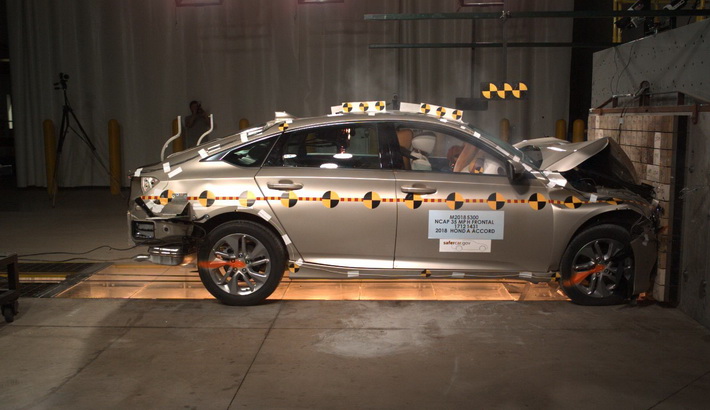
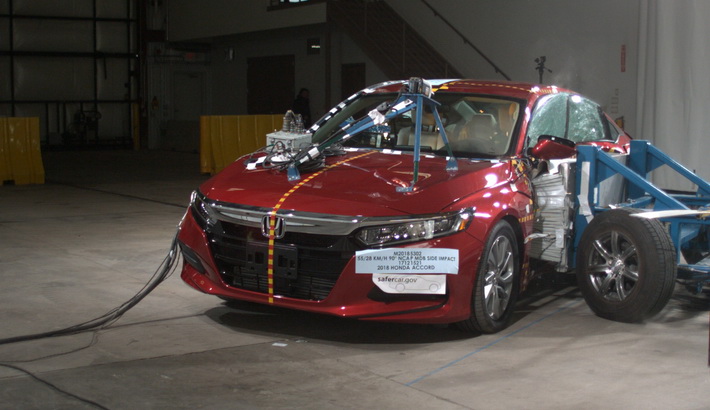
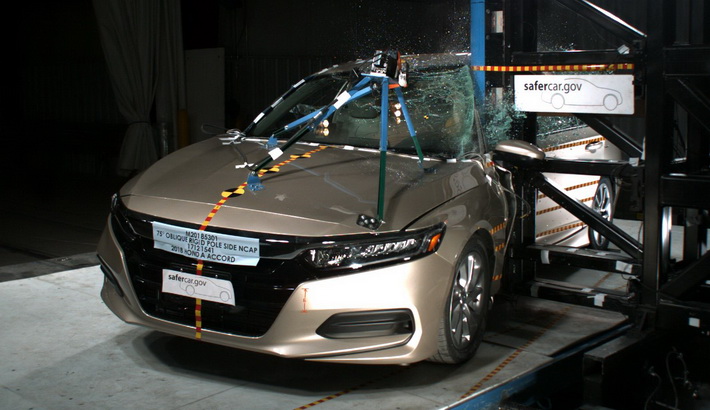
NHTSA crash tests
The agency crash-tested this model year itself. These are its own
photographs and star ratings.
Frontal crash test
Side barrier crash test
Side pole crash test
Photographs taken by NHTSA during its own New Car Assessment Program crash
tests of this model year. Public domain.
Configuration
Overall
Front
Side
Rollover
2018 Honda Accord 4 DR FWD
9.3% risk
When owners complained
A spike years after the car went on sale usually means a part wearing
out on schedule across the whole fleet — the kind of pattern no single
owner can see from inside their own car.
Oct 2017peak 81Sep 2026
NHTSA investigations into the 2018 Honda Accord
An investigation is the step before a recall: the agency has seen enough
complaints to look into a pattern itself. An open one means it thinks
something may be wrong and nothing has been fixed yet.
On February 21, 2022, the Office of Defects Investigation (ODI) opened Preliminary Evaluation (PE22003) to assess reports of inadvertent activation of the Collision Mitigation Braking System (CMBS), an automatic emergency braking (AEB) system, in model year 2017-2019 Honda CR-V and 2018-2019 Honda Accord vehicles. The reports allege that activation of the AEB system occurs while driving with no apparent obstruction in the vehicle's forward path, resulting in sudden vehicle deceleration. Honda indicated that they were aware of a total of X,XXX reports that may relate to the alleged defect. Hon...
On February 21, 2022, the Office of Defects Investigation (ODI) opened Preliminary Evaluation (PE22003) to assess reports of inadvertent activation of the Collision Mitigation Braking System (CMBS), an automatic emergency braking (AEB) system, in model year 2017-2019 Honda CR-V and 2018-2019 Honda Accord vehicles. The reports allege that activation of the AEB system occurs while driving with no apparent obstruction in the vehicle's forward path, resulting in sudden vehicle deceleration. Honda indicated that they were aware of a total of X,XXX reports that may relate to the alleged defect. Hon...
Recalls on the 2018 Honda Accord
A complaint is one owner's allegation. A recall is the point at which
the manufacturer or a regulator agreed the defect is real and dangerous
enough to fix for free — however old the car is.
United States — NHTSA
26V332000
AIR BAGS:SENSOR:OCCUPANT CLASSIFICATION:FRONT PASSENGER
Honda (American Honda Motor Co.) is recalling certain 2018-2021, 2023 Acura TLX, 2019-2024 RDX, 2017-2020, 2022-2026 MDX, 2017-2021, 2023, 2025 Honda Ridgeline, 2017-2022 Pilot, 2019-2021 Passport, 2018-2026 Odyssey, 2019-2022 Insight, 2019-2021 HR-V, 2018-2020 Fit, 2020-2022 CR-V Hybrid, 2017-2022 CR-V, 2017-2018, 2021 Civic Type R, 2017-2021 Civic hatchback, 2016-2020 Civic coupe, 2016-2022 Civic, 2017-2022 Accord Hybrid, and 2016-2022 Accord vehicles. The front passenger seat weight sensor may crack and short circuit, which can cause the air bags to deploy unintentionally during a crash.
Risk: Air bags that deploy unintentionally during a crash increase the risk of injury.
23V858000
FUEL SYSTEM, GASOLINE:DELIVERY:FUEL PUMP
Honda (American Honda Motor Co.) is recalling certain 2013-2023 Honda Accord, Civic Coupe, Civic Sedan, Civic Hatchback, Civic Type R, CR-V, HR-V, Ridgeline, Odyssey, Acura ILX, MDX, MDX Hybrid, RDX, RLX, TLX, 2019-2022 Honda Insight, Passport, 2020 Honda CR-V Hybrid, 2018-2019 Honda Clarity PHEV, Fit, and 2015-2020 Honda Accord Hybrid, Pilot, Acura NSX vehicles. The fuel pump inside the fuel tank may fail.
Risk: Fuel pump failure can cause an engine stall while driving, increasing the risk of a crash.
23V158000
SEAT BELTS:FRONT:BUCKLE ASSEMBLY
Honda (American Honda Motor Co.) is recalling certain 2017-2020 CR-V, 2018-2019 Accord and Accord Hybrid, 2018-2020 Odyssey, 2019 Insight, and 2019-2020 Acura RDX vehicles. A manufacturing issue with the front seat belts may cause the seat belt buckle channel to interfere with the release button, preventing the seat belt buckle from latching.
Risk: An unlatched seat belt cannot properly restrain the seat occupant during a crash, increasing their risk of injury.
20V771000
ELECTRICAL SYSTEM:BODY CONTROL MODULE:SOFTWARE
Honda (American Honda Motor Co.) is recalling certain 2018-2020 Accord Sedan, Accord Hybrid, and 2019-2020 Insight vehicles. A software error may cause intermittent or continuous disruptions in communication between the Body Control Module (BCM) and other components. This may result in malfunctions of various systems such as the windshield wipers and defroster, rearview camera, exterior lights, audible warning of a stopped vehicle, and power window operation. As such, these vehicles fail to comply with the requirements of Federal Motor Vehicle Safety Standard (FMVSS) number 103, "Windshield Defrosting and Defogging Systems" and number 111, "Rear Visibility" as well as FMVSS numbers 104, 108, 114, 118, and 305.
Risk: Various system malfunctions such as inoperative windshield wipers, defroster, rearview camera, or exterior lighting can increase the risk of a crash.
20V314000
FUEL SYSTEM, GASOLINE:DELIVERY:FUEL PUMP
Honda (American Honda Motor Co.) is recalling certain 2018-2019 Acura NSX, 2019 Acura RDX, RLX and RLX Sport Hybrid, 2018-2019 Honda Accord, Civic Hatchback, Civic Type R and HR-V, 2019-2020 Insight and 2019 Fit vehicles. The low-pressure fuel pump inside the fuel tank may fail.
Risk: If the fuel pump fails, the engine can stall while driving, increasing the risk of a crash.
18V629000
BACK OVER PREVENTION: SENSING SYSTEM: CAMERA
Honda (American Honda Motor Co.) is recalling certain 2018 Honda Accord and 2019 Honda Insight vehicles. In certain scenarios, the back-up camera center display may not function properly. As such, these vehicles fail to comply with the requirements of Federal Motor Vehicle Safety Standard (FMVSS) number 111, "Rearview Mirrors."
Risk: If the rearview camera display does not show what is behind the vehicle, it can increase the risk of a crash.
Canada — Transport Canada
Canada runs its own recall programme, and its campaigns do not
always mirror the American ones.
Recall 202625112,371 units in Canada
Seats And Restraints
Issue: On certain vehicles, the weight sensor for the front passenger seat may not have been manufactured properly. As a result, the passenger-front airbag and knee airbag could deploy in a crash that doesn't require them to. Note: This recall is an expansion of Transport Canada recall no. 2024-059. If the weight sensor fails, the SRS warning light would turn on in the instrument panel. Safety Risk: An airbag system that doesn't work properly could increase the risk of injury in a crash. Corrective Actions: The company will notify owners by mail and advise you to take your vehicle to a dealership to replace the passenger-front seat weight sensor.
Recall 202559939 units in Canada
Wheels
Issue: This recall is for certain aluminum wheels that were installed before delivery or sold as a dealer accessory. On certain vehicles, the wheels may not have been manufactured properly. As a result, the wheel nut(s) could loosen and cause the wheel(s) to detach. Safety Risk: A wheel separation could cause a loss of control and increase the risk of a crash. Additionally, a wheel that separates could create a road hazard for others. Corrective Actions: Honda will notify owners by mail and advise you to take your vehicle to a dealership to inspect and, if necessary, replace the hub(s), wheel(s) and wheel nut(s).
Recall 2024262291,588 units in Canada
Fuel System
Issue: This recall is for low-pressure fuel pumps installed on certain vehicles or sold at dealerships as a replacement part. On certain vehicles, the low-pressure fuel pump could fail. If this happens, the engine may run rough or may not start and the check engine light may turn on. This could also result in a sudden loss of engine power while driving. Note: This recall replaces Transport Canada recall no. 2023-679. Vehicles that were repaired under that recall don't require this repair. Safety Risk: A sudden loss of engine power could increase the risk of a crash. Corrective Actions: The company will notify owners by mail and advise you to take your vehicle to a dealership to replace the fuel pump motor.
Recall 2023679285,461 units in Canada
Fuel System
This recall was replaced by Transport Canada recall no. 2024-262. Issue: This recall is for low-pressure fuel pumps installed on certain vehicles or sold at dealerships as a replacement part. On certain vehicles, the low-pressure fuel pump could fail. If this happens, the engine may run rough or may not start and the check engine light may turn on. This could also result in a sudden loss of engine power while driving. Note: This is an expansion of Transport Canada recall nos. 2020-236 and 2021-182. Safety Risk: A sudden loss of engine power could increase the risk of a crash. Corrective Actions: The company will notify owners by mail and advise you to take your vehicle to a dealership to replace the fuel pump motor.
Recall 202312752,196 units in Canada
Seats And Restraints
Issue: On certain vehicles, the seat belt buckles for the driver and front-passenger seats could wear over time and may not latch securely. If this happens, the seat belt could unlatch unexpectedly. Safety Risk: A seat belt that doesn't latch securely could create an increased risk of injury in a crash. Corrective Actions: Honda will notify owners by mail and instruct you to take your vehicle to a dealership to inspect the driver and front-passenger seat belt assemblies. In most cases, the seat belt buckle release buttons will be replaced. If the dealer determines that a buckle can't be repaired, it will be replaced with a new part.
Recall 202061133,150 units in Canada
Electrical
Issue: On certain vehicles, a software problem in the Body Control Module (BCM) could cause different systems and warnings to stop working. This can include: the window defrosting/defogging system, windshield wipers, turn signals and lights, rearview camera display, and power windows. Safety Risk: Vehicle systems that stop working suddenly could increase the risk of a crash or injury. Corrective Actions: Honda will notify owners by mail and instruct you to take your vehicle to a dealer to update the BCM software.
Recall 202023610,456 units in Canada
Fuel System
Issue: On certain vehicles, the low-pressure fuel pump could fail. If this happens, then engine may run rough or may not start and the check engine light may turn on. This could also result in a sudden loss of engine power while driving. Note: For the RLX model, only the RLX Hybrid model is affected by this recall. Safety Risk: A sudden loss of engine power could increase the risk of a crash. Corrective Actions: The company will notify owners by mail and instruct you to take your vehicle to a dealer to replace the fuel pump motor.
Recall 201850014,521 units in Canada
Visual System
Certain vehicles do not comply with the requirements of Canada Motor Vehicle Safety Standard (CMVSS) 111 - Mirrors and Rear Visibility Systems. Due to a software programming error, the rearview image may not display on the centre display screen while the vehicle is in the reverse gear. This could increase the risk of a crash causing property damage or injury. Correction: Dealers will reprogram the centre display assembly software.
Reports where the owner recorded a crash, a fire, an injury or a death.
Dallas, GACrash
ENGINE
Issue 1: Faulty Collision Mitigation Braking System & Subsequent Crash Incident Details: In July of 2025, my vehicle’s automatic braking warning lights randomly activated and triggered an unprompted, emergency stop on [XXX]—despite having no vehicles ahead of me. This sudden malfunction directly caused a rear-end collision on the interstate. Documentation: A formal crash report was filed with the Georgia State Patrol. Ongoing Risk: The false automatic braking warnings continue to trigger randomly, creating an extreme safety hazard for myself and surrounding traffic. Issue 2: Premature Turbocharger Failure & Cracked Head Gasket Diagnostic Timeline: Immediately upon picking up the car from a body shop repair, every warning light on the dashboard illuminated erratically. After Ed Voyles Honda in Marietta claimed nothing was wrong, the body shop replaced a potentially loose battery cable. The issue persisted, and Shottenkirk Honda in Cartersville ultimately diagnosed a total turbocharger failure in March 2026. Out-of-Pocket Cost: Honda denied any goodwill coverage despite the widespread, documented failure of these 1.5L engines across 2018–2023 models. I paid $1,700 out of pocket to replace the turbocharger. Escalating Failures: Shortly after the turbo replacement, the head gasket cover cracked—another notorious, widely recognized defect inherent to this specific engine setup. At only seven years old, this vehicle has proven to be unreliable, dangerous, and financially burdensome. The known defects in the 1.5L powertrain warrant a widespread recall. Given my long-standing loyalty and the severe nature of these defects, I request a full reimbursement of the $1,700 turbocharger repair costs and an immediate investigation into the phantom braking issue. I expect a prompt reply outlining how Honda intends to resolve these safety issues. INFORMATION REDACTED PURSUANT TO THE FREEDOM OF INFORMATION ACT (FOIA), 5 U.S.C. 552(B)(6)
NHTSA complaint #11758960 — an unverified report by a vehicle owner.
Issue 1: Faulty Collision Mitigation Braking System & Subsequent Crash Incident Details: In July of 2025, my vehicle’s automatic braking warning lights randomly activated and triggered an unprompted, emergency stop on [XXX]—despite having no vehicles ahead of me. This sudden malfunction directly caused a rear-end collision on the interstate. Documentation: A formal crash report was filed with the Georgia State Patrol. Ongoing Risk: The false automatic braking warnings continue to trigger randomly, creating an extreme safety hazard for myself and surrounding traffic. Issue 2: Premature Turbocharger Failure & Cracked Head Gasket Diagnostic Timeline: Immediately upon picking up the car from a body shop repair, every warning light on the dashboard illuminated erratically. After Ed Voyles Honda in Marietta claimed nothing was wrong, the body shop replaced a potentially loose battery cable. The issue persisted, and Shottenkirk Honda in Cartersville ultimately diagnosed a total turbocharger failure in March 2026. Out-of-Pocket Cost: Honda denied any goodwill coverage despite the widespread, documented failure of these 1.5L engines across 2018–2023 models. I paid $1,700 out of pocket to replace the turbocharger. Escalating Failures: Shortly after the turbo replacement, the head gasket cover cracked—another notorious, widely recognized defect inherent to this specific engine setup. At only seven years old, this vehicle has proven to be unreliable, dangerous, and financially burdensome. The known defects in the 1.5L powertrain warrant a widespread recall. Given my long-standing loyalty and the severe nature of these defects, I request a full reimbursement of the $1,700 turbocharger repair costs and an immediate investigation into the phantom braking issue. I expect a prompt reply outlining how Honda intends to resolve these safety issues. INFORMATION REDACTED PURSUANT TO THE FREEDOM OF INFORMATION ACT (FOIA), 5 U.S.C. 552(B)(6)
NHTSA complaint #11758960 — an unverified report by a vehicle owner.
West Chester, PACrash
AIR BAGS
My son had an accident where he re-ended another car that caused damage to the front of his car. The AirBags did not deploy in his car; and I beleive they should have with the amount of damage that the car sustained.
NHTSA complaint #11749635 — an unverified report by a vehicle owner.
Phenix City, AL1 injured
SEAT BELTS
The car was sold to me in 2021 with no airbags and no working seatbelt in the back passenger seat. The car was bought at AX Auto in Atlanta Ga. I have been in touch with them and they keep ignorning me and will not fix this issue.
NHTSA complaint #11748063 — an unverified report by a vehicle owner.
Phenix City, AL1 injured
AIR BAGS
The car was sold to me in 2021 with no airbags and no working seatbelt in the back passenger seat. The car was bought at AX Auto in Atlanta Ga. I have been in touch with them and they keep ignorning me and will not fix this issue.
NHTSA complaint #11748063 — an unverified report by a vehicle owner.
Mount Kisco, NY1 injured
AIR BAGS
Side airbags deployed while driving for no reason/ no collision. Yes the car is available for inspection. The car was towed to a mechanic shop, while I was picked up by an ambulance. Yes my safety was put at risk as the airbags were deployed while car was in motion, knocking me out unconscious, leaving the car in motion possibly putting others at risk as well. I finally came to and was able to press the brake before any collision could happen. There were no warning signs prior. This incident caused me dizziness , headache , and with neck pain.
NHTSA complaint #11745307 — an unverified report by a vehicle owner.
The most recent complaints
In the owners' own words, exactly as filed with NHTSA.
Bridgeport, CT
ENGINE
I am reporting a recurring safety and mechanical issue with my 2018 Honda Accord 1.5T, which currently has approximately 128,900 miles. My vehicle has been experiencing shaking/rough operation and multiple warning lights while driving. Diagnostic scans have shown P0301 – Cylinder 1 Misfire and U0401-68. The ignition coils were replaced with original/OEM parts in an attempt to correct the issue. After the repair, the warning lights went away temporarily, but within several days the same warning lights and symptoms returned, and the vehicle again showed the P0301 cylinder 1 misfire code. I am concerned because the vehicle continues to shake and operate abnormally despite the repair. I have learned that Honda has addressed cylinder-head-gasket concerns involving certain 1.5L turbocharged Accord vehicles, which may cause engine misfires. However, I have not had my vehicle diagnosed with a defective head gasket, so I am not claiming that this is definitely the cause of my vehicle's problem. When I checked my VIN through NHTSA, it showed 0 unrepaired recalls. I am submitting this complaint so that NHTSA has a record of the recurring problem and can determine whether my vehicle's condition may be related to a broader safety defect affecting 2018 Honda Accord 1.5T vehicles. I am concerned about the possibility of the continued misfire causing loss of engine performance, loss of power, stalling, or otherwise making the vehicle unsafe to operate if the underlying problem worsens. I have photographs of the diagnostic scans documenting the codes and records showing the previous repair.
NHTSA complaint #11764229 — an unverified report by a vehicle owner.
Bridgeport, CT
FORWARD COLLISION AVOIDANCE: ADAPTIVE CRUISE CONTROL
I am reporting a recurring safety and mechanical issue with my 2018 Honda Accord 1.5T, which currently has approximately 128,900 miles. My vehicle has been experiencing shaking/rough operation and multiple warning lights while driving. Diagnostic scans have shown P0301 – Cylinder 1 Misfire and U0401-68. The ignition coils were replaced with original/OEM parts in an attempt to correct the issue. After the repair, the warning lights went away temporarily, but within several days the same warning lights and symptoms returned, and the vehicle again showed the P0301 cylinder 1 misfire code. I am concerned because the vehicle continues to shake and operate abnormally despite the repair. I have learned that Honda has addressed cylinder-head-gasket concerns involving certain 1.5L turbocharged Accord vehicles, which may cause engine misfires. However, I have not had my vehicle diagnosed with a defective head gasket, so I am not claiming that this is definitely the cause of my vehicle's problem. When I checked my VIN through NHTSA, it showed 0 unrepaired recalls. I am submitting this complaint so that NHTSA has a record of the recurring problem and can determine whether my vehicle's condition may be related to a broader safety defect affecting 2018 Honda Accord 1.5T vehicles. I am concerned about the possibility of the continued misfire causing loss of engine performance, loss of power, stalling, or otherwise making the vehicle unsafe to operate if the underlying problem worsens. I have photographs of the diagnostic scans documenting the codes and records showing the previous repair.
NHTSA complaint #11764229 — an unverified report by a vehicle owner.
Bridgeport, CT
LANE DEPARTURE: ASSIST
I am reporting a recurring safety and mechanical issue with my 2018 Honda Accord 1.5T, which currently has approximately 128,900 miles. My vehicle has been experiencing shaking/rough operation and multiple warning lights while driving. Diagnostic scans have shown P0301 – Cylinder 1 Misfire and U0401-68. The ignition coils were replaced with original/OEM parts in an attempt to correct the issue. After the repair, the warning lights went away temporarily, but within several days the same warning lights and symptoms returned, and the vehicle again showed the P0301 cylinder 1 misfire code. I am concerned because the vehicle continues to shake and operate abnormally despite the repair. I have learned that Honda has addressed cylinder-head-gasket concerns involving certain 1.5L turbocharged Accord vehicles, which may cause engine misfires. However, I have not had my vehicle diagnosed with a defective head gasket, so I am not claiming that this is definitely the cause of my vehicle's problem. When I checked my VIN through NHTSA, it showed 0 unrepaired recalls. I am submitting this complaint so that NHTSA has a record of the recurring problem and can determine whether my vehicle's condition may be related to a broader safety defect affecting 2018 Honda Accord 1.5T vehicles. I am concerned about the possibility of the continued misfire causing loss of engine performance, loss of power, stalling, or otherwise making the vehicle unsafe to operate if the underlying problem worsens. I have photographs of the diagnostic scans documenting the codes and records showing the previous repair.
NHTSA complaint #11764229 — an unverified report by a vehicle owner.
Morganton, NC
ELECTRICAL SYSTEM
1>Engine failure: Around the time vehicle reached 148,000 miles on it, it blew a head gasket on cylinder 2. Coolant was in the cylinders. The vehicle would not accelerate and was misfiring. 2> Safety was affected as this occured on interstate 40 and caused the vehicle to slow to an unsafe speed. 3>Problem was confirmed by Morganton Honda- Morganton NC. 4> Check engine light.
NHTSA complaint #11763581 — an unverified report by a vehicle owner.
Morganton, NC
ENGINE
1>Engine failure: Around the time vehicle reached 148,000 miles on it, it blew a head gasket on cylinder 2. Coolant was in the cylinders. The vehicle would not accelerate and was misfiring. 2> Safety was affected as this occured on interstate 40 and caused the vehicle to slow to an unsafe speed. 3>Problem was confirmed by Morganton Honda- Morganton NC. 4> Check engine light.
NHTSA complaint #11763581 — an unverified report by a vehicle owner.
Morganton, NC
FUEL/PROPULSION SYSTEM
1>Engine failure: Around the time vehicle reached 148,000 miles on it, it blew a head gasket on cylinder 2. Coolant was in the cylinders. The vehicle would not accelerate and was misfiring. 2> Safety was affected as this occured on interstate 40 and caused the vehicle to slow to an unsafe speed. 3>Problem was confirmed by Morganton Honda- Morganton NC. 4> Check engine light.
NHTSA complaint #11763581 — an unverified report by a vehicle owner.
Since I purchased this car in 2022, the collision mitigation braking system has randomly engaged for no reason. This has happened multiple times over the years, day and night, when no other vehicle, road obstructions, or other factors warrant the system triggering.
NHTSA complaint #11763757 — an unverified report by a vehicle owner.
Nacogdoches, TX
ENGINE
Unknown of actual issue. Experiencing persistent hard excessive jerking when accelerating. Extended warranty was placed for most Hondas due to head gasket issue but not for 2.0T
NHTSA complaint #11763250 — an unverified report by a vehicle owner.
at 132,000 milesGreenville, SC
ENGINE AND ENGINE COOLING:ENGINE:OIL/LUBRICATION:SEALS/GASKETS
The contact's sister-in-law owns a 2018 Honda Accord. The contact stated that while driving the vehicle, the vehicle stalled with several warning lights illuminated. The driver pulled over to the side of the road, and the vehicle failed to restart immediately. The vehicle was restarted after a while. The driver continued driving, but the failure reoccurred. The vehicle was taken to a dealer, where it was diagnosed and determined that the cylinder head gasket, gasket kit, and coolant needed to be replaced. The failure mileage was approximately 132,000.
NHTSA complaint #11762778 — an unverified report by a vehicle owner.
Orlando, FL
ELECTRICAL SYSTEM
Vehicle dashboard lights up with multiple warnings, power loss/limp mode in traffic and while driving. Dealership said it’s a very common problem but Honda refuses to make a recall. Technician says it is most likely caused by faulty fuel pump which is already recall that caused damage to the injectors.
NHTSA complaint #11762358 — an unverified report by a vehicle owner.
Orlando, FL
ENGINE
Vehicle dashboard lights up with multiple warnings, power loss/limp mode in traffic and while driving. Dealership said it’s a very common problem but Honda refuses to make a recall. Technician says it is most likely caused by faulty fuel pump which is already recall that caused damage to the injectors.
NHTSA complaint #11762358 — an unverified report by a vehicle owner.
Orlando, FL
FUEL/PROPULSION SYSTEM
Vehicle dashboard lights up with multiple warnings, power loss/limp mode in traffic and while driving. Dealership said it’s a very common problem but Honda refuses to make a recall. Technician says it is most likely caused by faulty fuel pump which is already recall that caused damage to the injectors.
NHTSA complaint #11762358 — an unverified report by a vehicle owner.
Greensboro, NC
ELECTRICAL SYSTEM
It started with multiple lights glowing on my dash. Then progressively the car felt sluggish and ultimately while driving to church in July the car cut off while I was making a turn. Some kind gentleman pushed my car helping me get out the intersection.
NHTSA complaint #11762233 — an unverified report by a vehicle owner.
Greensboro, NC
ENGINE
It started with multiple lights glowing on my dash. Then progressively the car felt sluggish and ultimately while driving to church in July the car cut off while I was making a turn. Some kind gentleman pushed my car helping me get out the intersection.
NHTSA complaint #11762233 — an unverified report by a vehicle owner.
Elizabethtown, PA
ENGINE
Car was overheating while driving. Received warning signs on the dash to pull over and turn car off immediately. Which I did. Very dangerous to do, especially with my three year old on a 90° summer day. I felt fear for my life while waiting on the side of a busy road during rush hour for the engine to cool and figure out what to do. Here the head gasket blew. A defect in the engine that Honda knows about. As a matter of fact, they have lawsuits for this exact occurrence.
NHTSA complaint #11762275 — an unverified report by a vehicle owner.
Greensboro, NC
FUEL/PROPULSION SYSTEM
It started with multiple lights glowing on my dash. Then progressively the car felt sluggish and ultimately while driving to church in July the car cut off while I was making a turn. Some kind gentleman pushed my car helping me get out the intersection.
NHTSA complaint #11762233 — an unverified report by a vehicle owner.
Fairburn, GA
ENGINE
I own a 2018 Honda Accord Sport 2.0T that has been consistently maintained through authorized Honda dealerships. On July 30, 2026, at 135,968 miles, I took my vehicle to Nalley Honda for a Blind Spot Information System warning and maintenance. The dealership performed a multi-point inspection and documented the spark plugs, cooling-system hoses, and fluid leaks as PASSING. I authorized approximately $1,231 in repairs and maintenance. Only days and approximately 202 miles later, multiple warning lights appeared. I returned to the same dealership. At 136,170 miles, Honda documented DTC P0302 (Cylinder #2 Misfire). The injectors passed an air-fuel test. The technician then noted pressure releasing from the cooling system despite low coolant temperature. A head-gasket leak test was performed and FAILED. Honda diagnosed a blown cylinder head gasket and recommended approximately $4,906 in repairs, including spark plugs that had passed inspection only days earlier. I am concerned about the sudden failure of a major engine component in a well-maintained vehicle, particularly so soon after a Honda dealership inspection. I have learned that other Honda Accord 2.0T owners have reported premature head-gasket failures. A failed head gasket can result in misfires, coolant loss, overheating, reduced engine performance, and potential engine damage while driving. I am requesting that NHTSA review this complaint along with similar complaints involving Honda Accord 2.0T head-gasket failures to determine whether a defect trend exists and whether an investigation is warranted.
NHTSA complaint #11761480 — an unverified report by a vehicle owner.
Fairburn, GA
LANE DEPARTURE: BLIND SPOT DETECTION
I own a 2018 Honda Accord Sport 2.0T that has been consistently maintained through authorized Honda dealerships. On July 30, 2026, at 135,968 miles, I took my vehicle to Nalley Honda for a Blind Spot Information System warning and maintenance. The dealership performed a multi-point inspection and documented the spark plugs, cooling-system hoses, and fluid leaks as PASSING. I authorized approximately $1,231 in repairs and maintenance. Only days and approximately 202 miles later, multiple warning lights appeared. I returned to the same dealership. At 136,170 miles, Honda documented DTC P0302 (Cylinder #2 Misfire). The injectors passed an air-fuel test. The technician then noted pressure releasing from the cooling system despite low coolant temperature. A head-gasket leak test was performed and FAILED. Honda diagnosed a blown cylinder head gasket and recommended approximately $4,906 in repairs, including spark plugs that had passed inspection only days earlier. I am concerned about the sudden failure of a major engine component in a well-maintained vehicle, particularly so soon after a Honda dealership inspection. I have learned that other Honda Accord 2.0T owners have reported premature head-gasket failures. A failed head gasket can result in misfires, coolant loss, overheating, reduced engine performance, and potential engine damage while driving. I am requesting that NHTSA review this complaint along with similar complaints involving Honda Accord 2.0T head-gasket failures to determine whether a defect trend exists and whether an investigation is warranted.
NHTSA complaint #11761480 — an unverified report by a vehicle owner.
Alpharetta, GA
POWER TRAIN
Car went into limp mode and was struggling to accelerate, went and got it diagnosed and was notified that my spark plugs needed to be replaced. Car began running fine but a few months went by and the issue came back. I was told I needed my spark plugs changed again. After the third time, I went and had my car diagnosed again and was told I needed a battery for the car because it was drained. Then I got the Turbo replaced and still the issue remains. All lights on the dashboard are on, car overheats and goes into limp mode, sometimes not accelerating over 20 MPH. My car went into limp mode on the highway, this scared me, so I haven't drove it since. Ive seen countless comments of users with the same make and model, experiencing the same issue. Its sad that Honda, known to be a trustworthy and reliable brand for years would do their customers like this, especially considering the state of the economy at the moment.
NHTSA complaint #11761198 — an unverified report by a vehicle owner.
Las Vegas, NV
POWER TRAIN
There is a hole in the engine block and it happed while I was driving, people could’ve been hurt on the road because of this mechanical failure. Vehicle has only been inspected by a private mechanic who found the problem. There was no warning of this besides a add air to tire warning.
NHTSA complaint #11761461 — an unverified report by a vehicle owner.
Alpharetta, GA
ELECTRICAL SYSTEM
Car went into limp mode and was struggling to accelerate, went and got it diagnosed and was notified that my spark plugs needed to be replaced. Car began running fine but a few months went by and the issue came back. I was told I needed my spark plugs changed again. After the third time, I went and had my car diagnosed again and was told I needed a battery for the car because it was drained. Then I got the Turbo replaced and still the issue remains. All lights on the dashboard are on, car overheats and goes into limp mode, sometimes not accelerating over 20 MPH. My car went into limp mode on the highway, this scared me, so I haven't drove it since. Ive seen countless comments of users with the same make and model, experiencing the same issue. Its sad that Honda, known to be a trustworthy and reliable brand for years would do their customers like this, especially considering the state of the economy at the moment.
NHTSA complaint #11761198 — an unverified report by a vehicle owner.
Alpharetta, GA
ENGINE
Car went into limp mode and was struggling to accelerate, went and got it diagnosed and was notified that my spark plugs needed to be replaced. Car began running fine but a few months went by and the issue came back. I was told I needed my spark plugs changed again. After the third time, I went and had my car diagnosed again and was told I needed a battery for the car because it was drained. Then I got the Turbo replaced and still the issue remains. All lights on the dashboard are on, car overheats and goes into limp mode, sometimes not accelerating over 20 MPH. My car went into limp mode on the highway, this scared me, so I haven't drove it since. Ive seen countless comments of users with the same make and model, experiencing the same issue. Its sad that Honda, known to be a trustworthy and reliable brand for years would do their customers like this, especially considering the state of the economy at the moment.
NHTSA complaint #11761198 — an unverified report by a vehicle owner.
Las Vegas, NV
ENGINE
There is a hole in the engine block and it happed while I was driving, people could’ve been hurt on the road because of this mechanical failure. Vehicle has only been inspected by a private mechanic who found the problem. There was no warning of this besides a add air to tire warning.
NHTSA complaint #11761461 — an unverified report by a vehicle owner.
The contact owns a 2018 Honda Accord. The contact stated that while driving at an undisclosed speed, the AC evaporator became inoperable and was blowing hot air. The contact stated that the failure had been occurring since the vehicle was purchased in 2018. The contact stated that the evaporator was leaking. The dealer confirmed the failure. The manufacturer was notified of the failure. The vehicle was not repaired.
NHTSA complaint #11761420 — an unverified report by a vehicle owner.
Oldsmar, FL
STEERING
On August 29th 2026 at 1:28PM (13:28) 148,320 mi. on odometer During interstate driving and topping the Sunshine Skyway Bridge on Interstate 275 Northbound (27.617863, -82.653639) the vehicle detected both road departure and engaged the emergency automated braking due to the shadow generated by the superstructure of the Skyway Bridge falling on the road surface. The vehicle attempted to correct the "road departure" by steering the vehicle away from the perceived problem and violently engaged the brakes nearly causing a collision as it has done numerous times before. In this particular event, it was an extraordinarily dangerous situation given the location that it occurred (190ft in the air on a walled in 2 lane interstate highway). I have reported this to NHTSA and American Honda on multiple previous occasions and await a repair or even an acknowledgement of this extremely dangerous issue. Honda has opened a case on this but have had 12+ months and no response has been issued.
NHTSA complaint #11760916 — an unverified report by a vehicle owner.