Owners have filed 91 complaints
about the 2014 Toyota 4RUNNER with NHTSA between 2013 and 2026.
The largest single group is the electrical system.
Across this model's run it ranks 25 of 34 worst.
The letter says how bad. This says what kind — whether this year drew
an unusual number of complaints, unusually dangerous
ones, or failures that arrived unusually early.
The dashed ring is 50 — the national norm. Further out is worse.
Complaint volume — 25
Against the median year of the Toyota 4RUNNER. 50 means typical for this
model; 100 means roughly double.
Severity — 57
11% of these complaints
involved a crash, fire, injury or death, against a national rate of
9.7%.
Early failure — 74
43% of failures with a mileage on record happened under
36,000 miles, against a national rate of
29%.
Odometer readings owners gave when they filed. About half of all
complaints include one.
Under 1,000 miles
59.8%
1,000 – 9,999 miles
35.9%
10,000 – 24,999 miles
59.8%
25,000 – 49,999 miles
1121.6%
50,000 – 74,999 miles
1223.5%
75,000 – 99,999 miles
815.7%
100,000 – 149,999 miles
59.8%
150,000+ miles
23.9%
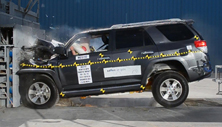
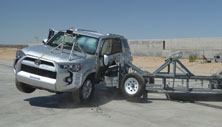
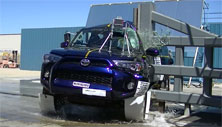
NHTSA crash tests
The agency crash-tested this model year itself. These are its own
photographs and star ratings.
Frontal crash test
Side barrier crash test
Side pole crash test
Photographs taken by NHTSA during its own New Car Assessment Program crash
tests of this model year. Public domain.
Configuration
Overall
Front
Side
Rollover
2014 Toyota 4Runner SUV AWD
24.6% risk
2014 Toyota 4Runner SUV FWD
24.6% risk
When owners complained
A spike years after the car went on sale usually means a part wearing
out on schedule across the whole fleet — the kind of pattern no single
owner can see from inside their own car.
Dec 2013peak 5Jul 2026
NHTSA investigations into the 2014 Toyota 4RUNNER
An investigation is the step before a recall: the agency has seen enough
complaints to look into a pattern itself. An open one means it thinks
something may be wrong and nothing has been fixed yet.
From 2000 through 2017, Takata produced millions of air bag inflators using two types of phase-stabilized ammonium nitrate ("PSAN") propellant -- propellant 2004 and propellant 2004L. After prolonged exposure to high temperature cycles and humidity, inflators using propellant 2004 can degrade, causing the propellant to burn too quickly when ignited. The rapid burning can cause the inflator to rupture during deployment, potentially causing serious or even fatal injury to vehicle occupants. See 2016 Blomquist Report at www.nhtsa.gov/sites/nhtsa.gov/files/documents/expert_report-hrblomquist.pdf.C...
Recalls on the 2014 Toyota 4RUNNER
A complaint is one owner's allegation. A recall is the point at which
the manufacturer or a regulator agreed the defect is real and dangerous
enough to fix for free — however old the car is.
United States — NHTSA
20V012000
FUEL SYSTEM, GASOLINE:DELIVERY:FUEL PUMP
Toyota Motor Engineering & Manufacturing (Toyota) recalled certain 2018-2019 4Runner, Highlander, Camry, Land Cruiser, Sequoia, Sienna, Tacoma and Tundra, and Lexus RC 300, RC 350, GS 350, GX 460, IS 300, LC 500, LS 500, LX 570, RX 350L, and 2019 Toyota Avalon and Corolla, and certain Lexus NX 300, and ES 350 vehicles on January 13, 2020. On March 4, 2020, Toyota expanded the recall to include certain 2014-2015 Toyota 4Runner and Land Cruiser, 2018 Avalon, Corolla, 2014 FJ Cruiser, 2017 Sienna and Lexus 2018 ES 350, 2018-2019 GS 300, 2013-2014 GS350, 2014-2015 GX 460, IS 350 and LX 570, 2014 IS F, 2018-2019 IS 350, LC 500H and LS 500H, 2013-2015 LS 460, 2015 NX 200T and RC350, 2017 RC 200T and RX 350. Toyota also removed the 2018-2019 Toyota 4Runner and Land Cruiser and 2018-2019 Lexus GX 460 and LX 570 and 2019 NX300 from inclusion in this recall. On March 19, 2020, Toyota expanded the recall to include 2015 Lexus GS350 vehicles. The low-pressure fuel pump inside the fuel tank may fail.
Risk: If the fuel pump fails, the engine can stall while driving, increasing the risk of a crash.
19V741000
AIR BAGS:FRONTAL:PASSENGER SIDE:INFLATOR MODULE
Toyota Motor Engineering & Manufacturing (Toyota) is recalling certain 2010-2016 4Runner, 2003-2006 Tundra, 2003-2013 Corolla, 2009-2010 Corolla Matrix, 2004-2005 RAV4, 2002-2007 Sequoia, 2011-2013 Sienna, 2008-2012 Scion xB, 2008-2009 Lexus IS-F, 2007-2012 Yaris and Lexus ES350, 2010-2017 Lexus GX460, 2002-2010 Lexus SC430, 2006-2012 Lexus IS250 and IS350 and 2010-2015 Lexus IS250C and IS350C vehicles. These vehicles had their driver or passenger frontal air bag inflators previously replaced under a prior recall using inflators of the same design. The inflators may explode due to propellant degradation occurring after long-term exposure to high absolute humidity, temperature and temperature cycling.
Risk: An inflator explosion may result in sharp metal fragments striking the driver or other occupants resulting in serious injury or death.
19V005000
AIR BAGS:FRONTAL:PASSENGER SIDE:INFLATOR MODULE
Toyota Motor Engineering & Manufacturing (Toyota) is recalling certain 2014-2016 Toyota 4Runner, 2014-2015 Scion xB, Lexus IS350C, IS250C, 2014 Toyota Sienna, Lexus IS-F, and 2014-2017 Lexus GX460 vehicles sold, or ever registered in the states of Alabama, California, Florida, Georgia, Hawaii, Louisiana, Mississippi, South Carolina, Texas, Puerto Rico, American Samoa, Guam, the Northern Mariana Islands (Saipan), and the U.S. Virgin Islands or "Zone A." Toyota is also recalling certain 2011-2013 Toyota Corolla, Corolla Matrix, Lexus IS250, IS350, 2011-2016 4Runner, 2011-2015 Scion xB, Lexus IS350C, IS250C, 2011-2014 Toyota Sienna, Lexus IS-F, 2011-2017 Lexus GX460, and 2011-2012 Lexus ES350 vehicles ever registered in the states of Arizona, Arkansas, Delaware, District of Columbia, Illinois, Indiana, Kansas, Kentucky, Maryland, Missouri, Nebraska, Nevada, New Jersey, New Mexico, North Carolina, Ohio, Oklahoma, Pennsylvania, Tennessee, Virginia, and West Virginia or "Zone B." Toyota is also recalling certain 2010-2013 Toyota Corolla, Corolla Matrix, Lexus IS350, 2010-2016 4Runner, 2010-2013 Lexus IS250, 2010-2015 Scion xB, Lexus IS350C, IS250C, 2010-2017 Lexus GX460, 2010-2014 Lexus
Risk: An inflator explosion may result in sharp metal fragments striking the driver or other occupants resulting in serious injury or death.
17V425000
STRUCTURE:BODY:HOOD:HINGE AND ATTACHMENTS
Southeast Toyota Distributors, LLC (SET) is recalling certain 2011-2016 Toyota Tacoma and 4Runner vehicles equipped with accessory hood scoops installed by SET or SET dealers. The adhesive attaching the hood scoop may weaken, allowing the hood scoop to detach from the vehicle.
Risk: If the hood scoop detaches, it may become a road hazard, increasing the risk of a crash.
16V577000
ENGINE AND ENGINE COOLING:EXHAUST SYSTEM:MANIFOLD/HEADER/MUFFLER/TAIL PIPE
Southeast Toyota Distributors, LLC (SET) is recalling certain model year 2010-2015 Toyota 4Runner vehicles manufactured September 3, 2009, to December 1, 2014. The affected vehicles may be equipped with accessory exhaust tips installed by SET or SET dealers that may contact people and possibly burn them while they are standing behind the vehicle.
Risk: Contact with an exhaust tip may result in personal injury.
15V515000
ENGINE AND ENGINE COOLING:EXHAUST SYSTEM:MANIFOLD/HEADER/MUFFLER/TAIL PIPE
Southeast Toyota Distributors, LLC (SET) is recalling certain model year 2010-2015 Toyota 4Runner vehicles manufactured March 29, 2010, to July 30, 2015. The affected vehicles may be equipped with accessory exhaust tips installed by SET or SET dealers that may contact people and possibly burn them while they are standing behind the vehicle.
Risk: Contact with an exhaust tip may result in personal injury.
14V828000
EQUIPMENT
Southeast Toyota Distributors, LLC (SET) is recalling certain model year 2014-2015 Toyota 4Runner, Tacoma, FJ Cruiser, Land Cruiser, RAV4, Scion FRS, and XB vehicles. The affected vehicles may have accessories installed by SET, such as running boards or other items, that were incorrectly installed. The accessory attaching fasteners were not tightened with the proper torque, possibly causing the accessory to detach from the vehicle.
Risk: Accessories that detach from a vehicle may result in a vehicle crash and/or personal injury.
Canada — Transport Canada
Canada runs its own recall programme, and its campaigns do not
always mirror the American ones.
Recall 202172355,683 units in Canada
Electrical
Issue: This recall is for certain block heater kits installed on certain vehicles or sold as accessories at Toyota or Lexus dealerships. On certain vehicles, the engine block heater cable may not have enough heat protection and could be damaged by high temperatures. If this happens, the cable could short circuit while plugged in, and cause the wiring to overheat or melt. Note: This recall only affects the following block heater/cord part numbers: C014003034 PK5A408J09 PU14000904 C014003151 PK5A408J13 PU14000905 C014000885 PK5A489J11 PU14000907 C014000888 PK5A489J22 PU14000909 C014000907 PK5A410H00 PU14000911 C014100904 PU14000900 PU14000913 C014100907 PU14000901 PU14003571 C014100911 PU14000902 PK5A489J14 PK5A408J05 PU14000903 Safety Risk: Engine block heater wiring that overheats or melts could create the risk of a fire. Corrective Actions: Toyota recommends that you should stop using the engine block heater immediately. Toyota will notify owners by mail and instruct you to take your vehicle to a dealer to disable the engine block heater. For some vehicles, the corrective actions for this recall are under development. For others, a new engine block heater cannot be installed, and the owner will receive a refund of the purchase price of the engine block heater.
Recall 2020514126,597 units in Canada
Fuel System
Issue: On certain vehicles, the low-pressure fuel pump could fail. If this happens, then engine may run rough or may not start and the check engine light may turn on. This could also result in a sudden loss of engine power while driving. Note: This recall is an expansion of recalls SRC R95/SRC R96 and SRC RA2/SRC RA3 (Transport Canada Recall Numbers 2020-005 and 2020-088). Safety Risk: A sudden loss of engine power could increase the risk of a crash. Corrective Actions: The company will notify owners by mail and instruct you to take your vehicle to a dealer to replace the fuel pump.
Recall 2020088111,835 units in Canada
Fuel System
Issue: On certain vehicles, the low-pressure fuel pump could fail. If this happens, then engine may run rough or may not start and the check engine light may turn on. This could also result in a sudden loss of engine power while driving. Note: This recall is an expansion of recall SRC R95/SRC R96 (Transport Canada Recall No. 2020-005) Safety Risk: A sudden loss of engine power could increase the risk of a crash. Corrective Actions: The company will notify owners by mail and instruct you to take your vehicle to a dealer to replace the fuel pump.
Recall 2019008376,282 units in Canada
Airbag
Issue: On certain vehicles, long-term exposure to high absolute humidity and temperature, combined with high temperature cycling, may eventually degrade the propellant contained in the passenger-front airbag. This could cause the airbag to deploy with more force than normal. If the airbag inflator ruptures, fragments could be propelled toward vehicle occupants or cause damage to the airbag assembly, preventing its proper function. Safety Risk: If the vehicle is involved in a crash requiring an airbag deployment, the airbag inflator could rupture and create a risk of injury. Corrective Action: Owners will be notified by mail and instructed to take their vehicle to a dealer to have the passenger-front airbag inflator or airbag module replaced. Note: The Canadian climate results in the propellant degrading slowly. This recall is being conducted as a precaution to address future risk. It is expected that all airbag inflators will be replaced before their function would be affected.
Reports where the owner recorded a crash, a fire, an injury or a death.
Waxhaw, NCCrash
AIR BAGS
I had a collision and rear ended a truck. My front left bumper was completely damaged. My chest hit the steering wheel. My airbags did not deploy.
NHTSA complaint #11670137 — an unverified report by a vehicle owner.
Buckeye, AZCrashFire1 injured
AIR BAGS
Vehicle was involved in an accident where the driver side airbag did not deploy.
NHTSA complaint #11657608 — an unverified report by a vehicle owner.
Honolulu, HI1 injured
STRUCTURE:BODY
GREATLY REDUCED SAFETY IN FRONTAL IMPACT DURING AN ACCIDENT DUE TO CORRODED FRAME COMPONENTS CAUSED BY FACTORY INSTALLED FOAM PIECES THAT RETAIN RAIN WATER. THIS PROBLEM HAS BEEN NOTICED, PERSONALLY BY ME, ON MULTIPLE TOYOTA 4RUNNERS OF MODEL YEARS 2014-2016 SO FAR. THE CORROSION DAMAGE ON MY VEHICLE MAKES ME FEEL UNSAFE WHILE DRIVING TO WORK AND NOT ADEQUATE TO BE TOWED FROM THE FRONT HOOKS INCASE OF AN EMERGENCY. I TRIED TO BRING THIS CONCERN TO A LOCAL TOYOTA SERVICE DEPARTMENT AND THAT WAS OF NO HELP. IMAGES ARE ATTACHED BELOW THAT SHOW HOW THE FACTORY FOAM PIECES SURROUNDING THE RADIATOR AND ITS "SHROUD" HAVE CAUSED A HIGHLY CONCERNING AMOUNT OF RUST ON THE VEHICLE'S BUMPER AND FRAME SUPPORT MEMBERS. THESE FOAM PIECES GET WET FROM DRIVING IN THE RAIN AND RETAIN THE WATER. THIS OVERTIME CAUSED THE RUST SHOWN BELOW. THE NEWER MODEL VEHICLES SEEM TO HAVE A RUBBER FLAP RATHER THAN FOAM WHICH WOULD PREVENT WATER DAMAGE ON THE FRAME MEMBERS. MAHALOS ## VIN PASSED ## TOYOTA 2014 ##
NHTSA complaint #11376235 — an unverified report by a vehicle owner.
at 70,000 milesPetal, MSCrash
AIR BAGS
TAKATA RECALL - I WAS IN A SERIOUS WRECK AND MY AIR BAGS NEVER DEPLYED
NHTSA complaint #11066719 — an unverified report by a vehicle owner.
at 30,500 milesMiami, FLCrash
STRUCTURE:BODY
I WAS THE SECOND CAR WAITING FOR THE LIGHT TO TURN GREEN SO I COULD MAKE A LEFT. SUDDENLY A HONDA CRV MADE AN OPEN RIGHT TURN AND HIT THE CAR IN FRONT OF ME AND MYSELF. MY TOYOTA SUFFERED EXTENSIVE DAMAGE COMPARED TO THE DAMAGE OF THE CRV. WHEN I LOOK AT MY CAR I FIND THAT THERE IS NO STEEL BUMPER AT THE EXTREME LEFT OR RIGHT OF THE VEHICLE. MY CAR WAS STATIONARY. SINCE THERE IS NO BUMPER TO PROTECT THE VEHICLE THE ENTIRE PANELS ON THE ENGINE COMPARTMENT SHIFTED SLIGHTLY TO THE RIGHT. THIS IS MEDIOCRE AND FRAUDULENT ENGINEERING FROM TOYOTA. IT IS ALSO A SAFETY ISSUE.
NHTSA complaint #11006487 — an unverified report by a vehicle owner.
at 32,000 milesGreenwich, CTCrash
VEHICLE SPEED CONTROL
TL* THE CONTACT OWNS A 2014 TOYOTA 4RUNNER. AFTER PLACING THE SHIFTER IN THE REVERSE POSITION, THE VEHICLE SUDDENLY EXPERIENCED UNINTENDED ACCELERATION. WHILE DRIVING IN REVERSE, THE VEHICLE ACCELERATED TO 20 MPH BEFORE CRASHING INTO A SECOND VEHICLE. DURING THE INCIDENT, THE BRAKES WOULD NOT STOP THE VEHICLE. A POLICE REPORT WAS FILED AND THERE WERE NO INJURIES. THE CAUSE OF THE FAILURE WAS NOT DETERMINED. THE MANUFACTURER WAS NOTIFIED OF THE FAILURE. THE FAILURE MILEAGE WAS 32,000.....UPDATED 02/06/17 *BF CONSUMER STATED CRASHED INTO THIRD VEHICLE. UPDATED 8/30/18
NHTSA complaint #10927004 — an unverified report by a vehicle owner.
The most recent complaints
In the owners' own words, exactly as filed with NHTSA.
Pearland, TX
ENGINE
I am reporting what I believe is a design defect involving the Secondary Air Injection (SAI) System on my 2014 Toyota 4Runner. My vehicle illuminated the Check Engine Light and stored Diagnostic Trouble Code P2440 (Secondary Air Injection System Switching Valve Stuck Open). During my inspection, I found that the factory-installed foam air pump filter had completely deteriorated and was missing. The filter appears to have disintegrated over time rather than being removed during maintenance. The filter is intended to prevent contaminants from entering the Secondary Air Injection pump and switching valves. Once it deteriorates, debris can enter the system, potentially contaminating the switching valve and causing the P2440 fault. This failure caused my vehicle to enter reduced-power ("limp") mode, resulting in a significant loss of engine power and acceleration. This created a safety hazard because the vehicle could not accelerate normally while driving, increasing the risk when merging into traffic, crossing intersections, or traveling at highway speeds. Toyota has discontinued the original replacement foam filter, preventing owners from restoring the system with the factory-designed component. Numerous other owners have reported similar failures involving deteriorated or missing foam filters, P2440/P2442 diagnostic codes, and costly Secondary Air Injection System repairs. I respectfully request that NHTSA investigate whether deterioration of this factory foam filter is a design or material defect that allows contamination of the Secondary Air Injection System and can lead to limp mode and reduced engine performance. If confirmed, Toyota should provide an appropriate remedy, such as redesigned components or an extended warranty for affected vehicles. This failure appears to result from deterioration of an original factory component rather than improper maintenance or normal wear and presents a potential safety concern for other Toyota 4Runner owners.
NHTSA complaint #11753646 — an unverified report by a vehicle owner.
Torrance, CA
STRUCTURE:BODY
White Paint Peeling From Metal Body Panels
NHTSA complaint #11729684 — an unverified report by a vehicle owner.
at 80,000 milesDenver, CO
TIRES:SIDEWALL
The contact owns a 2014 Toyota 4Runner. The contact purchased four Bridgestone tires in 2022, Tire Line: Alenza AS Ultra, Tire Size: 245/60/R20, DOT Number: 1RBTEAAU1. The contact stated that all four tires had developed cracks on the sidewalls and by the tire beads. The tires were replacement tires. The tire dealer was contacted and advised the contact that it was normal wear on the tires. The manufacturer was notified of the failure. The tire failure mileage was approximately 20,000. The vehicle failure mileage was 80,000.
NHTSA complaint #11723397 — an unverified report by a vehicle owner.
Waxhaw, NCCrash
AIR BAGS
I had a collision and rear ended a truck. My front left bumper was completely damaged. My chest hit the steering wheel. My airbags did not deploy.
NHTSA complaint #11670137 — an unverified report by a vehicle owner.
North Salt Lake, UT
UNKNOWN OR OTHER
paint is peeling on my 2014 Toyota 4runner . Toyota recalled for white paint but nothing for blue . i already paid so much for the car but not paying extra for the paint . Toyota should fix it .
NHTSA complaint #11665538 — an unverified report by a vehicle owner.
Buckeye, AZCrashFire1 injured
AIR BAGS
Vehicle was involved in an accident where the driver side airbag did not deploy.
NHTSA complaint #11657608 — an unverified report by a vehicle owner.
Timberlake, OH
ENGINE
My exhaust pipe rusted apart after the muffler causing the hot exhaust to expel upward and melt a rubber grommet on the floor. Then it proceeded to shoot into cargo area, melting the carpet backing and Styrofoam pad and insulation under the cargo area carpeting. This happened on an 11 hour road trip with the cargo area full of vacation stuff. I'm concerned about this being a potential fire and carbon monoxide issue.
NHTSA complaint #11629264 — an unverified report by a vehicle owner.
Cross Hill, SC
POWER TRAIN
Stumbling/Studering and hesitation when accelerating took it to dealership and they performed a tune-up and complete fuel system service when to pick it up and still doing the same thing. Dealership rechecked it and said Torque converter was faulty. Had to replace transmission.
NHTSA complaint #11542722 — an unverified report by a vehicle owner.
Cross Hill, SC
UNKNOWN OR OTHER
The handsfree calling/talking is unusable neither party can hear the other due to it echoing and has very distortion. So I'm unable to use my handsfree talking while driving.
NHTSA complaint #11542714 — an unverified report by a vehicle owner.
Cross Hill, SC
UNKNOWN OR OTHER
Left rear Brake Caliper Failure, Both Front Struts and both rear shocks were worn out per dealership. Had to replace all above.
NHTSA complaint #11542728 — an unverified report by a vehicle owner.
Cross Hill, SC
FUEL/PROPULSION SYSTEM
I notice my gas wasn't lasting long. One day I was pumping gas and noticed that underneath my 4-runner gas was pouring out from the top of my fuel tank. Took it to the dealership and they repaired the charcoal canister, canister assembly and purge valve assembly. Cost me $953.48 with parts and labor. Very dangerous due to it could have started a fire while driving.
NHTSA complaint #11542712 — an unverified report by a vehicle owner.
Lancaster, NY
STEERING
Intermediate steering shaft u joint Steering is difficult. Vehicle only has 80000 miles Just out of warranty as of 5/23
NHTSA complaint #11535423 — an unverified report by a vehicle owner.
at 140,941 milesSaint Louis Park, MN
VISIBILITY:SUN/MOON ROOF ASSEMBLY
The contact owns a 2014 Toyota 4Runner. The contact stated that while driving approximately 55 MPH, the sunroof exploded without impact. There were no injuries sustained. The local dealer was contacted but the vehicle was not diagnosed or repaired. The manufacturer was not contacted. The failure mileage was approximately 140,941.
NHTSA complaint #11531831 — an unverified report by a vehicle owner.
Frederick, MD
UNKNOWN OR OTHER
My gear shift became difficult to shift. As I was driving it, when I physically shifted to the Drive position, the display didn't confirm "D", but I could drive. As I was driving, the car shifted to Neutral without me shifting, but did not show "N" on the display. My car stopped accelerating and revved higher. This occurred as I was driving on the road around 45 mph. I could not tell on the display that I was not in Drive. I pulled over safely luckily. I Continued to try to get it to drive to get it to a dealership to look at. They reported it was PRNDL switch issue. TECH FOUND INTERNAL CORROSION IN TRANSMISSION RANGE SENSOR CREATING A PHYSICAL RESISTANCE IN SENSOR WHICH PREVENTED VEHICLE FROM PROPERLY INDICATING GEAR. TECH REPLACED TRANSMISSION RANGE SENSOR, ADJUSTED SENSORWITH TECHSTREAM DATA LIST, AND PERFORMED HEALTH CHECK This is not the first they have seen either. This would appear to be a common safety issue to drivers. I also had a difficult time confirming the car was in the Park "P" position. I believe this issue could have potentially affected the vehicle's ability to engage in park and stay in park, much like the issue with getting into Drive and staying in Drive.
NHTSA complaint #11501788 — an unverified report by a vehicle owner.
Frederick, MD
ELECTRICAL SYSTEM
My gear shift became difficult to shift. As I was driving it, when I physically shifted to the Drive position, the display didn't confirm "D", but I could drive. As I was driving, the car shifted to Neutral without me shifting, but did not show "N" on the display. My car stopped accelerating and revved higher. This occurred as I was driving on the road around 45 mph. I could not tell on the display that I was not in Drive. I pulled over safely luckily. I Continued to try to get it to drive to get it to a dealership to look at. They reported it was PRNDL switch issue. TECH FOUND INTERNAL CORROSION IN TRANSMISSION RANGE SENSOR CREATING A PHYSICAL RESISTANCE IN SENSOR WHICH PREVENTED VEHICLE FROM PROPERLY INDICATING GEAR. TECH REPLACED TRANSMISSION RANGE SENSOR, ADJUSTED SENSORWITH TECHSTREAM DATA LIST, AND PERFORMED HEALTH CHECK This is not the first they have seen either. This would appear to be a common safety issue to drivers. I also had a difficult time confirming the car was in the Park "P" position. I believe this issue could have potentially affected the vehicle's ability to engage in park and stay in park, much like the issue with getting into Drive and staying in Drive.
NHTSA complaint #11501788 — an unverified report by a vehicle owner.
Frederick, MD
ENGINE
My gear shift became difficult to shift. As I was driving it, when I physically shifted to the Drive position, the display didn't confirm "D", but I could drive. As I was driving, the car shifted to Neutral without me shifting, but did not show "N" on the display. My car stopped accelerating and revved higher. This occurred as I was driving on the road around 45 mph. I could not tell on the display that I was not in Drive. I pulled over safely luckily. I Continued to try to get it to drive to get it to a dealership to look at. They reported it was PRNDL switch issue. TECH FOUND INTERNAL CORROSION IN TRANSMISSION RANGE SENSOR CREATING A PHYSICAL RESISTANCE IN SENSOR WHICH PREVENTED VEHICLE FROM PROPERLY INDICATING GEAR. TECH REPLACED TRANSMISSION RANGE SENSOR, ADJUSTED SENSORWITH TECHSTREAM DATA LIST, AND PERFORMED HEALTH CHECK This is not the first they have seen either. This would appear to be a common safety issue to drivers. I also had a difficult time confirming the car was in the Park "P" position. I believe this issue could have potentially affected the vehicle's ability to engage in park and stay in park, much like the issue with getting into Drive and staying in Drive.
NHTSA complaint #11501788 — an unverified report by a vehicle owner.
North Salt Lake, UT
UNKNOWN OR OTHER
Three of the four locks do not work on a consistent basis. My car got broken into because the locks don't work. I just replaced three of the four locks for around $1,200.00. Neither the key fob nor the actual key would open the doors on the vehicle. This is an extreme safety issue in case of emergency, and it really makes me mad. It is a well-known defect which is commented on countless vehicle websites. There were no warning messages, the locks just stopped working.
NHTSA complaint #11497648 — an unverified report by a vehicle owner.
Gilbert, AZ
ELECTRICAL SYSTEM
The horn stopped functioning. This is a safety hazard because i am not able to alert other drivers. The vehicle has only been inspected by the Toyota Dealer. No codes and no lights were displayed.Fearing for my family's safety, I paid for the repairs.
NHTSA complaint #11465513 — an unverified report by a vehicle owner.
Las Cruces, NM
VISIBILITY/WIPER
Windshield cracking
NHTSA complaint #11454605 — an unverified report by a vehicle owner.
Highlands Ranch, CO
FUEL/PROPULSION SYSTEM
Fuel level sensor in gas tank not working properly
NHTSA complaint #11453120 — an unverified report by a vehicle owner.
Wilmington, MA
STEERING
The steering became almost unresponsive and I could not turn the steering wheel while driving. I brought it to a repair shop and they said the intermediate steering shaft and u-joints were rotted out and rusted to where it seized up. The vehicle only has 55k miles on it and I don’t live by the ocean. The parts were repaired by a shop and steering feels like new again. Had this seized up on the highway or at high speeds it could have been very bad. There were no warning lamps or issues with steering before
NHTSA complaint #11436144 — an unverified report by a vehicle owner.
Southbridge, MA
UNKNOWN OR OTHER
Having major problems with door lock actuators. just replaced front passenger side for 950 dollars at Toyota dealer and was told the other 3 doors may start failing as well. I did not realize at first that the door was not locking which would make it so easy for someone to break into my car.It is a 2014 Toyota 4runner. Sure enough the front driver side door is not locking. I need to spend another 950 dollars to get it fixed. What is wrong with these actuators? Now the replacement actuator I had put on the passenger side is giving me problems with the door opening and closing. What next?? Toyota should definitely have a recall on these actuators. It appears that I am not the only one having problems. This is a security issue.
NHTSA complaint #11426420 — an unverified report by a vehicle owner.
Lawndale, CA
FUEL/PROPULSION SYSTEM
Car would have trouble starting. Once i got it to start it would stall when stopped
NHTSA complaint #11419689 — an unverified report by a vehicle owner.
at 71,000 milesCincinnati, OH
STEERING
WHEN APPLYING THE BRAKES, THE VEHICLE / STEERING WHEEL SHAKES "VIOLENTLY". ALMOST TO THE POINT THAT IT IS HARD TO HOLD ON TO THE STEERING WHEEL. AND IF I'M DRIVING AT HIGHWAY SPEEDS THE VEHICLE IS EXTREMELY HARD TO STOP. I HAVE HAD TO SWERVE AROUND THE VEHICLE IN FRONT OF ME NUMEROUS TIMES BECAUSE MY BRAKES COULD NOT STOP MY VEHICLE IN TIME. IN AN ATTEMPT TO FIX THIS ISSUE I HAVE HAD A CERTIFIED MECHANIC REPLACE THE FRONT ROTORS AT 71K MILES, 83K MILES, 100K MILES WITH THE LAST TIME BEING WITH GENUINE TOYOTA ROTORS. EACH TIME THE VEHICLE WILL DRIVE GREAT FOR ABOUT 10K MILES AND THAN GO BACK TO THE VIOLENT SHAKING. EVEN WITH THE LAST SET OF GENUINE TOYOTA ROTORS, THE VIOLENT SHAKING STARTED AFTER ABOUT 15K - 18K MILES. LUCKILY WITH COVID I DON'T HAVE TO DRIVE ON THE HIGHWAY MUCH, BUT EVEN AT CITY SPEEDS IT STILL REALLY SHAKES. SO HERE I AM STILL LOOKING FOR A PERMANENT SOLUTION TO MY PROBLEM
NHTSA complaint #11416317 — an unverified report by a vehicle owner.
at 71,000 milesCincinnati, OH
SERVICE BRAKES
WHEN APPLYING THE BRAKES, THE VEHICLE / STEERING WHEEL SHAKES "VIOLENTLY". ALMOST TO THE POINT THAT IT IS HARD TO HOLD ON TO THE STEERING WHEEL. AND IF I'M DRIVING AT HIGHWAY SPEEDS THE VEHICLE IS EXTREMELY HARD TO STOP. I HAVE HAD TO SWERVE AROUND THE VEHICLE IN FRONT OF ME NUMEROUS TIMES BECAUSE MY BRAKES COULD NOT STOP MY VEHICLE IN TIME. IN AN ATTEMPT TO FIX THIS ISSUE I HAVE HAD A CERTIFIED MECHANIC REPLACE THE FRONT ROTORS AT 71K MILES, 83K MILES, 100K MILES WITH THE LAST TIME BEING WITH GENUINE TOYOTA ROTORS. EACH TIME THE VEHICLE WILL DRIVE GREAT FOR ABOUT 10K MILES AND THAN GO BACK TO THE VIOLENT SHAKING. EVEN WITH THE LAST SET OF GENUINE TOYOTA ROTORS, THE VIOLENT SHAKING STARTED AFTER ABOUT 15K - 18K MILES. LUCKILY WITH COVID I DON'T HAVE TO DRIVE ON THE HIGHWAY MUCH, BUT EVEN AT CITY SPEEDS IT STILL REALLY SHAKES. SO HERE I AM STILL LOOKING FOR A PERMANENT SOLUTION TO MY PROBLEM
NHTSA complaint #11416317 — an unverified report by a vehicle owner.