Owners have filed 718 complaints
about the 2003 Toyota 4RUNNER with NHTSA between 2006 and 2026.
The largest single group is the body & structure.
Across this model's run it ranks 7 of 34 worst.
The letter says how bad. This says what kind — whether this year drew
an unusual number of complaints, unusually dangerous
ones, or failures that arrived unusually early.
The dashed ring is 50 — the national norm. Further out is worse.
Complaint volume — 100
Against the median year of the Toyota 4RUNNER. 50 means typical for this
model; 100 means roughly double.
Severity — 24
4.7% of these complaints
involved a crash, fire, injury or death, against a national rate of
9.7%.
Early failure — 13
7% of failures with a mileage on record happened under
36,000 miles, against a national rate of
29%.
NHTSA files every complaint against a named sub-assembly, not just a
system. This is the difference between knowing it was "the engine" and
knowing which part of it — the list to hand a mechanic.
Body
24690.1%
Underbody Shields
72.6%
Frame AND Members
72.6%
Exhaust System
41.5%
Driveline
31.1%
Driveshaft
20.7%
Sun/Moon Roof Assembly
20.7%
Frontal
20.7%
When it fails
Odometer readings owners gave when they filed. About half of all
complaints include one.
Under 1,000 miles
81.6%
1,000 – 9,999 miles
30.6%
10,000 – 24,999 miles
193.7%
25,000 – 49,999 miles
163.1%
50,000 – 74,999 miles
499.6%
75,000 – 99,999 miles
6813.3%
100,000 – 149,999 miles
16131.5%
150,000+ miles
18736.6%
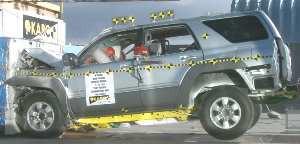
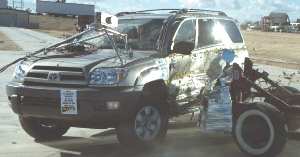
NHTSA crash tests
The agency crash-tested this model year itself. These are its own
photographs and star ratings.
These stars come from the pre-2011 crash test programme. NHTSA
rebuilt the programme for the 2011 model year and states that
ratings either side of that change are not comparable — so do
not read these against a 2011-or-newer car's stars.
Frontal crash test
Side barrier crash test
Photographs taken by NHTSA during its own New Car Assessment Program crash
tests of this model year. Public domain.
Configuration
Overall
Front
Side
Rollover
2003 Toyota 4Runner 4-DR.
—
—
—
When owners complained
A spike years after the car went on sale usually means a part wearing
out on schedule across the whole fleet — the kind of pattern no single
owner can see from inside their own car.
Apr 2006peak 23Jan 2026
NHTSA investigations into the 2003 Toyota 4RUNNER
An investigation is the step before a recall: the agency has seen enough
complaints to look into a pattern itself. An open one means it thinks
something may be wrong and nothing has been fixed yet.
DP18002Opened 17 Aug 2018Closed 18 Mar 2022STRUCTURE:FRAME AND MEMBERS
Frame corrosion
On August 7, 2018, the Office of Defects Investigation (ODI) received a defect petition from Mr. Gary Weinreich alleging premature frame corrosion failure in model year (MY) 2002 - 2006 Toyota 4Runner vehicles. The petitioner based his request upon a corrosion-related front suspension failure he experienced in his MY 2005 Toyota 4Runner, a class action lawsuit settlement involving other Toyota products, and other complaints of underbody corrosion in Toyota 4Runner vehicles that he found in NHTSA?s online complaint database. The petitioner submitted a complaint to NHTSA documenting his experien...
RQ10003Opened 16 Feb 2010Closed 1 Mar 2011ELECTRICAL SYSTEM:SOFTWARE
Unintended and Uncontrolled Acceleration
On February 16, 2010, NHTSA's Office of Defects Investigation (ODI) opened RQ10-003 to determine whether the scope of prior Toyota recalls relating to potential unintended acceleration were sufficiently broad, including, among others, Toyota recalls 07E-082, 09V-388, 10V-017, and 10V-023.NHTSA also requested information regarding potential electronic causes of unintended acceleration in Toyota and Lexus vehicles.I. Pedal Interference from Floor mats, Carpet Covers and Plastic Pads in Carpets.During the RQ10-003 investigation, ODI reviewed a large volume of documents to assess whether additiona...
Recalls on the 2003 Toyota 4RUNNER
A complaint is one owner's allegation. A recall is the point at which
the manufacturer or a regulator agreed the defect is real and dangerous
enough to fix for free — however old the car is.
United States — NHTSA
11V113000
VEHICLE SPEED CONTROL:ACCELERATOR PEDAL
TOYOTA IS RECALLING CERTAIN MODEL YEAR 2008 THROUGH 2011 LEXUS LX570, 2003 THROUGH 2009 TOYOTA 4RUNNER, AND 2006 THROUGH 2010 RAV4 VEHICLES. THE ACCELERATOR PEDAL CAN GET STUCK IN THE WIDE OPEN POSITION DUE TO ITS BEING TRAPPED BY AN UNSECURED OR INCOMPATIBLE DRIVER'S FLOOR MAT.
Risk: A STUCK OPEN ACCELERATOR PEDAL MAY RESULT IN VERY HIGH VEHICLE SPEEDS AND MAKE IT DIFFICULT TO STOP THE VEHICLE, WHICH COULD CAUSE A CRASH, SERIOUS INJURY OR DEATH.
03V146000
FUEL SYSTEM, GASOLINE
ON CERTAIN SPORT UTILITY VEHICLES EQUIPPED WITH V6 ENGINES, THE FUEL PULSATION DAMPER, LOCATED ON THE FUEL RAIL, MAY HAVE BEEN IMPROPERLY ASSEMBLED, CAUSING A DIAPHRAGM IN THE PULSATION DAMPER TO BE DAMAGED. IF THE DIAPHRAGM FAILS, FUEL MAY LEAK.
Risk: THIS COULD RESULT IN AN ENGINE COMPARTMENT FIRE IF A HEAT SOURCE OR AN IGNITION SOURCE IS PRESENT.
02V339000
WHEELS
ON CERTAIN SPORT UTILITY VEHICLES EQUIPPED WITH FIVE FACTORY ALLOY WHEELS (MODEL 6934 AND 6936), WITH FACTORY LLAT, AND WITH PORT INSTALLED WR4, FOUR ALLOY WHEEL UPGRADE PROCESSED AT THE JACKSONVILLE, FLORIDA PORT AND DISTRIBUTED BY SOUTHEAST TOYOTA DISTRIBUTORS IN THE STATES OF ALABAMA, FLORIDA, GEORGIA, NORTH AND SOUTH CAROLINA, WHEN THE VEHICLES WERE PROCESSED AT THE PORT, AN ALLOY TIRE/WHEEL UPGRADE WAS INSTALLED. THE UPGRADE INCLUDED 4 ALLOY WHEELS. THE ORIGINAL SPARE TIRE/ALLOY WHEEL WAS NOT CHANGED. THE SPARE TIRE REQUIRES THE USE OF A DIFFERENT STYLE OF WHEEL NUT TO ATTACH IT TO THE VEHICLE.
Risk: IF THE SPARE TIRE/WHEEL IS INSTALLED ON THE VEHICLE USING THE WHEEL NUTS PROVIDED FOR THE UPGRADE ALLOY WHEEL, DAMAGE TO THE WHEEL COULD RESULT AND COULD EVENTUALLY LEAD TO A LOOSE WHEEL.
Canada — Transport Canada
Canada runs its own recall programme, and its campaigns do not
always mirror the American ones.
Recall 202172355,683 units in Canada
Electrical
Issue: This recall is for certain block heater kits installed on certain vehicles or sold as accessories at Toyota or Lexus dealerships. On certain vehicles, the engine block heater cable may not have enough heat protection and could be damaged by high temperatures. If this happens, the cable could short circuit while plugged in, and cause the wiring to overheat or melt. Note: This recall only affects the following block heater/cord part numbers: C014003034 PK5A408J09 PU14000904 C014003151 PK5A408J13 PU14000905 C014000885 PK5A489J11 PU14000907 C014000888 PK5A489J22 PU14000909 C014000907 PK5A410H00 PU14000911 C014100904 PU14000900 PU14000913 C014100907 PU14000901 PU14003571 C014100911 PU14000902 PK5A489J14 PK5A408J05 PU14000903 Safety Risk: Engine block heater wiring that overheats or melts could create the risk of a fire. Corrective Actions: Toyota recommends that you should stop using the engine block heater immediately. Toyota will notify owners by mail and instruct you to take your vehicle to a dealer to disable the engine block heater. For some vehicles, the corrective actions for this recall are under development. For others, a new engine block heater cannot be installed, and the owner will receive a refund of the purchase price of the engine block heater.
Recall 2011082115,600 units in Canada
Other
On certain vehicles, the accelerator pedal may become stuck in the wide open position due to an unsecured or incompatible driver's floor mat. A fully depressed accelerator pedal may result in very high vehicle speeds and make it difficult to slow or stop the vehicle. This could result in a crash causing property damage and/or personal injury. Correction: Dealers will modify or replace the accelerator pedal. Note: This is an expansion of recall 2009290 for vehicles not previously included in the campaign.
Recall 20030991,317 units in Canada
Fuel System
On certain vehicles, the diaphragm in the pulsation damper at the end of the fuel rail may be damaged and could leak. In the worst case, this may result in a fire if in the presence of a heat source or an ignition source. Correction: Dealer will replace the pulsation damper.
Odometer Fraud. The contact investigated a 2003 Toyota 4 Runner. The contact stated that during the investigation, he discovered a fraudulent scheme of approximately 15 vehicles with odometer fraud. The contact stated that the suspects targeted Facebook Marketplace victims by spraying oil on the engine prior to test-driving the vehicle, and when the vehicle began smoking, the suspects would ask for a discount for the vehicle. The contact added that after the vehicle was purchased, the odometer was rolled back and the vehicle was resold. The vehicle was a private sale. At the time of purchase, the vehicle mileage was 150,000, and at the time of the vehicle being sold, it was discovered that the mileage was 306,000.
NHTSA complaint #11696425 — an unverified report by a vehicle owner.
Roseland, NJ
UNKNOWN OR OTHER
While my mechanic was servicing a small exhaust leak on my vehicle he noticed that the chassis/frame of the vehicle was heavily corroded. He told me that he believe it was no longer safe to drive and that I contact Toyota. I had a local Toyota service center also look at it and they confirmed that the chassis/frame was heavily corroded and unsafe to drive.
NHTSA complaint #11688509 — an unverified report by a vehicle owner.
My vehicle: 2003 4Runner SR5 2WD VIN: [XXX] Issue: Front driver's side door will not open. Electronic locks are operating, but the door release is not functioning. Safety Concern: What if I was in a situation where I did need to get out of the vehicle immediately? Such as a high-water incident, fire, etc. Especially for a person [XXX], as myself, this would be a big issue. When attempting to exit the car after pulling into the driveway, I could not open the driver's door. The locks would release, but the door latch would not. I had to crawl over the console to get out through the passenger side. This was not easy as I had back fusion surgery and 8 disc replaced, fused. I had to open the sunroof to help with get over and out. After I did get out, I tried the key in the driver's door, it would actuate the door locks on all doors, but the driver's side door latch would still not release. I even disconnected the battery and reconnected. No help. And after knowing more, it was not an electrical issue, but mechanical failure. I now have it at the repair shop after talking with Toyota Service manage who admitted it was a poor design as the repair for this is to destroy the door panel to get to the actuator to attempt to release the door latch. The estimate for this work is 1,150.00. I am beyond frustration, and especially when I see there is no recall for this issue. There are penty of conversations on this same issue on 4Runner forums as well as all over YouTube. Thank you for looking into this. You can reach me at: [XXX] [XXX] [XXX] INFORMATION REDACTED PURSUANT TO THE FREEDOM OF INFORMATION ACT (FOIA), 5 U.S.C. 552(B)(6)
NHTSA complaint #11662305 — an unverified report by a vehicle owner.
Kansas City, MO
STRUCTURE:BODY
Toyota has had issues with their frames rusting out and the 4th generation 4Runner is not exempt from this issue. My 2003 is requiring extensive work to keep it on the road safely due to frame rust. A recall to replace frames should be in place.
NHTSA complaint #11619222 — an unverified report by a vehicle owner.
Bronx, NY
STRUCTURE:BODY
There is major corrosion on the chassis, brake-power steering-transmission lines, and all metal brackets on the frame and engine. The corrosion is so bad there is holes on the chassis. Known issue, many complaints, Toyota Corp. says to keep calling back maybe something will be done in the future. Unable to upload photos!
NHTSA complaint #11561325 — an unverified report by a vehicle owner.
Dallas, TX
STRUCTURE:BODY
Severe frame rust, there was a recall for tacomas but 4Runners have the issue just as bad
NHTSA complaint #11551123 — an unverified report by a vehicle owner.
at 115,000 milesIndianapolis, IN
STRUCTURE:FRAME AND MEMBERS
The contact owns a 2003 Toyota 4Runner. The contact stated that upon taking the vehicle to several independent mechanics for servicing, he was informed that the subframe was significantly corroded and needed to be replaced. The vehicle was not repaired. The dealer was not notified of the failure. The manufacturer was notified of the failure and informed the contact the vehicle was not covered under recall. The failure mileage was approximately 115,000.
NHTSA complaint #11537118 — an unverified report by a vehicle owner.
Bark River, MI
UNKNOWN OR OTHER
Frame is rotted from front to back
NHTSA complaint #11510765 — an unverified report by a vehicle owner.
at 165,000 milesGranger, IN
STRUCTURE:FRAME AND MEMBERS
The contact owns a 2003 Toyota 4Runner. The contact stated that while the vehicle was at the tire retailer for tire replacement, the technician informed him that the subframe was corroded. The vehicle was then taken to an independent mechanic, who diagnosed that the passenger's side front and rear subframes were severely corroded, as well as the cross member. The mechanic advised the contact to stop driving the vehicle. The dealer was made aware of the failure and informed the contact that there was no recall associated with the VIN. The vehicle was not repaired. The manufacturer was not made aware of the failure. The failure mileage was approximately 165,000.
NHTSA complaint #11503828 — an unverified report by a vehicle owner.
Roseville, CA
SERVICE BRAKES
The VSC system in the vehicle becomes disabled due to a firmware 'glitch' identified by Toyota when an emission system issue is detected by the onboard diagnostic system. The VSC system is listed as an 'essential safety feature,' so I'm curious why a recall was never ordered to patch defective firmware that can cause VSC to become disabled due to a completely unrelated emissions issue.
NHTSA complaint #11502152 — an unverified report by a vehicle owner.
Pomona, CA
STRUCTURE:BODY
Extensive rust through out frame, resulting in holes in structural members. Leaving frame in a weak and vulnerable state.
NHTSA complaint #11501555 — an unverified report by a vehicle owner.
Austin Texas, TX
UNKNOWN OR OTHER
I purchased this 2003 Toyota 4Runner in 2018 under what I assumed was prime condition, for a vehicle that spent the majority of its life in Nebraska/Kansas before I moved to Texas in 2021. At 87,400 miles at the time of purchase, the vehicle had no visible damage to the exterior besides a few paint chips, some minor hail damage and scratches, and some easily fixed surface rust in the paint on the tailgate. The previous owner had driven it leisurely and had kept the miles low after 15 years. The car has had some mechanical issues, but nothing out of the ordinary outside of some regular maintenance over the first few years. Being close to 100,000 miles, the timing belt and pump was replaced around 98,000 miles. Other issues have been fixed periodically, please reference the attached files. After joining a Toyota 4Runner 4th Generation Facebook group and seeing a post about another's issues with rust damage in October 2020, I decided to take a look at my own frame. I then inspected my own vehicle, and found significant frame rot damage. It is extensive, with significant rust to the frame, with large holes and soft patches that question the integrity of the frame and the safety of the vehicle on the road. Every time I hit a small bump or pothole, I fear the frame will crack and I will lose control as others have. I have not sought out professional repairs due to the extensive cost, and am awaiting the outcome of a current class action lawsuit by the Bell Legal Group. The 4th Generation Toyota 4Runner (2003-2009) is built on the exact same frame as the Toyota Tacoma of that era, yet while the Tacoma was recalled for frame rot, the 4Runner was not included, which I believe to be a gross oversight in previous legal proceedings. The 2003-2009 Toyota 4Runner is a reliable vehicle, but poses significant frame rot issues much earlier than should be expected.
NHTSA complaint #11500005 — an unverified report by a vehicle owner.
Austin Texas, TX
SUSPENSION
I purchased this 2003 Toyota 4Runner in 2018 under what I assumed was prime condition, for a vehicle that spent the majority of its life in Nebraska/Kansas before I moved to Texas in 2021. At 87,400 miles at the time of purchase, the vehicle had no visible damage to the exterior besides a few paint chips, some minor hail damage and scratches, and some easily fixed surface rust in the paint on the tailgate. The previous owner had driven it leisurely and had kept the miles low after 15 years. The car has had some mechanical issues, but nothing out of the ordinary outside of some regular maintenance over the first few years. Being close to 100,000 miles, the timing belt and pump was replaced around 98,000 miles. Other issues have been fixed periodically, please reference the attached files. After joining a Toyota 4Runner 4th Generation Facebook group and seeing a post about another's issues with rust damage in October 2020, I decided to take a look at my own frame. I then inspected my own vehicle, and found significant frame rot damage. It is extensive, with significant rust to the frame, with large holes and soft patches that question the integrity of the frame and the safety of the vehicle on the road. Every time I hit a small bump or pothole, I fear the frame will crack and I will lose control as others have. I have not sought out professional repairs due to the extensive cost, and am awaiting the outcome of a current class action lawsuit by the Bell Legal Group. The 4th Generation Toyota 4Runner (2003-2009) is built on the exact same frame as the Toyota Tacoma of that era, yet while the Tacoma was recalled for frame rot, the 4Runner was not included, which I believe to be a gross oversight in previous legal proceedings. The 2003-2009 Toyota 4Runner is a reliable vehicle, but poses significant frame rot issues much earlier than should be expected.
NHTSA complaint #11500005 — an unverified report by a vehicle owner.
Austin Texas, TX
STRUCTURE:BODY
I purchased this 2003 Toyota 4Runner in 2018 under what I assumed was prime condition, for a vehicle that spent the majority of its life in Nebraska/Kansas before I moved to Texas in 2021. At 87,400 miles at the time of purchase, the vehicle had no visible damage to the exterior besides a few paint chips, some minor hail damage and scratches, and some easily fixed surface rust in the paint on the tailgate. The previous owner had driven it leisurely and had kept the miles low after 15 years. The car has had some mechanical issues, but nothing out of the ordinary outside of some regular maintenance over the first few years. Being close to 100,000 miles, the timing belt and pump was replaced around 98,000 miles. Other issues have been fixed periodically, please reference the attached files. After joining a Toyota 4Runner 4th Generation Facebook group and seeing a post about another's issues with rust damage in October 2020, I decided to take a look at my own frame. I then inspected my own vehicle, and found significant frame rot damage. It is extensive, with significant rust to the frame, with large holes and soft patches that question the integrity of the frame and the safety of the vehicle on the road. Every time I hit a small bump or pothole, I fear the frame will crack and I will lose control as others have. I have not sought out professional repairs due to the extensive cost, and am awaiting the outcome of a current class action lawsuit by the Bell Legal Group. The 4th Generation Toyota 4Runner (2003-2009) is built on the exact same frame as the Toyota Tacoma of that era, yet while the Tacoma was recalled for frame rot, the 4Runner was not included, which I believe to be a gross oversight in previous legal proceedings. The 2003-2009 Toyota 4Runner is a reliable vehicle, but poses significant frame rot issues much earlier than should be expected.
NHTSA complaint #11500005 — an unverified report by a vehicle owner.
Spring, TX
STRUCTURE:BODY
Vehicle frame has rusted through and has holes affecting structural condition.
NHTSA complaint #11495953 — an unverified report by a vehicle owner.
Novi, MI
POWER TRAIN
Complete corrosion of entire frame causing unavoidable damage to framework.
NHTSA complaint #11485060 — an unverified report by a vehicle owner.
Hillsborough, NJ
STEERING
There is severe rust on the frame, the rear is listing by 3/4 of an inch due to suspension rust, parts of the frame are perforated and lots of rust can fall out of drain holes when tapped. I am unable to steer the truck due to the intermediate steering column rust. The Tacoma was recalled for the same reason, I am assuming the 4runner has not been recalled because it was manufactured in greater numbers, and therefore more costly to repair, the danger of the severe rust is the same in both vehicles.
NHTSA complaint #11481057 — an unverified report by a vehicle owner.
Hillsborough, NJ
UNKNOWN OR OTHER
There is severe rust on the frame, the rear is listing by 3/4 of an inch due to suspension rust, parts of the frame are perforated and lots of rust can fall out of drain holes when tapped. I am unable to steer the truck due to the intermediate steering column rust. The Tacoma was recalled for the same reason, I am assuming the 4runner has not been recalled because it was manufactured in greater numbers, and therefore more costly to repair, the danger of the severe rust is the same in both vehicles.
NHTSA complaint #11481057 — an unverified report by a vehicle owner.
Hillsborough, NJ
SUSPENSION
There is severe rust on the frame, the rear is listing by 3/4 of an inch due to suspension rust, parts of the frame are perforated and lots of rust can fall out of drain holes when tapped. I am unable to steer the truck due to the intermediate steering column rust. The Tacoma was recalled for the same reason, I am assuming the 4runner has not been recalled because it was manufactured in greater numbers, and therefore more costly to repair, the danger of the severe rust is the same in both vehicles.
NHTSA complaint #11481057 — an unverified report by a vehicle owner.
Indianapolis, IN
STRUCTURE:BODY
Excessive frame rust causing difficulty to keep vehicle on the road. No warning lamps, I noticed the rust starting years ago, now the rust is so bad that the frame is rusted through causing difficulty steering and loud crunch noises. I contacted Toyota Consumer Affairs explaining the rust concern and asked if I needed to take the vehicle to a dealership for inspection, they said it wasn’t necessary (sounds like they don’t want to admit the existence of a possible manufacturing defect). The vehicle is available for inspection. I feel like I would be doing a disservice to society if I continue to drive this vehicle on public roads due to the danger of injuring a pedestrian or another motorist.
NHTSA complaint #11479718 — an unverified report by a vehicle owner.
Urbana, OH
UNKNOWN OR OTHER
Rusted frame
NHTSA complaint #11476780 — an unverified report by a vehicle owner.
Greenville, MI
STEERING
Stabilizer bar connected to the frame rusted off,back passenger side! Causing the vehicle to sway uncontrollably, due to the low rate of speed, I was able to regain control of my vehicle and not drive off the bridge I was driving over at the time or crash into another vehicle. The engine runs great, everything works, the vehicle still looks good but the frame is rusting out from underneath it! Toyota Needs To Make It Right!
NHTSA complaint #11474433 — an unverified report by a vehicle owner.
Greenville, MI
STEERING
Stabilizer bar connecting the axle to the frame rusted off. I was driving only 25-30mph at the time, luckily. The vehicle swayed violently almost causing an accident and nearly forcing me off the bridge I happened to driving over. Very fortunate no one was hurt and nothing was damaged from the incident. You can imagine the tragedy if that had happened on the highway driving 75mph! Major accident, innocent lives damaged or lost. This is a very dangerous vehicle not only to the driver and passengers but also to anybody that happened to be innocently in the path of an out of control Toyota 4runner. Toyota Please fix this, for your safety and everyone else on the highway. People should be warned!!
NHTSA complaint #11474448 — an unverified report by a vehicle owner.
Greenville, MI
SUSPENSION
Stabilizer bar connected to the frame rusted off,back passenger side! Causing the vehicle to sway uncontrollably, due to the low rate of speed, I was able to regain control of my vehicle and not drive off the bridge I was driving over at the time or crash into another vehicle. The engine runs great, everything works, the vehicle still looks good but the frame is rusting out from underneath it! Toyota Needs To Make It Right!
NHTSA complaint #11474433 — an unverified report by a vehicle owner.