Owners have filed 542 complaints
about the 2018 Hyundai Tucson with NHTSA between 2018 and 2026.
The largest single group is the engine & cooling.
Across this model's run it ranks 6 of 22 worst.
The letter says how bad. This says what kind — whether this year drew
an unusual number of complaints, unusually dangerous
ones, or failures that arrived unusually early.
The dashed ring is 50 — the national norm. Further out is worse.
Complaint volume — 69
Against the median year of the Hyundai Tucson. 50 means typical for this
model; 100 means roughly double.
Severity — 46
8.9% of these complaints
involved a crash, fire, injury or death, against a national rate of
9.7%.
Early failure — 92
54% of failures with a mileage on record happened under
36,000 miles, against a national rate of
29%.
Odometer readings owners gave when they filed. About half of all
complaints include one.
Under 1,000 miles
138.6%
1,000 – 9,999 miles
2113.8%
10,000 – 24,999 miles
3321.7%
25,000 – 49,999 miles
2919.1%
50,000 – 74,999 miles
2113.8%
75,000 – 99,999 miles
1610.5%
100,000 – 149,999 miles
1711.2%
150,000+ miles
21.3%
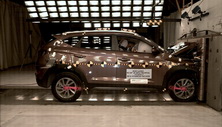
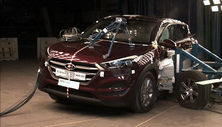
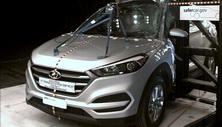
NHTSA crash tests
The agency crash-tested this model year itself. These are its own
photographs and star ratings.
Frontal crash test
Side barrier crash test
Side pole crash test
Photographs taken by NHTSA during its own New Car Assessment Program crash
tests of this model year. Public domain.
Configuration
Overall
Front
Side
Rollover
2018 Hyundai Tucson SUV FWD
15.5% risk
2018 Hyundai Tucson SUV AWD
16.2% risk
When owners complained
A spike years after the car went on sale usually means a part wearing
out on schedule across the whole fleet — the kind of pattern no single
owner can see from inside their own car.
Jun 2018peak 17Sep 2026
NHTSA investigations into the 2018 Hyundai Tucson
An investigation is the step before a recall: the agency has seen enough
complaints to look into a pattern itself. An open one means it thinks
something may be wrong and nothing has been fixed yet.
DP22003Opened 12 Sep 2022Closed 12 Dec 2023ENGINE
Loss of Motive Power
The National Highway Traffic Safety Administration (NHTSA) received a letter dated July 13, 2022, petitioning the Agency to initiate a safety defect investigation into loss of motive power allegations attributed to oil drain pan assembly failures on certain Hyundai Motor America, Inc. and Kia America, Inc. vehicles spanning Model Years (MY) 2005-2021. The Petitioners cited examples of complaints indicating that the subject vehicles were experiencing rapid loss of engine oil due to oil drain plug back outs, resulting in loss of motive power and/or catastrophic engine damage. Additional complain...
Recalls on the 2018 Hyundai Tucson
A complaint is one owner's allegation. A recall is the point at which
the manufacturer or a regulator agreed the defect is real and dangerous
enough to fix for free — however old the car is.
United States — NHTSA
20V543000
SERVICE BRAKES, HYDRAULIC:ANTILOCK/TRACTION CONTROL/ELECTRONIC LIMITED SLIP:CONTROL UNIT/MODULE
Hyundai Motor America (Hyundai) recalled certain 2019-2021 Tucson vehicles on September 4, 2020. On December 30, 2020, Hyundai expanded the recall population, and added certain 2016-2018 Tucson vehicles. The Anti-lock Brake Hydraulic Electronic Control Unit (HECU) could corrode internally and cause an electrical short, possibly resulting in an engine compartment fire.
Risk: An engine compartment fire can increase the risk of injury or crash.
Canada — Transport Canada
Canada runs its own recall programme, and its campaigns do not
always mirror the American ones.
Recall 2024552824,695 units in Canada
Label
Issue: On certain vehicles, the compliance label may be missing information in French. The words listed on the label for "Tires", "Rims", "Front" and "Rear" appear in English only, when they should be listed as "Tires/Pneus", "Rims/Jantes", "Front/Avant" and "Rear/Arriere". Canadian regulations require this information to be listed on the label in both English and French. Safety Risk: These small errors do not affect vehicle safety. Corrective Actions: This is not a recall. The company has corrected the compliance label for all new vehicles.
Recall 2022244178,064 units in Canada
Engine
Issue: Hyundai Auto Canada is conducting a Product Improvement Campaign that provides an update to the engine control module to detect potential problems before an engine fails. An engine failure would cause a sudden loss of power with an inability to restart. Note: This only affects certain vehicles equipped with a 2.0 L Nu GDI engine. For the Sonata model, only the Sonata Hybrid and Plug-In Hybrid (PHEV) models are affected by this campaign. This is an expansion of R0180 (Transport Canada #2021-575). Any vehicle that received a software update under campaign R0180 does not require this update. Safety Risk: A sudden loss of engine power could increase the risk of an accident. An engine failure could also create the risk of a fire. Corrective Actions: Hyundai will notify owners by mail and advise you to take your vehicle to a dealer to update the software for the engine control module. Note: Hyundai recommends that you should always follow the correct vehicle maintenance schedule, which is printed in the Owner's Manual. If you experience unusual engine noise, reduced power, or a check engine/oil warning light, Hyundai advises you to immediately visit a Hyundai dealership to have your vehicle diagnosed.
Recall 2021575152,924 units in Canada
Engine
This recall was replaced by Transport Canada Recall No. 2022-244. Issue: Hyundai Auto Canada is conducting a Product Improvement Campaign that provides an update to the engine control module to detect potential problems before an engine fails. An engine failure would cause a sudden loss of power with an inability to restart. Note: This only affects certain vehicles equipped with a 2.0 L Nu GDI engine. For the Sonata model, only the Sonata Hybrid and Plug-In Hybrid (PHEV) models are affected by this campaign. All vehicles previously included in TC # 2021-034 are now part of this new campaign. Safety Risk: A sudden loss of engine power could increase the risk of an accident. An engine failure could also create the risk of a fire. Corrective Actions: Hyundai will notify owners by mail and advise you to take your vehicle to a dealer to update the software for the engine control module. Note: Hyundai recommends that you should always follow the correct vehicle maintenance schedule, which is printed in the Owner's Manual. If you experience unusual engine noise, reduced power, or a check engine/oil warning light, Hyundai advises you to immediately visit a Hyundai dealership to have your vehicle diagnosed.
Recall 2020648144,700 units in Canada
Brakes
Issue: On certain vehicles, a problem in the control module for the antilock brake system (ABS) could cause it to short circuit. Note: This is an expansion of recall 2020-431. This recall does not affect vehicles equipped with Smart Cruise Control(SCC). Safety Risk: A short circuit could create a fire risk. Corrective Actions: Hyundai will notify owners by mail and advise you to take your vehicle to a dealer to revise the ABS fuse wiring and update the ABS control module, if necessary. Hyundai recommends that you should park your vehicle outdoors, and away from other vehicles or structures until the recall repairs have been completed.
Reports where the owner recorded a crash, a fire, an injury or a death.
Portland, MEFire
UNKNOWN OR OTHER
Approximately one month ago I had a high pressure fuel pump installed in my 2018 Hyundai Tucson. While driving on the highway, about ten minutes from home, my car suddenly burst into flames. There were no warning lights in the cockpit. There was no smoke in the cabin. Another motorist flagged me down. I got out of the vehicle just in time for it to become fully engulfed in flame. It burned down on the highway. Police and fire responded. Insurance is investigating. If I was inside the vehicle, I would have certainly died.
NHTSA complaint #11729665 — an unverified report by a vehicle owner.
Portland, MEFire
ENGINE
Approximately one month ago I had a high pressure fuel pump installed in my 2018 Hyundai Tucson. While driving on the highway, about ten minutes from home, my car suddenly burst into flames. There were no warning lights in the cockpit. There was no smoke in the cabin. Another motorist flagged me down. I got out of the vehicle just in time for it to become fully engulfed in flame. It burned down on the highway. Police and fire responded. Insurance is investigating. If I was inside the vehicle, I would have certainly died.
NHTSA complaint #11729665 — an unverified report by a vehicle owner.
Portland, MEFire
FUEL/PROPULSION SYSTEM
Approximately one month ago I had a high pressure fuel pump installed in my 2018 Hyundai Tucson. While driving on the highway, about ten minutes from home, my car suddenly burst into flames. There were no warning lights in the cockpit. There was no smoke in the cabin. Another motorist flagged me down. I got out of the vehicle just in time for it to become fully engulfed in flame. It burned down on the highway. Police and fire responded. Insurance is investigating. If I was inside the vehicle, I would have certainly died.
NHTSA complaint #11729665 — an unverified report by a vehicle owner.
Enterprise, ALCrash
AIR BAGS
On October 13th 2025, we were involved in a serious collision while driving our 2018 Hyundai Tucson. The vehicle was struck from behind and spun into a semi-truck, totalling the vehicle. Despite the forward and lateral collision to the semi-truck, no airbags deployed at all during the accident. This resulted in the Tucson driver striking his head on the steering wheel. Our 5-month old son was also on-board the vehicle in his car seat. While everyone walked away from the accident, both adults passengers had whiplash/minor neck injuries that could have been mitigated by airbags deploying. We have serious safety concerns about Hyundai's airbags because of this incident.
NHTSA complaint #11694065 — an unverified report by a vehicle owner.
Enterprise, ALCrash
STRUCTURE:BODY
On October 13th 2025, we were involved in a serious collision while driving our 2018 Hyundai Tucson. The vehicle was struck from behind and spun into a semi-truck, totalling the vehicle. Despite the forward and lateral collision to the semi-truck, no airbags deployed at all during the accident. This resulted in the Tucson driver striking his head on the steering wheel. Our 5-month old son was also on-board the vehicle in his car seat. While everyone walked away from the accident, both adults passengers had whiplash/minor neck injuries that could have been mitigated by airbags deploying. We have serious safety concerns about Hyundai's airbags because of this incident.
NHTSA complaint #11694065 — an unverified report by a vehicle owner.
Canton, TXCrash1 injured
AIR BAGS
After an impact with a large buck (deer) on a main highway while traveling 70 miles per hour, the airbags failed to deploy.
NHTSA complaint #11666669 — an unverified report by a vehicle owner.
The most recent complaints
In the owners' own words, exactly as filed with NHTSA.
Yoakum, TX
UNKNOWN OR OTHER
I took my Tucson to my local Hyundai dealership on Friday, August 28, 2026. It was there for a standard oil change and tire rotation. When I scheduled the appointment online the system also said there was a recall. I always stay on top of that so I let them take care of that as well. The recall didn’t seem like anything major, it was something to do with emissions. Ok, when I left the dealership that day the engine was warm so there was no noticeable difference. I didn’t use my vehicle at all for the next few days. When I got into it Monday morning for work I noticed immediately after starting the car and taking off the engine was hesitating and bucking. This lasted a few minutes. The problem seems to improve once the engine is warm but others are reporting online that they’re having issues with engines stalling as well. There’s something wrong with the software update that’s being used and no one seems to have a fix. I reached out to Hyundai with my concern and they recommended I take it back to the dealership to be diagnosed and see if my warranty would cover any repairs. My vehicle was free of problems before that update and now it’s falling back on me to pay for a potential problem they caused. There has been no accidents for me personally with this but it’s most definitely a safety hazard.
NHTSA complaint #11761793 — an unverified report by a vehicle owner.
Yoakum, TX
ENGINE
I took my Tucson to my local Hyundai dealership on Friday, August 28, 2026. It was there for a standard oil change and tire rotation. When I scheduled the appointment online the system also said there was a recall. I always stay on top of that so I let them take care of that as well. The recall didn’t seem like anything major, it was something to do with emissions. Ok, when I left the dealership that day the engine was warm so there was no noticeable difference. I didn’t use my vehicle at all for the next few days. When I got into it Monday morning for work I noticed immediately after starting the car and taking off the engine was hesitating and bucking. This lasted a few minutes. The problem seems to improve once the engine is warm but others are reporting online that they’re having issues with engines stalling as well. There’s something wrong with the software update that’s being used and no one seems to have a fix. I reached out to Hyundai with my concern and they recommended I take it back to the dealership to be diagnosed and see if my warranty would cover any repairs. My vehicle was free of problems before that update and now it’s falling back on me to pay for a potential problem they caused. There has been no accidents for me personally with this but it’s most definitely a safety hazard.
NHTSA complaint #11761793 — an unverified report by a vehicle owner.
West Point, VA
ENGINE
2018 Hyundai Tucson catastrophic engine failure consistent with known Hyundai Nu engine defect pattern documented across 141 prior owner-filed NHTSA complaints for this same vehicle. OBD codes P0326, P0301, P0302, P0303, P0304 documented July 19–25, 2026. Independent licensed mechanic confirmed in writing that engine requires replacement. Authorized Hyundai dealership service manager verbally confirmed coolant in oil — the exact failure mode documented in prior NHTSA complaints for this vehicle generation. Service Campaign 966/KSDS was completed and active when failure occurred and did not prevent it. Hyundai Motor America denied goodwill claim Case #43120457 citing out-of-warranty status and aftermarket parts — no written test results or inspection report has been produced to this household. Requesting federal investigation into pattern of engine failures in 2018 Hyundai Tucson consistent with acknowledged Nu engine defects.
NHTSA complaint #11762047 — an unverified report by a vehicle owner.
Joshua, TX
ENGINE
I own a Hyundai Tucson 2018 SEL Plus. My problem is my vehicle is coming to the end of it's 100,000 mile warranty. This vehicle started burning oil about 30,000 miles and it got worse. I checked on recalls and there was no recalls for my VIN number for this vehicle. My Hyundai vehicle is burning a quart of oil every 300 miles and this is no exaggeration. I bought the car brand new and had to replace my 1st Catalytic converter at 79,627 miles on 5/14/25 that was originally on the car. The second Catalytic converter that I had put on I, had to replace that Catalytic converter again at my cost at approximately $900.00 and then after that it plugged up again at 91,928 miles on 7/28/26 and I, had to replace that one that is the third one now. The Catalytic converter company had warranted the work and the converter to be installed. This has caused the car to not only misfire, but become a possible road hazard to miss enough and possibly cause it to stall or reduce the power output of the vehicle while in operation and on public roads in traffic and possibly create a major accident on the freeway. This is a major saftey concern being that you could not only lose power while in motion but could lock up the engine. We talked to mechanics, other people that own them and even the service guys at Hyundai knew it is problem. The service genteman said that they would clean the valves I, believe they talked about cleaning the valves with walnuts like sand blasting and I, told him cleaning the valves is not going to do anything for the oil consumption, because the oil consumption is the engine.The engine when it was originally made on the number 3 cyclinder was bored wrong. That is our problem because the oil rings and rings are letting the oil bypass the piston and filing out the iriadium spark plug and our car mileage has gone down because of this the rings are wearing faster and causing us to keep buying newer spark plugs. " Check Engine Light Flashes " plugged Cat Converter.
NHTSA complaint #11761559 — an unverified report by a vehicle owner.
Whitestown, IN
ENGINE
My engine is consuming an excessive amount of oil due to a known issue with the Hyundai engine design impacting cars from 2011-2018. My car only had approximately 89,900 miles on it when I noticed the issues. Hyundai is aware of the defect and has re-engineered their engines due to the issue. The engine is available for inspection upon request. My safety and the safety of others is put at risk every time I drive. By denying my claim, I am forced to repeatedly top off my oil to maintain levels and try to drive as safely as possible, however my car is at risk of engine failure due to the consumption. I have escalated these concerns to Hyundai and I was still denied. The problem was confirmed by a Hyundai dealer. The denial stems from Hyundai’s policy that it must be consuming greater than 1 quart for every 1,000 miles driven. However, my car is still consuming oil and it is incredibly unsafe. The engine was inspected by qualified Hyundai mechanics. The consumption issue was documented in their paperwork. The oil light would intermittently flicker while I drove, which had never happen before. Additionally, the car began to drive rough and I recognized something was likely wrong with the car. Unwilling to take any safety risks, I immediately scheduled an appointment with the dealership to determine the issue.
NHTSA complaint #11760584 — an unverified report by a vehicle owner.
Attleboro, MA
ENGINE
My 2018 Hyundai Tucson with the 2.0L engine has suffered catastrophic engine failure. The engine lost compression in cylinder 4 and now requires a full replacement . This is part of a broader pattern—the 2016–2018 Tucson is known for excessive oil consumption that leads to engine failure, with over 1,900 engine-related complaints filed with NHTSA across these model years . Prior to this failure, I reported excessive oil consumption and other engine issues to my dealership. Despite these reports, the problem was not resolved, and I was given inadequate guidance on how to address it. The engine ultimately failed while I was driving, creating a sudden loss of power that posed a safety risk. Other Hyundai Tucson vehicles with the same engine have been covered by recalls for related engine defects , but my specific VIN was not included, despite exhibiting identical symptoms. Meanwhile, other owners report that similar engine failures have been dismissed or denied coverage by Hyundai . This inconsistency in how the manufacturer handles a known, widespread defect is what prompted me to file this complaint.
NHTSA complaint #11757350 — an unverified report by a vehicle owner.
Johnson City, NY
ENGINE
On Thursday, August 6, 2026, while driving my 2018 Hyundai Tucson on Interstate 81, the vehicle experienced sudden, severe engine vibration and a loud metallic ticking sound before losing power and stalling completely on the highway. I was stranded on the side of the highway in a high-speed traffic zone, creating an immediate and hazardous safety situation. Because the vehicle was completely inoperable, I was forced to pay $200 out-of-pocket to have the vehicle towed 35 miles to the nearest authorized Hyundai dealership service center. Upon arrival at the dealership, an on-site service technician performed an OBD-II diagnostic scan on the lot and confirmed diagnostic trouble code P1326 (Engine Knock Sensor Detection System / Connecting Rod Bearing Failure). Despite the technician confirming the presence of this critical safety defect, the dealership service desk explicitly refused to enter the diagnostic code into Hyundai’s corporate system, stating they would not process or submit the vehicle for inspection or warranty authorization for over a month. Hyundai Motor America Customer Care was contacted immediately and witnessed the dealership’s refusal to log the safety defect. While Corporate assigned a Case Manager, Hyundai and the dealership have continually stalled the intake process under Service Campaign 966 / T6G and refused to provide direct-bill rental transportation or loaner support while the car sits disabled on the dealer lot. As a direct result of this sudden highway engine failure, the manufacturer's failure to address a known safety defect, and the refusal to provide recall mobility support, I have suffered ongoing financial loss, out-of-pocket towing expenses, and forced leave from employment. I am filing this report to document the hazardous highway failure of code P1326 and the refusal of the manufacturer and dealer to process a critical safety recall intake in a timely manner. My husband is the registered owner but I am the driver.
NHTSA complaint #11756421 — an unverified report by a vehicle owner.
Burien, WA
UNKNOWN OR OTHER
My 2018 Hyundai Tucson Limited equipped with the 1.6T engine and 7-speed EcoShift Dual-Clutch Transmission (DCT) is suffering from severe, dangerous clutch judder, slippage, and sudden acceleration hesitation. This vehicle matches the exact manufacturing defects and symptoms outlined in Hyundai Technical Service Bulletin TSB 21-AT-014H, but the defect has never been properly resolved by the manufacturer.The primary safety defect occurs when accelerating from a complete stop or during low-speed maneuvers (such as yielding at a roundabout or turning at an intersection). When pressing the gas pedal, the transmission violently shudders, hesitates, and fails to properly engage the clutch pack. This creates a severe, unpredictable time lag where the engine revs but the vehicle experiences a total loss of motive power and fails to move forward.This unexpected loss of propulsion has caused multiple near-miss situations where oncoming traffic had to slam on their brakes to avoid hitting my vehicle because it stalled or lagged while pulling out. It is an immediate physical safety hazard to myself, my passengers, and other drivers on the road. The failure is completely unpredictable and significantly worsens in warm weather or during stop-and-go driving conditions.I previously presented this vehicle to an authorized Hyundai dealership to complain about this exact transmission hesitation and shuddering while the vehicle was still covered under the factory warranty window. The service department failed to properly log, diagnose, or repair the failing double clutch pack at that time. Because the defect was reported within the warranty period and never corrected, the safety hazard has persisted and deteriorated to the point where the vehicle is now unsafe to operate in normal traffic. Hyundai is currently refusing to cover the full cost of this safety-related transmission failure.
NHTSA complaint #11755158 — an unverified report by a vehicle owner.
San Antonio, TX
ENGINE
My car had a lot of trouble accelerating it’s delayed
NHTSA complaint #11753308 — an unverified report by a vehicle owner.
Hurricane, UT
ENGINE
The engine has been consuming oil, where we were adding at least a quart of oil between oil changes. We noticed the vehicle would shake like it was going to die while idling at a stop light or in a drive through. Recently my husband was driving home from work on a busy highway and the vehicles check engine light started blinking on and off. He pulled over and had the vehicle towed. The oil consumption made the vehicle throw a rod and damage the engine. Now we are needing to replace the engine.
NHTSA complaint #11752813 — an unverified report by a vehicle owner.
Suwanee, GA
ENGINE
Incident Summary: On 07/16/2026, my 2018 Hyundai Tucson experienced a severe engine failure resulting in sudden knocking sound from engine and stopped in middle of road. This sudden failure while operating the vehicle created an immediate safety risk on the roadway. The vehicle was taken to Rick case Hyundai on 07/22/2026 , where diagnostics confirmed on 07/24/2026 internal engine damage tied to connecting rod bearing wear—a known, widespread safety hazard affecting Hyundai 2.0L Nu GDI engines. Reason for Complaint: Hyundai Motor America denied warranty coverage and engine replacement, claiming that Service Campaign 966 / Knock Sensor Detection System (KSDS) software had not been installed prior to the failure. The KSDS update is a software monitoring/warning tool, not a mechanical fix or routine maintenance requirement. Missing a software patch does not cause physical connecting rod bearing failure. Hyundai is using missing software updates to systematically deny coverage for known, dangerous engine defects. I am reporting this incident because sudden engine stalling on public roads poses a severe crash hazard, and Hyundai should not be permitted to avoid addressing safety-critical mechanical failures based on procedural software campaign exclusions.
NHTSA complaint #11752633 — an unverified report by a vehicle owner.
Torrance, CA
POWER TRAIN
While driving my 2018 Hyundai Tucson Limited 1.6L Turbo with the 7-speed EcoShift dual clutch transmission (DCT), the vehicle has repeatedly failed to engage and hold gears, resulting in loss of motive power in traffic. Diagnostic scanning retrieved codes P074B (Unable to Engage Gear 3), P074B71 (Unable to Select 3rd Gear), P074B07 (Gear Dropped Out of 3rd Gear), P092177 (1st Gear System Referencing Failure), and P0921 (Gear Shift Forward Actuator Circuit Range/Performance). A Hyundai dealer diagnosed the failure as requiring transmission replacement at approximately 93,000 miles. This is the same 7-speed DCT and the same failure mode addressed by NHTSA Campaign 16V628000 (Hyundai Recall 149) and Hyundai Service Campaign T1B, which covered 2016–2017 Tucson vehicles but excluded the 2018 model year despite using the same transmission. Hyundai has acknowledged this defect in 2018 vehicles through TSB 21-AT-014H and TSB 22-AT-007H, which prescribe a TCU software update, but issued these as service bulletins rather than a recall, so owners were never notified. When I requested the TSB software update, the Hyundai dealer refused to perform it. This defect creates a serious safety hazard: the vehicle can drop out of gear or fail to accelerate without warning while in traffic, increasing the risk of a crash — the identical hazard NHTSA cited in granting recall 16V628000. I request that NHTSA review whether the existing recall scope should be expanded to include 2018 Tucson vehicles.
NHTSA complaint #11748939 — an unverified report by a vehicle owner.
Torrance, CA
ELECTRICAL SYSTEM
While driving my 2018 Hyundai Tucson Limited 1.6L Turbo with the 7-speed EcoShift dual clutch transmission (DCT), the vehicle has repeatedly failed to engage and hold gears, resulting in loss of motive power in traffic. Diagnostic scanning retrieved codes P074B (Unable to Engage Gear 3), P074B71 (Unable to Select 3rd Gear), P074B07 (Gear Dropped Out of 3rd Gear), P092177 (1st Gear System Referencing Failure), and P0921 (Gear Shift Forward Actuator Circuit Range/Performance). A Hyundai dealer diagnosed the failure as requiring transmission replacement at approximately 93,000 miles. This is the same 7-speed DCT and the same failure mode addressed by NHTSA Campaign 16V628000 (Hyundai Recall 149) and Hyundai Service Campaign T1B, which covered 2016–2017 Tucson vehicles but excluded the 2018 model year despite using the same transmission. Hyundai has acknowledged this defect in 2018 vehicles through TSB 21-AT-014H and TSB 22-AT-007H, which prescribe a TCU software update, but issued these as service bulletins rather than a recall, so owners were never notified. When I requested the TSB software update, the Hyundai dealer refused to perform it. This defect creates a serious safety hazard: the vehicle can drop out of gear or fail to accelerate without warning while in traffic, increasing the risk of a crash — the identical hazard NHTSA cited in granting recall 16V628000. I request that NHTSA review whether the existing recall scope should be expanded to include 2018 Tucson vehicles.
NHTSA complaint #11748939 — an unverified report by a vehicle owner.
Torrance, CA
ENGINE
While driving my 2018 Hyundai Tucson Limited 1.6L Turbo with the 7-speed EcoShift dual clutch transmission (DCT), the vehicle has repeatedly failed to engage and hold gears, resulting in loss of motive power in traffic. Diagnostic scanning retrieved codes P074B (Unable to Engage Gear 3), P074B71 (Unable to Select 3rd Gear), P074B07 (Gear Dropped Out of 3rd Gear), P092177 (1st Gear System Referencing Failure), and P0921 (Gear Shift Forward Actuator Circuit Range/Performance). A Hyundai dealer diagnosed the failure as requiring transmission replacement at approximately 93,000 miles. This is the same 7-speed DCT and the same failure mode addressed by NHTSA Campaign 16V628000 (Hyundai Recall 149) and Hyundai Service Campaign T1B, which covered 2016–2017 Tucson vehicles but excluded the 2018 model year despite using the same transmission. Hyundai has acknowledged this defect in 2018 vehicles through TSB 21-AT-014H and TSB 22-AT-007H, which prescribe a TCU software update, but issued these as service bulletins rather than a recall, so owners were never notified. When I requested the TSB software update, the Hyundai dealer refused to perform it. This defect creates a serious safety hazard: the vehicle can drop out of gear or fail to accelerate without warning while in traffic, increasing the risk of a crash — the identical hazard NHTSA cited in granting recall 16V628000. I request that NHTSA review whether the existing recall scope should be expanded to include 2018 Tucson vehicles.
NHTSA complaint #11748939 — an unverified report by a vehicle owner.
Waynesburg, KY
UNKNOWN OR OTHER
Car shaking, oil is burning , and drive hard. Engine and, oil light is now appearing.
NHTSA complaint #11748351 — an unverified report by a vehicle owner.
Waynesburg, KY
ENGINE
Car shaking, oil is burning , and drive hard. Engine and, oil light is now appearing.
NHTSA complaint #11748351 — an unverified report by a vehicle owner.
Waynesburg, KY
FUEL/PROPULSION SYSTEM
Car shaking, oil is burning , and drive hard. Engine and, oil light is now appearing.
NHTSA complaint #11748351 — an unverified report by a vehicle owner.
Forest Lake, MN
ENGINE
-Very high oil consumption. Going through a little over a quart very 900-1000 miles. Has a GDI turbo engine. -Transmission issues. Has a dual clutch transmission that slips.
NHTSA complaint #11745205 — an unverified report by a vehicle owner.
Kapaa, HI
POWER TRAIN
January 9, 2026, driver was on I25, when driver heard a loud thud and the RPMs kept rising but the vehicle would not accelerate. Was very dangerous and barely avoided a collision with other drivers on the road. Barely got it home and shut it off. Tried to drive again but would not get out of reverse. Car was towed to Hyundai dealership for inspection. EGO4 Check Engine Light Diagnostic. 120883. Transmission and rear coupler/differential replaced. Test driven and dealership said it drove as designed and shifted as designed. Cost $10,955.29.
NHTSA complaint #11744822 — an unverified report by a vehicle owner.
Kapaa, HI
UNKNOWN OR OTHER
January 9, 2026, driver was on I25, when driver heard a loud thud and the RPMs kept rising but the vehicle would not accelerate. Was very dangerous and barely avoided a collision with other drivers on the road. Barely got it home and shut it off. Tried to drive again but would not get out of reverse. Car was towed to Hyundai dealership for inspection. EGO4 Check Engine Light Diagnostic. 120883. Transmission and rear coupler/differential replaced. Test driven and dealership said it drove as designed and shifted as designed. Cost $10,955.29.
NHTSA complaint #11744822 — an unverified report by a vehicle owner.
Kapaa, HI
ENGINE
On June 5, 2026, driver was on I25, when driver heard engine making a winding and weird noise. Vehicle immediately went from 60 mph to 40 mph. It was extremely dangerous and driver barely evaded a collusion with several other vehicles. A check oil and engine light came on. Towed back to same Hyundai dealership. They claim engine needs replaced and needs maintenance kit. Total cost $16,892.87. Note: prior to, in January 2026 the transmission and differential were replaced. Was told there were no other issues (same Hyundai dealership).
NHTSA complaint #11744826 — an unverified report by a vehicle owner.
Phoenix, AZ
ELECTRICAL SYSTEM
While idling at a standstill (in a drive-thru queue), my 2018 Hyundai Tucson suddenly experienced a severe engine overheat, causing the vehicle's air conditioning system to immediately blow hot air and shut down. The vehicle was brought directly to an authorized Hyundai dealership (Chapman Hyundai on [XXX]) for an emergency inspection.The dealership's certified technicians confirmed that the electric Engine Cooling Fan Assembly completely failed and subsequently caused the main Front Wiring Harness and Fuse Box to physically melt. The dealership documented this catastrophic electrical and thermal meltdown under Repair Order #XXX.This is a critical safety defect. A melted engine wiring harness poses an immediate and severe risk of an electrical short circuit, sudden vehicle stalling in live traffic, or a catastrophic under-hood engine fire. Because this component controls the primary cooling of the powertrain, its failure creates an extreme hazard to the vehicle occupants and surrounding traffic. Hyundai must investigate this component failure before it results in a thermal fire incident or an accident due to sudden power loss. INFORMATION REDACTED PURSUANT TO THE FREEDOM OF INFORMATION ACT (FOIA), 5 U.S.C. 552(B)(6)
NHTSA complaint #11743329 — an unverified report by a vehicle owner.
Phoenix, AZ
ENGINE
While idling at a standstill (in a drive-thru queue), my 2018 Hyundai Tucson suddenly experienced a severe engine overheat, causing the vehicle's air conditioning system to immediately blow hot air and shut down. The vehicle was brought directly to an authorized Hyundai dealership (Chapman Hyundai on [XXX]) for an emergency inspection.The dealership's certified technicians confirmed that the electric Engine Cooling Fan Assembly completely failed and subsequently caused the main Front Wiring Harness and Fuse Box to physically melt. The dealership documented this catastrophic electrical and thermal meltdown under Repair Order #XXX.This is a critical safety defect. A melted engine wiring harness poses an immediate and severe risk of an electrical short circuit, sudden vehicle stalling in live traffic, or a catastrophic under-hood engine fire. Because this component controls the primary cooling of the powertrain, its failure creates an extreme hazard to the vehicle occupants and surrounding traffic. Hyundai must investigate this component failure before it results in a thermal fire incident or an accident due to sudden power loss. INFORMATION REDACTED PURSUANT TO THE FREEDOM OF INFORMATION ACT (FOIA), 5 U.S.C. 552(B)(6)
NHTSA complaint #11743329 — an unverified report by a vehicle owner.
Houston, TX
SUSPENSION
This vehicle had a engine replaced by the dealership Nov 2024.Has not run the same since.Getting worse and seems like transmission issues.I was told The first and the 2nd owner which I'm the 2nd owner has a 5 year 100,000 mile warranty.It's been 4 years and since I've had the vehicle I've driven round off 60,OOO miles .The vehicle had $84,000 something miles on it when I got it.It's becoming very dangerous to drive around other cars giving out of power in the middle of streets and barely not going up hills or freeways and streets.😮
NHTSA complaint #11741044 — an unverified report by a vehicle owner.
Houston, TX
ENGINE
This vehicle had a engine replaced by the dealership Nov 2024.Has not run the same since.Getting worse and seems like transmission issues.I was told The first and the 2nd owner which I'm the 2nd owner has a 5 year 100,000 mile warranty.It's been 4 years and since I've had the vehicle I've driven round off 60,OOO miles .The vehicle had $84,000 something miles on it when I got it.It's becoming very dangerous to drive around other cars giving out of power in the middle of streets and barely not going up hills or freeways and streets.😮
NHTSA complaint #11741044 — an unverified report by a vehicle owner.