Owners have filed 530 complaints
about the 2019 Hyundai Tucson with NHTSA between 2018 and 2026.
The largest single group is the engine & cooling.
Across this model's run it ranks 5 of 22 worst.
The letter says how bad. This says what kind — whether this year drew
an unusual number of complaints, unusually dangerous
ones, or failures that arrived unusually early.
The dashed ring is 50 — the national norm. Further out is worse.
Complaint volume — 67
Against the median year of the Hyundai Tucson. 50 means typical for this
model; 100 means roughly double.
Severity — 48
9.2% of these complaints
involved a crash, fire, injury or death, against a national rate of
9.7%.
Early failure — 100
68% of failures with a mileage on record happened under
36,000 miles, against a national rate of
29%.
NHTSA files every complaint against a named sub-assembly, not just a
system. This is the difference between knowing it was "the engine" and
knowing which part of it — the list to hand a mechanic.
Warnings
622.2%
Body
622.2%
Automatic Emergency Braking
518.5%
Assist
311.1%
Blind Spot Detection
311.1%
Adaptive Cruise Control
27.4%
Crank/Camshaft Position Sensor
13.7%
Instrument Cluster/Panel
13.7%
When it fails
Odometer readings owners gave when they filed. About half of all
complaints include one.
Under 1,000 miles
118.5%
1,000 – 9,999 miles
3527.1%
10,000 – 24,999 miles
3224.8%
25,000 – 49,999 miles
2015.5%
50,000 – 74,999 miles
1310.1%
75,000 – 99,999 miles
107.8%
100,000 – 149,999 miles
64.7%
150,000+ miles
21.6%
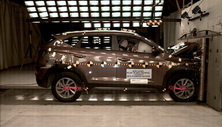
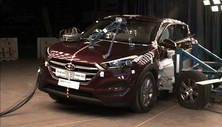
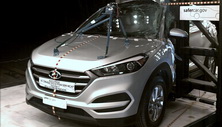
NHTSA crash tests
The agency crash-tested this model year itself. These are its own
photographs and star ratings.
Frontal crash test
Side barrier crash test
Side pole crash test
Photographs taken by NHTSA during its own New Car Assessment Program crash
tests of this model year. Public domain.
Configuration
Overall
Front
Side
Rollover
2019 Hyundai Tucson SUV AWD
15.5% risk
2019 Hyundai Tucson SUV FWD
16.2% risk
When owners complained
A spike years after the car went on sale usually means a part wearing
out on schedule across the whole fleet — the kind of pattern no single
owner can see from inside their own car.
Dec 2018peak 34Sep 2026
NHTSA investigations into the 2019 Hyundai Tucson
An investigation is the step before a recall: the agency has seen enough
complaints to look into a pattern itself. An open one means it thinks
something may be wrong and nothing has been fixed yet.
The Office of Defects Investigation (ODI) has received eight Hyundai Motor America (Hyundai) and eight Kia America, Inc. (Kia) Part 573 Recall Reports between 2016 and 2023. The combined 16 safety recalls all involve the antilock braking system (ABS) modules or Hydraulic Electronic Control Units (HECU) manufactured by the equipment supplier Mando. The Part 573 Recall Reports contain varying defect descriptions and differing remedy descriptions for the same or similar equipment supplied by Mando. Safety recalls included in this Audit Query (AQ) review include: Hyundai recalls 20V-520, 20V-543,...
DP22003Opened 12 Sep 2022Closed 12 Dec 2023ENGINE
Loss of Motive Power
The National Highway Traffic Safety Administration (NHTSA) received a letter dated July 13, 2022, petitioning the Agency to initiate a safety defect investigation into loss of motive power allegations attributed to oil drain pan assembly failures on certain Hyundai Motor America, Inc. and Kia America, Inc. vehicles spanning Model Years (MY) 2005-2021. The Petitioners cited examples of complaints indicating that the subject vehicles were experiencing rapid loss of engine oil due to oil drain plug back outs, resulting in loss of motive power and/or catastrophic engine damage. Additional complain...
Recalls on the 2019 Hyundai Tucson
A complaint is one owner's allegation. A recall is the point at which
the manufacturer or a regulator agreed the defect is real and dangerous
enough to fix for free — however old the car is.
United States — NHTSA
20V543000
SERVICE BRAKES, HYDRAULIC:ANTILOCK/TRACTION CONTROL/ELECTRONIC LIMITED SLIP:CONTROL UNIT/MODULE
Hyundai Motor America (Hyundai) recalled certain 2019-2021 Tucson vehicles on September 4, 2020. On December 30, 2020, Hyundai expanded the recall population, and added certain 2016-2018 Tucson vehicles. The Anti-lock Brake Hydraulic Electronic Control Unit (HECU) could corrode internally and cause an electrical short, possibly resulting in an engine compartment fire.
Risk: An engine compartment fire can increase the risk of injury or crash.
Canada — Transport Canada
Canada runs its own recall programme, and its campaigns do not
always mirror the American ones.
Recall 2024552824,695 units in Canada
Label
Issue: On certain vehicles, the compliance label may be missing information in French. The words listed on the label for "Tires", "Rims", "Front" and "Rear" appear in English only, when they should be listed as "Tires/Pneus", "Rims/Jantes", "Front/Avant" and "Rear/Arriere". Canadian regulations require this information to be listed on the label in both English and French. Safety Risk: These small errors do not affect vehicle safety. Corrective Actions: This is not a recall. The company has corrected the compliance label for all new vehicles.
Recall 2022244178,064 units in Canada
Engine
Issue: Hyundai Auto Canada is conducting a Product Improvement Campaign that provides an update to the engine control module to detect potential problems before an engine fails. An engine failure would cause a sudden loss of power with an inability to restart. Note: This only affects certain vehicles equipped with a 2.0 L Nu GDI engine. For the Sonata model, only the Sonata Hybrid and Plug-In Hybrid (PHEV) models are affected by this campaign. This is an expansion of R0180 (Transport Canada #2021-575). Any vehicle that received a software update under campaign R0180 does not require this update. Safety Risk: A sudden loss of engine power could increase the risk of an accident. An engine failure could also create the risk of a fire. Corrective Actions: Hyundai will notify owners by mail and advise you to take your vehicle to a dealer to update the software for the engine control module. Note: Hyundai recommends that you should always follow the correct vehicle maintenance schedule, which is printed in the Owner's Manual. If you experience unusual engine noise, reduced power, or a check engine/oil warning light, Hyundai advises you to immediately visit a Hyundai dealership to have your vehicle diagnosed.
Recall 2021575152,924 units in Canada
Engine
This recall was replaced by Transport Canada Recall No. 2022-244. Issue: Hyundai Auto Canada is conducting a Product Improvement Campaign that provides an update to the engine control module to detect potential problems before an engine fails. An engine failure would cause a sudden loss of power with an inability to restart. Note: This only affects certain vehicles equipped with a 2.0 L Nu GDI engine. For the Sonata model, only the Sonata Hybrid and Plug-In Hybrid (PHEV) models are affected by this campaign. All vehicles previously included in TC # 2021-034 are now part of this new campaign. Safety Risk: A sudden loss of engine power could increase the risk of an accident. An engine failure could also create the risk of a fire. Corrective Actions: Hyundai will notify owners by mail and advise you to take your vehicle to a dealer to update the software for the engine control module. Note: Hyundai recommends that you should always follow the correct vehicle maintenance schedule, which is printed in the Owner's Manual. If you experience unusual engine noise, reduced power, or a check engine/oil warning light, Hyundai advises you to immediately visit a Hyundai dealership to have your vehicle diagnosed.
Recall 2020648144,700 units in Canada
Brakes
Issue: On certain vehicles, a problem in the control module for the antilock brake system (ABS) could cause it to short circuit. Note: This is an expansion of recall 2020-431. This recall does not affect vehicles equipped with Smart Cruise Control(SCC). Safety Risk: A short circuit could create a fire risk. Corrective Actions: Hyundai will notify owners by mail and advise you to take your vehicle to a dealer to revise the ABS fuse wiring and update the ABS control module, if necessary. Hyundai recommends that you should park your vehicle outdoors, and away from other vehicles or structures until the recall repairs have been completed.
Recall 202043126,491 units in Canada
Brakes
This recall was replaced by Transport Canada Recall No. 2020-648. Issue: On certain vehicles, the control module for the antilock brake system (ABS) could corrode internally and cause a short circuit. Safety Risk: A short circuit could create a fire risk. Corrective Actions: Hyundai will notify owners of this problem by mail. The corrective actions for this recall are still being finalized. Hyundai recommends that you should park your vehicle outdoors, and away from other vehicles or structures until the recall repairs have been completed.
Recall 2019640275,533 units in Canada
Engine
Issue: Hyundai Auto Canada is conducting a Product Improvement Campaign that provides an update to the engine control module to detect potential problems before an engine fails. An engine failure would cause a sudden loss of power with an inability to restart. Note: This affects Sonata and Santa Fe Sport equipped with a 2.4 L GDI or 2.0 L Turbo GDI engine, as well as Tucson equipped with a 2.4 L GDI engine. Safety Risk: A sudden loss of engine power could increase the risk of an accident. Corrective Actions: The company will notify owners by mail. Owners will be instructed to take their vehicle to a dealer to update the software for the engine control module. Note: Vehicles previously repaired under Product Improvement Campaign R0153 (TC # 2019-130) do not require this software update. Owners can find additional information at <a href="http://www.hyundaiengineinfo.ca">www.hyundaiengineinfo.ca</a>.
Reports where the owner recorded a crash, a fire, an injury or a death.
Wantagh, NYFire
ENGINE
While traveling northbound on [XXX] in Florida traffic came to a stop, and when I stopped, my engine seized, I attempted to restart, but was unable to get a restart. My attempts to restart caused the starter to start burning smoke was coming from under the hood this put me at serious risk being on an interstate highway in the left lane at [XXX]. It was very difficult for me to push the car to the side of the road in this dangerous situation, recalling how Harry Chapin died in New York, because his car failed, and was struck by another vehicle. I was able to get the car onto the shoulder away from the moving traffic. The engine that seized is a 2.0 GDI engine and that engine has been identified to have multiple failures and being replaced after failing . Hyundai sent a letter. I believe this engine should be recalled and replaced before others are put in the same dangerous situation. INFORMATION REDACTED PURSUANT TO THE FREEDOM OF INFORMATION ACT (FOIA), 5 U.S.C. 552(B)(6)
NHTSA complaint #11761578 — an unverified report by a vehicle owner.
Saint Augustine, FLCrash
SERVICE BRAKES
ABS light on dash is illuminated due to no known cause. Mechanic explained that the ABS system will not work when the light is illuminated which, I believe, contributed to a "fender bender" my vehicle was involved in due to the ABS system failure.
NHTSA complaint #11760202 — an unverified report by a vehicle owner.
Tallahassee, FLFire
ELECTRICAL SYSTEM
On March 21st, while driving my Hyundai vehicle, I noticed the vehicle began making a ticking sound. After stopping the vehicle, it slowly began catching on fire. The fire ultimately spread and resulted in the vehicle becoming a total loss. This created a serious safety concern and placed me at risk. I later learned there was a recall associated with the vehicle. However, I never received any recall notices because Hyundai reportedly had the wrong address on file. Had I been properly notified of the recall and potential safety risks, I would have done everything in my power to ensure the vehicle was inspected, repaired, and safe to drive. Because I was unaware of the recall issue, the vehicle continued to be operated without my knowledge of the potential danger. The incident caused significant financial and transportation hardship, including loss of reliable transportation and additional financial strain. Hyundai later reached a determination regarding the matter, but I remain concerned about the serious safety risk and the fact that I did not receive proper recall notification before the incident occurred. I am submitting this complaint because I believe the recall notification process and handling of this matter should be reviewed further due to the serious safety risk involved.
NHTSA complaint #11737337 — an unverified report by a vehicle owner.
Tallahassee, FLFire
ENGINE
On March 21st, while driving my Hyundai vehicle, I noticed the vehicle began making a ticking sound. After stopping the vehicle, it slowly began catching on fire. The fire ultimately spread and resulted in the vehicle becoming a total loss. This created a serious safety concern and placed me at risk. I later learned there was a recall associated with the vehicle. However, I never received any recall notices because Hyundai reportedly had the wrong address on file. Had I been properly notified of the recall and potential safety risks, I would have done everything in my power to ensure the vehicle was inspected, repaired, and safe to drive. Because I was unaware of the recall issue, the vehicle continued to be operated without my knowledge of the potential danger. The incident caused significant financial and transportation hardship, including loss of reliable transportation and additional financial strain. Hyundai later reached a determination regarding the matter, but I remain concerned about the serious safety risk and the fact that I did not receive proper recall notification before the incident occurred. I am submitting this complaint because I believe the recall notification process and handling of this matter should be reviewed further due to the serious safety risk involved.
NHTSA complaint #11737337 — an unverified report by a vehicle owner.
Tallahassee, FLFire
FUEL/PROPULSION SYSTEM
On March 21st, while driving my Hyundai vehicle, I noticed the vehicle began making a ticking sound. After stopping the vehicle, it slowly began catching on fire. The fire ultimately spread and resulted in the vehicle becoming a total loss. This created a serious safety concern and placed me at risk. I later learned there was a recall associated with the vehicle. However, I never received any recall notices because Hyundai reportedly had the wrong address on file. Had I been properly notified of the recall and potential safety risks, I would have done everything in my power to ensure the vehicle was inspected, repaired, and safe to drive. Because I was unaware of the recall issue, the vehicle continued to be operated without my knowledge of the potential danger. The incident caused significant financial and transportation hardship, including loss of reliable transportation and additional financial strain. Hyundai later reached a determination regarding the matter, but I remain concerned about the serious safety risk and the fact that I did not receive proper recall notification before the incident occurred. I am submitting this complaint because I believe the recall notification process and handling of this matter should be reviewed further due to the serious safety risk involved.
NHTSA complaint #11737337 — an unverified report by a vehicle owner.
Richmond, KY1 injured
ROLLOVER
The contact's daughter owns a 2019 Hyundai Tucson. The contact stated that his daughter had parked the vehicle and left it unattended while in the on position. After approximately 10-15 minutes, the daughter attempted to shut off the vehicle by turning the ignition key from the front passenger side, but after powering off the vehicle rolled backwards down the driveway, also dragging the daughter. While rolling backwards, the front passenger door hit the concrete mail box, and the vehicle continued to roll across the street before stopping in the neighbor's yard. During the incident, the daughter attempted to activate the emergency brake, but was unsuccessful. As a result, the daughter sustained several bruises to the right leg/knee and the back area, which did not require medical treatment. The passenger side door and the concrete mail box were damaged. The police were called to the scene, but no report was filed. The cause of the failure was not determined. The manufacturer and local dealer were not yet notified of the incident. The failure mileage was unknown.
NHTSA complaint #11705009 — an unverified report by a vehicle owner.
The most recent complaints
In the owners' own words, exactly as filed with NHTSA.
Morristown, TN
POWER TRAIN
I had bought my car in May of 2025 and within 12 hours of owning it. The check engine light came on. They replaced the sensor well. A couple days later, the check engine light came on again, and they had to rebuild my whole engine had the car for a month at this time. When they rebuilt the engine, they had the car for over a month. And ever since I got it back, it's always something the same thing has to get repaired. Well, I took it to the shop. Yesterday because it was misfiring, and I needed to have some spark plugs replaced, and they said that the Ignition coil needed to be replaced, but there was a recall on that not too long ago. And they fixed that on the recall. There's no reason that should have already went a few months later. Well, the problem is when I bought my car, I bought it from tar. Hyundai, it's now rusty, while it's Hyundai. They charged me $200 just to get my car out of their lot. Because I refused service because they were trying to charge me. $2500 to fix my car. Now mind you, I've already put over $4000 extra into this car. After purchasing it for over 21000 now they're not wanting to honor any work that Tara. Hyundai done because they don't be responsible. They don't want to honor the tar. Hyundai warranty or anything I've had it with this Hyundai company. I've been driving this lemon. It is yet again in the shop. Being fixed, although the engine was rebuilt a year ago, there is no reason. This car should keep having engine failure. They don't want to honor it. They don't want to give me a new car, they don't want to, they're acting like they don't care like, 00 well, it's your fault, but I did not buy the car, as is it came with a warranty. When they reserved my engine and had to rebuild it. They extended my warranty 2 hundred and fifty thousand miles
NHTSA complaint #11763305 — an unverified report by a vehicle owner.
Morristown, TN
ENGINE
I had bought my car in May of 2025 and within 12 hours of owning it. The check engine light came on. They replaced the sensor well. A couple days later, the check engine light came on again, and they had to rebuild my whole engine had the car for a month at this time. When they rebuilt the engine, they had the car for over a month. And ever since I got it back, it's always something the same thing has to get repaired. Well, I took it to the shop. Yesterday because it was misfiring, and I needed to have some spark plugs replaced, and they said that the Ignition coil needed to be replaced, but there was a recall on that not too long ago. And they fixed that on the recall. There's no reason that should have already went a few months later. Well, the problem is when I bought my car, I bought it from tar. Hyundai, it's now rusty, while it's Hyundai. They charged me $200 just to get my car out of their lot. Because I refused service because they were trying to charge me. $2500 to fix my car. Now mind you, I've already put over $4000 extra into this car. After purchasing it for over 21000 now they're not wanting to honor any work that Tara. Hyundai done because they don't be responsible. They don't want to honor the tar. Hyundai warranty or anything I've had it with this Hyundai company. I've been driving this lemon. It is yet again in the shop. Being fixed, although the engine was rebuilt a year ago, there is no reason. This car should keep having engine failure. They don't want to honor it. They don't want to give me a new car, they don't want to, they're acting like they don't care like, 00 well, it's your fault, but I did not buy the car, as is it came with a warranty. When they reserved my engine and had to rebuild it. They extended my warranty 2 hundred and fifty thousand miles
NHTSA complaint #11763305 — an unverified report by a vehicle owner.
Oswego, NY
UNKNOWN OR OTHER
My 2019 Hyundai Tucson repeatedly shuts off while driving , without any warning. It rolls backwards while in park. The car could easily hit me taking things out of the trunk or hit my neighbors walking past my drive. The car has no power. It can’t get up to speed. It shakes and I have to get someone to add oil to it frequently. The first time this happened was in April of 2023. The engine seized up and it was towed to Driver’s Village in Cicero, NY. They replaced the engine block. But not the converter. Now, it is happening again. I have had 2 diagnostic tests done. One by my mechanic and the other by Advanced Auto Parts. Both tests say that the problem is the catalytic converter, but Hyundai refuses to fix the problem and will not honor my extended warranty. I have written and called them numerous times for almost 2 years now, about this and they say they will call me back, but they do not. None of the dealerships will even look at my car. I need someone to look at my vehicle. This vehicle is not safe. Other Tucson owners have the same problems with their cars, that I am complaining about. There is a federal emissions warranty that Hyundai claim they have never heard of, that would fix my car and make it safe to drive. I just want Hyundai to stand behind their warranty and fix my car before it kills someone.
NHTSA complaint #11762256 — an unverified report by a vehicle owner.
Oswego, NY
ENGINE
My 2019 Hyundai Tucson repeatedly shuts off while driving , without any warning. It rolls backwards while in park. The car could easily hit me taking things out of the trunk or hit my neighbors walking past my drive. The car has no power. It can’t get up to speed. It shakes and I have to get someone to add oil to it frequently. The first time this happened was in April of 2023. The engine seized up and it was towed to Driver’s Village in Cicero, NY. They replaced the engine block. But not the converter. Now, it is happening again. I have had 2 diagnostic tests done. One by my mechanic and the other by Advanced Auto Parts. Both tests say that the problem is the catalytic converter, but Hyundai refuses to fix the problem and will not honor my extended warranty. I have written and called them numerous times for almost 2 years now, about this and they say they will call me back, but they do not. None of the dealerships will even look at my car. I need someone to look at my vehicle. This vehicle is not safe. Other Tucson owners have the same problems with their cars, that I am complaining about. There is a federal emissions warranty that Hyundai claim they have never heard of, that would fix my car and make it safe to drive. I just want Hyundai to stand behind their warranty and fix my car before it kills someone.
NHTSA complaint #11762256 — an unverified report by a vehicle owner.
Oswego, NY
FUEL/PROPULSION SYSTEM
My 2019 Hyundai Tucson repeatedly shuts off while driving , without any warning. It rolls backwards while in park. The car could easily hit me taking things out of the trunk or hit my neighbors walking past my drive. The car has no power. It can’t get up to speed. It shakes and I have to get someone to add oil to it frequently. The first time this happened was in April of 2023. The engine seized up and it was towed to Driver’s Village in Cicero, NY. They replaced the engine block. But not the converter. Now, it is happening again. I have had 2 diagnostic tests done. One by my mechanic and the other by Advanced Auto Parts. Both tests say that the problem is the catalytic converter, but Hyundai refuses to fix the problem and will not honor my extended warranty. I have written and called them numerous times for almost 2 years now, about this and they say they will call me back, but they do not. None of the dealerships will even look at my car. I need someone to look at my vehicle. This vehicle is not safe. Other Tucson owners have the same problems with their cars, that I am complaining about. There is a federal emissions warranty that Hyundai claim they have never heard of, that would fix my car and make it safe to drive. I just want Hyundai to stand behind their warranty and fix my car before it kills someone.
NHTSA complaint #11762256 — an unverified report by a vehicle owner.
Wantagh, NYFire
ENGINE
While traveling northbound on [XXX] in Florida traffic came to a stop, and when I stopped, my engine seized, I attempted to restart, but was unable to get a restart. My attempts to restart caused the starter to start burning smoke was coming from under the hood this put me at serious risk being on an interstate highway in the left lane at [XXX]. It was very difficult for me to push the car to the side of the road in this dangerous situation, recalling how Harry Chapin died in New York, because his car failed, and was struck by another vehicle. I was able to get the car onto the shoulder away from the moving traffic. The engine that seized is a 2.0 GDI engine and that engine has been identified to have multiple failures and being replaced after failing . Hyundai sent a letter. I believe this engine should be recalled and replaced before others are put in the same dangerous situation. INFORMATION REDACTED PURSUANT TO THE FREEDOM OF INFORMATION ACT (FOIA), 5 U.S.C. 552(B)(6)
NHTSA complaint #11761578 — an unverified report by a vehicle owner.
at 60,000 milesOswego, NY
ENGINE
The contact owns a 2019 Hyundai Tucson. The contact stated that while the vehicle was parked in the driveway and turned off, the vehicle rolled backwards and occasionally ended up in the street in front of the residence. The contact stated that while driving 55 MPH, the vehicle stalled in the middle of traffic and other vehicles to go around the vehicle. The vehicle was restarted and was pulled over to the side of the road and the vehicle stalled. The vehicle was towed to a dealer where it was diagnosed and determined that the engine block needed to be replaced. The contact stated that there was ice built up underneath the tires, and an unknown ring was replaced. The vehicle was repaired, but the vehicle reversed inadvertently while parked and stalled while driving at various speeds, and the vehicle failed to accelerate as intended, and the vehicle was shaking abnormally on several occasions. The vehicle was taken to the same dealer but was not diagnosed; however, the contact was notified that the failure might be associated with the catalytic converter. The manufacturer was notified of the failure. The failure mileage was approximately 60,000.
NHTSA complaint #11761675 — an unverified report by a vehicle owner.
Far Rockaway, NY
ENGINE
OnXXX my car experienced sudden knocking in the engine. I pulled over to the service station on the [XXX] and had my car towed to Empire Hyundai in [XXX]. I had just changed oil on XXXand upon inspection oil level was fine. Problem is the theta 2 engine and though the car is under extended warranty Hyundai is requesting maintenance records before repairing this. INFORMATION REDACTED PURSUANT TO THE FREEDOM OF INFORMATION ACT (FOIA), 5 U.S.C. 552(B)(6)
NHTSA complaint #11760673 — an unverified report by a vehicle owner.
Saint Augustine, FLCrash
SERVICE BRAKES
ABS light on dash is illuminated due to no known cause. Mechanic explained that the ABS system will not work when the light is illuminated which, I believe, contributed to a "fender bender" my vehicle was involved in due to the ABS system failure.
NHTSA complaint #11760202 — an unverified report by a vehicle owner.
Las Vegas, NV
SERVICE BRAKES
When the vehicle in front of me stopped quickly, I braked quickly but did not hit the car. At that time, all the lights on my dashboard went off and were still on when I took the car to dealer for a diagnosis.
NHTSA complaint #11758362 — an unverified report by a vehicle owner.
When the vehicle in front of me stopped quickly, I braked quickly but did not hit the car. At that time, all the lights on my dashboard went off and were still on when I took the car to dealer for a diagnosis.
NHTSA complaint #11758362 — an unverified report by a vehicle owner.
at 56,000 milesLas Vegas, NV
SERVICE BRAKES, HYDRAULIC
The contact owns a 2019 Hyundai Tucson. The contact stated that while driving approximately 30 MPH and depressing the brake pedal, the vehicle responded as intended; however, several unknown warning lights were illuminated. The vehicle was taken to the dealer, where it was diagnosed and determined that the ABS had failed and needed to be replaced. The vehicle was repaired at the owner's expense. The contact became aware that notification for NHTSA Campaign Number: 20V543000 (Service Brakes, Hydraulic); was previously received; however, the VIN was no longer included in the recall. The contact was unsure if the recall repair was performed. The contact requested a reimbursement from the dealer, but the request was denied. The manufacturer was not notified of the failure. The failure mileage was approximately 56,000.
NHTSA complaint #11754470 — an unverified report by a vehicle owner.
Buena Park, CA
ENGINE
I have noticed that the engine oil level in my vehicle drops significantly between regular oil changes. Despite adhering to the manufacturer's recommended maintenance schedule, I frequently have to add a quart of oil after driving only about [800~1,000 마일] miles.I understand that this is a widely reported issue with Hyundai Owners Forum affecting 2019 models. Many experts and fellow owners have identified that this rapid oil loss is often caused by manufacturing defects, such as faulty piston rings, which can eventually lead to catastrophic engine failure.As a Hyundai owner, I am highly concerned about the safety, reliability, and decreased resale value of my vehicle. Running low on oil without warning creates a high risk of sudden engine breakdown while driving on the highway.I kindly request that Hyundai Corporate or my local authorized dealer investigate and resolve this matter. Specifically, I am asking for:An official engine inspection and a proper Oil Consumption Test.Necessary repairs or a full engine replacement under the applicable powertrain warranty at no cost to me.
NHTSA complaint #11751036 — an unverified report by a vehicle owner.
Ambler, PA
ELECTRICAL SYSTEM
The 2019 Tucson has 60,413 miles. My daughter drives it very low mileage - a couple of miles a day back and forth to school. Friday she was driving and the car lost engine power and it stopped driving. No warning lights. There was a cloud of smoke and it smelled like burning plastic. She was on a busy road but pulled over and quickly exited the vehicle. I had it towed and the mechanic says the engine oil was empty and the engine has seized. We do regularly scheduled oil changes. No lights or warnings and the car just stopped in traffic.
NHTSA complaint #11744669 — an unverified report by a vehicle owner.
Ambler, PA
ENGINE
The 2019 Tucson has 60,413 miles. My daughter drives it very low mileage - a couple of miles a day back and forth to school. Friday she was driving and the car lost engine power and it stopped driving. No warning lights. There was a cloud of smoke and it smelled like burning plastic. She was on a busy road but pulled over and quickly exited the vehicle. I had it towed and the mechanic says the engine oil was empty and the engine has seized. We do regularly scheduled oil changes. No lights or warnings and the car just stopped in traffic.
NHTSA complaint #11744669 — an unverified report by a vehicle owner.
Cedar Rapids, IA
POWER TRAIN
While driving, the check engine light began flashing and the vehicle shook severely due to engine misfiring. The vehicle has had a recurring cylinder 3 misfire throughout ownership. Spark plugs and ignition coils were first replaced around 40,000 miles and replaced again in December 2025 for the same recurring issue. A Hyundai dealership inspected the vehicle and found codes P0300 random misfire and P0303 cylinder 3 misfire. The dealership technician documented that the piston rings did not look good and confirmed the catalytic converter was damaged as a result of the misfires. The vehicle has had an engine rattle at idle, oil consumption, and blow-by since early in ownership. The engine defect is progressive and predates the current mileage. The flashing check engine light and severe shaking while driving at highway speeds created an unsafe condition with other vehicles on the road. The problem has been confirmed by a Hyundai dealership. Hyundai Motor America was contacted and denied goodwill warranty assistance. The vehicle is available for inspection upon request.
NHTSA complaint #11740933 — an unverified report by a vehicle owner.
Cedar Rapids, IA
ENGINE
While driving, the check engine light began flashing and the vehicle shook severely due to engine misfiring. The vehicle has had a recurring cylinder 3 misfire throughout ownership. Spark plugs and ignition coils were first replaced around 40,000 miles and replaced again in December 2025 for the same recurring issue. A Hyundai dealership inspected the vehicle and found codes P0300 random misfire and P0303 cylinder 3 misfire. The dealership technician documented that the piston rings did not look good and confirmed the catalytic converter was damaged as a result of the misfires. The vehicle has had an engine rattle at idle, oil consumption, and blow-by since early in ownership. The engine defect is progressive and predates the current mileage. The flashing check engine light and severe shaking while driving at highway speeds created an unsafe condition with other vehicles on the road. The problem has been confirmed by a Hyundai dealership. Hyundai Motor America was contacted and denied goodwill warranty assistance. The vehicle is available for inspection upon request.
NHTSA complaint #11740933 — an unverified report by a vehicle owner.
Edgewood, MD
ENGINE
The vehicle will not get to highway speed causing it to impede traffic and presenting a safety risk for collision.
NHTSA complaint #11739697 — an unverified report by a vehicle owner.
at 49,400 milesLowell, MA
ELECTRICAL SYSTEM
The contact owns a 2019 Hyundai Tucson. The contact stated while the contact's husband was driving, the contact noticed an abnormal loud sound. In addition, the contact noticed smoke coming from the front of the vehicle. No warning lights were illuminated. The contact noticed an unusual odor in the interior of the vehicle. The contact's husband drove the vehicle to the shoulder of the road. The contact stated that the engine seized. In addition, the contact stated that the smoke and the unusual odor subsided. The vehicle was towed to the contact's residence. In addition, the contact stated that when the failure occurred, the contact's minor children were occupants of the vehicle. The contact stated that the minor children were frightened. The vehicle was not diagnosed or repaired by an independent mechanic or the dealer. The manufacturer was made aware of the failure. The contact was informed of an open recall associated with the contact's VIN, NHTSA Campaign Number: 20V543000 (Service Brakes, Hydraulic). In addition, the contact was informed that her contact information was not updated in the database. The failure mileage was approximately 49,400.
NHTSA complaint #11738088 — an unverified report by a vehicle owner.
at 49,400 milesLowell, MA
SERVICE BRAKES, HYDRAULIC
The contact owns a 2019 Hyundai Tucson. The contact stated while the contact's husband was driving, the contact noticed an abnormal loud sound. In addition, the contact noticed smoke coming from the front of the vehicle. No warning lights were illuminated. The contact noticed an unusual odor in the interior of the vehicle. The contact's husband drove the vehicle to the shoulder of the road. The contact stated that the engine seized. In addition, the contact stated that the smoke and the unusual odor subsided. The vehicle was towed to the contact's residence. In addition, the contact stated that when the failure occurred, the contact's minor children were occupants of the vehicle. The contact stated that the minor children were frightened. The vehicle was not diagnosed or repaired by an independent mechanic or the dealer. The manufacturer was made aware of the failure. The contact was informed of an open recall associated with the contact's VIN, NHTSA Campaign Number: 20V543000 (Service Brakes, Hydraulic). In addition, the contact was informed that her contact information was not updated in the database. The failure mileage was approximately 49,400.
NHTSA complaint #11738088 — an unverified report by a vehicle owner.
at 49,400 milesLowell, MA
VISIBILITY
The contact owns a 2019 Hyundai Tucson. The contact stated while the contact's husband was driving, the contact noticed an abnormal loud sound. In addition, the contact noticed smoke coming from the front of the vehicle. No warning lights were illuminated. The contact noticed an unusual odor in the interior of the vehicle. The contact's husband drove the vehicle to the shoulder of the road. The contact stated that the engine seized. In addition, the contact stated that the smoke and the unusual odor subsided. The vehicle was towed to the contact's residence. In addition, the contact stated that when the failure occurred, the contact's minor children were occupants of the vehicle. The contact stated that the minor children were frightened. The vehicle was not diagnosed or repaired by an independent mechanic or the dealer. The manufacturer was made aware of the failure. The contact was informed of an open recall associated with the contact's VIN, NHTSA Campaign Number: 20V543000 (Service Brakes, Hydraulic). In addition, the contact was informed that her contact information was not updated in the database. The failure mileage was approximately 49,400.
NHTSA complaint #11738088 — an unverified report by a vehicle owner.
at 81,000 milesHillsville, VA
ENGINE
The contact owns a 2019 Hyundai Tucson. The contact stated while driving at an undisclosed speed, the contact noticed an abnormal sound and the engine seized. The check engine warning light illuminated. The contact stated that while attempting to start the vehicle, the vehicle started. The failure reoccurred. The contact stated while attempting to start the vehicle, the vehicle started and the engine spuddered. The vehicle was towed to an independent mechanic where it was diagnosed with a failed engine. The contact was informed that the engine needed to be replaced. The vehicle was not repaired. The contact was advised to take the vehicle to the dealer. The vehicle was towed to the dealer where it was diagnosed with a failed engine. The contact was informed that the engine needed to be replaced. The vehicle was not repaired. The manufacturer was made aware of the failure and a case was filed. The contact was advised to take the vehicle to the dealer for diagnostic testing. The contact was later informed that the repair was not covered under the recall because of open recalls associated with the contact's VIN. The failure mileage was approximately 81,000.
NHTSA complaint #11738126 — an unverified report by a vehicle owner.
Lexington, SC
ENGINE
I purchased this vehicle from CarMax about 5 months ago. It had 74,XXX miles. CarMax showed no open recalls and a printed sheet from your site showing the same. Several weeks ago, while driving, the engine seized. I sent it to one of the local Hyundai dealers for repair. Hyundai said because recall Campaign #966 had not been performed, they would not replace the engine under the extended warranty. When I purchased the vehicle, I had the foresight to purchase an extended warranty from Assurant. Eventually I found they will cover the repair. I have to pay the $600 deductible, plus a $350 labor charge for diagnostic work. Here is my problem, CarMax told me there was no open recalls (based on your web site), and I counted on CarMax having an accurate knowledge about this when I purchased the vehicle. This is particularly disturbing because in 2022 CarMax settled out of court with 30+ states in part, for failure to disclose open recalls on vehicles they sold. True, I could have checked myself, but how did your entity report no open recalls on this VIN, and CarMax reported no open recalls on this VIN, but Hyundai was aware of the open recalls, and denied an engine warranty repair because the recall campaign had not been completed? There are two other open campaigns, # 933 and #P33 as well. The Hyundai dealer is going to perform these recalls after the repair. To summarize, I purchased this vehicle in good faith that the information provided on the NHTSA sheet, and the CarMax sheet were correct there were no open recalls. My bank financed the auto under the premise it was a safe reliable risk for them. Now, I'm going to be out $950 plus rental car expenses I've already paid. Please contact me if you have more questions.
NHTSA complaint #11737757 — an unverified report by a vehicle owner.
Tallahassee, FLFire
ELECTRICAL SYSTEM
On March 21st, while driving my Hyundai vehicle, I noticed the vehicle began making a ticking sound. After stopping the vehicle, it slowly began catching on fire. The fire ultimately spread and resulted in the vehicle becoming a total loss. This created a serious safety concern and placed me at risk. I later learned there was a recall associated with the vehicle. However, I never received any recall notices because Hyundai reportedly had the wrong address on file. Had I been properly notified of the recall and potential safety risks, I would have done everything in my power to ensure the vehicle was inspected, repaired, and safe to drive. Because I was unaware of the recall issue, the vehicle continued to be operated without my knowledge of the potential danger. The incident caused significant financial and transportation hardship, including loss of reliable transportation and additional financial strain. Hyundai later reached a determination regarding the matter, but I remain concerned about the serious safety risk and the fact that I did not receive proper recall notification before the incident occurred. I am submitting this complaint because I believe the recall notification process and handling of this matter should be reviewed further due to the serious safety risk involved.
NHTSA complaint #11737337 — an unverified report by a vehicle owner.
Tallahassee, FLFire
ENGINE
On March 21st, while driving my Hyundai vehicle, I noticed the vehicle began making a ticking sound. After stopping the vehicle, it slowly began catching on fire. The fire ultimately spread and resulted in the vehicle becoming a total loss. This created a serious safety concern and placed me at risk. I later learned there was a recall associated with the vehicle. However, I never received any recall notices because Hyundai reportedly had the wrong address on file. Had I been properly notified of the recall and potential safety risks, I would have done everything in my power to ensure the vehicle was inspected, repaired, and safe to drive. Because I was unaware of the recall issue, the vehicle continued to be operated without my knowledge of the potential danger. The incident caused significant financial and transportation hardship, including loss of reliable transportation and additional financial strain. Hyundai later reached a determination regarding the matter, but I remain concerned about the serious safety risk and the fact that I did not receive proper recall notification before the incident occurred. I am submitting this complaint because I believe the recall notification process and handling of this matter should be reviewed further due to the serious safety risk involved.
NHTSA complaint #11737337 — an unverified report by a vehicle owner.