Owners have filed 1,460 complaints
about the 2017 Hyundai Tucson with NHTSA between 2016 and 2026.
The largest single group is the engine & cooling.
Across this model's run it ranks 1 of 22 worst.
The letter says how bad. This says what kind — whether this year drew
an unusual number of complaints, unusually dangerous
ones, or failures that arrived unusually early.
The dashed ring is 50 — the national norm. Further out is worse.
Complaint volume — 100
Against the median year of the Hyundai Tucson. 50 means typical for this
model; 100 means roughly double.
Severity — 29
5.7% of these complaints
involved a crash, fire, injury or death, against a national rate of
9.7%.
Early failure — 100
62% of failures with a mileage on record happened under
36,000 miles, against a national rate of
29%.
NHTSA files every complaint against a named sub-assembly, not just a
system. This is the difference between knowing it was "the engine" and
knowing which part of it — the list to hand a mechanic.
Body
4158.6%
Latch
1217.1%
Blind Spot Detection
45.7%
Accelerator Pedal
34.3%
Catalytic Convertor
34.3%
Automatic Transmission
34.3%
Key/Sender
22.9%
Automatic Emergency Braking
22.9%
When it fails
Odometer readings owners gave when they filed. About half of all
complaints include one.
Under 1,000 miles
7212.2%
1,000 – 9,999 miles
12020.3%
10,000 – 24,999 miles
10918.5%
25,000 – 49,999 miles
11319.2%
50,000 – 74,999 miles
8714.7%
75,000 – 99,999 miles
539.0%
100,000 – 149,999 miles
355.9%
150,000+ miles
10.2%
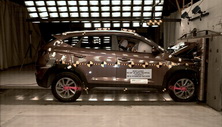
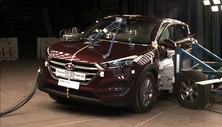
NHTSA crash tests
The agency crash-tested this model year itself. These are its own
photographs and star ratings.
Frontal crash test
Side barrier crash test
Side pole crash test
Photographs taken by NHTSA during its own New Car Assessment Program crash
tests of this model year. Public domain.
Configuration
Overall
Front
Side
Rollover
2017 Hyundai Tucson SUV AWD
16.2% risk
2017 Hyundai Tucson SUV FWD
15.5% risk
When owners complained
A spike years after the car went on sale usually means a part wearing
out on schedule across the whole fleet — the kind of pattern no single
owner can see from inside their own car.
Sep 2016peak 37Sep 2026
NHTSA investigations into the 2017 Hyundai Tucson
An investigation is the step before a recall: the agency has seen enough
complaints to look into a pattern itself. An open one means it thinks
something may be wrong and nothing has been fixed yet.
DP22003Opened 12 Sep 2022Closed 12 Dec 2023ENGINE
Loss of Motive Power
The National Highway Traffic Safety Administration (NHTSA) received a letter dated July 13, 2022, petitioning the Agency to initiate a safety defect investigation into loss of motive power allegations attributed to oil drain pan assembly failures on certain Hyundai Motor America, Inc. and Kia America, Inc. vehicles spanning Model Years (MY) 2005-2021. The Petitioners cited examples of complaints indicating that the subject vehicles were experiencing rapid loss of engine oil due to oil drain plug back outs, resulting in loss of motive power and/or catastrophic engine damage. Additional complain...
EA21003Opened 22 Dec 2021Closed 5 Feb 2024ENGINE
Engine Fires
On March 29, 2019, the Office of Defects Investigation (ODI) opened two Preliminary Evaluations (PE19-003 on Hyundai and PE19-004 on Kia) to broadly investigate incidents of non-crash fires (regardless of origin or operational status of the vehicle) on various model year Hyundai and Kia vehicles. During the PE investigations, Hyundai and Kia issued several recalls to address vehicle fires, including those due to engine failures involving various engine types. The remedies for the engine failure recalls typically involve engine inspection (to detect existing damage), and if necessary, engine...
Recalls on the 2017 Hyundai Tucson
A complaint is one owner's allegation. A recall is the point at which
the manufacturer or a regulator agreed the defect is real and dangerous
enough to fix for free — however old the car is.
United States — NHTSA
21V727000
ENGINE
Hyundai Motor America (Hyundai) is recalling certain 2017 Tucson and Sonata Hybrid vehicles. The connecting rod bearings inside the engine may wear prematurely, which can result in engine damage.
Risk: A damaged engine can increase the risk of a fire or it can cause an engine stall, increasing the risk of a crash.
20V543000
SERVICE BRAKES, HYDRAULIC:ANTILOCK/TRACTION CONTROL/ELECTRONIC LIMITED SLIP:CONTROL UNIT/MODULE
Hyundai Motor America (Hyundai) recalled certain 2019-2021 Tucson vehicles on September 4, 2020. On December 30, 2020, Hyundai expanded the recall population, and added certain 2016-2018 Tucson vehicles. The Anti-lock Brake Hydraulic Electronic Control Unit (HECU) could corrode internally and cause an electrical short, possibly resulting in an engine compartment fire.
Risk: An engine compartment fire can increase the risk of injury or crash.
16V842000
ELECTRICAL SYSTEM:WIRING
Hyundai Motor America (Hyundai) is recalling certain model year 2016-2017 Tucson vehicles manufactured May 19, 2015, to November 14, 2016, and 2017 Santa Fe vehicles manufactured November 28, 2015, to November 14, 2016. The affected vehicles may be equipped with an accessory trailer hitch wiring harness that, due to a malfunction of the tow hitch module, may result, in the trailer brake lights being constantly illuminated. As such, these vehicles fail to comply with the requirements of Federal Motor Vehicle Safety Standard (FMVSS) number 108, " Lamps, Reflective Devices, and Associated Equipment."
Risk: If the trailer brake lights stay illuminated while being used, other drivers may be confused, increasing the risk of a crash.
Canada — Transport Canada
Canada runs its own recall programme, and its campaigns do not
always mirror the American ones.
Recall 2024552824,695 units in Canada
Label
Issue: On certain vehicles, the compliance label may be missing information in French. The words listed on the label for "Tires", "Rims", "Front" and "Rear" appear in English only, when they should be listed as "Tires/Pneus", "Rims/Jantes", "Front/Avant" and "Rear/Arriere". Canadian regulations require this information to be listed on the label in both English and French. Safety Risk: These small errors do not affect vehicle safety. Corrective Actions: This is not a recall. The company has corrected the compliance label for all new vehicles.
Recall 2022244178,064 units in Canada
Engine
Issue: Hyundai Auto Canada is conducting a Product Improvement Campaign that provides an update to the engine control module to detect potential problems before an engine fails. An engine failure would cause a sudden loss of power with an inability to restart. Note: This only affects certain vehicles equipped with a 2.0 L Nu GDI engine. For the Sonata model, only the Sonata Hybrid and Plug-In Hybrid (PHEV) models are affected by this campaign. This is an expansion of R0180 (Transport Canada #2021-575). Any vehicle that received a software update under campaign R0180 does not require this update. Safety Risk: A sudden loss of engine power could increase the risk of an accident. An engine failure could also create the risk of a fire. Corrective Actions: Hyundai will notify owners by mail and advise you to take your vehicle to a dealer to update the software for the engine control module. Note: Hyundai recommends that you should always follow the correct vehicle maintenance schedule, which is printed in the Owner's Manual. If you experience unusual engine noise, reduced power, or a check engine/oil warning light, Hyundai advises you to immediately visit a Hyundai dealership to have your vehicle diagnosed.
Recall 2021575152,924 units in Canada
Engine
This recall was replaced by Transport Canada Recall No. 2022-244. Issue: Hyundai Auto Canada is conducting a Product Improvement Campaign that provides an update to the engine control module to detect potential problems before an engine fails. An engine failure would cause a sudden loss of power with an inability to restart. Note: This only affects certain vehicles equipped with a 2.0 L Nu GDI engine. For the Sonata model, only the Sonata Hybrid and Plug-In Hybrid (PHEV) models are affected by this campaign. All vehicles previously included in TC # 2021-034 are now part of this new campaign. Safety Risk: A sudden loss of engine power could increase the risk of an accident. An engine failure could also create the risk of a fire. Corrective Actions: Hyundai will notify owners by mail and advise you to take your vehicle to a dealer to update the software for the engine control module. Note: Hyundai recommends that you should always follow the correct vehicle maintenance schedule, which is printed in the Owner's Manual. If you experience unusual engine noise, reduced power, or a check engine/oil warning light, Hyundai advises you to immediately visit a Hyundai dealership to have your vehicle diagnosed.
Recall 202157334,607 units in Canada
Engine
Issue: On certain vehicles equipped with a 2.0 L Nu GDI engine, the connecting rod bearings could wear prematurely. As a result, there could be an abnormal knocking noise from the engine and/or the oil pressure warning light may turn on. If you continue to drive the vehicle with worn connecting rod bearings, the engine could fail. An engine failure would cause a sudden loss of power with an inability to restart. In some cases, a damaged connecting rod could puncture the engine block and cause an oil leak. Note: For the Sonata model, only the Sonata Hybrid is affected by this recall. Additional Note: Engine compartment fires can happen for many different reasons. In some cases, there is too much damage to find the cause of a fire. Safety Risk: A sudden loss of engine power could increase the risk of a crash. Oil that leaks onto a hot component could cause a fire. Corrective Actions: Hyundai will notify owners by mail and instruct you to take your vehicle to a dealer for an engine inspection test, to determine if there is bearing damage. If damage is found, the engine will be replaced. Dealers will also update the software for the engine control module. Note: Hyundai recommends that you should always follow the correct vehicle maintenance schedule, which is printed in the Owner's Manual.
Recall 2021034100,927 units in Canada
Engine
This campaign was replaced by Transport Canada No. 2021-575. Issue: Hyundai Auto Canada is conducting a Product Improvement Campaign that provides an update to the engine control module to detect potential problems before an engine fails. An engine failure would cause a sudden loss of power with an inability to restart. Note: This only affects vehicles equipped with a 2.0 L Nu engine. For the Sonata model, only the Sonata Hybrid is affected by this campaign. Safety Risk: A sudden loss of engine power could increase the risk of an accident. An engine failure could also create the risk of a fire. Corrective Actions: The company will notify owners by mail. Owners will be instructed to take their vehicle to a dealer to update the software for the engine control module. Note: Hyundai recommends that you should always follow the correct vehicle maintenance schedule, which is printed in the Owner's Manual. If you experience unusual engine noise, reduced power, or a check engine/oil warning light, Hyundai advises you to immediately visit a Hyundai dealership to have your vehicle diagnosed.
Recall 2020648144,700 units in Canada
Brakes
Issue: On certain vehicles, a problem in the control module for the antilock brake system (ABS) could cause it to short circuit. Note: This is an expansion of recall 2020-431. This recall does not affect vehicles equipped with Smart Cruise Control(SCC). Safety Risk: A short circuit could create a fire risk. Corrective Actions: Hyundai will notify owners by mail and advise you to take your vehicle to a dealer to revise the ABS fuse wiring and update the ABS control module, if necessary. Hyundai recommends that you should park your vehicle outdoors, and away from other vehicles or structures until the recall repairs have been completed.
Reports where the owner recorded a crash, a fire, an injury or a death.
Colorado Springs, CO2 injured
UNKNOWN OR OTHER
The panoramic sunroof glass suddenly shattered while the vehicle was being driven on the interstate, with no visible impact, object strike, or prior damage observed. The component involved is the sunroof glass panel, and it has already been removed and replaced through insurance repairs, so it is not available for inspection (however, pictures are available upon request). The incident created a loud, explosion-like sound and resulted in glass fragments falling into the interior of the vehicle, including onto the driver and the front-seat passenger, causing minor injuries. This also created a significant safety risk due to driver distraction, panic, and the potential for more serious injury while the vehicle was in motion at highway speeds. The issue has not been reproduced or independently duplicated by a dealer or service center; however, it was inspected and documented by the insurance company and repair facility during the claims and repair process, which confirmed that full glass replacement was necessary. The vehicle or component has been inspected by insurance representatives and a repair shop, but it has not been inspected by the manufacturer or law enforcement. There were no warning lamps, dashboard messages, or any prior symptoms indicating a problem before the failure occurred, and the sunroof appeared to fail suddenly and without any advance indication while the vehicle was in motion.
NHTSA complaint #11735176 — an unverified report by a vehicle owner.
Colorado Springs, CO2 injured
VISIBILITY/WIPER
The panoramic sunroof glass suddenly shattered while the vehicle was being driven on the interstate, with no visible impact, object strike, or prior damage observed. The component involved is the sunroof glass panel, and it has already been removed and replaced through insurance repairs, so it is not available for inspection (however, pictures are available upon request). The incident created a loud, explosion-like sound and resulted in glass fragments falling into the interior of the vehicle, including onto the driver and the front-seat passenger, causing minor injuries. This also created a significant safety risk due to driver distraction, panic, and the potential for more serious injury while the vehicle was in motion at highway speeds. The issue has not been reproduced or independently duplicated by a dealer or service center; however, it was inspected and documented by the insurance company and repair facility during the claims and repair process, which confirmed that full glass replacement was necessary. The vehicle or component has been inspected by insurance representatives and a repair shop, but it has not been inspected by the manufacturer or law enforcement. There were no warning lamps, dashboard messages, or any prior symptoms indicating a problem before the failure occurred, and the sunroof appeared to fail suddenly and without any advance indication while the vehicle was in motion.
NHTSA complaint #11735176 — an unverified report by a vehicle owner.
at 107,000 milesFountain, COFire
ENGINE
The contact owns a 2017 Hyundai Tucson. The contact stated that while driving at an undisclosed speed, an abnormal pop sound could be heard coming from the engine. The oil warning light was illuminated. The contact was about to merge to the side of the road when the contact noticed a glow on the underside of the vehicle. The contact then pulled into a parking lot, smoke was emitting from under the hood, and entered the vehicle through the A/C vents, and noticed the flames under the hood. The contact stated that the heater was turned on, and the contact immediately turned off the heater. The contact opened the hood and used a fire extinguisher to extinguish the flames. The fire department was called to check the vehicle to make sure the fire was extinguished. The fire department used a thermo reader to make sure that there was no more risk of a fire. The vehicle was towed to the residence. The contact towed the vehicle to the dealer, where it was diagnosed that the engine had failed. The contact was informed that the vehicle had an open recall pending: NHTSA Campaign Number: 21V727000 (ENGINE). The dealer informed the contact that since the recall was not performed, the engine had failed. The contact stated that he was the second owner and that the vehicle was purchased in 2022. The contact was unaware of the recall at the time of purchase. The dealer refused to complete the recall repairs. The vehicle was not repaired. Most recently, the contact was informed that the connecting rod failed and punctured the bottom end of the engine. The vehicle remained at the dealer unrepaired. The manufacturer was made aware of the failure and denied the recall repairs. The failure mileage was approximately 107,000.
NHTSA complaint #11709909 — an unverified report by a vehicle owner.
Warr Acres, OKFire1 injured
ENGINE
On [July 4, 2025], while driving, my vehicle experienced a sudden loss of power followed by smoke and flames coming from the engine compartment. The fire required emergency response and caused significant damage to the vehicle. Thankfully, no one was injured, but the incident posed a serious risk to my safety and others on the road. I had not received any prior warning signs such as engine knocking or warning lights. The fire appears to be directly related to the known defect outlined in Recall 209. I am requesting that NHTSA investigate this incident and ensure Hyundai is held accountable for the full scope of this defect, including fire risk. I am also seeking assistance in ensuring Hyundai provides appropriate compensation or resolution for the damages caused.
NHTSA complaint #11671728 — an unverified report by a vehicle owner.
at 110,000 milesPhelan, CAFire
ENGINE
The contact owned a 2017 Hyundai Tucson. The contact stated that the vehicle was unoccupied and parked at the residence for a couple of days, he received a call from a neighbor informing that there was a fire at his residence. The contact was not home at the time and upon arrival, he observed the vehicle engulfed in flames. The fire then quickly spread from the vehicle to the stand-alone garage and driveway causing damage. The contact and a neighbor attempted to extinguish the fire but were unsuccessful. The fire department extinguished the fire. A police report was filed. The vehicle was towed by the insurance company to the salvage lot where a forensic specialist was pending an investigation per the manufacturer and was yet to produce any information. The contact mentioned that the vehicle burned leaving only the framing remains. The manufacturer was notified of the failure. The failure mileage was approximately 110,000.
NHTSA complaint #11619124 — an unverified report by a vehicle owner.
Ada, OKFire1 injured1 killed
ELECTRICAL SYSTEM
Car had smoke engine overheating this is the 3rd engine I got sick from the smoke I don’t feel safe in that car
NHTSA complaint #11575146 — an unverified report by a vehicle owner.
The most recent complaints
In the owners' own words, exactly as filed with NHTSA.
Indianapolis, IN
UNKNOWN OR OTHER
Vehicle is losing a lot of oil. But there is no oil leaking on the ground. Upon looking at the safety recall, it says it might be fire hazardous. I noticed smoke coming from under the hood. Vehicle run rough and also hear sounds.
NHTSA complaint #11762626 — an unverified report by a vehicle owner.
Indianapolis, IN
ENGINE
Vehicle is losing a lot of oil. But there is no oil leaking on the ground. Upon looking at the safety recall, it says it might be fire hazardous. I noticed smoke coming from under the hood. Vehicle run rough and also hear sounds.
NHTSA complaint #11762626 — an unverified report by a vehicle owner.
Easton, MD
ENGINE
Franchise dealer Preson Hyundai is actively obstructing a court-ordered settlement tracking test for an engine burning 2.0 qts internally, forcing a young driver with child to operate an oil starving vehicle at risk of highway engine seizure and fire.
NHTSA complaint #11759112 — an unverified report by a vehicle owner.
Wellfleet, MA
ENGINE
I have a 2017 Hyundai Tucson with a 1.6 turbo engine, and I have been experiencing massive oil consumption. Oil is coming out of the tail pipe with occasional big puff of smoke out of the tailpipe. Skipping and hesitation during acceleration, rough cold start, I have previously had the check engine light on with a multiple misfire code. I changed the plugs and the coils, and it did not resolve the problems. I then took it to the mechanic, and he told me that the car has to go to Hyundai because these are known problems with my particular motor. I took it to Balise Hyundai in Hyannis Mass. and was told that they know about these motor issues but could not help me because the engine light was not on.' If the light comes on, then bring it back and we will check it out'.I was then told that any work performed would be my responsibility to pay for it out of my pocket. If it a known problem by Hyundai, then I think that a recall or something should be posted so customers are not stuck with a very big service bill. Any help to get my vehicle running the way it was designed to would be greatly appreciated. Apparently, there are no recalls or campaigns about these issues on my vehicle even though they are well known to Hyundai
NHTSA complaint #11759212 — an unverified report by a vehicle owner.
Bensalem, PA
UNKNOWN OR OTHER
My transmission warning light is currently on. I’ve had problems with the transmission and the dual clutch. My car falls on the cusp of 2016-2017 dual clutch problems. The 2016 was recalled although 2017 has not. Hyundai has received numerous complaints just like this and nothing has been resolved.
NHTSA complaint #11757281 — an unverified report by a vehicle owner.
Graysville, AL
ENGINE
I keep having to add oil but there is no puddle from a leak on the ground. There is also no smoke coming out of the exhaust. It is using an excessive amount of oil.
NHTSA complaint #11757176 — an unverified report by a vehicle owner.
at 97,000 milesArlington, SD
ENGINE
The contact owns a 2017 Hyundai Tucson. The contact stated that while driving at an undisclosed speed, the vehicle was shaking and vibrating abnormally, and the engine was making abnormal sounds. The check engine warning light was illuminated. The vehicle was taken to an independent mechanic, and an oil change was performed as associated with NHTSA Campaign Number: 21V727000 (Engine); however, the VIN was not included in the recall. The vehicle was not repaired. The manufacturer was not made aware of the failure. The failure mileage was approximately 97,000.
NHTSA complaint #11753739 — an unverified report by a vehicle owner.
Stockton, CA
POWER TRAIN
What component or system failed or malfunctioned, and is it available for inspection upon request? **Transmission How was your safety or the safety of others put at risk? **Car stalled, no warming. Has the problem been reproduced or confirmed by a dealer or independent service center? **Yes, J&M Transmission in Tracy, Ca Has the vehicle or component been inspected by the manufacturer, police, insurance representatives or others? **Yes, car was taken in for repair where input shaft speed sensors were replaced. Were there any warning lamps, messages or other symptoms of the problem prior to the failure, and when did they first appear? **No warning lights appeared at time of malfunction/ stall. J&M later reported check engine light was on when running tests.
NHTSA complaint #11752960 — an unverified report by a vehicle owner.
Chicago, IL
ENGINE
Car was driving weird Consuming lots of oil Check engine light flashing Took to mechanic where they replaced the spark plugs and ignition coils, cleared light. Issue was resolved for about a month. Rough idling began car begin to shake while driving. Took back to shop was told rod bearring problem. Upon research found out this is a COMMKON problem among Hyundai vehicles however my vehicle was not apart of the ‘affected batch’. Took to Hyundai and got a diagnostic where it was confirmed that a new engine was needed, for $9000.
NHTSA complaint #11752751 — an unverified report by a vehicle owner.
Brighton, CO
POWER TRAIN
The Core Symptoms: "The high-pressure fuel pump is leaking internally. Raw gasoline is flooding into the engine oil crankcase, causing severe fuel dilution. The engine air filter is physically soaked in raw fuel and smells strongly of gasoline." My engine is always extremely hot after I have only went 15 mins away from home. Sometimes takes over two hours to cool down. The Safety Risk: "When attempting to accelerate, the vehicle experiences severe fuel starvation, causing the engine to bog down and act like it is going to stall in the middle of traffic, creating a severe crash hazard. Additionally, there is a loud 'popping' sound/mini-backfire upon turning the vehicle off due to unburnt fuel vapors, presenting a high risk of an underhood engine fire. I have only 83,000 miles on my car.
NHTSA complaint #11751381 — an unverified report by a vehicle owner.
Brighton, CO
ENGINE
The Core Symptoms: "The high-pressure fuel pump is leaking internally. Raw gasoline is flooding into the engine oil crankcase, causing severe fuel dilution. The engine air filter is physically soaked in raw fuel and smells strongly of gasoline." My engine is always extremely hot after I have only went 15 mins away from home. Sometimes takes over two hours to cool down. The Safety Risk: "When attempting to accelerate, the vehicle experiences severe fuel starvation, causing the engine to bog down and act like it is going to stall in the middle of traffic, creating a severe crash hazard. Additionally, there is a loud 'popping' sound/mini-backfire upon turning the vehicle off due to unburnt fuel vapors, presenting a high risk of an underhood engine fire. I have only 83,000 miles on my car.
NHTSA complaint #11751381 — an unverified report by a vehicle owner.
Brighton, CO
FUEL/PROPULSION SYSTEM
The Core Symptoms: "The high-pressure fuel pump is leaking internally. Raw gasoline is flooding into the engine oil crankcase, causing severe fuel dilution. The engine air filter is physically soaked in raw fuel and smells strongly of gasoline." My engine is always extremely hot after I have only went 15 mins away from home. Sometimes takes over two hours to cool down. The Safety Risk: "When attempting to accelerate, the vehicle experiences severe fuel starvation, causing the engine to bog down and act like it is going to stall in the middle of traffic, creating a severe crash hazard. Additionally, there is a loud 'popping' sound/mini-backfire upon turning the vehicle off due to unburnt fuel vapors, presenting a high risk of an underhood engine fire. I have only 83,000 miles on my car.
NHTSA complaint #11751381 — an unverified report by a vehicle owner.
Levittown, NY
STEERING
Subject: Formal Safety Complaint Regarding Steering Failure – 2017 Hyundai Tucson To Whom It May Concern, I am submitting this complaint to request that the National Highway Traffic Safety Administration (NHTSA) investigate a potentially serious safety defect involving the Motor-Driven Power Steering (MDPS) system in my 2017 Hyundai Tucson. I am the second owner of this vehicle. The vehicle currently has approximately 61,000 miles and remains within Hyundai's 10-Year/100,000-Mile Powertrain Warranty period applicable to subsequent owners. Approximately two years ago, the vehicle's engine was replaced under a Hyundai safety recall. Recently, I began experiencing intermittent steering problems in which the steering wheel becomes extremely difficult to turn and appears to momentarily jam or lock while driving. This condition significantly affects vehicle control and creates a serious safety hazard, particularly during turns, lane changes, or emergency maneuvers. I brought the vehicle to Advantage Hyundai in [XXX] for diagnosis. The dealership determined that the vehicle had a Motor Position Sensor Error (Diagnostic Trouble Code C2401) within the Motor-Driven Power Steering (MDPS) system. The dealership informed me that the repair is not covered under the vehicle's warranty and declined to repair it. The dealer also submitted a request to Hyundai for goodwill assistance (Prior Authorization No. XXX), but Hyundai denied that request. I subsequently contacted Hyundai National Consumer Affairs (Case No. XXX) seeking assistance. Unfortunately, Hyundai also denied my request despite the relatively low mileage and the serious safety implications of the steering malfunction. My concern extends beyond the cost of repair. A malfunction in the electronic power steering system that causes steering to bind, jam, or become difficult to control presents a significant risk of a crash, injury, or loss of life. Steering is one of the most critical safety INFORMATION REDACTED PURSUANT TO THE FREEDOM OF INFORMATION ACT (FOIA), 5 U.S.C.
NHTSA complaint #11750742 — an unverified report by a vehicle owner.
Levittown, NY
UNKNOWN OR OTHER
Subject: Formal Safety Complaint Regarding Steering Failure – 2017 Hyundai Tucson To Whom It May Concern, I am submitting this complaint to request that the National Highway Traffic Safety Administration (NHTSA) investigate a potentially serious safety defect involving the Motor-Driven Power Steering (MDPS) system in my 2017 Hyundai Tucson. I am the second owner of this vehicle. The vehicle currently has approximately 61,000 miles and remains within Hyundai's 10-Year/100,000-Mile Powertrain Warranty period applicable to subsequent owners. Approximately two years ago, the vehicle's engine was replaced under a Hyundai safety recall. Recently, I began experiencing intermittent steering problems in which the steering wheel becomes extremely difficult to turn and appears to momentarily jam or lock while driving. This condition significantly affects vehicle control and creates a serious safety hazard, particularly during turns, lane changes, or emergency maneuvers. I brought the vehicle to Advantage Hyundai in [XXX] for diagnosis. The dealership determined that the vehicle had a Motor Position Sensor Error (Diagnostic Trouble Code C2401) within the Motor-Driven Power Steering (MDPS) system. The dealership informed me that the repair is not covered under the vehicle's warranty and declined to repair it. The dealer also submitted a request to Hyundai for goodwill assistance (Prior Authorization No. XXX), but Hyundai denied that request. I subsequently contacted Hyundai National Consumer Affairs (Case No. XXX) seeking assistance. Unfortunately, Hyundai also denied my request despite the relatively low mileage and the serious safety implications of the steering malfunction. My concern extends beyond the cost of repair. A malfunction in the electronic power steering system that causes steering to bind, jam, or become difficult to control presents a significant risk of a crash, injury, or loss of life. Steering is one of the most critical safety INFORMATION REDACTED PURSUANT TO THE FREEDOM OF INFORMATION ACT (FOIA), 5 U.S.C.
NHTSA complaint #11750742 — an unverified report by a vehicle owner.
at 62,000 milesMiddletown Township, NJ
ENGINE
The contact owns a 2017 Hyundai Tucson. The contact stated that while driving at an undisclosed speed, an abnormal knocking sound was heard coming from under the hood, and the RPMs independently increased. The "Check Engine Oil" warning light illuminated. The contact managed to pull over to the shoulder of the road, and the vehicle was towed to a local Midas shop, where it was diagnosed with total engine failure.The vehicle was towed to a local dealer, who discovered metal shavings in the engine oil pan during diagnosis. The vehicle was not repaired due to the high cost. Upon further investigation, the contact associated the failure with an unknown NHTSA Campaign number. The manufacturer was made aware of the failure. The failure mileage was approximately 62,000.
NHTSA complaint #11748995 — an unverified report by a vehicle owner.
Fort Wayne, IN
ENGINE
#1. This vehicle uses a lot of oil !!! It burns through it like crazy I have to check the oil every other day. #2. When I come to a stop while driving and give it gas to take off IT WONT GO !!!!! It hesitates and when it does go it LUNGES FORWARD!! This is a huge manufacturer problem not a buyer problem. The engine is junk.! 3. I’ve called numerous places to get help. This car needs to be recalled. This is a huge safety violation. It doesn’t wanna go when you give it gas and when it does, it lunges forward that can cause a huge accident on the highways. This car was made in China. It is junk. I’ve called to get help with this issue and no one wants to help. Nobody returns my calls and I’ll Hyundai wants to do is it even more money out of me when this isn’t my fault the car is junk. For safety concerns I would like someone to call me at [XXX]. This car needs to be recalled and my daughter has one. It’s doing the same thing except hers is a lot worse. Hers is further advance where it’s actually stalling in the middle of the road while driving huge safety violation. INFORMATION REDACTED PURSUANT TO THE FREEDOM OF INFORMATION ACT (FOIA), 5 U.S.C. 552(B)(6)
NHTSA complaint #11746594 — an unverified report by a vehicle owner.
Fort Wayne, IN
FUEL/PROPULSION SYSTEM
#1. This vehicle uses a lot of oil !!! It burns through it like crazy I have to check the oil every other day. #2. When I come to a stop while driving and give it gas to take off IT WONT GO !!!!! It hesitates and when it does go it LUNGES FORWARD!! This is a huge manufacturer problem not a buyer problem. The engine is junk.! 3. I’ve called numerous places to get help. This car needs to be recalled. This is a huge safety violation. It doesn’t wanna go when you give it gas and when it does, it lunges forward that can cause a huge accident on the highways. This car was made in China. It is junk. I’ve called to get help with this issue and no one wants to help. Nobody returns my calls and I’ll Hyundai wants to do is it even more money out of me when this isn’t my fault the car is junk. For safety concerns I would like someone to call me at [XXX]. This car needs to be recalled and my daughter has one. It’s doing the same thing except hers is a lot worse. Hers is further advance where it’s actually stalling in the middle of the road while driving huge safety violation. INFORMATION REDACTED PURSUANT TO THE FREEDOM OF INFORMATION ACT (FOIA), 5 U.S.C. 552(B)(6)
NHTSA complaint #11746594 — an unverified report by a vehicle owner.
Murrieta, CA
ENGINE
I am filing a safety complaint regarding my Hyundai vehicle after experiencing a sudden engine failure that appears consistent with known rod bearing and engine defects affecting certain Hyundai engines. While driving, my vehicle began making a knocking noise and shortly thereafter suffered catastrophic engine failure. The engine lost power and became inoperable, requiring the vehicle to be towed. This failure occurred without any prior indication that the engine was about to fail. My concern is that this type of engine failure creates a significant safety hazard because it can occur unexpectedly while driving, potentially causing a loss of power in traffic and increasing the risk of a crash. The dealership inspected the vehicle and engine but did not report excessive sludge buildup. I have provided available maintenance records showing that oil changes were performed during my ownership. Despite this, there appears to be disagreement regarding the cause of the failure. I am aware of reports involving rod bearing and engine failures in similar Hyundai vehicles and believe NHTSA should investigate whether this failure is related to a broader manufacturing or design defect. The cost of replacing the engine is substantial, and consumers may be placed at risk if these failures occur while vehicles are being operated on public roads. I am requesting that NHTSA review this issue and determine whether additional investigation, recalls, or other corrective actions are warranted. Vehicle Information: Year: 2017 Make: Hyundai Model: Tucson Mileage at Failure: Approximately 72,000 miles Date of Failure: [XXX] VIN: [XXX] INFORMATION REDACTED PURSUANT TO THE FREEDOM OF INFORMATION ACT (FOIA), 5 U.S.C. 552(B)(6)
NHTSA complaint #11746127 — an unverified report by a vehicle owner.
Trinity, FL
VEHICLE SPEED CONTROL
While traveling on the highway the car began to lose speed rapidly until coming to a complete stop, no warning lights were present prior.
NHTSA complaint #11745847 — an unverified report by a vehicle owner.
Trinity, FL
STEERING
While traveling on the highway the car began to lose speed rapidly until coming to a complete stop, no warning lights were present prior.
NHTSA complaint #11745847 — an unverified report by a vehicle owner.
Trinity, FL
ENGINE
While traveling on the highway the car began to lose speed rapidly until coming to a complete stop, no warning lights were present prior.
NHTSA complaint #11745847 — an unverified report by a vehicle owner.
at 86,000 milesMesquite, TX
ENGINE AND ENGINE COOLING:EXHAUST SYSTEM:EMISSION CONTROL:CATALYTIC CONVERTOR
The contact owns a 2017 Hyundai Tucson. The contact stated that while driving at undisclosed speeds, the vehicle was consuming an excessive amount of engine oil. The contact stated that oil was frequently added to the engine. The vehicle became inoperable. The vehicle was towed to a dealer, where it was diagnosed and determined that the catalytic converter needed to be replaced. The catalytic converter was replaced; however, the failure persisted. The vehicle was returned to the dealer for inspection, and the catalytic converter was replaced a second time. The vehicle was repaired; however, the failure persisted. No additional repairs were performed. The manufacturer was notified of the failure. The approximate failure mileage was 86,000.
NHTSA complaint #11745682 — an unverified report by a vehicle owner.
Mchenry, IL
ENGINE
Catastrophic engine failures AT 57k miles while driving, resulted in engine replacment under recall warranty. Timing chain replacement done at 93K miles. Second Engine failure while driving at 107K. Hyundai refuses to fix the engine.
NHTSA complaint #11743818 — an unverified report by a vehicle owner.
Suffolk, VA
UNKNOWN OR OTHER
Catalytic converter has now failed twice with only 105,000 miles
NHTSA complaint #11743126 — an unverified report by a vehicle owner.
Matthews, NC
ENGINE
2017 Hyundai Tucson | VIN: [XXX] | Mileage: 75,000 I have owned this vehicle for approximately five years and have experienced severe excessive oil consumption for the past two to three years. The issue was first discovered when the vehicle entered protective mode due to critically low oil levels despite a routine oil change having been performed only a few months prior. I am currently required to add approximately one quart of oil every month to maintain safe operating levels. I visited an authorized Hyundai dealership to have an oil consumption test performed. The dealership informed me that if the test confirmed excessive consumption, I would be required to pay out of pocket for an engine replacement. I declined, as Hyundai Motor America has publicly acknowledged this exact defect in the 2017 Tucson through NHTSA Recall 21V727000, multiple Technical Service Bulletins, and a class action settlement covering 2014-2021 Tucson vehicles with the Nu 2.0-liter GDI engine. My VIN was found ineligible on the class action settlement website despite the acknowledged defect. Hyundai has admitted this engine suffers from premature bearing wear, excessive oil consumption, and risk of engine failure and fire. I am requesting NHTSA investigate why my VIN falls outside current recall coverage despite presenting identical symptoms to affected vehicles. INFORMATION REDACTED PURSUANT TO THE FREEDOM OF INFORMATION ACT (FOIA), 5 U.S.C. 552(B)(6)
NHTSA complaint #11743121 — an unverified report by a vehicle owner.