Owners have filed 599 complaints
about the 2022 Hyundai Tucson with NHTSA between 2021 and 2026.
The largest single group is the fuel & propulsion.
Across this model's run it ranks 3 of 22 worst.
The letter says how bad. This says what kind — whether this year drew
an unusual number of complaints, unusually dangerous
ones, or failures that arrived unusually early.
The dashed ring is 50 — the national norm. Further out is worse.
Complaint volume — 76
Against the median year of the Hyundai Tucson. 50 means typical for this
model; 100 means roughly double.
Severity — 59
11.4% of these complaints
involved a crash, fire, injury or death, against a national rate of
9.7%.
Early failure — 100
70% of failures with a mileage on record happened under
36,000 miles, against a national rate of
29%.
NHTSA files every complaint against a named sub-assembly, not just a
system. This is the difference between knowing it was "the engine" and
knowing which part of it — the list to hand a mechanic.
Automatic Emergency Braking
2435.8%
Warnings
1928.4%
Blind Spot Detection
69.0%
Rearview System Braking
46.0%
Warnings
46.0%
Adaptive Cruise Control
46.0%
Body
46.0%
Warning
23.0%
When it fails
Odometer readings owners gave when they filed. About half of all
complaints include one.
Under 1,000 miles
711.5%
1,000 – 9,999 miles
1118.0%
10,000 – 24,999 miles
914.8%
25,000 – 49,999 miles
2032.8%
50,000 – 74,999 miles
813.1%
75,000 – 99,999 miles
46.6%
100,000 – 149,999 miles
23.3%
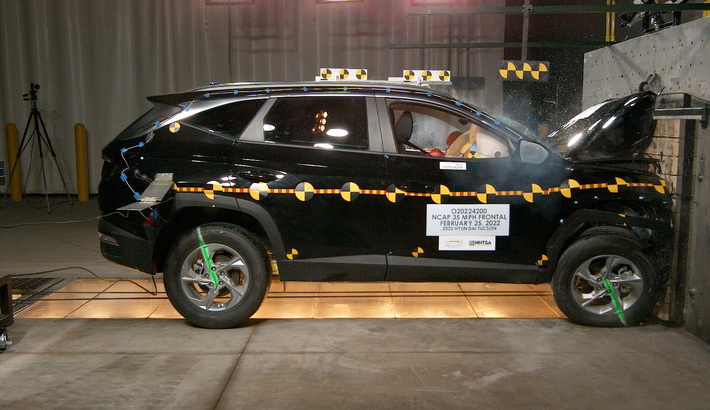
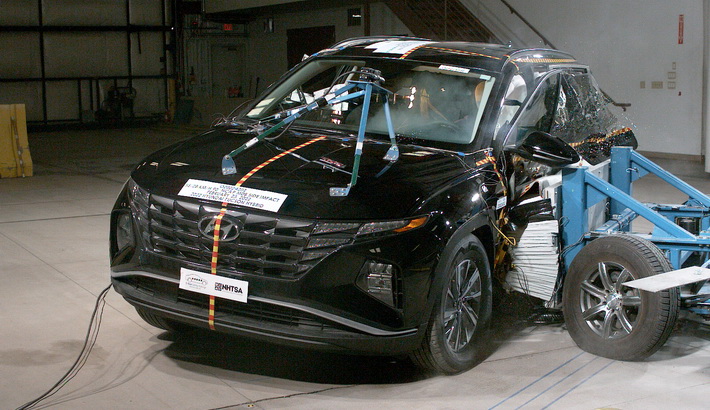
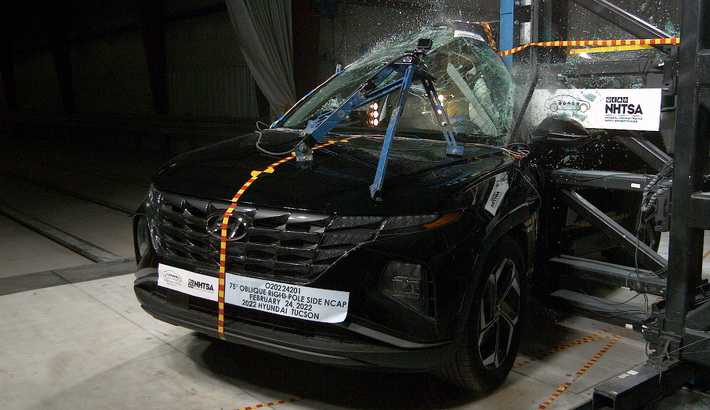
NHTSA crash tests
The agency crash-tested this model year itself. These are its own
photographs and star ratings.
Frontal crash test
Side barrier crash test
Side pole crash test
Photographs taken by NHTSA during its own New Car Assessment Program crash
tests of this model year. Public domain.
Configuration
Overall
Front
Side
Rollover
2022 Hyundai Tucson SUV FWD Later Release
15.9% risk
2022 Hyundai Tucson SUV AWD Later Release
17.4% risk
2022 Hyundai Tucson SUV AWD Early Release
17.4% risk
2022 Hyundai Tucson SUV FWD Early Release
15.9% risk
When owners complained
A spike years after the car went on sale usually means a part wearing
out on schedule across the whole fleet — the kind of pattern no single
owner can see from inside their own car.
Jun 2021peak 24Sep 2026
NHTSA investigations into the 2022 Hyundai Tucson
An investigation is the step before a recall: the agency has seen enough
complaints to look into a pattern itself. An open one means it thinks
something may be wrong and nothing has been fixed yet.
DP22005Opened 27 Jan 2023Closed 7 Aug 2023ELECTRICAL SYSTEM:PROPULSION SYSTEM
Pedestrian alert sounds
NHTSA received a petition on or about July 18, 2022, requesting that Federal Motor Vehicle Safety Standard (FMVSS) 141 be applied to all electric and hybrid vehicles operating in the United States. The petition can be reviewed at NHTSA.gov under ODI Number 11486072. FMVSS 141 establishes performance requirements for pedestrian alert sounds for motor vehicles. The standard applies to hybrid and electric vehicles that have a gross vehicle weight rating of 4,536 KG or less or are defined as low-speed vehicles. The standard became fully applicable to all such vehicles manufactured on or after Marc...
DP22003Opened 12 Sep 2022Closed 12 Dec 2023ENGINE
Loss of Motive Power
The National Highway Traffic Safety Administration (NHTSA) received a letter dated July 13, 2022, petitioning the Agency to initiate a safety defect investigation into loss of motive power allegations attributed to oil drain pan assembly failures on certain Hyundai Motor America, Inc. and Kia America, Inc. vehicles spanning Model Years (MY) 2005-2021. The Petitioners cited examples of complaints indicating that the subject vehicles were experiencing rapid loss of engine oil due to oil drain plug back outs, resulting in loss of motive power and/or catastrophic engine damage. Additional complain...
Recalls on the 2022 Hyundai Tucson
A complaint is one owner's allegation. A recall is the point at which
the manufacturer or a regulator agreed the defect is real and dangerous
enough to fix for free — however old the car is.
United States — NHTSA
25V893000
TRAILER HITCHES
Hyundai Motor America (Hyundai) is recalling certain 2022-2024 Tucson vehicles equipped with an optional Mobis tow hitch wiring harness. The wiring harness may have been installed incorrectly, allowing water into the control module. Moisture accumulation may cause the trailer lighting to fail or an electrical short circuit.
Risk: Nonfunctioning trailer lights can increase the risk of a crash. A short circuit can increase the risk of a fire.
23V038000
STRUCTURE:BODY:ROOF AND PILLARS
Hyundai Motor America (Hyundai) is recalling certain 2022 Tucson and 2022-2023 Santa Cruz vehicles. The roof moldings may detach.
Risk: A detached roof molding could become a road hazard, increasing the risk of a crash.
21V938000
ELECTRICAL SYSTEM:SOFTWARE
Hyundai Motor America (Hyundai) is recalling certain 2022 Tucson vehicles. The software installed in the Integrated Central Control Unit (ICU) may be incompatible with the vehicle, which could result in inoperative headlights and/or taillights.
Risk: Inoperative headlights or taillights can decrease visibility for both the driver and surrounding traffic, increasing the risk of a crash.
Canada — Transport Canada
Canada runs its own recall programme, and its campaigns do not
always mirror the American ones.
Recall 20257029,669 units in Canada
Accessories
Issue: This recall is for certain trailer wiring harnesses that were installed before delivery or sold as a dealer accessory. On certain vehicles, the trailer wiring harness may not have been manufactured properly. As a result, water could leak into the harness and cause it to fail. If this happens, the trailer lights and/or the vehicle's stop lights may not work. This could also cause the wiring harness to short circuit. Note: This recall only affects certain vehicles equipped with a Hyundai Genuine accessory trailer wiring harness part number N7H03-AP100. Safety Risk: Vehicle and/or trailer lights that don't work could make the vehicle and/or trailer less visible and cause others not to recognize that the vehicle is braking or intends to turn or change lanes. These issues could increase the risk of a crash. Additionally, a short circuit can create the risk of a fire. Corrective Actions: Hyundai will notify owners in writing. The corrective actions for this recall are under development.
Recall 2024552824,695 units in Canada
Label
Issue: On certain vehicles, the compliance label may be missing information in French. The words listed on the label for "Tires", "Rims", "Front" and "Rear" appear in English only, when they should be listed as "Tires/Pneus", "Rims/Jantes", "Front/Avant" and "Rear/Arriere". Canadian regulations require this information to be listed on the label in both English and French. Safety Risk: These small errors do not affect vehicle safety. Corrective Actions: This is not a recall. The company has corrected the compliance label for all new vehicles.
Recall 2021357693 units in Canada
Lights And Instruments
Issue: On certain hybrid electric vehicles (HEV), the daytime running lamps (DRLs) do not turn on when you use the Remote Smart Parking Assist feature. Canadian regulations require the DRLs to turn on when the vehicle moves. Safety Risk: A moving vehicle without daytime running lights may be less visible to people and could increase the risk of a crash. Corrective Actions: Hyundai will notify owners by mail and instruct you to take your vehicle to a dealer to update the vehicle software.
Reports where the owner recorded a crash, a fire, an injury or a death.
Leominster, MACrash
ELECTRICAL SYSTEM
My wife was driving my SUV while I was a passenger. We were in the left lane, and put the left turn signal on while traveling south bound approaching an intersection to take a left turn (traveling approximately 3-5 Miles Per Hour and slowing) at the traffic light (traffic light was green). There was a car in front of us that had stopped waiting for oncoming traffic to clear and make the same left turn onto the same road as us. While traveling in this lane we hit a deep pot hole (not very visible while driving), just as we were approaching the vehicle stopped in front of us. When hitting the pot hole, our SUV seemed to leap forward a bit and when the brakes were applied to slow and stop, the braking system failed (appeared to freeze) and the brakes did not work, and because the braking didn’t work, our vehicle hit the car in front of us. Prior to and after hitting the pothole, no audible warning sounds or visible alerts appeared and no emergency braking was activated. The airbags in our vehicle never deployed. Our safety (my wife and I) as well as the safety of the 2 passengers in the other vehicle were at risk as we all could have been injured in the accident. As we needed the vehicle for transportation, we immediately began filing all the necessary police and insurance reports and brought our vehicle into an Auto Body Repair Shop to be repaired the next day. During the repair work, some of the responsible components may or may not have been replaced and the Auto Body Repair Shop also had all the car sensors recalibrated by a 3rd party, which is why we did not bring the car to a dealership to evaluate. To the best of our knowledge, the manufacturer, the police and the insurance company did not inspect the vehicle. We are not experts, but hitting a pothole might be considered an edge case, so I’m not sure that a dealership would have tried or been able to replicate the issue.
NHTSA complaint #11759064 — an unverified report by a vehicle owner.
Leominster, MACrash
SERVICE BRAKES
My wife was driving my SUV while I was a passenger. We were in the left lane, and put the left turn signal on while traveling south bound approaching an intersection to take a left turn (traveling approximately 3-5 Miles Per Hour and slowing) at the traffic light (traffic light was green). There was a car in front of us that had stopped waiting for oncoming traffic to clear and make the same left turn onto the same road as us. While traveling in this lane we hit a deep pot hole (not very visible while driving), just as we were approaching the vehicle stopped in front of us. When hitting the pot hole, our SUV seemed to leap forward a bit and when the brakes were applied to slow and stop, the braking system failed (appeared to freeze) and the brakes did not work, and because the braking didn’t work, our vehicle hit the car in front of us. Prior to and after hitting the pothole, no audible warning sounds or visible alerts appeared and no emergency braking was activated. The airbags in our vehicle never deployed. Our safety (my wife and I) as well as the safety of the 2 passengers in the other vehicle were at risk as we all could have been injured in the accident. As we needed the vehicle for transportation, we immediately began filing all the necessary police and insurance reports and brought our vehicle into an Auto Body Repair Shop to be repaired the next day. During the repair work, some of the responsible components may or may not have been replaced and the Auto Body Repair Shop also had all the car sensors recalibrated by a 3rd party, which is why we did not bring the car to a dealership to evaluate. To the best of our knowledge, the manufacturer, the police and the insurance company did not inspect the vehicle. We are not experts, but hitting a pothole might be considered an edge case, so I’m not sure that a dealership would have tried or been able to replicate the issue.
NHTSA complaint #11759064 — an unverified report by a vehicle owner.
My wife was driving my SUV while I was a passenger. We were in the left lane, and put the left turn signal on while traveling south bound approaching an intersection to take a left turn (traveling approximately 3-5 Miles Per Hour and slowing) at the traffic light (traffic light was green). There was a car in front of us that had stopped waiting for oncoming traffic to clear and make the same left turn onto the same road as us. While traveling in this lane we hit a deep pot hole (not very visible while driving), just as we were approaching the vehicle stopped in front of us. When hitting the pot hole, our SUV seemed to leap forward a bit and when the brakes were applied to slow and stop, the braking system failed (appeared to freeze) and the brakes did not work, and because the braking didn’t work, our vehicle hit the car in front of us. Prior to and after hitting the pothole, no audible warning sounds or visible alerts appeared and no emergency braking was activated. The airbags in our vehicle never deployed. Our safety (my wife and I) as well as the safety of the 2 passengers in the other vehicle were at risk as we all could have been injured in the accident. As we needed the vehicle for transportation, we immediately began filing all the necessary police and insurance reports and brought our vehicle into an Auto Body Repair Shop to be repaired the next day. During the repair work, some of the responsible components may or may not have been replaced and the Auto Body Repair Shop also had all the car sensors recalibrated by a 3rd party, which is why we did not bring the car to a dealership to evaluate. To the best of our knowledge, the manufacturer, the police and the insurance company did not inspect the vehicle. We are not experts, but hitting a pothole might be considered an edge case, so I’m not sure that a dealership would have tried or been able to replicate the issue.
NHTSA complaint #11759064 — an unverified report by a vehicle owner.
Pendleton, SCCrash
VEHICLE SPEED CONTROL
On 3 occasions over my 18-month ownership of this certified pre-owned Hyundai 2022 Tucson, the vehicle surged suddenly forward WITH BRAKE APPLIED at creeping (parking) speeds of 3-4 mph. No warning lamps were observed. On the most recent (3rd) occasion, a crash over a sidewalk and into a storefront caused $10,000 damage. No pedestrians were harmed, no airbags deployed and neither passenger was harmed. The service department is "unable to duplicate" the surging behavior and declares the car mechanically "safe to drive."
NHTSA complaint #11743887 — an unverified report by a vehicle owner.
Pendleton, SCCrash
SERVICE BRAKES
On 3 occasions over my 18-month ownership of this certified pre-owned Hyundai 2022 Tucson, the vehicle surged suddenly forward WITH BRAKE APPLIED at creeping (parking) speeds of 3-4 mph. No warning lamps were observed. On the most recent (3rd) occasion, a crash over a sidewalk and into a storefront caused $10,000 damage. No pedestrians were harmed, no airbags deployed and neither passenger was harmed. The service department is "unable to duplicate" the surging behavior and declares the car mechanically "safe to drive."
NHTSA complaint #11743887 — an unverified report by a vehicle owner.
Pendleton, SCCrash
FUEL/PROPULSION SYSTEM
On 3 occasions over my 18-month ownership of this certified pre-owned Hyundai 2022 Tucson, the vehicle surged suddenly forward WITH BRAKE APPLIED at creeping (parking) speeds of 3-4 mph. No warning lamps were observed. On the most recent (3rd) occasion, a crash over a sidewalk and into a storefront caused $10,000 damage. No pedestrians were harmed, no airbags deployed and neither passenger was harmed. The service department is "unable to duplicate" the surging behavior and declares the car mechanically "safe to drive."
NHTSA complaint #11743887 — an unverified report by a vehicle owner.
The most recent complaints
In the owners' own words, exactly as filed with NHTSA.
Lithonia, GA
ENGINE
Vehicle Fuel Injector code P053F84 Reading on 9/9/26, this is the second time vehicle was taken to the dealership for the exact same problem, the idle button in orange, and displayed, first visit while vehicle within warranty limits technician stated couldn't find anything wrong, now vehicle is out of warranty and dealership wants $1300 to fix the same issue.also the Engine was hesitating at each occurrence.
NHTSA complaint #11763264 — an unverified report by a vehicle owner.
Lithonia, GA
FUEL/PROPULSION SYSTEM
Vehicle Fuel Injector code P053F84 Reading on 9/9/26, this is the second time vehicle was taken to the dealership for the exact same problem, the idle button in orange, and displayed, first visit while vehicle within warranty limits technician stated couldn't find anything wrong, now vehicle is out of warranty and dealership wants $1300 to fix the same issue.also the Engine was hesitating at each occurrence.
NHTSA complaint #11763264 — an unverified report by a vehicle owner.
Palm Coast, FL
FORWARD COLLISION AVOIDANCE: WARNINGS
I had just started accelerating from a stop light at 715 am on a clear morning. I was not close to any other cars and there was no traffic entering. Without warning my collision warning came on and brought the car to a sudden stop. This is damgerous and I am lucky I was not rear ended
NHTSA complaint #11761873 — an unverified report by a vehicle owner.
I had just started accelerating from a stop light at 715 am on a clear morning. I was not close to any other cars and there was no traffic entering. Without warning my collision warning came on and brought the car to a sudden stop. This is damgerous and I am lucky I was not rear ended
NHTSA complaint #11761873 — an unverified report by a vehicle owner.
Post Falls, ID
ENGINE
The car was shaking, idling and accelerating and engine lights on.
NHTSA complaint #11761706 — an unverified report by a vehicle owner.
Post Falls, ID
LANE DEPARTURE: BLIND SPOT DETECTION
The car was shaking, idling and accelerating and engine lights on.
NHTSA complaint #11761706 — an unverified report by a vehicle owner.
The car was shaking, idling and accelerating and engine lights on.
NHTSA complaint #11761706 — an unverified report by a vehicle owner.
at 69,000 milesBellingham, MA
TRAILER HITCHES
The contact owns a 2022 Hyundai Tucson. The contact stated that while driving at an undisclosed speed, the right turn signal indicator light failed to illuminate on the instrument panel upon depressing the turn signal lever to make a right turn. No warning lights illuminated. Additionally, upon depressing the turn signal lever to make a left turn, the left turn signal indicator light failed to illuminate. The contact stated that the failure progressed. While driving at various speeds, the brake lights failed to illuminate when the brake pedal was depressed. The vehicle was taken to an independent mechanic, where it was diagnosed that the wiring harness needed to be replaced. The vehicle was repaired. The contact associated the failure with NHTSA Campaign Number: 25V893000 (Trailer Hitches); however, the VIN was not included in the recall. The dealer and the manufacturer were notified of the failure, and a case was filed. The failure mileage was approximately 69,000.
NHTSA complaint #11760871 — an unverified report by a vehicle owner.
at 69,000 milesBellingham, MA
ELECTRICAL SYSTEM
The contact owns a 2022 Hyundai Tucson. The contact stated that while driving at an undisclosed speed, the right turn signal indicator light failed to illuminate on the instrument panel upon depressing the turn signal lever to make a right turn. No warning lights illuminated. Additionally, upon depressing the turn signal lever to make a left turn, the left turn signal indicator light failed to illuminate. The contact stated that the failure progressed. While driving at various speeds, the brake lights failed to illuminate when the brake pedal was depressed. The vehicle was taken to an independent mechanic, where it was diagnosed that the wiring harness needed to be replaced. The vehicle was repaired. The contact associated the failure with NHTSA Campaign Number: 25V893000 (Trailer Hitches); however, the VIN was not included in the recall. The dealer and the manufacturer were notified of the failure, and a case was filed. The failure mileage was approximately 69,000.
NHTSA complaint #11760871 — an unverified report by a vehicle owner.
Houston, TX
POWER TRAIN
In April 2026 (29,805 miles) I was on an interstate underpass U-turn and when I went to accelerate from the U-turn, the vehicle “revved”, had difficulty accelerating, and appeared to not go into the next gear for a roughly 10 seconds, meaning I was unable to accelerate and get out of the way from oncoming traffic. Traffic slowed and the vehicle suddenly returned to normal (no warning lights appeared) and I drove home cautiously with hazards on. When attempting to leave less than 45 minutes later, the vehicle started, then as I placed it into drive, it began lunging and the check engine light appeared. Because it was running rough and kept lunging, I parked and had it towed to the dealership. The DTC code listed was PO30300 (DTC system powertrain and subsystem EMS). Per the dealership, fuel injector #3 was bad and needed to be replaced. When I picked up the vehicle, notes stated “ GDI FUEL INJCTR REPL (ALL4)”. I picked up the vehicle after the repair. In August 2026 (30,923 miles), with less than 1,000 miles driven since repair, I started the vehicle and it immediately “died”. I restarted it and the check engine light came on and it began lunging out of my driveway. I also had difficulty getting the vehicle to brake and almost hit our community entrance/exit gate. A notification appeared on my infotainment system stating: “A possible condition with your Engine Control System has been detected. A full system check is recommended to be done soon. Please contact your local dealership to schedule an appointment”. The DTC codes listed on the Hyundai app were: PO30020, PO30040, PO30010, PO30000, and PO19185, P217700. (DTC system powertrain and subsystem EMS). I had the vehicle towed to the dealership. They didn’t have a loaner vehicle and I canceled my trip. Later, I was notified that “a hose was disconnected and was allowing air to enter the engine”. He stated, “we flushed it out and everything is working now”. I was told I could come pick it up before they closed.
NHTSA complaint #11760655 — an unverified report by a vehicle owner.
Houston, TX
ENGINE
In April 2026 (29,805 miles) I was on an interstate underpass U-turn and when I went to accelerate from the U-turn, the vehicle “revved”, had difficulty accelerating, and appeared to not go into the next gear for a roughly 10 seconds, meaning I was unable to accelerate and get out of the way from oncoming traffic. Traffic slowed and the vehicle suddenly returned to normal (no warning lights appeared) and I drove home cautiously with hazards on. When attempting to leave less than 45 minutes later, the vehicle started, then as I placed it into drive, it began lunging and the check engine light appeared. Because it was running rough and kept lunging, I parked and had it towed to the dealership. The DTC code listed was PO30300 (DTC system powertrain and subsystem EMS). Per the dealership, fuel injector #3 was bad and needed to be replaced. When I picked up the vehicle, notes stated “ GDI FUEL INJCTR REPL (ALL4)”. I picked up the vehicle after the repair. In August 2026 (30,923 miles), with less than 1,000 miles driven since repair, I started the vehicle and it immediately “died”. I restarted it and the check engine light came on and it began lunging out of my driveway. I also had difficulty getting the vehicle to brake and almost hit our community entrance/exit gate. A notification appeared on my infotainment system stating: “A possible condition with your Engine Control System has been detected. A full system check is recommended to be done soon. Please contact your local dealership to schedule an appointment”. The DTC codes listed on the Hyundai app were: PO30020, PO30040, PO30010, PO30000, and PO19185, P217700. (DTC system powertrain and subsystem EMS). I had the vehicle towed to the dealership. They didn’t have a loaner vehicle and I canceled my trip. Later, I was notified that “a hose was disconnected and was allowing air to enter the engine”. He stated, “we flushed it out and everything is working now”. I was told I could come pick it up before they closed.
NHTSA complaint #11760655 — an unverified report by a vehicle owner.
Houston, TX
FUEL/PROPULSION SYSTEM
In April 2026 (29,805 miles) I was on an interstate underpass U-turn and when I went to accelerate from the U-turn, the vehicle “revved”, had difficulty accelerating, and appeared to not go into the next gear for a roughly 10 seconds, meaning I was unable to accelerate and get out of the way from oncoming traffic. Traffic slowed and the vehicle suddenly returned to normal (no warning lights appeared) and I drove home cautiously with hazards on. When attempting to leave less than 45 minutes later, the vehicle started, then as I placed it into drive, it began lunging and the check engine light appeared. Because it was running rough and kept lunging, I parked and had it towed to the dealership. The DTC code listed was PO30300 (DTC system powertrain and subsystem EMS). Per the dealership, fuel injector #3 was bad and needed to be replaced. When I picked up the vehicle, notes stated “ GDI FUEL INJCTR REPL (ALL4)”. I picked up the vehicle after the repair. In August 2026 (30,923 miles), with less than 1,000 miles driven since repair, I started the vehicle and it immediately “died”. I restarted it and the check engine light came on and it began lunging out of my driveway. I also had difficulty getting the vehicle to brake and almost hit our community entrance/exit gate. A notification appeared on my infotainment system stating: “A possible condition with your Engine Control System has been detected. A full system check is recommended to be done soon. Please contact your local dealership to schedule an appointment”. The DTC codes listed on the Hyundai app were: PO30020, PO30040, PO30010, PO30000, and PO19185, P217700. (DTC system powertrain and subsystem EMS). I had the vehicle towed to the dealership. They didn’t have a loaner vehicle and I canceled my trip. Later, I was notified that “a hose was disconnected and was allowing air to enter the engine”. He stated, “we flushed it out and everything is working now”. I was told I could come pick it up before they closed.
NHTSA complaint #11760655 — an unverified report by a vehicle owner.
at 108,565 milesSpringfield, MA
ELECTRICAL SYSTEM
The contact owns a 2022 Hyundai Tucson. The contact stated while driving at an undisclosed speed, several unknown warning lights illuminated. The vehicle was taken to an independent mechanic, where it was diagnosed with ECU software error. The contact was advised to contact the dealer. The dealer was made aware of the failure and advised the contact to report the failure to the NHTSA Hotline. The contact referenced an unknown recall; however, the VIN was not associated with a recall related to the failure. The manufacturer was not made aware of the failure. The failure mileage was approximately 108,565.
NHTSA complaint #11760437 — an unverified report by a vehicle owner.
Quilcene, WA
ENGINE
Vehicle turned itself off with no warning while being driven @ 40 moh. Dealer suspects fuel injectors, but could be ignition coil.
NHTSA complaint #11760391 — an unverified report by a vehicle owner.
at 108,565 milesSpringfield, MA
ENGINE
The contact owns a 2022 Hyundai Tucson. The contact stated while driving at an undisclosed speed, several unknown warning lights illuminated. The vehicle was taken to an independent mechanic, where it was diagnosed with ECU software error. The contact was advised to contact the dealer. The dealer was made aware of the failure and advised the contact to report the failure to the NHTSA Hotline. The contact referenced an unknown recall; however, the VIN was not associated with a recall related to the failure. The manufacturer was not made aware of the failure. The failure mileage was approximately 108,565.
NHTSA complaint #11760437 — an unverified report by a vehicle owner.
North Richland Hills, TX
UNKNOWN OR OTHER
On August 26, 2026, while driving to work, my 2022 Hyundai Tucson unexpectedly lost power and shut down while the vehicle was being driven. This created a serious safety concern because the vehicle became inoperable while in traffic. This vehicle has had a history of repeated problems and has been taken to Hyundai dealerships for repairs on numerous occasions. Despite these previous dealership visits and repair attempts, the vehicle continues to experience problems. The latest incident, in which the vehicle shut down while being driven, has significantly increased my concern regarding the safety and reliability of the vehicle. The vehicle is being made available for inspection and diagnosis. At this time, the exact component or cause of the failure is unknown. I am requesting that this complaint be documented because of the sudden loss of power while driving and the vehicle's history of repeated dealership visits and repairs. I am concerned that this condition could cause a crash if the vehicle unexpectedly loses power again while traveling in traffic or at highway speeds.
NHTSA complaint #11759644 — an unverified report by a vehicle owner.
Clarksville, TN
FUEL/PROPULSION SYSTEM
Fuel injector went bad causing vehicle engine to misfire and shake rapidly. Check engine light is on. The vehicle only has 40,000 miles on it. Seems to be a very common concern for this make and model and roughly the same years. Will not accelerate instantly and will surge a bit when it does. Will still shake when the vehicle is idle.
NHTSA complaint #11759767 — an unverified report by a vehicle owner.
Leominster, MACrash
ELECTRICAL SYSTEM
My wife was driving my SUV while I was a passenger. We were in the left lane, and put the left turn signal on while traveling south bound approaching an intersection to take a left turn (traveling approximately 3-5 Miles Per Hour and slowing) at the traffic light (traffic light was green). There was a car in front of us that had stopped waiting for oncoming traffic to clear and make the same left turn onto the same road as us. While traveling in this lane we hit a deep pot hole (not very visible while driving), just as we were approaching the vehicle stopped in front of us. When hitting the pot hole, our SUV seemed to leap forward a bit and when the brakes were applied to slow and stop, the braking system failed (appeared to freeze) and the brakes did not work, and because the braking didn’t work, our vehicle hit the car in front of us. Prior to and after hitting the pothole, no audible warning sounds or visible alerts appeared and no emergency braking was activated. The airbags in our vehicle never deployed. Our safety (my wife and I) as well as the safety of the 2 passengers in the other vehicle were at risk as we all could have been injured in the accident. As we needed the vehicle for transportation, we immediately began filing all the necessary police and insurance reports and brought our vehicle into an Auto Body Repair Shop to be repaired the next day. During the repair work, some of the responsible components may or may not have been replaced and the Auto Body Repair Shop also had all the car sensors recalibrated by a 3rd party, which is why we did not bring the car to a dealership to evaluate. To the best of our knowledge, the manufacturer, the police and the insurance company did not inspect the vehicle. We are not experts, but hitting a pothole might be considered an edge case, so I’m not sure that a dealership would have tried or been able to replicate the issue.
NHTSA complaint #11759064 — an unverified report by a vehicle owner.
Leominster, MACrash
SERVICE BRAKES
My wife was driving my SUV while I was a passenger. We were in the left lane, and put the left turn signal on while traveling south bound approaching an intersection to take a left turn (traveling approximately 3-5 Miles Per Hour and slowing) at the traffic light (traffic light was green). There was a car in front of us that had stopped waiting for oncoming traffic to clear and make the same left turn onto the same road as us. While traveling in this lane we hit a deep pot hole (not very visible while driving), just as we were approaching the vehicle stopped in front of us. When hitting the pot hole, our SUV seemed to leap forward a bit and when the brakes were applied to slow and stop, the braking system failed (appeared to freeze) and the brakes did not work, and because the braking didn’t work, our vehicle hit the car in front of us. Prior to and after hitting the pothole, no audible warning sounds or visible alerts appeared and no emergency braking was activated. The airbags in our vehicle never deployed. Our safety (my wife and I) as well as the safety of the 2 passengers in the other vehicle were at risk as we all could have been injured in the accident. As we needed the vehicle for transportation, we immediately began filing all the necessary police and insurance reports and brought our vehicle into an Auto Body Repair Shop to be repaired the next day. During the repair work, some of the responsible components may or may not have been replaced and the Auto Body Repair Shop also had all the car sensors recalibrated by a 3rd party, which is why we did not bring the car to a dealership to evaluate. To the best of our knowledge, the manufacturer, the police and the insurance company did not inspect the vehicle. We are not experts, but hitting a pothole might be considered an edge case, so I’m not sure that a dealership would have tried or been able to replicate the issue.
NHTSA complaint #11759064 — an unverified report by a vehicle owner.
My wife was driving my SUV while I was a passenger. We were in the left lane, and put the left turn signal on while traveling south bound approaching an intersection to take a left turn (traveling approximately 3-5 Miles Per Hour and slowing) at the traffic light (traffic light was green). There was a car in front of us that had stopped waiting for oncoming traffic to clear and make the same left turn onto the same road as us. While traveling in this lane we hit a deep pot hole (not very visible while driving), just as we were approaching the vehicle stopped in front of us. When hitting the pot hole, our SUV seemed to leap forward a bit and when the brakes were applied to slow and stop, the braking system failed (appeared to freeze) and the brakes did not work, and because the braking didn’t work, our vehicle hit the car in front of us. Prior to and after hitting the pothole, no audible warning sounds or visible alerts appeared and no emergency braking was activated. The airbags in our vehicle never deployed. Our safety (my wife and I) as well as the safety of the 2 passengers in the other vehicle were at risk as we all could have been injured in the accident. As we needed the vehicle for transportation, we immediately began filing all the necessary police and insurance reports and brought our vehicle into an Auto Body Repair Shop to be repaired the next day. During the repair work, some of the responsible components may or may not have been replaced and the Auto Body Repair Shop also had all the car sensors recalibrated by a 3rd party, which is why we did not bring the car to a dealership to evaluate. To the best of our knowledge, the manufacturer, the police and the insurance company did not inspect the vehicle. We are not experts, but hitting a pothole might be considered an edge case, so I’m not sure that a dealership would have tried or been able to replicate the issue.
NHTSA complaint #11759064 — an unverified report by a vehicle owner.
at 3,212 milesRosharon, TX
ELECTRICAL SYSTEM
The contact owns a 2022 Hyundai Tucson. The contact stated that the check engine warning light illuminated and was cleared; however, the warning light returned hours or days later. The dealer had cleared the check engine warning light approximately 15-16 times. The vehicle occasionally stalled while driving at various speeds. The dealer diagnosed the vehicle with terminal engine failure. The contact was informed that the fuel system needed to be overhauled, and the fuel injectors and caps needed to be replaced. The vehicle was repaired twice. The failure persisted after the contact had confirmed the diagnosis with a certified mechanic. The vehicle was returned to the dealer, who replaced the engine. The vehicle was parked for several hours, and the contact attempted to turn on the headlights, but the headlights failed to illuminate. While driving the vehicle, the vehicle hesitated several times. The following day, the vehicle failed to start approximately four times. The vehicle was driven to the dealer but hesitated several times along the way and failed to start once at the dealer. The dealer diagnosed the vehicle and determined that the battery and other parts needed to be replaced; however, the vehicle was not repaired. The manufacturer was made aware of the failure, and a complaint was filed. The failure mileage was 3,212.
NHTSA complaint #11756964 — an unverified report by a vehicle owner.
at 3,212 milesRosharon, TX
ENGINE
The contact owns a 2022 Hyundai Tucson. The contact stated that the check engine warning light illuminated and was cleared; however, the warning light returned hours or days later. The dealer had cleared the check engine warning light approximately 15-16 times. The vehicle occasionally stalled while driving at various speeds. The dealer diagnosed the vehicle with terminal engine failure. The contact was informed that the fuel system needed to be overhauled, and the fuel injectors and caps needed to be replaced. The vehicle was repaired twice. The failure persisted after the contact had confirmed the diagnosis with a certified mechanic. The vehicle was returned to the dealer, who replaced the engine. The vehicle was parked for several hours, and the contact attempted to turn on the headlights, but the headlights failed to illuminate. While driving the vehicle, the vehicle hesitated several times. The following day, the vehicle failed to start approximately four times. The vehicle was driven to the dealer but hesitated several times along the way and failed to start once at the dealer. The dealer diagnosed the vehicle and determined that the battery and other parts needed to be replaced; however, the vehicle was not repaired. The manufacturer was made aware of the failure, and a complaint was filed. The failure mileage was 3,212.
NHTSA complaint #11756964 — an unverified report by a vehicle owner.
Middletown, MD
UNKNOWN OR OTHER
While driving at night, the headlights on my 2022 Hyundai Tucson Hybrid shut off randomly, including when using the turn signal. The lights will turn off without warning at highway speeds, creating a serious safety hazard. Using the turn signal can cause the headlights to turn off, and sometimes using the turn signal will temporarily turn them back on. The headlight mode also changes by itself while driving (AUTO to OFF to ON to OFF). Additionally, when the vehicle is turned off, the headlights often stay on no matter what mode the switch is in. I have to restart the vehicle and manipulate the turn signal/headlight stalk multiple times to get the lights to turn off. This is a recurring and dangerous failure that affects nighttime visibility and safety for me and my family. No other electrical issues are present. This is available for inspection. Safety for my family and all others on the road put at risk as the headlights randomly shut off at night. The problem was reproduced by the dealer. The dealer quoted a $1,500 repair, but this a safety‑critical defect in the lighting control system.
NHTSA complaint #11755276 — an unverified report by a vehicle owner.
Middletown, MD
EXTERIOR LIGHTING
While driving at night, the headlights on my 2022 Hyundai Tucson Hybrid shut off randomly, including when using the turn signal. The lights will turn off without warning at highway speeds, creating a serious safety hazard. Using the turn signal can cause the headlights to turn off, and sometimes using the turn signal will temporarily turn them back on. The headlight mode also changes by itself while driving (AUTO to OFF to ON to OFF). Additionally, when the vehicle is turned off, the headlights often stay on no matter what mode the switch is in. I have to restart the vehicle and manipulate the turn signal/headlight stalk multiple times to get the lights to turn off. This is a recurring and dangerous failure that affects nighttime visibility and safety for me and my family. No other electrical issues are present. This is available for inspection. Safety for my family and all others on the road put at risk as the headlights randomly shut off at night. The problem was reproduced by the dealer. The dealer quoted a $1,500 repair, but this a safety‑critical defect in the lighting control system.
NHTSA complaint #11755276 — an unverified report by a vehicle owner.
Calabasas, CA
SERVICE BRAKES
Front brake rotors warped causing violent brake pedal pulsating and steering wheel vibration. My vehicle has only 18000 miles. The dealership Hyundai reported problem as a service bulletin TSB 23-BR-004H. I believe this a safety issue and a recall should be annouced.
NHTSA complaint #11755025 — an unverified report by a vehicle owner.