Owners have filed 684 complaints
about the 2023 Jeep Grand Cherokee with NHTSA between 2022 and 2026.
The largest single group is the electrical system.
Across this model's run it ranks 27 of 34 worst.
The letter says how bad. This says what kind — whether this year drew
an unusual number of complaints, unusually dangerous
ones, or failures that arrived unusually early.
The dashed ring is 50 — the national norm. Further out is worse.
Complaint volume — 29
Against the median year of the Jeep Grand Cherokee. 50 means typical for this
model; 100 means roughly double.
Severity — 36
7% of these complaints
involved a crash, fire, injury or death, against a national rate of
9.7%.
Early failure — 100
68% of failures with a mileage on record happened under
36,000 miles, against a national rate of
29%.
How 2023 compares with every other Jeep Grand Cherokee
NHTSA files every complaint against a named sub-assembly, not just a
system. This is the difference between knowing it was "the engine" and
knowing which part of it — the list to hand a mechanic.
Automatic Emergency Braking
2532.5%
Warnings
1924.7%
Body
911.7%
Blind Spot Detection
79.1%
Rearview System Braking
56.5%
Assist
56.5%
Warning
45.2%
Adaptive Cruise Control
33.9%
When it fails
Odometer readings owners gave when they filed. About half of all
complaints include one.
Under 1,000 miles
710.1%
1,000 – 9,999 miles
1217.4%
10,000 – 24,999 miles
1927.5%
25,000 – 49,999 miles
2536.2%
50,000 – 74,999 miles
57.2%
75,000 – 99,999 miles
11.4%
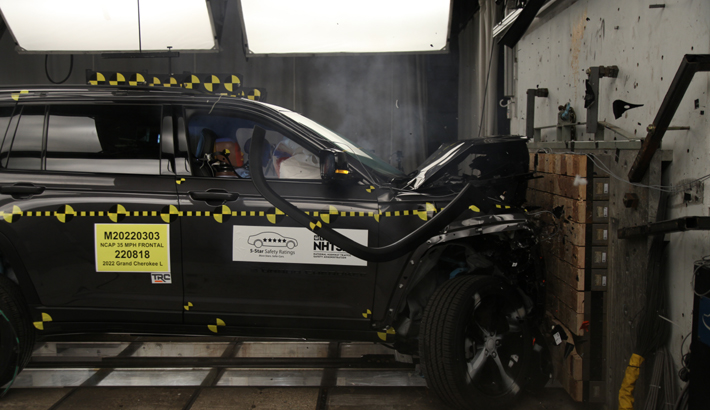
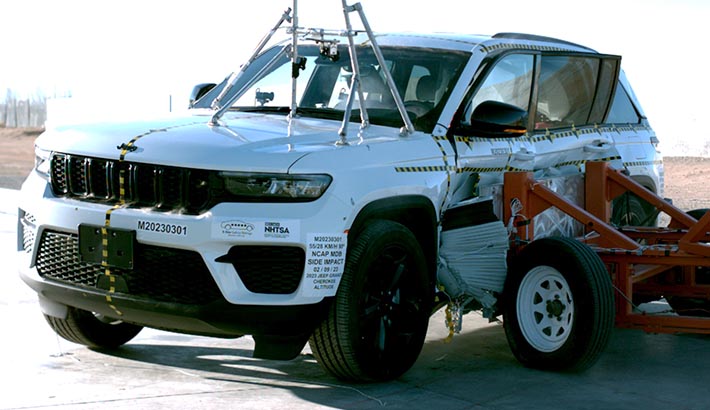
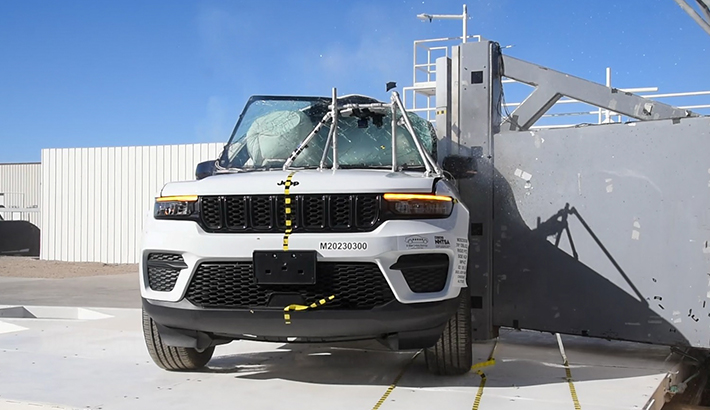
NHTSA crash tests
The agency crash-tested this model year itself. These are its own
photographs and star ratings.
Frontal crash test
Side barrier crash test
Side pole crash test
Photographs taken by NHTSA during its own New Car Assessment Program crash
tests of this model year. Public domain.
Configuration
Overall
Front
Side
Rollover
2023 Jeep Grand Cherokee SUV 4WD
—
—
2023 Jeep Grand Cherokee SUV RWD
—
—
When owners complained
A spike years after the car went on sale usually means a part wearing
out on schedule across the whole fleet — the kind of pattern no single
owner can see from inside their own car.
Oct 2022peak 54Sep 2026
NHTSA investigations into the 2023 Jeep Grand Cherokee
An investigation is the step before a recall: the agency has seen enough
complaints to look into a pattern itself. An open one means it thinks
something may be wrong and nothing has been fixed yet.
1
investigation is
still open.
RQ25005Opened 11 Dec 2025Still openSUSPENSION:REAR:SPRINGS:COIL SPRINGS
Recall 23V-413 Post Remedy Failures
On June 8, 2023, Fiat Chrysler Automobiles US, LLC (FCA) filed Safety Recall 23V-413 affecting certain 2022–2023 Jeep Grand Cherokee and2021–2023 Jeep Grand Cherokee L vehicles to address rear coil springs that may not have been properly installed during vehicle production. An improperly installed rear coil spring may detach while the vehicle is in motion, creating a road hazard that can increase the risk of a crash for following motorists and may result in injury to other road users. Since the filing of Recall 23V-413, the National Highway Traffic Safety Administration (NHTSA) has received tw...
Recalls on the 2023 Jeep Grand Cherokee
A complaint is one owner's allegation. A recall is the point at which
the manufacturer or a regulator agreed the defect is real and dangerous
enough to fix for free — however old the car is.
United States — NHTSA
26V562000
SUSPENSION:REAR:SPRINGS:COIL SPRINGS
Chrysler (FCA US, LLC) is recalling certain 2021-2023 Jeep Grand Cherokee L, 2022-2023 Jeep Grand Cherokee, and Jeep Grand Cherokee 4XE vehicles. The rear coil springs may be incorrectly installed and detach from the vehicle while driving.
Risk: Rear coil springs that detach from the vehicle while driving increase the risk of a crash.
26V413000
POWER TRAIN:AUTOMATIC TRANSMISSION:GEAR POSITION INDICATION (PRNDL)
Chrysler (FCA US, LLC) is recalling certain 2022-2024 Jeep Grand Cherokee, 2023 Jeep Wagoneer, 2024 Jeep Grand Cherokee L, and Jeep Wagoneer L vehicles. A software error may cause the transmission gear selection indicator not to display. As such, these vehicles fail to comply with the requirements of Federal Motor Vehicle Safety Standard number 102, "Transmission shift lever sequence, starter interlock, and transmission braking effect."
Risk: A missing gear selection indicator may lead to unintended vehicle movement or a vehicle rollaway, increasing the risk of a crash.
26V328000
AIR BAGS: AIR BAG/RESTRAINT CONTROL MODULE:SOFTWARE
Chrysler (FCA US, LLC) is recalling certain 2022-2026 Jeep Grand Cherokee and 2023-2025 Jeep Grand Cherokee L vehicles. A software error in the occupant restraint controller module may cause the delayed deployment of the side air bags during a crash. As such, these vehicles fail to comply with the requirements of Federal Motor Vehicle Safety Standard number 214, "Side Impact Protection."
Risk: Delayed air bag deployment during a crash increases the risk of injury.
26V051000
SUSPENSION:REAR:SPRINGS:COIL SPRINGS
Chrysler (FCA US, LLC) is recalling certain 2021-2023 Jeep Grand Cherokee L and 2022-2023 Jeep Grand Cherokee vehicles. The rear coil springs may be incorrectly installed and detach from the vehicle while driving.
Risk: Rear coil springs that detach from the vehicle while driving increase the risk of a crash.
Chrysler (FCA US, LLC) is recalling certain 2020-2025 Jeep Wrangler 4Xe and 2022-2026 Grand Cherokee 4Xe vehicles. The high voltage battery may fail internally and lead to a vehicle fire while parked or driving.
Risk: A vehicle fire can increase the risk of injury.
25V576000
ELECTRICAL SYSTEM:PROPULSION SYSTEM
Chrysler (FCA US, LLC) is recalling certain 2022-2026 Jeep Grand Cherokee Plug-In Hybrid Electric (PHEV) vehicles. A software error within the hybrid control processor may result in a loss of drive power.
Risk: A loss of drive power increases the risk of a crash.
25V472000
SEATS:MID/REAR ASSEMBLY:HEAD RESTRAINT
Chrysler (FCA US, LLC) is recalling certain 2023-2024 Jeep Grand Cherokee and Jeep Grand Cherokee L vehicles. The second-row seat head restraints may not lock in the upright position. As such, these vehicles fail to comply with the requirements of Federal Motor Vehicle Safety Standard number 202, "Head Restraints."
Risk: Head restraints that do not lock can result in an increased risk of injury to seat occupants during a crash.
Chrysler (FCA US, LLC) is recalling certain 2023 Jeep Grand Cherokee and Jeep Grand Cherokee L vehicles. The blower motor may fail, which can cause the defrosting and defogging system to be inoperative. As such, these vehicles fail to comply with the requirements of Federal Motor Vehicle Safety Standard number 103, "Windshield Defrosting and Defogging Systems."
Risk: An inoperative windshield defrosting and defogging system may decrease the driver's visibility, increasing the risk of a crash.
Canada — Transport Canada
Canada runs its own recall programme, and its campaigns do not
always mirror the American ones.
Recall 202641814,363 units in Canada
Suspension
Issue: On certain vehicles, the recall repairs completed by an FCA dealer during recalls 64A and 20D (Transport Canada recall nos. 2023-336 and 2026-037) may not have been done correctly or may not be effective. As a result, another repair is required. On certain vehicles, the rear coil springs may not have been installed correctly. As a result, the spring(s) could detach from the vehicle while driving. Note: This recall affects 2022-2023 Jeep Grand Cherokee and 2021-2023 Grand Cherokee L models. Safety Risk: A coil spring that detaches from the vehicle could create a road hazard for others and increase the risk of a crash. Corrective Actions: FCA Canada will notify owners in writing and advise you to take your vehicle to a dealership to replace the rear coil spring lower isolators.
Recall 202624421,194 units in Canada
Airbag
Issue: On certain vehicles, a software problem in the occupant restraint controller could cause the door airbag pressure sensor(s) not to work properly. As a result, the side airbag(s) may not work properly in a crash. Note: This recall affects 2022-2025 Grand Cherokee and 2023-2025 Grand Cherokee L models. Safety Risk: Airbags that don't work properly could increase the risk of injury in a crash. Corrective Actions: FCA Canada will notify owners in writing and advise you to take your vehicle to a dealership to update the occupant restraint controller software.
Recall 20260373,065 units in Canada
Suspension
Issue: On certain vehicles, the recall repairs completed by an FCA dealer during recall 64A (Transport Canada recall no. 2023-336) may not have been done correctly. As a result, a second repair is required. On certain vehicles, the rear coil springs may not have been installed correctly. As a result, the spring(s) could detach from the vehicle while driving. Note: This recall affects 2022-2023 Jeep Grand Cherokee and 2021-2023 Grand Cherokee L models. Safety Risk: A coil spring that detaches from the vehicle could create a road hazard for others and increase the risk of a crash. Corrective Actions: FCA Canada will notify owners in writing and advise you to take your vehicle to a dealership to inspect and, if necessary, repair the rear coil spring assemblies.
Recall 20256175,658 units in Canada
Engine
Issue: On certain vehicles, the engine may not have been manufactured properly. As a result, the engine could make abnormal noises and a warning light may turn on. If you continue to drive the vehicle with these symptoms, the engine could fail. Note: This recall only affects plug-in hybrid (PHEV) models. Safety Risk: An engine failure could cause a sudden loss of power to the wheels and/or increase the risk of a vehicle fire. Both issues could increase the risk of a crash or injury. Corrective actions: FCA Canada will notify owners in writing and advise you to take your vehicle to a dealership to update the powertrain control module software. This software will monitor the engine and warn you if it detects a problem. If you see this warning, you should contact a dealership to arrange for the replacement of the engine.
Recall 202559520,753 units in Canada
High Voltage
Issue: On certain vehicles, the recall repairs completed by an FCA dealer during recall 95B (Transport Canada recall no. 2024-566) may not be effective. As a result, another repair is required. On certain vehicles, there could be a problem inside the high-voltage battery that can cause a fire, even while parked with the ignition off. Note: This recall only affects 4xe plug-in hybrid (PHEV) models. This recall replaces Transport Canada recall no. 2024-566. Safety Risk: The vehicle could catch fire, even while parked and turned off. Corrective Actions: To reduce the safety risk, FCA advises not to charge your vehicle, and to park it outdoors and away from other vehicles or structures until the recall repairs have been completed. FCA Canada will notify owners in writing and advise you to take your vehicle to a dealership to update the high-voltage battery pack software. If necessary, the battery pack will be replaced.
Recall 20254533,476 units in Canada
High Voltage
Issue: On certain vehicles, a software problem in the hybrid control processor could cause a loss of power to the wheels. Note: This recall only affects plug-in hybrid (PHEV) models. Safety Risk: A sudden loss of power to the wheels could increase the risk of a crash. Corrective Actions: FCA Canada will notify owners in writing. The corrective actions for this recall are under development.
Recall 20253825,853 units in Canada
Seats And Restraints
Issue: On certain vehicles, the second-row head restraints may not have been manufactured properly. As a result, they may not be able to lock in the upright position. Note: This recall affects both the Grand Cherokee and Grand Cherokee L models. Safety Risk: A head restraint that's not positioned correctly could increase the risk of injury in a crash. Corrective Action: FCA Canada will notify owners in writing and advise you to take your vehicle to a dealership to inspect and, if necessary, replace the second-row head restraints.
Recall 2025354180 units in Canada
Heater And Defroster
Issue: On certain vehicles, the connector for the blower motor may have been damaged. As a result, the connector could fail and could cause the windshield defrost system not to work properly. This could cause the vehicles not to meet the requirements of Canadian regulations. Note: This recall affects both the Grand Cherokee and Grand Cherokee L models. Safety Risk: A windshield defroster that doesn't work may cause reduced visibility and increase the risk of a crash. Corrective Actions: FCA Canada will notify owners in writing and advise you to take your vehicle to a dealership to inspect and, if necessary, replace the blower motor assembly.
Reports where the owner recorded a crash, a fire, an injury or a death.
at 35,000 milesCoopersburg, PACrash
SERVICE BRAKES, HYDRAULIC
The contact owns a 2023 Jeep Grand Cherokee. The contact stated that while driving at an undisclosed speed searching for a parking spot, the brake pedal was depressed; however, the vehicle failed to stop as intended. The contact stated that the brake pedal was depressed to the floorboard; however, the vehicle crashed into three unoccupied parked vehicles. The contact stated that the vehicle crashed into the passenger’s side of one vehicle and sideswiped the front passenger's side of another vehicle and sideswiped the front driver's side of the third vehicle. The vehicle was towed to a local collision center. No injuries were sustained. A Police report was filed. The vehicle was later towed to the dealer for a diagnostic test; however, the diagnostic test was inconclusive. In addition, there was an unknown error message temporarily displayed. The manufacturer was not made aware of the failure. The failure mileage was approximately 35,000.
NHTSA complaint #11744285 — an unverified report by a vehicle owner.
at 47,000 milesLevittown, NYFire
ELECTRICAL SYSTEM
The contact owns a 2023 Jeep Grand Cherokee. The contact received notifications of NHTSA Campaign Numbers: 25V741000 (Electrical System) and 25V576000 (Electrical System). The contact stated that while the vehicle was parked and turned off in the driveway, she heard popping noises and saw smoke coming from underneath the vehicle near the rear passenger seat. The contact called the fire department, which responded and extinguished the fire. The firefighters cut the battery lines, removed the battery, and pushed the vehicle away from the contact's home. A hazmat team arrived and sprayed water on the battery for three hours. A fire department report was filed. The vehicle was towed to the dealer, where the manufacturer's investigation unit inspected the vehicle and determined that the failure was related to the battery. The contact was informed that the battery failure was covered under warranty, which was extended. The insurance company was notified of the failure, but informed the contact that the battery was not covered by the policy. The contact stated that the vehicle experienced a loss of drive power four to six months before the failure, which she related to NHTSA Campaign Number: 25V576000 (Electrical System). The manufacturer was informed of the failure, and two cases were filed. The manufacturer issued a letter instructing the dealer to repair the vehicle. The vehicle was not yet repaired. The failure mileage was approximately 47,000.
NHTSA complaint #11731128 — an unverified report by a vehicle owner.
at 47,000 milesLevittown, NYFire
FIRERELATED
The contact owns a 2023 Jeep Grand Cherokee. The contact received notifications of NHTSA Campaign Numbers: 25V741000 (Electrical System) and 25V576000 (Electrical System). The contact stated that while the vehicle was parked and turned off in the driveway, she heard popping noises and saw smoke coming from underneath the vehicle near the rear passenger seat. The contact called the fire department, which responded and extinguished the fire. The firefighters cut the battery lines, removed the battery, and pushed the vehicle away from the contact's home. A hazmat team arrived and sprayed water on the battery for three hours. A fire department report was filed. The vehicle was towed to the dealer, where the manufacturer's investigation unit inspected the vehicle and determined that the failure was related to the battery. The contact was informed that the battery failure was covered under warranty, which was extended. The insurance company was notified of the failure, but informed the contact that the battery was not covered by the policy. The contact stated that the vehicle experienced a loss of drive power four to six months before the failure, which she related to NHTSA Campaign Number: 25V576000 (Electrical System). The manufacturer was informed of the failure, and two cases were filed. The manufacturer issued a letter instructing the dealer to repair the vehicle. The vehicle was not yet repaired. The failure mileage was approximately 47,000.
NHTSA complaint #11731128 — an unverified report by a vehicle owner.
Montour Falls, NYCrash
ELECTRICAL SYSTEM
On February 28, 2026, while preparing to leave our home with our two children in the vehicle, we experienced a critical vehicle malfunction. Upon attempting to start the car, all dashboard warning lights illuminated, including transmission error, “service needed,” and “automatic emergency braking system needs service.” The battery warning light was also on. The vehicle would not start initially. After eventually starting the car, we temporarily placed it in neutral and pushed it out of the garage, during which the brakes functioned normally. The vehicle was briefly driven and appeared operational, but due to ongoing safety concerns and multiple recalls, we parked it at the top of our driveway. On the following day, the vehicle would not start again. We arranged for it to be towed to the dealership. On March 2, 2026, when the tow truck arrived, the car’s position prevented loading onto the truck. Multiple jump-start attempts failed initially, then briefly started the vehicle, but it immediately shut off again. We placed the vehicle in neutral using the manual override and tested the brakes, which initially showed stiffness but were operational. While attempting to move the vehicle to allow tow truck access, the brakes suddenly failed. Despite pressing the brake pedal fully and brake lights being illuminated, the vehicle did not stop and rolled uncontrollably into our garage. Consequences: •Garage property damage: approximately $11,000 •Personal injury: my father-in-law fell while the vehicle rolled out of control •Vehicle remains at dealership with an open case, but the situation remains unresolved Safety Concern: This incident raises serious safety concerns regarding the reliability of the braking system and vehicle electronics. The vehicle became uncontrollable while brakes were applied, posing a direct risk of injury or death to occupants and others. We fear that similar failures could occur under normal driving conditions, including highway speeds.
NHTSA complaint #11722276 — an unverified report by a vehicle owner.
Montour Falls, NYCrash
ENGINE
On February 28, 2026, while preparing to leave our home with our two children in the vehicle, we experienced a critical vehicle malfunction. Upon attempting to start the car, all dashboard warning lights illuminated, including transmission error, “service needed,” and “automatic emergency braking system needs service.” The battery warning light was also on. The vehicle would not start initially. After eventually starting the car, we temporarily placed it in neutral and pushed it out of the garage, during which the brakes functioned normally. The vehicle was briefly driven and appeared operational, but due to ongoing safety concerns and multiple recalls, we parked it at the top of our driveway. On the following day, the vehicle would not start again. We arranged for it to be towed to the dealership. On March 2, 2026, when the tow truck arrived, the car’s position prevented loading onto the truck. Multiple jump-start attempts failed initially, then briefly started the vehicle, but it immediately shut off again. We placed the vehicle in neutral using the manual override and tested the brakes, which initially showed stiffness but were operational. While attempting to move the vehicle to allow tow truck access, the brakes suddenly failed. Despite pressing the brake pedal fully and brake lights being illuminated, the vehicle did not stop and rolled uncontrollably into our garage. Consequences: •Garage property damage: approximately $11,000 •Personal injury: my father-in-law fell while the vehicle rolled out of control •Vehicle remains at dealership with an open case, but the situation remains unresolved Safety Concern: This incident raises serious safety concerns regarding the reliability of the braking system and vehicle electronics. The vehicle became uncontrollable while brakes were applied, posing a direct risk of injury or death to occupants and others. We fear that similar failures could occur under normal driving conditions, including highway speeds.
NHTSA complaint #11722276 — an unverified report by a vehicle owner.
Montour Falls, NYCrash
SERVICE BRAKES
On February 28, 2026, while preparing to leave our home with our two children in the vehicle, we experienced a critical vehicle malfunction. Upon attempting to start the car, all dashboard warning lights illuminated, including transmission error, “service needed,” and “automatic emergency braking system needs service.” The battery warning light was also on. The vehicle would not start initially. After eventually starting the car, we temporarily placed it in neutral and pushed it out of the garage, during which the brakes functioned normally. The vehicle was briefly driven and appeared operational, but due to ongoing safety concerns and multiple recalls, we parked it at the top of our driveway. On the following day, the vehicle would not start again. We arranged for it to be towed to the dealership. On March 2, 2026, when the tow truck arrived, the car’s position prevented loading onto the truck. Multiple jump-start attempts failed initially, then briefly started the vehicle, but it immediately shut off again. We placed the vehicle in neutral using the manual override and tested the brakes, which initially showed stiffness but were operational. While attempting to move the vehicle to allow tow truck access, the brakes suddenly failed. Despite pressing the brake pedal fully and brake lights being illuminated, the vehicle did not stop and rolled uncontrollably into our garage. Consequences: •Garage property damage: approximately $11,000 •Personal injury: my father-in-law fell while the vehicle rolled out of control •Vehicle remains at dealership with an open case, but the situation remains unresolved Safety Concern: This incident raises serious safety concerns regarding the reliability of the braking system and vehicle electronics. The vehicle became uncontrollable while brakes were applied, posing a direct risk of injury or death to occupants and others. We fear that similar failures could occur under normal driving conditions, including highway speeds.
NHTSA complaint #11722276 — an unverified report by a vehicle owner.
The most recent complaints
In the owners' own words, exactly as filed with NHTSA.
Valatie, NY
POWER TRAIN
- The high-voltage (HV) battery system and related hybrid control processor (HCP) software — repeatedly, across three separate incidents (Jan 2026 coolant heater/HCP fault, June 2026 front axle disconnect fault, Sept 2026 full HV battery replacement). Also affected: front axle disconnect actuator (drivetrain). Yes, available for inspection — vehicle is at Chrysler Dodge Jeep Ram of Clifton Park. - Recall 68C: HV battery fire risk (owners told not to charge, park away from structures). Recall 73C: possible loss of drive power while driving, increasing crash risk. Recall 20C: head restraints failing to lock, increasing injury risk in a crash. - Yes — confirmed and repair attempted by an authorized Stellantis dealer (Chrysler Dodge Jeep Ram of Clifton Park) on three separate repair orders (RO #106187, #109788, and the current September 2026 visit), with documented diagnostic trouble codes each time (P29BB, C1463, and the current critical HV battery code). - Inspected/repaired by the authorized dealer under manufacturer recall directives (FCA/Stellantis) each time. No police or insurance involvement, since no accident occurred. - Yes — Check Engine Light (Jan 2026, code P29BB), Service 4WD light (June 2026, code C1463), and Check Engine Light again (Sept 2026, current critical HV battery code). Recall notices (68C, 73C, 20C, etc.) were also received separately as advance manufacturer warnings before some of these symptoms appeared.
NHTSA complaint #11763645 — an unverified report by a vehicle owner.
Valatie, NY
ELECTRICAL SYSTEM
- The high-voltage (HV) battery system and related hybrid control processor (HCP) software — repeatedly, across three separate incidents (Jan 2026 coolant heater/HCP fault, June 2026 front axle disconnect fault, Sept 2026 full HV battery replacement). Also affected: front axle disconnect actuator (drivetrain). Yes, available for inspection — vehicle is at Chrysler Dodge Jeep Ram of Clifton Park. - Recall 68C: HV battery fire risk (owners told not to charge, park away from structures). Recall 73C: possible loss of drive power while driving, increasing crash risk. Recall 20C: head restraints failing to lock, increasing injury risk in a crash. - Yes — confirmed and repair attempted by an authorized Stellantis dealer (Chrysler Dodge Jeep Ram of Clifton Park) on three separate repair orders (RO #106187, #109788, and the current September 2026 visit), with documented diagnostic trouble codes each time (P29BB, C1463, and the current critical HV battery code). - Inspected/repaired by the authorized dealer under manufacturer recall directives (FCA/Stellantis) each time. No police or insurance involvement, since no accident occurred. - Yes — Check Engine Light (Jan 2026, code P29BB), Service 4WD light (June 2026, code C1463), and Check Engine Light again (Sept 2026, current critical HV battery code). Recall notices (68C, 73C, 20C, etc.) were also received separately as advance manufacturer warnings before some of these symptoms appeared.
NHTSA complaint #11763645 — an unverified report by a vehicle owner.
Valatie, NY
FUEL/PROPULSION SYSTEM
- The high-voltage (HV) battery system and related hybrid control processor (HCP) software — repeatedly, across three separate incidents (Jan 2026 coolant heater/HCP fault, June 2026 front axle disconnect fault, Sept 2026 full HV battery replacement). Also affected: front axle disconnect actuator (drivetrain). Yes, available for inspection — vehicle is at Chrysler Dodge Jeep Ram of Clifton Park. - Recall 68C: HV battery fire risk (owners told not to charge, park away from structures). Recall 73C: possible loss of drive power while driving, increasing crash risk. Recall 20C: head restraints failing to lock, increasing injury risk in a crash. - Yes — confirmed and repair attempted by an authorized Stellantis dealer (Chrysler Dodge Jeep Ram of Clifton Park) on three separate repair orders (RO #106187, #109788, and the current September 2026 visit), with documented diagnostic trouble codes each time (P29BB, C1463, and the current critical HV battery code). - Inspected/repaired by the authorized dealer under manufacturer recall directives (FCA/Stellantis) each time. No police or insurance involvement, since no accident occurred. - Yes — Check Engine Light (Jan 2026, code P29BB), Service 4WD light (June 2026, code C1463), and Check Engine Light again (Sept 2026, current critical HV battery code). Recall notices (68C, 73C, 20C, etc.) were also received separately as advance manufacturer warnings before some of these symptoms appeared.
NHTSA complaint #11763645 — an unverified report by a vehicle owner.
at 40,000 milesSaint Hedwig, TX
STEERING
The contact owns a 2023 Jeep Grand Cherokee. The contact stated that the vehicle swayed from side to side without warning while driving at highway speeds, and the contact lost control of the vehicle. Additionally, there was an abnormal clunking sound coming from the vehicle while driving over bumps in the roadway or making a sharp turn. Upon a dealer inspection, the rear passenger’s side knuckle assembly bolt was found to be snapped, resulting in damages to the front suspension bushing. The contact associated the failure with NHTSA Campaign Number: 24V132000 (Suspension, Steering); and the manufacturer stated that the VIN was not included in the recall and directed the contact to file a report with the NHTSA Hotline. The vehicle was not yet repaired. The failure mileage was approximately 40,000.
NHTSA complaint #11762104 — an unverified report by a vehicle owner.
at 40,000 milesSaint Hedwig, TX
SUSPENSION
The contact owns a 2023 Jeep Grand Cherokee. The contact stated that the vehicle swayed from side to side without warning while driving at highway speeds, and the contact lost control of the vehicle. Additionally, there was an abnormal clunking sound coming from the vehicle while driving over bumps in the roadway or making a sharp turn. Upon a dealer inspection, the rear passenger’s side knuckle assembly bolt was found to be snapped, resulting in damages to the front suspension bushing. The contact associated the failure with NHTSA Campaign Number: 24V132000 (Suspension, Steering); and the manufacturer stated that the VIN was not included in the recall and directed the contact to file a report with the NHTSA Hotline. The vehicle was not yet repaired. The failure mileage was approximately 40,000.
NHTSA complaint #11762104 — an unverified report by a vehicle owner.
Golden Valley, AZ
UNKNOWN OR OTHER
CRITICAL VEHICLE SAFETY COMPLAINT - CHRONIC MULTI-SYSTEM DEFECTS The vehicle is a 2023 Jeep Grand Cherokee 4xe operating under severe chronic safety non-compliance. The vehicle has an active, un-remedied engine block casting sand contamination fire/loss of propulsion and crash risk (FCA 78C / NHTSA 25V-766) listing 'Parts Unavailable.' It also carries an open side-curtain airbag deployment failure recall (NHTSA 26V-328). Furthermore, the vehicle experiences intermittent climate control and HVAC failures where the heating, air conditioning, and windshield defroster loops completely disable while in motion on the highway. This directly mirrors the safety vulnerabilities detailed in federal recall 24V-111 (FCA 04B), where faulty hybrid control processor software leaves the front windshield defogger inoperable. When this occurs, the windshield instantly fogs over at high speeds, resulting in an unrecoverable, immediate loss of forward visibility. In addition, temperatures in the summer are between 100 and 120 degrees. Having no air conditioning during this time is a health and safety concern. Dealership technicians state they 'cannot replicate' the issue, forcing me to operate a vehicle that routinely violates Federal Motor Vehicle Safety Standard No. 571.103. Operating this highly volatile hybrid asset on a regular 4.5-hour remote highway commute to act as a caregiver for an elderly parent presents a life-threatening environment. The vehicle is a severe liability threat due to active fire and crash risk, structural airbag failure, and sudden visibility blinding.
NHTSA complaint #11760893 — an unverified report by a vehicle owner.
Lawton, OK
SUSPENSION
I was driving down that interstate where I felt that back end of the Jeep drop. I did not hit a bump or anything. When I got out of the vehicle I noticed a significant drop in the height of the vehicle. At first I though something happened with the shocks. My vehicle was repaired with the recall 23V413 however for some reason it didn't make 26V051 recall. I took it to the dealership and they said since it wasn't on the 26V051 recall they would not fix it. I think the repair for the 23V413 did not hold or work and this could cause significant problems. I'm not sure where the coil fell off but I think could cause significant damage or injury if it flew off and hit another vehicle or caused me to have significant steering issues on the interstate. The dealership did confirm that the rear coils did fail.
NHTSA complaint #11761119 — an unverified report by a vehicle owner.
Golden Valley, AZ
ENGINE
CRITICAL VEHICLE SAFETY COMPLAINT - CHRONIC MULTI-SYSTEM DEFECTS The vehicle is a 2023 Jeep Grand Cherokee 4xe operating under severe chronic safety non-compliance. The vehicle has an active, un-remedied engine block casting sand contamination fire/loss of propulsion and crash risk (FCA 78C / NHTSA 25V-766) listing 'Parts Unavailable.' It also carries an open side-curtain airbag deployment failure recall (NHTSA 26V-328). Furthermore, the vehicle experiences intermittent climate control and HVAC failures where the heating, air conditioning, and windshield defroster loops completely disable while in motion on the highway. This directly mirrors the safety vulnerabilities detailed in federal recall 24V-111 (FCA 04B), where faulty hybrid control processor software leaves the front windshield defogger inoperable. When this occurs, the windshield instantly fogs over at high speeds, resulting in an unrecoverable, immediate loss of forward visibility. In addition, temperatures in the summer are between 100 and 120 degrees. Having no air conditioning during this time is a health and safety concern. Dealership technicians state they 'cannot replicate' the issue, forcing me to operate a vehicle that routinely violates Federal Motor Vehicle Safety Standard No. 571.103. Operating this highly volatile hybrid asset on a regular 4.5-hour remote highway commute to act as a caregiver for an elderly parent presents a life-threatening environment. The vehicle is a severe liability threat due to active fire and crash risk, structural airbag failure, and sudden visibility blinding.
NHTSA complaint #11760893 — an unverified report by a vehicle owner.
Golden Valley, AZ
FUEL/PROPULSION SYSTEM
CRITICAL VEHICLE SAFETY COMPLAINT - CHRONIC MULTI-SYSTEM DEFECTS The vehicle is a 2023 Jeep Grand Cherokee 4xe operating under severe chronic safety non-compliance. The vehicle has an active, un-remedied engine block casting sand contamination fire/loss of propulsion and crash risk (FCA 78C / NHTSA 25V-766) listing 'Parts Unavailable.' It also carries an open side-curtain airbag deployment failure recall (NHTSA 26V-328). Furthermore, the vehicle experiences intermittent climate control and HVAC failures where the heating, air conditioning, and windshield defroster loops completely disable while in motion on the highway. This directly mirrors the safety vulnerabilities detailed in federal recall 24V-111 (FCA 04B), where faulty hybrid control processor software leaves the front windshield defogger inoperable. When this occurs, the windshield instantly fogs over at high speeds, resulting in an unrecoverable, immediate loss of forward visibility. In addition, temperatures in the summer are between 100 and 120 degrees. Having no air conditioning during this time is a health and safety concern. Dealership technicians state they 'cannot replicate' the issue, forcing me to operate a vehicle that routinely violates Federal Motor Vehicle Safety Standard No. 571.103. Operating this highly volatile hybrid asset on a regular 4.5-hour remote highway commute to act as a caregiver for an elderly parent presents a life-threatening environment. The vehicle is a severe liability threat due to active fire and crash risk, structural airbag failure, and sudden visibility blinding.
NHTSA complaint #11760893 — an unverified report by a vehicle owner.
Gray, ME
ENGINE
The contact owns a 2023 Jeep Grand Cherokee. The contact received notification of NHTSA Campaign Number: 25V766000 (ENGINE); however, the part to do the recall repair was unavailable. The contact stated that the manufacturer had exceeded a reasonable amount of time for the recall repair. The manufacturer was made aware of the issue. The contact had not experienced a failure.
NHTSA complaint #11757534 — an unverified report by a vehicle owner.
at 36,028 milesPhillipston, MA
ELECTRICAL SYSTEM
The contact owns a 2023 Jeep Grand Cherokee. The contact stated that while driving at an undisclosed speed, the vehicle was losing traction and was shifting very rough while in hybrid mode. The contact received notification of NHTSA Campaign Number: 25V741000 (Electrical System); and the vehicle was repaired in February; however, the repair failed to prevent the failure. The contact stated that while using the gas engine feature, the engine was running rough and sounded as if the engine was struggling, and the vehicle nearly stalled. The contact received a second notification of NHTSA Campaign Number: 25V766000 (Engine); however, the part to do the recall repair was not yet available. The dealer was notified of the failures. The vehicle was not repaired. The manufacturer was notified of the failure. The failure mileage was 36,028.
NHTSA complaint #11754590 — an unverified report by a vehicle owner.
at 36,028 milesPhillipston, MA
ENGINE
The contact owns a 2023 Jeep Grand Cherokee. The contact stated that while driving at an undisclosed speed, the vehicle was losing traction and was shifting very rough while in hybrid mode. The contact received notification of NHTSA Campaign Number: 25V741000 (Electrical System); and the vehicle was repaired in February; however, the repair failed to prevent the failure. The contact stated that while using the gas engine feature, the engine was running rough and sounded as if the engine was struggling, and the vehicle nearly stalled. The contact received a second notification of NHTSA Campaign Number: 25V766000 (Engine); however, the part to do the recall repair was not yet available. The dealer was notified of the failures. The vehicle was not repaired. The manufacturer was notified of the failure. The failure mileage was 36,028.
NHTSA complaint #11754590 — an unverified report by a vehicle owner.
at 64,000 milesConroe, TX
POWER TRAIN
The contact owns a 2023 Jeep Grand Cherokee. While the contact’s daughter was reversing the vehicle, the hybrid vehicle suddenly changed direction, and the vehicle drove forward approximately 3 feet and stalled. The vehicle was towed to the local dealer. The contact was informed that the part needed to repair the vehicle was on back order. No further information was available. The manufacturer was notified of the failure. The failure mileage was 64,000.
NHTSA complaint #11753005 — an unverified report by a vehicle owner.
Rncho Cordova, CA
ELECTRICAL SYSTEM
Since Nov 2025 there has been a recall with still no remedy for repair. The recall is a huge safety risk regarding the hybrid battery worrying me about it exploding or catching on fire as it warns me to not charge it in my garage and be careful charging it which is the only reason I purchased this hybrid.
NHTSA complaint #11752945 — an unverified report by a vehicle owner.
Rncho Cordova, CA
ENGINE
Since Nov 2025 there has been a recall with still no remedy for repair. The recall is a huge safety risk regarding the hybrid battery worrying me about it exploding or catching on fire as it warns me to not charge it in my garage and be careful charging it which is the only reason I purchased this hybrid.
NHTSA complaint #11752945 — an unverified report by a vehicle owner.
Rncho Cordova, CA
FUEL/PROPULSION SYSTEM
Since Nov 2025 there has been a recall with still no remedy for repair. The recall is a huge safety risk regarding the hybrid battery worrying me about it exploding or catching on fire as it warns me to not charge it in my garage and be careful charging it which is the only reason I purchased this hybrid.
NHTSA complaint #11752945 — an unverified report by a vehicle owner.
at 35,198 milesSteubenville, OH
ELECTRICAL SYSTEM
The contact owns a 2023 Jeep Grand Cherokee. The contact stated that while driving at an undisclosed speed, the instrument panel went blank. The contact became aware that the VIN was included in NHTSA Campaign Numbers: 25V741000 (Electrical System) and 26V328000 (Air Bags). The vehicle was driven to a local dealer, who later informed the contact that the recall repair for NHTSA Campaign Number: 25V741000 (Electrical System) could not be completed due to a lack of adequate staff or equipment. The vehicle was then towed to Thomas Auto Centers (67791 Mall Rd, St Clairsville, OH 43950), who informed the contact that the recall repair would take three to four weeks to complete. The contact stated that the manufacturer had exceeded a reasonable amount of time for the recall repair. The manufacturer was notified of the failure, opened a case, and followed up with the first dealer, who had the vehicle towed to the second dealer. The failure mileage was approximately 35,198.
NHTSA complaint #11752690 — an unverified report by a vehicle owner.
Woodinville, WA
UNKNOWN OR OTHER
At the end of March 2026, the hybrid battery was replaced due to a recall by the dealership. After this, several software updates done, including the BCM, per technician's notes. In May 2026, my vehicle was found bricked in my driveway, unable to jump start, giving warnings regarding the dual charging system. After being towed to the dealership, they found my 12v battery was dead and stated that it needed to be replaced, which was done, with no further testing per technician's notes. Six weeks later, in July 2026, my vehicle was found bricked in my driveway again, giving the same warnings on the dashboard as it did in May. Once towed to the dealership again, with further parasitic testing, they found a "TSB about improper BCM software causing the 12v systems battery to be drained, as well as the kombi flickering which was also experienced while vehicle was in shop. TSB stated the BCM needs to be flashed." (taken from the technician's notes). As the dealership explained it to me, my vehicle failed to receive an update for the BCM, causing this glitch to drain my 12v battery. Due to my vehicle exceeding the 36,000-mile warranty, the dealership forced me to pay for the work done in both May and July, in addition to paying for a rental car while my vehicle was in the shop, even though the cause of this problem originated from the manufacturer, and was no cause of mine.
NHTSA complaint #11752438 — an unverified report by a vehicle owner.
Seattle, WA
UNKNOWN OR OTHER
See safety recall from November 2025, no fix at this time
NHTSA complaint #11752514 — an unverified report by a vehicle owner.
Woodinville, WA
ELECTRICAL SYSTEM
At the end of March 2026, the hybrid battery was replaced due to a recall by the dealership. After this, several software updates done, including the BCM, per technician's notes. In May 2026, my vehicle was found bricked in my driveway, unable to jump start, giving warnings regarding the dual charging system. After being towed to the dealership, they found my 12v battery was dead and stated that it needed to be replaced, which was done, with no further testing per technician's notes. Six weeks later, in July 2026, my vehicle was found bricked in my driveway again, giving the same warnings on the dashboard as it did in May. Once towed to the dealership again, with further parasitic testing, they found a "TSB about improper BCM software causing the 12v systems battery to be drained, as well as the kombi flickering which was also experienced while vehicle was in shop. TSB stated the BCM needs to be flashed." (taken from the technician's notes). As the dealership explained it to me, my vehicle failed to receive an update for the BCM, causing this glitch to drain my 12v battery. Due to my vehicle exceeding the 36,000-mile warranty, the dealership forced me to pay for the work done in both May and July, in addition to paying for a rental car while my vehicle was in the shop, even though the cause of this problem originated from the manufacturer, and was no cause of mine.
NHTSA complaint #11752438 — an unverified report by a vehicle owner.
Woodinville, WA
FUEL/PROPULSION SYSTEM
At the end of March 2026, the hybrid battery was replaced due to a recall by the dealership. After this, several software updates done, including the BCM, per technician's notes. In May 2026, my vehicle was found bricked in my driveway, unable to jump start, giving warnings regarding the dual charging system. After being towed to the dealership, they found my 12v battery was dead and stated that it needed to be replaced, which was done, with no further testing per technician's notes. Six weeks later, in July 2026, my vehicle was found bricked in my driveway again, giving the same warnings on the dashboard as it did in May. Once towed to the dealership again, with further parasitic testing, they found a "TSB about improper BCM software causing the 12v systems battery to be drained, as well as the kombi flickering which was also experienced while vehicle was in shop. TSB stated the BCM needs to be flashed." (taken from the technician's notes). As the dealership explained it to me, my vehicle failed to receive an update for the BCM, causing this glitch to drain my 12v battery. Due to my vehicle exceeding the 36,000-mile warranty, the dealership forced me to pay for the work done in both May and July, in addition to paying for a rental car while my vehicle was in the shop, even though the cause of this problem originated from the manufacturer, and was no cause of mine.
NHTSA complaint #11752438 — an unverified report by a vehicle owner.
at 61,600 milesWolcott, CT
SUSPENSION
The contact owns a 2023 Jeep Grand Cherokee. While the contact's husband was driving approximately 72 MPH with the contact seated in the front passenger’s seat and two children in the rear seats, the occupants heard a loud bang coming from the rear of the vehicle. The vehicle immediately became uncontrollable and the rear-end shifted. A trailing vehicle swerved into the median to avoid a crash. Upon pulling over to the side of the road and inspecting the vehicle, the contact's husband noticed that the rear passenger-side coil spring had detached and was ejected from the vehicle. The driver drove the leaning vehicle to the dealer via a side road; however, the vehicle was not yet diagnosed or repaired. The contact stated that the vehicle was previously taken to the dealer for a recall repair under NHTSA Campaign Number: 26V051000 (Suspension), but the dealer informed the contact that the vehicle passed inspection and no repairs were needed. The contact stated that the failure occurred while on vacation, which required the contact to obtain a rental vehicle. The manufacturer was notified of the failure and denied vehicle rental assistance. The contact stated that both the dealer and the manufacturer failed to return phone calls. The failure mileage was approximately 61,600.
NHTSA complaint #11751491 — an unverified report by a vehicle owner.
Buffalo, NY
SUSPENSION
While pulling into my driveway on XXX, the rear coil spring on my vehicle completely suffered a structural failure/separation. This exact issue is the subject of the federal safety recall issued by FCA US LLC in February 2026 (NHTSA Campaign ID: 26V051000 / FCA Recall 20D), which acknowledges that the rear coil springs on 2021-2023 Grand Cherokees can detach while operating creating a critical road hazard. On XXX Towne Chrysler Dodge Jeep Inc. at [XXX] cleared my car of the recall stating that my vehicle was not affected. INFORMATION REDACTED PURSUANT TO THE FREEDOM OF INFORMATION ACT (FOIA), 5 U.S.C. 552(B)(6)
NHTSA complaint #11748353 — an unverified report by a vehicle owner.
Caledonia, MI
SUSPENSION
I had taken the Jeep in to have the rear coil fixed under the recall notice a couple of years ago. While driving out of state during the evening of XXX, the car made a large thud noise and the passenger rear side of the car dropped. We stepped out of the vehicle and the passenger rear coil spring was lying in the road. The car had not been in any accidents or had any damage. The spring simply dislodged and fell to the ground while we were driving. We had the Jeep towed to Jeff Wyler dealership in Columbus and provided them the spring that had fallen off. The dealership's number is [XXX]. We had to rent a car to return to Grand Rapids Michigan and still need to find a way to bring the Jeep home when the repaid is made. INFORMATION REDACTED PURSUANT TO THE FREEDOM OF INFORMATION ACT (FOIA), 5 U.S.C. 552(B)(6)
NHTSA complaint #11748267 — an unverified report by a vehicle owner.
West Friendship, MD
SEATS
My driver seat filled up with air in the lumbar while the vehicle was off. I tried adjusting the seat and it would not deflate. While I was moving my seat forward to get to the position for me to be able to drive the back of the seat blew apart.
NHTSA complaint #11746251 — an unverified report by a vehicle owner.