Owners have filed 3,289 complaints
about the 2017 Ford Escape with NHTSA between 2016 and 2026.
The largest single group is the engine & cooling.
Across this model's run it ranks 3 of 25 worst.
The letter says how bad. This says what kind — whether this year drew
an unusual number of complaints, unusually dangerous
ones, or failures that arrived unusually early.
The dashed ring is 50 — the national norm. Further out is worse.
Complaint volume — 100
Against the median year of the Ford Escape. 50 means typical for this
model; 100 means roughly double.
Severity — 20
3.8% of these complaints
involved a crash, fire, injury or death, against a national rate of
9.7%.
Early failure — 36
21% of failures with a mileage on record happened under
36,000 miles, against a national rate of
29%.
NHTSA files every complaint against a named sub-assembly, not just a
system. This is the difference between knowing it was "the engine" and
knowing which part of it — the list to hand a mechanic.
Body
5346.5%
Lugs/Nuts/Bolts/Studs
2723.7%
Automatic Transmission
1311.4%
Cooling System
54.4%
Torque Converter
54.4%
Turbo/Supercharger
43.5%
Tail Lights
43.5%
Spark Plugs
32.6%
When it fails
Odometer readings owners gave when they filed. About half of all
complaints include one.
Under 1,000 miles
201.4%
1,000 – 9,999 miles
674.7%
10,000 – 24,999 miles
1198.3%
25,000 – 49,999 miles
22315.6%
50,000 – 74,999 miles
36825.8%
75,000 – 99,999 miles
29120.4%
100,000 – 149,999 miles
29820.9%
150,000+ miles
402.8%
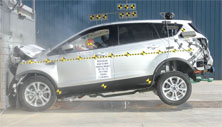
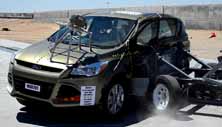
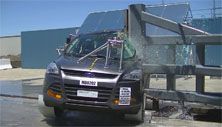
NHTSA crash tests
The agency crash-tested this model year itself. These are its own
photographs and star ratings.
Frontal crash test
Side barrier crash test
Side pole crash test
Photographs taken by NHTSA during its own New Car Assessment Program crash
tests of this model year. Public domain.
Configuration
Overall
Front
Side
Rollover
2017 Ford Escape SUV FWD
19.1% risk
2017 Ford Escape SUV AWD
18.5% risk
When owners complained
A spike years after the car went on sale usually means a part wearing
out on schedule across the whole fleet — the kind of pattern no single
owner can see from inside their own car.
Oct 2016peak 110Sep 2026
Recalls on the 2017 Ford Escape
A complaint is one owner's allegation. A recall is the point at which
the manufacturer or a regulator agreed the defect is real and dangerous
enough to fix for free — however old the car is.
United States — NHTSA
26V374000
VISIBILITY:POWER WINDOW DEVICES AND CONTROLS
Ford Motor Company (Ford) is recalling certain 2017 Escape vehicles previously repaired incorrectly under recall number 16V617. The power-operated windows may exert excessive force when encountering an object, before they automatically reverse. As such, these vehicles fail to comply with the requirements of Federal Motor Vehicle Safety Standard (FMVSS) number 118, "Power-Operated Window Systems."
Risk: A closing window that does not reverse direction as expected can pinch a driver or passenger before retracting, increasing the risk of injury.
26V011000
EQUIPMENT:ELECTRICAL:ENGINE BLOCK HEATER
Ford Motor Company (Ford) is recalling certain 2013-2018 Focus, 2013-2019 Escape, and 2015-2016 MKC vehicles equipped with a 2.0L engine. The engine block heater may crack and develop a coolant leak, causing it to short circuit when the block heater is plugged in.
Risk: An electrical short circuit can increase the risk of a fire.
22V413000
POWER TRAIN:AUTOMATIC TRANSMISSION:GEAR POSITION INDICATION (PRNDL)
Ford Motor Company (Ford) is recalling certain 2013-2019 Escape, 2013-2018 C-Max, 2013-2016 Fusion, 2013-2021 Transit Connect, and 2015-2018 Edge vehicles. The bushing that attaches the shifter cable to the transmission may degrade or detach.
Risk: A damaged or missing bushing may prevent the vehicle from shifting into the intended gear, and cause the vehicle to move in an unexpected direction. Additionally, the vehicle may roll after the driver selects the 'Park' position. Either scenario increases the risk of a crash or injury.
16V617000
VISIBILITY:POWER WINDOW DEVICES AND CONTROLS
Ford Motor Company (Ford) is recalling certain model year 2017 Ford Escape Titanium and SE vehicles manufactured October 5, 2015, to May 12, 2016. The settings for the closing-force of the power-operated windows may allow the windows to close on an object such as a body part and injure it before the windows auto-reverse. As such, these vehicles fail to comply with the requirements of Federal Motor Vehicle Safety Standard (FMVSS) number 118, "Power-Operated Window Systems."
Risk: If a window closes on a body part, it can increase the risk of injury.
Canada — Transport Canada
Canada runs its own recall programme, and its campaigns do not
always mirror the American ones.
Recall 20262914,354 units in Canada
Structure
Issue: On certain vehicles the recall repairs completed by a Ford dealer during recall 16C12 (Transport Canada recall no. 2016-410) may not have been done correctly. As a result, a second repair is required. On certain vehicles, the window automatic reversal system may not react correctly after detecting an obstruction. As a result, the window could close with too much force before it stops and retracts. Safety risk: A window that closes with excessive force could pinch a person and create a risk of injury. Corrective Actions: Ford will notify owners by mail and advise you to take your vehicle to a dealership to update the power window automatic reversal system software.
Recall 2026004193,627 units in Canada
Electrical
Issue: On certain vehicles, the engine block heater could leak coolant. If this happens, the block heater could short circuit when it's plugged in. Note: This recall only affects certain vehicles equipped with a 2.0 L engine. Safety Risk: A short circuit can create the risk of a fire. Corrective Actions: To reduce the safety risk, Ford advises you not to use the engine block heater until the recall repairs have been completed. Ford will notify owners by mail and advise you to take your vehicle to a dealership to replace the block heater. Alternatively, owners can choose to have the dealership permanently disable the engine block heater.
Recall 2022311362,062 units in Canada
Powertrain
Issue: On certain vehicles, the shift cable may detach from the transmission. This could cause the transmission not to shift gears when the shifter is moved. As a result, the transmission could be in a different gear than the gear shifter indicates. If a driver attempts to exit the vehicle while the transmission is not in Park, and the parking brake is not applied, the vehicle could move suddenly. Safety Risk: Sudden and unexpected movement of the vehicle could increase the risk of a crash. Corrective Actions: Ford will notify owners by mail and instruct you to take your vehicle to a dealership to replace the transmission shifter cable bushing and install a protective service cap. Ford advises that you should apply the parking brake each time the vehicle is parked.
Recall 20164105,157 units in Canada
Structure
Certain vehicles equipped with power-operated windows may fail to conform to Canada Motor Vehicle Safety Standard (CMVSS) 118 - Power-Operated Window, Partition and Roof Panel Systems. The power window system configuration may exceed the requirements for remote actuation closing force, contrary to the standard, which could increase the risk of injury. Correction: Dealers will update the power window operating software.
Reports where the owner recorded a crash, a fire, an injury or a death.
Philadelphia, PACrash
POWER TRAIN
My power lines were not installed properly and leaked all over burning up my transmission. This is aVERY common ford issue to the point where the place where I took it said I got a lot further than others. Ford needs to do better
NHTSA complaint #11741676 — an unverified report by a vehicle owner.
Philadelphia, PACrash
UNKNOWN OR OTHER
My power lines were not installed properly and leaked all over burning up my transmission. This is aVERY common ford issue to the point where the place where I took it said I got a lot further than others. Ford needs to do better
NHTSA complaint #11741676 — an unverified report by a vehicle owner.
Maplewood, MNCrash
ENGINE
My engine is internally leaking coolant. I consistently smell a sweet smell. I consistently have a service engine soon light on and it has a P0301 code. My car is only at 63,450 miles. My mechanic informs me the rememdy requires a complete long block replacement.
NHTSA complaint #11685568 — an unverified report by a vehicle owner.
Dallas, TXFire1 injured
UNKNOWN OR OTHER
When driving the vehicle it suddenly lost all acceleration power. I coasted to side of road and opened hood to determine the vehicle was on fire from rear of engine bay. I then proceeded to offload what I was able from behind the vehicle of my tools for my job. There was no over heat warning or other indicators of any major issues with the vehicle prior to the fire.
NHTSA complaint #11666420 — an unverified report by a vehicle owner.
Dallas, TXFire1 injured
ENGINE
When driving the vehicle it suddenly lost all acceleration power. I coasted to side of road and opened hood to determine the vehicle was on fire from rear of engine bay. I then proceeded to offload what I was able from behind the vehicle of my tools for my job. There was no over heat warning or other indicators of any major issues with the vehicle prior to the fire.
NHTSA complaint #11666420 — an unverified report by a vehicle owner.
at 50,000 milesSummit, NJCrash
ENGINE
The contact called on behalf of her husband, who owns a 2017 Ford Escape. The contact stated that her husband was approaching a stop sign at 5 MPH, and upon depressing the brake pedal, the vehicle continued to accelerate. The contact immediately depressed the brake pedal with both feet in order to bring the vehicle to a complete stop; no warning lights were illuminated. The failure occurred on several occasions where the brake pedal failed to stop the vehicle. On a most recent occasion, the contact parked in an empty lot when the vehicle accelerated, causing her to crash into a wall in front at an unknown speed. The building's wall was damaged, and the vehicle came to a stop upon impact. The vehicle was towed to a local repair center. A police report was filed. The vehicle was not destroyed. No injuries were reported. The vehicle was then taken to a local dealer, where the failure could not able to be duplicated. The vehicle was not repaired. The manufacturer was notified of the failure. The approximate failure mileage was 50,000.
NHTSA complaint #11665291 — an unverified report by a vehicle owner.
The most recent complaints
In the owners' own words, exactly as filed with NHTSA.
Yadkinville, NC
ENGINE
My car has experienced Catastrophic Engine Failure. There is a coolant intrusion into the cylinders and now the car is inoperable. It runs for 2 minutes before shutting the engine off.
NHTSA complaint #11764179 — an unverified report by a vehicle owner.
at 105,000 milesCollierville, TN
ENGINE AND ENGINE COOLING
The contact owns a 2017 Ford Escape. The contact stated that while the vehicle was at the service center for an instrument panel failure, a diagnostic test was performed on the engine. The contact was informed that in addition to the instrument panel failure, there was coolant inside the cylinders, and the engine needed to be replaced. The vehicle was not yet repaired. The failure mileage was 105,000.
NHTSA complaint #11763703 — an unverified report by a vehicle owner.
at 105,000 milesCollierville, TN
ELECTRICAL SYSTEM: INSTRUMENT CLUSTER/PANEL
The contact owns a 2017 Ford Escape. The contact stated that while the vehicle was at the service center for an instrument panel failure, a diagnostic test was performed on the engine. The contact was informed that in addition to the instrument panel failure, there was coolant inside the cylinders, and the engine needed to be replaced. The vehicle was not yet repaired. The failure mileage was 105,000.
NHTSA complaint #11763703 — an unverified report by a vehicle owner.
Rockford, IL
ENGINE
A coolant intrusion caused the head gasket to fail
NHTSA complaint #11763712 — an unverified report by a vehicle owner.
Rockford, IL
FUEL/PROPULSION SYSTEM
A coolant intrusion caused the head gasket to fail
NHTSA complaint #11763712 — an unverified report by a vehicle owner.
Ranson, WV
ENGINE
Head gasket and coolant intrusion issue, requiring complete replacement of engine costing over $7,000.00
NHTSA complaint #11762760 — an unverified report by a vehicle owner.
Aurora, CO
ENGINE
Coolant leaks internally into the engine cylinders. This is resulting in needing a full engine replacement for $15,000. It has been confirmed by the dealership. The check engine light came on.
NHTSA complaint #11762866 — an unverified report by a vehicle owner.
Cedar Lake, IN
ENGINE
My Ford Escape Titanium 2.0L 2017 started overheating. The coolant had just disappeared. The car sputtered in the morning with large plumes of white smoke. Due to the overheating my thermostat failed. I brought my car to the Art Hill Ford dealership in Merrilville Indiana for service. After a 5 hour pressure test, Tiffany A Depowski at Art Hill Ford Lincoln brought me to her desk and notified me and confirmed that I need a new engine due to Coolant Intrusion. The check engine light had been on for a couple months. I kept bringing the vehicle to my local mechanic. After he couldn't fix it I brought it to the dealer where they told me my engine needs to be replaced. Fortunately safety wasn't a direct factor. The risk of the engine seizing up while driving was a key factor with safety. The Ford invoice states verified coolant leak, recommend new engine is on the upload I sent under the section J#2
NHTSA complaint #11761984 — an unverified report by a vehicle owner.
Rancho Cordova, CA, CA
ENGINE
The vehicle suffered catastrophic engine failure at 72,000 miles due to a known Ford EcoBoost manufacturing defect where engine coolant leaks internally into the cylinders. Upon starting the vehicle in the parking lot, the engine began misfiring violently with blinking check engine light. The vehicle suddenly began misfiring, lost power, and became completely inoperable, creating a severe driving hazard. Code P0301 indicates Cylinder 1 Misfire detected. A professional mechanic ran diagnostics and confirmed a permanent Cylinder 1 Misfire caused by internal engine failure. The internal heating was so severe it cracked the spark plug on cylinder 1 rendering the car inoperable at 72, 000 miles. The mechanic said evidence of moisture was detected in the chamber.
NHTSA complaint #11761752 — an unverified report by a vehicle owner.
Mt. Juliet, TN
POWER TRAIN
Vehicle just hit 70k miles, started abruptly shaking between 30 and 50 mph. Torque converter is needing replaced. PCV hose has cracked and needs replaced. COOLANT DISAPPEARING DUE TO INTRUSION LEAK. Extremely costly repairs for a vehicle that isn't even close to 100k miles. Engine overheating on highway which is an extreme fire risk.
NHTSA complaint #11760923 — an unverified report by a vehicle owner.
Mt. Juliet, TN
UNKNOWN OR OTHER
Vehicle just hit 70k miles, started abruptly shaking between 30 and 50 mph. Torque converter is needing replaced. PCV hose has cracked and needs replaced. COOLANT DISAPPEARING DUE TO INTRUSION LEAK. Extremely costly repairs for a vehicle that isn't even close to 100k miles. Engine overheating on highway which is an extreme fire risk.
NHTSA complaint #11760923 — an unverified report by a vehicle owner.
at 76,000 milesPort Deposit, MD
ENGINE AND ENGINE COOLING
The contact owns a 2017 Ford Escape. The contact stated that during the initial start-up, the vehicle would sputter. The Check Engine Light illuminated. While driving at approximately 45 - 50 MPH, the vehicle displayed the message, "High Heat,' meaning that the engine was overheating. The contact had pulled over and turned on the fan, which allowed the engine to cool off. The contact put antifreeze in the vehicle, and the next morning there was no antifreeze in the vehicle. After completing some research, the contact believes they're experiencing coolant intrusion. The dealer was informed of the issue. The vehicle had not been diagnosed or repaired. The manufacturer was informed of the issue. The manufacturer confirmed that the engine block was no longer covered. The failure mileage was approximately 76,000.
NHTSA complaint #11760959 — an unverified report by a vehicle owner.
Simpsonville, SC
VISIBILITY
The contact owns a 2017 Ford Escape. The contact received notification of NHTSA Campaign Number: 26V374000 (VISIBILITY); however, the part to do the recall repair was unavailable. The local dealer was contacted, and a mechanic was sent to the residence to perform a software update, but the mechanic was unable to complete the software update. The vehicle was later driven to the local dealer, who was unsuccessful in completing the software update. The manufacturer was made aware of the issue. The contact had not experienced a failure.
NHTSA complaint #11761055 — an unverified report by a vehicle owner.
Mt. Juliet, TN
ENGINE
Vehicle just hit 70k miles, started abruptly shaking between 30 and 50 mph. Torque converter is needing replaced. PCV hose has cracked and needs replaced. COOLANT DISAPPEARING DUE TO INTRUSION LEAK. Extremely costly repairs for a vehicle that isn't even close to 100k miles. Engine overheating on highway which is an extreme fire risk.
NHTSA complaint #11760923 — an unverified report by a vehicle owner.
at 14,643 milesHarleysville, PA
SERVICE BRAKES, HYDRAULIC
The contact owns a 2017 Ford Escape. The contact stated that while driving at an undisclosed speed, the brake warning light was persistently illuminated. The vehicle was taken to the dealer to be diagnosed, and it was determined that the brake booster and brake master cylinder assembly needed to be replaced. The vehicle was repaired. The manufacturer was notified of the failure, but no assistance was provided. The failure mileage was approximately 14,643.
NHTSA complaint #11759498 — an unverified report by a vehicle owner.
Grand Junctio, CO
ENGINE
2.01 block features a narrow cooling slot machined into the block surface right between the cylinder bores. Under high boost pressure and thermal stress, the narrow metal section around this slot distorts or cracks. This erodes the head gasket clamping force and allows pressurized coolant to bypass the seal, leaking heavily into the combustion chamber. An engine replacement is required to repair.
NHTSA complaint #11759402 — an unverified report by a vehicle owner.
Bloomington, MN
ENGINE
Received P0304 code for 4th cylinder missfire. Appears to be affected by the know coolant intrusion issue with these models
NHTSA complaint #11758536 — an unverified report by a vehicle owner.
Coolidge, AZ
ENGINE
The 'Engine fault, service now' warning came on. Car started sputtering and in reverse engine shuts off. Car shakes while driving and loss of power. Upon further inspection looks like a coolant intrusion.
NHTSA complaint #11758594 — an unverified report by a vehicle owner.
Galeton, PA
POWER TRAIN
The 4th cylinder started misfiring due to a coolant leak, which is being caused due to the known engine design flaw with the Ford EcoBoost engines. My local mechanic diagnosed the problem and said that the car needs a new engine.
NHTSA complaint #11757782 — an unverified report by a vehicle owner.
Spokane, WA
ENGINE
The check engine light came on, indicating a misfire in cylinder one and later cylinder two. The local Ford service center states that Coolant has been leaking into cylinder 2 and that a full engine block replacement is required due to complete failure. The vehicle overheated a couple of times while driving before this diagnosis.
NHTSA complaint #11757700 — an unverified report by a vehicle owner.
Galeton, PA
ENGINE
The 4th cylinder started misfiring due to a coolant leak, which is being caused due to the known engine design flaw with the Ford EcoBoost engines. My local mechanic diagnosed the problem and said that the car needs a new engine.
NHTSA complaint #11757782 — an unverified report by a vehicle owner.
Eaton, OH
ENGINE
Purchased this vehicle in April of this year for my granddaughter. Check engine light came during test drive. Was told it needed some oil added and that took care of the issue. Soon after the check engine light continued so I made an appointment with auto mechanic. Code reads a misfire on 3rd cylinder with coolant leaking into cylinder. Extended warranty will not cover the $8k cost to replace engine. Ford knows of this issue. Many others do not understand why there isn't a recall on the engineering debacle. My granddaughter is pregnant and I'm worried about her driving this vehicle.
NHTSA complaint #11757807 — an unverified report by a vehicle owner.
Hillside, NJ
ENGINE
I got coolant into 1 of cylinders due to a faulty long block on my 17 Ford escape 2.0l . This is known to b a common issue on the 1.5 1.6 2.0 l ecoboost engine. Ford refuses to do anything even though they know its a design flaw
NHTSA complaint #11757227 — an unverified report by a vehicle owner.
Livonia, MI
ENGINE
Coolant intrusion. Same probably with every other 1.5L engine Ford knew had a problem but shipped anyways.
NHTSA complaint #11757332 — an unverified report by a vehicle owner.
Mokena, IL
ENGINE
There was a sudden loss of power/acceleration while driving our [XXX] on the highway. The car would bog down, then briefly accelerate, then lose acceleration again. The car started to shake at this point and then the check engine light came on. No symptoms prior to failure. Very dangerous as the car suddenly slowed down well below speeds for highway, resulting in cars swerving around us. Local mechanic and dealership both confirmed coolant intrusion due to engine block Crack. Car only has 65k miles and has been meticulously maintained. Currently available for inspection INFORMATION REDACTED PURSUANT TO THE FREEDOM OF INFORMATION ACT (FOIA), 5 U.S.C. 552(B)(6)
NHTSA complaint #11756911 — an unverified report by a vehicle owner.