Owners have filed 242 complaints
about the 2018 Ford Mustang with NHTSA between 2018 and 2026.
The largest single group is the engine & cooling.
Across this model's run it ranks 27 of 33 worst.
The letter says how bad. This says what kind — whether this year drew
an unusual number of complaints, unusually dangerous
ones, or failures that arrived unusually early.
The dashed ring is 50 — the national norm. Further out is worse.
Complaint volume — 36
Against the median year of the Ford Mustang. 50 means typical for this
model; 100 means roughly double.
Severity — 43
8.3% of these complaints
involved a crash, fire, injury or death, against a national rate of
9.7%.
Early failure — 95
55% of failures with a mileage on record happened under
36,000 miles, against a national rate of
29%.
NHTSA files every complaint against a named sub-assembly, not just a
system. This is the difference between knowing it was "the engine" and
knowing which part of it — the list to hand a mechanic.
Body
1536.6%
Latch
1024.4%
Camera
512.2%
Instrument Cluster/Panel
512.2%
Adaptive Cruise Control
24.9%
Warnings
24.9%
Valves/Valve Body
12.4%
Warnings
12.4%
When it fails
Odometer readings owners gave when they filed. About half of all
complaints include one.
Under 1,000 miles
97.6%
1,000 – 9,999 miles
2621.8%
10,000 – 24,999 miles
1613.4%
25,000 – 49,999 miles
3529.4%
50,000 – 74,999 miles
2521.0%
75,000 – 99,999 miles
43.4%
100,000 – 149,999 miles
21.7%
150,000+ miles
21.7%
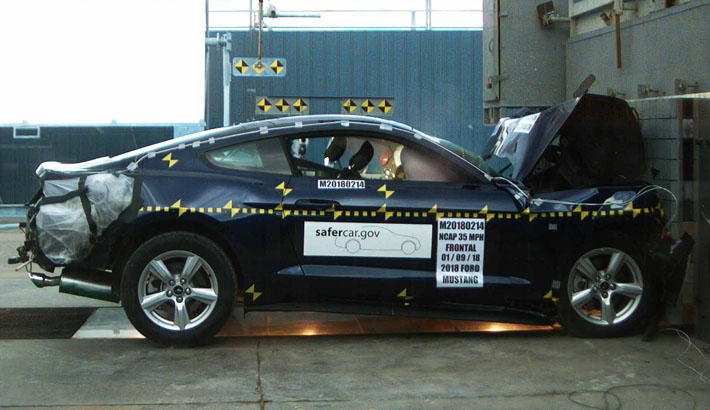
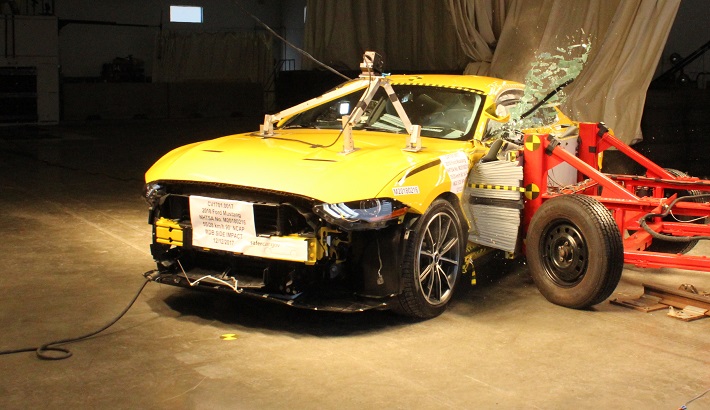
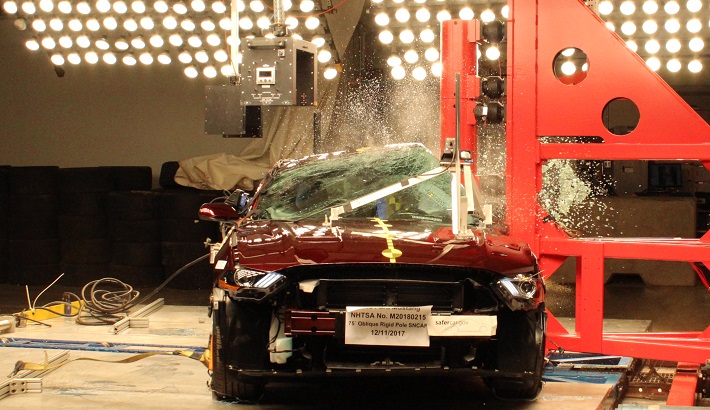
NHTSA crash tests
The agency crash-tested this model year itself. These are its own
photographs and star ratings.
Frontal crash test
Side barrier crash test
Side pole crash test
Photographs taken by NHTSA during its own New Car Assessment Program crash
tests of this model year. Public domain.
Configuration
Overall
Front
Side
Rollover
2018 Ford Mustang 2 DR RWD
9.3% risk
2018 Ford Mustang C RWD
—
—
—
8.1% risk
When owners complained
A spike years after the car went on sale usually means a part wearing
out on schedule across the whole fleet — the kind of pattern no single
owner can see from inside their own car.
Jan 2018peak 11Sep 2026
Recalls on the 2018 Ford Mustang
A complaint is one owner's allegation. A recall is the point at which
the manufacturer or a regulator agreed the defect is real and dangerous
enough to fix for free — however old the car is.
United States — NHTSA
25V572000
BACK OVER PREVENTION: SENSING SYSTEM: CAMERA
Ford Motor Company (Ford) is recalling certain 2015-2019 Lincoln MKC, Mustang, F-350 SD, F-250 SD, F-450 SD, 2015-2017 Lincoln Navigator, Expedition, 2015-2018 Edge, Transit Connect, 2016-2019 F-550 SD, Transit, 2017-2019 Econoline, and 2019 Ranger vehicles. The rearview camera may display a distorted, inverted, or blank image when the vehicle is in reverse.
Risk: A rearview camera that displays an inverted, distorted, or blank image can reduce the driver’s view behind the vehicle, increasing the risk of a crash.
18E035000
ENGINE AND ENGINE COOLING:ENGINE:GASOLINE:TURBO/SUPERCHARGER
Roush Performance Products, Inc. (Roush) is recalling certain aftermarket supercharger kits, part number R1318-6006P1-AA, sold for installation on 2018 Ford Mustangs. The hose barb fittings on the supercharger kits may be manufactured incorrectly, possibly causing damage to the fuel lines and resulting in a fuel leak.
Risk: A fuel leak can increase the risk of a fire.
18V213000
POWER TRAIN:AUTOMATIC TRANSMISSION
Ford Motor Company (Ford) is recalling certain 2017-2018 Ford F-150 and 2018 Ford Expedition and Mustang and Lincoln Navigator vehicles equipped with 10-speed automatic transmissions. A roll pin may not have been installed in the transmission, potentially causing a loss of the "Park" function.
Risk: Despite the transmission shift lever being placed in 'Park' and the instrument panel display indicating 'Park,' the vehicle may roll away after it has been exited if the parking brake has not been applied, increasing the risk of injury or a crash.
17V814000
ELECTRICAL SYSTEM:SOFTWARE
Ford Motor Company is recalling certain 2018 Ford Mustang vehicles equipped with an automatic transmission and a 12.4" digital instrument cluster. If the ignition is turned off when the transmission is not in PARK, the instrument cluster may not illuminate the PRNDL gear position display and the operator may not receive the "Key in Ignition" chime when the driver's door is opened. As such, these vehicles fails to comply with the requirements of Federal Motor Vehicle Safety Standard (FMVSS) number 102, "Transmission Shift Lever Sequence/Starter Interlock/Transmission Braking Effect," and number 114, "Theft Protection."
Risk: Without a visual or audible warning to the driver that the vehicle is in PARK, the vehicle may roll away after it has been exited if the parking brake has not been applied, increasing the risk of injury or a crash.
Canada — Transport Canada
Canada runs its own recall programme, and its campaigns do not
always mirror the American ones.
Recall 2025449122,125 units in Canada
Visual System
Issue: On certain vehicles, there could be a problem with the connections inside the rearview camera. As a result, the rearview camera image may not display correctly or at all when the transmission is shifted into reverse. Note: For certain models, this recall also affects incomplete vehicles. Safety Risk: A rearview camera image that doesn't display could reduce a driver's ability to see behind the vehicle while backing up. This could increase the risk of a crash. Corrective Actions: Ford will notify owners by mail and advise you to take your vehicle to a dealership to inspect and, if necessary, replace the rearview camera.
Recall 202064799 units in Canada
Brakes
This equipment recall is for replacement parts that were sold or installed by Ford dealerships between October 2019 and August 2020. This recall is not being conducted under the requirements of the Motor Vehicle Safety Act. Issue: On certain cars, the brake pedal and bracket assembly could fracture if rapid and forceful pressure is applied to the brake pedal, as typically seen during track and competition driving. If this happens, there could be a loss of braking. Note: This equipment recall only affects the following brake pedal and bracket assembly part numbers: FR3Z-2455-AA FR3Z-2455-AB Safety Risk: A loss of brakes can create the risk of a crash. Corrective Actions: Ford will notify its dealers of this recall. While dealers will attempt to contact people who may have purchased a part affected by this recall, if you have had the brake pedal and bracket assembly replaced on your car, you should contact the dealer that sold or installed it to find out if it is affected by this recall. Any part that is affected by this recall will be replaced, free of charge.
Recall 2020485833 units in Canada
Lights And Instruments
Issue: On certain vehicles, a software problem may cause the daytime running lamps (DRLs) to not turn on. Note: This recall only affects Shelby GT350 and Shelby GT500 models. Safety Risk: Daytime running lights that do not work could make the vehicle less visible to others and increase the risk of a crash. Corrective Actions: Ford will notify owners by mail and instruct you to take your vehicle to a dealer to update the body control module (BCM) software.
Recall 201816418 units in Canada
Powertrain
On certain vehicles, a roll pin attaching the park pawl rod guide cup to the transmission case may not have been installed. Over time, this could cause the transmission to lose the Park function even when the shifter and instrument panel display PARK. If the parking brake is not applied, this could result in unintended vehicle movement, which would increase the risk of crash causing injury and/or damage to property. Correction: Dealers will inspect and install the missing roll pin as necessary.
Recall 201765267 units in Canada
Lights And Instruments
Certain vehicles may fail to conform to Canada Motor Vehicle Safety Standard (CMVSS) 102 – Transmission Control Functions and (CMVSS) 114 - Theft Protection and Rollaway Prevention. When the ignition state is changed from the key-on to the key-off position and the transmission is not in PARK (P), the instrument cluster may not illuminate the PRNDL display and the operator may not receive the key-in-ignition warning chime when the driver’s door is opened. If the driver does not set the parking brake, this could cause unintended vehicle movement, increasing the risk of injury and/or property damage. Correction: Dealers will update the instrument cluster software.
Reports where the owner recorded a crash, a fire, an injury or a death.
Crystal Springs, MSCrash
POWER TRAIN
I was driving down the road in my 2018 Mustang ecoboost. When all of the sudden slowing down it locked the rear wheels up. I slid off the road and fortunately I didn’t hit anything but it did pop my side skirt off in the rear of the car. Thankfully the person behind me reacted in quick enough time to get around me considering the rainy weather conditions. This is very dangerous. It’s throwing a code for a solenoid B. Had traction control lights. And says see manual. But they all illuminated after the problem first happened. The car has been parked for a while. However someone suggested I try this website. There were no pre warnings to what was going on. The car drove fine up until the point of it just randomly deciding to lock the rear wheels up. I still owe money on the car and have been paying for it for almost two years since it happened. The car has around 100k miles. I saw online where my car is not the only case. One of the cases the car almost got hit by a train. Yikes.
NHTSA complaint #11708074 — an unverified report by a vehicle owner.
Crystal Springs, MSCrash
WHEELS
I was driving down the road in my 2018 Mustang ecoboost. When all of the sudden slowing down it locked the rear wheels up. I slid off the road and fortunately I didn’t hit anything but it did pop my side skirt off in the rear of the car. Thankfully the person behind me reacted in quick enough time to get around me considering the rainy weather conditions. This is very dangerous. It’s throwing a code for a solenoid B. Had traction control lights. And says see manual. But they all illuminated after the problem first happened. The car has been parked for a while. However someone suggested I try this website. There were no pre warnings to what was going on. The car drove fine up until the point of it just randomly deciding to lock the rear wheels up. I still owe money on the car and have been paying for it for almost two years since it happened. The car has around 100k miles. I saw online where my car is not the only case. One of the cases the car almost got hit by a train. Yikes.
NHTSA complaint #11708074 — an unverified report by a vehicle owner.
Crystal Springs, MSCrash
SERVICE BRAKES
I was driving down the road in my 2018 Mustang ecoboost. When all of the sudden slowing down it locked the rear wheels up. I slid off the road and fortunately I didn’t hit anything but it did pop my side skirt off in the rear of the car. Thankfully the person behind me reacted in quick enough time to get around me considering the rainy weather conditions. This is very dangerous. It’s throwing a code for a solenoid B. Had traction control lights. And says see manual. But they all illuminated after the problem first happened. The car has been parked for a while. However someone suggested I try this website. There were no pre warnings to what was going on. The car drove fine up until the point of it just randomly deciding to lock the rear wheels up. I still owe money on the car and have been paying for it for almost two years since it happened. The car has around 100k miles. I saw online where my car is not the only case. One of the cases the car almost got hit by a train. Yikes.
NHTSA complaint #11708074 — an unverified report by a vehicle owner.
at 46,000 milesLakewood, WACrash
STEERING
The contact owns a 2018 Ford Mustang. The contact stated that while driving at 63 MPH, the steering wheel was guided to drive forward, however, the steering wheel independently steered to the left direction. The vehicle independently accelerated and crashed into a concrete road barrier. The driver's rear and the driver's front area of the vehicle were damaged. The side air bag deployed both the passenger and driver. No injuries were sustained. A police report was filed. The vehicle was able to be driven away from the crash scene. The vehicle was taken to an independent mechanic who diagnosed the vehicle with an unknown steering part failure and the rear driver-side wheel bearing needed to be replaced. The vehicle was not repaired. The manufacturer was not made aware of the failure. The failure mileage was approximately 46,000.
NHTSA complaint #11584933 — an unverified report by a vehicle owner.
at 7,000 milesBuford, GACrash
POWER TRAIN
The contact owns a 2018 Ford Mustang. The contact stated that his son parked the vehicle and set the parking brake and exited the vehicle; however, the rolled away and crashed into a tree. The contact stated that after the failure, he researched online and found a recall for rollaway failures however, the vehicle was not manufactured in the date range of the recalled vehicles. The contact referenced NHTSA Campaign Number: 18V213000 (Power Train) as the possible cause of the failure. The contact spoke with the local dealer and was made aware that the manufacturer was very rigid when it came to vehicles that were not included in a recall even if the vehicle had experienced the failure listed in the recall. The contact was also informed that the manufacturer would not help if the VIN was not included in the recall. As a result, the rear bumper was dented, and the contact was unsure if the panel under the trunk was cracked. The contact stated that his son remembered shifting the vehicle into park and applying the parking brake. The contact stated that he heard a chime before exiting the vehicle but had not checked to identify the source of the sound. No injuries were sustained. No medical attention was required. A police report was not filed. The contact had assistance with placing the vehicle back into the initial parking space. The dealer was notified, and the contact was advised to schedule an appointment for the vehicle to be diagnosed. The vehicle was not diagnosed or repaired. The manufacturer was notified of the failure and the contact was informed that the VIN was not included in the recall. The failure mileage was approximately 7,000.
NHTSA complaint #11490557 — an unverified report by a vehicle owner.
at 7,000 milesBuford, GACrash
POWER TRAIN
******* DELETE VOQ ******* THIS COMPLAINT IS BEING MARKED FOR DELETION BECAUSE IT IS AN INADVERTENT DUPLICATE OF ODI# 11490557*DJR ******* DELETE VOQ *******
NHTSA complaint #11490558 — an unverified report by a vehicle owner.
The most recent complaints
In the owners' own words, exactly as filed with NHTSA.
Skokie, IL
UNKNOWN OR OTHER
I own a 2018 Ford Mustang EcoBoost convertible and am reporting persistent spider activity that has become a recurring driver-safety concern. Spider activity occurs on or around the vehicle essentially every day. I routinely see multiple spiders and webs on the windshield, hood, doors, roof, trunk, sides, and around both exterior mirrors. Spiders repeatedly build webs between the doors/body and both mirror housings, and I have seen spiders crawl out from behind the mirrors numerous times, especially the driver-side mirror. I also find web strands inside the passenger compartment. On three occasions, a spider rebuilt a large web across the driver’s-seat entry area after I removed it. On Sept. 10, 2026, after a commercial car wash earlier that day, I had about six spider sightings within roughly 10 minutes. While driving, I saw one crawl up the hood and disappear near the base of the windshield. Shortly afterward, a sizable spider appeared INSIDE the windshield directly in front of my face, apparently coming from where the dash meets the windshield. I have severe arachnophobia and had an immediate panic response. I was fortunate to reach a nearby parking lot and stop without crashing. During the same period, I saw two spiders on the trunk, then another crawling across the interior headliner directly above me, followed by another emerging from the driver-side mirror. I am becoming genuinely afraid to drive this vehicle. This is not a cosmetic complaint. Spiders repeatedly appear in the driver’s immediate environment and create a risk of sudden distraction, involuntary panic, abrupt steering/braking, loss of lane control, and a crash. The car is normally kept closed and I rarely lower the convertible top because of this problem. I am not asserting a specific defect or entry path. I am asking NHTSA to review similar complaints and determine whether a vehicle-design condition may be contributing to persistent spider habitation or intrusion into the driver’s area.
NHTSA complaint #11763525 — an unverified report by a vehicle owner.
Spring, TX
ENGINE
I own a 2018 Ford Mustang EcoBoost Premium with the 2.3L EcoBoost engine. The vehicle initially developed a check-engine light and was diagnosed with P0303 (Cylinder 3 misfire), P0316 (startup misfire), and P018C (fuel pressure sensor circuit low). On August 24, 2026, all four spark plugs and one ignition coil were replaced, and a fuel/induction cleaning service was performed. The P018C repair was declined at that time. On September 10, 2026, the vehicle started with an extremely rough idle and produced a very large cloud of white, sweet-smelling exhaust smoke. The check-engine light came on. The original codes, including the misfire codes, were present along with additional codes. The vehicle underwent approximately three hours of diagnostics and road testing. The codes were cleared, and afterward only P018C returned. Testing reportedly did not identify a head-gasket leak, but visible white smoke was still coming from the exhaust when I left the repair facility. Possible coolant intrusion involving the turbocharger was discussed, but the source was not confirmed. Later that day, the vehicle would not crank in Park but started in Neutral. While driving home, the engine began idling so violently at a traffic light that the entire vehicle shook and the tachometer fluctuated significantly. Before September 10, the vehicle had never produced white exhaust smoke, never shaken violently at idle, and always started. The repair facility attempted to inspect the cylinders with a borescope, but both of its borescopes were not functioning. I am concerned about possible coolant intrusion or another engine defect because of the Cylinder 3/startup misfire history, heavy white sweet-smelling exhaust, and severe intermittent rough running. The cause has not yet been confirmed, and I am concerned about possible engine failure or loss of power while driving.
NHTSA complaint #11763539 — an unverified report by a vehicle owner.
Spring, TX
ENGINE
I own a 2018 Ford Mustang EcoBoost Premium with the 2.3L EcoBoost engine. The vehicle initially developed a check-engine light and was diagnosed with P0303 (Cylinder 3 misfire), P0316 (startup misfire), and P018C. On August 24, 2026, all four spark plugs and one ignition coil were replaced and a fuel/induction cleaning was performed. On September 10, the vehicle suddenly started with an extremely rough idle and produced a large cloud of white, sweet-smelling exhaust smoke. The check-engine light illuminated and the previous codes returned along with additional codes. The vehicle continued producing white exhaust smoke after several hours of diagnostic testing. Later that day, the engine shook violently while I was stopped at a traffic light and the tachometer fluctuated significantly. On September 11, the check-engine light returned and the previous diagnostic codes were again present. Firestone documented that coolant was present in the exhaust, that the coolant level was low again after coolant had been added the previous day, that the engine was burning coolant and producing white smoke, and that coolant was mixed with the engine oil. Firestone stated the engine may have a cracked head, failed head gasket, or internal engine crack and recommended complete engine replacement. The engine has now suffered a serious internal failure severe enough that the repair facility recommends replacement. The vehicle has exhibited violent shaking, unstable engine speed, repeated misfires, rapid coolant loss, coolant contamination of the engine oil, and coolant burning through the exhaust. I am concerned that continued operation could result in complete engine failure or sudden loss of engine power while driving, creating a significant safety hazard in traffic. Before September 10, the vehicle had never produced white exhaust smoke or experienced this severe shaking. I am reporting this as a potential safety defect involving the 2.3L EcoBoost engine.
NHTSA complaint #11763758 — an unverified report by a vehicle owner.
Spring, TX
FUEL/PROPULSION SYSTEM
I own a 2018 Ford Mustang EcoBoost Premium with the 2.3L EcoBoost engine. The vehicle initially developed a check-engine light and was diagnosed with P0303 (Cylinder 3 misfire), P0316 (startup misfire), and P018C (fuel pressure sensor circuit low). On August 24, 2026, all four spark plugs and one ignition coil were replaced, and a fuel/induction cleaning service was performed. The P018C repair was declined at that time. On September 10, 2026, the vehicle started with an extremely rough idle and produced a very large cloud of white, sweet-smelling exhaust smoke. The check-engine light came on. The original codes, including the misfire codes, were present along with additional codes. The vehicle underwent approximately three hours of diagnostics and road testing. The codes were cleared, and afterward only P018C returned. Testing reportedly did not identify a head-gasket leak, but visible white smoke was still coming from the exhaust when I left the repair facility. Possible coolant intrusion involving the turbocharger was discussed, but the source was not confirmed. Later that day, the vehicle would not crank in Park but started in Neutral. While driving home, the engine began idling so violently at a traffic light that the entire vehicle shook and the tachometer fluctuated significantly. Before September 10, the vehicle had never produced white exhaust smoke, never shaken violently at idle, and always started. The repair facility attempted to inspect the cylinders with a borescope, but both of its borescopes were not functioning. I am concerned about possible coolant intrusion or another engine defect because of the Cylinder 3/startup misfire history, heavy white sweet-smelling exhaust, and severe intermittent rough running. The cause has not yet been confirmed, and I am concerned about possible engine failure or loss of power while driving.
NHTSA complaint #11763539 — an unverified report by a vehicle owner.
Bradenton, FL
SERVICE BRAKES
It is a well-known issue across Mustang forms that the brake pedal sensor switch goes bad as well as the small rubber pad that presses against the brake pedal switch. This has happened to me multiple friends in my Mustang group as well as tons online. This is a serious issue because either it will make your vehicle believe the brakes are constantly being pressed letting you shift into gears while the brakes technically aren’t even depressed. That could result in someone getting ran over. Also, it makes it appear that you’re constantly pressing the brake pedal so drivers do not know when you are actually pressing the brakes. I had that issue, I resolved it, but then my switch failed later, which let me not even start the vehicle.
NHTSA complaint #11762411 — an unverified report by a vehicle owner.
Deatsville, AL
ENGINE
2018 WITH 118,000 MILES. Had to get a full block engine replacement due to coolant intrusion into the cylinders. This was diagnosed and replaced at a Ford dealership.
NHTSA complaint #11757459 — an unverified report by a vehicle owner.
Chicago, IL
POWER TRAIN
Was driving my vehicle roughly 10-15mph after a stop, noticed vehicle wasn’t shifting into the gears properly as it was only in 2nd gear and the RPMs kept climbing, when it finally shifted into 3rd gear my transmission proceeded to lockup cause my rear tires to skid and stop in the middle of traffic and in the middle of an intersection disrupting the flow of traffic. Vehicle displayed a wrench light on the dash saying “see manual” as related to a Powertrain issue. Vehicle is in limp mode and barely drives, any shifting after 1st gear will cause the vehicle to lockup and lose all power for several seconds. ONLY HAS 28,330 MILES, DID NOT REACH THE FIRST SERVICE INTERVAL FOR MAINTENANCE ON THE TRANSMISSION.
NHTSA complaint #11754868 — an unverified report by a vehicle owner.
Melissa, TX
POWER TRAIN
My 2018 Ford Mustang EcoBoost with the 10R80 automatic transmission began experiencing hesitation, delayed engagement, and harsh jerking during low-speed acceleration (15-20 mph), especially when cold. Engine RPM would increase, but the vehicle would hesitate before engaging. The condition worsened over time and eventually the vehicle entered limp mode, causing a significant loss of power and illuminating a wrench warning light. An authorized Ford dealership diagnosed DTC P07F6 (Gear 9 Incorrect Ratio). The dealer verified fluid level, updated the PCM, and performed adaptive relearn procedures, but the problem remained. The transmission fluid was found to be dark with a burnt odor, and the dealer diagnosed an internal transmission failure requiring complete transmission replacement at an estimated cost of $9,250. This created a safety concern because the vehicle did not consistently accelerate as expected when entering traffic, crossing intersections, or merging onto roadways. Delayed engagement and loss of power reduced the ability to accelerate when needed. The vehicle has approximately 82,256 miles and has been maintained according to Ford's recommended service schedule. I am also aware of numerous publicly documented owner reports, technical discussions, and litigation involving the Ford 10R80 transmission used in vehicles from this generation. One of the commonly discussed concerns involves the CDF drum design in earlier 10R80 transmissions. My understanding is that Ford later revised the CDF drum design in subsequent production; however, when I contacted Ford regarding this transmission failure and requested assistance with repair const, they advised that my vehicle was not covered by any recall, customer satisfaction program, or warranty extension related to this issue. I am submitting this report so that my experience can be considered together with other reports to determine whether a broader safety-related defect exists.
NHTSA complaint #11752476 — an unverified report by a vehicle owner.
at 56,000 milesLake Wales, FL
ENGINE AND ENGINE COOLING
The contact owns a 2018 Ford Mustang. The contact stated that while driving at various speeds, the engine sputtered with the check engine warning light illuminated. There was heavy white smoke coming from the tailpipe. Upon arriving at the destination, the vehicle hesitated to restart, and the contact observed a significant loss of coolant. The vehicle stalled while driving at various speeds. Upon inspection, the dealer confirmed coolant intrusion in cylinders #2 and #3, resulting in total engine failure. The manufacturer was notified of the failure and stated that the VIN was not under recall, and there was no warranty associated with the vehicle. The vehicle was repaired out-of-pocket by the dealer. The failure mileage was approximately 56,000.
NHTSA complaint #11746432 — an unverified report by a vehicle owner.
at 69,900 milesBuda, TX
ENGINE AND ENGINE COOLING
The contact owns a 2018 Ford Mustang. The contact stated that the air conditioning system failed to function as intended. Additionally, the contact stated that while accelerating from a complete stop, several unknown warning lights were illuminated, and the vehicle chugged and failed to accelerate as intended. The contact pulled over to the side of the road. The vehicle was towed to the residence. The contact stated that the vehicle was inoperable. The dealer was notified of the failure and informed the contact that there was no recall or warranty coverage for the vehicle. The contact was provided an estimate for the repair. The vehicle was not diagnosed or repaired. The manufacturer was notified of the failure and suggested to purchase a new vehicle. The contact declined due to the sentimental value of the vehicle. The failure mileage was approximately 69,900.
NHTSA complaint #11744688 — an unverified report by a vehicle owner.
Ontario, CA
UNKNOWN OR OTHER
The trunk wiring which powers the tail lights, brake and parking lights, turn signals, trunk light, and the back up camera is too short, and it stretches and breaks when the trunk is opened and closed. Ford is aware of the issue, but is unwilling to fix it. The back up camera was already recalled, but it and the trunk light are not working again because the trunk wiring issue has not been addressed. The biggest auto safety issue is that the tail lights, brake and parking lights, turn signals, and back up light could also fail due to the trunk wiring being too short.
NHTSA complaint #11741698 — an unverified report by a vehicle owner.
Mobile, GA
ENGINE
1. Component failed and availability for inspection: The engine assembly block failed due to a manufacturing defect known as "coolant intrusion into the cylinders." The vehicle and the defective engine are currently located at my residence and remain fully available for federal or manufacturer inspection upon request. 2. Safety risk: The safety of myself and others was severely compromised. Coolant entering the combustion chambers causes sudden, severe engine misfires across all cylinders, erratic power loss, and instantaneous stalling. Operating a vehicle where the engine can suddenly lose all power on high-speed roads creates an immediate risk of rear-end collisions and catastrophic traffic accidents. Furthermore, high-pressure internal coolant leaks pose an inherent risk of engine fires. 3. Problem confirmed by a dealer: Yes. The problem has been officially diagnosed and confirmed by an authorized Ford dealership service center, which documented internal coolant intrusion. 4. Inspected by manufacturer, police, or insurance: The component was inspected and verified by the vehicle manufacturer's authorized dealership technicians. It has not been inspected by the police or insurance representatives, as no crash has occurred yet. 5. Warning lamps, messages, or symptoms prior to failure: Prior to the diagnosis, the vehicle exhibited a "Check Engine Light." Currently, the vehicle is suffering from critical failure symptoms: the Check Engine Light is flashing constantly, the engine misfire codes are actively showing on all 4 cylinders, and the vehicle shakes violently at low RPMs (rough idling). These severe symptoms first appeared approximately 2 moths ago and have progressively worsened due to the coolant intrusion.
NHTSA complaint #11738968 — an unverified report by a vehicle owner.
Somerset, NJ
POWER TRAIN
While completing a turn at a T-intersection, the vehicle experienced a complete loss of motive power for several seconds, leaving the car stationary in the path of oncoming traffic. The transmission (10R80) failed to engage, a known symptom of internal CDF Drum sleeve failure (TSB 24-2254). This follows a 'Green' inspection by a dealer on March 23rd where an axle seal leak and shifting issues were overlooked. The failure to engage gear during a turn creates an unreasonable risk of a T-bone collision.
NHTSA complaint #11732274 — an unverified report by a vehicle owner.
Somerset, NJ
FUEL/PROPULSION SYSTEM
While completing a turn at a T-intersection, the vehicle experienced a complete loss of motive power for several seconds, leaving the car stationary in the path of oncoming traffic. The transmission (10R80) failed to engage, a known symptom of internal CDF Drum sleeve failure (TSB 24-2254). This follows a 'Green' inspection by a dealer on March 23rd where an axle seal leak and shifting issues were overlooked. The failure to engage gear during a turn creates an unreasonable risk of a T-bone collision.
NHTSA complaint #11732274 — an unverified report by a vehicle owner.
Granada Hills, CA
ENGINE
A check engine light turned on and the vehicle was taken to a local dealership. The check engine light was for an engine misfire and was diagnosed further. There was an engine failure due to coolant entering the system. Upon further research, I learned this is a common issue for 2016-2020 Ford Mustangs and it is due to a faulty engine design. The dealership is recommending a new engine install with a price tag of over 13,000 despite this being known to happen because of a badly designed engine with these cars.
NHTSA complaint #11731787 — an unverified report by a vehicle owner.
Boerne, TX
ENGINE
The vehicle was subjected to the “ecoboom” due to Ford’s lack of care when designing the engine. The car blew the head gasket and now requires an engine rebuild.
NHTSA complaint #11731374 — an unverified report by a vehicle owner.
Lynnwood, WA
ENGINE
I was told by my mechanic I have a head gasket leak. Turns out there is a class action lawsuit for my 2.3 ecoboost motor for this coolant intrusion problem. It is a known problem. It is a safety issue as I’ve heard of some engine fires. My car only has 56000 miles on it but it is a 2018 so just out of the manufacturer warranty. I’ve reached out to Ford but no definitive answer on whether they will help or not they want me to pay them to diagnose it even though I’ve already had it properly diagnosed
NHTSA complaint #11730972 — an unverified report by a vehicle owner.
Beverly Hills, CA
BACK OVER PREVENTION
The contact owns a 2018 Ford Mustang. The contact received notification of NHTSA Campaign Number: 25V572000 (Back Over Prevention); however, the part to do the recall repair was not yet available. The local dealer was contacted but the vehicle was not repaired. The contact stated that the manufacturer had exceeded a reasonable amount of time for the recall repair. The manufacturer was made aware of the issue. The contact stated that the camera was inoperable. The vehicle was not repaired. The failure mileage was unavailable.
NHTSA complaint #11727593 — an unverified report by a vehicle owner.
at 99,858 milesMorgantown, KY
BACK OVER PREVENTION
The contact owns a 2018 Ford Mustang. The vehicle was taken to the dealer to be repaired under NHTSA Campaign Number: 25V572000 (BACK OVER PREVENTION); however, the dealer inspected the rear-view camera, and the camera was found to be functional. However, the contact reported that the camera image was distorted, with a grey raindrop line running across the screen. The dealer was notified of the failure. The vehicle was not repaired. The manufacturer was notified of the failure. The failure mileage was 99,858.
NHTSA complaint #11726770 — an unverified report by a vehicle owner.
Stillwater, OK
ENGINE
When driving the car, the engine temperature light came on, pulled the car over to let it cool down, when cooled, drove home and looked in the engine compartment, found the coolant reservoir empty, filled it with proper coolant, next day the engine light came on, took to O'Reilly auto parts to scan code, problem was Cylinder #3 misfire, changed out spark plug, noticed that coolant reservoir was low again, searched internet for possible causes when found that many people are having the same issue, turns out Ford manufactured the 2.3L engines with a faulty design where the cooling leaks into the cylinders "Coolant intrusion". the fix that Ford has established for this issue is to replace the engine with a "long block" version, but will not issue a recall. We have contacted Ford and explained the issue, but they will not repair. This should not be happening to a car with only 27,000 miles. now we are stuck with a car we can't drive and don't have the extra $5,000 plus dollars to replace the engine!
NHTSA complaint #11725806 — an unverified report by a vehicle owner.
Mount Laurel, NJ
ELECTRICAL SYSTEM
Touch screen system has completely stopped turning on (and wont turn on) any time the outside temperature drops below about 70 degrees fahrenheit. Per online research this is a common, known issue and given that this prevents the use of key saftey features such as the backup camera and climate controls I am unsure why this has not yet initiated a safety recall. I have dealt with this for the past 3 winters and can confirm it is 100% in relation to outside temperature. There is no warning lamp/message. The screen will simply not turn on in below 70 degree temperatures. A component to the touch screen must be shielded improperly/not graded for outdoor use.
NHTSA complaint #11723224 — an unverified report by a vehicle owner.
Greensboro, NC
STEERING
Recall
NHTSA complaint #11714068 — an unverified report by a vehicle owner.
Greensboro, NC
UNKNOWN OR OTHER
Recall
NHTSA complaint #11714068 — an unverified report by a vehicle owner.
Birch RUN, MI
ENGINE
Engine stopped working while traveling down a major interstate. Upon further inspection, the engine (EcoBoost) was defective and had to be replaced at my expense. This type of engine is known to have a manufacturing defect and was barely out of warranty. Ford would not replace the engine. Thank you
NHTSA complaint #11713953 — an unverified report by a vehicle owner.
Greensboro, NC
LANE DEPARTURE: BLIND SPOT DETECTION
Recall
NHTSA complaint #11714068 — an unverified report by a vehicle owner.