Owners have filed 1,374 complaints
about the 2016 Honda Civic with NHTSA between 2015 and 2026.
The largest single group is the steering.
Across this model's run it ranks 5 of 34 worst.
The letter says how bad. This says what kind — whether this year drew
an unusual number of complaints, unusually dangerous
ones, or failures that arrived unusually early.
The dashed ring is 50 — the national norm. Further out is worse.
Complaint volume — 100
Against the median year of the Honda Civic. 50 means typical for this
model; 100 means roughly double.
Severity — 30
5.8% of these complaints
involved a crash, fire, injury or death, against a national rate of
9.7%.
Early failure — 100
61% of failures with a mileage on record happened under
36,000 miles, against a national rate of
29%.
NHTSA files every complaint against a named sub-assembly, not just a
system. This is the difference between knowing it was "the engine" and
knowing which part of it — the list to hand a mechanic.
Body
4452.4%
AIR Conditioner
1315.5%
Defroster/Defogger/Hvac System
910.7%
Automatic Emergency Braking
67.1%
Compressor
33.6%
Assist
33.6%
Warnings
33.6%
Pressure Monitoring AND Regulating Systems
33.6%
When it fails
Odometer readings owners gave when they filed. About half of all
complaints include one.
Under 1,000 miles
8813.5%
1,000 – 9,999 miles
10616.3%
10,000 – 24,999 miles
9915.2%
25,000 – 49,999 miles
21232.5%
50,000 – 74,999 miles
9614.7%
75,000 – 99,999 miles
345.2%
100,000 – 149,999 miles
111.7%
150,000+ miles
60.9%
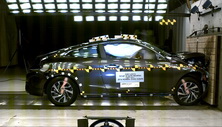
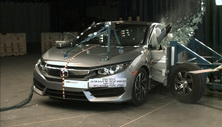
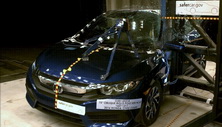
NHTSA crash tests
The agency crash-tested this model year itself. These are its own
photographs and star ratings.
Frontal crash test
Side barrier crash test
Side pole crash test
Photographs taken by NHTSA during its own New Car Assessment Program crash
tests of this model year. Public domain.
Configuration
Overall
Front
Side
Rollover
2016 Honda Civic 2 DR FWD
9.3% risk
2016 Honda Civic 4 DR FWD
9.5% risk
When owners complained
A spike years after the car went on sale usually means a part wearing
out on schedule across the whole fleet — the kind of pattern no single
owner can see from inside their own car.
Dec 2015peak 43Sep 2026
Recalls on the 2016 Honda Civic
A complaint is one owner's allegation. A recall is the point at which
the manufacturer or a regulator agreed the defect is real and dangerous
enough to fix for free — however old the car is.
United States — NHTSA
26V332000
AIR BAGS:SENSOR:OCCUPANT CLASSIFICATION:FRONT PASSENGER
Honda (American Honda Motor Co.) is recalling certain 2018-2021, 2023 Acura TLX, 2019-2024 RDX, 2017-2020, 2022-2026 MDX, 2017-2021, 2023, 2025 Honda Ridgeline, 2017-2022 Pilot, 2019-2021 Passport, 2018-2026 Odyssey, 2019-2022 Insight, 2019-2021 HR-V, 2018-2020 Fit, 2020-2022 CR-V Hybrid, 2017-2022 CR-V, 2017-2018, 2021 Civic Type R, 2017-2021 Civic hatchback, 2016-2020 Civic coupe, 2016-2022 Civic, 2017-2022 Accord Hybrid, and 2016-2022 Accord vehicles. The front passenger seat weight sensor may crack and short circuit, which can cause the air bags to deploy unintentionally during a crash.
Risk: Air bags that deploy unintentionally during a crash increase the risk of injury.
23V858000
FUEL SYSTEM, GASOLINE:DELIVERY:FUEL PUMP
Honda (American Honda Motor Co.) is recalling certain 2013-2023 Honda Accord, Civic Coupe, Civic Sedan, Civic Hatchback, Civic Type R, CR-V, HR-V, Ridgeline, Odyssey, Acura ILX, MDX, MDX Hybrid, RDX, RLX, TLX, 2019-2022 Honda Insight, Passport, 2020 Honda CR-V Hybrid, 2018-2019 Honda Clarity PHEV, Fit, and 2015-2020 Honda Accord Hybrid, Pilot, Acura NSX vehicles. The fuel pump inside the fuel tank may fail.
Risk: Fuel pump failure can cause an engine stall while driving, increasing the risk of a crash.
16V725000
PARKING BRAKE
Honda (American Honda Motor Co.) is recalling certain model year 2016 Honda Civic two door and four door 1.5L turbo and 2.0L vehicles. The electric parking brake (EPB) may not engage if it is applied immediately after turning the ignition off.
Risk: If the EPB is not applied, the vehicle may roll away, increasing the risk of a crash.
16V526000
EXTERIOR LIGHTING
American Honda Motor Co. (Honda) is recalling certain model year 2016 Civic 2-Door vehicles manufactured February 23, 2016, through May 20, 2016. The affected vehicles may have a damaged LED side marker light circuit board inside the taillight assembly, making the marker light inoperable. As such, these vehicles fail to comply with the requirements of Federal Motor Vehicle Safety Standard (FMVSS) number 108, "Lamps, Reflective Devices, and Assoc. Equipment."
Risk: If a side marker light does not function, vehicle visibility can be decreased to other drivers, increasing the risk of a crash.
16V074000
ENGINE AND ENGINE COOLING:ENGINE
Honda (American Honda Motor Co.) is recalling certain model year 2016 Civic vehicles manufactured September 22, 2015, to February 3, 2016 and equipped with 2.0L engines. The affected vehicles have engines with piston assemblies that may have been manufactured without a piston wrist pin circlip or with an incorrectly installed piston wrist pin circlip.
Risk: If a circlip is missing or incorrectly installed, the piston wrist pin may not be secure and may drift and damage the engine cylinder causing the engine to seize, and increasing the risk of a crash or a fire.
Canada — Transport Canada
Canada runs its own recall programme, and its campaigns do not
always mirror the American ones.
Recall 202625112,371 units in Canada
Seats And Restraints
Issue: On certain vehicles, the weight sensor for the front passenger seat may not have been manufactured properly. As a result, the passenger-front airbag and knee airbag could deploy in a crash that doesn't require them to. Note: This recall is an expansion of Transport Canada recall no. 2024-059. If the weight sensor fails, the SRS warning light would turn on in the instrument panel. Safety Risk: An airbag system that doesn't work properly could increase the risk of injury in a crash. Corrective Actions: The company will notify owners by mail and advise you to take your vehicle to a dealership to replace the passenger-front seat weight sensor.
Recall 20163552,492 units in Canada
Lights And Instruments
Certain two-door vehicles may not comply with the requirements of Canada Motor Vehicle Safety Standard (CMVSS) 108 - Lighting System and Retroreflective Devices. Some taillight assemblies may have a damaged rear LED side marker light, making it inoperable and are therefore not compliant with the requirements of the standard. This could reduce vehicle conspicuity, which could increase the risk of a crash causing injury and/or damage to property. Correction: Dealers will inspect, and, if necessary, replace the tail light assembly.
Recall 201604710,698 units in Canada
Engine
On certain vehicles equipped with 2.0L engines, a piston pin circlip may not have been installed or may have been improperly installed into the piston during assembly. If the circlip is not properly installed, over the course of engine operation, the piston pin will rub against the cylinder wall causing noise and damage, or in the worst case, the piston pin may detach from one side of the piston and cause an engine failure. Engine damage will eventually result in the engine stalling. Engine stalling would result in a loss of motive power; an engine failure would result in a sudden loss of motive power and may result in an under hood fire. These potential outcomes in conjunction with traffic and road conditions, and the driver's reactions, could increase the risk of a crash causing injury and/or property damage. Correction: Dealers will inspect, and repair as necessary.
Reports where the owner recorded a crash, a fire, an injury or a death.
Greencastle, IN1 injured
ELECTRICAL SYSTEM
My infotainment system about killed me 3 or 4 times
NHTSA complaint #11732610 — an unverified report by a vehicle owner.
Pine Bluff, ARCrash
AIR BAGS
2016 Honda civic EX steering wheel airbags and front passenger airbags didn’t deploy during my husbands wreck. He totaled the car…
NHTSA complaint #11713485 — an unverified report by a vehicle owner.
Long Beach, CACrash
WHEELS
My front driver side wheel completely detached from the vehicle’s body while I was driving home causing the left side of my car to collide with the street pavement and skid to a stop. The driver door airbags deployed, fluid leaked from under the vehicle and the bottom driver side of the car was damaged including the back left wheel/tire. The car had to be towed and an insurance claim was filed for review.
NHTSA complaint #11698436 — an unverified report by a vehicle owner.
Long Beach, CACrash
STEERING
My front driver side wheel completely detached from the vehicle’s body while I was driving home causing the left side of my car to collide with the street pavement and skid to a stop. The driver door airbags deployed, fluid leaked from under the vehicle and the bottom driver side of the car was damaged including the back left wheel/tire. The car had to be towed and an insurance claim was filed for review.
NHTSA complaint #11698436 — an unverified report by a vehicle owner.
Long Beach, CACrash
SUSPENSION
My front driver side wheel completely detached from the vehicle’s body while I was driving home causing the left side of my car to collide with the street pavement and skid to a stop. The driver door airbags deployed, fluid leaked from under the vehicle and the bottom driver side of the car was damaged including the back left wheel/tire. The car had to be towed and an insurance claim was filed for review.
NHTSA complaint #11698436 — an unverified report by a vehicle owner.
at 48,000 milesPhoenix, AZCrash
SERVICE BRAKES, AIR:ANTILOCK:ABS WARNING LIGHT
The contact's parent owns a 2016 Honda Civic. The contact stated that while the parent was parking into a parking space, and straightening the steering wheel; the brake pedal depressed but the vehicle continued to drive. Several warning messages were displayed "Vehicle Stability Assist Problem", "Power System Steering Problem", "Hill Start Assist Problem", "Emissions Systems Problem", "Brake Hold System Problem", and "Brake System Problem". The driver noticed that the brake pedal failed to respond and the vehicle rapidly accelerated, causing the vehicle to crash into two medians and crash into a parked and unoccupied Ford Edge vehicle at unknown speeds. The stationary vehicle was pushed halfway out of the parking spot. No air bags deployed, and there were no injuries reported. The vehicle was towed to a dealer where it was unknown if the vehicle was diagnosed. The vehicle was not repaired. The manufacturer was notified of the failure and a case was opened. The failure mileage was approximately 48,000.
NHTSA complaint #11580533 — an unverified report by a vehicle owner.
The most recent complaints
In the owners' own words, exactly as filed with NHTSA.
Troy, VA
STEERING
When the Honda Civic has been driven long enough for the steering to get warm, at highway speeds, the steering wheel will stick in position instead of centering itself. Manual adjustment has to be done to straighten the car.
NHTSA complaint #11763377 — an unverified report by a vehicle owner.
O Fallon, IL
STEERING
Mostly during warm weather and driving over 45MPH the steering gets sticky. When attempting to use a little pressure to make a slight correction to keep the care centered in the lane the steering "jumps" and over steers requiring to re-correct to stay centered in the lane. I'm having to keep correcting the steering which causes me difficulty and concerned about the safety especially driving on the highway.
NHTSA complaint #11762806 — an unverified report by a vehicle owner.
at 1,000 milesPetersburg, VA
STEERING
The contact owns a 2016 Honda Civic. The contact stated while driving 50 MPH, the steering wheel jerked, and the steering wheel was sticking. The contact stated that the failure was a known failure with the vehicle. The contact referenced an unknown recall; however, the VIN was not associated with a recall associated with the failure. The dealer was made aware of the failure by phone. The failure mileage was approximately 1,000.
NHTSA complaint #11761689 — an unverified report by a vehicle owner.
Union, OR
ENGINE
The check engine light came on the car had no power. The head gasket was blown.
NHTSA complaint #11761455 — an unverified report by a vehicle owner.
Williamsburg, VA
STEERING
My 2016 Honda Civic has developed a steering problem in which the steering feels sticky or notchy while driving. The steering wheel does not move smoothly when making small corrections and can feel like it catches or resists movement before releasing. This is especially noticeable while driving at higher speeds and makes it more difficult to make normal, smooth steering corrections and maintain the vehicle’s position in the lane. I took the vehicle to a Honda dealership for evaluation. The dealer diagnosed the problem as the steering rack and advised that the steering rack needs to be replaced. I am reporting this to NHTSA because this is a steering-related safety concern. The vehicle has approximately 95,000 miles, and I am concerned that this steering failure could result in loss of proper steering control or increase the risk of a crash.
NHTSA complaint #11760951 — an unverified report by a vehicle owner.
Covington, GA
WHEELS
Failure of my Electric Power Steering General Assembly/Steering Rack and Pinion in my 2016 Honda Civic EX sedan while driving at highway speeds. My steering wheel sticks or feels notchy at highway speeds requiring physical effort to overcome the binding. A highly reputable independent automotive shop (Gearheadz) in [XXX] has confirmed in its diagnosis that this is a dangerous defect that needs to be corrected. The odometer on my 2016 Honda Civic EX has only 70,000 mileage as of XXX. My car is in very good condition except for this manufacturing defect by Honda.. I discovered in my research that Honda has issued a massive safety recall for an identical physical safety hazard on 2022-2025 Honda Civics, but excluded the 2016-2021 model years. Hundreds of other owners have documented the exact same dangerous "sticky steering" symptoms at highway speeds in their Civics that predate the 2022-25 recall. My out-of-pocket expenses to correct this problem will exceed $2,000. The expense would more than double that amount if I let Honda repair or replace the steering rack and pinion problem. Clearly, Honda knows about this issue and yet has decided to limit its recall on the manufacturing defect that is NOT cause by the owner. INFORMATION REDACTED PURSUANT TO THE FREEDOM OF INFORMATION ACT (FOIA), 5 U.S.C. 552(B)(6)
NHTSA complaint #11759624 — an unverified report by a vehicle owner.
Covington, GA
STEERING
Failure of my Electric Power Steering General Assembly/Steering Rack and Pinion in my 2016 Honda Civic EX sedan while driving at highway speeds. My steering wheel sticks or feels notchy at highway speeds requiring physical effort to overcome the binding. A highly reputable independent automotive shop (Gearheadz) in [XXX] has confirmed in its diagnosis that this is a dangerous defect that needs to be corrected. The odometer on my 2016 Honda Civic EX has only 70,000 mileage as of XXX. My car is in very good condition except for this manufacturing defect by Honda.. I discovered in my research that Honda has issued a massive safety recall for an identical physical safety hazard on 2022-2025 Honda Civics, but excluded the 2016-2021 model years. Hundreds of other owners have documented the exact same dangerous "sticky steering" symptoms at highway speeds in their Civics that predate the 2022-25 recall. My out-of-pocket expenses to correct this problem will exceed $2,000. The expense would more than double that amount if I let Honda repair or replace the steering rack and pinion problem. Clearly, Honda knows about this issue and yet has decided to limit its recall on the manufacturing defect that is NOT cause by the owner. INFORMATION REDACTED PURSUANT TO THE FREEDOM OF INFORMATION ACT (FOIA), 5 U.S.C. 552(B)(6)
NHTSA complaint #11759624 — an unverified report by a vehicle owner.
Covington, GA
ELECTRICAL SYSTEM
Failure of my Electric Power Steering General Assembly/Steering Rack and Pinion in my 2016 Honda Civic EX sedan while driving at highway speeds. My steering wheel sticks or feels notchy at highway speeds requiring physical effort to overcome the binding. A highly reputable independent automotive shop (Gearheadz) in [XXX] has confirmed in its diagnosis that this is a dangerous defect that needs to be corrected. The odometer on my 2016 Honda Civic EX has only 70,000 mileage as of XXX. My car is in very good condition except for this manufacturing defect by Honda.. I discovered in my research that Honda has issued a massive safety recall for an identical physical safety hazard on 2022-2025 Honda Civics, but excluded the 2016-2021 model years. Hundreds of other owners have documented the exact same dangerous "sticky steering" symptoms at highway speeds in their Civics that predate the 2022-25 recall. My out-of-pocket expenses to correct this problem will exceed $2,000. The expense would more than double that amount if I let Honda repair or replace the steering rack and pinion problem. Clearly, Honda knows about this issue and yet has decided to limit its recall on the manufacturing defect that is NOT cause by the owner. INFORMATION REDACTED PURSUANT TO THE FREEDOM OF INFORMATION ACT (FOIA), 5 U.S.C. 552(B)(6)
NHTSA complaint #11759624 — an unverified report by a vehicle owner.
Seymour, TN
STEERING
I've owned this 2016 Honda Civic since May of 2025. At first I never experienced any issue from the steering, that is when I started to notice that my steering felt like it would be sticking, like you couldn't balance yourself on highways or speeds exceeding 30+mph. I started doing my own research and discovered that other civic owners (10th and 11th gen) were experiencing similar issues. I'm hoping Honda takes notice of the reports being sent in and issues either a recall or a fix to this problem.
NHTSA complaint #11758977 — an unverified report by a vehicle owner.
Woodstock, GA
STEERING
My 2016 Honda Civic EX-T intermittently experiences a sticky/notchy steering condition, particularly while driving at highway speeds. When making small steering corrections around the straight-ahead/center position, the steering wheel sometimes resists movement and feels as though it is sticking or binding. Additional steering effort is then required to overcome the resistance, after which the steering releases. This can cause a larger steering correction than intended and creates concern about maintaining precise directional control at highway speeds. The condition is intermittent and may not occur during a short test drive. I reported the condition to an authorized Honda dealer and requested that it be evaluated. The dealer test drove the vehicle but was unable to reproduce the condition. The dealer provided an estimate of approximately $5,887 should replacement of the EPS steering rack/gear become necessary. No EPS warning light is present. I have also opened a case with American Honda Customer Relations (Repair Diagnosis Information Request: 16569333) regarding this steering concern. I am reporting the condition to NHTSA because the intermittent increase in steering effort and subsequent release can potentially result in overcorrection and represents a safety concern.
NHTSA complaint #11757729 — an unverified report by a vehicle owner.
Whittier, CA
UNKNOWN OR OTHER
The vehicle has experienced repeated A/C refrigerant leaks. In March 2026, a Honda dealer replaced the condenser and compressor shaft seal under warranty. Several months later, the A/C again gradually lost cooling. The dealer diagnosed leaks from the evaporator, expansion valve, and two Schrader valves. The dealer quoted about $2,800 for parts and labor, including dashboard removal to access the evaporator. The repair has not been performed. The repeated loss of A/C may create a safety concern because the system helps defog and defrost the windshield, potentially affecting visibility. The dealer confirmed the leaks. Honda was contacted but denied goodwill assistance based on the vehicle's age. I am reporting this because multiple major A/C components have developed leaks within months of warranty repairs, and I have heard similar reports from other owners of 2016 Civics. I believe the pattern warrants investigation for a possible broader defect.
NHTSA complaint #11757577 — an unverified report by a vehicle owner.
Duluth, GA
STEERING
Steering will feel notchy or sticky while driving, especially on the highway while trying to stay in a lane. This will cause excessive force to "unstick" the steering while will then require another steering correction. This has happening with the car since purchase (used) in 2020.
NHTSA complaint #11755754 — an unverified report by a vehicle owner.
Rockville, VA
STEERING
My 2016 Honda Civic seems to have a 'sticky steering' issue. It is most noticeable when trying to stay straight in a lane, like when trying to make minor adjustments left or right, it would feel like the steering wheel will stick, causing it to jerk more in the direction I’m trying to steer, which causes slight over steering and having to correct back the other direction. It doesn’t happen all the time though. It’s random, but once it starts doing it, it stays that way till I’m done driving.
NHTSA complaint #11754367 — an unverified report by a vehicle owner.
Ashburn, VA
STEERING
While driving at highway speeds (55–70 mph), the electronic power steering (EPS) physically binds and sticks when held in a straight line. Making minor lane corrections requires a sudden, deliberate application of extra physical force to 'break' the wheel free from the center position. This causes the vehicle to momentarily overcorrect, posing a severe crash hazard due to unexpected lane drifting. An example is my wife hates riding in my car because she feels as if she is being tossed back and forth in the passenger seat. This is the exact mechanical EPS worm gear/preload spring manufacturing defect covered under NHTSA Recall Campaign 24V-744 for 2022–2025 models, but it is actively manifesting on my 2016 model without any dashboard warning lights or fault codes.
NHTSA complaint #11754293 — an unverified report by a vehicle owner.
Alpharetta, GA
STEERING
Steering wheel sticks and is jerky. Requires constant adjustments to drive straight, especially at highway speeds. Seems like grease is no longer effective and pinion gear sticks in spots. Very dangerous in my opinion. Unsafe. Honda should offer to service this by simply injecting new OEM grease.
NHTSA complaint #11753989 — an unverified report by a vehicle owner.
Redwood City, CA
STEERING
At highway speeds (more than 40-50 mph) the steering wheel feels "stiff" when driving straight and requires effort to move to the left or right. This causes a jerky motion to either left or right which then requires effort to correct, which then may cause a jerky motion in the opposite direction. Reading forums and other complaints on this website, it seems like this is a known Honda issue and must be corrected via a safety recall.
NHTSA complaint #11754075 — an unverified report by a vehicle owner.
SAN Luis, AZ
STEERING
On the freeway steering wheel feels like it’s getting stuck
NHTSA complaint #11752705 — an unverified report by a vehicle owner.
Phoenix, AZ
STEERING
With increasing frequency, at seemingly any condition or speed, a cluster of dashboard warnings, including power steering EPS, ABS, tire pressure TPMS, and others, flash on and stay on. Shortly after, the warnings appear power steering assist fails completely. This leads to uneasy and potentially dangerous circumstances as the car becomes minimally controllable as the physical effort required to maneuver is largely increased. Making turns especially difficult and hazardous while on public roads. This happens with increasing frequency. Initially restarting the car would temporarily fix the problem but that is decreasingly the case and the lights and steering lock happen again shortly after the reset. I no longer attempt to reset the car as it rarely helps now. I am actively keeping log of the frequency of this problem including date, time, and milage.
NHTSA complaint #11752474 — an unverified report by a vehicle owner.
at 100,000 milesShelton, CT
FUEL SYSTEM, GASOLINE
The contact owns a 2016 Honda Civic. The contact stated that while driving at an undisclosed speed, the vehicle went into LIMP Mode. There was no warning light illuminated. The contact pulled over to the side of the road; however, after the vehicle was restarted the vehicle operated normally. The failure was a persistent failure. The contact referenced NHTSA Campaign Number: 23V858000 (Fuel System, Gasoline); as the cause of the failure; however, the VIN was not included in the recall repair. The vehicle was taken to a dealer but was not diagnosed. The vehicle was not repaired. The manufacturer was notified of the failure. The failure mileage was 100,000.
NHTSA complaint #11752350 — an unverified report by a vehicle owner.
Phoenix, AZ
ELECTRICAL SYSTEM
With increasing frequency, at seemingly any condition or speed, a cluster of dashboard warnings, including power steering EPS, ABS, tire pressure TPMS, and others, flash on and stay on. Shortly after, the warnings appear power steering assist fails completely. This leads to uneasy and potentially dangerous circumstances as the car becomes minimally controllable as the physical effort required to maneuver is largely increased. Making turns especially difficult and hazardous while on public roads. This happens with increasing frequency. Initially restarting the car would temporarily fix the problem but that is decreasingly the case and the lights and steering lock happen again shortly after the reset. I no longer attempt to reset the car as it rarely helps now. I am actively keeping log of the frequency of this problem including date, time, and milage.
NHTSA complaint #11752474 — an unverified report by a vehicle owner.
Duncan, OK
STEERING
When driving on the highway or making a turn the wheel feels like it is sticking and it is making it difficult to drive long distance and it feels unsafe.
NHTSA complaint #11751728 — an unverified report by a vehicle owner.
at 84,000 milesClemson, SC
STEERING
The contact owns a 2016 Honda Civic. The contact stated that while driving at various speeds, the steering wheel became difficult to turn to the left or the right. No warning light was illuminated. The vehicle was taken to a local dealer; however, the vehicle was not diagnosed or repaired due to the cost. The manufacturer was not made aware of the failure. The failure mileage was approximately 84,000.
NHTSA complaint #11751457 — an unverified report by a vehicle owner.
Davenport, FL
AIR BAGS
N/a
NHTSA complaint #11750172 — an unverified report by a vehicle owner.
Sugar Land, TX
STEERING
Sticky steering causing overcorrecting while highway driving and presenting a dangerous condition in relation to the control of the vehicle. Honda recalled approximately 1.7 million newer vehicles—including 2022–2025 Honda Civic models—due to an improperly produced steering gearbox worm wheel that can swell, increasing internal friction and causing a "sticky" steering wheel. This year model is also a 10th generation Honda why was it not included in that recall?
NHTSA complaint #11749875 — an unverified report by a vehicle owner.
Greenville, SC
STEERING
EPS sticks once engine is up to temperature and car is moving at or just below highway speeds. Same symptoms as in 11th gen Civic.
NHTSA complaint #11748583 — an unverified report by a vehicle owner.