Owners have filed 781 complaints
about the 2017 Honda Civic with NHTSA between 2016 and 2026.
The largest single group is the steering.
Across this model's run it ranks 11 of 34 worst.
The letter says how bad. This says what kind — whether this year drew
an unusual number of complaints, unusually dangerous
ones, or failures that arrived unusually early.
The dashed ring is 50 — the national norm. Further out is worse.
Complaint volume — 67
Against the median year of the Honda Civic. 50 means typical for this
model; 100 means roughly double.
Severity — 46
9% of these complaints
involved a crash, fire, injury or death, against a national rate of
9.7%.
Early failure — 100
65% of failures with a mileage on record happened under
36,000 miles, against a national rate of
29%.
NHTSA files every complaint against a named sub-assembly, not just a
system. This is the difference between knowing it was "the engine" and
knowing which part of it — the list to hand a mechanic.
Body
3652.9%
Automatic Emergency Braking
710.3%
Compressor
68.8%
Assist
57.4%
Adaptive Cruise Control
57.4%
Defroster/Defogger/Hvac System
57.4%
Body Control Module/Bcm
22.9%
Warning
22.9%
When it fails
Odometer readings owners gave when they filed. About half of all
complaints include one.
Under 1,000 miles
3510.7%
1,000 – 9,999 miles
6018.3%
10,000 – 24,999 miles
7924.1%
25,000 – 49,999 miles
8726.5%
50,000 – 74,999 miles
319.5%
75,000 – 99,999 miles
185.5%
100,000 – 149,999 miles
144.3%
150,000+ miles
41.2%
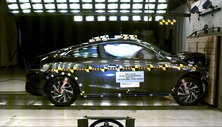
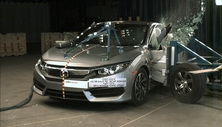
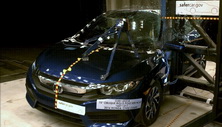
NHTSA crash tests
The agency crash-tested this model year itself. These are its own
photographs and star ratings.
Frontal crash test
Side barrier crash test
Side pole crash test
Photographs taken by NHTSA during its own New Car Assessment Program crash
tests of this model year. Public domain.
Configuration
Overall
Front
Side
Rollover
2017 Honda Civic 2 DR FWD
9.3% risk
2017 Honda Civic 5 HB FWD
9.5% risk
2017 Honda Civic 4 DR FWD
9.5% risk
When owners complained
A spike years after the car went on sale usually means a part wearing
out on schedule across the whole fleet — the kind of pattern no single
owner can see from inside their own car.
Nov 2016peak 19Sep 2026
Recalls on the 2017 Honda Civic
A complaint is one owner's allegation. A recall is the point at which
the manufacturer or a regulator agreed the defect is real and dangerous
enough to fix for free — however old the car is.
United States — NHTSA
26V332000
AIR BAGS:SENSOR:OCCUPANT CLASSIFICATION:FRONT PASSENGER
Honda (American Honda Motor Co.) is recalling certain 2018-2021, 2023 Acura TLX, 2019-2024 RDX, 2017-2020, 2022-2026 MDX, 2017-2021, 2023, 2025 Honda Ridgeline, 2017-2022 Pilot, 2019-2021 Passport, 2018-2026 Odyssey, 2019-2022 Insight, 2019-2021 HR-V, 2018-2020 Fit, 2020-2022 CR-V Hybrid, 2017-2022 CR-V, 2017-2018, 2021 Civic Type R, 2017-2021 Civic hatchback, 2016-2020 Civic coupe, 2016-2022 Civic, 2017-2022 Accord Hybrid, and 2016-2022 Accord vehicles. The front passenger seat weight sensor may crack and short circuit, which can cause the air bags to deploy unintentionally during a crash.
Risk: Air bags that deploy unintentionally during a crash increase the risk of injury.
23V858000
FUEL SYSTEM, GASOLINE:DELIVERY:FUEL PUMP
Honda (American Honda Motor Co.) is recalling certain 2013-2023 Honda Accord, Civic Coupe, Civic Sedan, Civic Hatchback, Civic Type R, CR-V, HR-V, Ridgeline, Odyssey, Acura ILX, MDX, MDX Hybrid, RDX, RLX, TLX, 2019-2022 Honda Insight, Passport, 2020 Honda CR-V Hybrid, 2018-2019 Honda Clarity PHEV, Fit, and 2015-2020 Honda Accord Hybrid, Pilot, Acura NSX vehicles. The fuel pump inside the fuel tank may fail.
Risk: Fuel pump failure can cause an engine stall while driving, increasing the risk of a crash.
18V817000
EQUIPMENT:OTHER:OWNERS/SERVICE/OTHER MANUAL
Honda (American Honda Motor Co.) is recalling certain 2017-2018 Honda Civic Hatchback and Civic Type R vehicles. The owners guide in these vehicles may not have been included or if included, the owner's guide may not have been properly provided required information. As such, these vehicles fail to comply with the requirements of Federal Motor Vehicle Safety Standard (FMVSS) number 225, "Child Restraint Anchorage Systems."
Risk: If the information is missing or improper, it can increase the risk of injury or a crash.
18V663000
STEERING:ELECTRIC POWER ASSIST SYSTEM
Honda (American Honda Motor Co.) is recalling certain 2017-2018 Honda Civic and CR-V vehicles. The magnet that controls the torque sensor output signal for the electronic power steering system may not be properly secured, allowing the magnet to become dislodged. During a full lock turn, the dislodged magnet may cause steering assist to be applied in the opposite direction.
Risk: The unintended steering input reduces vehicle maneuverability and increases the risk of a crash.
18V266000
AIR BAGS
Honda (American Honda Motor Co.) is recalling certain 2017 Honda Civic Hatchback and Civic Type R vehicles. Driver and front passenger seatback pads sold as replacement service parts were made without slit openings for the seat-mounted side air bags. In the event of a crash necessitating air bag deployment, the seatback pad would interfere and adversely affect air bag performance. As such, these vehicles fail to comply with the requirements of Federal Motor Vehicle Safety Standard (FMVSS) number 214, "Side Impact Protection."
Risk: If the seat-mounted air bags cannot not deploy correctly in the event of a crash, there would be an increased risk of injury.
17V706000
POWER TRAIN:DRIVELINE:DRIVESHAFT
Honda (American Honda Motor Co.) is recalling certain 2017 Honda Civic Sedan and Coupe vehicles. The right halfshaft may have been improperly heat treated, reducing its strength.
Risk: The improper heat treatment can result in the halfshaft breaking, preventing the engine from moving the vehicle, and can allow a possible roll away situation if the parking brake is not engaged. This can increase the risk of a crash.
Canada — Transport Canada
Canada runs its own recall programme, and its campaigns do not
always mirror the American ones.
Recall 202625112,371 units in Canada
Seats And Restraints
Issue: On certain vehicles, the weight sensor for the front passenger seat may not have been manufactured properly. As a result, the passenger-front airbag and knee airbag could deploy in a crash that doesn't require them to. Note: This recall is an expansion of Transport Canada recall no. 2024-059. If the weight sensor fails, the SRS warning light would turn on in the instrument panel. Safety Risk: An airbag system that doesn't work properly could increase the risk of injury in a crash. Corrective Actions: The company will notify owners by mail and advise you to take your vehicle to a dealership to replace the passenger-front seat weight sensor.
Recall 202559939 units in Canada
Wheels
Issue: This recall is for certain aluminum wheels that were installed before delivery or sold as a dealer accessory. On certain vehicles, the wheels may not have been manufactured properly. As a result, the wheel nut(s) could loosen and cause the wheel(s) to detach. Safety Risk: A wheel separation could cause a loss of control and increase the risk of a crash. Additionally, a wheel that separates could create a road hazard for others. Corrective Actions: Honda will notify owners by mail and advise you to take your vehicle to a dealership to inspect and, if necessary, replace the hub(s), wheel(s) and wheel nut(s).
Recall 20186311,210 units in Canada
Other
On certain vehicles, the owner's manual may not have been provided, or an incorrect manual was provided. This would result in an owner not having written information required by the Canadian Motor Vehicle Safety Regulations. If important safety information is not available to the owner, such as information regarding child restraint anchorage use, there could be an increased risk of injury in a crash. Correction: Honda will mail the correct owner's manual to all affected owners.
Recall 20185369 units in Canada
Steering
On certain vehicles, the electric power steering system could get caught in an infinite loop of steering assist going from lock to lock due to a manufacturing defect in the torque sensor. This could cause unintended steering input, reducing vehicle manoeuvrability, which could result in a crash causing injury and/or damage to property. Correction: Dealers will replace the steering gearbox assembly.
Recall 201821110 units in Canada
Seats And Restraints
Certain vehicles that have had a driver and/or front passenger seatback pad replaced may not comply with Canada Motor Vehicle Safety Standard (CMVSS) 214 - Side Impact Protection. Certain seatback pads sold as replacement service parts may have been manufactured without a slit opening for the seat mounted side airbags. In the event of a crash warranting deployment of the side airbag(s), the seatback pad would interfere and adversely affect airbag performance, which could increase the risk of injury to the front seated occupant. Correction: Dealers will inspect and replace the front seatback pad(s) as necessary.
Recall 2017552241 units in Canada
Powertrain
On certain vehicles, the passenger-side driveshaft could fracture and separate. If this were to occur while the vehicle is being driven, it could result in a loss of motive power. If this were to occur while the vehicle is parked on an incline without the parking brake applied (even when the gear selector has been placed in the Park position), it could result in unintended vehicle movement. Both situations could increase the risk of a crash causing injury and/or property damage. Correction: Dealers will inspect the serial number on the right driveshaft and replace the driveshaft, as necessary, and align the front wheels.
Reports where the owner recorded a crash, a fire, an injury or a death.
San Jose, CA1 injured
STRUCTURE:BODY
My 2017 Honda Civic just had a known BCM issue and many with the same models year from 2016-2018 experience the same failures. Honda should have a recall because it's where the car unknowingly drains the battery and the engine sits in idle/accessory mode that is damaging to other parts that the customer have to expense for.
NHTSA complaint #11759796 — an unverified report by a vehicle owner.
San Jose, CA1 injured
ELECTRICAL SYSTEM
My 2017 Honda Civic just had a known BCM issue and many with the same models year from 2016-2018 experience the same failures. Honda should have a recall because it's where the car unknowingly drains the battery and the engine sits in idle/accessory mode that is damaging to other parts that the customer have to expense for.
NHTSA complaint #11759796 — an unverified report by a vehicle owner.
Santa Clara, CACrash
AIR BAGS
Airbags failed to deploy! Fortunately, this was a rather minor accident and nobody was injured, but I found out that the system had tried to deploy the airbags and failed. I don't feel like this vehicle is safe to drive anymore.
NHTSA complaint #11757689 — an unverified report by a vehicle owner.
at 140,000 milesWaldorf, MD1 injured
AIR BAGS
The contact owns a 2017 Honda Civic. The contact stated that while driving from a complete stop and making a left turn, the contact heard a boom, and the front driver's side airbag suddenly deployed without warning or impact. The airbag hit the contact's hand. The contact received medical attention, and a stent was placed in the contact's arm up to the elbow. The vehicle was towed to a towing lot. The insurance company was informed of the failure. The local dealer was not contacted. The vehicle was not diagnosed or repaired. The manufacturer was not notified of the failure. The failure mileage was 140,000.
NHTSA complaint #11742631 — an unverified report by a vehicle owner.
at 59,600 milesHicksville, NYCrash1 injured
STEERING
The contact ownED a 2017 Honda Civic. The contact stated that while his daughter was driving at 30 MPH, there was an abnormal clicking sound, and the steering wheel locked up, causing her to lose control and crash into an electrical pole. No warning lights illuminated. The contact stated that the failure was related to NHTSA Campaign Number: 18V663000 (Steering). The yearly inspection was completed two weeks prior with no indication of an issue. The driver sustained a scratch on her leg, and medical attention was provided at the emergency room. All the air bags deployed. There was no reported fire. A police report was filed. The vehicle was towed to an auto repair center. The vehicle was deemed a total loss by the insurance company. The local dealer was not contacted. The vehicle was not diagnosed or repaired. The manufacturer was not notified. The failure mileage was approximately 69,600.
NHTSA complaint #11732629 — an unverified report by a vehicle owner.
Seabeck, WAFire
ELECTRICAL SYSTEM
car alarm going off for an extended period of time caused a short at the battery and caused a fire that destroyed the vehicle.
NHTSA complaint #11579014 — an unverified report by a vehicle owner.
The most recent complaints
In the owners' own words, exactly as filed with NHTSA.
Rancho Cucamonga, CA
VISIBILITY:DEFROSTER/DEFOGGER/HVAC SYSTEM
My air conditioning failed producing cool air in late 2020. I took it to Honda Penske in Ontario. The said at that time the Evaporator core is leaking but it not covered by warranty. I had pay out of pocket to install freon and that would like me for 5-6 months however the same problem would return. The following year I took it to El Monte Honda dealership where I purchased the car. They reviewed and stated the same the problem and they couldnt do anything about it. I once again had to pay out of pocket to install freon myself. Any local shop installs freon for $500. I have had to do that every summer of the last 4-5 years. My most recent visit was to Penske Honda which told me there is a recall for the AC Condensor, which was performed along with installing of freon. The same problem arises after 3 months where the evaporator core doesnt hold in the cool air, it leaks and eventually doesnt produce cool air at all. Hot days can be miserable especially with my kids in the Car.
NHTSA complaint #11763431 — an unverified report by a vehicle owner.
Champaign, IL
STEERING
Steering wheel gets stuck on highway driving and hard to make fine adjustments without force
NHTSA complaint #11761834 — an unverified report by a vehicle owner.
Oakdale, MN
VISIBILITY/WIPER
I'm submitting a complaint for visibility concerns because the A/C system is plauged with issues on this vehicle. When A/C systems don't function properly it causes a visibility concern because the defogger won't clear the windshield (especially in the cold winters in my home state of [XXX]). This is the first series that Honda used this type of refrigerant (R-1234yf) and they ended up having issues with a few other vehicles when introducing this refrigerant. They released Warranty Extension 6A5 for this series to cover the A/C compressor and a shaft seal for premature failure due to complications with the refrigerant. In my opinion this was a bandaid-fix applied in an attempt to sweep the issue under the rug. My car's A/C has failed 3 times in the 5 years that I've owned it. I took it to Hoda last week and they said this time it was the evaporator and that it's $2,700 to fix. I would argue that all parts in this A/C system (including the evaporator and condenser) are affected by the same issues that cause premature failure in the Compressor. INFORMATION REDACTED PURSUANT TO THE FREEDOM OF INFORMATION ACT (FOIA), 5 U.S.C. 552(B)(6)
NHTSA complaint #11761902 — an unverified report by a vehicle owner.
Tulare, CA
UNKNOWN OR OTHER
The vehicle suffered a complete, simultaneous loss of climate control and safety defroster/defogging capabilities due to a catastrophic failure of the factory A/C compressor and condenser. This loss of functionality stems directly from a well-documented factory defect where the compressor shaft seal chemically degrades over time (Honda TSB 23-039), leading to total internal lubrication loss and component seizing. While American Honda Motor Co. has an active warranty extension for this issue, corporate claims management is actively restricting consumer remedies by enforcing text-matching policy loopholes—refusing to reimburse subsequent owners for the complete component replacements mechanically required to safely repair the vehicle. This creates an immediate safety and financial hurdle preventing owners from maintaining functional windshield visibility systems.
NHTSA complaint #11761623 — an unverified report by a vehicle owner.
Mckeesport, PA
STEERING
After contact the Honda Corporation of this problem, they suggested that I file a complaint with your organization. I have reported a problem to Honda concerning the steering on my 2017 Honda Civic LX. The steering wheel is having a sticky, notchy effect when I am above 4o miles per hour. I am on the PA turnpike atleast once a week and really notice the problem then. What happens is that the car will slightly drift to one side and when I go to correct it, it is not a smooth transition, the steering has a sticky notchy effect which when I do correct the steering to be in the center, even the passager can feel this effect. I did take it to our Honda dealer where we purchased the car new and they said they did a computer diagnostic test and found nothing and could not take the car out for a certain amount of time to experience what I have been experiencing. We recently had all new tires and a four wheel alignment done on the car, but it is still doing the same thing. Honda Corp stated that their is a recall for this problem with 2017 Honda Civic, but that my VIN number does not fall in that category. THIS IS A SAFETY ISSUE and I feel that Honda should take responsibility in the matter since it is already a problem with other 2017 Honda's. Does someone have to get seriously hurt or killed before they look at this problem. I hope that someone is able to help with this situation as soon as possible. If you need addtional information, my number is [XXX]. Hope to hear from you in a proper time matter. This is the only car we have and the situation is a little nerve racking. Thank you, [XXX] [XXX] INFORMATION REDACTED PURSUANT TO THE FREEDOM OF INFORMATION ACT (FOIA), 5 U.S.C. 552(B)(6)
NHTSA complaint #11761363 — an unverified report by a vehicle owner.
Champaign, IL
STEERING
Sticky steerinng on highway Feels tight and difficult to make small adjustments Car then over corrects Has been happening for a while several years
NHTSA complaint #11761453 — an unverified report by a vehicle owner.
Hope Mills, NC
UNKNOWN OR OTHER
2017 Honda Civic Ex-L (Paint Code NH830M - Lunar Silver Metallic) Paint is coming off in patches throughout the entirety of the vehicle's body, exposing bare metal to the harsh environmental elements. Paint primer appears to have weak adhesion to the metal as both primer and paint is being removed in chunks. Car owner has reported this issue to North Carolina Honda Dealership, where owner was then redirected to have an inspection conducted at the local Subaru dealership, to which they have a contractual agreement with. Imaging and documentation were compiled and submitted. There was no follow-up with the owner after this incident. Owner has contacted both dealerships and was advised that the effected car needed to be completely repainted, quoting thousands of dollars at the owner's expense. Previous NHTSA Report Case ID: XXX, has provided no response/feedback to owner and is not showing as a publicly available complaint for the vehicle on [XXX]. Several similar complaints for this year/make/model have been found on other publicly available threads, to which remain as being unacknowledged/addressed. As the standard American is unable to fork out thousands of dollars for this type of manufacture paint-defect, bare metal is accruing rust and subsequently eating away at the vehicle's structural integrity. This is an extremely hazardous safety issue. INFORMATION REDACTED PURSUANT TO THE FREEDOM OF INFORMATION ACT (FOIA), 5 U.S.C. 552(B)(6)
NHTSA complaint #11761228 — an unverified report by a vehicle owner.
San Jose, CA1 injured
STRUCTURE:BODY
My 2017 Honda Civic just had a known BCM issue and many with the same models year from 2016-2018 experience the same failures. Honda should have a recall because it's where the car unknowingly drains the battery and the engine sits in idle/accessory mode that is damaging to other parts that the customer have to expense for.
NHTSA complaint #11759796 — an unverified report by a vehicle owner.
San Jose, CA1 injured
ELECTRICAL SYSTEM
My 2017 Honda Civic just had a known BCM issue and many with the same models year from 2016-2018 experience the same failures. Honda should have a recall because it's where the car unknowingly drains the battery and the engine sits in idle/accessory mode that is damaging to other parts that the customer have to expense for.
NHTSA complaint #11759796 — an unverified report by a vehicle owner.
Albuquerque, NM
AIR BAGS
Check airbag light is on. I'm paying $175 to see what's wrong with an airbag on a perfectly maintained car. Inspection is pending. Safety systems should be covered to at least 100,000 miles.
NHTSA complaint #11759330 — an unverified report by a vehicle owner.
Collegeville, PA
EXTERIOR LIGHTING
The Body Control Module (BCM) on my 2017 Honda Civic suffered an internal failure, creating immediate safety hazards. The defect caused persistent parasitic battery drain, sudden vehicle power loss, and erratic electrical behavior. A faulty BCM can cause critical safety components—such as exterior lighting, turn signals, and windshield wipers—to fail without warning while driving. Honda has already recalled 2018–2020 Accords and 2019–2020 Insights for identical BCM programming and hardware failures (NHTSA Campaign 20V771000 / Honda Campaign X95). My 2017 Civic utilizes similar BCM architecture and exhibits the exact same dangerous failure symptoms. This component defect is widespread across multiple Honda platforms from this generation, and the safety recall must be expanded to include the Honda Civic before a catastrophic electrical failure results in a crash or injury. I had to replace the unit entirely out of pocket to ensure the vehicle was safe to operate.
NHTSA complaint #11759494 — an unverified report by a vehicle owner.
Collegeville, PA
ELECTRICAL SYSTEM
The Body Control Module (BCM) on my 2017 Honda Civic suffered an internal failure, creating immediate safety hazards. The defect caused persistent parasitic battery drain, sudden vehicle power loss, and erratic electrical behavior. A faulty BCM can cause critical safety components—such as exterior lighting, turn signals, and windshield wipers—to fail without warning while driving. Honda has already recalled 2018–2020 Accords and 2019–2020 Insights for identical BCM programming and hardware failures (NHTSA Campaign 20V771000 / Honda Campaign X95). My 2017 Civic utilizes similar BCM architecture and exhibits the exact same dangerous failure symptoms. This component defect is widespread across multiple Honda platforms from this generation, and the safety recall must be expanded to include the Honda Civic before a catastrophic electrical failure results in a crash or injury. I had to replace the unit entirely out of pocket to ensure the vehicle was safe to operate.
NHTSA complaint #11759494 — an unverified report by a vehicle owner.
Collegeville, PA
VISIBILITY/WIPER
The Body Control Module (BCM) on my 2017 Honda Civic suffered an internal failure, creating immediate safety hazards. The defect caused persistent parasitic battery drain, sudden vehicle power loss, and erratic electrical behavior. A faulty BCM can cause critical safety components—such as exterior lighting, turn signals, and windshield wipers—to fail without warning while driving. Honda has already recalled 2018–2020 Accords and 2019–2020 Insights for identical BCM programming and hardware failures (NHTSA Campaign 20V771000 / Honda Campaign X95). My 2017 Civic utilizes similar BCM architecture and exhibits the exact same dangerous failure symptoms. This component defect is widespread across multiple Honda platforms from this generation, and the safety recall must be expanded to include the Honda Civic before a catastrophic electrical failure results in a crash or injury. I had to replace the unit entirely out of pocket to ensure the vehicle was safe to operate.
NHTSA complaint #11759494 — an unverified report by a vehicle owner.
Westerville, OH
VEHICLE SPEED CONTROL
The contact owns a 2017 Honda Civic. The contact stated that while driving at an undisclosed speed and exiting the freeway, while approaching a traffic light, the vehicle stalled and lost motive power. The vehicle was driven 50 MPH to a parking lot. Prior to the failure, the HVAC, emission, brakes, assist, and power steering warning lights were illuminated. The vehicle was taken to the local dealer, who was unable to determine the cause of the failure. The vehicle had not been diagnosed or repaired. The manufacturer was contacted, and a case was opened. The failure mileage was unknown.
NHTSA complaint #11758993 — an unverified report by a vehicle owner.
Westerville, OH
STEERING
The contact owns a 2017 Honda Civic. The contact stated that while driving at an undisclosed speed and exiting the freeway, while approaching a traffic light, the vehicle stalled and lost motive power. The vehicle was driven 50 MPH to a parking lot. Prior to the failure, the HVAC, emission, brakes, assist, and power steering warning lights were illuminated. The vehicle was taken to the local dealer, who was unable to determine the cause of the failure. The vehicle had not been diagnosed or repaired. The manufacturer was contacted, and a case was opened. The failure mileage was unknown.
NHTSA complaint #11758993 — an unverified report by a vehicle owner.
Chowchilla, CA
UNKNOWN OR OTHER
This vehicle had a recall from which an extended warranty was given from 10 years of purchase unlimited mileage. The condenser and compressor came defective from the manufacturer. I strongly believe they should include the A/C Evaporator as well. As i know i am not the only one with these issues. This issue is had fixed back in 2022 where one side blew cold air and the hot and white stuff spewed from the vents.
NHTSA complaint #11759061 — an unverified report by a vehicle owner.
Westerville, OH
ENGINE
The contact owns a 2017 Honda Civic. The contact stated that while driving at an undisclosed speed and exiting the freeway, while approaching a traffic light, the vehicle stalled and lost motive power. The vehicle was driven 50 MPH to a parking lot. Prior to the failure, the HVAC, emission, brakes, assist, and power steering warning lights were illuminated. The vehicle was taken to the local dealer, who was unable to determine the cause of the failure. The vehicle had not been diagnosed or repaired. The manufacturer was contacted, and a case was opened. The failure mileage was unknown.
NHTSA complaint #11758993 — an unverified report by a vehicle owner.
Santa Clara, CACrash
AIR BAGS
Airbags failed to deploy! Fortunately, this was a rather minor accident and nobody was injured, but I found out that the system had tried to deploy the airbags and failed. I don't feel like this vehicle is safe to drive anymore.
NHTSA complaint #11757689 — an unverified report by a vehicle owner.
Bartonville, TX
STEERING
sticky steering
NHTSA complaint #11756166 — an unverified report by a vehicle owner.
Lake Forest, CA
UNKNOWN OR OTHER
My car AC has been having issues as the driver side produces warmer air than the passenger side. Honda issued a 10 year extended warranty for two of the three AC components; the warranty covers only the compressor and condenser. My 2017 Honda Civic has roughly 64k miles on it and the AC evaporator needs to be replaced. The Honda dealership has responded that this would cost out of pocket to replace. Seeing as the extended warranty covers the other components but not the third related one I'm writing a formal complaint. My vehicle doesn't meet the minimum threshold of usage for the AC evaporator to fail having been in use for under 10 years and having about 64k miles on it.
NHTSA complaint #11754822 — an unverified report by a vehicle owner.
Alexandria, VA
UNKNOWN OR OTHER
About one month ago, I noticed that the paint on my rear quarter panel (to the right of my rear window) was peeling. It continues to peel. My insurance will not cover the paint failure, as the adjuster stated that they "will not touch my car because there are several class action lawsuits again Honda for the paint on this specific model and color of white" '. I have contacted Honda and they stated that after looking up my VIN, there are no lawsuits or recalls associated with my specific VIN. I am at a loss because the paint looks like a paint failure - not as though something hit or scratched the paint and caused it to peel. I am looking for assistance for reimbursement or how to get this covered. Because this is not an at fault event, I am unsure of next steps because the paint will continue to peel and then there is a possibility that the car will rust.
NHTSA complaint #11753059 — an unverified report by a vehicle owner.
Alexandria, VA
STRUCTURE:BODY
About one month ago, I noticed that the paint on my rear quarter panel (to the right of my rear window) was peeling. It continues to peel. My insurance will not cover the paint failure, as the adjuster stated that they "will not touch my car because there are several class action lawsuits again Honda for the paint on this specific model and color of white" '. I have contacted Honda and they stated that after looking up my VIN, there are no lawsuits or recalls associated with my specific VIN. I am at a loss because the paint looks like a paint failure - not as though something hit or scratched the paint and caused it to peel. I am looking for assistance for reimbursement or how to get this covered. Because this is not an at fault event, I am unsure of next steps because the paint will continue to peel and then there is a possibility that the car will rust.
NHTSA complaint #11753059 — an unverified report by a vehicle owner.
The contact owns a 2017 Honda Civic. The contact stated that while purchasing the vehicle, the contact became aware that the A/C was inoperable. Before purchasing the vehicle, the contact asked the dealer to replace the A/C condenser, and the component was replaced. The contact stated that three years later, the A/C compressor was replaced again, but the shaft seal was not replaced. The contact stated that on June 30, the evaporator failed, causing fumes to enter the A/C and there was bacteria trapped due to oil leaks from the shaft seal. The vehicle was taken to the dealer, where it was diagnosed with the failure of the evaporator, causing the oil from the shaft seal to leak into the evaporator. The vehicle was not repaired. The manufacturer was notified of the failure. The failure mileage was 125,500.
NHTSA complaint #11753040 — an unverified report by a vehicle owner.
The contact owns a 2017 Honda Civic. The contact stated that while purchasing the vehicle, the contact became aware that the A/C was inoperable. Before purchasing the vehicle, the contact asked the dealer to replace the A/C condenser, and the component was replaced. The contact stated that three years later, the A/C compressor was replaced again, but the shaft seal was not replaced. The contact stated that on June 30, the evaporator failed, causing fumes to enter the A/C and there was bacteria trapped due to oil leaks from the shaft seal. The vehicle was taken to the dealer, where it was diagnosed with the failure of the evaporator, causing the oil from the shaft seal to leak into the evaporator. The vehicle was not repaired. The manufacturer was notified of the failure. The failure mileage was 125,500.
NHTSA complaint #11753040 — an unverified report by a vehicle owner.
Wheaton, MD
STEERING
I just purchased a 2017 Honda Civic yesterday that seems to be experiencing issues similar to the electric power steering (EPS) malfunction involved in Honda’s EPS gearbox recall, even though my VIN is not included. The steering becomes stiff and jerky when trying to turn the wheel, particularly at higher speeds (especially on the highway) and when trying to slightly move the wheel to remain in the lanes. The condition occurs consistently and has made it difficult to maintain proper control of the vehicle, which is super concerning for me. This creates a safety risk because the steering does not respond smoothly or predictably. I purchased this car yesterday at around 75k miles, and I noticed it immediately once I hit the highway. After doing some research I see that many others are experiencing the same issue, as well as it already being a widely known issue with Honda hence their initial recall. I believe this defect should be investigated and expanded to my vin because myself and other owners are experiencing the same problem outside the current recall population.
NHTSA complaint #11751361 — an unverified report by a vehicle owner.