Owners have filed 276 complaints
about the 2015 Honda Odyssey with NHTSA between 2014 and 2026.
The largest single group is the engine & cooling.
Across this model's run it ranks 19 of 32 worst.
The letter says how bad. This says what kind — whether this year drew
an unusual number of complaints, unusually dangerous
ones, or failures that arrived unusually early.
The dashed ring is 50 — the national norm. Further out is worse.
Complaint volume — 26
Against the median year of the Honda Odyssey. 50 means typical for this
model; 100 means roughly double.
Severity — 56
10.9% of these complaints
involved a crash, fire, injury or death, against a national rate of
9.7%.
Early failure — 100
60% of failures with a mileage on record happened under
36,000 miles, against a national rate of
29%.
NHTSA files every complaint against a named sub-assembly, not just a
system. This is the difference between knowing it was "the engine" and
knowing which part of it — the list to hand a mechanic.
Body
2460.0%
Speedometer/Odometer
615.0%
Sun/Moon Roof Assembly
37.5%
Warning
25.0%
Warnings
25.0%
Wheelchair Lift/Ramp
12.5%
Camera System
12.5%
Injectors
12.5%
When it fails
Odometer readings owners gave when they filed. About half of all
complaints include one.
Under 1,000 miles
179.7%
1,000 – 9,999 miles
3922.3%
10,000 – 24,999 miles
2916.6%
25,000 – 49,999 miles
3620.6%
50,000 – 74,999 miles
2715.4%
75,000 – 99,999 miles
84.6%
100,000 – 149,999 miles
105.7%
150,000+ miles
95.1%
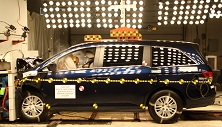
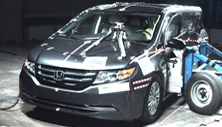
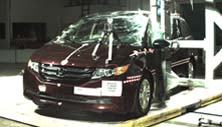
NHTSA crash tests
The agency crash-tested this model year itself. These are its own
photographs and star ratings.
Frontal crash test
Side barrier crash test
Side pole crash test
Photographs taken by NHTSA during its own New Car Assessment Program crash
tests of this model year. Public domain.
Configuration
Overall
Front
Side
Rollover
2015 Honda Odyssey VAN FWD
12.7% risk
When owners complained
A spike years after the car went on sale usually means a part wearing
out on schedule across the whole fleet — the kind of pattern no single
owner can see from inside their own car.
Sep 2014peak 10Sep 2026
NHTSA investigations into the 2015 Honda Odyssey
An investigation is the step before a recall: the agency has seen enough
complaints to look into a pattern itself. An open one means it thinks
something may be wrong and nothing has been fixed yet.
1
investigation is
still open.
DP26005Opened 13 Jul 2026Still openAIR BAGS: AIR BAG/RESTRAINT CONTROL MODULE
Inadvertent Deployment of Air Bags
The Office of Defects Investigation (ODI) received a Petition dated May 30, 2026. The Petition is requesting an investigation into inadvertent air bag deployment in model year (MY) 2011-2017 Honda Odyssey vehicles. The Petition contends that air bags can deploy absent a sufficiently severe event to trigger a deployment, such as an impact, rollover event, or G-force threshold breach. The Petition further alleges that the Diagnostic Trouble Codes (DTCs) and Supplemental Restraint System (SRS) conflict and inaccurate data is being recorded for the air bag system. The Petitioner cites 10 complaint...
Recalls on the 2015 Honda Odyssey
A complaint is one owner's allegation. A recall is the point at which
the manufacturer or a regulator agreed the defect is real and dangerous
enough to fix for free — however old the car is.
Rollx Vans (Rollx) is recalling certain GMC Yukon, Sierra, Chevrolet Express 2500, Ford Transit, E-250, Toyota Sienna, Sienna Hybrid, Honda Odyssey, Chrysler Town and Country, Voyager, Pacifica, Dodge Grand Caravan, and Ram Promaster vehicles equipped with QRT-Deluxe and QRT-Max wheelchair restraints. Please refer to Rollx's recall report for specific model year information. The retractors may not lock, preventing the wheelchair from being properly secured.
Risk: An unsecured wheelchair can move during transit, increasing the risk of injury.
23V858000
FUEL SYSTEM, GASOLINE:DELIVERY:FUEL PUMP
Honda (American Honda Motor Co.) is recalling certain 2013-2023 Honda Accord, Civic Coupe, Civic Sedan, Civic Hatchback, Civic Type R, CR-V, HR-V, Ridgeline, Odyssey, Acura ILX, MDX, MDX Hybrid, RDX, RLX, TLX, 2019-2022 Honda Insight, Passport, 2020 Honda CR-V Hybrid, 2018-2019 Honda Clarity PHEV, Fit, and 2015-2020 Honda Accord Hybrid, Pilot, Acura NSX vehicles. The fuel pump inside the fuel tank may fail.
Risk: Fuel pump failure can cause an engine stall while driving, increasing the risk of a crash.
18V170000
SEATS:MID/REAR ASSEMBLY
Honda (American Honda Motor Co.) is recalling certain 2014-2016 Honda Odyssey vehicles. The second row outboard seats have a lever to fold the seatback and slide the seat forward to access the third row seats. Due to a manufacturing error, if the walk-in release lever is used to fold a fully reclined left outboard seatback forward, the seatback may stay in the unlocked position (free-folding) or unexpectedly unlock without engaging the walk-in or recliner lever.
Risk: An unlocked second row left outboard seatback increases the risk of injury to the seat occupant during a crash.
17V725000
SEATS:MID/REAR ASSEMBLY
Honda (American Honda Motor Co.) is recalling certain 2011-2017 Honda Odyssey vehicles. The second row outboard seats can slide sideways to one of two positions. If a seat is placed between either of the two positions when attaching the seat to the vehicle floor, the seat will not latch properly to the seat striker, allowing the seat to tip forward unexpectedly during braking.
Risk: If the seat tips forward during braking, it can increase the risk of injury.
16V933000
SEATS:MID/REAR ASSEMBLY
Honda (American Honda Motor Co.) is recalling certain model year 2011-2016 Odyssey vehicles manufactured August 17, 2010, to October 1, 2015. The affected vehicles have second row outboard seats that have a release lever that allows the seats to move for easier access to the third row of seats. This release lever may remain in the unlocked position allowing the seats to move unexpectedly.
Risk: An unlocked second row outboard seat increases the risk of injury to the seat occupant during a crash.
16V417000
FUEL SYSTEM, GASOLINE:STORAGE:TANK ASSEMBLY
Honda (American Honda Motor Co.) is recalling certain model year 2015 Acura MDX 2WD and MDX 4WD vehicles, 2016 Acura MDX 4WD vehicles, 2015-2016 Honda Odyssey vehicles, and 2016 Honda Pilot 2WD and 4WD vehicles. The affected vehicles have fuel tanks that were manufactured with insufficient welds which may separate and allow fuel to leak out.
Risk: A fuel leak in the presence of an ignition source may result in a fire.
Canada — Transport Canada
Canada runs its own recall programme, and its campaigns do not
always mirror the American ones.
Recall 201812822,056 units in Canada
Seats And Restraints
On certain vehicles, the seat recliner mechanism for the second row left (driver’s) side seat may have a manufacturing error. If the second row left side seat walk-in feature (which folds the seatback and slides the seat forward for access to the third row) is operated while the seat is in the full recline position, the recliner cam could over rotate. When the seatback is returned to an upright position, there is a potential for the seatback to stay in unlocked position or unexpectedly unlock without engaging the lever. In the event of crash, an unlocked seatback could increase the risk of injury to the seat occupant. Correction: Dealers will test the seat to confirm proper operation. If the seat recliner is found to be operating properly, a stopper bracket (which limits the rotation of the cam) will be installed on the seat recliner mechanism. In cases where the seatback does not function properly, dealers will replace the seatback frame assembly and a stopper bracket will be installed and proper operation will be verified.
Recall 201756769,839 units in Canada
Seats And Restraints
On certain vehicles, the rear outboard strikers of the second row outboard (outer) seats have a collar to define two set positions. If an outboard seat is positioned over the collar while attaching the seat to the vehicle floor, the seat will not latch properly to the striker. An unlatched second row outboard seat could tip forward during moderate to heavy braking, which could increase the risk of injury to the seat occupant. Correction: Dealers will install a second row seat striker bracket and a warning label on both second row outer seats. Additionally, dealers will also place supplemental owner information cards in the glove box.
Recall 201664552,710 units in Canada
Seats And Restraints
On certain vehicles, the lever on the second row outboard seats, which allows access to the third row seat, may stay in the unlocked position after returning the seat to its normal seating position. An unlocked second row outboard seat could increase the risk of injury to the seat occupant in the event of a crash. Correction : Dealers will install an additional bracket and spring to the second row outboard seat adjuster to ensure proper engagement of the walk-in lever.
Recall 201559850,551 units in Canada
Label
Certain vehicles may not comply with Canadian Motor Vehicle Safety Regulations. The compliance label may bear incorrect rear Gross Axle Weight Rating (GAWR) information (lower than the vehicle's actual rear GAWR). Correction: A production change has been undertaken to remedy this technical non-compliance condition. No corrective recall action is required as the technical non-compliance conditions are deemed to be non-safety related.
Reports where the owner recorded a crash, a fire, an injury or a death.
Donalds, SCCrash1 injured
AIR BAGS
2015 Honda Odyssey Touring Elite, VIN [XXX]. Vehicle was involved in a frontal collision on XXX. The driver's frontal airbag did not deploy. During the impact, I was thrown forward and struck the steering wheel. Additionally, a side/sliding door opened during the collision. The door was closed before the collision. I am concerned about possible failures of the supplemental restraint system and door-latching system. INFORMATION REDACTED PURSUANT TO THE FREEDOM OF INFORMATION ACT (FOIA), 5 U.S.C. 552(B)(6)
NHTSA complaint #11760524 — an unverified report by a vehicle owner.
Donalds, SCCrash1 injured
STRUCTURE:BODY
2015 Honda Odyssey Touring Elite, VIN [XXX]. Vehicle was involved in a frontal collision on XXX. The driver's frontal airbag did not deploy. During the impact, I was thrown forward and struck the steering wheel. Additionally, a side/sliding door opened during the collision. The door was closed before the collision. I am concerned about possible failures of the supplemental restraint system and door-latching system. INFORMATION REDACTED PURSUANT TO THE FREEDOM OF INFORMATION ACT (FOIA), 5 U.S.C. 552(B)(6)
NHTSA complaint #11760524 — an unverified report by a vehicle owner.
at 221,092 milesMilwaukee, WI1 injured
AIR BAGS
The contact owns a 2015 Honda Odyssey. While the contact's fiancé was driving 30 MPH with the contact seated in the passenger's seat, the passenger's side air bag deployed without impact. The contact sustained injuries to the right arm and neck. Medical attention was provided. The air bag warning light was not illuminated. The local dealer was contacted; however, the vehicle was not diagnosed or repaired. The manufacturer was notified of the failure. The failure mileage was 221,092.
NHTSA complaint #11755046 — an unverified report by a vehicle owner.
at 178,581 milesGreenville, NCCrash
AIR BAGS
The contact owns a 2015 Honda Odyssey. The contact's stated while her husband was driving 25-30 MPH, occupied with her their two children, he was attempting to make a right turn and he got distracted due to a medical emergency with one of the daughter 's having a seizure in the right rear driver side of the vehicle and then the vehicle collided with the curb causing the vehicle to crash into a mailbox, two trees and a light pole. The contact stated that no air bags deployed in the vehicle. The contact stated no injuries. No medical attention was required. The contact stated that a police report was filed. The vehicle was towed to contact residence and the next day will be towed to a collision center. The contact stated that the failure was not diagnosed by a dealer or independent mechanic. The manufacturer was notified of the failure and informed her there were no recalls on her vehicle. The approximate failure mileage was 178,581.
NHTSA complaint #11740230 — an unverified report by a vehicle owner.
at 159,000 milesAnn Arbor, MICrash1 injured
ENGINE
The contact owns a 2015 Honda Odyssey. The contact stated that while pulling out of the parking space, the vehicle RPM had increased while the brake pedal had been depressed. As a result, the vehicle crashed into another vehicle in the lot. The rpm had continued to increase even with the vehicle being in the park position. The air bags did not deploy. No warning light was illuminated. A police report was filed. The vehicle was towed to an auto collision center. The driver was injured. No one outside of the vehicle was injured. The contact sustained back, neck, pelvic, and head inquiries that required medical attention. The doctor provided shots and medicine for the pain. The vehicle had not been diagnosed or repaired by an independent mechanic or dealer. The manufacturer was not made aware of the failure. The failure mileage was approximately 159,000. VIN not provided.
NHTSA complaint #11548726 — an unverified report by a vehicle owner.
Carrollton, GA1 injured
SEAT BELTS
7 year old in 2nd row passanger side seatbelt would not release and would only get tighter and tighter. Seatbelt got tighter and tighter around his belly causing pain and crushing his stomach. I had to cut the seatbelt to get him out. Tried pressing every button and opening and closing car door, locking and unlocking and restarting car, but nothing worked. The more we tried to pull on the seatbelt, the tighter it got. The seatbelt would not release or give any slack to get him out. I am taking car into the dealership for a dianostic this coming Friday.
NHTSA complaint #11473330 — an unverified report by a vehicle owner.
The most recent complaints
In the owners' own words, exactly as filed with NHTSA.
Wellborn, FL
UNKNOWN OR OTHER
My rear passenger sliding door is stuck open and won't close.
NHTSA complaint #11761940 — an unverified report by a vehicle owner.
Donalds, SCCrash1 injured
AIR BAGS
2015 Honda Odyssey Touring Elite, VIN [XXX]. Vehicle was involved in a frontal collision on XXX. The driver's frontal airbag did not deploy. During the impact, I was thrown forward and struck the steering wheel. Additionally, a side/sliding door opened during the collision. The door was closed before the collision. I am concerned about possible failures of the supplemental restraint system and door-latching system. INFORMATION REDACTED PURSUANT TO THE FREEDOM OF INFORMATION ACT (FOIA), 5 U.S.C. 552(B)(6)
NHTSA complaint #11760524 — an unverified report by a vehicle owner.
Donalds, SCCrash1 injured
STRUCTURE:BODY
2015 Honda Odyssey Touring Elite, VIN [XXX]. Vehicle was involved in a frontal collision on XXX. The driver's frontal airbag did not deploy. During the impact, I was thrown forward and struck the steering wheel. Additionally, a side/sliding door opened during the collision. The door was closed before the collision. I am concerned about possible failures of the supplemental restraint system and door-latching system. INFORMATION REDACTED PURSUANT TO THE FREEDOM OF INFORMATION ACT (FOIA), 5 U.S.C. 552(B)(6)
NHTSA complaint #11760524 — an unverified report by a vehicle owner.
at 221,092 milesMilwaukee, WI1 injured
AIR BAGS
The contact owns a 2015 Honda Odyssey. While the contact's fiancé was driving 30 MPH with the contact seated in the passenger's seat, the passenger's side air bag deployed without impact. The contact sustained injuries to the right arm and neck. Medical attention was provided. The air bag warning light was not illuminated. The local dealer was contacted; however, the vehicle was not diagnosed or repaired. The manufacturer was notified of the failure. The failure mileage was 221,092.
NHTSA complaint #11755046 — an unverified report by a vehicle owner.
Portland, TN
ENGINE
I first experienced an engine misfire in February 2025. The vehicle had a P0301 misfire code, and at the time I was unaware of Honda’s extended warranty related to this issue. We had a trusted mechanic friend inspect the vehicle and replace the spark plugs and ignition coils. He noted that there was significant carbon buildup. After those repairs, the vehicle appeared to run normally, and we believed the issue had been resolved. Later, I received Honda’s extended warranty notice and realized that the issue I experienced may have been related to the condition covered by the warranty. I contacted my local Honda dealership in August 2025 and explained the prior misfire, repairs performed, and the warranty notice I had received. However, because the check engine light was not currently illuminated, I was told there was nothing that could be done unless the vehicle was actively displaying the issue. I also contacted Honda Corporate regarding this matter. I was advised that reimbursement for some of the repairs I had already completed might be possible, but that it would need to be reviewed. I chose not to submit those receipts at the time because I was concerned that doing so might impact my ability to use the extended warranty coverage if the problem returned. Unfortunately, the issue appears to be progressing. On June 2, 2026, the vehicle set a P3400 code, which is related to the Variable Cylinder Management (VCM) system. At that time, the oil level was low. After adding oil and completing several driving cycles, the check engine light turned off. However, the vehicle continues to consume oil at an alarming rate. I have had to add additional oil again in July. The problem is progressing - it is the issue that should be covered by warranty but holds refuses to do anything because the light isn’t currently on,
NHTSA complaint #11753638 — an unverified report by a vehicle owner.
Fort Worth, TX
ELECTRICAL SYSTEM
American Honda Motor Co., Inc. issued an official Warranty Extension in July 2025 covering engine misfires from piston ring deterioration (DTCs P0301-P0304) on 2013-15 Pilot and 2013-17 Odyssey vehicles. My 2015 Honda Odyssey (VIN: [XXX]) experienced this exact defect, resulting in severe engine misfires and secondary alternator failure caused directly by engine fluid saturation leaking onto it from the primary defect. I paid $5,275.80 for repairs prior to campaign awareness (Invoices XXX and XXX). I submitted complete reimbursement documentation on January 31, 2026. Honda has withheld my funds for 178 days (which is 122 days past their promised 8 week deadline) while corporate customer care agents falsely claim payment is “approved but pending final management sign- off.” I have called 11 times and corporate managers who are never available HAVE NEVER returned my calls like the representative with Honda I've spoken with each time assures. This deliberate delay subverts federal safety campaign integrity and artificially manages liability exposure. Request immediate enforcement action for an ongoing corporate warranty evasion pattern. INFORMATION REDACTED PURSUANT TO THE FREEDOM OF INFORMATION ACT (FOIA), 5 U.S.C. 552(B)(6)
NHTSA complaint #11753339 — an unverified report by a vehicle owner.
Fort Worth, TX
ENGINE
American Honda Motor Co., Inc. issued an official Warranty Extension in July 2025 covering engine misfires from piston ring deterioration (DTCs P0301-P0304) on 2013-15 Pilot and 2013-17 Odyssey vehicles. My 2015 Honda Odyssey (VIN: [XXX]) experienced this exact defect, resulting in severe engine misfires and secondary alternator failure caused directly by engine fluid saturation leaking onto it from the primary defect. I paid $5,275.80 for repairs prior to campaign awareness (Invoices XXX and XXX). I submitted complete reimbursement documentation on January 31, 2026. Honda has withheld my funds for 178 days (which is 122 days past their promised 8 week deadline) while corporate customer care agents falsely claim payment is “approved but pending final management sign- off.” I have called 11 times and corporate managers who are never available HAVE NEVER returned my calls like the representative with Honda I've spoken with each time assures. This deliberate delay subverts federal safety campaign integrity and artificially manages liability exposure. Request immediate enforcement action for an ongoing corporate warranty evasion pattern. INFORMATION REDACTED PURSUANT TO THE FREEDOM OF INFORMATION ACT (FOIA), 5 U.S.C. 552(B)(6)
NHTSA complaint #11753339 — an unverified report by a vehicle owner.
Far Rockaway, NY
AIR BAGS
I drove very slowly over a speed bump by my local public high school and my airbags deployed. My hand was burnt from the airbag, my insurer gave me 14K + to repair the car, but that was not enough and so I took the money and bought a different car. furthermore because of this , my insurer increased significantly my monthly premium. My young children were in the car and were terrified. My insurer also only paid for a certain amount of days with the rental car, and I had to pay out-of-pocket for the other days.
NHTSA complaint #11751923 — an unverified report by a vehicle owner.
Odometer Fraud. The contact purchased a 2015 Honda Odyssey. It was discovered that there was a mileage discrepancy. The vehicle was a dealer sale. At the time of purchase, the vehicle mileage was 150,000. After reviewing a Carfax report, it was discovered that the mileage was 154,000.
NHTSA complaint #11746456 — an unverified report by a vehicle owner.
Odometer Fraud. The contact purchased a 2015 Honda Odyssey. It was discovered that there was a mileage discrepancy. The vehicle was a dealer sale. At the time of purchase, the vehicle mileage was 84,000 and at the time of registration, it was discovered that the mileage was 223,000.
NHTSA complaint #11741624 — an unverified report by a vehicle owner.
at 178,581 milesGreenville, NCCrash
AIR BAGS
The contact owns a 2015 Honda Odyssey. The contact's stated while her husband was driving 25-30 MPH, occupied with her their two children, he was attempting to make a right turn and he got distracted due to a medical emergency with one of the daughter 's having a seizure in the right rear driver side of the vehicle and then the vehicle collided with the curb causing the vehicle to crash into a mailbox, two trees and a light pole. The contact stated that no air bags deployed in the vehicle. The contact stated no injuries. No medical attention was required. The contact stated that a police report was filed. The vehicle was towed to contact residence and the next day will be towed to a collision center. The contact stated that the failure was not diagnosed by a dealer or independent mechanic. The manufacturer was notified of the failure and informed her there were no recalls on her vehicle. The approximate failure mileage was 178,581.
NHTSA complaint #11740230 — an unverified report by a vehicle owner.
MT Pleasant, WI
ENGINE
I had an engine failure on my odyssey that was causing a single piston to misfire - that i then had a honda dealer repair for around $3500. A couple months later i received a letter indicating this specific type of error was now under a recall for my vehicle so i submitted all the documentation for the recall reimbursement. That was in August of 2025 and I have still not received reimbursement - each time I contact Honda i am told this is just the normal process but nobody is able to provide me a date of when it will be reimbursed.
NHTSA complaint #11738121 — an unverified report by a vehicle owner.
Kaukauna, WI
ENGINE
I bought this car from a dealer in November of 2025 just over 95k miles. Two weeks after I bought it a PO303 code for a cylinder 3 misfire appeared. I changed the spark plug and the code went away. Then on Friday, April 10th, the code came back. I replaced the spark plug for a 2nd time. The code disappeared again. Then, on April 25th the code returned and I replaced the cylinder 3 spark plug for the 3rd time. After replacing the cylinder 3 plug for the 3rd time I took the car to an auto mechanic in my area. After their diagnosis I am looking at either repairing the current engine at a cost of 4500 dollars or replacing the engine at a cost of 7-8k. I believe my engine issue is the very same issue that 2011-2013 3.5l v6 Honda engines suffer from that resulted in a lawsuit and settlement.
NHTSA complaint #11735195 — an unverified report by a vehicle owner.
at 160,000 milesHartland, WI
ENGINE
The contact owns a 2015 Honda Odyssey. The contact stated that while driving at various speeds, the vehicle would hesitate to accelerate as intended while the accelerator pedal was depressed. The check engine warning light illuminated. The vehicle was towed to a local dealer, where it was diagnosed with a piston ring failure and related the failure to Honda Service Bulletin:25-061. The vehicle was not repaired due to cost. The manufacturer was made aware of the failure. The failure mileage was approximately 160,000.
NHTSA complaint #11734872 — an unverified report by a vehicle owner.
Omaha, NE
ENGINE
Our 2015 Honda Odyssey van has bad piston rings 1-3. The check engine light and all of the lights are on in the vehicle is not driving and idling poorly.This is the second time it has happened. The first time was under warranty at 112,000 miles, and now the van has 179,000 miles. There seems to be several recalls and known problems and warranty was extended last year, but we just missed it. The code is P0301. I took it to the Honda service and the spark plugs are fouled.
NHTSA complaint #11733880 — an unverified report by a vehicle owner.
Bogalusa, LA
SEATS
The driver side middle row seat slide while driving back and forth and never latch into place every time you brake or accelerate
NHTSA complaint #11733428 — an unverified report by a vehicle owner.
Manorville, NY
ENGINE
In November 2024, the engine of my 2015 Honda Odyssey misfired and I had all spark plugs replaced. The vehicle had 102, 171 miles on it. The issue was resolved at that time. On April 1, 2026 the engine misfire returned, check engine light came on and the repair shop advised that again the engine is having the same issue. The vehicle now has 117,000 miles on it. This does not appear to be an isolated case as I have read several other similar complaints.
NHTSA complaint #11729019 — an unverified report by a vehicle owner.
Portland, OR
POWER TRAIN
Approximately 7 months ago, my 2015 Honda Odyssey experienced an engine misfire with code P0302 (cylinder 2). All spark plugs were replaced at that time and the issue appeared resolved. However, the misfire has now returned with the check engine light on, again indicating cylinder misfire. The vehicle only has 71,000 miles on it, which makes this recurring issue particularly concerning. Based on my research, this appears to be a known defect related to Honda’s Variable Cylinder Management (VCM) system causing excessive oil consumption and spark plug fouling — an issue documented across 2013–2017 Odyssey vehicles and addressed under Honda Service Bulletin 25-061. I am requesting this complaint be on record and urge NHTSA to investigate this as a safety-related defect.”
NHTSA complaint #11727615 — an unverified report by a vehicle owner.
Portland, OR
ENGINE
Approximately 7 months ago, my 2015 Honda Odyssey experienced an engine misfire with code P0302 (cylinder 2). All spark plugs were replaced at that time and the issue appeared resolved. However, the misfire has now returned with the check engine light on, again indicating cylinder misfire. The vehicle only has 71,000 miles on it, which makes this recurring issue particularly concerning. Based on my research, this appears to be a known defect related to Honda’s Variable Cylinder Management (VCM) system causing excessive oil consumption and spark plug fouling — an issue documented across 2013–2017 Odyssey vehicles and addressed under Honda Service Bulletin 25-061. I am requesting this complaint be on record and urge NHTSA to investigate this as a safety-related defect.”
NHTSA complaint #11727615 — an unverified report by a vehicle owner.
Windermere, FL
VEHICLE SPEED CONTROL
I am submitting this urgent complaint regarding my 2015 Honda Odyssey, equipped with the 3.5L V6 engine referenced in (TSB) 20-023 which acknowledges that the front rocker arm oil control valve (spool valve) gasket may fail and leak engine oil directly onto the alternator located beneath it. This condition can cause alternator contamination, charging system failure, electrical malfunction, and potential fire risk due to oil exposure to electrical components. Despite knowledge of this issue, Honda did not notify vehicle owners and did not initiate a recall. Before the first breakdown occurred, I experienced a frightening and dangerous incident while in traffic. Without any human interference and without my pressing the accelerator, the vehicle suddenly accelerated and moved forward on its own, nearly striking the vehicle in front of me. I had to react immediately to prevent a collision. This unexpected surge was extremely disturbing and appeared to involve an electrical malfunction. Shortly thereafter, the vehicle broke down. After the first breakdown, I replaced the battery. Within approximately one hour of driving again, the vehicle failed again due to alternator failure. I was stranded at night, in darkness, alone, and exposed to active traffic. This created an immediate and foreseeable risk of collision, serious bodily injury, or death. Another car in that area around that time broke down on the highway I was expected to use and was hit by a semi on 95 and the driver of the stopped car was killed. That could have easily been me. A defect that can cause sudden electrical malfunction, unintended vehicle movement, loss of charging capability, vehicle disablement in traffic, and potential fire hazard constitutes a safety-related defect under federal motor vehicle safety standards. I respectfully request that you Initiate a formal investigation Evaluate whether a recall is warranted. Require reimbursement for repair costs Thank you very much.
NHTSA complaint #11721126 — an unverified report by a vehicle owner.
Windermere, FL
STEERING
I am submitting this urgent complaint regarding my 2015 Honda Odyssey, equipped with the 3.5L V6 engine referenced in (TSB) 20-023 which acknowledges that the front rocker arm oil control valve (spool valve) gasket may fail and leak engine oil directly onto the alternator located beneath it. This condition can cause alternator contamination, charging system failure, electrical malfunction, and potential fire risk due to oil exposure to electrical components. Despite knowledge of this issue, Honda did not notify vehicle owners and did not initiate a recall. Before the first breakdown occurred, I experienced a frightening and dangerous incident while in traffic. Without any human interference and without my pressing the accelerator, the vehicle suddenly accelerated and moved forward on its own, nearly striking the vehicle in front of me. I had to react immediately to prevent a collision. This unexpected surge was extremely disturbing and appeared to involve an electrical malfunction. Shortly thereafter, the vehicle broke down. After the first breakdown, I replaced the battery. Within approximately one hour of driving again, the vehicle failed again due to alternator failure. I was stranded at night, in darkness, alone, and exposed to active traffic. This created an immediate and foreseeable risk of collision, serious bodily injury, or death. Another car in that area around that time broke down on the highway I was expected to use and was hit by a semi on 95 and the driver of the stopped car was killed. That could have easily been me. A defect that can cause sudden electrical malfunction, unintended vehicle movement, loss of charging capability, vehicle disablement in traffic, and potential fire hazard constitutes a safety-related defect under federal motor vehicle safety standards. I respectfully request that you Initiate a formal investigation Evaluate whether a recall is warranted. Require reimbursement for repair costs Thank you very much.
NHTSA complaint #11721126 — an unverified report by a vehicle owner.
Windermere, FL
ELECTRICAL SYSTEM
I am submitting this urgent complaint regarding my 2015 Honda Odyssey, equipped with the 3.5L V6 engine referenced in (TSB) 20-023 which acknowledges that the front rocker arm oil control valve (spool valve) gasket may fail and leak engine oil directly onto the alternator located beneath it. This condition can cause alternator contamination, charging system failure, electrical malfunction, and potential fire risk due to oil exposure to electrical components. Despite knowledge of this issue, Honda did not notify vehicle owners and did not initiate a recall. Before the first breakdown occurred, I experienced a frightening and dangerous incident while in traffic. Without any human interference and without my pressing the accelerator, the vehicle suddenly accelerated and moved forward on its own, nearly striking the vehicle in front of me. I had to react immediately to prevent a collision. This unexpected surge was extremely disturbing and appeared to involve an electrical malfunction. Shortly thereafter, the vehicle broke down. After the first breakdown, I replaced the battery. Within approximately one hour of driving again, the vehicle failed again due to alternator failure. I was stranded at night, in darkness, alone, and exposed to active traffic. This created an immediate and foreseeable risk of collision, serious bodily injury, or death. Another car in that area around that time broke down on the highway I was expected to use and was hit by a semi on 95 and the driver of the stopped car was killed. That could have easily been me. A defect that can cause sudden electrical malfunction, unintended vehicle movement, loss of charging capability, vehicle disablement in traffic, and potential fire hazard constitutes a safety-related defect under federal motor vehicle safety standards. I respectfully request that you Initiate a formal investigation Evaluate whether a recall is warranted. Require reimbursement for repair costs Thank you very much.
NHTSA complaint #11721126 — an unverified report by a vehicle owner.
Honea Path, SC
UNKNOWN OR OTHER
The automatic sliding doors are malfunctioning and will not open. We bought this vehicle used from Fred Anderson Kia of Greenville.
NHTSA complaint #11718261 — an unverified report by a vehicle owner.
Vancouver, WA
ENGINE
Honda issued a warranty extension covering piston ring deterioration that causes engine misfires (DTCs P0301–P0304) due to oil fouling. I experienced this exact condition on 3/11/25 prior to issuance of the warranty extension, resulting in an engine misfire and loss of drivability. To restore basic operation of the vehicle, an independent repair facility replaced a fouled spark plug, documenting the misfire and oil fouling condition (including the P0301 code). I elected the minimum necessary repair to restore drivability, as the warranty extension had not yet been issued and the vehicle could not be operated safely without immediate service. Honda has acknowledged that this repair was temporary and consistent with the covered condition. Honda has denied reimbursement for this repair because the piston ring or short block replacement identified in the campaign was not completed. Honda has also stated that it will not perform the covered repair unless the misfire code is currently active or stored and the check engine light is illuminated. Honda representatives have acknowledged that this condition commonly recurs after a temporary spark plug repair, but have advised that no repair can be performed unless the issue resumes. This creates a situation in which the vehicle has a known covered defect, but access to repair is delayed until failure reoccurs, potentially outside the warranty extension mileage or time limits. I am submitting this complaint due to concerns that these requirements may prevent timely access to emissions-related repairs for a known defect and may discourage reasonable interim repairs necessary to maintain safe vehicle operation. Honda’s requirement that I continue operating the vehicle until the misfire reoccurs raises safety concerns. The prior failure resulted in loss of drivability, and I am uncomfortable transporting my family while knowingly operating a vehicle with a documented defect that Honda has acknowledged is likely to recur.
NHTSA complaint #11716004 — an unverified report by a vehicle owner.
Odometer Fraud. The contact purchased a 2015 Honda Odyssey. It was discovered that there was a discrepancy in mileage. The vehicle was a private sale. At the time of purchase, the mileage was 96,000; however, upon registration, it was discovered that the actual mileage was 222,000. While registering the vehicle, the contact was informed that the registration and the Carfax report presented to them at the time of sale had been modified, and there was evidence of Odometer Fraud. The contact was referred to file reports with the local Law Enforcement and with the NHTSA Hotline. The contact was unable to file a report with Law Enforcement and was redirected to the NHTSA Hotline.
NHTSA complaint #11711062 — an unverified report by a vehicle owner.