Owners have filed 1,691 complaints
about the 2018 Honda Odyssey with NHTSA between 2017 and 2026.
The largest single group is the driver assist & collision avoidance.
Across this model's run it ranks 2 of 32 worst.
The letter says how bad. This says what kind — whether this year drew
an unusual number of complaints, unusually dangerous
ones, or failures that arrived unusually early.
The dashed ring is 50 — the national norm. Further out is worse.
Complaint volume — 100
Against the median year of the Honda Odyssey. 50 means typical for this
model; 100 means roughly double.
Severity — 19
3.7% of these complaints
involved a crash, fire, injury or death, against a national rate of
9.7%.
Early failure — 100
62% of failures with a mileage on record happened under
36,000 miles, against a national rate of
29%.
NHTSA files every complaint against a named sub-assembly, not just a
system. This is the difference between knowing it was "the engine" and
knowing which part of it — the list to hand a mechanic.
Adaptive Cruise Control
13222.1%
Warnings
11419.1%
Body
9315.6%
Automatic Emergency Braking
8313.9%
Assist
7312.2%
Warning
6711.2%
Blind Spot Detection
233.9%
Warnings
122.0%
When it fails
Odometer readings owners gave when they filed. About half of all
complaints include one.
Under 1,000 miles
3810.2%
1,000 – 9,999 miles
9024.1%
10,000 – 24,999 miles
6918.5%
25,000 – 49,999 miles
6116.4%
50,000 – 74,999 miles
328.6%
75,000 – 99,999 miles
287.5%
100,000 – 149,999 miles
4211.3%
150,000+ miles
133.5%
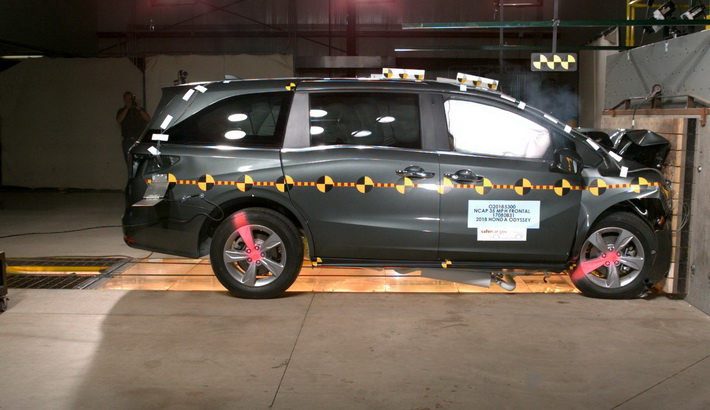
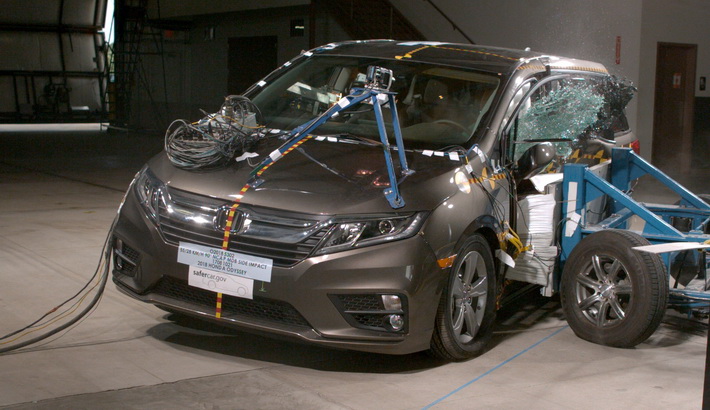
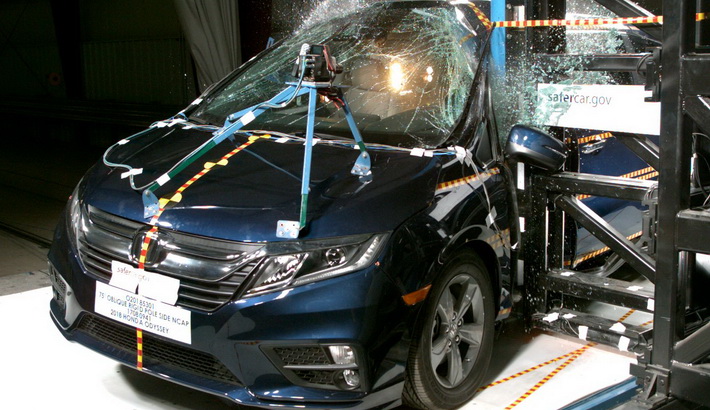
NHTSA crash tests
The agency crash-tested this model year itself. These are its own
photographs and star ratings.
Frontal crash test
Side barrier crash test
Side pole crash test
Photographs taken by NHTSA during its own New Car Assessment Program crash
tests of this model year. Public domain.
Configuration
Overall
Front
Side
Rollover
2018 Honda Odyssey VAN FWD
13.6% risk
When owners complained
A spike years after the car went on sale usually means a part wearing
out on schedule across the whole fleet — the kind of pattern no single
owner can see from inside their own car.
Jun 2017peak 54Sep 2026
NHTSA investigations into the 2018 Honda Odyssey
An investigation is the step before a recall: the agency has seen enough
complaints to look into a pattern itself. An open one means it thinks
something may be wrong and nothing has been fixed yet.
2
investigations are
still open.
PE25008Opened 20 Aug 2025Still openENGINE
Engine failure
The Office of Defects Investigation (ODI) has received 414 reports of connecting rod bearing failures in the 3.5L V6 engine used in the following vehicles: Model Years (MY) 2018-2020 Acura TLX, MY2016-2020 Acura MDX, MY2016-2020 Honda Pilot, MY2018-2020 Honda Odyssey, and MY2017-2019 Honda Ridgeline. The subject engine failures were analyzed as part of a Recall Query (RQ24013). It was determined that these engine failures are outside the scope of Honda Recall 23V-751. Further, evidence gathered in conjunction with RQ24013 does not suggest this failure is caused by the same crankshaft manufac...
EA25004Opened 26 Mar 2025Still openENGINE AND ENGINE COOLING:ENGINE:CRANK/CAMSHAFT POSITION SENSOR
No Restart After Auto Start/Stop Engages
On June 3, 2022, the Office of Defects Investigation (ODI) opened Preliminary Evaluation PE22005 after the agency received VOQs and several field reports concerning the Auto Idle Stop (AIS) feature on 2016-2019MY Honda Pilot vehicles. The complaints allege that the engine fails to restart on its own from a complete stop at a traffic light or road intersection with the AIS function engaged. The subject vehicles are equipped with a 3.5L engine with a 9-speed automatic transmission. On January 6, 2023, Honda released service bulletins 23-008 and 23-009. These service bulletins address the failure to r...
PE25018Opened 28 Oct 2025Closed 25 Jun 2026AIR BAGS
Inadvertent Deployment of Side Air Bags
On October 28, 2025, the Office of Defects Investigations (ODI) opened PE25018 to investigate complaints of inadvertent deployment of the side curtain and/or side thorax air bags. These complaints concern model year (MY) 2018-2022 Honda Odyssey vehicles manufactured by American Honda Motor Co. (Honda). Honda issued recall 26V227 on April 9, 2026, to address concerns of inadvertent side air bag deployment. In the recall filing, the company stated that “[a]s of April 2, 2026, Honda has had 130 warranty claims, 25 reports of an injury, and no reports of death related to this issue from January 24...
RQ24013Opened 8 Nov 2024Closed 20 Aug 2025ENGINE
Engine failure
On November 8, 2024, the Office of Defects Investigation (ODI) opened Recall Query RQ24013 to assess the scope of Honda recall 23V-751 after receiving complaints that alleged connecting rod bearing failures in vehicles that were not within the scope of recall 23V-751. In November 2023, Honda recalled 248,999 various Model Year (MY)2016–2020 Honda and Acura vehicles equipped with the 3.5L V6 engine. Honda recalled these vehicles due to a crankshaft manufacturing defect that caused premature connecting rod bearing wear and engine seizure. While the out-of-scope failures involved in these complai...
Recalls on the 2018 Honda Odyssey
A complaint is one owner's allegation. A recall is the point at which
the manufacturer or a regulator agreed the defect is real and dangerous
enough to fix for free — however old the car is.
United States — NHTSA
26V423000
BACK OVER PREVENTION: SENSING SYSTEM: CAMERA
Honda (American Honda Motor Co.) is recalling certain 2018-2020 Odyssey vehicles. Water may enter into the rearview camera, which can cause the rearview camera image to fail to display when the vehicle is in reverse. As such, these vehicles fail to comply with the requirements of Federal Motor Vehicle Safety Standard number 111, "Rear Visibility."
Risk: A rearview image that does not display reduces the driver's view behind the vehicle, increasing the risk of a crash.
26V332000
AIR BAGS:SENSOR:OCCUPANT CLASSIFICATION:FRONT PASSENGER
Honda (American Honda Motor Co.) is recalling certain 2018-2021, 2023 Acura TLX, 2019-2024 RDX, 2017-2020, 2022-2026 MDX, 2017-2021, 2023, 2025 Honda Ridgeline, 2017-2022 Pilot, 2019-2021 Passport, 2018-2026 Odyssey, 2019-2022 Insight, 2019-2021 HR-V, 2018-2020 Fit, 2020-2022 CR-V Hybrid, 2017-2022 CR-V, 2017-2018, 2021 Civic Type R, 2017-2021 Civic hatchback, 2016-2020 Civic coupe, 2016-2022 Civic, 2017-2022 Accord Hybrid, and 2016-2022 Accord vehicles. The front passenger seat weight sensor may crack and short circuit, which can cause the air bags to deploy unintentionally during a crash.
Risk: Air bags that deploy unintentionally during a crash increase the risk of injury.
26V227000
AIR BAGS: AIR BAG/RESTRAINT CONTROL MODULE:SOFTWARE
Honda (American Honda Motor Co.) is recalling certain 2018-2022 Odyssey vehicles. A software programming error can cause the side and side curtain air bags to deploy unexpectedly.
Risk: Air bags that deploy unexpectedly can increase the risk of injury.
23V858000
FUEL SYSTEM, GASOLINE:DELIVERY:FUEL PUMP
Honda (American Honda Motor Co.) is recalling certain 2013-2023 Honda Accord, Civic Coupe, Civic Sedan, Civic Hatchback, Civic Type R, CR-V, HR-V, Ridgeline, Odyssey, Acura ILX, MDX, MDX Hybrid, RDX, RLX, TLX, 2019-2022 Honda Insight, Passport, 2020 Honda CR-V Hybrid, 2018-2019 Honda Clarity PHEV, Fit, and 2015-2020 Honda Accord Hybrid, Pilot, Acura NSX vehicles. The fuel pump inside the fuel tank may fail.
Risk: Fuel pump failure can cause an engine stall while driving, increasing the risk of a crash.
23V751000
ENGINE AND ENGINE COOLING:ENGINE:HARD PARTS INTERNAL/MECHANICAL
Honda (American Honda Motor Co.) is recalling certain 2015-2020 Acura TLX, 2016-2020 Acura MDX, 2016 and 2018-2019 Pilot, 2017 and 2019 Ridgeline, and 2018-2019 Odyssey vehicles. Due to a manufacturing error, the connecting rod bearing in the engine may wear and seize, damaging the engine.
Risk: A damaged engine may run improperly or stall while driving, increasing the risk of a fire, crash, or injury.
23V431000
BACK OVER PREVENTION:DISPLAY FUNCTION
Honda (American Honda Motor Co.) is recalling certain 2018-2023 Odyssey, 2019-2022 Pilot, and 2019-2023 Passport vehicles. Due to a faulty Media Oriented Systems Transport (MOST) communication coaxial cable connector, the rearview camera image may not appear on the display. As such, these vehicles fail to comply with the requirements of Federal Motor Vehicle Safety Standard number 111, "Rear Visibility."
Risk: A rearview camera that does not display an image can reduce the driver's rear view, increasing the risk of a crash or injury.
23V158000
SEAT BELTS:FRONT:BUCKLE ASSEMBLY
Honda (American Honda Motor Co.) is recalling certain 2017-2020 CR-V, 2018-2019 Accord and Accord Hybrid, 2018-2020 Odyssey, 2019 Insight, and 2019-2020 Acura RDX vehicles. A manufacturing issue with the front seat belts may cause the seat belt buckle channel to interfere with the release button, preventing the seat belt buckle from latching.
Risk: An unlatched seat belt cannot properly restrain the seat occupant during a crash, increasing their risk of injury.
21V010000
FUEL SYSTEM, GASOLINE:STORAGE
Braun Corporation (Braun) is recalling certain 2018-2021 Braun-modified Honda Odyssey vehicles. The fuel tank assembly installed by Braun may be susceptible to the fuel tank overfilling into the charcoal canister. If the charcoal canister fills with a sufficient amount of fuel, fuel may leak out.
Risk: A fuel leak in the presence of an ignition source may increase the risk of fire.
Canada — Transport Canada
Canada runs its own recall programme, and its campaigns do not
always mirror the American ones.
Recall 202632632,289 units in Canada
Visual System
Issue: On certain vehicles, the recall repairs completed by a Honda dealer during recall O38 (Transport Canada recall no. 2020-345) may not be effective. As a result, certain vehicles require a second repair. On certain vehicles, moisture could enter the rearview camera and cause it not to work properly. If this happens, the rearview image may be distorted or not display at all. Also, the camera image may not appear in certain bright light conditions. Note: This recall replaces recall O38 (Transport Canada recall no. 2020-345). Vehicles that were repaired under that recall also require this repair. Safety Risk: A rearview camera image that doesn't display properly could reduce a driver's ability to see behind the vehicle while backing up. This could increase the risk of a crash. Corrective Actions: Honda will notify owners by mail and advise you to take your vehicle to a dealer to replace the rearview camera.
Recall 202625112,371 units in Canada
Seats And Restraints
Issue: On certain vehicles, the weight sensor for the front passenger seat may not have been manufactured properly. As a result, the passenger-front airbag and knee airbag could deploy in a crash that doesn't require them to. Note: This recall is an expansion of Transport Canada recall no. 2024-059. If the weight sensor fails, the SRS warning light would turn on in the instrument panel. Safety Risk: An airbag system that doesn't work properly could increase the risk of injury in a crash. Corrective Actions: The company will notify owners by mail and advise you to take your vehicle to a dealership to replace the passenger-front seat weight sensor.
Recall 202618137,910 units in Canada
Seats And Restraints
Issue: On certain vehicles, under certain conditions, a software problem could cause the side airbag(s) and side curtain airbag(s) to inflate unexpectedly. Safety Risk: An airbag that deploys without a crash could create a risk of injury. Corrective Actions: Honda will notify owners by mail and advise you to take your vehicle to a dealership to reprogram or replace the supplemental restraint system (SRS) electronic control unit (ECU), as necessary.
Recall 2024262291,588 units in Canada
Fuel System
Issue: This recall is for low-pressure fuel pumps installed on certain vehicles or sold at dealerships as a replacement part. On certain vehicles, the low-pressure fuel pump could fail. If this happens, the engine may run rough or may not start and the check engine light may turn on. This could also result in a sudden loss of engine power while driving. Note: This recall replaces Transport Canada recall no. 2023-679. Vehicles that were repaired under that recall don't require this repair. Safety Risk: A sudden loss of engine power could increase the risk of a crash. Corrective Actions: The company will notify owners by mail and advise you to take your vehicle to a dealership to replace the fuel pump motor.
Recall 2023679285,461 units in Canada
Fuel System
This recall was replaced by Transport Canada recall no. 2024-262. Issue: This recall is for low-pressure fuel pumps installed on certain vehicles or sold at dealerships as a replacement part. On certain vehicles, the low-pressure fuel pump could fail. If this happens, the engine may run rough or may not start and the check engine light may turn on. This could also result in a sudden loss of engine power while driving. Note: This is an expansion of Transport Canada recall nos. 2020-236 and 2021-182. Safety Risk: A sudden loss of engine power could increase the risk of a crash. Corrective Actions: The company will notify owners by mail and advise you to take your vehicle to a dealership to replace the fuel pump motor.
Recall 202335088,228 units in Canada
Visual System
Issue: On certain vehicles, the terminals on the coaxial cable for the audio display unit may not have been manufactured correctly. As a result, the audio display unit could lose its connection, and the rearview camera image may not display when the transmission is shifted into reverse gear. Safety Risk: A rearview camera image that doesn't display could reduce a driver's ability to see behind the vehicle while backing up. This could increase the risk of a crash. Corrective Actions: Honda will notify owners by mail and advise you to take your vehicle to a dealership to replace the media oriented systems transport (MOST) cable harness, and install a cover over the audio display unit connector.
Recall 202312752,196 units in Canada
Seats And Restraints
Issue: On certain vehicles, the seat belt buckles for the driver and front-passenger seats could wear over time and may not latch securely. If this happens, the seat belt could unlatch unexpectedly. Safety Risk: A seat belt that doesn't latch securely could create an increased risk of injury in a crash. Corrective Actions: Honda will notify owners by mail and instruct you to take your vehicle to a dealership to inspect the driver and front-passenger seat belt assemblies. In most cases, the seat belt buckle release buttons will be replaced. If the dealer determines that a buckle can't be repaired, it will be replaced with a new part.
Recall 202101225 units in Canada
Fuel System
Issue: On certain vans converted for wheelchair access by BraunAbility, the fuel tank can be overfilled and fuel can enter the charcoal canister. If this happens, fuel can leak from the canister onto nearby components and the ground. Note: This problem only affects Honda Odyssey wheelchair vans with a power infloor side-entry ramp, which were altered between September 13, 2018 and December 3, 2020. Safety Risk: A fuel leak can create the risk of a fire. Corrective Actions: BraunAbility will notify owners by mail and instruct you to take your vehicle to a BraunAbility service center for an inspection. If there is evidence of a fuel leak, the dealer will install a new fuel tank assembly that has a different fill limit vent valve. The dealer will also replace the charcoal canister. A warning label will be applied on or near the fuel filler neck advising you not to overfill or "top off" the fuel tank.
Reports where the owner recorded a crash, a fire, an injury or a death.
at 135,000 milesNorthwood, OHCrash
AIR BAGS
The contact owns a 2018 Honda Odyssey. While the contact's wife was driving at an undisclosed speed, the vehicle drove over a pothole and the driver's- and passenger's-side curtain airbags deployed. The air bags deployment frightened the contact’s wife, and the steering wheel was jerked, and the vehicle crashed into the concrete median. The contact stated that the front driver's side tire was flat. The contact removed the deployed side curtain air bags and replaced the driver's side front wheel. The vehicle was inspected by the insurance company. The vehicle was deemed a total loss. The contact received notification of NHTSA Campaign Number: 26V227000 (Air Bags). The contact stated that the recall notification was received the day after the failure had occurred. The manufacturer was contacted by phone, and a case was filed. The contact was informed that the case was denied. The failure mileage was approximately 135,000.
NHTSA complaint #11762174 — an unverified report by a vehicle owner.
Tampa, FL2 injured
AIR BAGS
The passenger side curtain airbags deployed while driving with no prior warning.
NHTSA complaint #11758397 — an unverified report by a vehicle owner.
Frederick, MD1 injured
SEAT BELTS
While my child was riding in the second row drivers side captains chair of my 2018 Odyssey, she fell asleep and unknowingly moved the shoulder strap portion of the seat belt behind her head/ upper body. I was driving and could not see that the belt had been moved because she was seated behind me and was also covered by a blanket. After the vehicle was parked, she unbuckled the seat belt and attempted to exit the vehicle. As she got out, the seat belt retracted and tightened around her abdomen and torso, trapping her against her seat. The belt became extremely tight and we were unable to free her after 20 minutes of struggling to create slack and slide her out.The pressure from the belt cause visible injuries to her abdomen. Because we could not safely release her, we were forced to cut the seat belt. The damaged seat belt was inspected by a Honda dealership, which recommended replacement of the entire seat assembly, costing $3,000. Honda customer relations was also notified and provided us with a case number. I am submitting this report because a child was trapped by the seat belt during normal vehicle use, requiring the belt to be cut to safely free her.
NHTSA complaint #11753597 — an unverified report by a vehicle owner.
Charlotte, NC1 injured
SEAT BELTS
On 4/30/26 my 10 year old son was sitting in the middle row behind the driver buckled in his seatbelt. The middle row, middle seatbelt (that comes down from ceiling) got wrapped around his neck and kept tightening. He yelled for help. I was driving and saw in my rearview mirror that my son was being pulled up by his neck from the seatbelt in the ceiling. I pulled into a shopping center immediately to try to help him. I could not reach down in between the seats to unhook it because the more I tried to release him, the more it would tighten. That seatbelt requires a tool to be pressed into the lock to release it and the more I tried to get to the seatbelt to unfasten it the more it was tightening and pulling my son up (he was literally starting to hang from the ceiling). I unhooked his seatbelt so he could push himself up to try to release some of the tension around his neck. I wound up running into a Michaels store screaming that I needed scissors because my son was hanging from a seatbelt. She gave me scissors and I went back out and cut the seatbelt to release my son from the seatbelt noose around his neck. He had red marks around his neck afterwards. I still have the cut seatbelt and the other half retracted into the ceiling. Research has confirmed that there have been other reports of issues with children having to be cut out of seatbelts due to the Automatic Locking Retractor (ALR) in Honda Odysseys, model years 2011, 2012, 2013, 2014 and my model 2018. I called Honda corporate on 6/8/26 and filed a complaint. I was told I would receive an email response. I have not received an email or any response. So I called Honda corporate again on 6/25/26 and was told someone would reach out to me, but they could not tell me anything over the phone at that time. I made an appointment at my Honda dealership to have the seatbelt replaced, but have been waiting on a response from Honda corporate before doing any repairs.
NHTSA complaint #11746477 — an unverified report by a vehicle owner.
Portage, WI1 injured
UNKNOWN OR OTHER
For a couple of weeks we have been having issues with our 2018 Honda Odyssey's back right door. When you go to open it, something happens where it makes it shut after fully opening. Our resolution for the time was to just push on the door harder and it would continue to slide open. Today, on XXX I was going to put my [XXX] son in his carseat, which is located mid van right side. He snuck infront of me and was standing in the path of the sliding door, it did what it normally does, the same door did not detect his body and began shutting on him. As it was squeezing his shoulders I was pushing back on the sliding door with all my strength, and after a few seconds it opened back up. I'm not sure whether the sensor failed, or it can't detect past a certain height, but either way it was a very scary situation. This had just happened an hour ago, so I haven't reported it to any authorities or anything. I came home and googled how to make a manufacturer report and it lead me here. If I had not been standing behind my son, I believe the door would have continued shutting more, enough to sustain serious injuries if not more. My son physically was okay, aside from a red mark on his upper arm where the door was shutting on him, he did need at least 5 minutes of consoling after, which only happens when something truly hurt him. INFORMATION REDACTED PURSUANT TO THE FREEDOM OF INFORMATION ACT (FOIA), 5 U.S.C. 552(B)(6)
NHTSA complaint #11743897 — an unverified report by a vehicle owner.
Portage, WI1 injured
ELECTRICAL SYSTEM
For a couple of weeks we have been having issues with our 2018 Honda Odyssey's back right door. When you go to open it, something happens where it makes it shut after fully opening. Our resolution for the time was to just push on the door harder and it would continue to slide open. Today, on XXX I was going to put my [XXX] son in his carseat, which is located mid van right side. He snuck infront of me and was standing in the path of the sliding door, it did what it normally does, the same door did not detect his body and began shutting on him. As it was squeezing his shoulders I was pushing back on the sliding door with all my strength, and after a few seconds it opened back up. I'm not sure whether the sensor failed, or it can't detect past a certain height, but either way it was a very scary situation. This had just happened an hour ago, so I haven't reported it to any authorities or anything. I came home and googled how to make a manufacturer report and it lead me here. If I had not been standing behind my son, I believe the door would have continued shutting more, enough to sustain serious injuries if not more. My son physically was okay, aside from a red mark on his upper arm where the door was shutting on him, he did need at least 5 minutes of consoling after, which only happens when something truly hurt him. INFORMATION REDACTED PURSUANT TO THE FREEDOM OF INFORMATION ACT (FOIA), 5 U.S.C. 552(B)(6)
NHTSA complaint #11743897 — an unverified report by a vehicle owner.
The most recent complaints
In the owners' own words, exactly as filed with NHTSA.
Vincennes, IN
ELECTRICAL SYSTEM
This vehicle is actively immobilized on private residential property with its central ADAS safety networks and Advanced Driver-Assist networks completely crashed and offline (DTC U3000-49) and active short-to-ground circuit failures (DTC B2035) rendering the passenger sliding doors completely inoperable, creating an immediate entrapment and safety hazard. These progressive component failures cascade directly from severe environmental moisture intrusion inside the rear tailgate enclosure. This exact water migration vector intersects directly with active federal safety campaign NHTSA Recall 26-V-423 (Rearview Camera Failure), which isolates moisture intrusion into the panel housing as the root factory manufacturing defect. A manufacturer franchise location documented active water leakage onto the Power Tailgate Control Unit and heavy corrosion on the wiring connector under a previous Repair Order but performed zero interim moisture sealing, corrosion cleanup, or terminal mitigation, allowing progressive water migration to completely destroy the wiring system harness. Furthermore, American Honda Corporate Case Management explicitly stated on a recorded verbal line that the manufacturer is denying all repair assistance to remedy these cascading safety campaign electrical defects under an active corporate case. The manufacturer is in open default of its statutory federal obligation to remedy a safety recall defect free of charge to the consumer.
NHTSA complaint #11763754 — an unverified report by a vehicle owner.
Vincennes, IN
FUEL/PROPULSION SYSTEM
This vehicle is actively immobilized on private residential property with its central ADAS safety networks and Advanced Driver-Assist networks completely crashed and offline (DTC U3000-49) and active short-to-ground circuit failures (DTC B2035) rendering the passenger sliding doors completely inoperable, creating an immediate entrapment and safety hazard. These progressive component failures cascade directly from severe environmental moisture intrusion inside the rear tailgate enclosure. This exact water migration vector intersects directly with active federal safety campaign NHTSA Recall 26-V-423 (Rearview Camera Failure), which isolates moisture intrusion into the panel housing as the root factory manufacturing defect. A manufacturer franchise location documented active water leakage onto the Power Tailgate Control Unit and heavy corrosion on the wiring connector under a previous Repair Order but performed zero interim moisture sealing, corrosion cleanup, or terminal mitigation, allowing progressive water migration to completely destroy the wiring system harness. Furthermore, American Honda Corporate Case Management explicitly stated on a recorded verbal line that the manufacturer is denying all repair assistance to remedy these cascading safety campaign electrical defects under an active corporate case. The manufacturer is in open default of its statutory federal obligation to remedy a safety recall defect free of charge to the consumer.
NHTSA complaint #11763754 — an unverified report by a vehicle owner.
Vincennes, IN
FORWARD COLLISION AVOIDANCE: WARNINGS
This vehicle is actively immobilized on private residential property with its central ADAS safety networks and Advanced Driver-Assist networks completely crashed and offline (DTC U3000-49) and active short-to-ground circuit failures (DTC B2035) rendering the passenger sliding doors completely inoperable, creating an immediate entrapment and safety hazard. These progressive component failures cascade directly from severe environmental moisture intrusion inside the rear tailgate enclosure. This exact water migration vector intersects directly with active federal safety campaign NHTSA Recall 26-V-423 (Rearview Camera Failure), which isolates moisture intrusion into the panel housing as the root factory manufacturing defect. A manufacturer franchise location documented active water leakage onto the Power Tailgate Control Unit and heavy corrosion on the wiring connector under a previous Repair Order but performed zero interim moisture sealing, corrosion cleanup, or terminal mitigation, allowing progressive water migration to completely destroy the wiring system harness. Furthermore, American Honda Corporate Case Management explicitly stated on a recorded verbal line that the manufacturer is denying all repair assistance to remedy these cascading safety campaign electrical defects under an active corporate case. The manufacturer is in open default of its statutory federal obligation to remedy a safety recall defect free of charge to the consumer.
NHTSA complaint #11763754 — an unverified report by a vehicle owner.
at 90,332 milesVineyard, UT
BACK OVER PREVENTION
The contact owns a 2018 Honda Odyssey. The contact stated that while driving 25 MPH, the audio of the vehicle unexpectedly became inoperable. The failure was a recurring failure. Additionally, there was an abnormal burning odor inside the vehicle. The contact associated the failure with NHTSA Campaign Number: 23V431000 (Back Over Prevention); however, the VIN was not included in the recall. The dealer was contacted and stated that the cost of the repair was not covered because the VIN was not included in the recall. The failure mileage was approximately 90,332.
NHTSA complaint #11763401 — an unverified report by a vehicle owner.
Merritt Island, FL
POWER TRAIN
My vehicle intermittently shifts from normal automatic Drive (D) into S mode without any intentional driver input. I do not touch or activate the steering-wheel paddle shifter when this occurs. Searching on reddit and other forums I see many other drivers have the same issue. The problem appears to happen primarily after coming to a complete stop, such as at a traffic light or stop sign. When I then press the accelerator to proceed, the vehicle may have very little acceleration because it has unexpectedly entered S mode. This has occurred while I was attempting to turn or proceed into traffic and has nearly caused an accident on multiple occasions. The issue is intermittent and cannot be reproduced on demand. However, it has happened multiple times under similar circumstances. I am certain I did not intentionally activate the paddle shifter. I am concerned this may be a safety defect involving the electronic shift control, paddle shifter, transmission controls, sensors, or related software. An unexpected change in transmission mode immediately after stopping can create a dangerous situation because the driver expects normal automatic operation and acceleration when entering an intersection or traffic. I am requesting that NHTSA document this complaint and investigate whether this is a safety-related defect that may affect other vehicles.
NHTSA complaint #11763173 — an unverified report by a vehicle owner.
Liberty Twp, OH
UNKNOWN OR OTHER
Tail gate problems Looks like there are a lot of tailgate problems with the Honda Odyssey, including water leaks that can affect the control module. I replaced the control module, but it looks like there’s a lot of information and research about this issue online.
NHTSA complaint #11762619 — an unverified report by a vehicle owner.
Corning, NY
UNKNOWN OR OTHER
Rear sliding door failure, doors wouldn't latch properly resulting in opening when driving down the road. Took to dealership for repair. Paid $1633.78 they replaced rear latches 3/31/2026. Rear latches failed to open resulting in one Rear door cable breaking and one that will not open at all 9/1/2026. Neither door opens at this point.
NHTSA complaint #11762447 — an unverified report by a vehicle owner.
Corning, NY
STRUCTURE:BODY
Rear sliding door failure, doors wouldn't latch properly resulting in opening when driving down the road. Took to dealership for repair. Paid $1633.78 they replaced rear latches 3/31/2026. Rear latches failed to open resulting in one Rear door cable breaking and one that will not open at all 9/1/2026. Neither door opens at this point.
NHTSA complaint #11762447 — an unverified report by a vehicle owner.
Corning, NY
ELECTRICAL SYSTEM
Rear sliding door failure, doors wouldn't latch properly resulting in opening when driving down the road. Took to dealership for repair. Paid $1633.78 they replaced rear latches 3/31/2026. Rear latches failed to open resulting in one Rear door cable breaking and one that will not open at all 9/1/2026. Neither door opens at this point.
NHTSA complaint #11762447 — an unverified report by a vehicle owner.
Saint Louis, MO
UNKNOWN OR OTHER
Front Molecular sensor/Camera
NHTSA complaint #11762383 — an unverified report by a vehicle owner.
Saint Louis, MO
FORWARD COLLISION AVOIDANCE: ADAPTIVE CRUISE CONTROL
Front Molecular sensor/Camera
NHTSA complaint #11762383 — an unverified report by a vehicle owner.
Saint Louis, MO
LANE DEPARTURE: WARNING
Front Molecular sensor/Camera
NHTSA complaint #11762383 — an unverified report by a vehicle owner.
at 135,000 milesNorthwood, OHCrash
AIR BAGS
The contact owns a 2018 Honda Odyssey. While the contact's wife was driving at an undisclosed speed, the vehicle drove over a pothole and the driver's- and passenger's-side curtain airbags deployed. The air bags deployment frightened the contact’s wife, and the steering wheel was jerked, and the vehicle crashed into the concrete median. The contact stated that the front driver's side tire was flat. The contact removed the deployed side curtain air bags and replaced the driver's side front wheel. The vehicle was inspected by the insurance company. The vehicle was deemed a total loss. The contact received notification of NHTSA Campaign Number: 26V227000 (Air Bags). The contact stated that the recall notification was received the day after the failure had occurred. The manufacturer was contacted by phone, and a case was filed. The contact was informed that the case was denied. The failure mileage was approximately 135,000.
NHTSA complaint #11762174 — an unverified report by a vehicle owner.
at 60,000 milesEllicott City, MD
LATCHES/LOCKS/LINKAGES:TAILGATE:LATCH
The contact owns a 2018 Honda Odyssey. The contact stated that the rear liftgate was inoperable and had to be unlocked through the emergency release in the trunk. Additionally, the contact stated that the rear window seal was significantly fractured. A message that the tailgate was inoperable was displayed accompanied by a chime that was heard inside and outside the vehicle while driving. The contact stated that the message was displayed after a rainstorm. Additionally, while the contact's son was using the seat belt, the contact became aware that the passenger’s side third-row seat belt and seat belt retractor housing attached to the roof were wet. The vehicle was taken to a dealer, where it was diagnosed and determined that the tailgate printed circuit board for the locking mechanism was corroded, and the motor had failed. The vehicle was scheduled for the repair. Additionally, the dealer referred the contact to an auto body service center to determine where the water was entering the vehicle. The failure mileage was approximately 60,000.
NHTSA complaint #11762099 — an unverified report by a vehicle owner.
Austin, TX
ENGINE
NHTSA Recall 19V-299 / Honda Campaign Z4J. Sudden gear refusal, shifting malfunctions, and stalling. The premature structural failure of my 10-speed transmission is a direct consequence of the known factory software defect that violently shifts the car into Park while moving.
NHTSA complaint #11761878 — an unverified report by a vehicle owner.
Caddo Mills, TX
POWER TRAIN
The vehicle would not accelerate over 40MPH, we took the vehicle into the dealership for what we thought was a failed fuel injector, upon inspection they found metal shavings in the oil and mentioned the engine is not repairable and would need a whole new replacement. We had this vehicle 9 months. Upon investigation there was a known recall that is identical to the issues we are experiencing. The whole engine is failed and we cannot utilize it. It was inspected by the dealership. The check engine light is illuminating, and does not increase in speed. My family and I were unable to drive at a reasonable speed on the highway once it failed.
NHTSA complaint #11761430 — an unverified report by a vehicle owner.
Midvale, UT
ELECTRICAL SYSTEM
The windshield-mounted front monocular camera (Honda Sensing unit) overheated and failed/burnt out. This failure completely disabled the Forward Collision Warning, Automatic Emergency Braking, Lane Departure Warning, Lane Keeping Assist, and Adaptive Cruise Control systems, triggering multiple safety system warning lights on the dashboard.
NHTSA complaint #11760970 — an unverified report by a vehicle owner.
at 195,000 milesRoaming Shores, OH
LATCHES/LOCKS/LINKAGES
The contact owns a 2018 Honda Odyssey. The contact stated that while driving at an undisclosed speed, the passenger's side power sliding door unexpectedly opened and failed to latch. The vehicle was not diagnosed or repaired by a dealer or an independent mechanic. The contact associated the failure with NHTSA Campaign Number: 18V795000 (Latches/Locks/Linkages); however, the VIN was not included in the recall. The manufacturer was not notified of the failure. The failure mileage was approximately 195,000.
NHTSA complaint #11760867 — an unverified report by a vehicle owner.
Midvale, UT
FORWARD COLLISION AVOIDANCE: WARNINGS
The windshield-mounted front monocular camera (Honda Sensing unit) overheated and failed/burnt out. This failure completely disabled the Forward Collision Warning, Automatic Emergency Braking, Lane Departure Warning, Lane Keeping Assist, and Adaptive Cruise Control systems, triggering multiple safety system warning lights on the dashboard.
NHTSA complaint #11760970 — an unverified report by a vehicle owner.
Midvale, UT
LANE DEPARTURE: WARNING
The windshield-mounted front monocular camera (Honda Sensing unit) overheated and failed/burnt out. This failure completely disabled the Forward Collision Warning, Automatic Emergency Braking, Lane Departure Warning, Lane Keeping Assist, and Adaptive Cruise Control systems, triggering multiple safety system warning lights on the dashboard.
NHTSA complaint #11760970 — an unverified report by a vehicle owner.
Hillsdale, MI
AIR BAGS
COMPONENT THAT FAILED & AVAILABILITY: The vehicle's primary electrical architecture and data communications network (CAN bus) failed during a safety recall service for the SRS ECU and rearview camera. After attempting to complete the recall work, the vehicle is no longer able to start. SAFETY RISK: The manufacturer's federally mandated safety recall remedy compromised the vehicle's critical safety and control infrastructure. This rendered a previously reliable family vehicle entirely inoperable, destroying its ability to communicate, start, or turn on. It poses a systemic safety risk if the corporate recall procedure itself causes severe electronic failures in consumer vehicles. REPRODUCTION & DEALER CONFIRMATION: Yes. The failure was induced directly by Williams Honda ([XXX]) during service on Thursday, XXX. The dealership's Service Manager explicitly confirmed to me that their technicians compromised the electrical architecture while performing the SRS ECU and rearview camera recall work. The vehicle has remained dead at their facility ever since. INSPECTION BY OTHERS: The vehicle has been actively inspected by dealership technicians in coordination with Honda Engineering headquarters. It has not been inspected by police or insurance representatives, as no crash occurred. I have requested an inspection by a Honda Corporate Field Technical Specialist (FTS). WARNING LAMPS & PRIOR SYMPTOMS:NONE. Prior to this appointment, the vehicle was in perfect electrical and mechanical working order. There were absolutely no warning lamps, messages, or symptoms of any starting or electrical problems. The vehicle had just safely completed a seven-hour road trip immediately prior to being dropped off for the recall work. INFORMATION REDACTED PURSUANT TO THE FREEDOM OF INFORMATION ACT (FOIA), 5 U.S.C. 552(B)(6)
NHTSA complaint #11760347 — an unverified report by a vehicle owner.
Hillsdale, MI
ELECTRICAL SYSTEM
COMPONENT THAT FAILED & AVAILABILITY: The vehicle's primary electrical architecture and data communications network (CAN bus) failed during a safety recall service for the SRS ECU and rearview camera. After attempting to complete the recall work, the vehicle is no longer able to start. SAFETY RISK: The manufacturer's federally mandated safety recall remedy compromised the vehicle's critical safety and control infrastructure. This rendered a previously reliable family vehicle entirely inoperable, destroying its ability to communicate, start, or turn on. It poses a systemic safety risk if the corporate recall procedure itself causes severe electronic failures in consumer vehicles. REPRODUCTION & DEALER CONFIRMATION: Yes. The failure was induced directly by Williams Honda ([XXX]) during service on Thursday, XXX. The dealership's Service Manager explicitly confirmed to me that their technicians compromised the electrical architecture while performing the SRS ECU and rearview camera recall work. The vehicle has remained dead at their facility ever since. INSPECTION BY OTHERS: The vehicle has been actively inspected by dealership technicians in coordination with Honda Engineering headquarters. It has not been inspected by police or insurance representatives, as no crash occurred. I have requested an inspection by a Honda Corporate Field Technical Specialist (FTS). WARNING LAMPS & PRIOR SYMPTOMS:NONE. Prior to this appointment, the vehicle was in perfect electrical and mechanical working order. There were absolutely no warning lamps, messages, or symptoms of any starting or electrical problems. The vehicle had just safely completed a seven-hour road trip immediately prior to being dropped off for the recall work. INFORMATION REDACTED PURSUANT TO THE FREEDOM OF INFORMATION ACT (FOIA), 5 U.S.C. 552(B)(6)
NHTSA complaint #11760347 — an unverified report by a vehicle owner.
Hillsdale, MI
ENGINE
COMPONENT THAT FAILED & AVAILABILITY: The vehicle's primary electrical architecture and data communications network (CAN bus) failed during a safety recall service for the SRS ECU and rearview camera. After attempting to complete the recall work, the vehicle is no longer able to start. SAFETY RISK: The manufacturer's federally mandated safety recall remedy compromised the vehicle's critical safety and control infrastructure. This rendered a previously reliable family vehicle entirely inoperable, destroying its ability to communicate, start, or turn on. It poses a systemic safety risk if the corporate recall procedure itself causes severe electronic failures in consumer vehicles. REPRODUCTION & DEALER CONFIRMATION: Yes. The failure was induced directly by Williams Honda ([XXX]) during service on Thursday, XXX. The dealership's Service Manager explicitly confirmed to me that their technicians compromised the electrical architecture while performing the SRS ECU and rearview camera recall work. The vehicle has remained dead at their facility ever since. INSPECTION BY OTHERS: The vehicle has been actively inspected by dealership technicians in coordination with Honda Engineering headquarters. It has not been inspected by police or insurance representatives, as no crash occurred. I have requested an inspection by a Honda Corporate Field Technical Specialist (FTS). WARNING LAMPS & PRIOR SYMPTOMS:NONE. Prior to this appointment, the vehicle was in perfect electrical and mechanical working order. There were absolutely no warning lamps, messages, or symptoms of any starting or electrical problems. The vehicle had just safely completed a seven-hour road trip immediately prior to being dropped off for the recall work. INFORMATION REDACTED PURSUANT TO THE FREEDOM OF INFORMATION ACT (FOIA), 5 U.S.C. 552(B)(6)
NHTSA complaint #11760347 — an unverified report by a vehicle owner.
Chesapeake, VA
POWER TRAIN
The car on a weekly basis or almost every time it is driven. The car jerks when driving at low speeds. This is a safety risk when driving for vehicles in front or behind me, as the car jerks forward. This has been mentioned to the dealer, but they stated a charge of 180 USD will be incurred for diagnoses. If you look at the NHTSA complaints database there are numerous complaints similar to what I am experiencing from other owners stating the same issue of jerkiness on the honda Odessey. I am surprised there is no recall on this. I put the date in down below but it happens almost every time the car is driven.
NHTSA complaint #11760061 — an unverified report by a vehicle owner.
at 105,000 milesTrinity, FL
ELECTRICAL SYSTEM
The contact owns a 2018 Honda Odyssey. The contact stated that while driving at an undisclosed speed, the accelerator pedal was depressed, but the vehicle failed to accelerate, requiring the contact to forcefully depress the accelerator pedal to move the vehicle. The contact stated that multiple warning lights unexpectedly illuminated, including the Road Departure Mitigation system, Collision Mitigation Braking System, and Lane Departure Warning system warning lights, and all related safety features failed to operate. The vehicle was not diagnosed or repaired. The dealer and the manufacturer were not notified of the failure. The failure mileage was approximately 105,000.
NHTSA complaint #11760009 — an unverified report by a vehicle owner.